Showing posts with label disaster relief. Show all posts

Friday, May 13, 2022

Celebrating My 23rd PhD Student - Dr. Mojtaba Salarpour

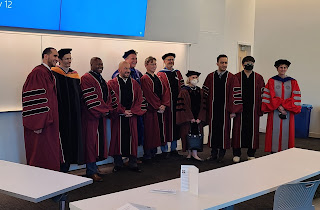
Now is the time of the year in academia, when we mark major milestones, such as the completion of degrees by our students. Yesterday, was a very special day, during which we had the Isenberg School PhD robing ceremony of the class of 2022.

It was wonderful to take part in the ceremony and to speak about my 23rd PhD student, now - Dr. Mojtaba Salarpour! It was the first such in-person ceremony in 3 years because of the pandemic.

The program is below and includes the names of the 6 students from the Isenberg School that received the PhD this past year and the names of their dissertations and their PhD advisors. Impressively, 3 of the 6 are from my Operations and Information Management Department. Mojtaba's concentration in our PhD program was Management Science.

It was nice to see my Department Chair, Professor Senay Solak, at the ceremony and also my 24th PhD student - Dana Hassani.

Mojtaba is from Iran and, while at UMass Amherst, he taught several courses, and was President of the UMass Amherst INFORMS Student Chapter for 2 years, including 1 1/2 years during the pandemic. He was instrumental in organizing several very interesting virtual panels - one of which was with healthcare researchers from Mass General Hospital and another one was on a career panel. Plus, we had the honor of hosting Dr. Mauricio Resende, Principal Research Scientist of Amazon, in the Chapter's Speaker Series that I help the chapter to organize. Under his tenure as President, the Chapter was recognized with the Magna Cum Laude Award from INFORMS!

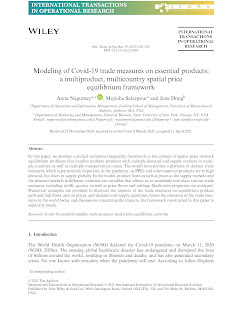
Mojtaba's PhD dissertation, "Essays on Supply Chain Economic Networks for Disaster Management Inspired by the Covid-19 Pandemic," constructed several highly relevant game theory models with applications, literally, "drawn from the news." His research, while at UMass Amherst, yielded 4 published papers and 1 published book chapter. I am delighted that he will be an Assistant Professor (tenure-track) at Texas A&M Commerce, starting this Fall. Below, are first pages of his papers.


As I said in my speech about Mojtaba at the ceremony, Mojtaba Salarpour is "standing on the shoulders of giants," since my academic genealogy, by way of my PhD advisor at Brown University, Professor Stella Dafermos, goes back to Maxwell, Newton, and Galileo - so- "no pressure!"

After the ceremony, it was great to enjoy the delicious food provided by UMass Amherst and to see many colleagues, students, and friends!


Congratulations to all the students, Class of 2022, now alums of their alma mater! With best wishes to you on your new journeys with a special congratulations to Dr. Mojtaba Salarpour! I remember fondly the delicious pistachios he brought for me from Iran when he arrived and after he landed in Boston Logan.

Saturday, October 10, 2020

Thanks to the USC Center for Artificial Intelligence in Society!

This past Wednesday, I had the pleasure of being the first speaker in the virtual seminar series organized by the University of Southern California's Center for Artificial Intelligence in Society (CAIS).  The title of my presentation was, "Game Theory Network Models for Disaster Relief," and my host was Professor Phebe Vayanos!


The talk was well advertised and it was a pleasure and delight to have participants viewing my presentation even from Mexico and India! It was very thoughtful for CAIS to open up the virtual seminar to the public. Terrific that also students and colleagues from UMass Amherst could view it.

The organizers of this series have posted the video recording on youtube, so that additional folks that are interested can see it:


And, luckily, we managed to conduct this event when we did, since two hours afterwards, we lost electric power due to a fierce windstorm that struck Massachusetts. We were without electric power and, hence, without Wi Fi, for 30 hours, signifying further the importance of research and practice surrounding all phases of disaster management, from preparedness and mitigation to response and recovery. Some of our neighbors are still without power and a neighbor was trapped in his car for 4 hours with trees and downed power lines in front and behind his vehicle. And, yesterday morning, we saw the Town of Amherst crew taking down with great skill an ailing tree so that it, too, would not fall and disrupt electricity and communications!


Wednesday, September 9, 2020

Very Excited About My Upcoming Speaking Engagements

The new academic year is off to a great start. It is the third week of the new academic year at UMass Amherst and I have been pleasantly surprised at how much I am enjoying teaching remotely.  I think that the engagement with students, with the right technology, enthusiasm, and energy, is making for a very rewarding educational experience. 

The beginning of the academic year also tends to be the time for the start of different speaker series and  a renewed conference season (post the summer). Such events are all now taking place remotely. The time to prepare a good talk has perhaps grown since the delivery is very often through Zoom, and one has to be cognizant of that.

In less than a month, I will be giving three invited presentations, each on a different theme/topic.

In late September, I'll have two presentations. The first presentation is an invited one for the INFORMS Chicago Analytics Conference,  and my talk will take place on September 25. This conference is being organized by the INFORMS Chicago Chapter and the INFORMS Analytics Society. The title of this presentation is, "Novel Supply Chain Network Models Inspired by the Covid-19 Pandemic: From Optimization to Game Theory."

I very much like the theme of this conference, which is Analytics to the Rescue! Joining me as invited speakers are fabulous colleagues of mine in the profession. I 'm sure that the Q&A will be stimulating and enlightening after my talk and the discussions wonderful, although virtual, throughout this conference.

The following Monday, on September 28, 2020, I will be speaking on, "Optimization of Food Supply Chain Networks: Why Quality, Trade Instruments, and Labor All Matter."  The venue for this presentation is something extra special - it is the Amazon Consumer Science Summit! I am one of six invited speakers and am truly honored to be presenting at this summit, which takes place September 28-October 1, 2020. My host is Dr. Mauricio G.C. Resende. I had been invited to speak at the Amazon Research Scientist Summit in August 2018, but with the wildfires in the area at that time and the bad smoke conditions, I sent my presentation in lieu of travel.

My presentation at the Amazon Summit will be panoramic in scope and will include some very recent research, inspired by the pandemic, on food supply chains and disruptions, as well as research done with my former PhD student, now Dr. Deniz Besik, who is in her first year as an Assistant Professor at the University of Richmond.  We wrote 6 papers together (thus far), some with other co-authors, including Professors June Dong, Dong Li, and Ladimer S. Nagurney. All six of the papers have been published. Deniz's successful PhD defense took place on March 6, 2020, only a few days before WHO declared the Covid-19 pandemic.  The research that we did on tariffs, quotas, and tariff-rate quotas is very relevant in the pandemic. 

And, on October 7, 2020, I will be speaking on "Game Theory Network Models for Disaster Relief," at the USC Center for Artificial Intelligence in Society." Information on that presentation is available on this website. We have continued our research on game theory in the pandemic and I now have a PhD student, Mojtaba Salarpour, focusing on this topic. His most recent published paper is, "A Stochastic Disaster Relief Game Theory Network Model," which we co-authored with Professors June Dong and Ladimer S. Nagurney. It was published in SN Operations Research Forum (2020) and is available on the journal's website in its entirety. We also have an article now, in press, entitled, "Competition for Medical Supplies Under Stochastic Demand in the Covid-19 Pandemic: A Generalized Nash Equilibrium Framework," which we co-authored with Professors Dong and Pritha Dutta.  I am very excited about also giving this presentation and my hosts at USC have reached out to me to see whether I would also like to meet with students virtually and I, enthusiastically, agreed.

Thursday, January 16, 2020

Beginning of My Sabbatical and My Twelfth Year of Blogging

It is hard to believe that this month I am celebrating 11 years of writing on this blog. My first post  was on the New Year - New Administration - New Blog. In that post I also noted a Letter to the Editor that I had had published in The New York Times on the students in my Transportation and Logistics class that I teach at the Isenberg School.  It is quite interesting to look back at the posts. Many provide timely advice. Interestingly, my third post was on my interview with Linda Baker on the Braess Paradox, for an article that she wrote for the Scientific American. And, coincidentally, my most recent article is on The Braess Paradox, an invited chapter for The International Encyclopedia of Transportation.

My blog has over 1,600 posts that I have written!

I am about to start my sabbatical, which means that I will not be teaching this Spring 2020 semester. I must admit that I will miss not teaching Humanitarian Logistics and Healthcare and also my PhD Seminar but there are many projects to start and others to finish up and also numerous very exciting speaking engagements and visits. Some service activities to the Isenberg School (and beyond, of course), will still be on my plate.

I am very excited about the INFORMS Security Conference, which takes place next month in Monterey, California. The website is live and the speakers and talks look fabulous - I am especially delighted that all speakers get a 50 minute time slot, so one can really share insights and also gain some!

At this conference, I will be speaking on: Game Theory Network Models for Disaster Relief. Coincidentally, the first conference presentation that I ever gave was when I worked in the high tech sector for the Naval Underwater Systems Center in beautiful Newport, Rhode Island, and it was at an MIT/ONR Conference at the Naval Postgraduate School in Monterey! I was the only female presenter. In addition to working, I was also pursuing a Master's at Brown University at that time. It will be very special to be back there.

Some other highlights of my sabbatical, in terms of conferences and visits are the following:

In March, I will have the honor of giving a plenary talk at the Netgcoop Conference in Corsica, France, while my PhD student, Deniz Besik, presents on our work on tariffs, quotas, and trade at the INFORMS Optimization Society Conference in Greenville, South Carolina.

In April, I will have the pleasure of being an invited speaker at an International Workshop at the University of Brescia in Italy on Variational Analysis and Applications for Modelling of Energy Exchange. There I will see many wonderful Italian colleagues!

In May, it will be time to fly to Iowa, a state that I have never been to. Many thanks to Professor Ann Campbell for inviting me to give a plenary talk at a very exciting 2-day workshop - Future BA (Business Analytics) Prof! This workshop will take place at the Tippie College of Business at the University of Iowa and all expenses for accepted applicants will be covered. The workshop is for advanced PhD students and post-docs —especially women and individuals from underrepresented groups — who are interested in academic careers in Business Analytics.

A huge highlight of my sabbatical will be the CORS Conference in Toronto in June. Also at this conference I will have the immense honor of delivering the Harold Larnder Prize plenary talk. The list of previous recipients of this prize can be found here. I am absolutely thrilled by this recognition and am the only the second female to receive this prize, which dates to 1986. The title of my Larnder lecture is: Trade Wars: OR in the Economic Battlefields.

I spoke at the CORS Conference in Halifax and had a tremendous time. Having been born in Canada, and having lived for a few years in Toronto, it will be great to be back. 
I will also be giving a seminar at the University of Toronto in March.

There will be other conferences in June and I will be busy also co-editing a new Dynamics of Disasters volume with Panos M. Pardalos and Ilias S. Kotsireas. We have received a contract from Springer and work has already begin with refereeing some of  the contributions, etc.

And, in late August, as my sabbatical is coming to a close, it will be time for the CLAIO 2020 Conference in Madrid, Spain. In 2019, I had the pleasure of speaking in Chile,  Colombia, and Mexico, and am so honored to have been selected the IFORS Distinguished Lecturer (IDL) at CLAIO. I will give my IDL plenary at this conference with the title: NetwORks: Changing Our WORld for the Better. This will be my first visit to Spain.


Of course, as my schedule and time permit, I will still be supporting the great UMass Amherst INFORMS Student Chapter and its Speaker Series and also directing the Virtual Center for Supernetworks and working with my PhD students! Updates on my sabbatical will certainly be posted on this blog.

Many thanks to everyone for 11 great years of support of this blog!

Sunday, November 24, 2019

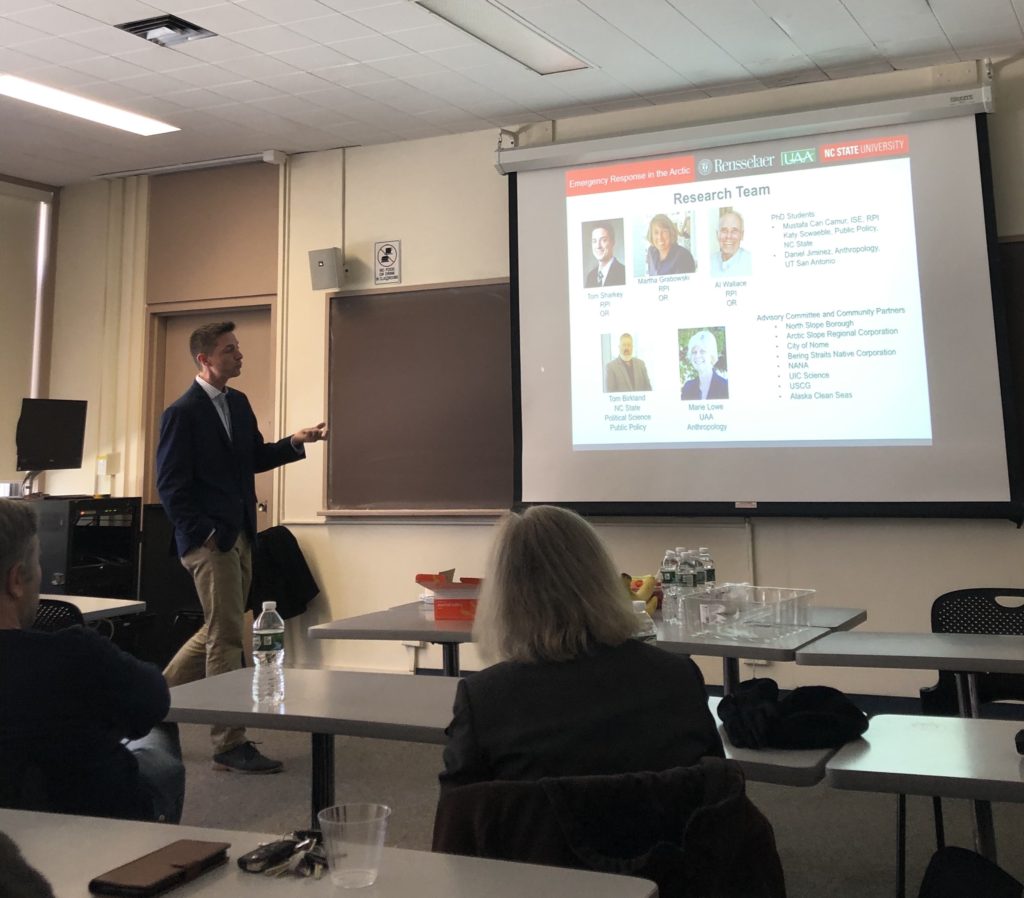
Great Talk on Emergency Response in the Arctic by Professor Tom Sharkey of RPI

Recently, we had the great pleasure of hosting RPI Professor Tom Sharkey in our UMass Amherst INFORMS Speaker Series.  His talk, based on an NSF-funded research project, was extremely timely and fascinating.
In fact, an article on this project, co-authored by Professor Sharkey with his project collaborators, including Professor Al Wallace of RPI,  was the cover story in the November issue of ISE Magazine and is definitely worthwhile to read.

His talk attracted an audience of faculty and students from multiple departments and schools at UMass Amherst, including the Isenberg School, the College of Engineering, and also the College of Natural Sciences and Mathematics.

It was a pleasure to introduce Professor Sharkey - I had last seen him this past March when I gave a talk at RPI. Since then, a PhD alumna of RPI's ISE program, whose PhD advisor was Professor Wallace, Dr. Anne P. Massey, has become the first female Dean of the Isenberg School - very exciting!


Professor Sharkey emphasized the interdisciplinary nature of the project in his presentation and noted that the team is working on constructing Operations Research (OR) models to help in emergency response (ER), while also helping communities. Collaborators, outside of RPI faculty, include a professor at NCState and one at the University of Alaska.

He noted the changes that are happening in the Arctic, including tourism and increasing commercial activity, as well as the possibility of broadened maritime shipping,  and the various associated challenges from uncertainty in sea conditions to shortcomings in infrastructure, including broadband. He stated that, even without oil exploration, there is still the possibility of spills. The shipping time from China to Rotterdam has now been decreased by 10-14 days. And, when it comes to ER, mobilization may be bottlenecked by the limited capacity of a community. Infrastructure investments take a while to build out. He discussed the need to determine the minimum budget required in order to achieve a certain response time in an emergency.

Also, he emphasized that there may be unintended consequences and it is important to identify who actually benefits from infrastructure investments.

Professor Sharkey described a mass rescue event, with accompanying network figure, in the case of the need to rescue cruise ship evacuees. His talk clearly resonated with me since we have done a lot of work on disaster relief and, to-date, I have co-edited two volumes on Dynamics of Disasters, with Professors Ilias S. Kotsireas and Panos M. Pardalos.

In 2016, I hosted the visit of Rasmus Dahlberg, who is a disaster researcher, based in Denmark (and also a novelist and TV and radio personality).  After Sharkey's visit to UMass Amherst, I connected the two of them, due to their very similar interests in Arctic emergency response research. Dahlberg is also a practitioner in this important domain. He also has a contributed chapter in the first Dynamics of Disasters (DOD) volume that I co-edited and spoke at the first DOD conference that I co-organized in Kalamata, Greece.

Professor Sharkey spoke abut identifying "dual-use" infrastructure planning, a concept I like very much. For example, improved "connectivity" for Arctic regions is an important goal, in transport (in terms of roads and ports) as well as in communications.  Fast and reliable Internet could then allow for telemedicine, as well as teleeducation in the Arctic. Of course, he also brought up the important question: "Who is going to pay?"

There were many questions during and after his very information talk. We took a group photo and then enjoyed a lunch at the University Club. We thank Professor Sharkey for his excellent, very inspiring  lecture in our Speaker Series!
Also, we celebrated, with cake, 15 years of the UMass Amherst INFORMS Student Chapter (30 semesters of great speakers in its Speaker Series)!

Professor Sharkey was interviewed after the lunch for the chapter's youtube channel, and, when the approved video is posted, we will let everyone know via social media.

In the meantime, many thanks to the outstanding UMass Amherst INFORMS Student Chapter, and to its Officers, for their amazing work, that brings all those interested in Operations Research/Management Science throughout UMass Amherst (and beyond) closer together as a community, both professionally and socially.

Tuesday, June 18, 2019

Very Excited About Speaking at Multiple Operations Research Conferences in Europe - from North to South!

Since returning from the fabulous NetSci conference in Burlington, Vermont, which I blogged about, I have been finalizing the talks that I will be giving at conferences over the next few weeks in Europe.

Next Sunday, the EURO Dublin 2019 conference begins, at University College Dublin. This conference will convene academics, practitioners, and students from around the globe and I can hardly contain my excitement. I am so looking forward to seeing many colleagues as well as former doctoral students, including Dr. Dmytro Matsypura, who will be traveling from the University of Sydney in Australia!
In addition to fabulous tutorials, plenary talks, and sessions, I am looking forward to a journal editorial board meeting next Monday for the journal International Transactions in Operational Research, expertly edited by Professor Celso Ribeiro  and a panel that day on Women in OR.

I was planning on attending a special banquet next Monday evening, but with my tutorial on Tuesday, bright and early at 8:30AM, I had to decline the invitation. I am thrilled to have the opportunity to deliver this tutorial and am very grateful to the EURO Dublin conference organizers!
Next Tuesday evening, there will be the conference banquet, and, on Wednesday morning (there is certainly a "bright and early" theme here), I agreed to be on another panel (just this morning) on Making and Impact with OR, as part of the stream on this theme. The invitation came from Dr. Joaquim Gromicho, and this panel will be chaired by Dr. Cathal MacSwiney Brugha. And, on Tuesday, afternoon, I will be speaking on some of our research on tariffs in a session that I organized.


Then, after giving a talk at IBM in Dublin on Thursday, which I am very much looking forward to, we will journey through several countries for the Dynamics of Disasters conference in Greece, that I co-organized with Professors Ilias S. Kotsireas and Panos M. Pardalos. At the Dynamics of Disasters conference, I will present some of our latest research on humanitarian logistics and disaster relief.The research was done with one of my doctoral students, Mojtaba Salarpour, and Professor Patrizia Daniele, who was on the organizing committee of the EURO Dublin conference!


The last conference that I will be speaking at in Europe over this three week period is the World Congress on Global Optimization (WCGO), where I have the honor of delivering a plenary talk (there is also some additional good news that will be officially announced at this conference).
 
And, coincidentally, when I will be at WCGO in France, my co-author, Dr. Ken Calvert, will be speaking on our Internet research with Professors Tilman Wolf and Jim Griffioen in Dallas at the ICDCS2019 conference.

So, for the non-academics out there, these are just some of the types of activities that faculty keep themselves very busy with during the summer months.

Now, I am working on optimizing the packing of a carry-on suitcase for all the professional  travel in both the north and south of Europe.

Sunday, March 31, 2019

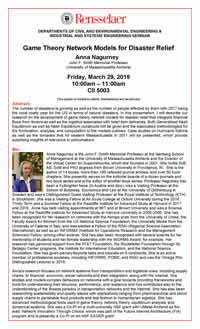
Delightful Surprises During My Visit to Speak at RPI on Disaster Relief


This past Friday, I had the pleasure of speaking at RPI (Rensselaer Polytechnic Institute) in Troy, New York, at 10AM, so the day began quite early with a two hour drive from Amherst, MA. I was hosted by two Engineering departments and had been invited to give a talk there a year ago but my schedule did not permit a visit until now.
                                                   RPI
I had given my host, Professor David Mendonca, a list of topics that I could speak on and the one selected was: Game Theory Network Models for Disaster Relief.
 RPI
My talk is available for download and it was exciting to polish it since, in just the past three weeks, three of our papers on the topic have been published in journals, including: An Integrated Financial and Logistical Game Theory Model for Humanitarian Organizations with Purchasing Costs, Multiple Freight Service Providers, and Budget, Capacity, and Demand Constraints,  Anna Nagurney, Mojtaba Salarpour, and Patrizia Daniele, International Journal of Production Economics 212: (2019), pp 212-226.

The drive on the Mass Pike was smooth, despite the rain, and my husband was the designated driver. He had not been to RPI since he had been accepted there for Grad School, but ended up matriculating at Brown University, so he was eager to go back. I had to check my cv to see when was the last time I had spoken at RPI and found that I had given a seminar at RPI at the Electrical, Computer, and Systems Engineering Department,  December 5, 2001! I recall a lavish holiday party with white roses and shrimp that I viewed in passing.

Once the technology for my presentation was set up, I heard some footsteps behind me and was absolutely thrilled to see one of my Operations and Information Management students from the Isenberg School of Management - Emily Agoglia! She had been a student in my Humanitarian Logistics and Healthcare class at Isenberg, is from Philadelphia, and is a world traveler, having most recently taken part in an academic program in Cuba! And she presented me with the lovely memento from Cuba below.
She had been in Cuba, when I was speaking and taking part in the amazing Congreso Futuro in Chile, so when we get together, we cannot stop comparing experiences. Her father is Professor Chris Agoglia, a renowned Accounting faculty member at Isenberg.

And, there was another delightful surprise - Professor William "Al" Wallace, who is now the Chair of the Department of Industrial and Systems Engineering at RPI, came to my talk. He was the doctoral dissertation advisor of the incoming Isenberg School Dean - Dr. Anne P. Massey! Dr. Massey will be the first female Dean of the Isenberg School and it has an illustrious history of over 70 years. In fact, this coming Friday, we will be celebrating the 50th anniversary of our PhD program! I am very excited since many of my former PhD students will be coming back to campus. I am preparing a talk and have organized the Management Science PhD alumni panel for that day.

The photo below is of me with Professor Wallace and Emily.
After my talk, I had the pleasure of meeting with Professors Sergio Pequito, Thomas Sharkey, and Kristin Bennett. Sergio and I talked about our love of interdisciplinary work. With Thomas "Tom" we discussed his thrilling NSF project on the Arctic and he recently returned from Alaska, so I had to take the photo below. We also chatted about colleagues Dr. Renata Konrad of WPI (a fellow Ukrainian, whom we hosted in our UMass Amherst INFORMS Speaker Series) and Dr. Kayse Maas of Northeastern (and, of course, we then talked about the NSF workshop on human trafficking). Professor Bennett remembers me from way back when when she was in Amherst and from one of her first INFORMS conferences and thanked be for being an inspiration (that and many other surprises  made that rainy day a very bright one)! She received her PhD from University of Wisconsin Madison and Dr. Olvi Mangasarian was her PhD advisor.
The lunch was at the RPI Faculty Club where I enjoyed great conversations with Professors David Mendonca, Kristen Schell, and Cara Wang,  and ate a spicy lunch with purple rice!
Dr. Cara Wang is a Professor of transportation and her advisor was Professor Kara Kockelman of UT Austin. I know Kara from the regional science community. Interestingly, Cara had been at Bucknell University and then moved to RPI. Coincidentally, we recently hosted Dr. Thiago Serra in our UMass Amherst INFORMS Speaker Series and he is off to Bucknell University as an Assistant Professor in the Fall. Also, Dr. Kristen Schell is a relatively new faculty member of ISE at RPI and received her PhD from CMU in engineering policy. Our IE/OR doctoral student, Destenie Nock at UMass Amherst, defended her dissertation recently and will be joining that program as an Assistant Professor in the Fall.

And I would be remiss to forget to mention that Professor David Mendonca is an undergrad alumnus of UMass Amherst, and my Management colleague, Professor Emeritus Art Elkins, had convinced him to go to CMU since the Nobel laureate in Economic Sciences Herbert Simon was there (I had had dinner with Dr. Simon in Amherst at the Lord Jeffery Inn a while ago.) Dr. Mendonca collaborates with a cognitive psychologist, Dr. Wayne Gray at RPI, who is a Lafayette College alumnus, from the same class as my husband, so he kindly kept my husband busy and very entertained while I was speaking and meeting with colleagues!

On our journey back, we turned on the radio, only to hear UMass Amherst hockey score its first goal in its game against Harvard University and they won 4-0; they repeated their amazing performance yesterday evening against Notre Dame University, also with a score of 4-0, and are now off to the NCAA Frozen Four for the first time in the history of UMass Amherst hockey! The first game in the final will be on April 11, right when we are having a special banquet at the Isenberg School for the $62 million Business Innovation Hub celebration with the official unveiling (although we have been using it already a lot since late January) on April 12.

Saturday, March 23, 2019

Fabulous Guest Lecture by a MEMA Expert on the Boston Marathon - Public Safety and Security Experience

Having expert practitioners speak to students in my Humanitarian Logistics and Healthcare class provides outstanding educational experiences that stay with students even after they graduate. The logistics of scheduling experts can, in itself, be challenging, but the risks reap great rewards.

This past Tuesday, we had the honor of hosting Ms. Sara Zalieckas, who is an All Hazards Planner with MEMA (Massachusetts Emergency Management Agency) and is based in Framingham, Massachusetts (about a two hour drive to UMass Amherst). She arrived in time for the early morning class, which meets from 8:30AM-9:45AM and, although I was waiting for her in the original atrium to escort her to the classroom, and she was in the new $62million addition to the Isenberg School,  we connected in time!

Ms Zalieckas is a Canadian, which made me extra excited since I was also born in Canada, and, in fact, had been to Halifax last summer to present at the CORS (Canadian Operations Research Society) conference, where she is from! She has worked for MEMA since 2012 and, hence, was employed by MEMA, when the bombing at the Boston Marathon took place on April 15, 2013.
The title of her guest lecture was: The Boston Marathon - Public Safety and Security Experience.

This year's Boston Marathon is taking place on April 15, 2019.

Ms. Zalieckas informed us of the extensive planning involved among multiple organizations to ensure the safety and security of runners, volunteers, supporters, and spectators alike in this major sports event, which covers over 26 miles (I have run several Ocean State marathons in RI, so I understand the energy and athleticism involved). It is considered the most challenging sports event to secure in the country. The Super Bowl is in one location, in contrast, for example. In 2013, there were 27,000 registered runners and the weather was ideal. In 2019, 60,000 runners are expected.

Rather than detailing the horrific attacks at the 2013 Boston Marathon, I will refer you to a blogpost I wrote following the guest lecture of Dr. Pierre Rouzier, who is a sports medicine physician, based at UMass Amherst, and who was working in a triage tent at that Marathon.

Post 2013, the focus  has been on lessons learned, and on assessing vulnerabilities and threats. Ms. Zalieckas brought to our attention, the 2013 Boston Marathon after action report, which can be accessed here.

Previously, jurisdictions had been working in silos, which was understandable since the marathon course covers a distance of over 26 miles.  Now there is a Unified Coordination Plan, with plans for evacuations, should the need arise, along the course in multiple locations, with even alternative routes to shelters along the Boston Marathon route identified, along with transportation options, such as buses staged. This I found truly fascinating. Now there is a joint information center and system, so that rumors, which are unsubstantiated, do not propagate, along with misinformation. There are also station "blocking" vehicles along the course.

The level of detail and the organizations involved to ensure public safety and security is extraordinary. More intense planning has been taking place since January 2019 to test out communications, to run tabletop exercises and training, to conduct intelligence and investigations (with appropriate federal partners), and to also address how to respond to mass casualty events. I also found it very impressive that MEMA, along with partners, has structured coordination of decision making and there is now a Unified Coordination Center. You may know that the MEMA headquarters in Framingham is actually an underground bunker built during the Cold War and our President at that time, John F. Kennedy, was to inaugurate its opening, but he was assassinated.

It is also so impressive that there is!a drone response plan is in place for the Boston Marathon and, of course, GIS is also utilized to monitor congestion along the route.

Ms. Sara Zaieckas' guest lecture was mesmerizing. I also was very pleased that we had a female speaker this term (and will be having another one next month).

We took a group photo after her guest lecture.

In appreciation, we presented Ms. Zalieckas with a gift from the Isenberg School of Management, and I followed up with several photos and a formal thank you letter, which I also copied to the new Director of MEMA, Ms. Samantha Phillips, which was recently appointed to this important most by Governor Charlie Baker. Quite exciting to have a female at the helm of MEMA!

I wish all the runners, the volunteers, supporters, and spectators, as well as the emergency management folks and their liaisons, a wonderful and safe 2019 Boston Marathon! We will be watching and cheering from near and far!