Showing posts with label Stella Dafermos. Show all posts

Tuesday, November 28, 2023

Writing a Professional Obituary is Hard, Writing One for a Friend, Very Hard

The past few years  have been  difficult ones, with many losing friends and loved ones.

As an academic, I have been very blessed to have colleagues around the globe that I consider to be friends, and some are close collaborators. Also, as an academic, I have been inspired by the work of top scholars, and have enjoyed interactions with them.

The bigger your network is, the more frequently you grieve those that pass away.

This year, in April, I lost a friend at the age of 42, Professor Urmila Pyakurel of Nepal. She had communicated with me only 3 days before dying. Urmila was an extraordinary researcher on networks, focusing on evacuation networks. She was also an educator and a mentor,  and a Full Professor of Mathematics. She was the youngest of 12 children and had to overcome immense challenges to reach the Professor level in academia.

                                       Professor Urmila Pyakurel

A way in academia that we can honor a scholar, who has passed away, is by writing a professional obituary.

I wrote an obituary of Urmila with Professor Tanka Nath Dhamala of Tribhuvan University, who was her "doctor father." The obituary has now been published in the journal Operations Research Forum in the December 2023 issue. A preprint is available here. 


Included in this professional obituary are remembrances by: Dr. Enno Aufderheide, Secretary General, Alexander von  Humboldt Foundation, Professor Stephan Dempe,TU Bergakademie Freiberg, Dr. Hari Nandan Nath,Tribhuvan University, which was Urmila's home institution,  Mr. Durga Prasad Khanal, also of Tribhuvan University, and Dr. Naba Raj Lamsal, Former Director of  Radio Nepal, and BBC correspondent. We also included my remembrance. I had met Urmila in 2019 at a Dynamics of Disasters conference in Kalamata, Greece that I had co-organized with Professors Panos M. Pardalos and Ilias S. Kotsireas. Her warmth and intellect I found inspiring.                        
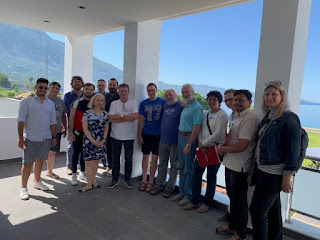


  Some of the conferees at the 2019 Dynamic of Disasters conference in Greece (Professor Urmila is in the photo above with the red bag.)

The first professional obituary I ever wrote (and remember - many journalists are "trained" by writing obituaries), and this one was also very, very difficult to write, was for my PhD dissertation advisor at Brown University, Professor Stella Dafermos, who passed away at age 49. I was her first PhD student. The obituary was published in the journal Operations Research. Stella was one of the very few in Operations Research honored in this way upon passing. I also wrote an In Memoriam for Stella with MIT Professor Amedeo Odoni, which was published in Transportation Science.

Stella chaired my PhD dissertation committee and Professor Martin Beckmann, a renowned economist at Brown, was also on my committee. When he passed away at the age of 93, Professor David Boyce and I wrote the In Memoriam, which was published in Transportation Science. David Boyce and I also wrote an In Memoriam in Transportation Science for Beckmann's co-authors of the classical book, Studies in the Economics of Transportation, Bart McGuire and Chris Winsten. More information on this book can be found here.

In my Transportation and Logistics class that I teach I always share with students stories about Dafermos and Beckmann since their work lives on and has had a tremendous impact. Urmila's publications will also have a tremendous impact on evacuation networks in Nepal, which suffers from so many disasters, and beyond. I will always treasure the wonderful memories of Urmila's smile, her friendship and support. 

Monday, October 18, 2021

It's Official - Announcement of Stella Dafermos Achievement Award in Transportation Science, Thanks to TSL Society of INFORMS!

This morning the business meeting of the Transportation Science and Logistics (TSL) Society of INFORMS took place in a virtual format. There were over 100 participants, with even Norway, Germany, and Israel represented!

I'd like to thank the President of TSL, Professor Mike Hewitt, for running a very professional, and swiftly moving, meeting at which there were many wonderful award announcements and professional updates.

It is now official - I have known about this for months but had to be quiet until the announcement today. 
I am delighted that the TSL Society is recognizing my PhD dissertation advisor, Professor Stella Dafermos, who, sadly, passed away in April 1990 at age 49, with an award in her honor - Stella Dafermos Achievement Award in Transportation Science. I was her first PhD student

I will be chairing the first award committee and am deeply moved and honored.

I'd like to sincerely thank the President and the Board of the TSL Society for recognizing this amazing female trailblazer and role model in this significant way.

I was asked to prepare a short speech highlighting her contributions. 


Stella made herstory/history, in many respects.  She was the second female recipient of a PhD in Operations Research in the US and was the first female Full Professor in Engineering and in Applied Mathematics at Brown University, which she achieved in 1982.

Her 1980 paper, "Traffic Equilibrium and Variational Inequalities," published in the INFORMS journal, Transportation Science, was among the list of 12 most impactful papers in the journal over its 50 year history, as of 2016. All these classic papers can be downloaded for free on the above link provided.


Stella Dafermos had the highest standards when it came to scientific research.  She was guest editing a special issue on Network Equilibrium of Transportation Science, when she passed away, so Professor Amedeo Odoni of MIT and I completed the editorial process and we also published an In Memoriam to Stella in the special issue.

As I said in my speech this morning, "One wonders how much the world has missed because of her untimely passing."

I leave you with a photo of  Stella with Professor George Nemhauser that I took in Tokyo at the Mathematical Programming Symposium, August 28 - September 2, 1988. Stella loved conferencing and I enjoyed travel with her very much as well as publishing with her in many journals, including Operations Research and Mathematical Programming as well as Transportation Science, among others.

When I informed Stella’s husband, Dr. Constantine Dafermos, the Alumni-Alumnae University Professor Applied Mathematics at Brown University,about the Stella Dafermos Achievement Award, he responded, “I am delighted, moved and also – on behalf of Stella – honored.” “I feel that establishing the prize is a major service to your field, as it will serve as a recognition of the contributions in the early days and as a reminder that women were among these contributors.”

Let's continue to do our very best to uphold the highest standards that she set.

Thursday, November 19, 2015

Remembering Herbert E. Scarf of Yale, Great Economist and Operations Researcher - Rest in Peace

This past Tuesday, while teaching my Transportation and Logistics class at the Isenberg School of Management, a class that I love to teach, we were discussing the importance of identifying conditions that guarantee uniqueness of equilibria. I had presented an extended model of transportation network equilibria and we were analyzing it qualitatively.

In order to emphasize to the students  the importance of uniqueness (I was focusing on link flows),  I related to the students a wonderful workshop that I had spoken at, which took place at Stanford University.  The workshop was entitled: Applied General Equilibrium Workshop and it took place March 11-12, 1988. My presentation was  (I checked on my cv): "Variational inequalities and the computation of large-scale equilibria."

I mentioned to my students how exciting it was for me to see George Dantzig there, Curtis Eaves, the Nobel laureate Kenneth Arrow, and also Herbert Scarf.  My dissertation advisor at Brown University, Stella Dafermos, was also there and we were the only two females that had been invited to take part. Strangely enough, I even recall now, although the workshop took place back in 1988,  what Kenneth Arrow was wearing (one of his favorite plaid shirts),  and Herb Scarf's shoes, which, for some reason, impressed me because they were stylish and looked so comfortable. I recall them as being beige Rockport shoes.  The audience, when I spoke about Wardrop's two principles of travel behavior, thought I had said "Wardrobe equilibrium", which Stella and I thought was very funny.

At the workshop we also discussed conditions for uniqueness, which was judged to be a very important property for policy makers when it came to equilibrium problems and a Harvard economics professor was especially avid on this point. The workshop was an intellectual delight and one of the last times that I was with my advisor at a conference since she passed away in 1990.

On Tuesday, when I was reminiscing and sharing the above in my class, I had no idea until I got back to my office and then saw the news, that Professor Herbert E. Scarf had passed away and only two days ago! 

INFORMS produced a fine tribute to Scarf  and the INFORMS President, Ed Kaplan of Yale, recently shared the sad news with all of us. I told my students today of Scarf's passing.

Scarf I remember as being very stately, pleasant, and elegant and had a very warm and welcoming way about him. I was in awe of him because of his book, "Computation of Economic Equilibria," with T. Hansen, which was published by Yale University Press in 1973. Scarf was an economist and also a great contributor to operations research.

In my first book, "Network Economics: A Variational Inequality Approach", which was published in 1993 as the first book in the series: Advances in Computational Economics, I cite Scarf's book in chapter 7, which is on Walrasian Price Equilibrium.  That book is my most highly cited publication according to Google Scholar.

Scarf was a true visionary and realized the importance of algorithmic tools to solve complex equilibrium problems. We have much to thank him for and he will be missed.


Thursday, June 2, 2011

The Academic Genealogy Surprises Continue -- Back to Newton and Even Galileo Thanks to Mike Trick

Those of us in Operations Research are well aware of the heritage of our discipline, which includes such luminaries as the physicist Phillip Morse, and, as a distinct discipline, originates in the 1940s.

Many of us are curious about other students that have had the same doctoral dissertation advisor since networks in academia and beyond are important.

While I knew that the doctoral dissertation advisor of my dissertation advisor, Stella Dafermos, was F. Thomas "Tom" Sparrow, my academic genealogy trail ended there.

It was not until I received email messages from fellow OR blogger and CMU Professor Mike Trick that I found out that his advisor's, advisor's advisor was also Tom Sparrow, so we are academic cousins! Mike received his PhD from Georgia Tech while I received mine from Brown University.

In another recent blogpost, Mike, being the serious scholar and researcher that he is, traced our heritage back to Sir Isaac Newton, who needs no introductions to any living scientist, but, wait, there is more ...

While not technically his advisor in the current sense, the most important advisor to Newton was Isaac Barrow, the discoverer of the Fundamental Theorem of Calculus.

Barrow, in turn, studied under Vincenzio Viviani, who studied under Galileo di Vincenzo Bonaiuti de' Galilei, who is considered the father of modern physics.

Looking back in OR/MS Today, I found Great Moments in HistORy by Saul Gass and the second item mentions none other than Newton!

We clearly need to enthusiastically celebrate our scientific roots with our disciplinary brothers and sisters, including physicists.

Friday, June 26, 2009

The Importance of Knowing Languages, Prize Competitions, and Michael Jackson

This certainly has been an interesting week! I am serving on two scientific prize committees. The first competition is the 2009 Mathematics Competition for Young Mathematicians in Ukraine sponsored by the Shevchenko Scientific Society of America and the U.S.-Ukraine Foundation with a prize of $6,000US. This is the second year that this competition is taking place and I also served on last year's award committee. This week, as part of the reviewing process, I read over a dozen nomination packets and evaluated the scientific papers forwarded by the nominees, their curriculum vitae, plus letters by outside examiners who commented on the publications and overall reputations of the nominees. If English was the only language that I could read, I would have been unable to appropriately evaluate the submitted materials and to rank the top candidates for the award.

The years of learning both Ukrainian (my first language) and Russian (I have a degree in Russian from Brown U. plus three degrees in Applied Mathematics) paid off! As for English, that is my second language, which I began studying in kindergarten a while ago. During this competition I read mathematics papers in all three languages plus nomination and review letters in those languages. Mathematics is its own beautiful and elegant language so I certainly put my degrees and expertise to great use this week. The competition is now in its second round and we hope to announce the recipient of this award soon. To see the caliber of research and publications being done by young mathematicians in Ukraine, a country of 46 million people, which continues to struggle after its independence, was very inspiring!

In addition, I am serving as the Chair of the WORMS (Women in Operations Research and the Management Sciences) Award of INFORMS. The deadline for nominations is July 1, 2009. This award celebrates and recognizes a person who has contributed significantly to the advancement and recognition of women in the field of Operations Research and the Management Sciences.It is an honor to be serving as the chair of this committee.

The shocking and untimely death of Michael Jackson yesterday at age 50 invoked memories of the death of my dissertation advisor at Brown University, Dr. Stella Dafermos, who was truly a leader in her fields of operations research and transportation science and who died just shy of her 50th birthday. The former spoke in his language of music and the latter in her language of applied mathematics and operations research. They left lasting legacies, respectively, in music and scholarly publications.