Yesterday morning my flight on Delta from Boston Logan landed in London Heathrow at 7AM. The flight was early and it had been so comfortable - I managed to even stretch out over 3 middle seats and can't remember when I had this luxury in the recent past.
All Souls College at Oxford University had arranged for me to be picked up at Heathrow. Both my suitcases arrived quickly in baggage claim and although customs was a mass of humanity especially the "all passports" queue, I took advantage of the wait by speaking to the female in front of me, who, was from DC and was returning to Oxford for a visit since she had received her Master's last year from Oxford University in environmental sciences. She was wonderful to talk to and told me of several places that I should go to, including University Park, which I strolled through today.
My driver brought me to my apartment, which is gated and requires a combination to get past the gate and another one to get into the building. The apartment has views of greenery from each window and as I am writing the birds outside are keeping me company. The air is very crisp and the temperature just perfect for research, walking, and exploring.
I will be reporting to All Souls College on Monday, which will be by first day as a Visiting Fellow. I am very excited about this great opportunity.
Yesterday I walked to downtown Oxford and found a favorite tea room and restaurant that we had been to last year when we were in Europe for multiple conferences from Greece through Scotland.
I walked at least 10 miles which is always my way of avoiding jet lag since one then switches to the new time zone and collapses in a deep sleep at night. I even managed to get to a Sainsbury food store to purchase some fresh produce, other food, and household supplies.
Everyone is so friendly here and my ears are getting adjusted to the variety of British accents that I hear. I managed to get a monthly bus pass at Debenham's but have been walking exclusively, so far.
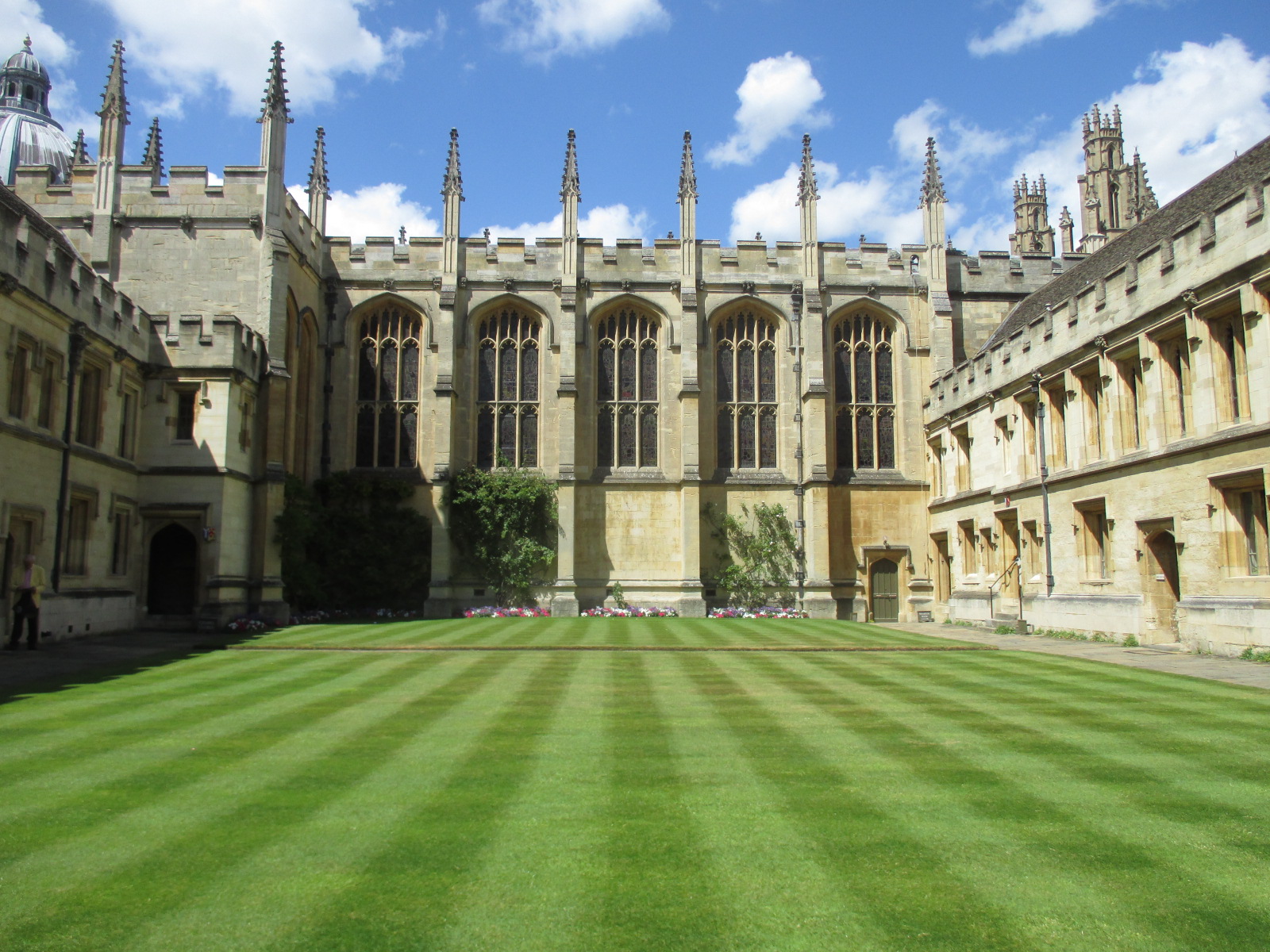
Below are some photos taken in my first 36 hours in Oxford.
The first photo below is of Trinity College, Oxford University, which is very close to All Souls College.
All Souls College was closed today (but it is a Saturday). I took the photo below of the entrance.
There were various sports teams and many families enjoying University Park today.
The tree below in the park charmed me - yes, being from Amherst, Massachusetts, I am certainly at tree hugger.
The arch below on the Oxford University campus caught my eye.
The bus I will take advantage of sooner or later since there will be quite a few late evening lectures to attend.
But, this afternoon, I walked the scenic way back from downtown to my apartment.
The beauty of Oxford from the architecture to the natural environment is captivating.

I do believe that living abroad, as an academic, enriches one intellectually, culturally, spiritually, and research-wise. Tonight, I will enjoy reading a nice, thick British newspaper followed by my copy of the latest issue of The Economist.
Showing posts with label architecture. Show all posts
Saturday, April 30, 2016
Thursday, July 9, 2015
Looking Forward to Being a Visting Fellow at All Souls College at Oxford University
This past Tuesday, my husband and I took the train from London to Oxford (now the same trains and the London tube are not running due to a strike, the first in 20 years).
I have been conferencing in Europe, beginning with the Dynamics of Disasters conference in Greece, followed by the EUROPT conference, now taking place in Edinbirg, Scotland, and next week, the EURO conference in Glasgow.
Since Oxford is ony a one hour train ride from London it made sense to go and visit All Souls College at Oxford University where I will be a Visiting Fellow next year during the trinity term.
All Souls College is considered to be one of the most prestigious colleges at Oxford and the history of it, which dates to the mid 1400s testifies to that.
I heard the great news that I was selected to be a Visiting Fellow at All Souls College while I was checking by email on the MetroNorth train to New York City last November. Only a few days after the good news the Isenberg School of Management had a special tribute to Gene Isenberg, and I spoke with one of his grandsons, Stefan, who had graduated from Oxford University.
I have been communicating with the Visiting Fellow secretary regularly and got a chance to meet her at Oxford and also to meet one of the porters.
Women have been allowed to be Fellows at All Souls College only since 1979.
According to All Souls College in regards to Visiting Fellowships: The purpose of the scheme is to bring to the College distinguished scholars (and occasionally individuals with careers in public service) from outside the University of Oxford who would benefit from undertaking their research project here.
The architecture of Oxford University is stunning as are the green spaces and river surroundings.
We even managed to find the place that we will be living at while I am a Visiting Fellow and I enjoyed seeing the gift below of this year's Fellows in front of the complex.
As for the food in Oxford, my husband and I shared a delicious lunch of fish and chips with mushed peas (they were so good0 and avocado. Then, after miles of walking, we treated ourselves to a cream tea (what can beat a scone and cold clotted cream plus hot tea in the afternoon?) in the oldest coffee house in England.
It will be quite the experience moving from New England to Old England next year - I am very much looking forward to it and will also have to bring my Brown University cap and gown for various academic events.
I have been conferencing in Europe, beginning with the Dynamics of Disasters conference in Greece, followed by the EUROPT conference, now taking place in Edinbirg, Scotland, and next week, the EURO conference in Glasgow.
Since Oxford is ony a one hour train ride from London it made sense to go and visit All Souls College at Oxford University where I will be a Visiting Fellow next year during the trinity term.
All Souls College is considered to be one of the most prestigious colleges at Oxford and the history of it, which dates to the mid 1400s testifies to that.
I heard the great news that I was selected to be a Visiting Fellow at All Souls College while I was checking by email on the MetroNorth train to New York City last November. Only a few days after the good news the Isenberg School of Management had a special tribute to Gene Isenberg, and I spoke with one of his grandsons, Stefan, who had graduated from Oxford University.
I have been communicating with the Visiting Fellow secretary regularly and got a chance to meet her at Oxford and also to meet one of the porters.
Women have been allowed to be Fellows at All Souls College only since 1979.
According to All Souls College in regards to Visiting Fellowships: The purpose of the scheme is to bring to the College distinguished scholars (and occasionally individuals with careers in public service) from outside the University of Oxford who would benefit from undertaking their research project here.
The architecture of Oxford University is stunning as are the green spaces and river surroundings.
We even managed to find the place that we will be living at while I am a Visiting Fellow and I enjoyed seeing the gift below of this year's Fellows in front of the complex.
As for the food in Oxford, my husband and I shared a delicious lunch of fish and chips with mushed peas (they were so good0 and avocado. Then, after miles of walking, we treated ourselves to a cream tea (what can beat a scone and cold clotted cream plus hot tea in the afternoon?) in the oldest coffee house in England.
It will be quite the experience moving from New England to Old England next year - I am very much looking forward to it and will also have to bring my Brown University cap and gown for various academic events.
Tuesday, January 20, 2015
Future Internet Infrastructure Research at UMass Amherst and at the Isenberg School
I was delighted to hear this morning from Karen Hayes, the Director of Research Communications and Outreach, that the Feature Article, UMass Amherst experts are driving the future of Internet infrastructure, is now online on the ResearchNext website.
The faculty from Computer Science and Electrical and Computer Engineering and the Isenberg School of Management that appear in the article were interviewed last summer.
It is truly amazing that at UMass Amherst there are two (out of the five) funded National Science Foundation (NSF) Future Internet Architecture (FIA) projects.
As the article notes, my doctoral students and I are working with Professor Tilman Wolf of the Department of Electrical and Computer Engineering on the FIA project that we are calling ChoiceNet. Our collaborators include colleagues at the University of Kentucky (Professors Ken Calvert and Jim Griffioen), NCState (Professors Rudra Duuta and George Rouskas), and RENCI an UNC (Dr. Ilya Baldine). My doctoral students who have been funded on this NSF grant are: Sara Saberi, who is an Isenberg Scholar Award recipient, and Dong "Michelle" Li, who received the Outstanding Doctoral Student Researcher Award from the Isenberg School in 2014. Both Sara and Michelle are PhD students in the Management Science track at the Isenberg School.
Just last week, I spoke at the INFORMS Computing Society conference on our latest research on ChoiceNet in the form of introducing duration-based contracts for Internet services so as to offer consumers more choices. The paper, which is online, thanks to INFORMS and the great conference Proceedngs editors, is: A Game Theory Model for a Differentiated Service-Oriented Internet with Duration-Based Contracts, Anna Nagurney, Sara Saberi, Tilman Wolf, and Ladimer S. Nagurney, Proceedings of ICS 2015: Operations Research and Computing: Algorithms and Software for Analytics, Brian Borchers, J. Paul Brooks, and Laura McLay, Editors, INFORMS (2015) pp 15-29. Our presentation can be viewed here.
The project page for ChoiceNet is here where you can find some of our papers.
I very much liked the quote from our Vice Chancellor in the article: “The fact that our campus was selected to take a leadership role on two of the five FIA projects speaks volumes about our faculty expertise,” says Mike Malone, vice chancellor for research and engagement. “We take an interdisciplinary approach to science, which is critical to an initiative of this size.”
In addition to ChoiceNet, the other FIA project that UMass Amherst researchers are involved in is MobilityFirst. Professors Jim Kurose, Arun Venkataramani, and Michael Zink are working on that project. And, for those who have not heard, Distinguished University Professor Jim Kurose of Computer Science is now the new Program Director of CISE (Computer & Information Science & Engineering) Directorate at NSF!
The faculty from Computer Science and Electrical and Computer Engineering and the Isenberg School of Management that appear in the article were interviewed last summer.
It is truly amazing that at UMass Amherst there are two (out of the five) funded National Science Foundation (NSF) Future Internet Architecture (FIA) projects.
As the article notes, my doctoral students and I are working with Professor Tilman Wolf of the Department of Electrical and Computer Engineering on the FIA project that we are calling ChoiceNet. Our collaborators include colleagues at the University of Kentucky (Professors Ken Calvert and Jim Griffioen), NCState (Professors Rudra Duuta and George Rouskas), and RENCI an UNC (Dr. Ilya Baldine). My doctoral students who have been funded on this NSF grant are: Sara Saberi, who is an Isenberg Scholar Award recipient, and Dong "Michelle" Li, who received the Outstanding Doctoral Student Researcher Award from the Isenberg School in 2014. Both Sara and Michelle are PhD students in the Management Science track at the Isenberg School.
Just last week, I spoke at the INFORMS Computing Society conference on our latest research on ChoiceNet in the form of introducing duration-based contracts for Internet services so as to offer consumers more choices. The paper, which is online, thanks to INFORMS and the great conference Proceedngs editors, is: A Game Theory Model for a Differentiated Service-Oriented Internet with Duration-Based Contracts, Anna Nagurney, Sara Saberi, Tilman Wolf, and Ladimer S. Nagurney, Proceedings of ICS 2015: Operations Research and Computing: Algorithms and Software for Analytics, Brian Borchers, J. Paul Brooks, and Laura McLay, Editors, INFORMS (2015) pp 15-29. Our presentation can be viewed here.
The project page for ChoiceNet is here where you can find some of our papers.
I very much liked the quote from our Vice Chancellor in the article: “The fact that our campus was selected to take a leadership role on two of the five FIA projects speaks volumes about our faculty expertise,” says Mike Malone, vice chancellor for research and engagement. “We take an interdisciplinary approach to science, which is critical to an initiative of this size.”
In addition to ChoiceNet, the other FIA project that UMass Amherst researchers are involved in is MobilityFirst. Professors Jim Kurose, Arun Venkataramani, and Michael Zink are working on that project. And, for those who have not heard, Distinguished University Professor Jim Kurose of Computer Science is now the new Program Director of CISE (Computer & Information Science & Engineering) Directorate at NSF!
Tuesday, May 6, 2014
Toward An Economy Plane for the Internet - A Paradigm Shift Through Our NSF Research
Yesterday we heard the good news that our paper:
had been accepted by the Editor of Computer Communication Review (CCR) for publication. We expect it to appear in the July 2014 issue.
CCR, according to its website, is the magazine of ACM SIGCOMM. ACM, as some of you may know, is the acronym for the Association for Computing Machiner, the world's largest educational and scientific computing society. SIGCOMM is the special interest group on Data Communication.
The scope of CCR is that: Technical papers accepted to CCR typically report on practical advances or the practical applications of theoretical advances. CCR serves as a forum for interesting and novel ideas at an early stage in their development. The focus is on timely dissemination of new ideas that may help trigger additional investigations. While the innovation and timeliness are the major criteria for its acceptance, technical robustness and readability will also be considered in the review process. We particularly encourage papers with early evaluation or feasibility studies.
Our paper reports on our vision for our National Science Foundation (NSF) project: Network Innovation Through Choice, which, as you can see from the names on our paper, is multiuniversity and multidisciplinary (and also multiyear). I truly enjoy working with this great team of computer scientists and electrical and computer engineers and provide the network economics and operations research and management science perspective.
In particular, we are envisioning and working on a Future Internet Architecture (FIA) and are, in fact, one of five such teams in the U.S. selected by NSF. Our FIA is called ChoiceNet.
In this paper, in the Abstract, we state that: "The Internet has been a key enabling technology for many new distributed applications and services. However, the deployment of new protocols and services in the Internet infrastructure itself has been sluggish, especially where economic incentives for network providers are unclear. In our work, we seek to develop an “economy plane” for the Internet that enables network providers to offer new network- based services (QoS, storage, etc.) for sale to customers. The explicit connection between economic relationships and network services across various time scales enables users to select among service alternatives. The resulting competition among network service providers will lead to overall better technological solutions and more competitive prices. In this paper, we present the architectural aspects of our ChoiceNet economy plane as well as some of the technological problems that need to be addressed in a practical deployment."
Also, we are delighted that our earlier paper,A Network Economic Game Theory Model of a Service-Oriented Internet with Choices and Quality Competition, Anna Nagurney, Dong Li, Tilman Wolf, and Sara Saberi, Netnomics 14(1-2): (2013) pp 1-25, which is also based on this NSF funded project was selected by ACM Computing Reviews in its list of Best of 2013. The list recognizes notable items published in computing.
Our paper was selected in the Computer Applications category and the full list can be downloaded here. Both Sara Saberi and Dong Li are my doctoral students in Management Science at the Isenberg School at UMass Amherst.
It is terrific to see interdisciplinary research making advances in what may actually be a paradigm shift!
had been accepted by the Editor of Computer Communication Review (CCR) for publication. We expect it to appear in the July 2014 issue.
CCR, according to its website, is the magazine of ACM SIGCOMM. ACM, as some of you may know, is the acronym for the Association for Computing Machiner, the world's largest educational and scientific computing society. SIGCOMM is the special interest group on Data Communication.
The scope of CCR is that: Technical papers accepted to CCR typically report on practical advances or the practical applications of theoretical advances. CCR serves as a forum for interesting and novel ideas at an early stage in their development. The focus is on timely dissemination of new ideas that may help trigger additional investigations. While the innovation and timeliness are the major criteria for its acceptance, technical robustness and readability will also be considered in the review process. We particularly encourage papers with early evaluation or feasibility studies.
Our paper reports on our vision for our National Science Foundation (NSF) project: Network Innovation Through Choice, which, as you can see from the names on our paper, is multiuniversity and multidisciplinary (and also multiyear). I truly enjoy working with this great team of computer scientists and electrical and computer engineers and provide the network economics and operations research and management science perspective.
In particular, we are envisioning and working on a Future Internet Architecture (FIA) and are, in fact, one of five such teams in the U.S. selected by NSF. Our FIA is called ChoiceNet.
In this paper, in the Abstract, we state that: "The Internet has been a key enabling technology for many new distributed applications and services. However, the deployment of new protocols and services in the Internet infrastructure itself has been sluggish, especially where economic incentives for network providers are unclear. In our work, we seek to develop an “economy plane” for the Internet that enables network providers to offer new network- based services (QoS, storage, etc.) for sale to customers. The explicit connection between economic relationships and network services across various time scales enables users to select among service alternatives. The resulting competition among network service providers will lead to overall better technological solutions and more competitive prices. In this paper, we present the architectural aspects of our ChoiceNet economy plane as well as some of the technological problems that need to be addressed in a practical deployment."
Also, we are delighted that our earlier paper,A Network Economic Game Theory Model of a Service-Oriented Internet with Choices and Quality Competition, Anna Nagurney, Dong Li, Tilman Wolf, and Sara Saberi, Netnomics 14(1-2): (2013) pp 1-25, which is also based on this NSF funded project was selected by ACM Computing Reviews in its list of Best of 2013. The list recognizes notable items published in computing.
Our paper was selected in the Computer Applications category and the full list can be downloaded here. Both Sara Saberi and Dong Li are my doctoral students in Management Science at the Isenberg School at UMass Amherst.
It is terrific to see interdisciplinary research making advances in what may actually be a paradigm shift!
Labels:
ACM,
architecture,
best paper,
CCR,
computing reviews,
future internet,
game theory,
Isenberg School,
management science,
network economics,
NSF,
operations research,
SIGCOMM,
UMass Amherst
Friday, June 28, 2013
Internet of Things and Distributed Cyber-Physical Systems
I was delighted to see that the latest round of Presidential Innovation Fellows announced recently by the White House includes not only our very own Dr. Bev Woolf, of the Computer Science Department at UMass Amherst, but also two Fellows in Disaster Response & Recovery and also two in Cyber-Physical Systems in the list of 43 new Fellows.
Coincidentally, a paper written by Professors Tilman Wolf, Michael Zink, and me, and entitled: "The Cyber-Physical Marketplace: A Framework for Large-Scale Horizontal Integration in Distributed
Cyber-Physical Systems," will be presented on July 8, 2013, in the opening session, following the keynote, at The Third International Workshop on Cyber-Physical Networking Systems, in Philadelphia. In our paper, we acknowledge support from the National Science Foundation on our project: Network Innovation Through Choice.
As we state in our paper: Cyber-Physical Systems (CPS) promise to provide technical solutions to solve some of the most important societal and environmental problems. By combining sensing and response actions in the physical domain with processing and communication functionality in the computational domain, CPS can provide novel solutions in the areas of health care, transportation, energy, disaster response, manufacturing, defense, etc. It can be expected that cyber-physical systems will become ubiquitously deployed in the coming decade as users demand more “smart” solutions in their environment.
Traditionally, cyber-physical systems have been considered to be tightly integrated solutions that are aimed at specific application domains. Typical examples include industrial control, flight control in airplanes, agriculture, etc. These traditional application domains of CPS are often characterized by safety concerns and tight performance constraints. In parallel, a broader view of cyber-physical systems has emerged, often termed distributed cyber-physical systems (DCPS) orthe “Internet of Things,” where interacting components are more loosely coupled and real-time constraints and safety concerns are less dominating. Application domains from this space include home automation (e.g., lighting and temperature control), smart appliances (e.g., operation based on energy availability and price), smart traffic control, etc.
In our paper, we argue that in order to develop a common infrastructure for a large-scale DCPS, it is critical to develop a framework that allows for horizontal integration of CPS components. We discuss the vision, requirements, and design of such a framework. We present several specific technical challenges that need to be addressed in this context as well as potential solution approaches. We also provide examples to illustrate how our framework can lead to innovative new uses, from weather sensing to smart transportation, that can have meaningful impact on practical problems.
Coincidentally, a paper written by Professors Tilman Wolf, Michael Zink, and me, and entitled: "The Cyber-Physical Marketplace: A Framework for Large-Scale Horizontal Integration in Distributed
Cyber-Physical Systems," will be presented on July 8, 2013, in the opening session, following the keynote, at The Third International Workshop on Cyber-Physical Networking Systems, in Philadelphia. In our paper, we acknowledge support from the National Science Foundation on our project: Network Innovation Through Choice.
As we state in our paper: Cyber-Physical Systems (CPS) promise to provide technical solutions to solve some of the most important societal and environmental problems. By combining sensing and response actions in the physical domain with processing and communication functionality in the computational domain, CPS can provide novel solutions in the areas of health care, transportation, energy, disaster response, manufacturing, defense, etc. It can be expected that cyber-physical systems will become ubiquitously deployed in the coming decade as users demand more “smart” solutions in their environment.
Traditionally, cyber-physical systems have been considered to be tightly integrated solutions that are aimed at specific application domains. Typical examples include industrial control, flight control in airplanes, agriculture, etc. These traditional application domains of CPS are often characterized by safety concerns and tight performance constraints. In parallel, a broader view of cyber-physical systems has emerged, often termed distributed cyber-physical systems (DCPS) orthe “Internet of Things,” where interacting components are more loosely coupled and real-time constraints and safety concerns are less dominating. Application domains from this space include home automation (e.g., lighting and temperature control), smart appliances (e.g., operation based on energy availability and price), smart traffic control, etc.
In our paper, we argue that in order to develop a common infrastructure for a large-scale DCPS, it is critical to develop a framework that allows for horizontal integration of CPS components. We discuss the vision, requirements, and design of such a framework. We present several specific technical challenges that need to be addressed in this context as well as potential solution approaches. We also provide examples to illustrate how our framework can lead to innovative new uses, from weather sensing to smart transportation, that can have meaningful impact on practical problems.
Subscribe to:
Posts (Atom)