When the invitation came from Professor Joe Naoum-Sawaya of the Ivey Business School at Western University (formerly Western Ontario University) in London, Ontario, Canada, I was very intrigued. He and his colleague, Professor Bissan Ghaddar, were organizing a Workshop on Smart Cities Analytics, and might I be interested in speaking?
The invitation was quickly accepted and this past Thursday, after teaching my Transportation and Logistics class, I was off to Bradley Airport for my flights on Air Canada to Toronto and then to London (London, Ontario, that is)! The flights on the puddle jumpers were surprisingly very comfortable and I had a delightful conversation on the first leg with a mother, originally from Jamaica, who was traveling with her 7 month old daughter. She had been to visit her 90 year old grandmother in Connecticut and is still fostering children - she has fostered over 100. Hearing about such exceptional human beings is always a wonder of travel.
Having been to England in September for the OR60 conference and the Early Career Researcher Workshop at Lancaster to speak, I appreciated the big welcome sign at the London, Ontario airport (never to be confused with Heathrow but there is a Tim Horton's there). It was my first time to the Ivey School and London, Ontario.
The logistics of my travel were expertly organized with a pickup at the airport.
The London Park Hotel, where the workshop guest speakers were accommodated, provided me with a suite which looked more like an apartment - I loved it! Given that I was in Canada, the next morning, I got to see many young hockey players at breakfast who were in town with their families for a tournament. Last Monday was Canadian Thanksgiving so many had a week holiday.
It was thrilling to see the guest speakers at the workshop and the participants. The Ivey School, the site of the workshop, is in a stunning building.
As you can see from the above workshop poster, the speakers traveled from France, Denmark, Ireland, and the US, with one local speaker, for the workshop, which clearly demonstrates the excitement surrounding the theme of the workshop.
The full schedule with the talk titles and abstracts can be downloaded here.
The format of the workshop was excellent, with 45 minute talks and time for discussion. Lunch was also provided as well as refreshments at breaks and registration was free, thanks to the sponsors. The audience consisted of faculty and students from the host university and neighboring universities, including the University of Waterloo (my host for my previous speaking engagement at a Canadian university). I admit, since I was born in Canada, I like to support my Operations Research and Management Science colleagues in Canada and it is a pleasure to do so.
The workshop began with a welcome and opening remarks by Professor Naoum-Sawaya and an Associate Dean at Ivey.
Thanks to Professor Joe Naoum-Sawaya for letting me be the first speaker.
As promised to participants, I have posted my talk.

My talk was based on two earlier papers of mine:
Design of Sustainable Supply Chains for Sustainable Cities,
Anna Nagurney, Environment & Planning B 42(1): (2015) pp 40-57 and Supply Chain Network Sustainability Under Competition and Frequencies of Activities from Production to Distribution,
Anna Nagurney, Min Yu, and Jonas Floden, Computational Management Science 10(4): (2013) pp 397-422.
After the coffee break, it was time for Professor Ivana Ljubic to speak on
Very Large Scale Covering Location Problems in the Design of Advanced Metering Infrastructure. Professor Ljubic is a Professor at ESSEC in France.
Her talk focused on smart metering and the Internet of Things (IoT) and the challenges posed by the limitations of current infrastructure. She described elegant models that she had constructed for related facility location problems to determine where to place bay stations for wireless communications to cover homes with the consideration of an investment budget or a percentage of demand coverage. The exact algorithms that she presented, along with extensive computational results, on truly large-scale problems, were very elegant and impressive.

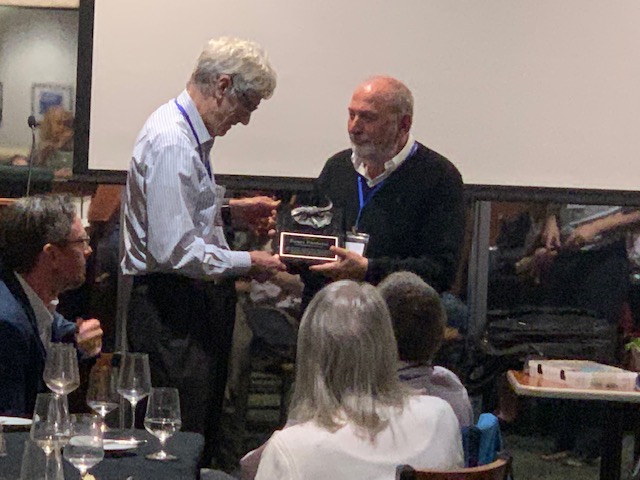
Professor Ljubic, who is very active on Twitter and is a jet-setter, and we enjoy communicating in this way, told me that she had met me at the Computational Management Science (CMS) conference in Vienna, Austria in 2010, so I promised her that I would try to retrieve some photos from that conference and I have posted them below - even with my former doctoral student, Tina Wakolbinger, who is now a Professor at the Vienna University of Economics and Business!
Professor Pierre Pinson of the Technical University of Denmark, who is French, presented a talk on
Community-Based and Peer-to-Peer Electricity Markets, in which he shared with us that Copenhagen is planning on being carbon-neutral by 2050. He also told us that Denmark produces the cheapest electric power in Europe but, after taxes, it is the most expensive. He suggested that governments may need to rethink taxes in terms of social responsibility with taxes being a function of distance. He emphasized the purchasing of electricity locally and discussed consensus-based optimization with fascinating reciprocity constraints. He described how individuals have self-interest with interest to collaborate locally and how exchanges within a community do not have to be settled with monetary compensation. He also emphasized the construction of a social welfare function and the cost of a social construct with a community wanting to be as autonomous as possible. Professor Pinson further elaborated on networks of communities for urban design and mentioned blockchains and possible coordination mechanisms.He told us that "we need to change the game" and need new business models.
I thoroughly enjoyed his very thought-provoking presentation and told him that I will be reading his papers!
Then it was time for lunch and further stimulating conversations and discussions. Another special highlight for me was seeing Professor Hani S. Mahmassani, the Director of the Transportation Center at Northwestern University. Just to further emphasize how much I respect Professor Mahmassani, I even had a photo of him in my presentation that morning. Hani, if I may, is a true scholar and leader in transportation, one who not only does outstanding research but also parlays his work into practice with high impact. And, to further celebrate his accomplishments, in the introduction to his talk, Professor Naoum-Sawaya shared with us (I also heard this great news at lunch) that Professor Mahmassani has been appointed to the Advisory Board for Smart Cities for Monaco and also to the Advisory Board for the Panama Canal. So, huge congratulations to him!
Professor Mahmassani's talk was entitled:
Predictive Analytics for Real-time Urban Mobility: Autonomous, Connected, Electric, Shared (ACES).

Professor Mahmassani took us on a vivid journey of the state-of-the-art of his topic and described several key takeaways, overviewing connected vehicles (when and in what form and at what rate); major disruptive influences from technology to players; shared mobility fleets; why we still need predictive models even if we may be able to ultimately see the state of the transportation system at all times, and how transportation agencies must be willing to embrace change. He emphasized how autonomous, connected vehicle ideas have evolved from ITS with one of the goals being to eliminate or to reduce human errors. He spoke on connected systems that should be coordinated, with "cooperative driving," optimized flow and routing. He also brought up, which he recognized that I would very much appreciate - that freight services might be managed in a system-optimized manner, whereas travelers even in shared, connected vehicles, might be (should be) routed in a user-optimized way. Such discussions I have had with the students in the Transportation and Logistics class that I teach at the Isenberg School. He also brought out that intelligence (think of Google) will reside in vehicles but what about the infrastructure that will be needed to operationalize connected, autonomous vehicles? He mentioned a report put out by his center on
Mobility 2050 - Emerging Futures, definitely word reading.
Given the fascinating talks, I hope that the organizers will be able to post them and, frankly, I asked when will the next such workshop be because of the stimulating important issues and discussions from multiple very creative perspectives!
Professor Mahmassani's talk was followed by a talk from another Northwestern University Professor, Professor Chaithanya Bandi of the Kellogg School. Concidentally, both are MIT PhD alums, but of different programs. Dr. Bandi changed the title and topic of his presentation and his talk was on:
Data Driven Analytics for Government, with a focus on Singapore! I have been invited to Singapore but have not been there (yet) although my husband has and he did bring me some marvelous souvenirs from there. We were presented with numerous fascinating facts about Singapore including that 80% of the population lives in public housing. The government shares "Moments of Life" in which its citizens are congratulated for various milestones. Humans are considered "sensors" with even government-aided dating taking place. Singapore is focused on "customizable communities" and Dr. Bandi shared with us the cost/taxes of vehicle ownership in Singapore. He then described some research that he has been involved in regarding hospital staffing and patient flows - data-rich but an uncertain environment. He also mentioned his work on LEGO Networks with Itai Guravich in which subsystems are first optimized and the system is then built up.

Then Professor Xianbin Wang of the Electrical and Computer Engineering at the host university discussed his research with collaborators in the presentation:
Technical Challenges and Business Opportunities of Ubiquitously Connected Society. He asked the question - what are we trying to solve through IoT and by connecting everything? He also mentioned 5G and ICT infrastructure needs associated with it. Some of his concerns include interoperability issues associated with IoT and how to create internetwork collaboration. It was good to hear him mention the increasing overhead associated with cybersecurity and the proliferation of devices and impacts on communications. He is a proponent of "Software Defined Networking (SDN) Enabled Synergistic Resource Sharing".
The final presenter, and he deserves extra applause, was Professor Robert Shorten of University College Dublin, who spoke on:
Distributed Ledger Technology, Cyber-Physical Systems, and Social Compliance. He, in his talk, showed us a collage of photos of activities in cities, including one with a homeless person rummaging through the trash and asked us what we had observed. He had posted this photo to demonstrate that we do not enforce social contracts and people may be putting rubbish in the incorrect bins and, hence, not recycling, as they should be. The homeless person was performing a useful task for society. Professor Shorten then described how blockchain has a lot of potential for the enforcement of social contracts and noted that distributed ledger systems (DLTs) have operational costs that are low and fast transaction times. he also spoke about competitive versus collaborative DLTs. He presented an elegant graph model of DAGs (directed acyclic graph) with no transaction fees. Underlying his work are ordinary differential equations for which he has also conducted stability analysis. It was great to see that in my talk I had described a Nash Equilibrium model for sustainable supply chains, and Professor Shorten also had Nash Equilibrium in one of his slides. He spoke about the use of tokens for "the cost of misbehaving" as when one would drive through a red light, for example, and the use of DLTs would be anonymous (an audience member brought up the use of fines). It was very interesting to listen to him speak on how to design controls so as to incentivize people to behave as in being socially compliant in traffic, given the risk of getting caught. He also brought up "string stability," as in what happens downstream in other junctions of the network, if someone drive through a red light.
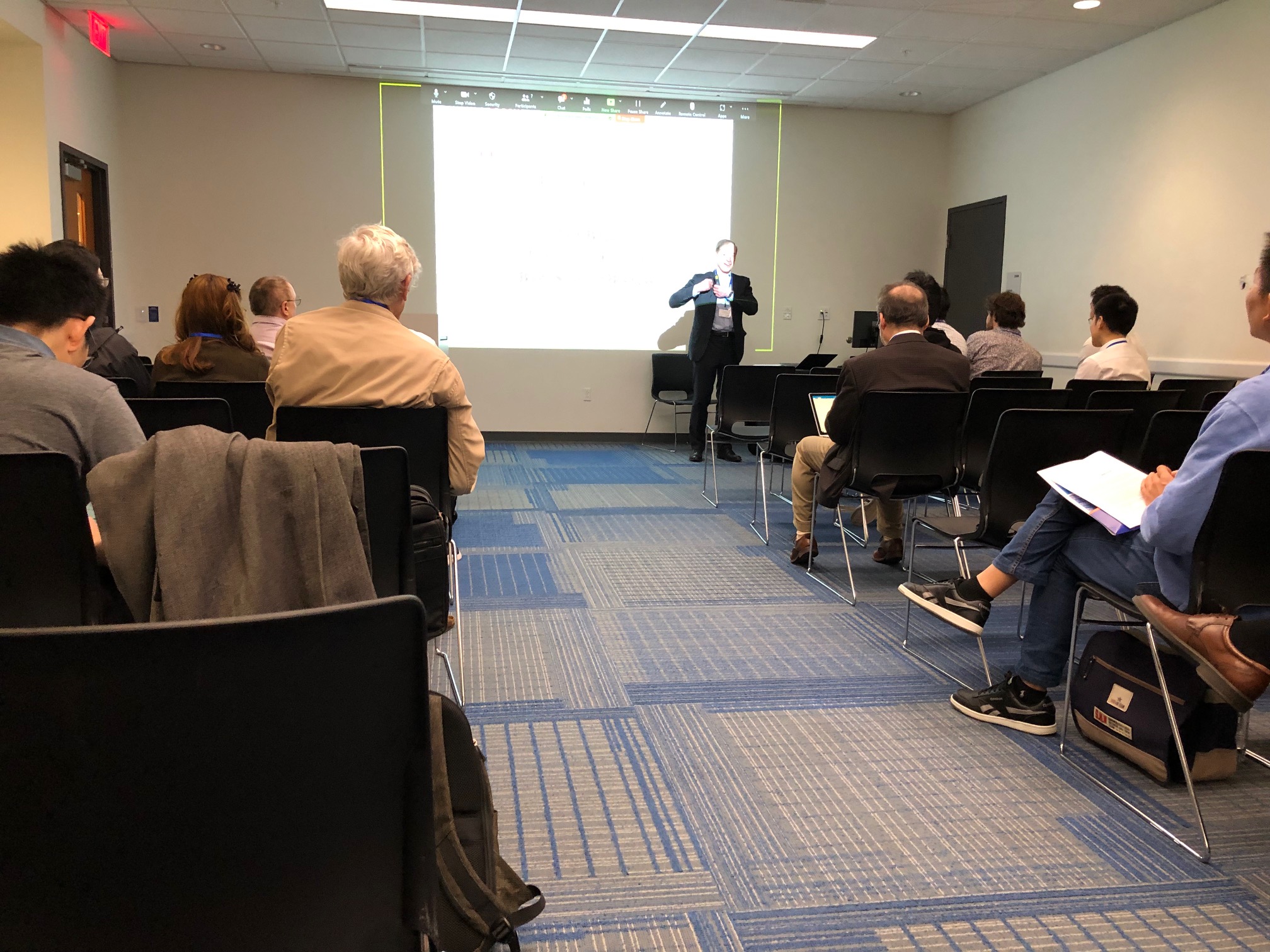
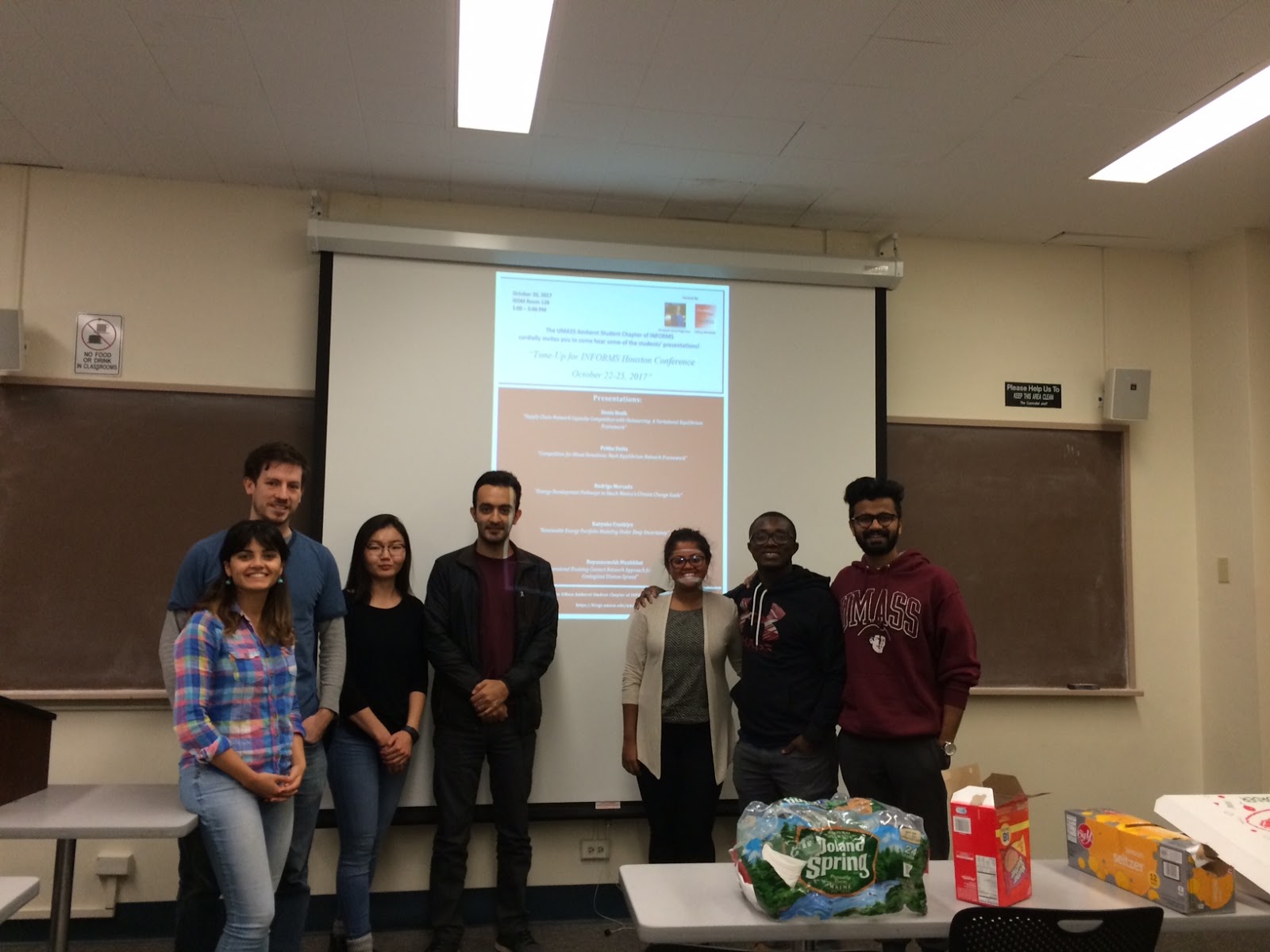
Since my cellphone was dying I apologize for not taking a photo of Professor Shorten and, instead, I share several photos below of the group of speakers, the group of Twitter users, and the females on Twitter!
Thanks, again, to the organizers, the guest speakers, and the terrific audience, for a fabulous idea-generating workshop!








 Posts
Posts