Showing posts with label congestion pricing. Show all posts

Friday, July 5, 2013

Congestion Pricing Works

I have been back in the US  for over a week now and miss the fresh, cooler air of Sweden.

Massachusetts has been sweltering but I refuse to install air conditioners in our home and we use the trees around our property for cooling (natural) along with some fans. I do not want to add to global warming.

Policies can also make a big impact on our environment and I have written two books that focus entirely on the subject: Environmental Networks (with K. K. Dhanda and P. Ramanujam, two former doctoral students of mine) and Sustainable Transportation Networks. Several other of my books also provide math models, analyses, and algorithms for environmental decision-making.

It is important to study policies analytically before implementation and my collaborators and I have written many papers on topics ranging from pollution permits, carbon taxes, to sustainable supply chains. In fact, we are presently finishing up a paper on competitive sustainable supply chains with examples from around the world. I am working with Professor Jonas Floden from Sweden and Professor Min Yu, who is a Professor at the University of Portland, but is spending part of the summer in China.

My passion is a clean, healthy environment, and that is one of the reasons that this year and last year I have been spending a lot of time in Sweden as a Visiting Professor at the School of Business, Economics and Law at the University of Gothenburg. My host there has been Professor Jonas Floden and a few weeks ago we were interviewed by a journalist, May Catherine O'Connor, who had traveled from San Francisco to Gothenburg to observe the imposed congestion pricing scheme in practice.

Mary Catherine, Jonas, and I had fabulous discussions on transportation and congestion pricing and the experiences in both Gothenburg and Stoickholm, capped with a lunch in Haga. Jonas and I had to indulge in the Swedish neatballs with ligonberries but Mary Catherine is a vegetarian so had a really nice fritatta.
Congestion pricing was instituted in the city of Gothenburg in January 2013 and I can personally see the difference in road traffic. The city was very proactive and instituted more frequent bus service, provided public transport passes to commuters for several weeks, and offered free parking in downtown on weekends. There are separate bus lanes to improve the flow of busses and, of course, numerous pedestrian lanes and bicycle lanes. I continue to marvel at how extremely fit the Swedes are and miss the hours of walking that I would do every day as just part of life -- even bringing groceries home by foot and walking to and from work.
Ms. O'Connor has now written a piece, Congestion pricing: Does it make cities more car-free?,   for SmartPlanet, which appeared yesterday, July 4th.


You can read her article here. 

I am very much looking forward to teaching my Transportation & Logistics class this fall at the Isenberg School of Management in which we discuss how tolls can be quantitatively formulated and then applied. Some of this classical work goes back to Stella Dafermos, who was my doctoral dissertation advisor at Brown University and the second female in the work to receive a PhD in Operations Research!

It is exciting to see analytics being put into practice to make a better planet for all of us!

And, for a set of lectures on transportation and logistics, including toll setting, please feel free to see my lectures on these topics.




Friday, June 7, 2013

Celebrating Sweden's National Day

Yesterday, was Sweden's National Day. In a sense, it is like the 4th of July in the US, but not quite, since the holiday only became an official holiday in 2005 and many of my colleagues here in Sweden have told me  that they are not quite used to it. Celebrating Midsommer is the big event here -- the beginning of summer!

But yesterday was simply gorgeous, and, clearly, the Swedes have started to celebrate their National Day in grand style, given that it was a day off from work (although many restaurants, to our surprise, were open here in Gothenburg).

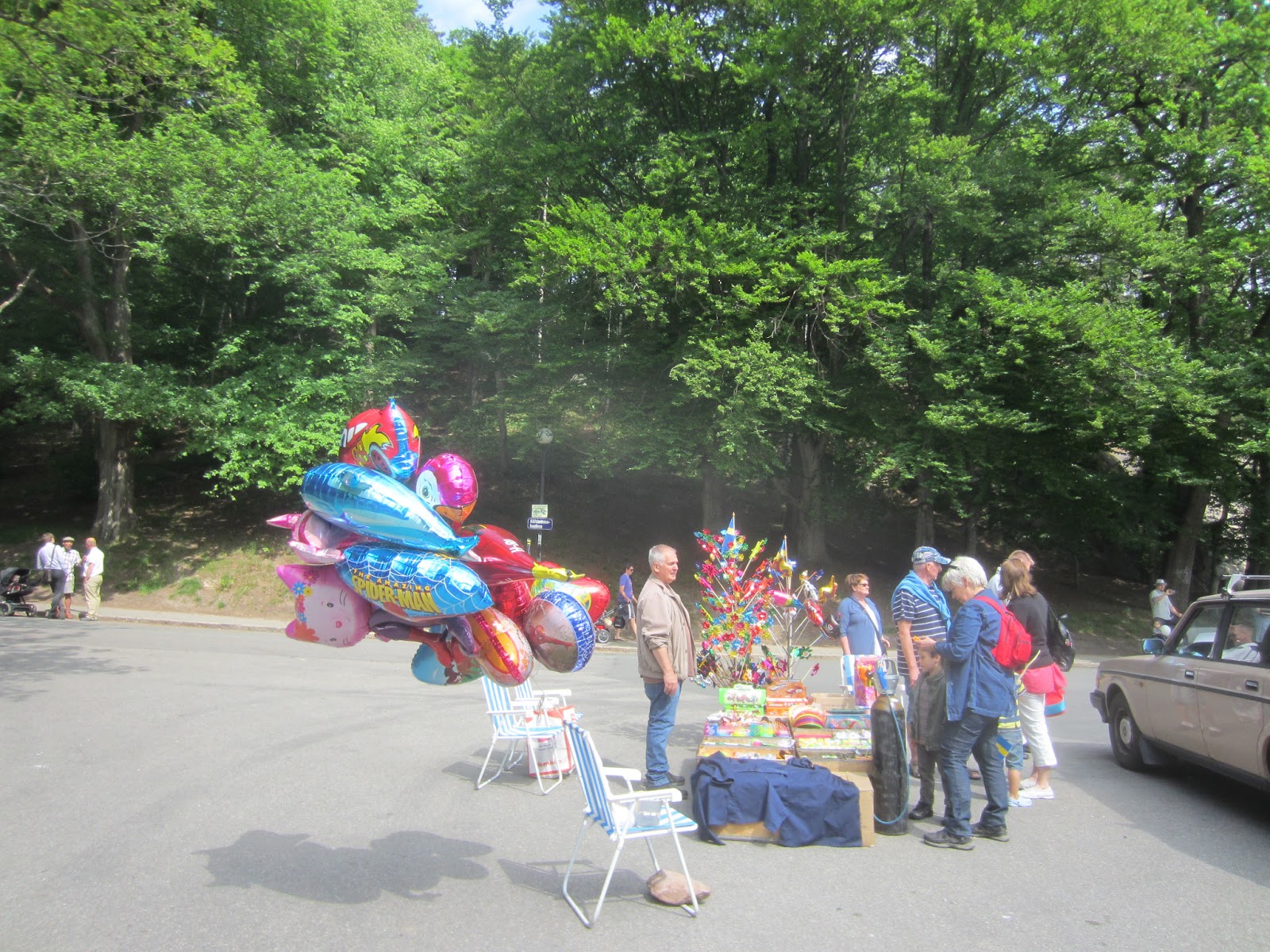
After getting (a lot of) work done and catching up after 3 days of logistics conferencing, we sauntered off to the grand park in Gothenburg, Slottsskogen, which, as the photos below depict, was filled with celebratory events and people enjoying themselves. I have been told that it is also a day that new citizens of Sweden especially appreciate. Thousands of new citizens were invited to the festivities in the park!

We did some flag-waving for Sweden and enjoyed the folks in native costumes, the bands, and the gorgeous greenery and smiling people of all ages.
 

I had messages from several Swedish colleagues last evening and we clearly all enjoyed the holiday very much. Some had ventured to the famous amusement park, which I have yet to go to.

Today, I will be talking to a journalist who heard me speak at The New York Times EnergyforTomorrow Conference on April 25, 2013 in NYC  on traffic and congestion pricing and a colleague will join me. This should be a very interesting conversation given the goings-on now in Gothenburg and transportation tolls!

Wednesday, March 20, 2013

Building Sustainable Cities and The New York Times Energy Conference

I am very excited about being a speaker at The New York Times EnergyForTomorrow Conference with the theme Building Sustainable Cities that will take place next month, April 25, 2013.
 

I will be speaking in the session on Transportation and Traffic.

The agenda is thrilling as are the speakers that will be taking part.  I will certainly be in great company!

I hope to bring an international perspective to the discussions on transportation and traffic given my experiences as an academic and as a globe trotter.

For  the past three weeks I have been back in Europe -- working as a Visiting Professor at the School of Business, Economics and Law at the University of Gothenburg and  living again in glorious Sweden, with a 4 day diversion in Vienna, Austria, where I lectured on perishable product supply chains in healthcare and also instructed an intensive short course Humanitarian Logistics and Healthcare.

The Nordic countries, and even Austria, are advancing their focus on sustainability and have implemented transportation policies that are working.

For example, Stockholm's congestion pricing scheme, which originated in January 2006,  has been deemed a success, as my colleagues at the Royal Institute of Technology (KTH) in Stockholm have shown rigorously in their published research.

Gothenburg, the second largest city in Sweden, just this past January instituted a congestion tax or toll and having been here in October and now,  I can see a concrete difference in term,s of the traffic reduction. My colleagues tell me how thousands of citizens who own cars were mailed coupons for free public transport for two weeks and have altered their travel behavior. More are coming into the center city to shop on weekends since there is free parking offered in certain parking garages and in the evenings.

Since I teach transportation and logistics (among other network-based courses) at the Isenberg School of Management,  tolls are a topic that I am very familiar with, especially since my dissertation advisor at Brown University, Professor Stella Dafermos, had contributed to the literature on this topic even back in the 1970s!
What a brilliant mind she had and the operations research community lost a female genius when she died at age 49.

While in Vienna,  I was impressed by the red and black trams/trolleys snaking through the city! Also, the parking charges there are so steep (and one can park on streets for only two hours) that many elect to take public transport instead -- using, typically, a combination of modes for commuting.

In fact, none of the students in my class in Vienna had driven a car that morning-- all had taken public transport, or had bicycled, or had walked to the university.

The photos below were taken in Gothenburg and demonstrate the different modes of transport that I (and many others) avail ourselves of. Without transportation there is no mobility and no logistics (just imagine  supply chains without transportation -- a topic of my previous post) -- it's not just about the network topologies but how our critical infrastructure is utilized!

The top photo was provided by one of my wonderful hosts, Professor Jonas Floden, who has also driven me in the above golf cart on the island where he lives and where cars are banned!

Tuesday, June 12, 2012

Carrots vs. Sticks to Reduce Traffic Congestion

I am sitting in my office at the School of Business, Economics and Law in Gothenburg, Sweden and am catching up on some reading before I head back to doing research.

In this city, the public transportation is outstanding and I have ridden the trams, ferries, and busses and, as someone who teaches and research transportation and logistics, frankly, I just enjoy seeing the multimodal traffic flow so well through the beautiful streets of this city (and the public transport is highly utilized).

I have also been told by my transport and logistics colleagues here at the University of Gothenburg that soon the city will be instituting congestion charging and it also plans on developing additional transport links to the periphery of the city so that the region grows economically.

Each year (while not on sabbatical) I teach a transportation & logistics course at the Isenberg School of Management at UMass Amherst and I enjoy teaching this class very much. Of course, one of the topics is tolls or congestion pricing.

There is an article in The New York Times, which quotes a bunch of researchers that I have cited, notably, Frank Kelly of the UK, who has also done some nice work on the Braess paradox. The article describes a recent $3 million transportation grant awarded to a Stanford researcher, Dr. Prabhakar, who is a computer scientist, and who, while stuck in traffic in India, came up with a system to offer incentives via a lottery for commuters to change their time of departure for a commute and then get, depending on the value, a financial reimbursement in one's paycheck. This system has now been implemented at Stanford and, given the competitive nature of employees there, it seems to be working quite well, reducing the commuting time from 25 minutes to 7 minutes, in some cases . However, whether it can scale up to a city such as NYC, for example, is questionable.

This reminds me of how I try to motivate students -- usually through carrots,  rather than sticks, although sometimes, albeit,  infrequently, the latter may have to be implemented but gently. Peer pressure also works well when it comes to motivating others towards hard work and success.

Given the technology for  Prabhakar's system, called Capri, Congestion and Parking Relief Incentives, which combines computer networks, smartphones, and travel behavior with economics, we are seeing another excellent example of supernetworks in action.  As for the acronym of his system, Capri, I was flooded by some remarkable memories of a computational economics conference that I spoke at a few years ago on that magical island of Capri, which entailed taking a taxi from Naples through a tunnel and then a hydrofoil, followed by a bus winding up and around the cliffs to the top, where the conference hotel was located, appropriately named, Annacapri.


Monday, October 3, 2011

Nobel prize "awarded" to a deceased scientist and deja vu

****** An Update to the Post Below***************************

The Nobel Prize committee has decided to have this year's prize in Medicine awarded to three, although Dr. Steinman passed away three days ago. According to the reading of the statutes the committee did not "knowingly" award the prize to a deceased individual.

The Nobel Committee issued a press release on the above.
The release stated:


The decision to award the 2011 Nobel Prize in Physiology or Medicine to the late Ralph Steinman shall remain unchanged, in keeping with the earlier announcement from the Nobel Assembly at Karolinska Institutet.

The events that have occurred are unique and, to the best of our knowledge, are unprecedented in the history of the Nobel Prize. In light of this, the Board of the Nobel Foundation has held a meeting this afternoon.

An interpretation of the purpose of this rule leads to the conclusion that Ralph Steinman shall be awarded the 2011 Nobel Prize in Physiology or Medicine.

According to the statutes of the Nobel Foundation, work produced by a person since deceased shall not be given an award. However, the statutes specify that if a person has been awarded a prize and has died before receiving it, the prize may be presented.


Original post, written this morning, is below.

Today, the announcement was made for the first of a series of Nobel prizes for 2011, and, eerily, Rockefeller University announced that Dr. Ralph Steinman, one of the three co-recipients of the 2011 Nobel prize in Medicine, which was announced today, had passed away three days ago on September 30. He had been suffering from pancreatic cancer for four years.

Now the Nobel prize committee has to determine what to do, since Nobel prizes are not awarded posthumously.

I have heard that some await the phone call from Stockholm in the wee hours of the morning and it is rather strange that the official announcement was made without first contacting/trying to reach Dr. Steinman.

I recall, back in 1996, when Dr. William Vickrey of Columbia was selected to receive the Nobel prize in Economic Sciences for his work on congestion pricing, work in transportation that I am quite familiar with and have also done research on.

Eerily, he suffered a heart attack three days after the announcement while driving to a conference in Boston. He had lived with his wife in Hastings-on-Hudson, which is next to Yonkers, where I "grew up." The Nobel was accepted on his behalf.

Saturday, August 13, 2011

Supernetwork Analytics -- Paying for the True Cost of Transportation and Negative Externalities


How many of us realize the true costs of the impact of our driving on others?

Of course, those of us who work on networks and transportation regularly compute costs of operating various systems (system-optimization) as opposed to figuring out which is the best route of travel from an origin to a destination (user-optimization). Typically, the costs that we consider in such applications reflect time or a monetarization of time and costs of fuel consumption and since the classical work of Beckmann, McGuire, and Winsten's (1956) book, "Studies in the Economics of Transportation," we also include congestion, which is a negative externality and what, in economics and beyond, refers to the negative impacts of one's activities.

Increasingly, we are also utilizing generalized costs, which, for example, can include other costs such as the emissions generated and many of us have worked on the price of anarchy, relevant to congested networks from transportation to the Internet.

What if there was a computerized financial and telecommunications system that could quantify the true cost of using our transportation networks? Such a system might actually provide a powerful feedback loop to alter individuals' driving behavior and might even motivate them to switch to more environmentally friendly modes of travel, such as public transportation, bicycles, or even one's feet.

While traveling recently in San Diego on, yes, 8 lane highways (each way), I was stunned by the passing on the right, on the left, but overall quite decent drivers although the wide spans of highways made me yearn for the northeast of the US (weather notwithstanding). There was limited public transit in sight and we spent 6 days there.

The Netherlands has begun an experiment, which demonstrates supernetworks (networks of networks) in action. Various vehicles, including cars, were installed with high technology to track vehicle movements in order to calculate not only the distance traveled, but also the fuel efficiency of the vehicle, the associated emissions, plus the expected "business" of the roads, as well as the wear and tear of the vehicle on the roads (very cool but more on this aspect later).

Other factors that I might include would be the number of passengers traveling (of course, the greater the number the greater impact on fuel consumption but a lightening of the congestion).

The New York Times reported on this experiment in a recent article, Netherlands Meter Plan Links Gas Pedals to Wallets, from Eindhoven, which, interestingly, is the location of a fellow research group on supernetworks, and our Virtual Center for Supernetworks is planning on hosting a visiting scholar from that group this Fall.

My research team has been working on sustainable transportation for many years now and in my Sustainable Transportation Networks book I describe many different policies to alleviate congestion and emission including marketable pollution permits, emission and congestion tolls, etc. The book is focused on transportation whereas our Environmental Networks book emphasizes models and algorithms to enhance sustainability on a macro scale.

Now for the clincher, as my students in transportation and logistics know, we can construct link tolls and they will always be nonnegative, but path tolls can be constructed that take on negative values (think of subsidies and one of my favorite ones is that children in strollers and their caretakers ride free on busses in Stockholm, Sweden, which I even took advantage of when we lived there with our daughter and the busses are so comfortable and handsome).

So, as someone who is extremely frustrated by the low quality of road infrastructure in the area of Massachusetts that I live in, would the government pay the vehicle operators for the wear and tear on their vehicles (plus their anatomies) if such a supernetwork system were to be installed in the US?

Infrastructure matters and with the right public and private partnerships we should be able to make the US a model for transportation and logistics but in whose lifetime?