Collaborations are great for science and they are also fun.
It is very rewarding when you work together on challenging problems that you are passionate about and get results.
One of my passions is sustainability and developing mathematical models using networks, optimization, and game theory to assess and analyze supply chains in a holistic manner both from cost and profit perspectives as well as from their environmental impacts.
With two great co-authors, Professor Jonas Floden of the School of Business, Economics and Law at the University of Gothenburg in Sweden and Professor Min Yu (an Isenberg PhD '12 in Management Science) of the Pamplin School of Business at the University of Portland in Oregon, the paper, "Supply Chain Network Sustainability Under Competition Frequencies of Activities from Production to Distribution," has now been completed. The paper, was inspired, in part, by my paper, "Design of Sustainable Supply Chains for Sustainable Cities," which is now available online in the journal, Environment & Planning B.
Now for the challenge: the deadline for submission of our new paper for a special of a journal was fast approaching. The theme of environmental applications for the journal special issue was inspired by the year 2013 having the theme Mathematics of Planet Earth.
I was back from Gothenburg, Swedem, where Professor Floden and I had numerous discussions on environmental sustainability, use of alternative transport modes, and various surveys and case studies in Sweden and Europe. Professor Yu was in China, having attended a conference on supply chains and visiting her family. Jonas and I were also interviewed by a journalist from San Franciscoon congestion pricing and the feature appeared on SmartPlanet.
We were literally communicating and working on our paper around the clock with a 6 hour time difference between ET (in the US) and Sweden and another 6 hour one between Sweden and China.
In the past two weeks, we have dealt with some major drama -- but the news is all good and we can breathe sighs of relief. Sichuan province, where Min was based for a while, has encountered the worst floods in 50 years and you may recall that it was also the location for the major earthquake in 2008.
In our paper, we not only capture competition among firms through their supply chain networks, and assume that they produce a differentiated product, but we also include frequencies of the various supply chain activities from production to storage to ultimate distribution to the demand markets. In addition, each firm weights its environmental emissions throughout it supply chain in an individual way. We focus on GHG emissions, especially carbon, but our framework is sufficiently general to also be applicable to emissions of particulate matter (PM). PMs have recently been the focus of much media attention due to their huge negative impact on air quality and human health from China to the United Kingdom and even the U.S.!
We allow for multiple options, which is especially relevant when firms have choices associated with transport models.
Our computations reveal that not only can reducing emissions be good for profits but choosing the right transport mode (intermodal, for example, or the right size truck) can reduce emissions. You may recall the milk run load paradox, discovered by one of the PhD students in Gthenburg, Niklas Arvidsson, that I have written about, which further shows that one needs to include the load (think flow in network parlance) to calculate emissions, as we do in our paper.
Our model can be applied to products in many industries from food and fast fashion to high technology products and demonstrates that a firm's smart action and wise choices in a highly competitive environment can be good for both business and the environment!
Showing posts with label transport. Show all posts
Showing posts with label transport. Show all posts
Friday, July 12, 2013
Friday, July 5, 2013
Congestion Pricing Works
I have been back in the US for over a week now and miss the fresh, cooler air of Sweden.
Massachusetts has been sweltering but I refuse to install air conditioners in our home and we use the trees around our property for cooling (natural) along with some fans. I do not want to add to global warming.
Policies can also make a big impact on our environment and I have written two books that focus entirely on the subject: Environmental Networks (with K. K. Dhanda and P. Ramanujam, two former doctoral students of mine) and Sustainable Transportation Networks. Several other of my books also provide math models, analyses, and algorithms for environmental decision-making.
It is important to study policies analytically before implementation and my collaborators and I have written many papers on topics ranging from pollution permits, carbon taxes, to sustainable supply chains. In fact, we are presently finishing up a paper on competitive sustainable supply chains with examples from around the world. I am working with Professor Jonas Floden from Sweden and Professor Min Yu, who is a Professor at the University of Portland, but is spending part of the summer in China.
My passion is a clean, healthy environment, and that is one of the reasons that this year and last year I have been spending a lot of time in Sweden as a Visiting Professor at the School of Business, Economics and Law at the University of Gothenburg. My host there has been Professor Jonas Floden and a few weeks ago we were interviewed by a journalist, May Catherine O'Connor, who had traveled from San Francisco to Gothenburg to observe the imposed congestion pricing scheme in practice.
Mary Catherine, Jonas, and I had fabulous discussions on transportation and congestion pricing and the experiences in both Gothenburg and Stoickholm, capped with a lunch in Haga. Jonas and I had to indulge in the Swedish neatballs with ligonberries but Mary Catherine is a vegetarian so had a really nice fritatta.

 Congestion pricing was instituted in the city of Gothenburg in January 2013 and I can personally see the difference in road traffic. The city was very proactive and instituted more frequent bus service, provided public transport passes to commuters for several weeks, and offered free parking in downtown on weekends. There are separate bus lanes to improve the flow of busses and, of course, numerous pedestrian lanes and bicycle lanes. I continue to marvel at how extremely fit the Swedes are and miss the hours of walking that I would do every day as just part of life -- even bringing groceries home by foot and walking to and from work.
 Ms. O'Connor has now written a piece, Congestion pricing: Does it make cities more car-free?, for SmartPlanet, which appeared yesterday, July 4th.
You can read her article here.
I am very much looking forward to teaching my Transportation & Logistics class this fall at the Isenberg School of Management in which we discuss how tolls can be quantitatively formulated and then applied. Some of this classical work goes back to Stella Dafermos, who was my doctoral dissertation advisor at Brown University and the second female in the work to receive a PhD in Operations Research!
It is exciting to see analytics being put into practice to make a better planet for all of us!
And, for a set of lectures on transportation and logistics, including toll setting, please feel free to see my lectures on these topics.
Massachusetts has been sweltering but I refuse to install air conditioners in our home and we use the trees around our property for cooling (natural) along with some fans. I do not want to add to global warming.
Policies can also make a big impact on our environment and I have written two books that focus entirely on the subject: Environmental Networks (with K. K. Dhanda and P. Ramanujam, two former doctoral students of mine) and Sustainable Transportation Networks. Several other of my books also provide math models, analyses, and algorithms for environmental decision-making.
It is important to study policies analytically before implementation and my collaborators and I have written many papers on topics ranging from pollution permits, carbon taxes, to sustainable supply chains. In fact, we are presently finishing up a paper on competitive sustainable supply chains with examples from around the world. I am working with Professor Jonas Floden from Sweden and Professor Min Yu, who is a Professor at the University of Portland, but is spending part of the summer in China.
My passion is a clean, healthy environment, and that is one of the reasons that this year and last year I have been spending a lot of time in Sweden as a Visiting Professor at the School of Business, Economics and Law at the University of Gothenburg. My host there has been Professor Jonas Floden and a few weeks ago we were interviewed by a journalist, May Catherine O'Connor, who had traveled from San Francisco to Gothenburg to observe the imposed congestion pricing scheme in practice.
Mary Catherine, Jonas, and I had fabulous discussions on transportation and congestion pricing and the experiences in both Gothenburg and Stoickholm, capped with a lunch in Haga. Jonas and I had to indulge in the Swedish neatballs with ligonberries but Mary Catherine is a vegetarian so had a really nice fritatta.


You can read her article here.
I am very much looking forward to teaching my Transportation & Logistics class this fall at the Isenberg School of Management in which we discuss how tolls can be quantitatively formulated and then applied. Some of this classical work goes back to Stella Dafermos, who was my doctoral dissertation advisor at Brown University and the second female in the work to receive a PhD in Operations Research!
It is exciting to see analytics being put into practice to make a better planet for all of us!
And, for a set of lectures on transportation and logistics, including toll setting, please feel free to see my lectures on these topics.


Saturday, May 18, 2013
Tips on Publishing Journal Articles -- PhD Workshop
I have been busy preparing a series of presentations that I will be giving soon in Europe.
The first one I will deliver on June 3, 2013 at the School of Business, Economics and Law at the University of Gothenburg in Sweden.
 My presentation is entitled: Reflections of an Experienced Researcher on Presenting and Publishing Quantitative Research, and it is one of several presentations that will be given at the Nordlog Doctoral Workshop as part of the 25th NOFOMA Conference, Gothenburg, Sweden.
The full list of invited speakers is below:
Some Background Where Do Research Ideas Come From?
What is Your Philosophy of Research?
What About Collaboration?
What About Writing a Publishable Paper?
Why the Hard Work is Worth It
Some Final Points.

In my presentation, I will also discuss some of the competitive challenges associated with journal publishing from the point of journal article supply and demand (and hope) of authors for publication.
 I will also provide strategies for journal selection, revising a paper, etc., and emphasize that one should never give up hope if you believe in your work and to keep at it. This was a topic of a previous post of mine -- thanks to all of you who wrote me that you very much appreciated this blogpost.
The montage below has photos of several Nobel laureates in Economic Sciences who had their papers rejected and some of the very same papers, after they were eventually published, became classics. And there are others with the same experiences!
 Of the above laureates, I had met Paul Samuelson when I was at MIT as a Visiting Professor and Scholar over a 2 year period and I met Harry Markowitz in an elevator at an INFORMS Conference. Kenneth Arrow I had met at a workshop at Stanford University at which my dissertation advisor, Stella Dafermos, also took part. As for Paul Krugman, I enjoy his writings, including his OpEds in The New York Times and our points of additional intersections include that he is an RSAI Fellow, and so am I.
The PhD Workshop should be very interesting and fun, since we are even instructed to bring swimsuits and a towel for a sauna event in the evening!
The first one I will deliver on June 3, 2013 at the School of Business, Economics and Law at the University of Gothenburg in Sweden.

The full list of invited speakers is below:
- Dr. Alex Ellinger, editor of the Journal of Physical Distribution and Logistics Management
- Professor Anna Nagurney, University of Massachusetts Amherst
- Professor Michael Browne, University of Westminster
- Professor Patrik Jonsson, Chalmers University of Technology.
Some Background Where Do Research Ideas Come From?
What is Your Philosophy of Research?
What About Collaboration?
What About Writing a Publishable Paper?
Why the Hard Work is Worth It
Some Final Points.

In my presentation, I will also discuss some of the competitive challenges associated with journal publishing from the point of journal article supply and demand (and hope) of authors for publication.
The montage below has photos of several Nobel laureates in Economic Sciences who had their papers rejected and some of the very same papers, after they were eventually published, became classics. And there are others with the same experiences!

The PhD Workshop should be very interesting and fun, since we are even instructed to bring swimsuits and a towel for a sauna event in the evening!
Saturday, April 27, 2013
Sustainability is Sustainable and Good for Business, Our Health, Our World
I returned a short while ago from NYC where yesterday I took part in an extraordinary conference -- The New York Times 2013 Energy for Tomorrow Conference.

The full agenda of the conference can be accessed directly here.
It was an intellectual feast that brought together mayors, an Academy Award winner, thought leaders, scientists, environmentalists, investors, policy makers, and decision-makers, corporate employees from IBM to Google, as well as a farmer/former NBA player/MacArthur Fellow -- and these were just some of the speakers. In the audience, I met a colleague from Cornell (now retired), a diplomat from the Chinese embassy in DC, a Georgia Tech professor, numerous journalists from as far as Singapore, affordable housing advocates, urban planners, students, a researcher at MIT, head of the electric vehicle taxi program for NYC, and a financier in private equity, to single out just a few.
The conference began with a stimulating breakfast session (the food was good, too) on smart vehicles, but time was too short for me to be able to ask the question that I had -- what about cybersecurity issues in this product domain? I was thrilled that even operations research was mentioned -- indeed, where would transport studies be without OR?!
Mayor Michael Bloomberg of NYC, who needs no introduction, was introduced by Arthur Sulzberger Jr., the publisher of The New York Times, and both were absolutely brilliant.

With the paralysis in Washington (Congress) regarding environmental action, mayors and cities are leading the way. This is the first truly urban century and cities have to (and many are) taking action. We must unlock human creativity and take actions to mitigate risk. Mayor Bloomberg chairs the C40 group, which actually consists of 60 cities.
Mayor Bloomberg had 4 major points with the first one being that one must develop a plan with goals and metrics -- you have to be able to measure. He has done much to improve air quality and water quality and, along with the Sierra Club, has been instrumental in retiring many coal-fired power plants.
750,000 trees have been planted in NYC with a goal of planting 1 million and he gave credit also to Bette Midler.
He noted how sustainability provides good economic value -- being environmentally friendly improves your brand and helps in recruiting -- vibrant, smart employees want to work in places where they can breathe clean air!
He mentioned how he, with Al Gore (former VP and of the An Inconvenient Truth fame), climbed up on a rooftop and painted it white -- with white rooftops reducing energy costs by 20% -- a quick payback.
He also emphasized private-public partnerships -- closing roads to traffic -- something I have written about, spoken about, and even been interviewed on, and how we should be stealing the best ideas in terms of transport and sustainability from around the world.
What really intrigued me is when he said that China will become a leading environmentalist in the next 10 years He, as several others yesterday, emphasized resiliency and that we must prepare for extreme events. Hurricane Sandy was noted several times during the conference.
The next panel was the Mayors panel and the panelists were engaging, and very entertaining with one of my favorite quotes being "cars are the next cigarettes." The theme that people will vote with their feet (want to live and work in a sustainable location) continued.

We were then treated to a conversation between Andrew Revkin and Jeremy Irons, who has garnered not only an Academy Award, but numerous other awards for his acting. His passion for the environment resonated as did his eloquence. The night before the conference, the movie Trashed, which he was the Executive Producer of, was screened, and more info on what is being done to our globe because of garbage can be found here. He noted that he is using the actor's power to address important problems and even emphasized electronic recycling and packaging -- his knowledge impressed me. He noted that a film can inject a feeling of purpose. He also emphasized that it is about education and that industry should prove that what it is making is 100% safe. Since my research group does a lot of work on sustainable supply chains his message was near and very dear to me. Coincidentally, Revkin is a fellow Brown University grad and I heard him deliver the Daffodil Lecture at UMass a while back.

Thomas L. Friedman of The New York Times then led a panel on renewable energy with experts from the US and abroad, including the CEO of ConEd, Kevin Burke. Joe Nocera, also of The New York Times, followed with a panel on the role of technology and innovation and I was especially moved by Stephen Kennedy Smith, who spoke on agribusiness and urban food supply. I managed to talk with him later and mentioned that when I got my PhD from Brown his nephew, John F. Kennedy Jr., received his undergraduate degree. There are also other school ties which I noted.

During lunch, we ate (a very healthy spread) and discussed the urban food supply and since one of my most recent papers was on competitive food supply chains (with Min Yu), which was published in the European Journal of Operational Research, this topic was mesmerizing. Will Allen, the Renaissance man -- farmer and MacArthur Fellow, regaled us with his work in inner cities and urban farms.
I had to then take off since it was time to get ready for the Transport and Traffic panel that I was speaking at, which was moderated by Joe Nocera, and I had terrific company!
Below are several of my fellow panelists as we get ready in the "Green" room which actually had a red door.

The day concluded with breakout sessions in which we brainstormed and a closing session Dealbook: Investing in the city of tomorrow -- provocative and timely.

Prior to that we also got to hear Bill Keller of The Times in conversation with Carol Browner -- the former energy czar. She also spoke about resilience and noted the importance of physical infrastructure, nature, and communities -- simply fabulous

The conference was videostreamed and you can access the videos of the various panels on the conference website. The Transport and Traffic panel that I was part of can be accessed directly here.
I had to bring in the Braess paradox into the conversation as well as congestion charging and transport congestion policies dating back to Roman times -- when chariots were the problem!
And I could not resist posting photos below taken of me with Professor Richard Schuler, professor emeritus of Cornell, and of Dr. Yajun Fang of MIT taken at the reception at the end of a very exciting day. Professor Schuler is the academic father of Professor Ben Hobbs of Hopkins, an INFORMS Fellow.


New York City was as vibrant, exciting, and stunning as always and I share with you the additional photos that I took while walking as a very happy pedestrian in NYC!


And, on the way back to Massachusetts, via Amtrak on the Vermonter, as I strolled back to the dining car for a cup of tea I heard a greeting --"Hello, Anna!" and it was one of my favorite Isenberg School of Management colleagues, Professor Glenn Wong, of sports law and sports management fame.

The full agenda of the conference can be accessed directly here.
It was an intellectual feast that brought together mayors, an Academy Award winner, thought leaders, scientists, environmentalists, investors, policy makers, and decision-makers, corporate employees from IBM to Google, as well as a farmer/former NBA player/MacArthur Fellow -- and these were just some of the speakers. In the audience, I met a colleague from Cornell (now retired), a diplomat from the Chinese embassy in DC, a Georgia Tech professor, numerous journalists from as far as Singapore, affordable housing advocates, urban planners, students, a researcher at MIT, head of the electric vehicle taxi program for NYC, and a financier in private equity, to single out just a few.
The conference began with a stimulating breakfast session (the food was good, too) on smart vehicles, but time was too short for me to be able to ask the question that I had -- what about cybersecurity issues in this product domain? I was thrilled that even operations research was mentioned -- indeed, where would transport studies be without OR?!
Mayor Michael Bloomberg of NYC, who needs no introduction, was introduced by Arthur Sulzberger Jr., the publisher of The New York Times, and both were absolutely brilliant.
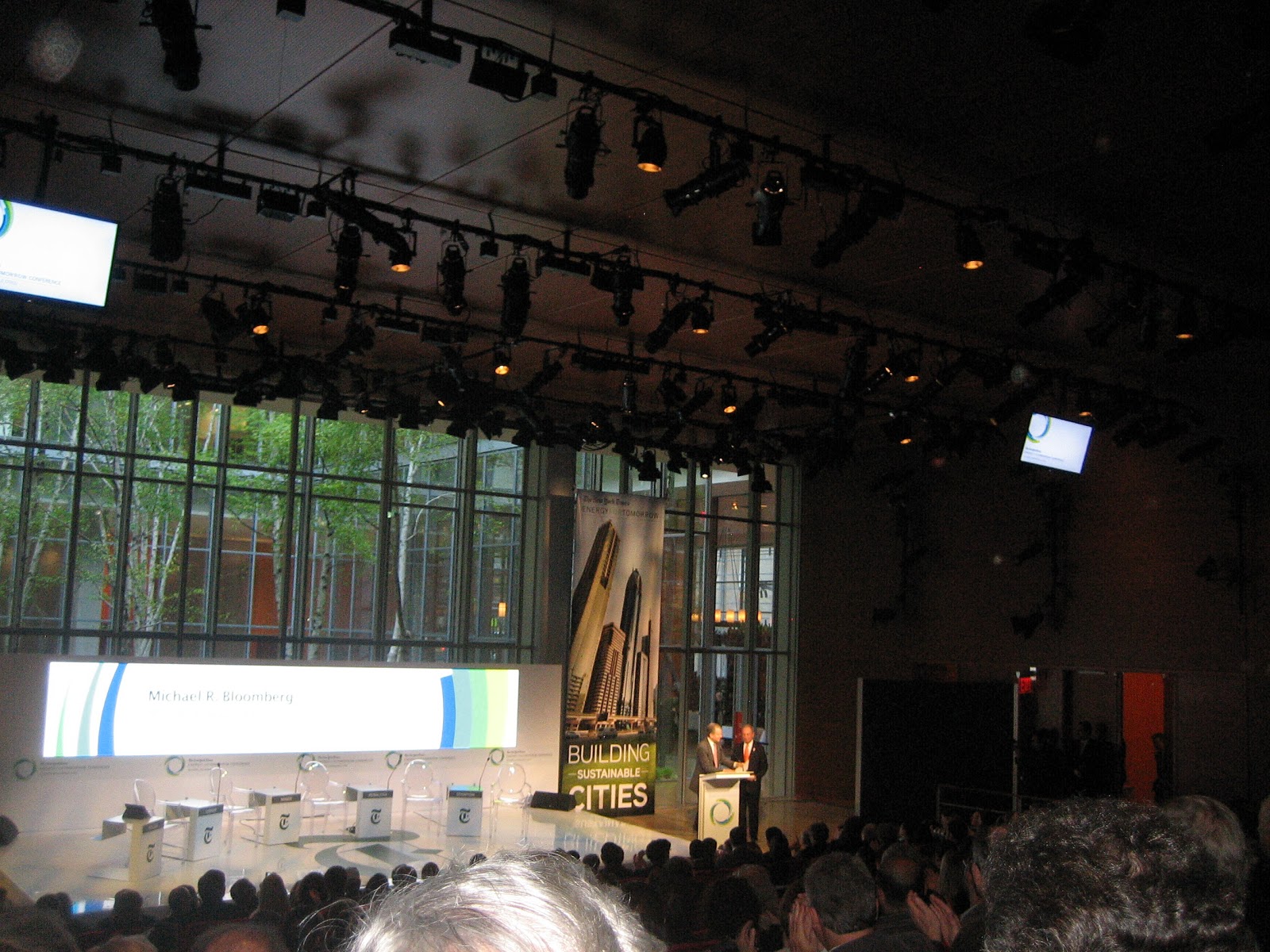
With the paralysis in Washington (Congress) regarding environmental action, mayors and cities are leading the way. This is the first truly urban century and cities have to (and many are) taking action. We must unlock human creativity and take actions to mitigate risk. Mayor Bloomberg chairs the C40 group, which actually consists of 60 cities.
Mayor Bloomberg had 4 major points with the first one being that one must develop a plan with goals and metrics -- you have to be able to measure. He has done much to improve air quality and water quality and, along with the Sierra Club, has been instrumental in retiring many coal-fired power plants.
750,000 trees have been planted in NYC with a goal of planting 1 million and he gave credit also to Bette Midler.
He noted how sustainability provides good economic value -- being environmentally friendly improves your brand and helps in recruiting -- vibrant, smart employees want to work in places where they can breathe clean air!
He mentioned how he, with Al Gore (former VP and of the An Inconvenient Truth fame), climbed up on a rooftop and painted it white -- with white rooftops reducing energy costs by 20% -- a quick payback.
He also emphasized private-public partnerships -- closing roads to traffic -- something I have written about, spoken about, and even been interviewed on, and how we should be stealing the best ideas in terms of transport and sustainability from around the world.
What really intrigued me is when he said that China will become a leading environmentalist in the next 10 years He, as several others yesterday, emphasized resiliency and that we must prepare for extreme events. Hurricane Sandy was noted several times during the conference.
The next panel was the Mayors panel and the panelists were engaging, and very entertaining with one of my favorite quotes being "cars are the next cigarettes." The theme that people will vote with their feet (want to live and work in a sustainable location) continued.

We were then treated to a conversation between Andrew Revkin and Jeremy Irons, who has garnered not only an Academy Award, but numerous other awards for his acting. His passion for the environment resonated as did his eloquence. The night before the conference, the movie Trashed, which he was the Executive Producer of, was screened, and more info on what is being done to our globe because of garbage can be found here. He noted that he is using the actor's power to address important problems and even emphasized electronic recycling and packaging -- his knowledge impressed me. He noted that a film can inject a feeling of purpose. He also emphasized that it is about education and that industry should prove that what it is making is 100% safe. Since my research group does a lot of work on sustainable supply chains his message was near and very dear to me. Coincidentally, Revkin is a fellow Brown University grad and I heard him deliver the Daffodil Lecture at UMass a while back.

Thomas L. Friedman of The New York Times then led a panel on renewable energy with experts from the US and abroad, including the CEO of ConEd, Kevin Burke. Joe Nocera, also of The New York Times, followed with a panel on the role of technology and innovation and I was especially moved by Stephen Kennedy Smith, who spoke on agribusiness and urban food supply. I managed to talk with him later and mentioned that when I got my PhD from Brown his nephew, John F. Kennedy Jr., received his undergraduate degree. There are also other school ties which I noted.

During lunch, we ate (a very healthy spread) and discussed the urban food supply and since one of my most recent papers was on competitive food supply chains (with Min Yu), which was published in the European Journal of Operational Research, this topic was mesmerizing. Will Allen, the Renaissance man -- farmer and MacArthur Fellow, regaled us with his work in inner cities and urban farms.
I had to then take off since it was time to get ready for the Transport and Traffic panel that I was speaking at, which was moderated by Joe Nocera, and I had terrific company!
Below are several of my fellow panelists as we get ready in the "Green" room which actually had a red door.

The day concluded with breakout sessions in which we brainstormed and a closing session Dealbook: Investing in the city of tomorrow -- provocative and timely.

Prior to that we also got to hear Bill Keller of The Times in conversation with Carol Browner -- the former energy czar. She also spoke about resilience and noted the importance of physical infrastructure, nature, and communities -- simply fabulous

The conference was videostreamed and you can access the videos of the various panels on the conference website. The Transport and Traffic panel that I was part of can be accessed directly here.
I had to bring in the Braess paradox into the conversation as well as congestion charging and transport congestion policies dating back to Roman times -- when chariots were the problem!
And I could not resist posting photos below taken of me with Professor Richard Schuler, professor emeritus of Cornell, and of Dr. Yajun Fang of MIT taken at the reception at the end of a very exciting day. Professor Schuler is the academic father of Professor Ben Hobbs of Hopkins, an INFORMS Fellow.


New York City was as vibrant, exciting, and stunning as always and I share with you the additional photos that I took while walking as a very happy pedestrian in NYC!


And, on the way back to Massachusetts, via Amtrak on the Vermonter, as I strolled back to the dining car for a cup of tea I heard a greeting --"Hello, Anna!" and it was one of my favorite Isenberg School of Management colleagues, Professor Glenn Wong, of sports law and sports management fame.
Wednesday, April 24, 2013
The New York Times Energy for Tomorrow Conference

This week is Earth Week and tomorrow, in NYC, The New York Times is hosting the 2013 Energy for Tomorrow Conference with the theme Building Sustainable Cities. I am very much looking forward to taking part in this event and hearing experts on energy, sustainable buildings, urban food supply, technology, and transport and traffic speak and discuss how we, together, can achieve more livable cities in this century.
I will be part of the discussion on Transport and Traffic moderated by The New York Times OpEd columnist, Joe Nocera. The other speakers in my session are:
Walter Hook, president, Institute for Transportation and Development Policy,
Peder Jensen, head of programme, governance and networks, European Environment Agency,
Naveen Lamba, intelligent transportation lead, IBM, and
Janette Sadik-Khan, NYC transportation commissioner.
I plan on discussing the (in)famous Braess paradox in which the addition of a new road may make all travelers/drivers in the network worse off in terms of an increase in travel time as well as the milk run freight paradox, where increasing the load factor (as often used by policy-makers as a means of improving freight efficiency), under certain conditions, can increase total costs and total emissions. The latter was discovered by Niklas Arvidsson, a doctoral student at the School of Business, Economics and Law, where I hold a Visiting Professorship (as part of my sabbatical this year from the Isenberg School of Management at UMass Amherst).
I will also be highlighting the importance of supply chains and city logistics for sustainable cities. This is a topic that I am passionate about and my most recent accepted paper, "Design of Sustainable Supply Chains for Sustainable Cities," is in press in the journal, Environment & Planning B.
The full agenda of the energy conference can be viewed here.
Subscribe to:
Posts (Atom)

 Posts