Showing posts with label congestion. Show all posts

Saturday, June 7, 2025

Our Latest Paper on Multicommodity Trade of Fresh Produce with a Case Study on Bananas Is Now Published!

I am thrilled that the paper, "Multicommodity Fresh Produce Trade Networks with Quality Deterioration Under Congestion and Transportation Capacities," that I co-authored with Deniz Besik of the University of Richmond is now published in the Journal of Global Optimization! Plus, the paper is published open access and can be read and downloaded on the link: https://link.springer.com/article/10.1007/s10898-025-01507-3.

Deniz presented this paper last year at the EURO Conference in Copenhagen:


The paper contains a very interesting case study on bananas, the most widely traded fruit globally, and demonstrates the impacts on fresh produce quality of transportation disruptions and delays. The work was inspired by recent challenges to transportation on the Panama Canal because of insufficient water, leading to congestion. The paper shows that because of negative transportation impacts, consumers may pay higher prices for bananas of lower quality. 

Deniz will present this paper at the 2025 Commodity and Energy Markets Association Annual Meeting (CEMA) in Houston in a few days, as I head to the EURO Conference in Leeds, United Kingdom, where I have three invited talks!

This was another outstanding collaboration of ours on a highly relevant topic.

Friday, October 23, 2015

Fabulous Launch of Forecasting Urban Travel Book at Northwestern University

I arrived today from Chicago, after taking part yesterday in the launch of the new book, "Forecasting Urban Travel,"  co-authored by Professors David Boyce and Huw Williams, and recently published by Edward Elgar.

The event took place at the Northwestern University library in the stunning Ver Steeg Faculty Lounge. The wonderful master of ceremonies was Professor Hani S. Mahmassani, who is the Director of Northwestern's Transportation Center.


I had the great honor of being one of the three panelists. When I received the invitation, I had to say "yes!" David Boyce I respect tremendously. He has been a mentor and dear friend for many years. He is an INFORMS Fellow, an RSAI Fellow, and a recipient of the Robert Herman Lifetime Achievement Award in Transportation Science.  I have been with David at numerous conferences and professional events in the US, Canada, Sweden, and even Russia.

The day began with a luncheon at the Norris University Center in a room with the spectacular views below (including one of the new Kellogg Business School Building under construction).
The below photos were taken at the luncheon and Professor Huw Williams had traveled from Wales with his wife for this special event.

The Ver Steeg Room is gorgeous, complete with an oil painting and was the perfect venue to celebrate the publication of this book, which, in my remarks, I called a masterpiece of scholarship.
Professor Hani S. Mahmassani welcomed the attendees and congratulated the authors.
The Dean of Libraries and the Transportation Librarian had opening remarks at the book launch. Below they are standing with Professor David Boyce.
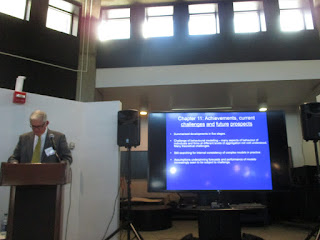
Then it was time for Professors Boyce and Williams to highlight the contributions in their over 600 page magnum opus. Boyce and Williams did a terrific job, each describing the specific chapters that he was responsible for.  I had read and reread the book and enjoyed very much hearing from the authors their intellectual  journey that resulted in the book's publication. According to Boyce, the genesis took place in Williams' garden in Cardiff, Wales, in 2003, when Boyce visited him, after they had completed a paper on forecasting urban travel, from both US and UK perspectives. Huw said to David that the paper should be expanded into a book. Much of the work over a ten year span took place collaboratively over the Internet.

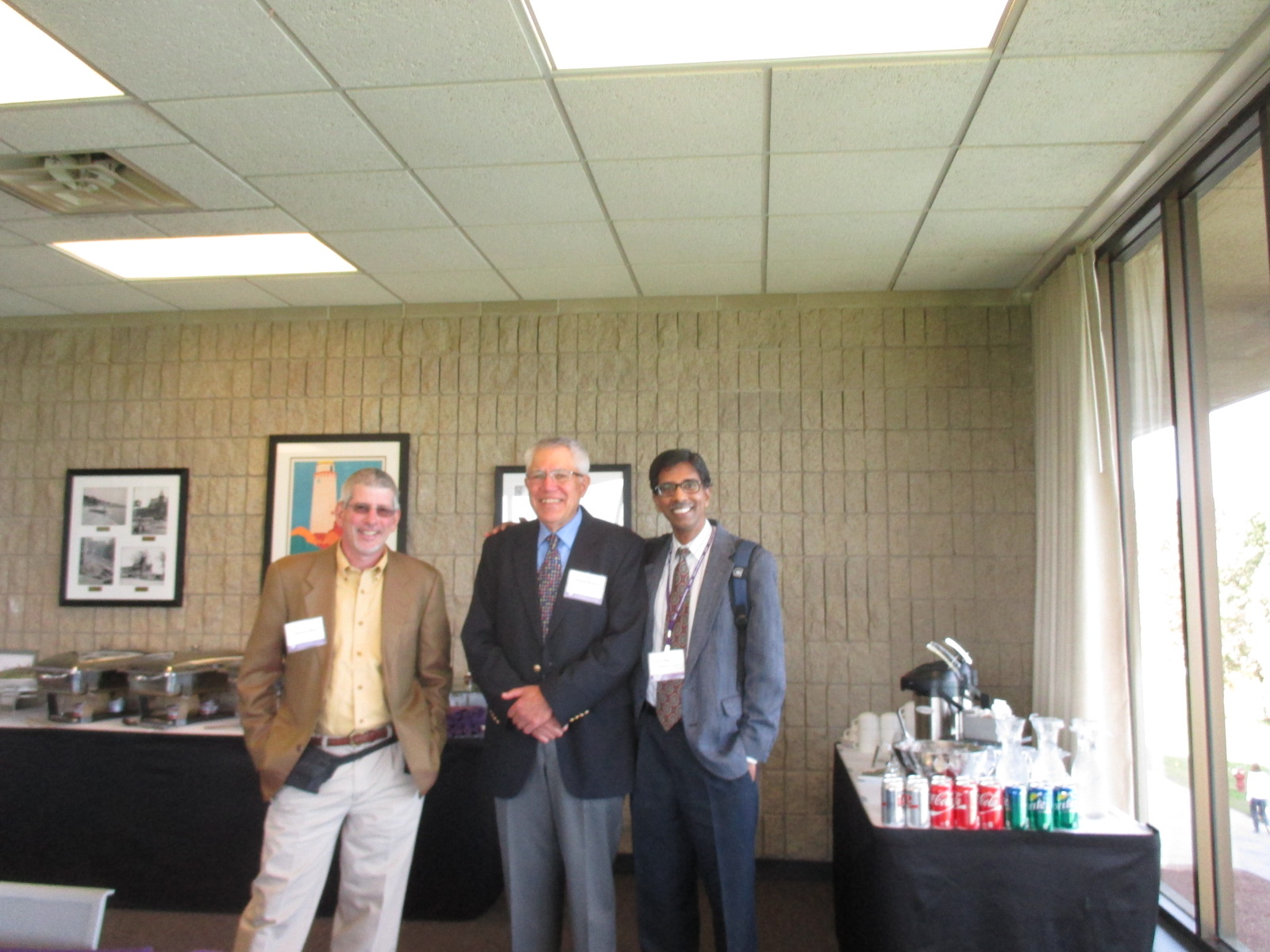
After the highlights of the 12 chapters had been presented we had a break and then it was time for the panelists. I enjoyed the mix of academics with a practitioner. Professor Ram Pendyala of Georgia Tech and Kermit Wies, former Deputy Executive Director, Chicago Metropolitan Agency for Planning, were my fellow panelists.

Below is a photo of the authors and panelists with Professor Mahmassani.

 My full presentation can be viewed here.  One of my favorites chapters in the book is Chapter 7 on Transportation Network Equilibrium.

The Q&A part was terrific with questions ranging from which was our favorite travel forecasting software, to questions about freight transportation, to issues surrounding acquisition of data.
 
Then it was time for a reception. The crabcakes were delicious and I had had some just the previous Friday at Legal Seafoods in Boston where I spoke at the ACEC conference.
The discussions at the reception were absolutely delightful and it was great to meet Professor Ken Small and to see Professor Marco Nie again, and even Paul Slater.

In my remarks,  I emphasized the deep scholarship behind this book and the history of the field. Also, in reading it, I remembered so many contributors so it was quite a  nostalgic walk down Memory Lane.  Boyce has always been one who welcomed new researchers into the field and has tirelessly guided and nurtured scholars, building bridges with practice. The following collage, which I included in my presentation emphasized the importance of people in the forecasting urban travel field and, I might add, the great friendships that have been made over the years. My dissertation advisor at Brown University, Dr. Stella Dafermos, is in the top left corner photo. She was the second female PhD in Operations Research in the world. Many in the photo collage below are noted in the book. Over 100 people reviewed chapters in the book.

The book takes on on a trip of 60 years over space and time. It already is a classic.

The paperback version should be available in 2016 Boyce told us.

We ended the perfect day with a delicious dinner, hosted by Hani S. Mahmassani at the Stained Glass restaurant  in Evanston.  The photo below taken by a waiter did not come out well but the memories will stay with us for forever.
The dessert (3 types of creme brulee was even better than it looks below!)
Many thanks to Boyce and Williams for a book that will be read by future generations of students, faculty, and transportation practitioners as well, I am sure, urban planners. Thank you also for helping to build such a special community!

Finally, congratulations!!!!


Friday, December 26, 2014

Looking Forward to New Book, Forecasting Urban Travel, by Boyce and Williams

I heard from my great colleague and friend, Professor David E. Boyce, who forwarded me his holiday letter that the book that he has been immersed in writing, with Professor Huw Williams, Forecasting Urban Travel: Past Present and Future, is in the final stages of production with the publisher, Edward Elgar.

On the book cover, featured above, are images of two of David's favorite cities, Chicago and Singapore. The book should be available for purchase in April 2015 from www.e-elgar.com/. Initially, it will be offered in hardcover and e-book formats. Within a year, according to David, a lower-priced paperback edition will then be issued. Finally, a Chinese translation is underway, which is quite exciting!

According to a news item published in the TSL (Transportation Science and Logistics Society) of INFORMS Fall 2014 newsletter, which we received just last week: The book presents, in a non-mathematical way the evolution of methods, models and theories underpinning travel forecasts and policy analysis, from the urban transportation studies of the 1950s to current applications throughout the urbanized world. From original documents, correspondence and interviews, especially from the United States and the United Kingdom, the authors seek to capture the spirit and problems faced in different eras, as changing information requirements, computing technology and planning objectives conditioned the nature of forecasts.

I have had the pleasure of seeing Chapter 7 of the book, which is on Transportation Network Equilibrium, which David asked me to provide feedback on, which was a pleasure to do, since it was like a trip down memory lane, during which I reminisced about the contributions of my doctoral dissertation advisor at Brown University, Professor Stella Dafermos, and her amazing contributions. It was also a pleasure to read and reflect on the work that we did jointly prior to her death.

I am sure that this book will be a classic in transportation science as well as the history of travel forecasting and am very much looking forward to its publication in the spring of 2015. Chapter 7, alone, is worth the price of the book, since there is a very human aspect to the rendition of discoveries therein and the individuals involved.

The contents of the book below are from the publisher's website:

Contents
Contents: Preface 1. Introduction 2. Emergence of the Traditional Approach 3. Early Developments in the UK 4. Travel Forecasting based on Discrete Choice Models, I 5. Travel Forecasting based on Discrete Choice Models, II 6. Activity-Based Travel Analysis and Forecasting 7. Transportation Network Equilibrium 8. Tradition and Innovation in US Practice 9. Tradition and Innovation in UK Practice 10. Computing Environment and Travel Forecasting Software 11. Achievements, Current Challenges and Future Prospects 12. Conclusion Index

Friday, July 11, 2014

Living in a Nonlinear World

This past week there have been two big events marking milestones in the lives of major contributors to our understanding of nonlinear phenomena - one very sad and one happy.

I heard the sad news via a tweet by Professor Laura McLay @lauramclay - Professor Harold Kuhn of Princeton University passed away on July 2, 2014 at the age of 88.  The Nobel laureate Al Roth of Stanford wrote this tribute to this co-founder of nonlinear programming and brilliant game theorist, who, interestingly, was a mathematician but had an appointment in Princeton's Economics Department.
Photo above of Harold Kuhn, courtesy of Princeton University

Anyone working, on, researching, or learning about our nonlinear world is aware of the powerful tool of nonlinear programming and the renowned Kuhn-Tucker optimality conditions, now commonly referred to as the Karush-Kuhn-Tucker or KKT Theorem. Dick Cottle of Stanford wrote a wonderful history of these scientific discoveries which can be read here.

Although I never met Karush, Kuhn or Tucker, my first academic interview when I was finishing my PhD in Applied Math at Brown with a specialization in Operations Research, was at SUNY Stony Brook, and I was interviewed by Al Tucker's son, Al Tucker, Jr., so, of course, we talked about his father. Al Tucker passed away in 1995.

This very same week, on July 5, 2014 we celebrated the 90th birthday of Professor Martin Beckmann, the only surviving author of the classic 1956 book, Studies in the Economics of Transportation, who was on my doctoral dissertation committee at Brown University.

I wrote about Beckmann's milestone birthday on this blog and sent his a special card. More information on this classic, including a special festchrift I organized at a previous INFORMS conference in San Francisco can be viewed here.
 The photo above was taken of Beckmann and me at Northwestern University a few years ago.

The massive impact of this book, which formalized what we now commonly refer to as user-optimization and system-optimization to capture different behaviors on congested network systems, with a focus on urban transportation networks, was summarized in our paper, A Retrospective on Beckmann, McGuire and Winsten’s Studies in the Economics of Transportation  David E. Boyce, Hani S. Mahmassani, and Anna Nagurney,  Papers in Regional Science  84: (2005) pp 85-103.

In their book, on page 59, they stated:  “Demand refers to trips and capacity refers to flows on roads. The connecting link is found in the distribution of trips over the network according to the principle that traffic follows shortest routes in terms of average cost. The idea of equilibrium in a network can then be described as follows: ... the existing traffic conditions are such as to call forth the demand that will sustain the flows that create these conditions.” And, as we noted in the paper, That these authors  succeeded to formulate and extensively analyze a nonlinear optimization problem whose optimality conditions correspond to this statement (and related behavioral assumptions) was an enormous advance in the rigorous modeling of network traffic, a result never before achieved for urban traffic, and most unlikely for any complex system involving interactions of human behavior with technology. Moreover, they provided a parallel model and analysis for the case of cost-minimizing (now called system optimum) flows in a congested traffic network.


Boyce published an article in the journal Economics of Transportation last year: "Beckmann's transportation network equilibrium model: Its history and relationship to the Kuhn–Tucker conditions."

Below I depict congestion on a link where the travel time or cost is an increasing function of the flow.


Congestion is a huge problem in the US an beyond. As I noted in my TEDX talk at UMass last November:  Congestion costs continue to rise:  the cost of congestion has risen from $24 billion in 1982 to $121 billion in 2011 in the United States. The average commuter spent an extra 38 hours traveling in 2011, up from 16 hours in 1982. In areas with over 3 million persons, commuters experienced an average of 52 hours of delay in 2011. In 2011,  2.9 billion gallons of wasted fuel -- enough to fill 4 New Orleans Superdomes.

 
Congestion is neither a new phenomenon - it even occurred in ancient Roman times during which time of day chariot policies were used to ameliorate congestion.


Information on some of the most congested roads in the US is available here.

More data can be found in the always fascinating Texas Transportation Institute's Urban Mobility report.

Neither is congestion, and associated nonlinearities, limited to urban transportation systems, but they also arise in freight systems, electric power generation and distribution networks, and the Internet!

And, importantly, if the user travel cost on a link is fixed, then, both user-optimizing solutions coincide with system-optimizing ones, so the (in)famous Braess paradox cannot occur!
 
Many, many thanks to Kuhn, Tucker, Karush, and, of course, to Martin Beckmann for providing us with some of the tools to model and better understand our nonlinear world!

Saturday, April 23, 2011

Supply Chain Disruptions, Congestion, Risk, and Foreign Affairs

Kyle Johnson, who was a Jack Welch Scholar at UMass Amherst, and graduated from the Isenberg School with a degree in Operations Management, and now works in high tech recycling, sent me an email message this past week that he thought of me when he was reading an article in Foreign Affairs and provided me with the link to it.

The article, "Japan's Disaster and the Manufacturing Meltdown -- What the Earthquake and Tsunami Revealed About Globalization," by Marc Levinson, highlights the dangers of single sourcing that the Japan triple disaster has painfully shown, which has impacted the automotive and high tech industries severely. Levinson also noted his 2008 article in Foreign Affairs, in which he presciently wrote:

“Congested shipping lanes and highways make transit times uncertain,” “and this uncertainty hurts profits.” Moreover, the push for ever-greater port security will further slow transit; physical inspection of shipping containers could delay delivery by two to three days or more. “Even if the proportion of containers pulled out of the flow of traffic is small, importers will be forced to reckon with the possibility that their goods might be delayed in transit. In some instances, importers will adjust by keeping more stocks in their U.S. warehouses at any one time.”

Just think of all the time that is now being spent to check for radiation of goods being imported from Japan!

In 2009, Drs. Qiang, Dong, and I wrote the article, Modeling of Supply Chain Risk Under Disruptions with Performance Measurement and Robustness Analysis, which appeared in the book, Managing Supply Chain Risk and Vulnerability: Tools and Methods for Supply Chain Decision Makers, T. Wu and J. Blackhurst, Editors, Springer, Berlin, Germany, pp 91-111. Our study extended previous supply chain research by capturing supply-side disruption risks, transportation and other cost risks, and demand-side uncertainty within an integrated modeling and robustness analysis framework. Moreover, we included congestion in the model and proposed a weighted performance measure to evaluate different supply chain disruptions.

Highlights of other research on supply chain risk I wrote about in an earlier blogpost, which was motivated by, in part, the frustration at the developing events in Japan and the suffering of the people there.

In our Fragile Network Economy, the identification of the performance of supply chain networks prior to disruptions and the determination of which nodes and links really matter needs to be done before disasters strike!

Lean manufacturing may be more than short-sided, it may be, frankly, foolish.

Friday, February 18, 2011

Collective Behavior from Animals to Pedestrians and Traffic Flow -- Symposium at the AAAS meeting

The AAAS Meeting taking place now in Washington DC is simply fantastic -- the weather the past two days was mild (with even forsythia starting to bloom) but, best of all, are the fascinating talks and the level of science and discussion at this meeting. I have been on an intellectual "high" since arriving in Washington. This conference with about 1,000 speakers is taking place at the Washington Convention Center.

Yesterday, the Mathematics and Collective Behavior Symposium took place, which was organized by Dr. Warren Page. Dr. Iain Couzin began the symposium with gorgeous videos of birds swarming, fish swimming, and throughout his presentation interwove clips of animal collective behavior (including that of sheep and caribou) coupled with some of the mathematical modeling and simulations that he conducts in his laboratory at Princeton. He even included results of a study that he did on undergraduates to try to understand pedestrian movements.

Dr. Pierre Degond then discussed his really interesting work on pedestrian flows and how the flows tend to assemble into lanes of traffic. He even mentioned cost functions associated with transportation flows. Both these speakers captivated the audience and the Q&A was great, but much too short. One audience member even noted crowds in disasters, so when it came for me to present my talk on User-optimized and System-optimized Travel Behavior, I was really ready, given the energy on the panel and in the audience.

In my presentation, I discussed the role that congestion is playing not only in urban transportation networks but also on the Internet and electric power networks. We are living in a nonlinear world. I spoke about selfish versus non-selfish travel behavior and the implications for congestion and travel time.

I brought out the Braess paradox, how we got to translate the original article, which had been published in German in 1968, with Professor Dietrich Braess and Dr. Tina Wakolbinger, so that scientists from any discipline could readily read its contents. I spoke about the methodologies that we use, and have developed, to formulate and solve centralized (system-optimized) versus decentralized (user-optimized) decision-making problems in a unifying way and how the theory of projected dynamical systems can be applied to capture the dynamic adjustment processes underlying a plethora of equilibrium problems, including traffic. I also spoke about what happens to the user-optimized flow patterns as demand varies over time and noted a recent result (in a theorem) that establishes that, as demand increases, the Braess paradox works itself out, suggesting a wisdom of crowds phenomenon, even in selfish networks. in which travelers only care about their own best route of travel.

I also talked about the network efficiency / performance measure that Dr. Patrick Qiang and I constructed that has been used to assess the importance of various links in transportation networks around the world.

I then went on to discuss our research on disasters and what concepts of movements need to be addressed there, as well as, how system-optimization can help in the optimal design of humanitarian-based supply chains for critical needs products.

I brought up how how research in network models, variational inequalities, and projected dynamical systems has now been applied to predator-prey systems and food webs, with notable success in fisheries, which helped to tie the talks at the symposium together.

The questions after my presentation were wonderful, thanks to such a knowledgeable and insightful audience, and many in the audience stayed for quite a while longer, after the symposium had officially ended, since there were so many interesting issues brought up, even potential applications to healthcare. I got a chance to speak with a female computer science faculty member from Howard University and a researcher who works in defense in Canada, the country of my birth.

I also had a chance to speak with journalists from Science News, The Economist, and was interviewed by a radio show host from Milan, Italy (now, how cool is that)! Of course, I had to tell him that the paper that I wrote (and had included a reference to in my presentation) that showed how the traffic flows evolve as demand varies in the Braess network (with applications to the Internet) was written with Professor David Parkes of Harvard and professor Patrizia Daniele of the University of Catania in Italy! I then had lunch with a journalist who focuses on the pharmaceutical industry, and we could not stop talking about global supply chains for medicines as well as food.

The symposium was taped and I believe that AAAS will make it available.

My presentation, in pdf format, can be accessed here.

And today I found a paper that discusses models of crowds, panic behavior, and disasters and that cites not only my translation with Braess and Wakolbinger, but even work of Professor Constantine Dafermos of Brown University, who was the husband of my dissertation advisor at Brown University, Professor Stella Dafermos, who passed away two decades ago. The abstract notes that the researchers' model is able to reproduce the so-called Braess paradox for pedestrians! And, yesterday, we even noted that, when it comes to evacuations, it may be best to actually have a divider in the exit door -- reducing capacity may actually improve traffic flow!

Friday, January 15, 2010

A Logistics Nightmare in Haiti Post the Earthquake and the Price of Anarchy

The New York Times is reporting today on the logistical nightmare faced by relief workers in trying to get the critical needs supplies to the victims of the earthquake in Haiti. Airplanes have had to circle from 2 to 3 hours before landing; there is no central control of distribution of supplies even after the planes land, plus many of the roads (which were not in good shape even prior to the quake) are now severely damaged if not littered with debris, and the principal port and equipment for unloading supplies have also been seriously affected. The relief workers are trying to determine alternative routes so that they can deliver the clean water, medical supplies, and food. At the same time, congestion is becoming an issue (sometimes referred to as convergence in humanitarian logistics parlance) since vehicles and supplies do not have sufficient warehousing capacity in which to offload and from which to distribute.

The situation in Haiti brings to mind a measure in network analysis, notably, in transportation and telecommunications, called the price of anarchy, which is the ratio of the total cost under user-optimizing (decentralized) behavior to the total cost under system-optimizing (centralized) behavior. We recently published a paper on transportation network robustness in the presence of degradable links in the International Transactions in Operational Research and related our new measures to the price of anarchy. Had Haiti had a more resilient and robust network infrastructure, the losses may not have been so severe.

As this article in the Times and others in the press have stated, this is a disaster of monumental proportions. What will happen in the next few hours and days will determine also how many of those who have survived will be able to go on in such horrendous circumstances.

What will transpire in the next couple of weeks and months in Haiti will be a serious case study on the interplay of development, reconstruction, and humanitarianism.