We arrived in Glasgow, Scotland, this past weekend, to attend and speak at the EURO 2015 conference, which has 2,300 operations research delegates from around the world. This is the biggest conference ever held in Glasgow and I was reminded of EURO 2006, which was in Reykljaik, Iceland, with 700 delegates and the biggest scientific conference there to that date. Frankly, the climate is not so different between the two but with more rain in Glasgow.
We were greeted, when we disembarked from the train from Edinburgh, by welcome banners in George Square. The University of Strathclyde is the site and organizer of this fabulous conference. The registration at the Innovation Centre with so many student helpers in red t-shirts was very efficient. The assistants have been very helpful with providing directions and answering questions throughout the conference. The emphasis on customer service has been extraordinary everywhere in Glasgow and Scotland that we have been. Queen Elizabeth and the Duke of Edinburgh had recently dedicated the Innovation Centre.
One of the first colleagues that I saw was Professor Panos M. Pardalos of the University of Florida, with whom I co-organized the Dynamics of Disasters conference in Kalamata, Greece, just two weeks ago (and we also connected in Edinburgh last week).
The first day of the conference was jam-packed. In the afternoon, my former PhD student at the Isenberg School, Dr, Amir Masoumi of Manhattan College, delivered our integrated disaster relief paper in a session organized by Professor Tina Wakolbinger of the Vienna University of Economics and Business (who also was my PhD student). Our paper is joint with Professor Min Yu of the University of Portland (another very successful former student of mine). The paper was recently published in an edited volume that includes a paper by the Nobel Laureate in Economic Sciences Paul Krugman.
Then it was time to run to a session organized by my long-time collaborator and Supernetwork Center Associate, Professor Patrizia Daniele of the University of Catania in Italy. Her session was on equilibrium problems and variational inequalities and I spoke in it on our ecolabelling and fashion supply chain research with Professor Jonas Floden of the University of Gothenburg and also Min Yu.
We even took a group photo of the session participants.
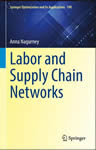
And, amazingly, the fashion supply chain paper that I presented was just published in a book by Springer, which was on display at the conference! Below I am with Christian Raucher of Springer.
At the exhibit were several books that I had chapters published in.
Another high point (so far) was listening to Professor Terry Rockafellar (since retiring from the University of Washington he has joined the University of Florida) give a plenary talk on his latest work on risk, which is brilliant. He also gave a talk the same day in another session organized by Patrizia Daniele! This is stamina and operations researchers have it.
After such an exciting day filled with great talks and reconnecting with colleagues and friends who had traveled to Glasgow, we convened a group for dinner, which included 3 of my former Isenberg PhD students (Wakolbinger, Masoumi, and Toyasaki), Professor Patrizia Daniele, Professor Monica Cojocaru, Professor Laura Scrimali, Professor Giancarlo Bigi, Professor Mauro Pssacantando, and my husband, Professor Ladimer S. Nagurney, at Amarone (which we had also eaten at in Edinburgh and enjoyed very much).
EURO 2015 also is serving as a great venue for a reunion of 5 Supernetwork Center Associates.
And both Professors Wakolbinger and Toyasaki also took part in our Dynamics of Disasters conference!
And, after all the great food that we have been consuming, what can be better than walking the Flasgow Green!
Showing posts with label ecolabelling. Show all posts
Tuesday, July 14, 2015
Tuesday, May 27, 2014
Information Asymmetry vs. Transparency and Why It Matters to Consumers and Investors
Recently, we have been devoting a lot of time to investigating information asymmetry, whether from a quality perspective, a time perspective, or a sustainability one.
Information matters and is crucial to good decision-making and, even in a world dominated by the Internet, with many experiencing information overload, obtaining the right information at the right time may not be attainable.
Having incomplete information can also lead to bad decisions and losses in investments.
Coincidentally, in a recent Financial Times OpEd, dated May 20, 2014, the former mayor of NYC, who needs no introduction whatsoever, Michael Bloomberg, and Mary Schapiro, the former chair of the US Securities and Exchange Commission, write on precisely this issue. Their OpEd, "Give investors access to all the information they need," is a MUST read! They begin their eloquent and extremely timely OpEd with the statement: The most valuable currency in financial markets is reliable information. They note that in a 2014 study it was found that 2/3 of global investors evaluate non-financial disclosures. However, only half of this group uses a structured process to make their assessments. They emphasize the importance of climate risk, quality issues, as in adulterated pharmaceutical products, and even data security issues and financial fraud. They note the organization established in 2011 that they serve as chair and co-chair of, respectively, the Sustainability Accounting Standards Board, that is working with US-listed companies and investors to establish industry-specific measurement and reporting standards on non-financial data.
Transparency matters and can assist in both competitiveness and resiliency. And, clearly, Bloomberg speaks from a wealth of know-how and practical experience - just remember the impact of SuperStorm Sandy on NYC and surrounding areas!
As for our research in this domain, I am very pleased to note that our paper, Equilibria and Dynamics of Supply Chain Network Competition with Information Asymmetry in Quality and Minimum Quality Standards, Anna Nagurney and Dong Li, has now been accepted for publication in Computational Management. Science. The paper emphasizes the importance of uniform quality standards and is inspired, in part, by failures in the pharma industry, as well as other products, too long of a list to note all of them. I am obsessed by quality - from the air that we breathe, to the food that we eat, the water that we drink, and the products that our families use. If only producers know the quality of their goods and not consumers, we all lose!
In addition, we have co-authored a paper that focuses on information asymmetry in time and utilizes gane theory to evaluate supply chain network competition in both product flows and the average time of product deliveries. The paper is Supply Chain Network Competition in Time-Sensitive Markets, Anna Nagurney, Min Yu, Jonas Floden, and Ladimer S. Nagurney. We will be presenting this paper at two different conferences in Europe in June.
Finally, environmental sustainability is a theme that we have long been very passionate about and have written alot on (including books on sustainable transportation and environmental networks). Making environmental impact information available to consumers can greatly influence their purchasing decisions and the environment. Given that I spend a lot of time in Sweden where environmental sustainability is almost a "given," our paper, Fashion Supply Chain Network Competition with Ecolabelling, Anna Nagurney, Min Yu, and Jonas Floden, quantifies the gains from ecolabelling. In our model, consumers are provided with the information associated the GHG emissions or the equivalent in the supply chain of the products.
Thanks to Bloomberg and Schapiro for their terrific OpEd and, remember, it was the Nobel laureate Robert Akerlof, whose inspiring paper on quality information asymmetry and 'lemons,' which was rejected by different journals 3 times, helped to enlighten us as to the value of information as well as quality!
Information matters and is crucial to good decision-making and, even in a world dominated by the Internet, with many experiencing information overload, obtaining the right information at the right time may not be attainable.
Having incomplete information can also lead to bad decisions and losses in investments.
Coincidentally, in a recent Financial Times OpEd, dated May 20, 2014, the former mayor of NYC, who needs no introduction whatsoever, Michael Bloomberg, and Mary Schapiro, the former chair of the US Securities and Exchange Commission, write on precisely this issue. Their OpEd, "Give investors access to all the information they need," is a MUST read! They begin their eloquent and extremely timely OpEd with the statement: The most valuable currency in financial markets is reliable information. They note that in a 2014 study it was found that 2/3 of global investors evaluate non-financial disclosures. However, only half of this group uses a structured process to make their assessments. They emphasize the importance of climate risk, quality issues, as in adulterated pharmaceutical products, and even data security issues and financial fraud. They note the organization established in 2011 that they serve as chair and co-chair of, respectively, the Sustainability Accounting Standards Board, that is working with US-listed companies and investors to establish industry-specific measurement and reporting standards on non-financial data.
Transparency matters and can assist in both competitiveness and resiliency. And, clearly, Bloomberg speaks from a wealth of know-how and practical experience - just remember the impact of SuperStorm Sandy on NYC and surrounding areas!
As for our research in this domain, I am very pleased to note that our paper, Equilibria and Dynamics of Supply Chain Network Competition with Information Asymmetry in Quality and Minimum Quality Standards, Anna Nagurney and Dong Li, has now been accepted for publication in Computational Management. Science. The paper emphasizes the importance of uniform quality standards and is inspired, in part, by failures in the pharma industry, as well as other products, too long of a list to note all of them. I am obsessed by quality - from the air that we breathe, to the food that we eat, the water that we drink, and the products that our families use. If only producers know the quality of their goods and not consumers, we all lose!
In addition, we have co-authored a paper that focuses on information asymmetry in time and utilizes gane theory to evaluate supply chain network competition in both product flows and the average time of product deliveries. The paper is Supply Chain Network Competition in Time-Sensitive Markets, Anna Nagurney, Min Yu, Jonas Floden, and Ladimer S. Nagurney. We will be presenting this paper at two different conferences in Europe in June.
Finally, environmental sustainability is a theme that we have long been very passionate about and have written alot on (including books on sustainable transportation and environmental networks). Making environmental impact information available to consumers can greatly influence their purchasing decisions and the environment. Given that I spend a lot of time in Sweden where environmental sustainability is almost a "given," our paper, Fashion Supply Chain Network Competition with Ecolabelling, Anna Nagurney, Min Yu, and Jonas Floden, quantifies the gains from ecolabelling. In our model, consumers are provided with the information associated the GHG emissions or the equivalent in the supply chain of the products.
Thanks to Bloomberg and Schapiro for their terrific OpEd and, remember, it was the Nobel laureate Robert Akerlof, whose inspiring paper on quality information asymmetry and 'lemons,' which was rejected by different journals 3 times, helped to enlighten us as to the value of information as well as quality!
Subscribe to:
Posts (Atom)