Showing posts with label emergency response. Show all posts

Tuesday, April 18, 2023

Thanking Mr. David Gutierrez of the American Red Cross for His Brilliant Guest Lecture in My Humanitarian Logistics & Healthcare Class

Having expert practitioners speak to students and share their experiences and lessons from the field supports transformative education.

Last week, we had the honor and pleasure of hosting Mr. David Gutierrez of the American Red Cross (ARC) as a guest lecturer in my Humanitarian Logistics and Healthcare class at the Isenberg School of Management. Mr. Gutierrez was an outstanding Professor for a Day! The certificate was kindly signed by the Isenberg School Dean - Dr. Anne P. Massey.

The original date of his lecture was rescheduled because he had been intensively responding to the aftermath of the tornado in Rolling Fork, Mississippi.

Mr. David Gutierrez in the Senior Director of the National Incident Command Team of the American Red Cross. The National Incident Command Team was established about 1 year ago due to the unprecedented number of disasters. According to Mr. Gutierrez: "disasters have been nonstop." The ARC has been dealing with many challenges including climate displacement.

Mr. Gutierrez shared his "story" with us and his incredible career with the ARC, which continues. Professionally, he started out as a High School teacher and began volunteering with the ARC in 1992. Over more than three decades, he has served in various roles including: Health & Safety Director, AFES Station Manager, Chapter Executive, Chapter Operations Manager, State Relations Disaster Liaison, State Resource Office Coordinator, Emergency Services Director, State Disaster Officer, Division Disaster Director and Division Disaster Executive. In his current role as the Senior Director for the National Incident Command Team, he is responsible for initiating a Red Cross disaster response for level 5 disasters and higher. This includes oversight and direction of all activities related to disaster leadership development, disaster response training, partnerships with government and non-government agencies, and capacity building for the organization. An example of a  level 1 disaster is a house fire, that the ARC would also respond to.

He spoke about the 3Hs - Health, Hunger, and Housing, and how the ARC provides security to victims of disasters for up to 1 year. Many of those impacted by disasters are experiencing poverty and disasters create further stressors on the most vulnerable. The #1 priority of the National Incident Command Team is to respond. The other priority is to build capacity and to make sure that the workforce is trained. The students were very inspired and also amazed that 98% of the ARC workforce consists of volunteers! I very much appreciated that Mr. David Gutierrez noted the relevance of the logistics behind the workforce and in getting the workers to impacted areas in a timely manner. Sometimes there can be as many as 2,000 volunteers. The ARC pays for the travel expenses as well as the room and board. He discussed the specific case of Hurricane Ian and the impact on Tampa Bay, along with the response of the ARC.

Mr. Gutierrez has deployed to over 50 relief operations throughout his tenure with the Red Cross. He also serves as a National Disaster Relief Operation Job Director for the ARC. He served as the job director for Hurricane Ian, Hurricane Laura, Hurricane Ida, and Hurricane Harvey. In the role of job director, Mr. Gutierrez is responsible for leading a team of individuals who provide a range of clients with a comfortable, safe, welcoming environment by delivering mass care services, which include shelter, feeding, distribution of relief supplies, reunification, Disaster Health Services, Disaster Mental Health Services, Disaster Spiritual Care, Casework and Recovery Planning, and access to a host of services provided by partners in the community.

He emphasized the importance of needs assessment and in learning from previous disaster experiences. This reinforced what the students have learned from other guest speakers this semester, including Dr. George Karagiannis of Resilience First and Mr. Jeff Hescock of UMass Amherst! Lessons learned must be captured and shared. He also noted the necessity behind collaboration with partners; coordination with response partners, and also effective communication.

Mr. Gutierrez's dedication to the American Red Cross shone through his presentation  Along with his team,  he works to ensure timely, efficient disaster response efforts, ensuring that local community organizations and the Red Cross are coordinating and collaborating in order to efficiently and effectively meet community needs.

Mr. Gutierrez is a role model. His dedication, work ethic, kindness, and effectiveness are awe-inspiring. On behalf of my students, and all those that he and his team have helped, I send my deepest gratitude.

Sunday, November 24, 2019

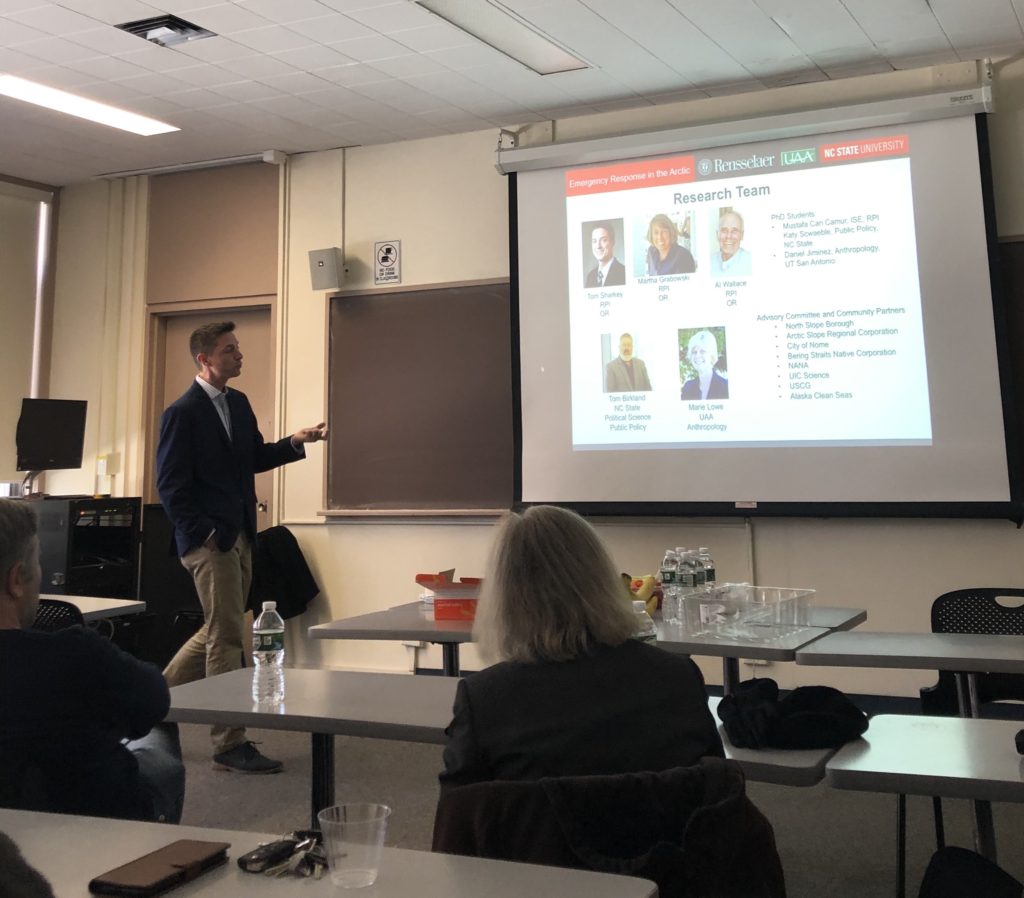
Great Talk on Emergency Response in the Arctic by Professor Tom Sharkey of RPI

Recently, we had the great pleasure of hosting RPI Professor Tom Sharkey in our UMass Amherst INFORMS Speaker Series.  His talk, based on an NSF-funded research project, was extremely timely and fascinating.
In fact, an article on this project, co-authored by Professor Sharkey with his project collaborators, including Professor Al Wallace of RPI,  was the cover story in the November issue of ISE Magazine and is definitely worthwhile to read.

His talk attracted an audience of faculty and students from multiple departments and schools at UMass Amherst, including the Isenberg School, the College of Engineering, and also the College of Natural Sciences and Mathematics.

It was a pleasure to introduce Professor Sharkey - I had last seen him this past March when I gave a talk at RPI. Since then, a PhD alumna of RPI's ISE program, whose PhD advisor was Professor Wallace, Dr. Anne P. Massey, has become the first female Dean of the Isenberg School - very exciting!


Professor Sharkey emphasized the interdisciplinary nature of the project in his presentation and noted that the team is working on constructing Operations Research (OR) models to help in emergency response (ER), while also helping communities. Collaborators, outside of RPI faculty, include a professor at NCState and one at the University of Alaska.

He noted the changes that are happening in the Arctic, including tourism and increasing commercial activity, as well as the possibility of broadened maritime shipping,  and the various associated challenges from uncertainty in sea conditions to shortcomings in infrastructure, including broadband. He stated that, even without oil exploration, there is still the possibility of spills. The shipping time from China to Rotterdam has now been decreased by 10-14 days. And, when it comes to ER, mobilization may be bottlenecked by the limited capacity of a community. Infrastructure investments take a while to build out. He discussed the need to determine the minimum budget required in order to achieve a certain response time in an emergency.

Also, he emphasized that there may be unintended consequences and it is important to identify who actually benefits from infrastructure investments.

Professor Sharkey described a mass rescue event, with accompanying network figure, in the case of the need to rescue cruise ship evacuees. His talk clearly resonated with me since we have done a lot of work on disaster relief and, to-date, I have co-edited two volumes on Dynamics of Disasters, with Professors Ilias S. Kotsireas and Panos M. Pardalos.

In 2016, I hosted the visit of Rasmus Dahlberg, who is a disaster researcher, based in Denmark (and also a novelist and TV and radio personality).  After Sharkey's visit to UMass Amherst, I connected the two of them, due to their very similar interests in Arctic emergency response research. Dahlberg is also a practitioner in this important domain. He also has a contributed chapter in the first Dynamics of Disasters (DOD) volume that I co-edited and spoke at the first DOD conference that I co-organized in Kalamata, Greece.

Professor Sharkey spoke abut identifying "dual-use" infrastructure planning, a concept I like very much. For example, improved "connectivity" for Arctic regions is an important goal, in transport (in terms of roads and ports) as well as in communications.  Fast and reliable Internet could then allow for telemedicine, as well as teleeducation in the Arctic. Of course, he also brought up the important question: "Who is going to pay?"

There were many questions during and after his very information talk. We took a group photo and then enjoyed a lunch at the University Club. We thank Professor Sharkey for his excellent, very inspiring  lecture in our Speaker Series!
Also, we celebrated, with cake, 15 years of the UMass Amherst INFORMS Student Chapter (30 semesters of great speakers in its Speaker Series)!

Professor Sharkey was interviewed after the lunch for the chapter's youtube channel, and, when the approved video is posted, we will let everyone know via social media.

In the meantime, many thanks to the outstanding UMass Amherst INFORMS Student Chapter, and to its Officers, for their amazing work, that brings all those interested in Operations Research/Management Science throughout UMass Amherst (and beyond) closer together as a community, both professionally and socially.

Thursday, February 15, 2018

Puerto Rico and the Response to Hurricanes Irma and Maria - A Truly Inspiring Lecture by a MEMA Official

Today the students in my Humanitarian Logistics and Healthcare class at the Isenberg School had the great honor and privilege of hearing from a consummate professional and practitioner - Mr. Patrick Carnevale of MEMA (Massachusetts Emergency Management Agency). Mr. Carnevale presented a guest lecture in my class entitled, Puerto Rico 2017: Hurricanes Irma and Maria. He spoke about the weeks that he spent there in October assisting in the extremely challenging response.

His presentation was, honestly, lifechanging to all those in the audience. In fact, I just received a long email from a student in the class who wrote what is a beautiful tribute to him, and I quote just a part of it below:

The talk by Mr. Carnevale this morning was really touching and inspirational. It is not often that one encounters people like him who take pride in the work they do and are so emotionally attached because they care so much about the well-being of  the less fortunate. 

As an international student at UMass, since my first day, I have seen the country go through a major transformation (for the worse), but hearing Patrick today restores some faith in the good people that we are surrounded by and shows that there is some hope for the country as long as we have people like him working for us!

Mr. Carnevale has worked for MEMA for 17 years and he said that the hurricanes hitting Puerto Rico was the "most difficult" disaster to be part of. He worked 7 days a week there, 14 hours a day, and slept on an Italian cruise ship (don't ask him about the food or accommodations, a photo of the latter he shared with us), which was housing 2,500 of the responders. Puerto Rico in September had 3.4 million people and the temperature there was about 84 degrees with high humidity. The rainy season is April to November so the responders also had to deal with that. There are now 35,000 Puerto Ricans leaving the island monthly with the highest number of families now living in Massachusetts with additional challenges because of the housing stock and schools.

46% of the people in Puerto Rico lived in poverty even before the multiple hurricane strike. Moreover, the infrastructure already was subpar from the electric power networks to the roads and bridges.
Mr. Carnevale told us how the San Juan Convention Center was taken over by the federal government and served as a joint field office.. Although he stated that the coordination was OK, he found the bureaucratic forms and paperwork very much slowed down the delivery of the supplies, assuming that you could even find the contacts. He said that it took 3 days to schedule a mission because of this. In the field there were 1,500 representatives from the military, Homeland Security, VOADS, and urban search and rescue folks, and he was also in the field.

His mission was to lead  the central island coordination task force. MEMA was the second group on-site and he mentioned that the military had 180 helicopters, with the big ones able to carry 6 pallets of goods. There were many isolated communities to which trucks could not deliver baby supplies, food, water, and medicines. He spoke of a very useful federal app, known as MAGE,  that was helpful in mapping route disruptions, destroyed bridges, etc. His mission coordinated 587 flights and 32 ground trips.
The challenges the responders faced were immense and included challenges in communications: dealing with language barriers, limited cell phone services, and sporadic functioning of satellite phones because of congestion. Additional challenges were the constantly changing environmental conditions with new landslides and bridge outages.

He shared with us experiences and insights that you do not read about in the media and that were incredibly eye-opening!

He also spoke of the successes from relationship building to the delivery of supplies. ATM machines were not functioning so many responders carried cash and Mr. Carnevale also took part in "extraordinary examples of altruism" as my student so brilliantly wrote after hearing him speak today.
We thank Mr. Patrick Carnevale from the bottom of our hearts for his extraordinary work and that of his team and for his great humanity and for sharing his experiences and wisdom with us today. He is a true Humanitarian Hero!

And this afternoon, he was in Boston meeting with the Governor and Lt. Governor.

Friday, November 8, 2013

Integrated Supply Chains for Disaster Relief

Yesterday, I reminded the students in the undergraduate Logistics and Transportation class that I am teaching this semester of recent natural disasters that affected us regionally from Superstorm Sandy in 2012, to the freaky Halloween snowstorm in 2011 (with power out for days on our area), to the once in 500 years flood, as a consequence of Hurricane Irene, also in 2011.

I also remarked that, thus far, this academic year has been relatively free of natural disasters in New England and Massachusetts.

I was speaking on how what we have learned in the course, to-date, including the network performance measure that I described yesterday, based on work done with Dr. Patrick Qiang. The network performance measure is known as the N-Q measure (for Nagurney-Qiang) and can  be applied to identify the most important nodes and links in transportation and logistics networks, including supply chains, since their removal from the network has the biggest impact on the network's performance.

The most important nodes and links are those that should be protected the most and also restored post disaster the quickest.  Our measure has been applied to identify the most important highways in Germany by Schultz, whether to build a new subway line in Dublin, Ireland, and even to assess the impacts on transportation of the major fires that struck Greece several years ago.

However, just because your region  or even country is not presently experiencing (or working to recover from) a disaster, does not mean that people elsewhere are not either preparing, enduring and suffering from, or working towards recovering from one disaster (or several).

And, indeed, yesterday and today, in the Philippines, what may be the biggest level 5 storm ever recorded is taking place, as reported on CNN.com
Watch this video

Storm has 235 mph wind gusts

Next week, at the 60th Annual North American Meeting of the Regional Science Association International, which is taking place in Atlanta, GA, I will be giving a presentation on "An Integrated Disaster Relief Supply Chain Network Model with Time Targets and Demand Uncertainty," based on the paper of the same title, which is an invited paper for the Memorial Volume in honor of Professor Walter Isard, the founder of Regional Science. A preprint of the paper may be accessed here.  
Our presentation may be downloaded here.  The paper is co-authored with Professors Masoumi and Yu, two of my former doctoral students.
 

Our disaster relief supply chain network model captures both the preparedness phase and the response phase of the disaster management cycle (with the other two phases being mitigation and recovery). Also, in contrast to many of the models in the existing literature, our model does not consider targets for cost; instead, it minimizes the total operational costs of the activities in the supply chain network. This, we believe, makes more sense in that the relief operations budget largely depends on the intensity of damage and the fatality toll which may be difficult be determine a priori. In addition, our model allows for the pre-disaster and the post-disaster procurement of relief items, and involves the time and the cost associated with each strategy or a combination of both. Also, we handle nonlinear costs, which capture congestion effects, a big issue in disaster relief, and an aspect that has been missing from much of the literature on the topic.

According to The Washington Post:   The Philippines, which is hit by about 20 typhoons and storms a year, has in recent years become more serious about preparations to reduce deaths. Public service announcements are more frequent as are warnings issued by the president and high-ranking officials, regularly carried on radio and TV and social networking sites.

Provincial governors and mayors have taken a hands-on approach during crises, supervising evacuations, inspecting shelters and efforts to stockpile food and relief supplies.

After this megastorm has passed, we will see whether the efforts minimized losses in life, if not property, given the severity of the winds and rain.