Showing posts with label crisis management. Show all posts

Friday, May 31, 2024

Civilian-Military Integration of Ukrainian Defense Supply Chain - A Paper by Three Females

The ISCRAM conference, which took place recently in Munster, Germany, is now over. The conference focused on information systems for crisis response and management and attracted speakers from many countries.

I was thrilled that Professor Myroslava Kushnir of the Ukrainian Catholic University (UCU) in Lviv, Ukraine was able to present our paper, "Civilian-Military Integration of Ukrainian Defense Supply Chain" at the recent ISCRAM conference that took place in Munster, Germany.  The paper was also co-authored by Professor Renata Konrad of the Worcester Polytechnic Institute (WPI). For all three of us, Ukrainian is our first language.

The paper was published in the refereed conference Proceedings and is open access. It can be downloaded here.


I started working with Myroslava, through the outstanding UMass Amherst - Kyiv School of Economics (KSE) partnership, in which the 1st round of Virtual Scholars had 15 scholars in Ukraine matched up with faculty hosts at UMass Amherst. 9 of the 15 were matched with faculty at the Isenberg School of Management at UMass Amherst. I had the pleasure of working with Myroslava and also with Elena Besedina of KSE and Pavlo Martyshev of KSE as well as Oleg Nivievskyi of KSE. I published papers with all of them.

Nathan Greenfield wrote this wonderful article in World University News about the meaning of this partnership and you can see therein quotes from Kushnir, Besedina, and Martyshev.

Myroslava told me that she was the only Ukrainian that presented at the ISCRAM Conference.

Our research continues and we expect to have an announcement of the 2nd round of Virtual Scholars before too long.

Working with faculty and researchers in Ukraine has been incredibly humbling and inspirational.

Sunday, May 28, 2023

Some of the Highlights of the Great POMS Conference in Orlando!

I hope that everyone who took part in the POMS Conference in Orlando, which took place May 22-25, 2023, has returned safely to their homes. It was wonderful to be at this in-person POMS conference, the first such one since the 2019 POMS Conference, which took place in Washington DC.

I thought it important to document some of the highlights of the 33th Annual POMS Conference in Orlando, albeit, of course, from a personal perspective. I am sure that each conferee has their own special memories and experiences. This was truly an international conference and I was delighted to see and meet colleagues from many countries, including from The Netherlands, Norway, Germany, Finland, and even Brazil. Asia was also well-represented. 

I arrived mid-afternoon on Monday and at the Exhibit Hall I was thrilled to see Springer Nature Editor Matt Amboy and the display of Springer books. And there, on display, was my newest book, "Labor and Supply Chain Networks," which was published in 2023.

The venue for the conference was stunning - the Hyatt on International Drive.  The full program for the conference can be accessed here. Below is a photo of a late afternoon view taken from the 26th floor.
I enjoyed the keynote talk by Scott Colloredo, the Director of the Engineering Directorate at NASA’s John F. Kennedy Space Center in Florida (but sadly missed the keynote by Dr. Nada Sanders since I was traveling). It was interesting that the 2 keynote talks were both scheduled for last Monday. 

The sessions that I attended were organized in the Humanitarian Operations and Crisis Management track and I especially appreciated the breadth of innovative problems that are being tackled and addressed. Below is a sample.


I thank Dr. Mohammad Arbabian for the invitation to speak in his session. Coincidentally, he is at the Pamplin School of Business at the University of Portland, where my former PhD student, now an Associate Professor there, Dr. Min Yu, is also on the faculty. It was wonderful that she came to our session. Below are photos of the speakers in our session, a group photo, and also a photo with some of the members of the audience. Thanks to all who joined us!


I also enjoyed a panel of editors of the POM journal.

Although there were many conferees that I did not got get a chance to see - the conference was quite large with over 2 dozen parallel sessions, I did, through pure serendipity, encounter and exchange pleasantries with Renzo Akkerman, whom I have cited in quite a few papers on perishable food supply chains co-authored with Min Yu and Deniz Besik (both of whom were in attendance at the conference).

It was also great to see Marianne Jahre of Norway and Sarah Schiffling, who is now at Hanken in Finland. I was with Marianne in Cartagena, Colombia, back in 2019, where we were both invited speakers at a logistics conference organized at the Escuela Naval. I blogged the conference and unique experiences there.

And, of course, sharing meals with Deniz Besik, who is now an Assistant Professor at the University of Richmond, was terrific and also with Min Yu. It was great to have Ladimer S. Nagurney accompany me to the conference!

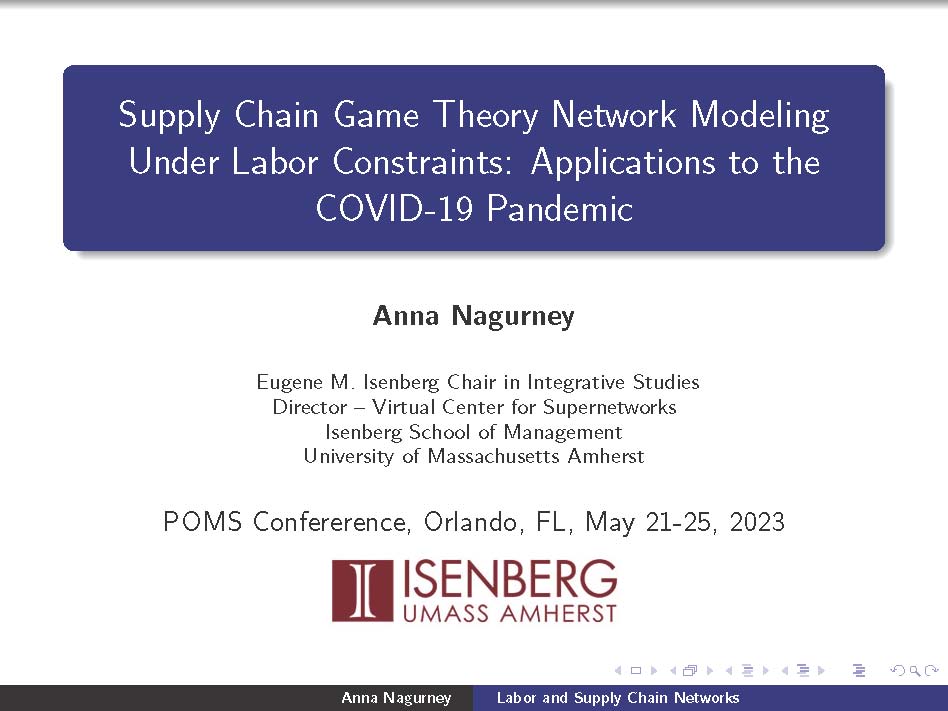
The title of my presentation at the conference was: "Supply Chain Game Theory Network Modeling Under Labor Constraints: Applications to the COVID-19 Pandemic." The presentation was based on a paper that I authored that was published in the European Journal of Operational Research. I was deeply honored when it received an Editor's Choice Award.


The complete slide deck of my presentation can be downloaded here.

Kudos to the staff at the Hyatt. Their friendliness and professionalism were so appreciated. I very much enjoyed meeting Alexandra from Haiti and Natalia from Lviv, Ukraine, who are working at The Diner at the Hyatt. It was very moving to speak with Natalia in Ukrainian. She had arrived in the US only 6 months ago.

And, it so happens that, next Friday, I will be giving the opening talk at the Innovations in Immigration Analytics Conference at WPI. My talk will be on refugee networks and regulations. Many thanks to Andrew Trapp for inviting me to speak.

And, for those wishing to walk down Memory Lane, please visit my blogpost on the POMS Conference in Washington DC!

Many thanks to the organizers of the POMS Conference for such a rewarding conference both scientifically and socially!


Tuesday, April 18, 2023

Thanking Mr. David Gutierrez of the American Red Cross for His Brilliant Guest Lecture in My Humanitarian Logistics & Healthcare Class

Having expert practitioners speak to students and share their experiences and lessons from the field supports transformative education.

Last week, we had the honor and pleasure of hosting Mr. David Gutierrez of the American Red Cross (ARC) as a guest lecturer in my Humanitarian Logistics and Healthcare class at the Isenberg School of Management. Mr. Gutierrez was an outstanding Professor for a Day! The certificate was kindly signed by the Isenberg School Dean - Dr. Anne P. Massey.

The original date of his lecture was rescheduled because he had been intensively responding to the aftermath of the tornado in Rolling Fork, Mississippi.

Mr. David Gutierrez in the Senior Director of the National Incident Command Team of the American Red Cross. The National Incident Command Team was established about 1 year ago due to the unprecedented number of disasters. According to Mr. Gutierrez: "disasters have been nonstop." The ARC has been dealing with many challenges including climate displacement.

Mr. Gutierrez shared his "story" with us and his incredible career with the ARC, which continues. Professionally, he started out as a High School teacher and began volunteering with the ARC in 1992. Over more than three decades, he has served in various roles including: Health & Safety Director, AFES Station Manager, Chapter Executive, Chapter Operations Manager, State Relations Disaster Liaison, State Resource Office Coordinator, Emergency Services Director, State Disaster Officer, Division Disaster Director and Division Disaster Executive. In his current role as the Senior Director for the National Incident Command Team, he is responsible for initiating a Red Cross disaster response for level 5 disasters and higher. This includes oversight and direction of all activities related to disaster leadership development, disaster response training, partnerships with government and non-government agencies, and capacity building for the organization. An example of a  level 1 disaster is a house fire, that the ARC would also respond to.

He spoke about the 3Hs - Health, Hunger, and Housing, and how the ARC provides security to victims of disasters for up to 1 year. Many of those impacted by disasters are experiencing poverty and disasters create further stressors on the most vulnerable. The #1 priority of the National Incident Command Team is to respond. The other priority is to build capacity and to make sure that the workforce is trained. The students were very inspired and also amazed that 98% of the ARC workforce consists of volunteers! I very much appreciated that Mr. David Gutierrez noted the relevance of the logistics behind the workforce and in getting the workers to impacted areas in a timely manner. Sometimes there can be as many as 2,000 volunteers. The ARC pays for the travel expenses as well as the room and board. He discussed the specific case of Hurricane Ian and the impact on Tampa Bay, along with the response of the ARC.

Mr. Gutierrez has deployed to over 50 relief operations throughout his tenure with the Red Cross. He also serves as a National Disaster Relief Operation Job Director for the ARC. He served as the job director for Hurricane Ian, Hurricane Laura, Hurricane Ida, and Hurricane Harvey. In the role of job director, Mr. Gutierrez is responsible for leading a team of individuals who provide a range of clients with a comfortable, safe, welcoming environment by delivering mass care services, which include shelter, feeding, distribution of relief supplies, reunification, Disaster Health Services, Disaster Mental Health Services, Disaster Spiritual Care, Casework and Recovery Planning, and access to a host of services provided by partners in the community.

He emphasized the importance of needs assessment and in learning from previous disaster experiences. This reinforced what the students have learned from other guest speakers this semester, including Dr. George Karagiannis of Resilience First and Mr. Jeff Hescock of UMass Amherst! Lessons learned must be captured and shared. He also noted the necessity behind collaboration with partners; coordination with response partners, and also effective communication.

Mr. Gutierrez's dedication to the American Red Cross shone through his presentation  Along with his team,  he works to ensure timely, efficient disaster response efforts, ensuring that local community organizations and the Red Cross are coordinating and collaborating in order to efficiently and effectively meet community needs.

Mr. Gutierrez is a role model. His dedication, work ethic, kindness, and effectiveness are awe-inspiring. On behalf of my students, and all those that he and his team have helped, I send my deepest gratitude.

Tuesday, October 30, 2012

Investing in Science for Economic Growth and Our Future in the Aftermath of Hurricane Sandy

The power had gone out in our neighborhood last night in Amherst, Massachusetts at 8PM sharp.

We had been expecting that it would, at some time, given the massive size and strength of Hurricane Sandy and had planned and prepared accordingly. We had purchased supplies even in Pennsylvania, where we had spent the weekend, filling up our cars with gas, getting enough cash from the ATM machines, stocking up on water and nonperishables as well as flashlights and extra batteries.  We had worked furiously yesterday at home, taking advantage of what electric power provides and knowing full well the difficulties presented when it is not available. My husband's university and mine (UMass Amherst) were closed yesterday due to Hurricane Sandy.

Only a few days before,  I had been speculating whether this October storm would be worse than that of our freaky Halloween snowstorm of a year ago when we were without power for over 72 hours and many of our friends in Connecticut for over 8 days!

We were prepared for this one, in part, because scientists had been informing us regularly as to the status of the weather forecasts for this major hurricane. I do admit that I followed closely the predictions of the European weather forecasting computer model versus the US one and was pleased to hear when they were "converging"  since the information that was being provided allowed for emergency preparedness of many organizations and communities.

Usually, we speak of algorithms converging to a solution, but, in this case, different mathematical models were converging to similar forecasts and information for the storm that is now being estimated as having caused over $20 billion in damage and it is not even over yet. Colleges and universities have shut down for 2 days -- including 5 Ivies -- my alma mater, Brown University, the University of Pennsylvania, which we had watched row in the Schuykill rowing regatta just this past Saturday in Philadelphia, along with many other college teams, and Princeton University (that also had its own regatta on Sunday), as well as Columbia University and Yale University. The breadth of the storm is affecting 900 miles and has produced low pressures never before measured.

Millions in the northeast of the US are without power and certain colleges are still without power.

In NYC, backup generators for hospitals failed resulting in superhuman efforts by the medical staff to evacuate and to keep life support systems for patients, including newborns, functioning.

The New York Stock Exchange has now been closed for the longest period for a shutdown due to weather since 1888!  Transportation in the major cities of the Northeast from Washington DC to Philadelphia and NYC has ground to a halt with mass transit systems shut down because of the anticipated flooding, which has now come to fruition, and bridges and tunnels are closed because of the winds of over 60 miles an hour that have swept over our communities and cities. Highways that we were on just two days ago in Connecticut were closed yesterday to all traffic except for emergency vehicles as was the Tappan Zee bridge and we drove over it this past Sunday.

Beautiful shorelines in New Jersey from Atlantic City to Long Island, Connecticut, and Rhode Island, now under water, and covered with debris, will be unveiled in new realizations as the tides pull back.

Today, after the sun rises, many of us will venture out of our shelters to survey the landscape, if we can, to see if and how it has been changed by Hurricane Sandy, which, as a natural disaster, will break records in terms of economic and physical impacts.

Last night, when the power failed, my husband and I hunkered down with a big battery-operated lamp and one flashlight each to read newspapers (good backup plan since we could not then be reading news online since our power had failed). 

An OpEd in The New York Times, "Science Is the Key to Growth," by Dr. Neal Lane, a former Director of the National Science Foundation (NSF) and the Chief Science and Technology Adviser to President Bill Clinton, caught my eye. In his thought-provoking OpEd, Lane writes:

Scientific knowledge and new technologies are the building blocks for longterm economic growth -- "the key to a 21st century economy," as President Obama said in the final debate.

He goes on to emphasize that the private sector can't do it alone and although companies translate our scientific discoveries into products federal investment in R&D, especially in basic research, is critical to their success -- just think of Google, for example, which he notes was started by two former grad students, whose names are now known by everyone using a computer, who were on NSF graduate fellowships!

Investments in science create jobs in entirely new industries and we deserve and need to be again "a land of rewarding jobs."  As Dr. Lane eloquently concludes: "we need to understand the basic investment principle in America's future: no science, no growth."

The electric power in our home was restored at 4AM and I hopped out of bed to get back to work.

Without science, there would be no weather forecasting -- there would be no modern healthcare -- there would be no well-thought out and executed evacuation plans -- and the same holds for recovery and reconstruction efforts.

The disasters of last year as well as the research that we had done for our Fragile Networks book motivated me to prepare a new course, Humanitarian Logistics and Healthcare, in which the students learned about crisis management and disaster relief and one of the student team projects was on the evacuation of a hospital.  This year, although I am on sabbatical, I have been invited to teach a condensed version of the course at the Vienna University of Economics and Business, where a former doctoral student of mine, Dr. Tina Wakolbinger, who received a PhD from the Isenberg School of Management, with a concentration in Management Science, is now a Full Professor. I will have an immense amount of material to cover and will definitely include topics about Hurricane Sandy.

Science uncovers frontiers and it also helps us to undetsand what makes for resiliency and how to prepare for emergencies and crises.

As I have written before, why can't the US be more like Sweden, where I spend a lot of time as a Visiting Professor and  which Dr. Lane also singled out, along with Israel, Japan, and South Korea in terms of investments in national research and development.

Thank you, Dr. Neal Lane, for speaking out!

Sunday, July 29, 2012

Crisis Management and Resilient Leaders


People are starting to take notice.

It is hard not to -- with record-breaking temperatures in the United States this summer, severe drought enveloping many states, including some of our major grain and corn states, which will surely drive prices up for food products, extreme weather events and storms happening with increasing frequency, plus climate change even affecting our infrastructure -- from our roads to our electric power networks.

There is even a blood shortage this summer -- the worst in 15 years -- being reported by the Red Cross, partially attributed to the storms and heat this summer.

We have been researching fragile critical infrastructure networks and even wrote the book, Fragile Networks, in which we defined terms such as robustness and quantified synergies associated with network integration, through the prism of supply chains, since, truly, it is supply chains that link our economic activities together through production, transportation, storage, and ultimate distribution. I spoke on Building Resiliency in Washington DC on a special Transportation Research Board panel.

Our world is changing and  leaders must become aware of crisis management.


We are in need of Resilient Leaders.

The Isenberg School of Management at UMass Amherst has on its homepage the following:

Resilient Leadership for an Evolving Business Climate

and it is great to see new courses being taught around this theme and new initiatives.

There is a feature news article, Students Learn Crisis Management in Innovative Isenberg Course,  on the new course in Humanitarian Logistics and Healthcare  that I taught in Spring 2012. In the course, we had speakers from the National Guard, the Red Cross, the UMass emergency preparedness group, and even a disaster communication expert and a former student of mine from the profit sector, who has worked in healthcare. Nice to see my students quoted in the article.

Yes, even the army has realized the importance of location theory in determining where its critical supplies should be stored since it expects a greater role in humanitarian crises and evacuation management -- topics that we studied in my course and timely response and deliveries can save lives in crises.

Our research from blood supply chains to supply chain metrics in the case of disasters can be accessed on the Virtual Center for Supernetworks website.


Thursday, May 12, 2011

How General Motors Crisis Managed the Japan Supply Chain Disruptions Post the Triple Disaster

Resilient companies are surviving by continuing to dynamically adapt to the supply chain disruptions and cascading failures post the triple Japan disaster that occurred on March 11, 2011.

To get the parts that are essential for their production processes they have been working even with the suppliers of their suppliers going upstream into the complex supply chain networks.

The New York Times is reporting, in a fascinating article, how General Motor's crisis management team, with white knuckles, resolved the crisis situation. GM, which spends about 2 percent of its parts-buying budget in Japan, identified 118 products that it needed to monitor for shortages but has resolved problems with all but five. The company’s chief executive, Daniel F. Akerson, predicted last week that the Japanese disruptions would have no material impact on G.M.’s earnings.

This is in stark contrast to Toyota, which is experiencing shortages of about 150 parts, for its North American plants, since it uses about 15% of its components from Japan.

GM was able to find alternative suppliers and to assist others in going online, even working back across multiple tiers of its supply chain, something that it had never, previously, had to do. However, there is still a chance of a shortfall in semiconductors and other electronics needed for autos and this situation is being closely monitored.

Clearly, companies must view and manage their supply chain networks as systems in their full complexities. One should move beyond the white board with green and red stickers for product and time management.

It looks as though GM will regain its place as the world's biggest auto company.

Akerson was very classy when, as quoted in the article, he said: “I want to win in the marketplace, but I want to win against a healthy and vibrant Toyota and Honda.” “Next year, we’ll put the gloves back on, and I’m sure they’ll go right back at us and we’ll go back at them.”

Our research on supply chain disruptions is relevant in this scenario. Our paper, Modeling of Supply Chain Risk Under Disruptions with Performance Measurement and Robustness Analysis, by Professors Qiang Qiang, Anna Nagurney, and June Dong, appeared in Managing Supply Chain Risk and Vulnerability: Tools and Methods for Supply Chain Decision Makers, T. Wu and J. Blackhurst, Editors, Springer, Berlin, Germany (2009) pp 91-111.