Showing posts with label making an impact. Show all posts

Saturday, June 28, 2025

Outstanding Making an Impact Lightning Talks: Honored to Speak on Tariffs, Trade, and OR

This post is the third in a series on the EURO Conference, which took place in Leeds, UK, June 22-25, 2025.

I was honored and delighted to have been invited by Ruth Kaufman to deliver a lighting talk in the Making an Impact session on Monday morning, June 23, of the conference at 8:30AM. All 13 speakers, from several different continents, showed up. The full list of speakers, their presentation titles, and abstracts can be found here: https://euro2025leeds.uk/making-an-impact/. The breadth of topics was fantastic and included algorithms for fighting crime, reducing food waste on airplane flights, and emergency ambulance service planning. 

My presentation was on Tariffs, Trade, and OR.

This session was a truly outstanding beginning to this scientific conference.

Below is photo of the speakers with Ruth Kaufman and Jane Parkin, followed by a photo of the audience.


I have been publishing on tariffs (of different types) for quite a few years now, so I very much enjoyed preparing and delivering my presentation, which is now posted on the Supernetwork Center website: https://supernet.isenberg.umass.edu/visuals/EURO2025_MakinganImpact-Tariffs,%20Trade,%20and%20OR.pdf

Saturday, June 29, 2019

The EURO 2019 Conference in Dublin Brings Operations Researchers Together From Around the Globe

The fabulous EURO 2019 conference, which took place June 23-26 at UCD in Dublin, Ireland is now over but the impact of the scientific exchanges, the renewal of friendships and new ones made, along with wonderful memories, will sustain many for a long time to come.

It was a conference that included tutorials, keynote talks, numerous fascinating and very timely panels, as well as scientific paper presentations on Operations Research. The organizers and organizing committee are congratulated on the success of the conference. Special thanks to Professors Sean McGarraghy and Luis Eduardo Neves Gouveia, the conference chairs, for even sending me a personal thank you this morning for my tutorial at the conference!

From the very beginning of our arrival in Dublin, there were numerous surprises - upon our arrival, we saw Melissa Moore, the Executive Director of INFORMS, and, soon thereafter, Mary Magrogan of INFORMS. The organizers had put many of the invited speakers up at the lovely Radisson Blu hotel, in walking distance of the university. It was, hence, very special, to be seeing colleagues from many countries at breakfast, including IFORS President Professor Maria Grazia Speranza, or on the lovely grounds, including Professor Kash Barker, in the photo with me below!
One aspect of the conference that I very much enjoyed was seeing my former doctoral students, now professors, Dr. Sara Saberi of WPI in the USA and Dr. Dmytro Matsypura of the University of Sydney in Australia, along with my long-time collaborator, Professor Patrizia Daniele of the University of Catania in Italy, who was also a member of the organizing committee.
I had a packed schedule. Monday afternoon of the conference, I was a panelist on the Women in OR panel, which had a terrific audience and discussions. Below I am standing with Professors Christina Phillips and Paula Carroll next to the lovely flowers.
 
This EURO conference was especially thrilling since Professor Martine Labbe, in the photo above next to me, who was also on the Women in OR panel, was named the first female recipient of the EURO Gold Medal award! We are standing next to Professors Maria Paola Scaparra and Annunziata Esposito Amideo.

And, we even had a male on this panel - Professor Daniele Vigo! Many thanks to the audience, including quite a few males, for their insights and suggestions as to how we can build a stronger community of nurturing females (as well as other less represented groups) in Operations Research and in science, in general! I do believe that we have started to strengthen our community in this regard and I also especially recognized WORMS - Women in Operations Research and the Management Science, a forum of INFORMS.

Earlier on Monday, we had an editorial board meeting of the Wiley journal, International Transactions in Operational Research, expertly edited by Professor Celso Ribeiro of Brazil. A photo of those in attendance is below (some had talks to give at the same time, and they were missed, including Dr. Mauricio Resende).
Also, among the award recipients at EURO was Dr. Paolo Toth and he is the rightmost figure in the photo above. It was delightful to see so many colleagues from multiple continents. I wish there had been more time to chat with everyone, including Professor Laura Albert of the University of Wisconsin Madison! I very much appreciated the lovely flowers and thoughtfulness of the organizers with even a gift presented to me after my tutorial on Tuesday morning, from 8:30-10AM.
Due to many requests, my tutorial slides can be downloaded from here. Special thanks to Professor Matthias Ehrgott, a member of the EURO organizing committee, for his wonderful introduction of me at my tutorial. I have known Professor Ehrgott for many years and have delightful memories of dining with him not only in the UK but even in New Zealand.

Many thanks to all those who came to my tutorial, including Professors Roman Slowinski and Roman Snajder! My father's name was also Roman.
Also, on Tuesday, I heard that several outstanding colleagues, several of whom were at EURO Dublin, including Dr. Stephan Onggo, had received large grants from EPSCR! It was such a happy day! Below I am standing with Dr. Onggo, whom I had the pleasure of personally congratulating. There will be great continuing research done on disaster relief and healthcare!

It was terrific to see our most recent Dynamics of Disaster book on display at the Springer booth at the conference. Below I am standing with Springer Senior Editor Christian Rauscher.

And, I love the element of surprise and serendipity that one often experiences at an international conference. In walking outside after my tutorial I saw a colleague from UMass Amherst, Professor Maciej Ciesielski of the College of Engineering, who wanted to attend my tutorial but took the bus to DCU rather than UCD and missed it!.
Tuesday night was the conference gala banquet at the Aviva rugby stadium, which was a very interesting experience at which I even got to see Professor Ann Campbell and her family who traveled all the way from Iowa! And it was wonderful to also see a collaborator of Ann's, Professor Jan Ehmke, who had been my host at an OR conference in Berlin two Septembers ago!
 On Wednesday morning (at 8:30AM), I spoke at the Making an Impact panel, which was part of a stream of sessions.  I had been invited just the week before by Dr. Joachim Gromicho because another panelist had a medical emergency. Photos of the panelists and of some audience members  are below. I was very impressed by the energy, enthusiasm, and wisdom of all at this event.

And, on Wednesday afternoon, it was time for a session on supply chains that I had organized. Dr. Saberi spoke on her latest work on sustainable supply chains and freight and I delivered a paper just accepted for publication in the Journal of Global Optimization on tariffs and world trade, co-authored with Professor Ladimer S. Nagurney, and my Isenberg School of Management doctoral student Deniz Besik. We had an audience of researchers from the US, Italy, Morocco, the Netherlands, and France at our session!

And, would you believe, on our last morning in Dublin, before I spoke at IBM, I met at breakfast Dr. Sarah Marie Jordaan, a Professor at Johns Hopkins, whose brother is a colleague at UMass Amherst. She had even recently hosted one of our doctoral students there, who will soon be a Professor at Carnegie Mellon University, Dr. Destenie Nock. It is truly a fabulous Operations Research world!

Then, on Thursday morning, I was off to give a talk at IBM Dublin, and then onwards to additional conferences, with a weekend in beautiful London.
Many thanks to Dr. Rahul Nair and to Dr. Sergiy Zhuk of IBM for their outstanding hospitality and great discussions of their amazing research!

And, at the Dublin airport, who was at a neighboring gate - my collaborator, Professor Patrizia Daniele, heading back home to Catania, Italy!
My next conference is in Greece - the 4th International Conference on Dynamics of Disasters, which I co-organized (again) with Professors Pardalos and Kotsireas. It will be hot there!

Tuesday, June 18, 2019

Very Excited About Speaking at Multiple Operations Research Conferences in Europe - from North to South!

Since returning from the fabulous NetSci conference in Burlington, Vermont, which I blogged about, I have been finalizing the talks that I will be giving at conferences over the next few weeks in Europe.

Next Sunday, the EURO Dublin 2019 conference begins, at University College Dublin. This conference will convene academics, practitioners, and students from around the globe and I can hardly contain my excitement. I am so looking forward to seeing many colleagues as well as former doctoral students, including Dr. Dmytro Matsypura, who will be traveling from the University of Sydney in Australia!
In addition to fabulous tutorials, plenary talks, and sessions, I am looking forward to a journal editorial board meeting next Monday for the journal International Transactions in Operational Research, expertly edited by Professor Celso Ribeiro  and a panel that day on Women in OR.

I was planning on attending a special banquet next Monday evening, but with my tutorial on Tuesday, bright and early at 8:30AM, I had to decline the invitation. I am thrilled to have the opportunity to deliver this tutorial and am very grateful to the EURO Dublin conference organizers!
Next Tuesday evening, there will be the conference banquet, and, on Wednesday morning (there is certainly a "bright and early" theme here), I agreed to be on another panel (just this morning) on Making and Impact with OR, as part of the stream on this theme. The invitation came from Dr. Joaquim Gromicho, and this panel will be chaired by Dr. Cathal MacSwiney Brugha. And, on Tuesday, afternoon, I will be speaking on some of our research on tariffs in a session that I organized.


Then, after giving a talk at IBM in Dublin on Thursday, which I am very much looking forward to, we will journey through several countries for the Dynamics of Disasters conference in Greece, that I co-organized with Professors Ilias S. Kotsireas and Panos M. Pardalos. At the Dynamics of Disasters conference, I will present some of our latest research on humanitarian logistics and disaster relief.The research was done with one of my doctoral students, Mojtaba Salarpour, and Professor Patrizia Daniele, who was on the organizing committee of the EURO Dublin conference!


The last conference that I will be speaking at in Europe over this three week period is the World Congress on Global Optimization (WCGO), where I have the honor of delivering a plenary talk (there is also some additional good news that will be officially announced at this conference).
 
And, coincidentally, when I will be at WCGO in France, my co-author, Dr. Ken Calvert, will be speaking on our Internet research with Professors Tilman Wolf and Jim Griffioen in Dallas at the ICDCS2019 conference.

So, for the non-academics out there, these are just some of the types of activities that faculty keep themselves very busy with during the summer months.

Now, I am working on optimizing the packing of a carry-on suitcase for all the professional  travel in both the north and south of Europe.

Sunday, January 24, 2016

The Most Impactful Papers in Transportation Science in 50 Years - A Walk Down Memory Lane

I was absolutely delighted when INFORMS sent out an announcement last Friday that it was making available for free download the 12 Most Impactful papers published in the journal Transportation Science in its 50 year history. These papers are listed below in chronological order.

According to the Transportation Science website: The selection was guided by the following principles. Even though overview and survey articles are important, valuable, and often highly cited, they were excluded. Highly cited papers (either in terms of total number of citations or in terms of number of annual citations) were prime candidates. However, the impact of an article is not always captured by the number of citations, so a few articles have been included because several editorial board members felt they needed to be. In the end, the articles represent most, but not all, the research areas that have contributed and continue to contribute to the success of the journal.

Seeing the list of papers brought back so many memories and the list includes such major themes in transportation as traffic assignment and network equilibrium, location theory, network design, and vehicle routing, plus even pedestrian crowd dynamics. Below, I reflect on the impact of the papers as well as the authors I have met and some I have come to know very well.

The first paper is: An Algorithm for the Traffic Assignment Problem, S Nguyen; Transportation Science 8 (3), 203-216, 1974. I met Sang Nguyen at the first conference I ever attended as a doctoral student at the University of Montreal. This paper, and those that followed, addressed algorithms for one of my favorite problems in transportation! The model formulated and solved was one in which you could reformulate the traffic assignment problem as a convex optimization problem.
  
The second paper,  On Stochastic Models of Traffic Assignment, CF Daganzo, Y Sheffi, Transportation Science 11 (3), 253-274, 1977, is another great classic.  Carlos Daganzo was the recipient of the 2013 Robert Herman Lifetime Achievement Award in Transportation Science. He was also elected into the National Academy of Engineering. He has supervised numerous doctoral students, many of whom are good friends of mine. Incorporating stochastic elements into traffic assignment was a big innovation. Yossi Sheffi I have known for many years and I had an office down from him when I was at MIT in the Center for Transportation under the Visiting Professorship for Women program. I am also a big fan of his books, including The Resilient Enterprise. The last time that I saw Yossi was in Zurich, Switzerland, when he and I were both invited speakers at the ETH Risk Workshop on Vulnerability and Resiliency of Supply Chains in September 2013.

Carlos Daganzo also has another paper on the list of classics, paper number 6: The Distance Traveled to Visit N Points with a Maximum of C Stops per Vehicle: An Analytic Model and an Application, CF Daganzo , Transportation Science 18 (4), 331-350, 1984

The third paper on this list of classics is especially near and dear to me since it is by my PhD dissertation advisor at Brown University, Stella Dafermos:  Traffic Equilibrium and Variational Inequalities, S Dafermos, Transportation Science 14 (1), 42-54, 1980. Here you can see who has cited this great paper. Seeing the list I had to reminisce since several of the papers I had co-authored with Stella and many others with my doctoral students as well as collaborators appear there.

Below, in her memory, I have posted two photos of Stella.

The first one below,  was taken when I was with Stella at a conference in her beloved Greece, back in 1987. The second photo was taken at the International Mathematical Programming Symposium, August 28-September 2, 1988, in Tokyo, Japan. I am sure that many of you recognize that we are standing with George L. Nemhauser (more on George later in this post. Sadly, Stella passed away on April 4, 1990. Her legacy lives on.
Since the above three papers were also influenced by the book, Studies in the Economics of Transportation, Beckmann, McGuire, and Winsten (1956), I had to include below a photo of myself with Beckmann (who was on my dissertation committee at Brown) on the beach in Australia, taking a break at one of my favorite workshops ever in Mallaccootta. This photo was taken in December 1992.
Daganzo is not the only one with two papers on this esteemed list. A hearty congratulations also go out to Mark Daskin. He also has two, the first being:  A Maximum Expected Covering Location Model: Formulation, Properties and Heuristic Solution, MS Daskin, Transportation Science 17 (1), 48-70, 1983 and the second paper being number 11:   A Joint Location-Inventory Model, ZJM Shen, C Coullard, MS Daskin, Transportation Science 37 (1), 40-55, 2003. Mark is renowned for his work in location theory. I have served on several committees with him and also applaud him for his support of females in OR/MS! The second co-author in the paper above is a female. Below is a photo of Mark with transportation colleagues that many of you will recognize (Marius Solomon, Gilbert Laporte, Teo Crainic, and Hani S. Mahmassani). We awarded Michael Florian the Robert Herman Lifetime Achievement Prize that year.
The next classic paper on the Transportation Science list is: Network Design and Transportation Planning: Models and Algorithms, TL Magnanti, RT Wong, Transportation Science 18 (1), 1-55, 1984. This paper as all the others on the list is fundamental and tremendously inspiring and, may I even say, useful! Tom Magnanti, another NAE member among  authors on this list, needs no introductions. Wong was his student at MIT. Tom was a great friend and mentor to Stella Dafermos and continues to be to numerous colleagues in Operations Research and Transportation Science.

The next paper was written by another co-author of mine:  A Column Generation Approach to the Urban Transit Crew Scheduling Problem, M Desrochers, F Soumis,  Transportation Science 23 (1), 1-13, 1989. When I was a Visiting Scholar at the Sloan School at MIT in 1989-1990, I had the pleasure of interacting with Magnanti, Orlin, and so many faculty who are not only outstanding but so nice! Francois Soumis was also a visitor at MIT at that time and we wrote the paper: A Stochastic Multiclass Network Equilibrium Model, which was published in Operations Research.

The next classic paper is:  The General Pickup and Delivery Problem, MWP Savelsbergh, M Sol, Transportation Science 29 (1), 17-29, 1995. Savelsbergh and I were elected INFORMS Fellows in 2014 with some other wonderful colleagues.

And, speaking of academic small world phenomenon, Savelsbergh is a co-author, with one of my former doctoral students, Dmytro Matsypra, of a paper on network design!

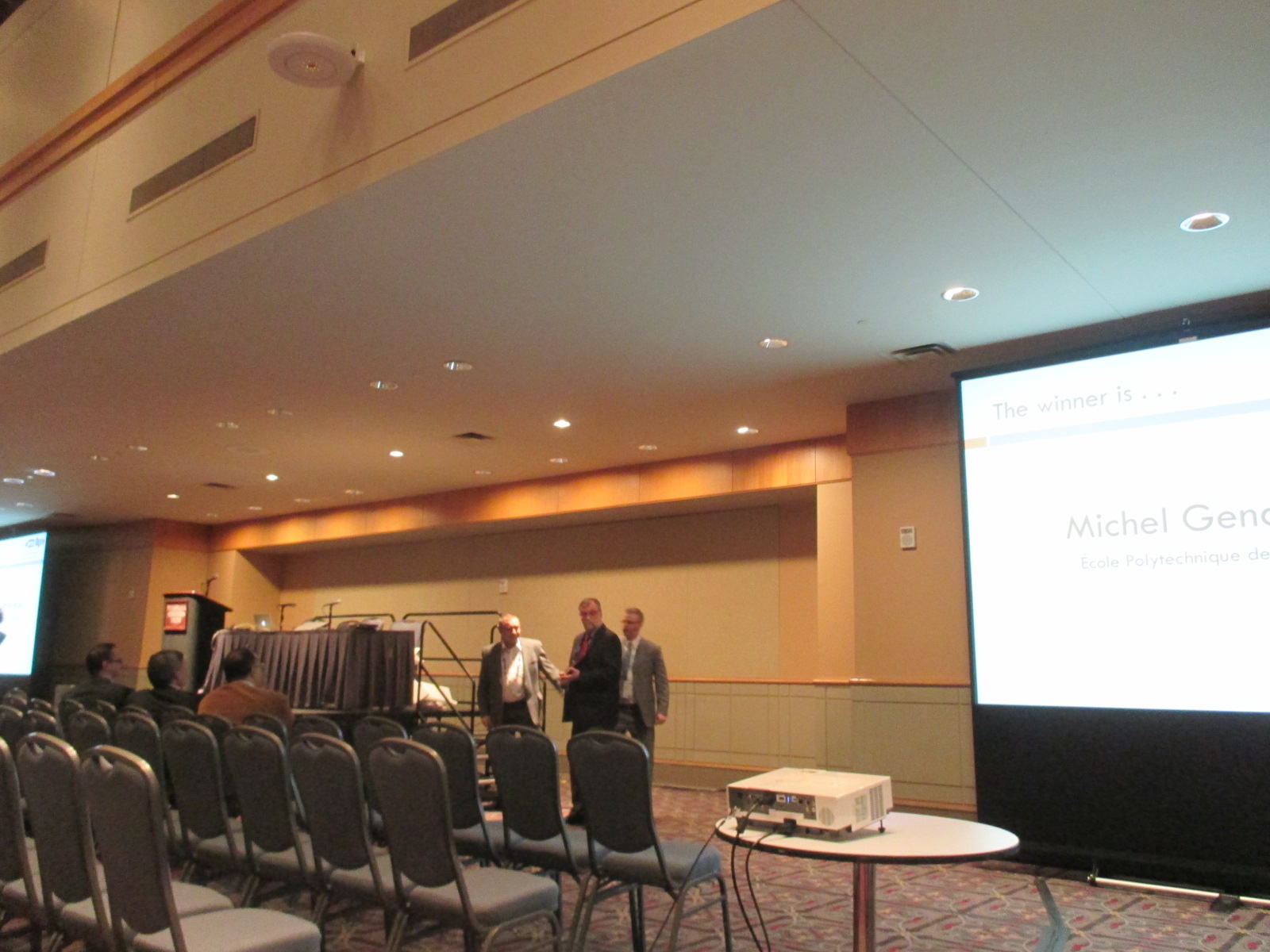
Paper number 9 on this list is: A Tabu Search Heuristic for the Vehicle Routing Problem with Soft Time Windows, É Taillard, P Badeau, M Gendreau, F Guertin, JY Potvin, Transportation Science 31 (2), 170-186, 1997 . As I had mentioned earlier, vehicle routing is an extremely important class of transportation problems. The third author, Michel Gendreau, I have known and enjoyed speaking to, going back to my days as an Assistant Professor. And, for his exceptional work, Michel, at our most recent INFORMS meeting in Philadelphia, was honored with the Robert Herman Lifetime Achievement Award. I took the photo below at the TSL meeting there.
And for all of you who love air transportation, paper number 10 is: Flight String Models for Aircraft Fleeting and Routing, C Barnhart, NL Boland, LW Clarke, EL Johnson, GL Nemhauser, RG Shenoi, Transportation Science 32 (3), 208-220, 1998.  What a terrific group of co-authors! Nemhauser, I have already mentioned earlier, and the first author is Cynthia Barnhart, who is now the Chancellor of MIT. She is a member of the National Academy of Engineering, as are Ellis Johnson and George. Both Cynthia and Ellis we had the pleasure of hosting at the Isenberg School through our great UMass Amherst INFORMS Speaker Series. The photo below I took of Cynthia after her talk with our wonderful students at that time back in 2005.
Below is a photo of Ellis Johnson after his presentation at the Isenberg School in 2009. My colleague, Senay Solak, was a doctoral student of his at Georgia Tech, and continues to work on airline problems.
And since Nemhauser is a co-author, below I have posted a photo from last year's INFORMS Computing Society conference at which he gave a great keynote talk.

The twelfth paper on the list is: Self-Organized Pedestrian Crowd Dynamics: Experiments, Simulations, and Design Solutions, D Helbing, L Buzna, A Johansson, T Werner,  Transportation Science 39 (1), 1-24, 2005. I know the first author of this paper, since not only was he with Sheffi and me at the ETH Zurich Risk Workshop, which he was involved in organizing, but, last March, he was one of my hosts when I gave a plenary talk in Berlin, Germany! Below is a photo of Dirk Helbing at the workshop in Berlin last March before his talk.
Congratulations to all the authors of these classic papers and thanks for the opportunity to walk down Memory Lane!