Showing posts with label network equilibrium. Show all posts

Monday, September 29, 2025

Our Spatial Price Network Equilibrium Paradox Paper is Published

It was thrilling to see our paper, "A Spatial Price Network Equilibrium Paradox," published this past week in the Springer journal Optimization Letters!

The paper I co-authored with Ladimer S. Nagurney and Ismael Pour, who is one of my PhD students at the Isenberg School of Management. The work builds on the famous Braess Paradox and reveals through numerous examples that: the addition of a new route from a supply market to a demand market may result in the supply price being lowered; the route costs being increased, and the demand price (the price that the consumers pay) also being increased relative to their values prior to the route addition. This result shows that there could be negative effects for both producers and for consumers and is especially relevant to the case of agricultural commodities. Hence, farmers may suffer in terms of lower prices for their products, and consumers in terms of higher prices that they pay! It is, hence, critical to investigate the impacts of the supply chain network topology, from a network design perspective, that includes the route topology.

This paper was first presented at the conference in Halkidiki in honor of Professor Panos M. Pardalos: 

https://annanagurney.blogspot.com/2024/06/the-outstanding-pardalos-70-conference.html


Ismael also presented the paper at the INFORMS Annual Meeting in Seattle last Fall and the slide deck can be downloaded here: https://supernet.isenberg.umass.edu/visuals/INFORMS2024-Presentation-NPS.pdf

The paper went through two revisions and can be accessed through the Springer journal website:

https://link.springer.com/article/10.1007/s11590-025-02244-y

We have done a lot of research on the Braess Paradox and even hosted the visit of Professor Dietrich Braess when I was a Science Fellow at the Radcliffe Institute for Advanced Study at Harvard University. More info on the paradox on the Supernetwork Center website: https://supernet.isenberg.umass.edu/braess/braess-new.html

Wednesday, May 18, 2016

Travel Route Choice Behavior - Green Way or the Congested Way

Moving to a new country, if only for a period of several months, is always very exciting for me and, since I arrived in Oxford, England almost 3 weeks ago to assume my Visiting Fellowship at All Souls College at Oxford University, I have had many wonderful experiences. I have enjoyed meeting other Fellows, doctoral students, staff members as well as colleagues from different universities at a conference and have been captivated by the beauty of the architecture as well as the gardens in this historic university town.
It has been so pleasant getting used to a new apartment, finding places to shop, and, would you believe, that I have not ridden in a car since the driver brought me from Heathrow London to Oxford almost three weeks ago and neither have I turned on the TV. Life here is just too interesting and there is so much to explore. The support provided by All Souls College with wonderful meals, fellowship, access to libraries, colloquia, and seminars at Oxford University, and its facilities, plus an office that overlooks a garden and fountain, have also given a great lift to my research work.
But, of course, I have to get to and from my office, which I do every day, including weekends that I am at Oxford.


The second day that I was in Oxford I purchased a monthly bus pass because I thought I might use the bus regularly and I do after evening college events.


However, I do love to walk, and, given the sumptuous meals (today, for  example, we had exquisite salmon, many salads, delicious carrots with nuts, and summer pudding filled with berries for lunch, for example) at All Souls College, one needs to exercise.


Now, which route should I choose to get to and from work as well as which mode of transportation. I am not renting a car and neither will I be biking in  although a wife of a deceased Visiting Fellow donated a bike for our use. I carry a brief case with papers and always an umbrella and riding a bike would be too cumbersome.


The first several days I walked the congested way on Iffley Road and then Henley Road and then noticed that I would cough. Also, there has been widespread coverage of pollutants in various cities, based on a study of the World Health Organization (WHO), including in Europe, especially with all the diesel vehicles, which, honesty, I could "feel." To walk the congested way took me thirty minutes.
Then I discovered the green way, which is via Meadow Lane, past a playground and elementary school, and past fields, and also Oxford University sports facilities such as a pool and track. This route takes me about 45 minutes but is preferable to me since I always get some great thinking done and arrive at my destination so refreshed and inspired - great exercise for mind and body and I have met several walkers along this way.
I have done a lot of research on travel choice behavior and multicriteria decision-making, weighting, for example, cost, time, and emissions generated.


Below are links to two of my papers on multicriteria travel decision-making.


Traffic Network Equilibrium and the Environment: A Multicriteria Decision-Making Perspective,
Anna Nagurney, June Dong, and Patricia L. Mokhtarian, in Computational Methods in Decision-Making, Economics and Finance, E. Kontoghiorges, B. Rustem, and S. Siokos, Editors, Kluwer Academic Publishers (2002) pp 501-523.


Multicriteria Network Equilibrium Modeling with Variable Weights for Decision-Making in the Information Age with Applications to Telecommuting and Teleshopping,
Anna Nagurney, June Dong, and Patricia Mokhtarian, Journal of Economic Dynamics and Control 26: (2002) pp 1629-1650.


This topic is part of a broader theme on sustainable transportation that I wrote a book on:
When the book was published in 1999 I received a nice letter from Vice President Al Gore, which hangs framed in my office at the Isenberg School of Management at UMass Amherst.


Now I believe that this work may benefit from another extension, and that is the inclusion of a criterion on health impact of your route choice. Not only do we in our choices of mode and route affect the environment, but we are also affected by it. And breathing diesel fumes and particulate matter is not good for living beings.


And, today,  I had the most unexpected, delightful conversation on the Braess paradox with Dr. Eric Panzer, who is  Fellow at All Souls College at Oxford and is a mathematician, and also with Professor Wolfgang Ernst, a law scholar. Both are Germans and Eric had even heard of the Braess paradox. We had tea together after the delicious lunch.


Sunday, January 24, 2016

The Most Impactful Papers in Transportation Science in 50 Years - A Walk Down Memory Lane

I was absolutely delighted when INFORMS sent out an announcement last Friday that it was making available for free download the 12 Most Impactful papers published in the journal Transportation Science in its 50 year history. These papers are listed below in chronological order.

According to the Transportation Science website: The selection was guided by the following principles. Even though overview and survey articles are important, valuable, and often highly cited, they were excluded. Highly cited papers (either in terms of total number of citations or in terms of number of annual citations) were prime candidates. However, the impact of an article is not always captured by the number of citations, so a few articles have been included because several editorial board members felt they needed to be. In the end, the articles represent most, but not all, the research areas that have contributed and continue to contribute to the success of the journal.

Seeing the list of papers brought back so many memories and the list includes such major themes in transportation as traffic assignment and network equilibrium, location theory, network design, and vehicle routing, plus even pedestrian crowd dynamics. Below, I reflect on the impact of the papers as well as the authors I have met and some I have come to know very well.

The first paper is: An Algorithm for the Traffic Assignment Problem, S Nguyen; Transportation Science 8 (3), 203-216, 1974. I met Sang Nguyen at the first conference I ever attended as a doctoral student at the University of Montreal. This paper, and those that followed, addressed algorithms for one of my favorite problems in transportation! The model formulated and solved was one in which you could reformulate the traffic assignment problem as a convex optimization problem.
  
The second paper,  On Stochastic Models of Traffic Assignment, CF Daganzo, Y Sheffi, Transportation Science 11 (3), 253-274, 1977, is another great classic.  Carlos Daganzo was the recipient of the 2013 Robert Herman Lifetime Achievement Award in Transportation Science. He was also elected into the National Academy of Engineering. He has supervised numerous doctoral students, many of whom are good friends of mine. Incorporating stochastic elements into traffic assignment was a big innovation. Yossi Sheffi I have known for many years and I had an office down from him when I was at MIT in the Center for Transportation under the Visiting Professorship for Women program. I am also a big fan of his books, including The Resilient Enterprise. The last time that I saw Yossi was in Zurich, Switzerland, when he and I were both invited speakers at the ETH Risk Workshop on Vulnerability and Resiliency of Supply Chains in September 2013.

Carlos Daganzo also has another paper on the list of classics, paper number 6: The Distance Traveled to Visit N Points with a Maximum of C Stops per Vehicle: An Analytic Model and an Application, CF Daganzo , Transportation Science 18 (4), 331-350, 1984

The third paper on this list of classics is especially near and dear to me since it is by my PhD dissertation advisor at Brown University, Stella Dafermos:  Traffic Equilibrium and Variational Inequalities, S Dafermos, Transportation Science 14 (1), 42-54, 1980. Here you can see who has cited this great paper. Seeing the list I had to reminisce since several of the papers I had co-authored with Stella and many others with my doctoral students as well as collaborators appear there.

Below, in her memory, I have posted two photos of Stella.

The first one below,  was taken when I was with Stella at a conference in her beloved Greece, back in 1987. The second photo was taken at the International Mathematical Programming Symposium, August 28-September 2, 1988, in Tokyo, Japan. I am sure that many of you recognize that we are standing with George L. Nemhauser (more on George later in this post. Sadly, Stella passed away on April 4, 1990. Her legacy lives on.
Since the above three papers were also influenced by the book, Studies in the Economics of Transportation, Beckmann, McGuire, and Winsten (1956), I had to include below a photo of myself with Beckmann (who was on my dissertation committee at Brown) on the beach in Australia, taking a break at one of my favorite workshops ever in Mallaccootta. This photo was taken in December 1992.
Daganzo is not the only one with two papers on this esteemed list. A hearty congratulations also go out to Mark Daskin. He also has two, the first being:  A Maximum Expected Covering Location Model: Formulation, Properties and Heuristic Solution, MS Daskin, Transportation Science 17 (1), 48-70, 1983 and the second paper being number 11:   A Joint Location-Inventory Model, ZJM Shen, C Coullard, MS Daskin, Transportation Science 37 (1), 40-55, 2003. Mark is renowned for his work in location theory. I have served on several committees with him and also applaud him for his support of females in OR/MS! The second co-author in the paper above is a female. Below is a photo of Mark with transportation colleagues that many of you will recognize (Marius Solomon, Gilbert Laporte, Teo Crainic, and Hani S. Mahmassani). We awarded Michael Florian the Robert Herman Lifetime Achievement Prize that year.
The next classic paper on the Transportation Science list is: Network Design and Transportation Planning: Models and Algorithms, TL Magnanti, RT Wong, Transportation Science 18 (1), 1-55, 1984. This paper as all the others on the list is fundamental and tremendously inspiring and, may I even say, useful! Tom Magnanti, another NAE member among  authors on this list, needs no introductions. Wong was his student at MIT. Tom was a great friend and mentor to Stella Dafermos and continues to be to numerous colleagues in Operations Research and Transportation Science.

The next paper was written by another co-author of mine:  A Column Generation Approach to the Urban Transit Crew Scheduling Problem, M Desrochers, F Soumis,  Transportation Science 23 (1), 1-13, 1989. When I was a Visiting Scholar at the Sloan School at MIT in 1989-1990, I had the pleasure of interacting with Magnanti, Orlin, and so many faculty who are not only outstanding but so nice! Francois Soumis was also a visitor at MIT at that time and we wrote the paper: A Stochastic Multiclass Network Equilibrium Model, which was published in Operations Research.

The next classic paper is:  The General Pickup and Delivery Problem, MWP Savelsbergh, M Sol, Transportation Science 29 (1), 17-29, 1995. Savelsbergh and I were elected INFORMS Fellows in 2014 with some other wonderful colleagues.

And, speaking of academic small world phenomenon, Savelsbergh is a co-author, with one of my former doctoral students, Dmytro Matsypra, of a paper on network design!

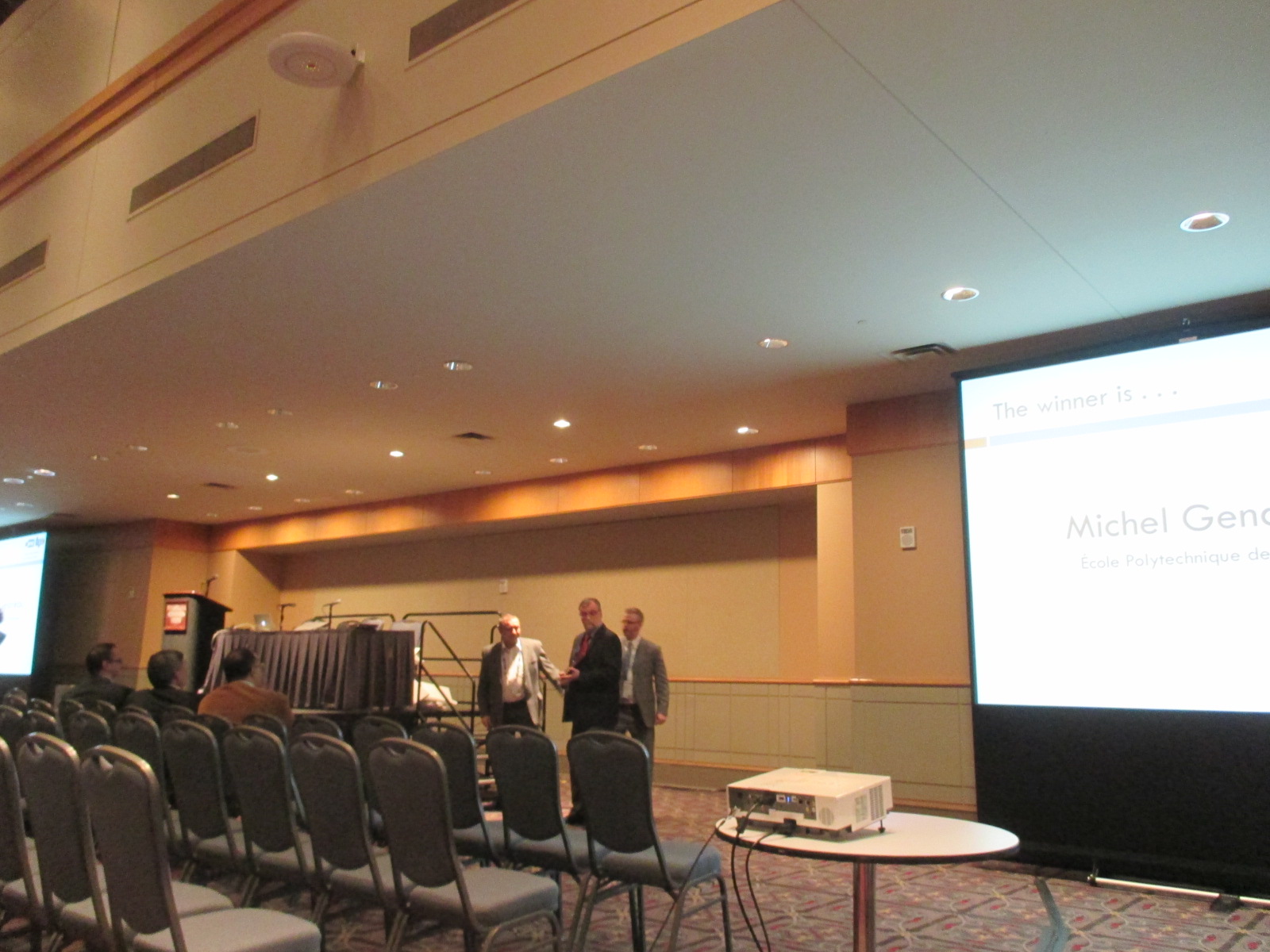
Paper number 9 on this list is: A Tabu Search Heuristic for the Vehicle Routing Problem with Soft Time Windows, É Taillard, P Badeau, M Gendreau, F Guertin, JY Potvin, Transportation Science 31 (2), 170-186, 1997 . As I had mentioned earlier, vehicle routing is an extremely important class of transportation problems. The third author, Michel Gendreau, I have known and enjoyed speaking to, going back to my days as an Assistant Professor. And, for his exceptional work, Michel, at our most recent INFORMS meeting in Philadelphia, was honored with the Robert Herman Lifetime Achievement Award. I took the photo below at the TSL meeting there.
And for all of you who love air transportation, paper number 10 is: Flight String Models for Aircraft Fleeting and Routing, C Barnhart, NL Boland, LW Clarke, EL Johnson, GL Nemhauser, RG Shenoi, Transportation Science 32 (3), 208-220, 1998.  What a terrific group of co-authors! Nemhauser, I have already mentioned earlier, and the first author is Cynthia Barnhart, who is now the Chancellor of MIT. She is a member of the National Academy of Engineering, as are Ellis Johnson and George. Both Cynthia and Ellis we had the pleasure of hosting at the Isenberg School through our great UMass Amherst INFORMS Speaker Series. The photo below I took of Cynthia after her talk with our wonderful students at that time back in 2005.
Below is a photo of Ellis Johnson after his presentation at the Isenberg School in 2009. My colleague, Senay Solak, was a doctoral student of his at Georgia Tech, and continues to work on airline problems.
And since Nemhauser is a co-author, below I have posted a photo from last year's INFORMS Computing Society conference at which he gave a great keynote talk.

The twelfth paper on the list is: Self-Organized Pedestrian Crowd Dynamics: Experiments, Simulations, and Design Solutions, D Helbing, L Buzna, A Johansson, T Werner,  Transportation Science 39 (1), 1-24, 2005. I know the first author of this paper, since not only was he with Sheffi and me at the ETH Zurich Risk Workshop, which he was involved in organizing, but, last March, he was one of my hosts when I gave a plenary talk in Berlin, Germany! Below is a photo of Dirk Helbing at the workshop in Berlin last March before his talk.
Congratulations to all the authors of these classic papers and thanks for the opportunity to walk down Memory Lane!
 

Friday, April 17, 2015

Being an Operations Research Paradigm Changer

I do believe that female voices need to be heard and not silenced and that is one of the reasons that I started this blog over 5 years ago.

This week I had to recall Stella Dafermos, since her birthday was April 14, and, since she was born in 1940, had she lived, she would have been 75 years old this year!

Stella Dafermos was my dissertation advisor at Brown University and she was the second female PhD in Operations Research in the world. She passed away on April 4, 1990 - 25 years ago, which is shocking. I spoke with Dr. Elise Miller-Hooks this week, who is now at NSF as a Program Director, and on leave from the University of Maryland. Elise was instrumental in having a Best Paper Award named in honor of Stella at the Transportation Research Board (TRB) Annual Meeting in DC. The first recipient of this award was Dr. Tao Lin of Virginia Tech for a single-authored paper but Elise told me that the web developer left and, hence, sadly, there has not been a big official announcement of the award

Stella was an Operations Research Paradigm Changer and I would say even a Research Paradigm Changer with her tremendous contributions to variational inequality theory, models, and algorithms, which allowed for the formulation, analysis, and rigorous solution of more general traffic network equilibrium problems that had, to that point been possible. The applications of variational inequalities now transcend operations research and transportation science and are fundamental to supply chains, game theory, regional science,  economics and finance, as well as ecology.

I am delighted that the book by Boyce and Williams, the cover of which is featured below, will be available soon.

Chapter 7 in the book, which I had the pleasure to review and comment on because Professor David Boyce forwarded me the draft to read over,  emphasizes the contributions of Stella to Transportation Network Equilibrium and I was delighted to see several of our joint papers cited.

Stella, to this date, remains the only female whose memory and contributions are honored by the premier journal Operations Research with an obituary,  that I wrote.

It's research that is a paradigm changer that is truly brilliant! Her legacy continues to impact both research and practice in complex network and decision-making. She set the highest standards, which I try to impart to my students now.


Friday, May 2, 2014

A Collaboration of 3 Academic Generations on E-Cycling + Sustainable Supply Chains

We recently received some great news.

Our paper, "When and for Whom Would E-Waste be a Treasure Trove? Insights from a Network Equilibrium Model of E-Waste Flows," was accepted by the Editor of the International Journal of Production Economics (IJPE) for publication.

This paper was co-authored by Professor Tina Wakolbinger of the Vienna University of Economics and Business in Austria, Professor Fuminori Toyasaki of York University in Canada, Thomas Nowak, a doctoral student being supervised by Professor Wakolbinger, and me.

Both Tina and Fuminori were my former doctoral students in Management Science at the Isenberg School of Management and worked in my Supernetwork Laboratory so this collaboration across three countries and three academic generations is extra special. Fuminori and I had earlier written the paper, "Reverse Supply Chain Management and Electronic Waste Recycling: A Multitiered Network Equilibrium Framework for E-Cycling,"  which was published in Transportation Research E in 2005, and it continues to be one of my most highly cited papers according to Google Scholar.

The abstract of our IJPE  paper is reprinted below.

Abstract:
E-waste is the fastest growing waste stream. Due to its potential economic value as well as its possible negative impacts on the environment, tracing e-waste  flow is a major concern for stakeholders of e-waste management. Especially, whether or not adequate amounts of electrical and electronic equipment waste (WEEE)  flow into the designed recycling systems is a fundamental
issue for sustainable operations. In this paper, we analyze how technical, market, and legislative factors influence the total amount of e-waste that is collected, recycled, exported and (legally and illegally) disposed of. We formulate the e-waste network  flow model as a variational inequality problem.

The results of the numerical examples highlight the importance of considering the interaction between the supply and the demand side for precious materials in policy-decisions. Low collection rates of e-waste lead to low profi ts for stakeholders and they make it difficult to establish sustainable recycling operations. Increasing WEEE collection rates increases recyclers profits; however, it only increases smelters' profits up to a certain limit. After this limit smelters cannot benefit further due to limited demand for precious materials. Furthermore, the results emphasize the importance of establishing international control regimes for WEEE  flows and they show possible negative consequences of the recent trend of dematerialization. More precisely, product dematerialization tends to decrease recyclers' and smelters' profits as well as increase out flow of e-waste from the designated recycling system.

Isn't it great to have research on sustainable supply chains capture the imagination of several academic generations?!

The photo above, taken in a cafe in Vienna, Austria,  is of Thomas Nowak, Professor Toyasaki Professor Wakolbinger, and two other former doctoral students of mine, Professor Dmytro Matsypura of the University of Sydney in Australia, and Professor Jose Cruz of the University of Connecticut.

Mother's Day is just around the corner and I am a very proud Academic MOM!


Sunday, February 2, 2014

60 Years of Urban Travel Forecasting - Traffic Continues to Fascinate

It is hard to miss all the recent news about transportation and traffic,  including the (in)famous so-called "traffic study" in New Jersey that closed lanes, which, in turn,  resulted in huge traffic jams on the George Washington bridge connecting the state of New Jersey with New York, lasting 4 days, and which has now even made international news as reported by the BBC.   The lane closures, it  seems, were instrumented under the guise of studying traffic flows, but, in reality, it is being alleged, they  were to punish the mayor of Fort Lee for "misallegiance." The scandal has even damaged the reputation and standing of the governor of New Jersey, Mr.  Christie,  a potential candidate for the 2016 Republican presidential nomination.

Who would have thought that traffic mis(management) could be a political weapon or even the downfall of government officials?!

Travel forecasting, that our New Jersey "leaders" might have benefited from, has actually been studied for over 60 years!

And, there is a new book being written, a U.S. - U.K. collaboration between Professors David E. Boyce and Huw Williams, which, I am told, is nearing completion on this very topic. I was contacted by Professor Boyce a few weeks ago to review Chapter 7 of the book, which, I believe, will be published by Edward Elgar Publishing, and should be about 700 pages! Chapter 7 is on Transportation Network Equilibrium, a topic very near and dear to me. What I especially like about this chapter (and book) is the tracing of the intellectual history of the various discoveries in terms of mathematical model building and algorithms, coupled with tensions between academics and practitioners, in a sense, in that the former want to get the latest advances into practice as soon as possible with many challenges along the way.

Professor Boyce is a great colleague and mentor, and renowned in transportation circles, having received  the Robert Herman Lifetime Achievement Award in Transportation Science. He is also an INFORMS Fellow and an RSAI Fellow. I have not (yet) met his co-author,  Professor Huw Williams, although I know of his work. Last Fall, Boyce gave the talk, Urban Travel Forecasting: A 60 Year Retrospective, at the Royal Institute of Technology in Stockholm, Sweden, and  he gave me permission to post it on the Virtual Center for Supernetworks website, since I found it so fascinating. He has been periodically, as time passes, updating this talk.

You can access his presentation, in pdf format, here.

Seeing photos of such luminaries as Martin Beckmann, Dan McFadden at the Nobel ceremonies with Moshe Ben-Akiva,  John Wardrop, plus Michael Florian in the slides (with a surprise photo of Suzanne Evans and me), was a great trip in nostalgia. And, I also enjoyed David Boyce's great sense of humor as the two slides below, taken from his talk, reveal.


And, for all those researchers and practitioners out there in operations research, and transportation science, see what remains to be done below!
And for a musical rendition of the New Jersey traffic jam,  enjoy the video with Bruce Springsteen and Jimmy Fallon below.
http://www.latenightwithjimmyfallon.com/video/bruce-springsteen-and-jimmy-fallon-gov-christie-traffic-jam-born-to-run-parody/n45079/

Thursday, August 16, 2012

Competing with Time -- Supply Chain Networks and Game Theory

Who does not feel pressed for time -- whether dealing with deadlines, juggling family and work responsibilities, and/or just finding time for exercise and some leisure pursuits?

Firms and organization are also pressed for time -- products that are produced and delivered that are spoiled, out-of-date, or out of style and fashion will just waste away on shelves and yield no revenues.

Supply chains today span the globe and provide the infrastructure for the production and delivery of goods and services, with more knowledgeable consumers demanding timely deliveries, despite, paradoxically,  the great distances that may be involved.  Indeed, delivery times are becoming a strategy, as important as productivity, quality, and even innovation. Smart firms have realized that speed of product delivery is a competitive advantage.

Whether in manufacturing (especially in build-to-order and made-on-demand industries such as certain computers, electronic equipment, specific cars, airplanes, furniture, etc.) or in digitally-based production and delivery (DVDs, online shopping, online content distribution, etc.) speed and consistency of delivery time are two essential components of customer satisfaction, along with price.

Stalk, Jr., in his seminal Harvard Business Review 1988 article, ``Time - The next source of competitive advantage," utilized the term time-based competition, to single out time as the major factor for sustained competitive advantage. Today, time-based competition has emerged as a paradigm for strategizing about and operationalizing supply chain networks in which efficiency and timeliness matter.

In a recent paper, A Supply Chain Network Game Theoretic Framework for Time-Based Competition with Transportation Costs and Product Differentiation, Anna Nagurney and Min Yu, we  developed a game theoretical framework for supply chain network time-based competition, which has the following features:

  • Firms are assumed to be spatially separated and can compete both on the production side and on the demand side;
  • Firms compete in an oligopolistic manner and, hence, influence the prices;
  • The time consumption of both production and transportation/shipment supply chain activities is made explicit;
  • The strategic variables of the firms are quantity variables and delivery time variables, and
  • Consumers at the demand markets for the substitutable, but differentiated, products respond to both the quantities of the products and to their delivery times, as reflected in the prices of the products.

In addition, by capturing the total cost associated with delivery times of each firm, along with their production costs and their transportation costs in their respective objective functions, the marginal cost of time can be quantified in this more general competitive supply chain network framework.

The governing equilibrium concept in our supply chain game theory model was that of Nash equilibrium. By using the theory of variational inequalities we could not only formulate the problem but also effectively and efficiently solve it.

 It is not only what you produce and deliver  -- knowing how long it will take to get to your customers is information that firms need and that customers respond to, through their wallets.

Saturday, January 1, 2011

Happy New Year for Business Analytics and Operations Research with Resolutions!

I hope that you have recovered from your New Year's Eve celebrations and are off to a fabulous start of the New Year!

Due to the blizzard of 2010, my family and I did not make it to NYC (and neither could many of our friends fly in) so we will not be attending the Salute to Vienna New Year's Concert 2011 in Lincoln Center with a ballet from Ukraine today, but my 92 year old uncle, who now lives in Manhattan, and was one of only three employees to show up at the bridge design engineering firm where he still works last Monday, will be there!

So, instead of being in NYC, I began 2011 in Amherst with a big bowl of blueberries, Greek yogurt, and muesli, and a delicious cup of Starbuck's coffee (a Christmas gift) and settled down to checking my email when my attention got pleasantly diverted from all the e-list renewals by the blogpost, New Year's Resolutions from Dr. O.R. Field, by Dr. Mike Trick.

I had reflected on last year's events in a recent blogpost, and, frankly, marveled at how many of the highlights were professional conferences around the globe where not only do colleagues reconnect and present their latest scientific discoveries but also exchange personal and professional stories and they do so in exciting venues.

Mike Trick, in his on target post, written with a lot of wisdom and humor, in an interview format, nails the celebratory events of our profession and calls them parties, right in the spirit of the season! He writes: Look at the parties I throw every year (that is “professional meetings” when discussing reimbursements with department heads). The last party I threw in Austin drew more than 4600 people! I remember ten years ago I would hold two parties a year and be lucky to get 2000 at either one of them. Any (of) my European parties (and what parties they are!) are also breaking records every year.

I concur and when I think of what I am looking forward to 2011 -- tops are the terrific conferences that will take place in 2011!

Thanks also to Mike for bringing out the fact that females add so much to both the leadership of INFORMS as well as to so many of its fun and rewarding professional activities from panels organized by WORMS to one of my favorites at the annual INFORMS conference -- the WORMS luncheon (which is a must get-together for many of our PhD graduates, male or female).

The success of Operations Research and Business Analytics is based on the discoveries, achievements, and accomplishments of its professionals, and the numbers (including students) that are attracted to it. The challenges facing our world today cannot be fully addressed nor resolved without the brainpower (past, present, and future) of our field.

The downside of the blizzard and the transportation disruptions was that we did not go to NYC; the upside was that we stayed back in Amherst to a landscape of great snow-covered beauty and tranquility and I wrote a paper on a topic that I had been researching for over a year. All the pieces fit together from the theory to the algorithm and the numerical examples and I was able to show the equivalence between two network equilibrium systems in economics and ecology and the paper cites the first paper (on spatial price equilibrium) that I ever published in the journal Operations Research and it was with my dissertation advisor at Brown, Stella Dafermos. There is nothing like the "Aha!" moment, which makes one soar intellectually (and emotionally)!

So when the going gets tough, go and do research!

Let me end with the beginning quotes from Oh! The Places You'll Go! by the incomparable Dr. Seuss, the nom de plume of Theodor Seuss Geisel, who was born and raised in Springfield, Massachusetts, graduated from Dartmouth College, and received his doctorate from Oxford University:

Congratulations!

Today is your day.
You’re off to Great Places!
You’re off and away!

You have brains in your head.
You have feet in your shoes.
You can steer yourself any direction you choose.
You’re on your own. And you know what you know. And YOU are the guy who’ll decide where to go.

You’ll look up and down streets. Look’em over with care. About some you will say, “I don’t choose to go there.” With your head full of brains and your shoes full of feet, you’re too smart to go down a not-so-good street.

And you may not find any you’ll want to go down. In that case, of course, you’ll head straight out of town. It’s opener there in the wide open air.

Out there things can happen and frequently do to people as brainy and footsy as you.

And when things start to happen, don’t worry. Don’t stew. Just go right along. You’ll start happening too.

Oh! The Places You’ll Go!

You’ll be on your way up!
You’ll be seeing great sights!
You’ll join the high fliers who soar to high heights.

Happy New Year to everyone!