Showing posts with label supply chains.. Show all posts

Friday, April 30, 2010

The Last Spring 2010 Lecture in Operations Research / Management Sciences


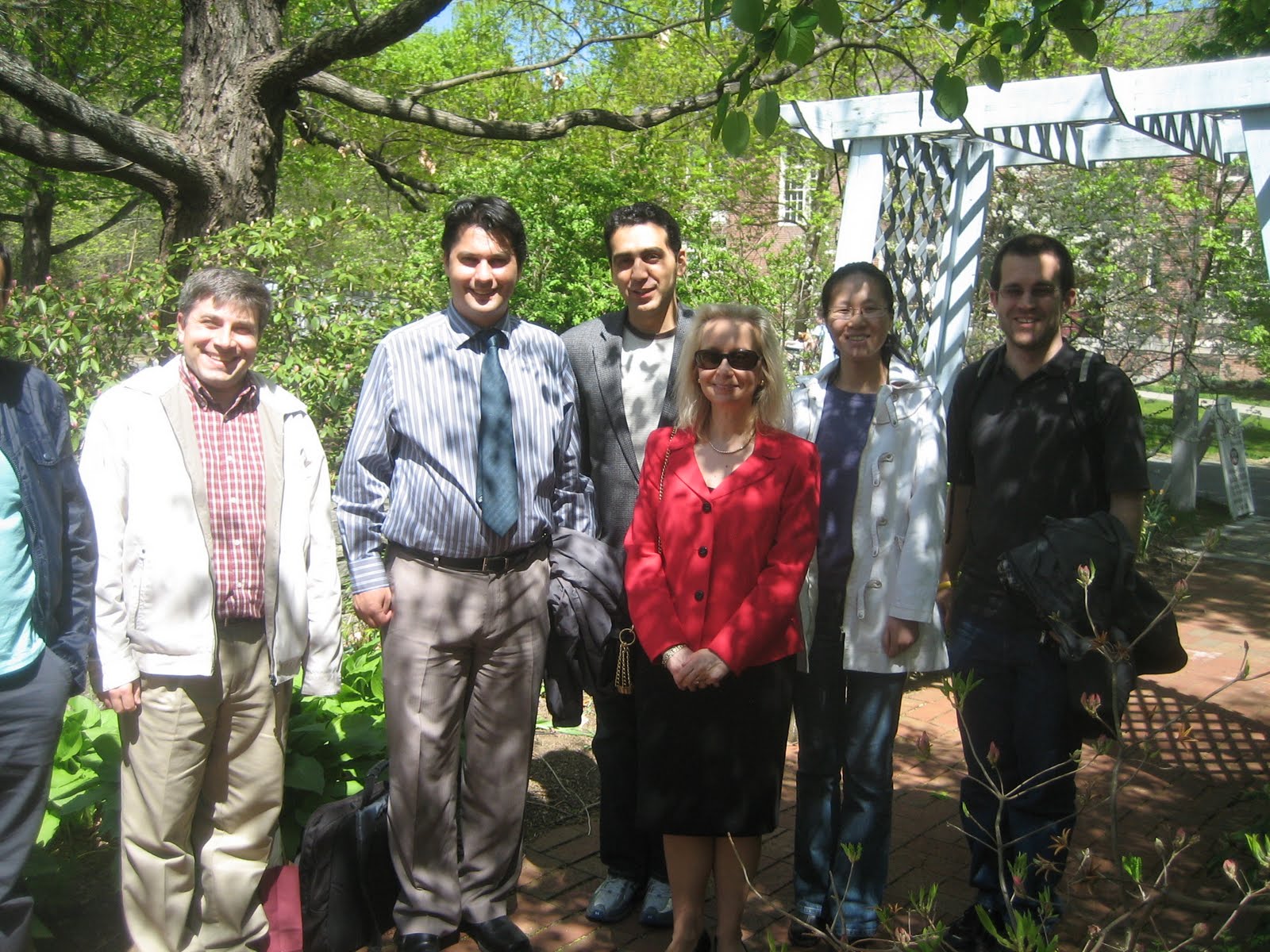
Today we were treated to a wonderful lecture by Professor Mehmet Gumus of the Desautels Faculty of Management at McGill University in Montreal, Canada. Professor Gumus concluded our Spring 2010 Speaker Series in Operations Research / Management Sciences
with a lecture on supply chains, information asymmetry, and agreements between a buyer and a reliable and a not reliable suppliers. He brought in such issues as visibility and insurance and considered uncertainty associated with the capacities of the suppliers. His results were very interesting and well-presented.

The lecture was a fitting conclusion to a wonderful Spring Speaker Series and to a wonderful set of talks that we hosted all year.

As the Faculty Advisor to the award-winning UMass Amherst INFORMS Student Chapter, I thank all of our terrific guest speakers, and commend the chapter officers and members.

Next Tuesday, we will be recognizing our chapter officers as well as staff members who have been so helpful to our chapter's activities all year at a party at the Isenberg School at UMass Amherst.

Above are some photos taken during Professor Gumus' visit on a simply spectacular April day.

Tuesday, February 16, 2010

Mergers and Acquisitions, Energy and the Environment

The New York Times is reporting that the number of mergers and acquisitions of energy companies is growing and that energy companies are increasingly seeking to acquire new sources for energy exploration. Companies are focusing on buying small, growing companies or on acquiring companies that expand their reserves in a period in which it is hard for them to find new places to drill. Targeted companies include companies in Africa as well as those that control drilling fields in deep waters in the Gulf of Mexico.

A recent study of ours, Environmental and Cost Synergy on Supply Chain Network Integration in Mergers and Acquisitions, that I co-authored with Dr. Trisha Woolley, appears in the recent volume, Sustainable Energy and Transportation Systems, Proceedings of the 19th International Conference on Multiple Criteria Decision Making, Lecture Notes in Economics and Mathematical Systems, M. Ehrgott, B. Naujoks, T. Stewart, and J. Wallenius, Editors, Springer, Berlin, Germany (2010) pp 51-78. In this paper, we developed a multicriteria supply chain network model to assess the possible cost and environmental synergies associated with supply chain network integration as in mergers and acquisitions. This work has direct relevance to energy companies who are considering whether to acquire or merge with an existing energy company (or not).

We have also (with Woolley and Dr. Patrick Qiang) developed metrics to assess the synergy associated with the supply chain network integration of multiproduct firms in the case of mergers and acquisitions. That paper, entitled, Multiproduct Supply Chain Horizontal Network Integration: Models, Theory, and Computational Results, will appear in the journal International Transactions in Operational Research.

Never Miss a Good Crisis -- Siemens CEO on Leadership

USA Today has a marvelous article on and interview with Peter Loscher, the CEO of Siemens, a high tech company with over 400,000 employees, which is 162 years old! The article notes that Loscher's leadership is based on his moral compass and that he was hired by Siemens in 2007 to clean up the corruption. His resume is incredible and he served previously as CEO of Aventis Pharma, CEO of GE Healthcare Bio-Sciences, and President of Merck Global Human Health.

In the interview, Peter Loscher talks about growing up in a small Austrian village and of his father telling him to always act ethically and that being a good man will result in a good life.

Today, Siemens is considered to be a role model with Dow Jones ranking the company on its sustainability world index with the highest score of 100 (when it previously had earned a 0).

Loscher (there is an "umlaut" over the "o" in his name) offers this piece of advice: never miss a good crisis. Under his leadership, he certainly "cleaned house," and replaced half of Siemens' 100 top executives. He also emphasizes the importance of being trustworthy and of transparency.

Peter Loscher received his MBA from the Vienna University of Economics and Business Administration, which is actually the largest business school in Europe. I had the privilege of giving a talk at this university on March 10, 2009, and was hosted by Professor Manfred Fischer, a dear friend, and scholar in regional science. The presentation that I gave was entitled, Synergies and Vulnerabilities of Supply Chain Networks in a Global Economy.

My mother lived in Vienna during part of World War II, as did one of my uncles, so it was very special to visit and to speak at this renowned institution. Clearly, the Vienna University of Economics and Business Adminsitration is doing an outstanding job of educating leaders, as evidenced in Siemens CEO, Peter Loscher. Plus, having had a Distinguished Chaired Fulbright in Innsbruck, Austria, I welcomed a return to that gorgeous country. Of course, it was also wonderful that my Fulbright experience resulted in the matriculation of an Austrian student, Tina Wakolbinger, at the Isenberg School of Management at UMass Amherst. Dr. Wakolbinger became my second PhD student from Europe (with Dr. Stavros Siokos being my first). Dr. Wakolbinger, as Peter Loscher, comes from a small village in Austria, and she is now a Professor at the Fogelman College of Economics and Business Administration at the University of Memphis in Tennessee.

Tuesday, February 2, 2010

The Pooling of Resources for Humanitarian Operations

The New York Times has a very interesting, provocative article on the pooling of resources for humanitarian operations and, in particular, as applied to Haiti, but the topic is broader and relevant in other disaster and humanitarian relief contexts. The article is focused on the pooling of financial resources and notes that the Red Cross, although it did not have a large presence in Haiti prior to the earthquake, because of its brand name recognition, has received many more financial donations than has Partners in Health, which has had a large presence in Haiti, even before the earthquake struck on January 12, 2010.

The issue of financial donations to relief organizations and providing stakeholders with proper accounting of donations is an important one and two of my former doctoral students, who are now professors, Dr. Tina Wakolbinger and Dr. Fuminori Toyasaki, are actively researching this topic.

I would argue that cooperation among humanitarian organizations in relief operations is critical and I have written on this topic earlier in this blog. In particular, as was evident in Haiti, there were numerous demand points (and there still are) for such products as water, food, medicines, and tents and the networks of different organizations were not working together in a synergistic manner. Some of the issues were obviously ones of lack of communication and coordination. Nevertheless, when it comes to the pooling of resources, including financial ones, by being able to represent the various activities of the humanitarian organizations as networks, one can actually quantify the synergistic gains from cooperation.

In joint work with Dr. Trisha Woolley and Dr. Patrick Qiang, we have developed a synergy measure that can be used to assess the benefits of cooperation by sharing of network resources. The work is documented in a study entitled, "Multiproduct Supply Chain Horizontal Network Integration: Models, Theory, and Computational Results," which is in press in the journal International Transactions in Operational Research. I presented this work earlier at the humanitarian logistics conference that I had organized, under the auspices of the Rockefeller Foundation, that took place at its Bellagio Center.

Wednesday, January 13, 2010

Earthquake in Haiti and Critical Needs

The worst earthquake in two centuries hit Haiti, the poorest country in the western hemisphere, yesterday. The pain, suffering, and devastation are horrific. This natural disaster is creating havoc for humanitarian operations because of the destruction of much of the infrastructure, such as roads and hospitals, in the capital, which was the hardest hit. Interestingly, the World Food Program had stockpiled food supplies in Haiti in preparation for disasters, with hurricanes, being the most expected ones. It is now also airlifting food supplies. Haiti is on an island which is also home to the Dominican Republic.

Exactly one year ago, my daughter and her classmates at the Bement School in Deerfield, Massachusetts were packing up to go on their trip to the Dominican Republic to help out in an orphanage. This year's 9th grade class at Bement is also scheduled in early February to travel there. The airport in Santo Domingo in the Dominican Republic is now being utilized to assist in Haiti's recovery. Last year, with excitement and nervous anticipation, I let my daughter travel there on a community service mission, which deeply affected all those who took part. I wonder whether this year's trip will take place given the extreme seriousness of the disaster in Haiti. She had, this past weekend, completed a huge photo montage of memories from last year's trip to the Dominican Republic that a teacher was going to deliver to the orphanage. I, in the meantime, was busy working on a research paper with a co-author on the assessment of supply chain performance in the case of disasters (an ironically timely topic) for submission to a special issue of a journal on transportation network vulnerability.

Our hearts and prayers go out to all those affected by this earthquake.