Showing posts with label Red Cross. Show all posts

Thursday, September 10, 2015

Brilliant Lecture by Dr. George Karagiannis on Risk Assessment and Disaster Management

One of the best parts of the intellectual life at a university is the wonderful people -faculty, students, and staff - plus guest speakers that one interacts with.

Today, we had the great pleasure and honor of hosting Dr. George Karagiannis from the Technical University of Crete, who I had met last summer at the Dynamics of Disasters conference that I co-organized in Kalamata, Greece. When he told me that he would be in Boston this week to speak at the Coastal Disasters conference and was eager to also speak at UMass Amherst, I knew that this was an opportunity that we could not miss out on.

Through the assistance of the UMass Transportation Center, the UMass ITE Chapter, as well as the UMass Amherst INFORMS Student Chapter, and the Isenberg School of Management, his visit to our campus and his presentation were a great success. The title of his talk was: "Coordination by Design, or the Common Operational Picture: From Risk Assessment to Disaster Response." George has completed 2 national risk assessments - for Greece and Malta and has worked also with the Greek Red Cross and the training of workers of the German Red Cross. He has immense field experiene and he had the audience captivated.

I was a bit anxious since he was traveling from Boston via Peter Pan bus lines and his arrival was to be shortly after my Transportation and Logistics class was ending. I made it to the Fine Arts bus stop 2 minutes before the bus arrived and together we went to the University Club for a delicious lunch which was hosted by the Transportation group of the Department of Civil and Environmental Engineering (a big thank you).  Attending the lunch were: Professor and Associate Dean John Collura, Professor Eric Gonzales, and two former UMass Amherst INFORMS Student Chapter Presidents: Michael Prokle and Shivanii Shukla.

Faculty and students came to Dr. Karagiannis' talk from the Isenberg School of Management, the Department of Civil and Environmental Engineering, and the Department of Mechanical and Industrial Engineering.

We learned about civil defense and organization of military operations and how they differ from emergency preparedness and disaster relief today. In the former, the organization is always hierarchical whereas in the latter each involved organization can have a hierarchical structure but the key to success is coordination. In many disaster relief operations there can be dozens or even hundreds of organizations involved so information exchange and situational awareness and a common operational picture are essential. Nevertheless, even with the latest in software and ICT if there is not trust among the stakeholders, that is, if the network has not been built on relationships, then there will not be success. Also, the emergency managers must be trained accordingly in the use of technology. In addition, Dr. Karagiannis emphasized the importance of capturing real time data efficiently and then one can make use of operations research tools more effectively. But getting the data quickly is still a major challenge in disasters even with the prevalence of social media (which messages can be trusted?).

Coordination is imperative; otherwise, locations may receive relief materials in duplicate or supplies not needed whereas others have shortages or no relief supplies.

What is needed is Next Generation Emergency Management - in essence, a Dr. Spock from Star Trek.

He also emphasized the migrant crisis facing the European Union for the past several months which has greatly accelerated recently. He spoke of the European Commission as not being a political union and, hence, decision-making can be very protracted despite earlier studies of scenarios foretelling the migrant crisis, decision-making is hampered. There were even decisions made earlier as to where to build shelters.

Tools act as a bridge between people but it is the network connecting people that is essential for the success of emergency operations. And, as Dr. Karagiannis noted in his talk, there is a disaster striking somewhere in the world every week and every 3 weeks one that requires international intervention. Disasters cannot be managed just by throwing resources at them.

Needless to say, Dr. Karagiannis' brilliant lecture, filled with many vivid examples, including a crash in a tunnel (and which county/province would be responsible for relief) brought the issue out dramatically to the audience. This will be a talk that we will be discussing for a long time to come and it has stimulated many exciting research questions.

Sunday, April 26, 2015

Learning from Experts on Disaster Management


When it comes to learning and education there is nothing like hearing from front-line expert practitioners. When the topics to be covered include emergency preparedness and disaster response some of the top experts who have played a role in responding to emergencies both local and global are right here in the Pioneer Valley in western Massachusetts. This is a public thank you acknowledging their contributions and willingness to share their wealth of experiences with students in a course on Humanitarian Logistics and Healthcare that I taught this semester at the Isenberg School of Management.

The course, which has students from the Isenberg School, the College of Engineering, and the School of Public Health at UMass Amherst, covers all phases of disaster management from preparedness and mitigation to response and recovery. Those of us in western Massachusetts will never forget such recent “natural” disasters as the Springfield tornado on June 1, 2011, the once in a 500 year flood in Deerfield and surrounding areas due to Hurricane Irene in late August 2011, followed by the snowstorm in late October, 2011, which resulted in massive power outages, and Superstorm Sandy, which hit landfall in the U.S. on October 29, 2012, and is the second most costly natural disaster in the U.S. after Hurricane Katrina. And, of course, we will always remember the shocking Boston Marathon bombing of April 15, 2013, the suffering of the victims, and the heroism of responders.

On February 4, 2015, Ms. Debbie Wilson, a registered nurse from Lenox, MA, who is also a student at UMass Amherst, spoke on her experiences, over a 6 week period last Fall in Liberia, working with Doctors without Borders in battling the biggest outbreak of Ebola in history. She talked about helping to set up an Ebola treatment facility for 120 patients, the importance of medical supplies and equipment, which would have to be delivered from Geneva, Switzerland. She spoke about her personal experiences donning the special protective gear with hygienists who would then spray the chlorine on her after which she could carefully disrobe. She dealt with temperatures of 100 degrees, horrible rains, insufficient food for the staff - essentially making do with bread and mayonnaise with some ketchup for many meals. She described how they got rid of the medical waste by burning it in a pit. She emphasized the importance of logisticians, known as “logs” and her travel there, in itself, was a logistical feat. Ms. Wilson traveled by plane, truck, and canoe. Through her efforts and those of her fellow healthcare workers, the survival rate of Ebola patients was increased. She asks now that we not forget western African countries since the healthcare infrastructure there has been decimated since so many doctors and nurses died battling Ebola.

On February 11, 2015, Mr. Jeffrey Hescock, the Director for Emergency Management and Business Continuity at UMass Amherst since September 2013, spoke about protecting education, research, and the reputation of the university and how careful planning for sports events and other events on campus and periphery can enhance community building and minimize negative outcomes. In his previous position as the Emergency Management and Business Continuity Manager for the UMass President’s Office, Mr. Hescock was responsible for safely evacuating students and staff from UMass Dartmouth during the search for one of the Boston marathon bombers there. He described the shelters that were set up so that students, most of who are commuters, could reconnect with family members and friends. He also described the challenges of dealing with the immense media response to the events. Of course, given that we have had two university closings on Mondays this semester, due to major snowfalls, the students were also very interested in finding out who makes the decision to close the university. The emergency notification system, in particular, works very well. UMass has an excellent organization structure consisting of an emergency operations team as well as a business continuity and recovery committee and conducts not only table-top exercises but also field exercises such as the emergency sheltering exercise last spring at the Mullins Center, which also involved the town of Amherst.

Ms. Kim Goulette, the new Executive Director of the Pioneer Valley Red Cross spoke on February 23, 2015. The Red Cross provides immediate response to people in need because of disasters. Whether it is food, blankets, drinks, or even teddy bears for children in the near term, or shelter, food, and resources during the recovery phase, Red Cross volunteers are there to help. Ms. Goulette spoke about the big fire in Amherst last summer in an apartment complex at which she assisted after only about 1 week on the job. She described the role of the Red Cross in feeding the National Guardsmen who were deployed to eastern MA because of the multiple immense snowfalls this winter that disrupted lives, transportation, and other infrastructure. The Red Cross, which consists of 97% volunteers, provided soup, peanut butter & jelly sandwiches, coffee and hot chocolate to the Guardsmen. A group of volunteers began their journey from the new Springfield headquarters with all the red cross activities now consolidated under one rook at 2AM to delivery nourishment.

On February 25, 2015, Mr. Brian Rust, the Director of Security Services at Cooley Dickinson Hospital spoke. He had originally been scheduled to speak the week before, but had to deal with emergencies at the hospital, and they were not patient emergencies! Nothing like some real-life practice in disruption management. Cooley Dickinson Hospital, which was recently acquired by Mass General Hospital, is one of our community hospitals, serving about 200,000 people. It seeks to provide the best possible healthcare in an appropriate setting. He noted that the population always assumes that hospitals will be available, when needed. He emphasized how a hospital is supposed to be prepared to be self-sufficient post a disaster for 96 hours. This, of course, entails backup power generators, the stockpiling of essential supplies, which is challenging given a model of just-in-time daily deliveries of medicines, and possible needs for additional food. Hazard analyses are conducted each year to prepare for possible natural disasters, human hazards, and technological ones. He emphasized the importance of communications and building strong relationships with other hospitals, first responders, etc.

During the snowstorms this past winter, 70 staff slept at the hospital to make sure that there was appropriate patient coverage, since a storm could affect transportation. And, the week prior to his lecture at the Isenberg School, Mr. Rust had to deal with multiple emergencies, beginning with a computer failure on Monday, followed by complete communication failure on Wednesday (not related to the Monday one) with no Internet or phone lines available. Hence, medical records could not be accessed electronically, and X-rays could not be read. Back to documentation on paper. This major disruption was fixed on Wednesday but then Wednesday afternoon a sprinkler pipe burst and flooded the back of the Emergency Room with thousands of gallons of water pouring in. There is a new cancer facility being constructed above the Emergency Room area and it seems that the pipe was not properly insulated. With facility experts on hand (luckily, he said, not everything has been outsourced) in a few hours the area was cleaned up and disinfected. During that period, however, 4 ambulances had to be diverted to other hospitals.

On March 25, 2015, we had the pleasure of hearing Mr. Jeff Meyer, the CEO of Blood Services for the Red Cross in Massachusetts and Connecticut, who told us how he had been a consultant for the Red Cross and was offered a job with this organization the day before 9/11. After the terrorist attacks that horrific day, he decided that he wanted to help communities and accepted the job offer from the Red Cross. With an outstanding background in operations, including an MBA, he has helped the Red Cross in balancing supply and demand of this life-saving product that is also highly perishable and has dealt with many challenges in the changing economic landscape of blood supply chains.

On April 8, 2015, the students got to hear from SMSgt Thomas Orifice of the 104th Fighter Wing of the Air National Guard in Westfield. He came dressed in fatigues and had the students at the edge of their seats as he spoke about the response to Superstorm Sandy. Because NOAA had forecasted Superstorm Sandy one week before landing, major planning could be done in a timely manner and, within 24 hours, the Air National Guard had mobilized and delivered water, food, and fuel, which was direly needed since, with the loss of electricity, the gas pumps were not functioning and public transportation in NYC was at a standstill. Mr. Orifice has had an over thirty year career with the National Guard and has served in France Italy, Germany, and Kyrgyztan, and also took part in the liberation of Bosnia and Iraq Operation Freedom. 

And, on April 22, 2015, last,  but not least, the "other" Professor Nagurney (my husband), Dr. Ladimer S. Nagurney, who is a Professor of Electric and Computer Engineering and Biomedical Engineering, at the University of Hartford, spoke to the class on Disaster Communications, including the challenges of technology in this important domain, along with FirstNet.

Many thanks to the above Hometown Heroes, who took time out of their very busy schedules to share experiences with students – we are very lucky to have you in our midst.

Also, given that the number of disasters is growing, as well as the number of people affected by them, I have made the lectures, as well as many of the guest lecture presentations, available online.

Wednesday, April 8, 2015

Blood Services and the Red Cross Lecture

I am so pleased to report that the lecture by Mr. Jeff Meyer, the CEO of  Red Cross Blood Services for Massachusetts and Connecticut, which he delivered on March 25, 2015 to my Humanitarian Logistics and Healthcare class is now available and posted so that everyone can learn and benefit.

Many thanks to Mr. Meyer for his graciousness in allowing us to do this! I wrote up a summary of the lecture on this blogpost and I have heard from several readers who very much appreciated it.

The Red Cross is now marking the second anniversary of the Boston marathon bombings with blood drives.  And to further emphasize the importance of blood donations, in that article you can read that:


Bombing survivor Heather Abbott, who lost a leg, says she wouldn't have survived without the several units of blood she received. Transit police officer Richard Donohue, who was critically wounded in the police standoff with the bombers and needed 46 units of blood, is also urging people to give blood. 

Mr. Lou Wigdor, who attended Jeff Meyer's guest lecture, wrote this illuminating piece on it for the Isenberg School of Management website, Business Students Embrace Blood Supply Economics.

Read more here: http://www.bellinghamherald.com/2015/04/05/4225245/red-cross-marking-marathon-bombings.html#storylink=cpy

Mr. Meyer's talk and visit continue to generate many discussions as well as research ideas. But, then again, a speaker (without any prompting) who notes "network optimization" several times in his lecture, is definitely a kindred spirit!

Wednesday, March 25, 2015

Mr. Jeff Meyer, CEO of Red Cross Blood Services for MA and CT at the Isenberg School

Bringing expert speakers to share their practical know-how and experiences is fabulous for students' education!

Today we had the honor and privilege of hosting Mr. Jeff Meyer, CEO of Blood Services for the Red Cross for MA and CT, in my Humanitarian Logistics and Healthcare class at the Isenberg School of Management.

He was fabulous. First some background: Jeff received his undergrad degree at Babson and his MBA from UCLA's Anderson School of Management, where he focused on (bravo) operations management. How can you not love a speaker who comes in and starts talking about linear programming models and how in many of the team projects at UCLA students wanted to work on Red Cross projects because of the challenging problems.

Mr. Meyer drove almost 2 hours from Dedham to speak to my class and we kept him overtime for about 40 minutes because his knowledge of blood supply chains is vast. He has worked for the Red Cross for 16 years and, would you believe,  he was a consultant for the Red Cross and was offered a job with this organization the day before 9/11. He accepted the job since after the terrorist attacks (and he was in DC and could not get back home for a week) since he decided he wanted to help humanity.

He had worked in California for Red Cross blood services and was responsible for managing the construction of a $41 million facility for blood services in southern CA.

Mr. Meyer had the class (and me) on the edges of our seats informing us of how the demand for blood in the  U.S. has declined since 2008. He spoke of negative drivers and positive drivers and the consolidation of blood centers. The Red Cross now supplies about 40% of the blood in the US and has closed 3 of its 5 testing centers. He spoke about that there are "wet" surgeons and "dry" surgeons, with the former liking more transfusions whereas the latter utilizing fewer in their surgeries. He stated that in studies, more transfusions do not yield better outcomes.

He showed us a map of the US marking where there was Red Cross coverage and presence and as Mr. Lou Wigdor, our Isenberg School writer and editor noted, the white parts corresponded to the oil states!
 I was very impressed that he multiple times spoke about the importance of network optimization, since this is what we have been learning in the class for the past 2 weeks.

He also emphasized how efficiencies can be gained from having a bigger collection site (fewer vehicles needed and there is greater potential for good service and more spread out and comfortable service as donors arrive).  He noted that, although some perceive blood as being a commodity, it is not and there are many differentiated "products" that it provides.

The challenges of this supply chain are immense because of the perishability - with red blood cells having a shelf life of 42 days and platelets only 5 days. Platelets are needed to treat cancer patients and the demand for platelets is growing because of the aging population.

From 2008 and prior there were many cases of blood shortages in the U.S. but the scenario has changed due, for example, to the recession and fewer elective surgeries, more individual blood banking, and medical advances that result in less loss of blood.

He even described a Red Cross blood app which has been very successful - 80% of those who elect to give blood through the app show up for appointments whereas among  those who call for an appointment only 50% do. Clearly, there are also challenges with supply meeting demand and risk associated with donors not showing up.

Interestingly, he also shared with us that different hospitals may have different preferences even as to the kinds of testing that is done on the blood which can cost $200 per pint.

Out of $3billion in annual costs of the Red Cross, $2billion of that is for blood services.

I had done research on blood supply chains with my former doctoral students, Amir H. Masoumi and Min Yu:
Mr. Jeff Meyer brought out so many interesting research questions today in his brilliant lecture that we will be kept very busy.

I'd like to thank him for sharing with the class such illuminating insights about this life-saving supply chain, for which logistics plays a fundamental role.

Wednesday, January 21, 2015

Hosting Amazing Speakers in Humanitarian Logistics and Healthcare

Today is the first class meeting for my course, Humanitarian Logistics and Healthcare, a course that I taught last year at the Isenberg School. I have also taught an intense version of this course at the Vienna University of Economics and Business in Austria and have been invited to offer it there again.

Logistics is one of my passions and Humanitarian Logistics is a subject that is not only extremely timely but also very challenging from multiple perspectives. Hence, it is a topic that is interdisciplinary and is continuing to evolve.

An important, and much appreciated part of the course, by both students (and me), is the experts that I bring in to speak to the class. We all come prepared with many questions and benefit greatly from the speakers' expertise on the front lines.

This year, in the month of February alone, we will be hosting:

  • Ms. Deborah Wilson, a registered nurse, who worked on the
    frontlines of the Ebola crisis in Liberia with Doctors Without Borders.
  • Mr. Jeff Hescock, Director of University Emergency Management
    and Business Continuity at UMass Amherst.
  • Mr. Brian Rust, Manager of Security Services and Emergency
    Preparedness Coordinator at Cooley Dickinson Hospital.
  • Ms. Kim Goulette, Executive Director of the Pioneer Valley Chapter of the American Red Cross.
We are so grateful and appreciative to all the above experts for the time that they take out of their very busy schedules to come to the Isenberg School to share their experiences and lessons learnes with us!

I am looking forward to a very exciting class and a great semester!

Thursday, January 8, 2015

Looking Forward to Teaching My Humanitarian Logistics and Healthcare Course at Isenberg

I have been enjoying working on my lectures for my SCH-MGMT 597LG - Humanitarian Logistics and Healthcare course during this winter break. I will be offering this course for the third time at the Isenberg School of Management (and have even taught a very condensed version of it at the Vienna University of Economics and Business while I was on sabbatical).

Some of the topics that I will be covering are:
  • Commercial vs. Humanitarian Supply Chains
  • Disaster Management Phases from Preparedness to Recovery
  • Supply Chain Risk Management
  • Fundamental Issues in Humanitarian Logistics
  • Network Performance, Robustness, and Resiliency
  • Learning from Disasters – Business and Humanitarian Ones
  • An Integrated Disaster Relief Model
  • Perishable Product Supply Chains in Healthcare
  • Earmarking and Financial Funds
  • Critical Needs Supply Chains Under Disruptions. 
The course attracts students from the Isenberg School of Management, the School of Public Health, and the College of Engineering.  Experts who are practitioners in the subject domain provide the students (and me) with deep insights and personal experiences. Last year, we benefited from lectures by Mr. Rick Lee of the Red Cross, who has since retired, and who made a lasting impact on this organization and numerous people through his 30 years with this organization, and from Dr. Pierre Rouzier, our UMass sports team physician, who spoke on his efforts during the Boston Marathon bombing to save lives and post the Haitian earthquake. We also had the pleasure of hearing from Mr. Jeff Hescock, the Director of  University Emergency Management and Business Continuity, We heard from Mr. Dave Madsen, a renowned news broadcaster in western MA with over 40 years of experience. In addition, my husband, Professor Ladimer S. Nagurney, spoke on disaster communications.

I have done a lot of research in this area with several members of my supernetworks team so the lectures are always being updated and are very current. And, hot off the press, is our paper, 
An Integrated Disaster Relief Supply Chain Network Model with Time Targets and Demand Uncertainty, Anna Nagurney, Amir H. Masoumi, and Min Yu, in Regional Science Matters: Studies Dedicated to Walter Isard, P. Nijkamp, A. Rose, and K. Kourtit, Editors, Springer International Publishing Switzerland (2015), pp 287-318. This book volume also contains a paper by the Nobel laureate in Economics, Professor Paul Krugman.

We were so inspired by the speakers and the value that they added to the course and the students' knowledge that I wrote a Guest Editorial about these "Hometown Heroes." 

This year, we will also be covering the Ebola crisis in western Africa, and the lessons learned. 

I'll be periodically blogging about this course and the speakers this year, so do stay tuned and stay warm!

Friday, March 28, 2014

The Power of One

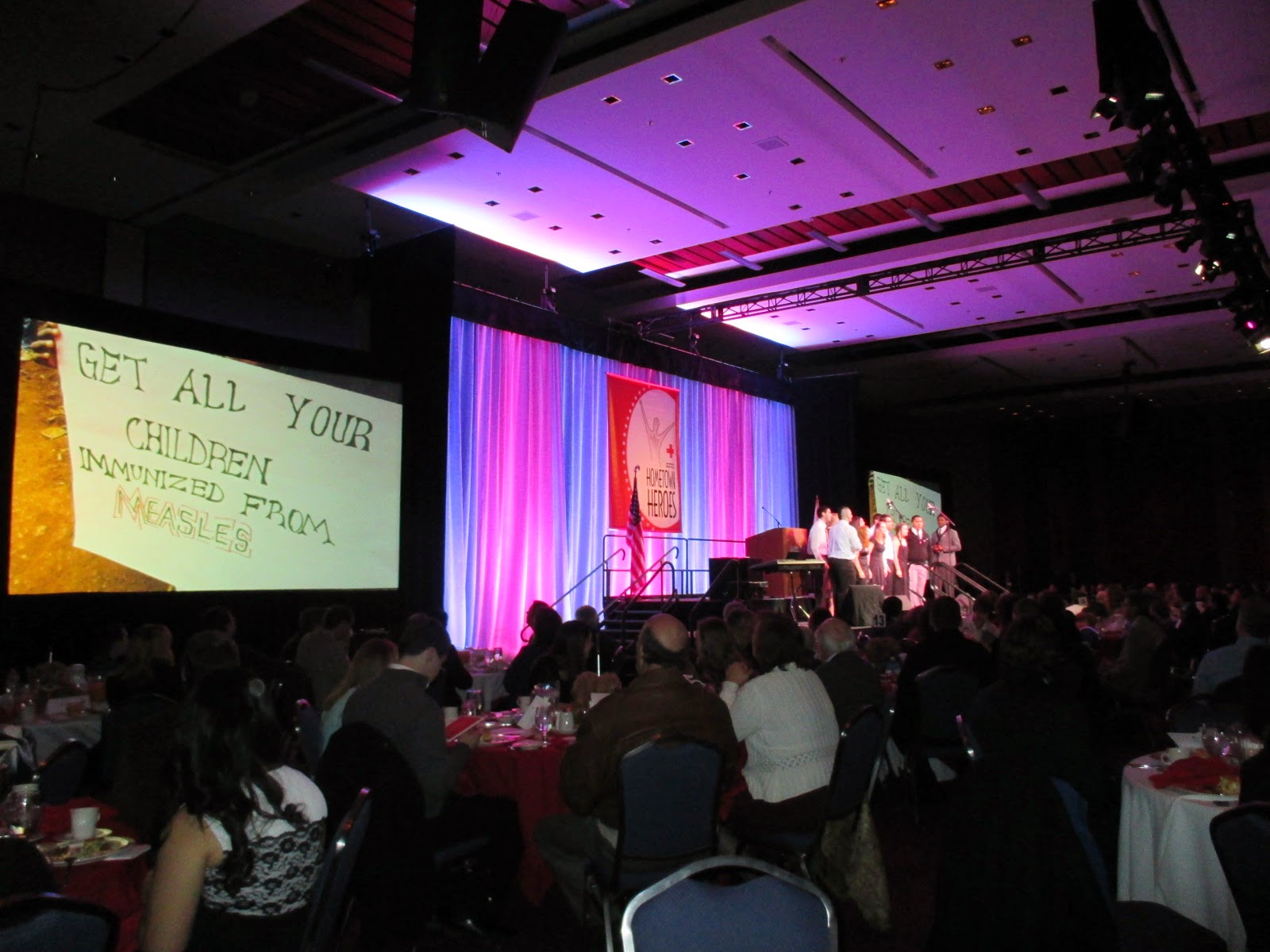
Yesterday, Nate Lare and I had the pleasure of attending the Hometown Heroes event at the Mass Mutual Center in Springfield, as guests of the Executive Director of the Pioneer Valley Chapter of the American Red Cross, Mr. Rick Lee.

Mr. Lee, along with several other community leaders and experts in emergency and disaster preparedness,  have spoken this semester in my Humanitarian Logistics and Healthcare class at the Isenberg School. I recognized them in a Guest Editorial that I wrote and that was recently published on masslive.com.

The Hometown Heroes event was truly inspiring with about 600 in attendance!

Eleven area residents were recognized by the Red Cross for "selfless acts of courage." A nice photo of these extraordinary individuals, including teenagers appears on masslive.com. Their acts, whether by giving blood hundreds of times, starting a sports program for disabled children, or, in the case of several individuals,  saving lives after accidents, fires, or health incidents, are exceptional!

I took the photos below at the event yesterday and commend the Red Cross for all that it does! Mr. Rick Lee announced at this event, at which he also received a Lifetime Achievement Award from the Red Cross for his 30 years of extraordinary service, that he will retire as of this August. Who will replace him?

The ending video to the theme and music of The Power of One was especially moving with many in the audience tearing up. It featured such extraordinary women as Clara Barton, Rosa Parks, and Anne Frank, with a segment on Mr. Rick Lee (which was a complete surprise to him). What a difference he has made through his work ethic, integrity, energy, and the building of powerful friendships and relationships. Who can say no to this amazing man!

So if, at times, you feel that you are all alone, know that you can, as the above individuals have, and the Hometown Heroes, as well, through The Power of One,  make a big difference. You can provide your students, colleagues, neighbors, and even strangers with a helping hand, a kind word, spiritual and physical sustenance, a smile, a token of appreciation, a congratulatory note, a conversation. Perhaps, through additional actions, research, writings, and a book you might even change the world! Never lose the courage to do what is right.

And, since, regrettably, the photo of  Mr. Rick Lee, Nate and me together at the event did not come out, I repost the photo taken of Mr. Rick Lee when he spoke to the students in my class this past February.
Nate is on the far left. And, to emphasize the amazing students in our Operations & Information Management program at the Isenberg School of Management at UMass Amherst that I am privileged to teach, Nate was a Hometown Hero in 2011 -- simply awesome! Nate alerted residents when a fire gutted their apartment complex.

Although this year's closing video is not online yet, I urge you to view last year's, which includes images of Clara Barton, Rosa Parks, and Anne Frank:


Wednesday, March 26, 2014

Hometown Heroes and Why I Wrote a Guest Editorial

Tomorrow morning, one of my Operations & Information Management students, who is in my Humanitarian Logistics and Healthcare class that I am teaching this semester, will be attending with me the Hometown Heroes event at the Mass Mutual Center in Springfield, MA.

We will be the guests of Mr. Rick Lee, the Executive Director of the Pioneer Valley Chapter of the American Red Cross, who spoke in my class in February.

The Pioneer Valley Chapter of the American Red Cross provides emergency response in Hampden, Hampshire and Franklin counties in western Massachusetts and is also behind a model call center for servicemen.

According to a lovely article in The Springfield Republican: The chapter created the Hometown Heroes program in the wake of the terrorist attacks of Sept. 11, 2001, Lee said. The idea was partially to help bridge gaps in funding left when so much charitable giving went to causes related to those attacks.
But the larger reason was, and remains, giving the community a way to honor people who go above and beyond to help others.

And in the beautiful words of Mr. Rick Lee:
"We are celebrating one of the most beautiful aspects of the human heart, which is kindness," Lee said.

This year 9 Hometown Heroes will be honored.

In addition to Mr. Rick Lee, this semester, we have hosted Mr. Jeff Hescock of UMass Amherst, Dr. Pierre Rouzier of UHS at UMass Amherst, Mr. Dave Madsen of WGGB, and even the other Dr. Nagurney, my husband, who gave a guest lecture on Disaster Communications.  The students and I were so inspired by these remarkable individuals that I wrote a Guest Editorial, Community Experts Enhance Disaster Management Education as Guest Speakers at the Isenberg School of Management at UMassabout their talks (with the exception of my husband's since he was guest lecturing when I was out of town), which was published the other day on masslive.com.

I had to thank these very special people in a public way and that is why I wrote the Guest Editorial, which also features a photo of Mr. Rick Lee with the students in my class.

In addition, the Isenberg School of Management posted a two-part series on this course focusing on the presentation of Dr. Rouzier and also that of Mr. Madsen. Many thanks to the Communications Department and especially to Mr. Lou Wigdor who attended these lectures and wrote them up so eloquently.

We have amazing people in our midst, which deserve special honors and recognition and among those I include the above individuals.

We look forward to seeing Mr. Lee of the Red Cross again tomorrow and honoring this year's Hometown Heroes for their exceptional courage!  Even two UPS drivers will be honored (perfect humanitarian logistics example!)

Wednesday, March 5, 2014

UMass Amherst INFORMS Student Chapter Presents Panel on Teaching

This semester I have been very busy teaching my course on Humanitarian Logistics and Healthcare and a Management Science seminar on Variational Inequalities, Networks, and Game Theory. Both of these courses are interdisciplinary with students from the Isenberg School of Management, the College of Engineering, the School of Public Health, and the Computer Science Department.

In a recent exchange with the President and CEO of the America Red Cross, Ms. Gail McGovern (we were communicating about the great guest lecture of Mr. Rick Lee in my course), she said many things that resonated with me but the below was especially beautiful:

Having come straight from teaching MBAs to the Red Cross, I know firsthand that yours is such a noble profession.  I still keep in touch with many of my students, and I'm proud of  every one of their accomplishments.  It's truly the gift that keeps on giving.

How very  true!

And, this Friday, our great UMass Amherst INFORMS Student Chapter will be hosting a special panel on teaching in which our very own PhD students in Management Science will be sharing their experiences with a lot of exciting Q&A and discussions I am sure.

Refreshments are at 11:00AM with the panel and discussion from 11:30-12:30 in Isenberg Room 128.

Please join us if you can.

The students  prepared the poster below. In this day and age, we need to all also be graphic artists.
 Some very valuable teaching also takes place outside of the classroom!

Friday, February 21, 2014

A Truly Inspiring Lecture by Mr. Rick Lee of the Red Cross at the Isenberg School

Yesterday, we had the distinct honor and privilege of hearing from Mr. Rick Lee, the Executive Director of the American Red Cross, Pioneer Valley Chapter.  He was a guest lecturer in the Humanitarian Logistics and Healthcare course that I am teaching this semester at the Isenberg School of Management.
Mr. Lee oversees 38 employees and 1,000 volunteers and was instrumental in the development of the Service to the Armed Forces (SAF) program with a focus on communications.

We heard about Henri Dunant, the Swiss businessman,  who led what became the international Red Cross movement in the mid 1800s, received a Nobel Peace Prize, but then lost his business and died as a penniless hermit in Switzerland. Mr. Lee spoke about the Geneva Convention and how it is imperative to inject humanity in the inhumane act of war. He also spoke about the amazing Clara Barton, all 5 feet and 90 pounds of her, who, after a trip to Switzerland, realized what needed to be done and, through her incredible leadership abilities, founded the American Red Cross. She did so in 1881 at age 60 and continued to lead it for 23 years!

The foundation of the Red Cross is trust and ethics and contact with donors and volunteers. The provisioning of food, shelter, evaluation of how bad it is, and communications to the public, are all aspects of Red Cross activities in disaster relief. Mr. Lee also emphasized that disaster relief is "a team sport." Interestingly, he also said that there is emphasis now on mitigation, as well.

We heard of the lessons learned from Hurricane Katrina and the need to understand different community groups and their roles as well as the great importance of communications with stakeholders.

We were very surprised to learn that since the Red Cross depends on financial donations, that if these were to stop, the Red Cross would shut down in only 180 days! My former doctoral students, who are now very successful international professors, Dr. Tina Wakolbinger and Dr. Fuminori Toyasaki, have done research on the modeling of financial flow of funds for disaster relief and the earmarking of donations.

We also heard about the tremendous role that the Red Cross played in sheltering and feeding hundreds of people for a month after the tornado hit Springfield, MA on June 1, 2011. He also emphasized how helpful private organizations are and can be in disaster relief by providing discounts for much-needed supplies, warehousing between disasters, and helping with deliveries. He singled out Walmart and Big-Y supermarkets and even noted hotels and motels who provide discounts for sheltering purposes.

He also emphasized the importance of buying locally and the importance of building relationships over time so that,  when disasters strike, one is ready. He even told us of free mobile apps for first aid and emergency preparedness offered by the Red Cross, including earthquake and tornado warning apps.

What is the power of one person? Clara Barton changed the world and over a century before the Internet. her impact continues to this day.

Mr. Lee, your presentation changed all of us. Thank you for being the heart and soul of our American Red Cross and our Hometown Hero!


Wednesday, January 29, 2014

Logistics Behind Scheduling Speakers for My Humanitarian Logistics Class

Having speakers come to campus is always a highlight and I have written a blogpost on "Tips for Organizing a Successful Speaker Series," which is one of my most popular ones.

Guest speakers also add tremendous value to a course!

This semester, I am offering, for the second time at UMass Amherst, a course on Humanitarian Logistics and Healthcare, with the syllabus available here. The course  has attracted students from the Isenberg School of Management, the School of Public Health, and the College of Engineering. One of the highlights of the course is the speakers that come to share their experiences with our students.

But, of course, scheduling speakers is a logistical exercise, because not only is it important to have them come when it makes sense in the course curriculum, but also practitioners in the space of disaster preparedness and emergency response are very busy people!

I am absolutely delighted that, in February, the students in my class will have the opportunity to hear from 4 experts: the new Director of Emergency Preparedness and Business Continuity at UMass Amherst, the Executive Director of the Red Cross of the Pioneer Valley,  a renowned doctor from the University Health Services who has done relief work in Haiti, post the devastating earthquake,  and also saved lives at the Boston Marathon bombing on April 15, 2013, as well as a top TV anchor from western Massachusetts!

The positive response to my invitations has been overwhelming and the speakers have agreed, despite scheduled surgeries, and other professional and personal obligations, to share their knowledge and wisdom with students.

One of my greatest challenges in terms of bringing speakers together (all at the same time) was the Humanitarian Logistics: Networks for Africa Workshop that I organized on behalf of the Rockefeller Foundation's Bellagio Center program back in May 2008. This workshop, which took place at the Rockefeller Foundation's Bellagio Center on Lake Como in Italy,  was (unplanned) situated between two major disasters:  Cyclone Nargis that  hit Myanmar/Burma and the Sichuan earthquake in China.
 
This workshop was one of the most stimulating workshops that I have had the honor to be part of with experts from academia (from 3 continents),  practitioners from the UN and CSIRO, and humanitarian logisticians with amazing experiences from the field! My final report on the workshop to the Rockefeller Foundation is available here.

I will be sharing what we learn from the  outstanding speakers in my Humanitarian Logistics and Healthcare class. At this point, I want to acknowledge them and to thank them for taking the time out of their extremely busy schedules to come to the Isenberg School to share their vast knowledge and experiences on various aspects of emergency preparedness and response.

I asked my students yesterday the  question: "Whom Have You Helped?" and told them that one of the themes of the professional society INFORMS (Institute for Operations Research and the Management Sciences) that I belong to and have benefited from greatly is Doing Good with Good O.R. (Operations Research).

A great question to answer and live by every day: "Whom Have You Helped?"

Thursday, March 14, 2013

Thank You to the Vienna University of Economics and Business

Last night I flew back to Gothenburg, Sweden from Vienna, Austria (through Munich). In Vienna, I had the distinct pleasure of teaching an intensive short course Humanitarian Logistics and Healthcare at the Vienna University of Economics and Business (WU). I also delivered a seminar in the Supply Chain Management Research Seminar Series.

WU is one of the largest universities in Europe.

The 25 students in my course were all in their final term  in the Supply Chain Master's degree program and represented Austria, Germany, Moldova, Bulgaria, Mexico, Turkey, and even the US (a student from Iowa)! They are also writing their dissertations.

I had prepared 9 lectures for the intensive short course and with all the discussions I did not have sufficient time to cover the final two topics but I have posted the lectures, including the syllabus online on the supernetworks center website:

I learned so much from the students -- the role of the Red Cross in Austria, for example, which is responsible for all the ambulances;  how males in Austria have to complete either 6 months of military service or 9 months of civil service -- with quite a few serving for the Red Cross. Females do not do military service but may elect to do civil (community) service and there were students in my course that were ambulance drivers as well as Red Cross volunteers who had helped communities during major snowfalls in Austria  by shoveling, along with the fire brigades, snow off of citizens' rooftops.

The student from Mexico had worked in rail operations when a major disaster struck there and she told me about the challenges in rerouting freight. A student from Bulgaria who lives near a nuclear power plant and her father works there told us about the emergency preparedness drills there and the alert systems.

It was also fascinating to hear about the kinds of warning systems that exist in their communities and countries (some have real shortfalls in this dimension and some are very advanced and sophisticated).

The students in the course are now working on their team project papers -- 5 teams of 5 students each with their papers due in 2 weeks.

Yesterday, the students gave short presentation to overview their projects, which were fascinating and so professionally well-done. I will be posting them on the class website once they all arrive.

We heard about the Fukushima triple disaster, with a focus on the nuclear disaster component, on the Gujarat Indian earthquake, the Indian tsunami, Hurricane Mitch, and the Chernobyl nuclear disaster.

I asked the students to focus on a humanitarian organization and what it did do well in terms of disaster relief and what, perhaps, it did not and the lessons that were learned.


We covered all phases of disaster relief with vivid case studies as well as performance metrics and even some mathematical models and disaster communications. We covered the differences between commercial and humanitarian supply chains and what possible synergies between the two exist.

I commend the Vienna University of Economics and Business on its great programs in terms of both education and research!

And it was wonderful to see how my former doctoral student, Dr. Tina Wakolbinger, who is now a Full Professor at WU, is flourishing there. She is the Director of the Research Institute for Supply Chain Management  and with her supervision of doctoral students, our academic genealogical "family" tree will be growing. 

The title of my seminar, which I gave this past Tuesday, was Perishable Product Supply Chains in Healthcare: Models, Analysis, and Computations. I  received fabulous questions and feedback and especially enjoyed hearing about the regulations surrounding the pharmaceutical industry in Europe (as opposed to the US). Given the news surrounding drug shortages, especially now in Greece, the seminar was quite timely. Several research directions that are promising will most likely be outgrowths from the discussions.

The seminar was based, primarily on our paper, A Supply Chain Generalized Network Oligopoly Model for Pharmaceuticals Under Brand Differentiation and Perishability, Amir H. Masoumi, Min Yu, and Anna Nagurney, Transportation Research E 48: (2012) pp 762-780 but I also related the model to our work on blood supply chains,Supply Chain Network Operations Management of a Blood Banking System with Cost and Risk Minimization, Anna Nagurney, Amir H. Masoumi, and Min Yu, Computational Management Science 9(2): (2012) pp 205-231,  and medical nuclear supply chains, Medical Nuclear Supply Chain Design: A Tractable Network Model and Computational Approach, Anna Nagurney and Ladimer S. Nagurney, International Journal of Production Economics 140(2): (2012) pp 865-874.

I thank my wonderful hosts: Professor Manfred Fischer, Professor Petra Staufer-Steinnocher, and, of course, Professor Tina Wakolbinger for the outstanding hospitality extended to me!

We even ate some classic Viennese cuisine and I returned with so many delicious Austrian chocolates, some of which I will be sharing with my Swedish colleagues this afternoon when we celebrate paper acceptances in journals!

Danke schon!


Sunday, July 29, 2012

Crisis Management and Resilient Leaders


People are starting to take notice.

It is hard not to -- with record-breaking temperatures in the United States this summer, severe drought enveloping many states, including some of our major grain and corn states, which will surely drive prices up for food products, extreme weather events and storms happening with increasing frequency, plus climate change even affecting our infrastructure -- from our roads to our electric power networks.

There is even a blood shortage this summer -- the worst in 15 years -- being reported by the Red Cross, partially attributed to the storms and heat this summer.

We have been researching fragile critical infrastructure networks and even wrote the book, Fragile Networks, in which we defined terms such as robustness and quantified synergies associated with network integration, through the prism of supply chains, since, truly, it is supply chains that link our economic activities together through production, transportation, storage, and ultimate distribution. I spoke on Building Resiliency in Washington DC on a special Transportation Research Board panel.

Our world is changing and  leaders must become aware of crisis management.


We are in need of Resilient Leaders.

The Isenberg School of Management at UMass Amherst has on its homepage the following:

Resilient Leadership for an Evolving Business Climate

and it is great to see new courses being taught around this theme and new initiatives.

There is a feature news article, Students Learn Crisis Management in Innovative Isenberg Course,  on the new course in Humanitarian Logistics and Healthcare  that I taught in Spring 2012. In the course, we had speakers from the National Guard, the Red Cross, the UMass emergency preparedness group, and even a disaster communication expert and a former student of mine from the profit sector, who has worked in healthcare. Nice to see my students quoted in the article.

Yes, even the army has realized the importance of location theory in determining where its critical supplies should be stored since it expects a greater role in humanitarian crises and evacuation management -- topics that we studied in my course and timely response and deliveries can save lives in crises.

Our research from blood supply chains to supply chain metrics in the case of disasters can be accessed on the Virtual Center for Supernetworks website.


Wednesday, February 22, 2012

Humanitarian Relief and the Red Cross -- What We Learned

Yesterday, we had the privilege and honor of hosting a guest speaker in the Humanitarian Logistics and Healthcare course that I am teaching at the Isenberg School of Management.

Our speaker was Mr. Rick Lee, who has worked for the Red Cross for close to three decades and is the Executive Director of the Red Cross Pioneer Valley Chapter. He is in the photo above with some of the students. He is a regular guest on radio and TV programs and it was very special that he took the time out of his busy schedule to educate us.

In his presentation, he overviewed not only the history of the Red Cross, even going back to Clara Barton, but also described its various symbols from the Red Cross (see photo below) to the Red Crescent and the Red Crystal, which was introduced in 2006.

The founder of the Red Cross, Henry Dunant, was the first recipient of the Nobel Peace Prize in 1901 and the Red Cross has received 3 Nobel Peace Prizes. The Red Cross has to be politically neutral and relies entirely on the donations of others from time to money to blood.

Keeping the trust of people is job #1 and its principal role is in disaster and emergency response; hence, it has to guarantee the safety of the products that it provides (including food) as well as the integrity of its volunteers and paid staff (not many).

When the tornadoes hit our area on June 1, 2011
, and affected an area 1/4 of a mile wide but 39 miles long, the coordination and teamwork that took effect and the role of the Red Cross in it was amazing. The devastation was mapped by individuals walking the areas.

The Mass Mutual Center in Springfield was the major area shelter and the Red Cross served thousands of meals and thousands of snacks through June 30, providing personal care packages, as well as securing healthcare and even support for finding housing. Mr. Lee showed us photos of the devastation and the assistance that followed, with many major corporations, in addition to Mass Mutual, donating thousands of dollars and some bringing water and energy drinks in truckloads.

The Red Cross relies on trust and, hence, financial donations are what is sorely needed during and post disasters as well as trained volunteers (who have undergone background checks). After the tornado disaster, all 100 volunteers showed up (of different religions, races, and professional status, but all joined by the desire to help) without even being called. He told us how he then called 100 individuals representing various corporations to get financial assistance and of the many who responded. A gentleman from Colorado, with ties to Springfield, who had heard abut the unexpected devastation sent in a $100,000 check to help in relief operations.

As for who lifted the spirits of the amazing Red Cross volunteers at the Mass Mutual Center -- none other than Bill Cosby. He showed up and, I might add, he has a doctorate in education from UMass Amherst. He also entertained those who had been displaced to the shelter and lifted their spirits (but he did it outside on Manor Square).

Mr. Rick Lee emphasized many of the aspects of emergency response and disaster relief that we have been covering in the course that I am teaching (without even being prompted) and he brought his depth of humanity and years of experience with humanitarian relief work to the students. One can prepare for high probability, low impact events but the low probability, high impact events are the truly challenging ones (and Massachusetts and New England have certainly had their share of such events this past year alone).

He told us about how someone he knows, after hearing on the news that day that a tornado was to strike, called his wife because the meteorologist was projecting a certain path for the tornado in Springfield and it was to hit their house. He told his wife to put the car in the garage and to go into the basement bathroom and to get in the tub -- the tornado struck 4 minutes afterwards-- the house was leveled, but his wife survived and crawled out from under the rubble. This meteorologist, according to Mr. Lee, saved numerous lives, and will be honored as a Hometown Hero later this season.

He told us about how a preschool in Springfield with 24 children was also leveled but that everyone survived because they had also made it to the basement. When the caretakers and children stumbled out of their destroyed preschool, they saw in front of them a schoolbus (Mr. Lee invoked God here) with child seats and a driver who ferried them all away to safety.

One must understand that trees were downed, houses and buildings were destroyed, certain roads impassable, and electric power lines were down. That month of June, Mr. Lee and the Red Cross volunteers worked 16 hour days.

He also told us that what is needed in those who work in humanitarian organizations and operations is kindness and integrity (but he also said that he wishes that there were courses such as the one I am teaching when he went to college). He emphasized the importance of relationships and communications with the former taking time to develop.

He told us to "Do the Right Thing," although it may not be politically popular and it may be very difficult.

As for the personal rewards of such hard work -- clearly the rewards are not monetary, but as Mr. Lee told us yesterday, when you help someone during his/her darkest hours, there is no greater reward.

The class was too short and some of us continued the conversation with him as he left the Isenberg School of Management.

Sunday, August 14, 2011

Our Blood Supply Chain Paper is Now Published and Reflections on Dr. Bernadine P. Healy -- RIP

I was struck by the recent death of Dr. Bernadine P. Healy, who not only was the first female head of the National Institutes of Health (NIH) but also was the second female (after Elizabeth Dole) to head the American Red Cross and did so during 9/11.

She recently passed away at the age of 67 and had an amazing career as a researcher (over 200 papers), educator, and top administrator both in academe, including Johns Hopkins University, as well as the above-noted major organizations.

She was also a wife and mother to two daughters.

The New York Times ran an obituary on her, as did many other leading newspapers and, despite some controversial decisions, she clearly brought attention to women's health care and the importance of teamwork in organizations.

Our first blood supply chain paper, in which discussions with the Red Cross were essential and are acknowledged, entitled,Supply Chain Network Operations Management of a Blood Banking System with Cost and Risk Minimization, has now been published by the journal Computational Management Science. With it, we honor her memory.

Dr. Frank Collins, the present Director of the NIH, in his moving tribute to Dr. Healy, acknowledged her words, which she made during an NIH exhibit on pioneering women doctors:

All of us, I believe, in our hearts are humanitarian. And how wonderful to be in a career that in almost any dimension of it—whether you're the doctor at the bedside, or the scientist in the laboratory, or the public health doc tracking down the latest epidemic—that you are doing something that is pure in its fundamental purpose, which is helping another human being.”

Thank you, Dr. Healy, for your gutsy leadership and R.I.P.

We hope that, through research and education, we can also make a difference.


Thursday, July 14, 2011

Designing a Sustainable Blood Banking Supply Chain Network


Interestingly, health care facilities in the United States are second only to the food industry in producing waste, generating more than 6,600 tons per day, and more than 4 billion pounds annually. In addition, considerable amounts of drugs have been found in 41 million Americans' drinking water due to the improper disposal of unused or expired drugs placed in domestic trash or discarded in the waste water. In other countries, up to 4 pounds of waste per hospital bed per day is produced, out of which 0.5 percent might be categorized as risky / potentially hazardous waste.

Medical waste, also known as clinical waste, refers to the waste products that can not be considered as general waste, and that is produced, typically, at health care premises, including hospitals, clinics, and labs. Due to the potentially hazardous nature of medical waste, both the American Dental Association (ADA) and the Centers for Disease Control (CDC) recommend that medical waste be removed in accordance with regulations.

Disposal of medical waste is not only costly to the health care industry, but also may harm the environment. Consequently, poor management of such waste may lead to the contamination of water, the soil, and the atmosphere. While many hospitals choose to have their waste burned so as to avoid polluting the soil through landfills, the incinerators themselves are one of the nation's leading sources of toxic pollutants such as dioxins and mercury. Thus, minimizing the amount of medical waste throughout the health care supply chains will lead to a cleaner environment, which may, in turn, also reduce illnesses and death.

When it comes to blood supply chains, the scarcity and vitalness of this highly perishable health care product make such supply chains crucial. Hence, the effective design and control of such systems can support the health and well-being of populations and can also positively affect the sustainability of the environment by reducing the associated waste. Indeed, since blood waste is a significant hazard to the environment, a major step in attaining a sustainable blood supply chain is to be able to minimize the outdating of blood products while satisfying the demand.

In our paper, "Supply Chain Network Design of a Sustainable Blood Banking System," Anna Nagurney and Amir H. Masoumi, we developed a multicriteria system-optimization framework for the supply chain network design of a sustainable blood banking system. The framework allows for the simultaneous determination of optimal link capacities through investments, and the flows on various links, which correspond to such application-based supply chain network activities as: blood collection, the shipment of collected blood, its testing and processing, its storage, its shipment to distribution centers, and, finally, to the points of demand. The system-optimization approach is believed to be mandated for critical supplies in that the demand for such products must be satisfied as closely as possible at minimal total cost. The use of a profit maximization criterion is not appropriate for an organization such as, for example, the American Red Cross, due to its non-profit status.

In particular, the sustainable supply chain network design model for blood banking that we developed is novel for several reasons:

1. it captures the perishability of the product through the use of arc multipliers;
2. it handles the costs associated with the discarding of the medical waste, which could be hazardous,
3. it captures the uncertainty associated with the demand for the product along with the risk associated with procurement of the product, and
4. it allows for total cost minimization and the total risk minimization associated with the design and operation of the blood banking supply chain network.

Our framework is a contribution to the growing literature on sustainable supply chains and to the design of sustainable supply chains, in particular (cf. Nagurney and Nagurney (2010) and the references therein). However, our supply chain network design model for sustainable blood systems focuses not on the minimization of emissions but rather on the minimization of waste. Moreover, it captures the perishability of this product.

We thank the Red Cross for helpful discussions conducted by Amir H. Masoumi as we conducted this research.

Our paper is now in press in the Springer International Series in Operations Research & Management Science, entitled: Sustainable Supply Chains: Models, Methods and Public Policy Implications, T. Boone, V. Jayaraman, and R. Ganeshan.

Tuesday, February 2, 2010

The Pooling of Resources for Humanitarian Operations

The New York Times has a very interesting, provocative article on the pooling of resources for humanitarian operations and, in particular, as applied to Haiti, but the topic is broader and relevant in other disaster and humanitarian relief contexts. The article is focused on the pooling of financial resources and notes that the Red Cross, although it did not have a large presence in Haiti prior to the earthquake, because of its brand name recognition, has received many more financial donations than has Partners in Health, which has had a large presence in Haiti, even before the earthquake struck on January 12, 2010.

The issue of financial donations to relief organizations and providing stakeholders with proper accounting of donations is an important one and two of my former doctoral students, who are now professors, Dr. Tina Wakolbinger and Dr. Fuminori Toyasaki, are actively researching this topic.

I would argue that cooperation among humanitarian organizations in relief operations is critical and I have written on this topic earlier in this blog. In particular, as was evident in Haiti, there were numerous demand points (and there still are) for such products as water, food, medicines, and tents and the networks of different organizations were not working together in a synergistic manner. Some of the issues were obviously ones of lack of communication and coordination. Nevertheless, when it comes to the pooling of resources, including financial ones, by being able to represent the various activities of the humanitarian organizations as networks, one can actually quantify the synergistic gains from cooperation.

In joint work with Dr. Trisha Woolley and Dr. Patrick Qiang, we have developed a synergy measure that can be used to assess the benefits of cooperation by sharing of network resources. The work is documented in a study entitled, "Multiproduct Supply Chain Horizontal Network Integration: Models, Theory, and Computational Results," which is in press in the journal International Transactions in Operational Research. I presented this work earlier at the humanitarian logistics conference that I had organized, under the auspices of the Rockefeller Foundation, that took place at its Bellagio Center.