Thursday, December 31, 2009

The finale -- Happy New Year!

The above treats were sampled and shared recently at the "finale" restaurant in Cambridge, Massachusetts with a friend who was visiting from Hong Kong.

Happy New Year!

Tuesday, December 29, 2009

Cancer, Traffic Jams, and the Braess Paradox

The article, "Old Ideas Spur New Approaches in Cancer Fight," in today's New York Times is a MUST-READ! In it, a reference is made to an article published in The Lancet in 1962, and written by Dr. Smithers, with the quote: Cancer is no more a disease of cells than a traffic jam is a disease of cars, Dr. Smithers wrote: A lifetime of study of the internal combustion engine would not help anyone understand our traffic problems.

The article goes on to demonstrate how results in "old" research papers are starting to ring true. Fascinatingly, the Times article begins with a female researcher, Mina Bissell, recalling how one of her research papers on the genesis of cancer was heaved into a waste basket by a prominent scientist twenty years ago. Her thesis: gene mutations are part of the process of cancer, but mutations alone are not enough. Cancer involves interaction between rogue cells and surrounding tissue.

The above statement reminds me of a traffic network with individual cells or drivers in cars competing for resources from the supply of the infrastructure.

Interestingly, several years back I heard from a group of medical researchers who were intrigued by possible analogies between the Braess paradox and cancer-targeted therapies. The therapies were not working out as expected and it seems that the concepts fom transportation networks of user-optimization vs. system-optimization might be relevant.

In fact, I included a note on this in the presentation that I gave as a Science Fellow at the Radcliffe Institute for Advanced Study at Harvard University that year and mentioned it in my talk and discussion. A few weeks ago, I heard, once again, from one of the medical researchers who also sent me several articles from the biological/medical/oncological scientific literatures.

As I tell my students, acquire as much knowledge as you can in your studies, since you never know when you may be applying different tools and methodologies in your future work. Interestingly, last June, while on the Traffic panel at the World Science Festival, the organizers had the prescience of convening a biologist (Iain Couzin of Princeton University), an operations researcher/economist/network scientist (yours truly of UMass Amherst), and an architect (Mitchell Joachim of Columbia University) to discuss traffic and its solutions!

I will be reading the materials forwarded to me by the medical researchers carefully and hope that what is old and even from other disciplines can shed new light and insights into one of the most challenging medical issues of modern times -- cancer and its cures.

If you would like to learn more about networks and their fascinating applications, please listen to the podcast interview with me by Barry List made possible by INFORMS.


Monday, December 28, 2009

Winter 2010 Newsletter -- Students and Colleagues Soaring


It's the time of the year when family members, friends, and colleagues send out cards and newsletters, which are always a treat to read and allow the reader to catch up. It is fascinating to see what is included in the writeups.

As we look forward to the New 2010 Year, I am pleased to share with you the new edition of the The Supernetwork Sentinel, which is the newsletter of the Virtual Center for Supernetworks.

This newsletter captures some of the wonderful activities of our Center Associates, who include students, academics, and leaders in industry.

You can access the latest edition and previous ones here.

Thursday, December 24, 2009

The Bridge Will be Torn Down and a Gorgeous Old House Was, Too


I have been writing this blog about infrastructure, networks, research, and education since I began the RENeW blog in January 2009. The blog was initiated for two reasons: 1. because I had been approached by a good number of people to start one and 2. I was finishing writing the Fragile Networks book with Patrick Qiang and blogging was a way in which to get news out and to also inform. Being an educator means keeping ties to students, even after they graduate, and to numerous colleagues and interested individuals, and this means of communication seems especially timely.

Throughout this semester, while teaching my undergrad transportation & logistics class, the students and I discussed associated events as they were occurring in the real world, from the closure of the San Francisco Bay bridge to the closure of the Lake Champlain bridge, along with the engineering, economic, and business consequences. We talked about passengers who were stranded on airport tarmacs for hours on planes before their release. We talked and learned about transportation modes and their variants around the globe. We came to truly appreciate the importance of transportation and logistics as networks that tie us all.

These and other stories continue as we near the New Year with President Obama passing a regulation that airlines on national flights cannot keep passengers on planes on the tarmac for longer than three hours without large financial penalties. Ah, the math modeling possibilities that now present themselves and colleagues in transportation and operations research have been recently quoted in the press on the associated scheduling and rescheduling issues and possible ramifications! However, all of my "stuck on the tarmac for 4 hours" stories have involved international flights so I guess I am not off the hook.

At the same time, we are reading about passengers being trapped in the Eurochunnel for hours with the Eurostar train shutting operation for days because of, supposedly, "unusually powdery snow entering the engines." In addition, due to a power failure yesterday, Amtrak had to shut train operation in parts of the Northeast yesterday for hours (during one of the busiest travel seasons of the year). Nevertheless, another theme for one of my blog posts was that of Boeing's production problems, which, for the time being, seem to have been now resolved, with the new Boeing 787 Dreamliner recently soaring over Washington state (2 years late but at least it can get up and fly now) . This is a fascinating case study on outsourcing and what happened.

The New York Times is now reporting in this NY Times Bridge Article that the Lake Champlain bridge that joins Vermont with New York State will not be repaired but rather will be imploded next Monday! The article demonstrates the huge impact on the communities from, first, the closure of this bridge last October and now with the heart-breaking news that this bridge will be destroyed. A lifeline for citizens is lost as well as an elegant (but one which needed lots of repairs) structure. I wrote about the closure of this bridge in a letter to the editor that was published in the Boston Globe last month.

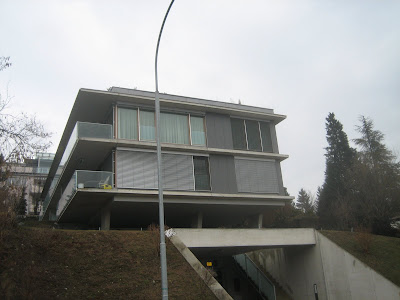
Last March we traveled to Austria, since I was invited to give a seminar at the Vienna University of Business and Economics. We landed first in Innsbruck, where we spent a few days since we wanted to reconnect and see friends and townfolks that we had interacted with back in 2002 while I held a Distinguished Chaired Fulbright at the University of Innsbruck. During our 4 month stay in Innsbruck we lived in the house featured above in the first photo, which was owned by a professor at the university. The address was 94 Schneeburgasse. We had heard that the house had been sold and condos had replaced this magical villa with views of the Alps and the 1964 Olympics ski jump.

We wandered to see our former neighbors on Schneeburgasse last March and were welcomed with hugs. Above I also include the photo of the condo complex that replaced the villa (with several of the units not filled).

Let's take great care when we destroy the old. Beauty in design and function should be preserved also for its living history.

Now, we will have to just make do with some photos and incredible memories -- the same holds for those whose lives have been forever changed because of the removal of the Champlain bridge.

Wednesday, December 23, 2009

Sharing, Giving, and Enjoying the Wonders of Every Season

This decade is coming to a close and it certainly has been a tumultuous one.

In an era of Facebook and Twitter it is time to reflect on what really matters and to make sense of it all in a week in which one had to attend both funeral wakes and holiday parties.

Last night, my daughter asked me to view the movie, "The Gods Must be Crazy," with her. She had seen it at the Bement School from which she had graduated last Spring and wanted to see it again, perhaps to try and make sense of so much that seems to be unexplainable these days. We laughed and laughed during the movie, especially during the hysterical transportation and vehicle parts. At the end, after a tense climax, the world seems well again through the simplicity of family life and community. The setting of the movie is Africa.

Last winter, my daughter and her ninth grade classmates from the Bement School, along with several of their teachers and a medical staff person, traveled to the Dominican Republic to help out at the La Suiza orphanage for a week. The orphanage is home to about 40 boys. The experience was profound for all those that took part and the students came to understand the importance of giving and sharing.

Last week, my daughter received a phone call from a journalist from our local newspaper asking her what inspired her to give to the Toy Fund. The interviews with her and another teenager appear in today's Daily Hampshire Gazette. Her name is misspelled but the lasting impact of helping out and the experience in the Dominican Republic linger. She is now a student at the Deerfield Academy, which also has a tradition of community service both in neighboring communities and abroad.

As for trying to make sense of it all, let me recommend a book of poems by Professor Frederick C. Tillis, which arrived at our door with a very special inscription. The name of the book is Beginning again and I find it very fitting as we start a new decade.

Monday, December 21, 2009

Calling American Students Lazy is Hurtful

In the meantime, I have heard from Dr. Dennis Hanno, the undergraduate dean at Babson. Dr. Hanno was a former colleague of mine at the Isenberg School of Management, and also a former neighbor in Amherst. He is an amazing individual, educator, and administrator. I urge you to read the commentary on his blog regarding the recent OpEd piece in the Boston Globe that I wrote about below. I am adding this link today (December 24, 2009) due to the uproar created by the OpEd piece. Please read Dean Hanno's commentary here.

In today's Boston Globe there is an OpEd piece written by Kara Miller, who teaches at Babson College. The article is entitled, "My lazy American students," and the author writes how she prefers having students from other countries in her classes since she feels that they have a much better work ethic, despite their, perhaps, poorer English.

I found this OpEd piece painful to read and insulting to all the hard-working students, American or international ones. This past semester was not easy with the H1N1 pandemic, with many families losing jobs and income because of the recession, among other additional stressors on both students and faculty alike.

I would like to counter the arguments in that article and say, in contrast, my students at the Isenberg School of Management at UMass Amherst were terrific this past semester. They showed up to do their presentations despite a big snowstorm. They showed up at their final exam besides it being dark and cold outside (and the heat was up to 80 degrees for some reason in the exam classroom). ALL of my students handed in their presentations on time and the students in my undergraduate class at the Isenberg School of Management were some of the best and the most hard-working ones I have ever had the privilege to teach.

American students are terrific as are the international ones! Interestingly, in my undergraduate class this term I had only one international student (from Hong Kong) whereas in my graduate class I had only one American student with all others being international ones.

As I have heard it said before "Apples don't fall far from the tree." Faculty serve as role models and are as much at fault if the students don't do well as the students are themselves. Honestly, if you can't say something nice perhaps it's best to let it be left unsaid.

Sunday, December 20, 2009

Learn More About Innovation and Scientific Research in South Africa and Beyond, the Smart Grid, Vaccines, Robust Optimization, and Supply Disruptions!

In the Northeast we have had a major snowstorm and it is a winter wonderland! The course grades have been submitted and before we catch our breaths, it gives me great pleasure to announce the Spring 2010 UMass Amherst Speaker Series in Operations Research / Management Science. Please be sure to mark your calendars and to join us,if you can. This series is now in its 12th semester of continuous operation and is open to the public. All talks take place at the Isenberg School of Management at UMass Amherst on scheduled Fridays in Room 112 from 11AM until noon.

I can share testimonials of audience members who have written to me and who have taken the time to thank me regarding our past speakers. Let it suffice to say that when undergraduates, grad students, faculty, and those from industry who have come to hear our speakers say that on Fridays when there is no speaker they are so disappointed -- that is the greatest praise. Speakers not only educate but inspire and open our eyes to new perspectives.

The Spring 2010 lineup will begin with a presentation on February 19, 2010 by Professor Mzamo Mangaliso of the Isenberg School on scientific innovation and research with experiences in South Africa. Professor Mangaliso served as the President of South Africa's counterpart of the US National Science Foundation and this talk is certainly going to be fascinating and very informative.

On March 5, 2010, we will be hosting Mr. Richard Brooks of ISO - New England, who will be speaking on the development of the smart grid, a topic not only timely but extremely relevant to consumers and businesses.

On April 2, 2010, Professor Sheldon Jacobson of the University of Illinois will be sharing with us his research on pediatric vaccines, their pricing and stockpiling issues. Professor Jacobson's visit is co-sponsored through the INFORMS Speakers Bureau. For more information on INFORMS, and its elegant new website, please click here.

Professor Dimitris Bertsimas of the Sloan School at MIT will be speaking on April 23, 2010. He is a member of the National Academy of Engineering and has garnered numerous awards for his research. He will be speaking on robust optimization. His talk is co-hosted by the Finance Seminar Series at the Isenberg School.

On April 30, 2010, Professor Mehmet Gumus of McGill University in Montreal, Canada will be presenting his research on supply disruptions and selection of optimal suppliers.

We may also have an additional speaker on March 26, 2010, from abroad, but are waiting for final confirmation.

Full information on the titles, abstracts, and short bios of the above speakers is now available on the Speaker Series website.

As one departmental chair from outside the Isenberg School said to me, this speaker series is not only educational, but we are also providing a community service -- the talks in this series are not to be missed.