Showing posts with label infrastructure. Show all posts

Saturday, March 6, 2021

A Big Thanks to Dr. George Karagiannis for His Brilliant Guest Lecture in My Humanitarian Logistics and Healthcare Class

This past week, we had the honor and pleasure of hosting Dr. George Karagiannis in my Humanitarian Logistics and Healthcare class, which, this year, is being taught remotely because of the COVID-19 pandemic.

An integral part of this course is having guest lecturers who are expert practitioners. Hearing from such experts reinforces the course material and provides for a rich educational experience for the students.

Now, for some background on Dr. Karagiannis, whom I met back in 2015, when I co-organized the Dynamics of Disasters conference in Kalamata, Greece, with Professors Ilias S. Kotsireas and Panos M. Pardalos, and Dr. Karagiannis was a speaker. We also hosted him for a seminar at the University of Massachusetts Amherst in the Fall of 2015.

Dr. George Karagiannis is Greece's Deputy Secretary-General for Civil Protection, the US equivalent of Deputy FEMA Administrator. From 2016 to 2019, he was a Technical Officer at the European Commission Joint Research Center, where his area of expertise revolved around emergency management, critical infrastructure protection and hybrid threats. Prior to joining the Joint Research Center, he was a Disaster Management Consultant. He has worked in four countries, developed two strategic national risk assessments, organized over 60 exercises, led the development of a dozen emergency operations plans and responded to disasters in the field. He also was a Research Scientist at the Technical University of Crete in Greece, where he his interdisciplinary research lay at the intersection of systems engineering and disaster resilience. George earned his Doctorate in Environmental Science and Engineering from Saint-Etienne School of Mines in France. He also holds degrees in Civil Engineering and in Disaster Management and Business Administration, and is a Certified Emergency Manager by the International Association of Emergency Managers.

Dr. Karagiannis's presentation title in my course was, "Humanitarian Needs Assessment & Information Management." He zoomed in from Athens, Greece, which was lovely since the students in this class are physically located not only in Massachusetts but across the US, with a student even enrolled, who is now in Turkey.


Due to multiple inquiries and requests, Dr. Karagiannis has given me permission to post the slide deck of his excellent presentation.

So many excellent insights and recommendation are contained in his presentation, which I urge you to study. Some of the takeaways that very much resonated with me and also reinforced the material that we have been covering in the class and will be addressing in subsequent weeks are the following:

1. Help flows were there are cameras. This statement demonstrates the importance of media in getting the news out but also emphasizes that, at times, people who are victims of disasters may not get the help that they need.
2. Goods may be donated and delivered that do not help the victims - such as fur coats from Greece following the Israel-Hezbollah war in 2006! The wrong goods create extra stressors (even if they are donated in good faith) since they require human resources to offload and also take up valuable storage space. In the case of the furs, they ultimately created a health hazard. I recall tuxedos being delivered to victims of Hurricane Katrina, and there are many other such incredible stories of the wrong goods.
3. When do you stop gathering data? How much data is "good enough" for needs assessment?
4. The recognition of the importance of time is paramount. If it takes a time t for needs assessment, it will take a time of 2t for making a decision.
5. One must distinguish primary data from secondary data.
6. Comparison over time is also essential in terms of the number of people displaced by the disaster.
7. One of the greatest challenges is learning to make decisions with only incomplete information when everything is at stake!
8. There is a shift of Emergency Management now in addressing infrastructure, which makes tremendous sense due to the negative impacts of climate change on infrastructure.

I very much like that he noted the UN Cluster Approach to support sector emergency functions, which we had emphasized in the course just a few days prior.

We also had a great discussion on how well Greece mitigated the spread of the coronavirus, starting their preparations already in early January! The country was very agile and reacted quickly.

The students were prepared with questions for the speaker. Dr. Karagiannis was so generous with his time - staying way past the class time window to answer questions.

And we honored him with a Professor for a Day certificate recognizing that his contributions.


Sunday, November 24, 2019

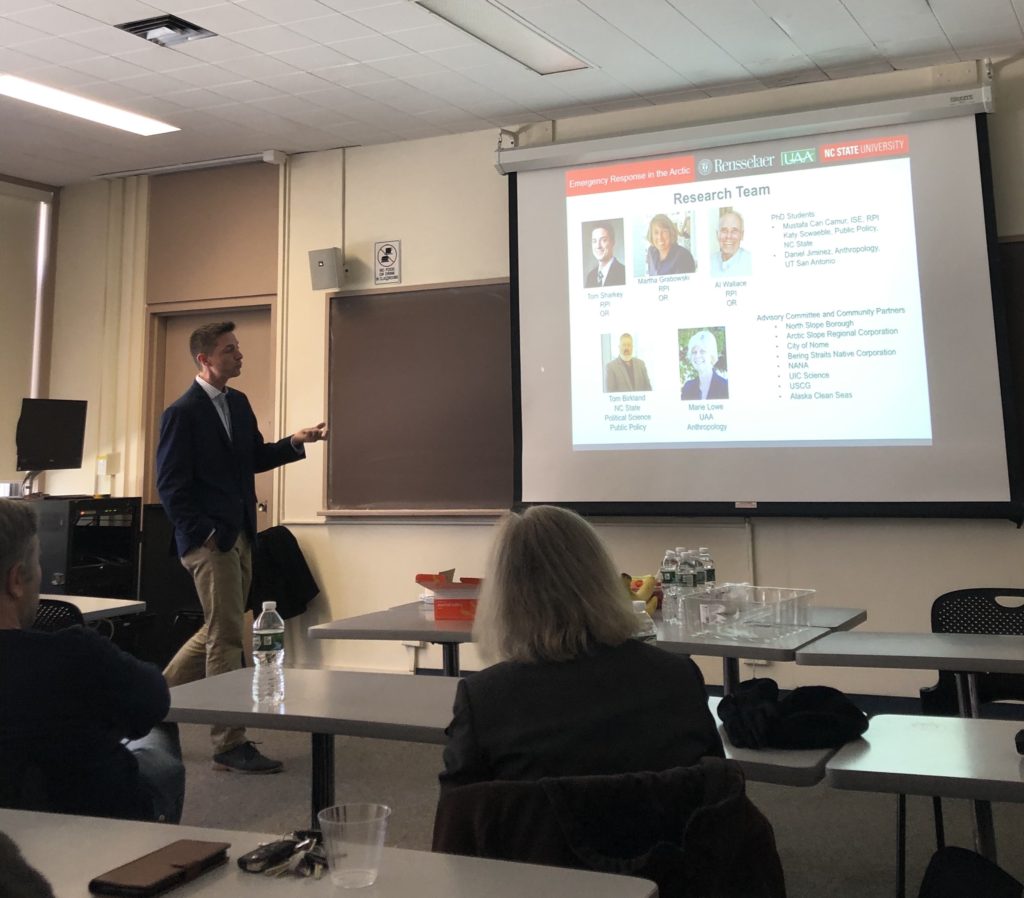
Great Talk on Emergency Response in the Arctic by Professor Tom Sharkey of RPI

Recently, we had the great pleasure of hosting RPI Professor Tom Sharkey in our UMass Amherst INFORMS Speaker Series.  His talk, based on an NSF-funded research project, was extremely timely and fascinating.
In fact, an article on this project, co-authored by Professor Sharkey with his project collaborators, including Professor Al Wallace of RPI,  was the cover story in the November issue of ISE Magazine and is definitely worthwhile to read.

His talk attracted an audience of faculty and students from multiple departments and schools at UMass Amherst, including the Isenberg School, the College of Engineering, and also the College of Natural Sciences and Mathematics.

It was a pleasure to introduce Professor Sharkey - I had last seen him this past March when I gave a talk at RPI. Since then, a PhD alumna of RPI's ISE program, whose PhD advisor was Professor Wallace, Dr. Anne P. Massey, has become the first female Dean of the Isenberg School - very exciting!


Professor Sharkey emphasized the interdisciplinary nature of the project in his presentation and noted that the team is working on constructing Operations Research (OR) models to help in emergency response (ER), while also helping communities. Collaborators, outside of RPI faculty, include a professor at NCState and one at the University of Alaska.

He noted the changes that are happening in the Arctic, including tourism and increasing commercial activity, as well as the possibility of broadened maritime shipping,  and the various associated challenges from uncertainty in sea conditions to shortcomings in infrastructure, including broadband. He stated that, even without oil exploration, there is still the possibility of spills. The shipping time from China to Rotterdam has now been decreased by 10-14 days. And, when it comes to ER, mobilization may be bottlenecked by the limited capacity of a community. Infrastructure investments take a while to build out. He discussed the need to determine the minimum budget required in order to achieve a certain response time in an emergency.

Also, he emphasized that there may be unintended consequences and it is important to identify who actually benefits from infrastructure investments.

Professor Sharkey described a mass rescue event, with accompanying network figure, in the case of the need to rescue cruise ship evacuees. His talk clearly resonated with me since we have done a lot of work on disaster relief and, to-date, I have co-edited two volumes on Dynamics of Disasters, with Professors Ilias S. Kotsireas and Panos M. Pardalos.

In 2016, I hosted the visit of Rasmus Dahlberg, who is a disaster researcher, based in Denmark (and also a novelist and TV and radio personality).  After Sharkey's visit to UMass Amherst, I connected the two of them, due to their very similar interests in Arctic emergency response research. Dahlberg is also a practitioner in this important domain. He also has a contributed chapter in the first Dynamics of Disasters (DOD) volume that I co-edited and spoke at the first DOD conference that I co-organized in Kalamata, Greece.

Professor Sharkey spoke abut identifying "dual-use" infrastructure planning, a concept I like very much. For example, improved "connectivity" for Arctic regions is an important goal, in transport (in terms of roads and ports) as well as in communications.  Fast and reliable Internet could then allow for telemedicine, as well as teleeducation in the Arctic. Of course, he also brought up the important question: "Who is going to pay?"

There were many questions during and after his very information talk. We took a group photo and then enjoyed a lunch at the University Club. We thank Professor Sharkey for his excellent, very inspiring  lecture in our Speaker Series!
Also, we celebrated, with cake, 15 years of the UMass Amherst INFORMS Student Chapter (30 semesters of great speakers in its Speaker Series)!

Professor Sharkey was interviewed after the lunch for the chapter's youtube channel, and, when the approved video is posted, we will let everyone know via social media.

In the meantime, many thanks to the outstanding UMass Amherst INFORMS Student Chapter, and to its Officers, for their amazing work, that brings all those interested in Operations Research/Management Science throughout UMass Amherst (and beyond) closer together as a community, both professionally and socially.

Friday, November 30, 2018

Fabulous Talk by Professor Mike Knodler on Transportation Safety and Operations with Cake Before!

Today we had the pleasure of hearing Professor Mike Knodler from the UMass Department of Civil and Environmental Engineering speak in our UMass Amherst INFORMS Speaker Series.
Dr. Knodler in the Director of the UMass Transportation Center, which includes the UMass traffic Safety Research program. We were all very much looking forward to his presentation and it was fascinating and very dynamic!

The morning began with a celebration of the UMass Amherst INFORMS Student Chapter's receipt of the Cum Laude Award from INFORMS at the INFORMS Conference in Phoenix, earlier this month, complete with a cake.
And we took a photo of the officers present.
It was great for the audience to have a chance to mingle with the speaker and one another before the presentation.
 And we enjoyed Dr. Knodler's Transportation Center socks - great branding!

Professor Knodler was introduced by this year's Chapter President, Katerina Deliali.


Professor Knodler began his presentation with the question: "What is OR (Operations Research)?" and stated that their work in transportation is to get OR into practice. He emphasized the incredible diversity of transportation and that the Center has 100 different funded topics in 60 different areas. The UMass Transportation Center links researchers with practitioners and now even includes an Aviation Center with an air traffic control simulator. Several of those affiliated with the Center are also conducting research on drones.
In his presentation he described some of the innovations to enhance traffic safety from signals to infrastructure design and also emphasized that recently the number of traffic deaths have been increasing in the US. He highlighted the many different modes of transportation introduced fairly recently, from electric bikes and scooters to under development, even hovercraft. He also spoke about complete streets and complete networks.

A highlight was when he brought out a Segway (and then another one was delivered) and brave members in the audience had the opportunity to ride one.

What very much impressed me was how the research done at the Transportation Center has become policy not only in the state of Massachusetts but even nationally.

After the great presentation and exciting Q&A we took a group photo.

Then it was time for lunch at the University Club and continuing conversations. Professor Knodler, though, had a meeting, and had to miss the desserts.
We thank Professor Knodler for taking the time out of his very busy schedule to share with us the exciting contributions of his research group and the UMass Amherst Transportation Center!

For more photos, do check out the UMass Amherst INFORMS Student Chapter writeup by Haris Csipetas.


Wednesday, March 9, 2016

Transformative Lectures by a Disaster Researcher - Challenges in the Arctic and Beyond

How often do students get to hear from a disaster researcher who has written 20 books, some of which are science-based Nordic disaster novels, with one of his books being commissioned now for a TV series?!

Yesterday, we had the pleasure of hosting Mr. Rasmus Dahlberg, who is Fellow at the Center for Disaster Research at the University of Copenhagen in Denmark. Mr. Dahlberg presented two talks yesterday (but, then again, he is a marathoner and is running the DC marathon next Sunday). He was coming to the Isenberg School from the University of Colorado Boulder where he had been conducting research for a month.

His first presentation, which was given in my 8:30AM Humanitarian Logistics and Healthcare class (after he had had a 7:30AM  interview with a Danish radio station on Tom Clancy, a writer that Dahlberg is an expert on),  was titled: "Offshore is Onshore" Building a Scalable Search and Rescue (SAR) Infrastructure in the Arctic.


This presentation of Dahlberg can be downloaded here.

Dahlberg also works with the Danish Emergency Management Association as well as with the Danish Red Cross so he has an immense amount of practical experience, which, coupled with his research, provides him with amazing narratives to share with audiences.

His first presentation focused on how to handle uncertainty and unpredictability in emergency management. He began with a possible crisis of a cruise ship with thousands of passengers sinking between Greenland and Iceland. He has been advising Greenland and Iceland on emergency management. He says such potential disasters keep him awake at night. He mentioned the Costa Concordia which sank in the Mediterranean in January 2012. When it comes to Arctic regions, the survivability of those in such a cruise ship disaster would be questionable. Fishermen know, for example, that, without protective gear, if they fall into such waters, they die in 2 minutes. He spoke of covered lifeboats (and also made references to the Titanic) as well as protective gear but said that what would really work, but which is not popular, would be to have two cruise ships transiting together in proximity. If passengers needed help on one, there should be sufficient capacity on the other to provide rescue and assistance.

He also spoke about Iceland, which has been the site of erupting volcanoes and earthquakes. Now the former US military base is being used as a potential triage site and not just a hangar in which to store blankets. He is working also on a big Nordic project to mitigate the affects of climate change, which will last until 2020. The Iceland Coast Guard has only 3 helicopters and 3 ships and, of course, Greenland, is even more short of transport equipment. He mentioned one big helicopter which he has flown in, in which 96 mushing dogs were transported once for a dog sled race in the middle of Greenland. What an image.

We got to hear stories of polar bears (they love Nutella)  and how Iceland is building up capacity for search and rescue missions in the region. It shocked us when he said that Iceland alone could handle no more than 7 hypothermia patients at a time. Greenland can handle no more than 8 trauma victims at a time!  All the search and rescue folks in Iceland are volunteers and they were the first country to respond to Haiti post the 2010 earthquake disaster. They are incredible and digging out folks, often using dogs for assistance, in avalanches, and clearly can even respond to earthquakes in warm climates! He noted that many hospitals in Scandinavia are specializing which can create capacity issues in disasters.

He told us that "safety science is driven by events" and  we all know of some major disasters that spurred new policies and actions afterwards. He emphasized Nassin Taleb's work and black swans and not just dealing with risk in terms of probabilities and impacts but also thinking of possibilities and worst case scenarios - just like a cruise ship with 4,000 passengers sinking in the Arctic.

He envisions a Search and Rescue Academy in which practitioners and researchers can be working together, side by side. I loved this.

He also noted that what is needed in disaster relief and emergency management - and disasters are those events that can't be managed by existing resources - is a coordinator of coordinators. This also very much resonated with me.


We took a group photo with the Professor for a Day plaque that was presented to Dahlberg.

Then Dahlberg and I went out for coffee and delicious scones at a downtown Amherst cafe and it was time for lunch at the University Club, which I hosted. It was extra special to have both undergraduates and graduate students make time (it was a Tuesday and not our usual seminar day of Friday) to attend.

At 2PM it was time for Dahlberg to present in our great UMass Amherst INFORMS Speaker Series. His presentation was: Bridging the Gap: Preparing for Long-Term Infrastructure Disruptions and it can be downloaded here.
 In this presentation, Dahlberg focused on what is critical infrastructure and emphasized multidisciplinary perspectives. He had a lot of great quotes from anthropologists including that infrastructure is "matter that enables movement of other matter." This brought out vividly that infrastructure may be invisible until it fails - we lose power, a bridge collapses, water is undrinkable, etc.

In doing his research on the importance of bridges and especially the Oresund bridge that he studied deeply, he spent days riding the train on the bridge which connects Malmo, Sweden with Copenhagen, Denmark,  interviewing people as to what they would think if the bridge was inoperable, say, for one day, one month, or a more extended period of time.  The knowledge workers could work at home for a period. The sewer truck driver told him that "he does not take his work home." To have a 20 minute commute each way change to a two and a half hour commute because with a bridge closure one would have to make use of multiple modes of transport, including a ferry, over greater distances, would clearly have an impact. However, this bridge was not considered a European Critical Infrastructure and, in fact, nothing in western Europe was! A small airport in Bulgaria, nevertheless, was.
I had the pleasure of meeting Mr. Dahlberg at the Dynamics of Disasters conference, which I coorganized last summer with Professors Panos M. Pardalos and Ilias Kotsireas in Kalamata, Greece. He was the first speaker and made such a powerful impression that when he said he wanted to visit me I knew that having him come and speak would be a transformative educational experience. And I am thrilled that his work on the topic that he spoke on is now a finalized chapter for the book that Kotsireas, Pardalos, and I  are co-editing on the conference.

Sunday, January 25, 2015

A Great Week for Our Research on Networks

Last week was the first week of the new academic semester at UMass Amherst and it was a very exciting one.

I always very much enjoy meeting new students in the courses that I am teaching.

Plus, it was a great week for news on our research on Networks.

One of the best things about collaborations, besides the synergy and dynamism of researching tough problems together, is that, when one gets good news, such as a paper getting accepted, or hearing of its publication, and/or some great publicity about the work, you can share it and celebrate together - even if it is across the miles!

This week, Luis Marentes, who was a visiting doctoral student in the College of Engineering at UMass Amherst last year, and who is from Colombia, Professor Tilman Wolf (who was his host), and with whom I have a large NSF grant, and Professors Yezid Donoso and Harold Castro of the  Department of Systems and Computing Engineering, Universidad de los Andes in  Bogota, Colombia, and I had our paper, "Overcoming Economic Challenges of Internet Operators in Low Income Regions through a Delay Tolerant Architecture with Mechanic Backhauls," appear online in the journal NetnomicsIt was great to share in the happiness of all those involved in this publication, which is on the dynamic pricing of Delay Tolerant Networks, and proposes a new computer architecture. To-date, there has been minimal work on the pricing in this domain and the identification of the potential profitability of Internet Service Providers in poor, and, often, rural communities, where even mechanic (even in the form of mule transportation) may be used to transport Internet information.

Also, our paper, "Securing the Sustainability of Global Medical Nuclear Supply Chains Through Economic Cost Recovery, Risk Management, and Optimization," co-authored with Professor Ladimer S. Nagurney of the University of Hartford and my doctoral student, Dong "Michelle" Li, appeared this week in the special issue of the International Journal of Sustainable Transportation devoted to Sustainability in Transportation Networks.  The paper was accepted for publication close to 3 years ago so it was nice to see it officially in the journal volume!

The first paper above has 5 co-authors, the second one has 3, and the one below only one (but ensuing ones on cybersecurity will have co-authors).  Specifically, the paper, "A Multiproduct Network Economic Model of Cybercrime in Financial Services,  that I wrote after our very successful Advanced Cyber Security Workshop at the MIT Sloan School last Fall, received very nice reviews from an INFORMS journal, and it has been revised and resubmitted. In the Acknowledgments I also thank the audience who came to my presentation at the Boston INFORMS Analytics conference in Spring 2014, which was a fabulous conference!


Another highlight this past week was having our NSF project: Network Innovation Through Choice, which we are calling ChoiceNet, and for which Professor Wolf and I are PI and Co-PI (along with 5 other Co-PIs from the University of Kentucky, NCState, and the Renaissance Institute (RENCI) at UNC) being featured on the UMass Amherst Research website in Research Next.  And the article, Internext, UMass Amherst experts are driving the future of Internet infrastructure, will appear in the 2014 UMass Amherst Annual Report on Research which will be available, I am told, by the end of this month. 


This should be a very exciting week as well with many interview candidates coming both to the Isenberg School and to UMass and with a major snowstorm forecast for early this week!

Monday, June 4, 2012

Repairing Roads -- Why Can't the US be More Like Sweden?

I read the excellent OpEd piece by Robert Frank of Cornell University that was published in The New York Times on how the repair of roads in the United States might end other types of gridlock (political, let us hope, and also economic by putting people to work).

I arrived in Gothenburg, Sweden, this past Thursday. This is my second extended stay in this lovely city, which is the second largest in Sweden.

As is appropriate, I am a Visiting Professor of Operations Management at the School of Business, Economics and Law at the University of Gothenburg and am seated in my office surrounded by my Transport & Logistics colleagues and my Finance colleagues (similar to my situation back at the Isenberg School of Management at UMass Amherst).

I continue to be impressed about the wonderful transport, including road infrastructure, in this city (and wherever I have traveled in Sweden before the contrast with the US has stunned me).

There is a lot of activity here now in parts of the city in repairing the sidewalks and the roads. The workers in their uniforms have even been planting flowers down the major avenue.

No wonder there are so many people of all ages promenading around the city as well as in the lovely parks and cafes.

In addition, the traffic flows well and I continue to be impressed by the multiple modes of transport that are available here -- from the trams and busses to the ferries and even bicycles, which one can borrow at various locations.

There are also bicycle lanes and pedestrian lanes.

Thanks to Robert Frank for again emphasizing what we have been writing about from our Fragile Networks book to various other writings, including an invited commentary for Resources for the Future.

When will the US get some of its pride back? Without repairing and investing in our networks, we cannot move the economy forward. Physical goods and services cannot be delivered digitally.

Monday, September 6, 2010

It's All About Transportation

The media has had extensive coverage of transportation news and research, which is very gratifying (and which is getting me really psyched to teach my Transportation & Logistics class).

News about Professor Arnie Barnett's study, "Cross-National Differences in Aviation Safety Records," which appears in the August issue of the INFORMS journal Transportation Science, has now gone viral with articles on it from The Washington Post to The Sydney Morning Herald, with the latter with the attention-grabbing headline of "Your Chances of Dying in a Plane Crash? It Depends Upon Where You Fly."

As those of us who have had the privilege of interacting with Professor Barnett of MIT's Sloan School of Management know, Professor Barnett has a fear of flying. We hosted Professor Barnett in our Speaker Series several Falls ago and he was fantastic! Coincidentally, as a frequent flier, this summer, I was trolling the Internet for safety stats on several airlines since I had a heavy travel schedule for speaking engagements that took me to South America and Eastern Europe. My intuition told me to be careful in deciding which airlines (and which routes) to fly and now Barnett's paper confirms that caution should, indeed, be taken.

Plus, who could have missed the news about the South Korean female, Ms. Cha, a 69-year-old widow with four children, who on her 950th attempt passed her written driver's test and then on her 10th attempt received her driver's license! She has been lauded as a national hero for her determination and for never giving up. She actually said that she enjoyed taking busses to her driver's ed classes since she had only a minimal elementary school education and minimal literacy and craved learning! Her goal was to be able to get a license so that she could take her grandchildren to the zoo.

As for another transportation news story, Michael Grynbaum, writing in The New York Times, has further coverage on the closure of Broadway in NYC, as well as on the history of the design on the street grid dating back to the early 1800s! My most recent paper, just published in Europhysics Letters, was on the related topic of network topology, traffic, the Braess paradox, and the wisdom of crowds.

Sunday, August 29, 2010

Investing in the Nation's Infrastructure but Doing it Right

In an interesting Op-Ed piece in The New York Times, Dr. Laura Tyson of the Haas School of Business at UC Berkeley, and a member of President Obama's Economic Recovery Advisory Board, is calling for a new stimulus package to invest in the nation's infrastructure.

My colleagues and I at the Supernetworks Center have been writing a lot on how to identify not only the costs of infrastructure degradation from our roads and bridges and even the Internet, from an economic and performance standpoint, but also on how to identify the effects of enhancement and investments by taking into consideration the behavior of those who will ultimately be using the infrastructure. In addition, it is imperative that the investments are made with cognizance of climate change and how best to adapt our infrastructure investments accordingly from transportation networks to supply chains and electric power generation and distribution networks.

Our paper, which contains highlights from our research and major findings, but in a more condensed fashion than found in our Fragile Networks book is entitled: "Fragile Networks: Identifying Vulnerabilities and Synergies in an Uncertain Age,"and it is in press in the journal International Transactions in Operational Research.

I just hope that if a new stimulus does get passed and even an Infrastructure Bank established, that economists, engineers, operations researchers and management scientists, and even environmental scientists, all work together so that what gets built, renovated, expanded, enhanced, and where, can have the greatest positive impact economically not only in the short-term but also in the long-term.

Thursday, April 29, 2010

Fragile Networks Book Makes a Best Seller List!

I am delighted to share with you that, according to the Academic Newswire and the Library Journal, the Fragile Networks book that I co-authored with my former doctoral student, Patrick Qiang, is a top 20 best seller in the Engineering/Technology category. Our publisher, John Wiley & Sons, is very pleased by this recognition. This is based on data since July 2009. Our book is number 20 on this best seller list and the list contains some very well-known authors and very prestigious presses.

This news appeared in the April 8 edition

or you can access the best seller list directly here.

The book is relevant to numerous applications, ranging from critical infrastructure (transportation networks, electric power networks, financial networks, the Internet) to military operations, corporate supply chains and mergers and acquisitions, as well as humanitarian logistics. It was recently featured in the Air Force Research Laboratory Library Newsletter at Wright-Patterson's Air Force Base.

Friday, January 22, 2010

Conundrum -- Satellite Communication Resiliency, Haiti, and the Last Mile

The issues of communications, and associated coordination, along with logistics and the bottlenecks, have permeated the post-earthquake humanitarian relief efforts in Haiti. Ironically, and, in a strange way, propitiously, it turns out that Haiti's Internet connectivity is robust precisely because its telecommunications infrastructure is so underdeveloped. Specifically, as reported in the IEEE Spectrum Tech Talk, most Haitian ISPs connect to the Internet via satellite and are not dependent on the country's lone undersea fiber optic cable link, which was knocked out the during the quake. The challenge for engineers now is the proverbial last mile--getting local connections to satellites restored so NGOs can get online. What is needed, from a communication hardware perspective, is that additional capacity, in the form of bandwidth, be added for satellite communications.

As I had written in this blog early on during this crisis, the International Telecommunications Union (ITU), a branch of the United Nations, located in Geneva, Switzerland, is providing additional satellite communication capacity (as it has done in numerous disasters prior). Dr. Cosmas Zavazava, the Head of Emergency Communications at the ITU, spoke at the humanitarian logistics conference that I organized, under the auspices of the Rockefeller Foundation. You can find his presentation here, along with many others, or access it directly below.


Our book, Fragile Networks: Identifying Vulnerabilities and Synergies in an Uncertain World, discusses how to identify the most important nodes and links in networks from telecommunications networks to transportation, logistical (including humanitarian ones), and even financial networks.

The United States and western Europe depend heavily on their copper and fiber optic interconnections (which are physical) for phone, Internet, and cable TV. There may be a very ironic lesson here and a critically important one in terms of the resiliency and robustness of telecoomunication infrastructure.

Thursday, December 24, 2009

The Bridge Will be Torn Down and a Gorgeous Old House Was, Too


I have been writing this blog about infrastructure, networks, research, and education since I began the RENeW blog in January 2009. The blog was initiated for two reasons: 1. because I had been approached by a good number of people to start one and 2. I was finishing writing the Fragile Networks book with Patrick Qiang and blogging was a way in which to get news out and to also inform. Being an educator means keeping ties to students, even after they graduate, and to numerous colleagues and interested individuals, and this means of communication seems especially timely.

Throughout this semester, while teaching my undergrad transportation & logistics class, the students and I discussed associated events as they were occurring in the real world, from the closure of the San Francisco Bay bridge to the closure of the Lake Champlain bridge, along with the engineering, economic, and business consequences. We talked about passengers who were stranded on airport tarmacs for hours on planes before their release. We talked and learned about transportation modes and their variants around the globe. We came to truly appreciate the importance of transportation and logistics as networks that tie us all.

These and other stories continue as we near the New Year with President Obama passing a regulation that airlines on national flights cannot keep passengers on planes on the tarmac for longer than three hours without large financial penalties. Ah, the math modeling possibilities that now present themselves and colleagues in transportation and operations research have been recently quoted in the press on the associated scheduling and rescheduling issues and possible ramifications! However, all of my "stuck on the tarmac for 4 hours" stories have involved international flights so I guess I am not off the hook.

At the same time, we are reading about passengers being trapped in the Eurochunnel for hours with the Eurostar train shutting operation for days because of, supposedly, "unusually powdery snow entering the engines." In addition, due to a power failure yesterday, Amtrak had to shut train operation in parts of the Northeast yesterday for hours (during one of the busiest travel seasons of the year). Nevertheless, another theme for one of my blog posts was that of Boeing's production problems, which, for the time being, seem to have been now resolved, with the new Boeing 787 Dreamliner recently soaring over Washington state (2 years late but at least it can get up and fly now) . This is a fascinating case study on outsourcing and what happened.

The New York Times is now reporting in this NY Times Bridge Article that the Lake Champlain bridge that joins Vermont with New York State will not be repaired but rather will be imploded next Monday! The article demonstrates the huge impact on the communities from, first, the closure of this bridge last October and now with the heart-breaking news that this bridge will be destroyed. A lifeline for citizens is lost as well as an elegant (but one which needed lots of repairs) structure. I wrote about the closure of this bridge in a letter to the editor that was published in the Boston Globe last month.

Last March we traveled to Austria, since I was invited to give a seminar at the Vienna University of Business and Economics. We landed first in Innsbruck, where we spent a few days since we wanted to reconnect and see friends and townfolks that we had interacted with back in 2002 while I held a Distinguished Chaired Fulbright at the University of Innsbruck. During our 4 month stay in Innsbruck we lived in the house featured above in the first photo, which was owned by a professor at the university. The address was 94 Schneeburgasse. We had heard that the house had been sold and condos had replaced this magical villa with views of the Alps and the 1964 Olympics ski jump.

We wandered to see our former neighbors on Schneeburgasse last March and were welcomed with hugs. Above I also include the photo of the condo complex that replaced the villa (with several of the units not filled).

Let's take great care when we destroy the old. Beauty in design and function should be preserved also for its living history.

Now, we will have to just make do with some photos and incredible memories -- the same holds for those whose lives have been forever changed because of the removal of the Champlain bridge.

Monday, June 15, 2009

Discover magazine, Infrastructure, The New York Times, and the Fragile Networks book

I am back from the World Science Festival (WSF) in NYC, which concluded yesterday with a science street fair. Photos from the numerous events have been posted on flickr.

There are also photos from the Traffic panel that I took part in last Friday evening.

The World Science Festival, which took place June 10-14, 2009, transformed NYC into a science mecca in which scientific research and exploration were recognized and celebrated. The atmosphere at the events, from the gala to yesterday's science fair, can only be described as electric -- the seats were filled at the various panels and events and I believe that many of those that participated will be looking at the world around us in new ways.

Megan Talkington, a journalist with Discover magazine, wrote a very nice article on the Traffic panel.

Now, it's time to reconnoiter and being on the Traffic panel at the World Science Festival has been the perfect segue for my new book with Patrick Qiang: Fragile Networks: Identifying Vulnerabilities and Synergies in an Uncertain World. Wiley, the book's publisher, has informed us that the book will be "released" this Friday, June 19, with worldwide distribution set for July 2009. Wiley issued a press release on the book in conjunction with my participation in the World Science Festival. The publication of this book is especially timely, given the interest surrounding infrastructure from transportation networks to the Internet and even electric power generation and distribution networks, plus financial networks. Indeed, the New York Times devoted yesterday its entire Sunday magazine to infrastructure. Plus, there have been recent OpEd pieces and major newspapers in the US highlighting the importance of complex networks and infrastructure. Our book provides an original synthesis of infrastructure networks and focuses on unique perspectives and solutions. The beauty and elegance of the book's approaches lie in a systematic analysis of networks, their resilience and robustness, as well as their vulnerability and the associated systemic risk. Fragile Networks identifies how to determine which nodes and links truly matter from economic and engineering perspectives. The book even formalizes mergers and acquisitions in a network framework!

Sunday, February 1, 2009

They are Back!

The Bement School 9th graders returned last night around 9PM from their service trip to the La Suiza orphanage in the Dominican Republic, only 2 hours or so late, after an unplanned delay at immigration at the JFK airport since one girl's passport and papers were being challenged. Given numerous stories from colleagues and friends about their misadventures at immigration at JFK, the parents of the travelers breathed a big sigh of relief, when we were finally notified that the student group of 20 and their teachers and coaches could proceed through!

When the 9th graders arrived back to Old Deerfield they were welcomed by parents and the excitement of all at the reunion was palpable. What the "Bementers" accomplished in less than a week is amazing -- they built bookshelves at the orphanage, painted what has now become a library and study area, and designed and painted a big mural. Most importantly, they played with the orphans (45 boys in all), carried the younger ones around, since they blossom with the attention, and organized games of basketball, soccer, and baseball. They played checkers with the children, shared books and toys with them, including hula hoops, climbed mango trees, and communicated with one another as only children can -- with hugs and laughter. They also accompanied the older ones to their school down the hill. The Bementers also helped the staff with dish washing and volunteered to do so since the orphanage is so short-staffed.

The fact that few of the 9th graders knew much, if any Spanish, did not matter!

As my daughter said, upon her return, "We had no TVs, no radios, no Internet, and no watches - time just stood still and it did not matter. It was so wonderful!" The food was delicious - pineapples, eggs, chicken, and rice -- the chickens ran freely there!" "We would help putting the little ones to bed and they even prayed for us." "Every night we collapsed to sleep in our large dormitory rooms, girls in one room and boys in another." "There was no hot water in the showers and sinks and we had fun brushing out teeth, sometimes outside." "Mom, you must do something about the traffic in the Dominican Republic, though, since there are no double yellow lines on the roads and the bus rides were interesting."

When my daughter entered our home late last night she ran up to the bathroom and said that she needed time to just stare and appreciate the bathroom amenities, and especially the shower stall.

One wonders whether $$$ sent to such an orphanage might result in physical improvements but, at the same time, the human contact and shared experiences among the students of the US and those at La Suiza may inspire dreams, which may be more fundamental and lasting. Clearly, a way in which to improve and sustain both the physical and educational infrastructure at the orphanage along with more face-to-face support and kindness plus enriching experiences would be ideal.

Such a trip that the Bement 9th graders experienced, with some associated possible risks, builds not only character, but also empathy, discipline, and appreciation. We hope that it is just the beginning of helping to construct an environment in which those who need it most can enjoy their childhoods, knowing that others care, and the process of growing up.

Wednesday, January 28, 2009

Stmulus Package, Infrastructure, Cost-Benefit Analysis, Research

I was very pleasantly surprised that in today's New York Times, David Leonhardt, in his article, "A Stimulus with Merit, and Misses," writes that "in the current system, the federal government sends money to states without any real effort to evaluate whether it will pay for worthy projects." In regards to the new stimulus project to restart the US economy, he states: "They don't consider whether those new roads will lead to faster traffic or simply more traffic." "In the world of infrastructure, cost-benefit analysis is still a science of the future."

Leonhardt gets how important it is to do system-wide analyses of transportation "improvements" and "investments" a priori in order to ascertain where the funds can be best spent. I would also add to the discussion how can we improve transportation infrastructure so that the environment is at the same time not negatively affected but rather, over time, improved.

We have the results of our major scientific studies, now available, which address the above two issues. Our paper, "A Relative Total Cost Index for the Evaluation of Transportation Network Robustness in the Presence of Degradable Links and Alternative Travel Behavior," published in the first issue of 2009 in the International Transactions in Operational Research, vol. 16, pp. 49-67, provides rigorous, computer-based tools to assess the impact of tranport link degradation on system performance. The paper, "Environmental Impact Assessment of Transportation Networks with Degradable Links in an Era of Climate Change," in press in the International Journal of Sustainable Transportation goes further and captures the impact on the environment of the degradation of roads.

Good to see that more and more journalists such as David Leonhardt of the New York Times and Linda Baker (February 2009 Scientific American) get that "building more" does not equate with "building better!"