Showing posts with label Austria. Show all posts

Thursday, June 29, 2017

Scenes from Vienna, Austria Before the Humanitarian Operations Conference

We arrived yesterday in Vienna, Austria, after flying from Boston Logan through Frankfurt. Thanks to both Lufthansa and Austrian Airlines for great flights.

I am in Vienna for the EURO HOpe conference, which begins today at the Vienna University of Economics and Business. I will be speaking at the conference later today and look forward to seeing operations researchers involved in humanitarian logistics.

Last time I was in Vienna was two years ago, just before the 2nd Dynamics of Disasters conference. Next week I will be off to the 3rd Dynamics of Disasters conference, which I helped to co-organize and is taking place in Kalamata, Greece.

Since I never have time for jet lag when arriving on a new continent I always try to walk for hours and then just switch to the new time zone.

Yesterday, I did precisely that as well as this morning and enjoyed rediscovering some favorite spots, from parks to cafes in lovely, cultural Vienna. My mother and uncle had spent time in Vienna during World War II, after leaving Ukraine, so I always feel very comfortable in this beautiful and very elegant city.

Below is the view of Vienna from our hotel.

The pastry shops and cafes are stunning.
And we indulged in some chocolate and cappuccinos yesterday afternoon.
I enjoy walking through the parks.
Of course, the architecture is also stunning and the trams are a terrific mode of transportation.
The EURO HOpe conference was organized by Professor Tina Wakolbinger, who was my PhD student in Management Science at the Isenberg School of Management. It should be a fabulous, focused conference. The full program can be downloaded in pdf format here.

Monday, June 30, 2014

World Cup Fever and Operations Research

The 2014 World Cup has been thrilling, dramatic, and awe-inspiring with the marvelous athleticism of the globe's top soccer players engaged in games that are simply riveting.
Brazil deserves our congratulations for uniting the world as we watch the beautiful game being played at its venues.

I know of two colleagues in Operations Research who have tickets to several of the games in Brazil and I hope to catch their faces on TV at upcoming matches, Dr. Celso Ribeiro, the Editor of the journal, International Transactions in Operational Research (ITOR), and Dr. Mauricio Resende, of AT&T.

This year, as in 2010, 2006, and even 2002, I have been spending weeks during the spring and summer out of the USA, and those have also been World Cup years.

In 2002, I was living with my family in Innsbruck, Austria, where I held a Distinguished Fulbright at the SOWI Business School at the University of Innsbruck.  Brazil won the tournament that year, beating Germany.

In 2006, which was my sabbatical year at Harvard, I traveled to Limassol. Cyprus,  to speak  at the 12th International Conference on Computing in Economics and Finance, June 22 - 24, 2006 and then to Iceland, for the 21st European Conference on Operational Research, Iceland, July 2-5, 2006, and, finally, to  Erice, Sicily, to give an invited talk at the INTERNATIONAL SCHOOL OF MATHEMATICS  G. STAMPACCHIA 44th Workshop: VARIATIONAL ANALYSIS AND PARTIAL DIFFERENTIAL EQUATIONS, Erice, Sicily, July 5-14.

I was with many operations researchers in Erice, when Italy beat France in the 2006 World Cup, an experience we will never forget because of the celebrations that followed and somehow I made it back the next day via Alitalia to Boston and with my hearty congratulations to the staff got upgraded to Business Class!

The below photo is of several of the Erice workshop participants, including Professor Panos Pardalos of the University of Florida, watching the final game!


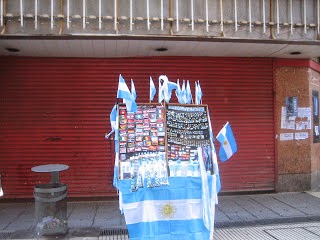
In 2010, we were in Buenos Aires, Argentina,  for the great ALIO-INFORMS Conference. The World Cup that year was taking place in South Africa. Buenos Aires was replendant in celebrating its team.   Spain won that year (and got eliminated early in 2014). Coincidentally, Dr. Celso Ribeiro gave a tutorial on sports scheduling at this conference, with a focus on soccer, which I enjoyed very much. A special issue of ITOR  was edited on the tutorials and I also had one with Q. Qiang.

I have spent almost 2 of the past several months in Europe, being based primarily in Sweden (which did not, however,  qualify for the 2014 World Cup). I have also been going to conferences in Erice (deja vu), in Taormina, also in Sicily, and in Greece. I have met up with may operations researchers at these venues and together we have cheered on many teams. I enjoy listening to the announcers in different languages.

The photo below was taken in Italy about 2 weeks ago, shortly before Italy was eliminated from the 2014 World Cup, and we commiserated with our many Italian friends.


I was disappointed that Greece lost last night especially since Greece was the most recent country at which I was at an operations research conference and it was a truly special one - as readers of my blog know. We recently celebrated Professor Pardalos' 60th birthday with a conference in Chalkidiki, Greece, at which I took the photo below, from the ferry. Many more photos are here.
The Costa Rican goalie, Keylor Navas, who was instrumental in Costa Rica beating Greece in last night's game,  has made headlines with his amazing plays. Afterwards, I enjoyed his quotes, in which he emphasizes his family (and how he kept on thinking of them during last night's game against Greece): I try to be a good father. I tried to be a good friend and in such a beautiful sport as football, I always try to have my kids happy so when they grow up, they can look back and they can see a father who did important things for their country.

It is great that the USA has made the round of 16, although it lost to Germany in its latest match,  and tomorrow it will be very exciting to watch the USA team play against Belgium.

Congratulations to all of the teams that qualified for this terrific 2014 World Cup in Brazil!

Wednesday, March 20, 2013

Building Sustainable Cities and The New York Times Energy Conference

I am very excited about being a speaker at The New York Times EnergyForTomorrow Conference with the theme Building Sustainable Cities that will take place next month, April 25, 2013.
 

I will be speaking in the session on Transportation and Traffic.

The agenda is thrilling as are the speakers that will be taking part.  I will certainly be in great company!

I hope to bring an international perspective to the discussions on transportation and traffic given my experiences as an academic and as a globe trotter.

For  the past three weeks I have been back in Europe -- working as a Visiting Professor at the School of Business, Economics and Law at the University of Gothenburg and  living again in glorious Sweden, with a 4 day diversion in Vienna, Austria, where I lectured on perishable product supply chains in healthcare and also instructed an intensive short course Humanitarian Logistics and Healthcare.

The Nordic countries, and even Austria, are advancing their focus on sustainability and have implemented transportation policies that are working.

For example, Stockholm's congestion pricing scheme, which originated in January 2006,  has been deemed a success, as my colleagues at the Royal Institute of Technology (KTH) in Stockholm have shown rigorously in their published research.

Gothenburg, the second largest city in Sweden, just this past January instituted a congestion tax or toll and having been here in October and now,  I can see a concrete difference in term,s of the traffic reduction. My colleagues tell me how thousands of citizens who own cars were mailed coupons for free public transport for two weeks and have altered their travel behavior. More are coming into the center city to shop on weekends since there is free parking offered in certain parking garages and in the evenings.

Since I teach transportation and logistics (among other network-based courses) at the Isenberg School of Management,  tolls are a topic that I am very familiar with, especially since my dissertation advisor at Brown University, Professor Stella Dafermos, had contributed to the literature on this topic even back in the 1970s!
What a brilliant mind she had and the operations research community lost a female genius when she died at age 49.

While in Vienna,  I was impressed by the red and black trams/trolleys snaking through the city! Also, the parking charges there are so steep (and one can park on streets for only two hours) that many elect to take public transport instead -- using, typically, a combination of modes for commuting.

In fact, none of the students in my class in Vienna had driven a car that morning-- all had taken public transport, or had bicycled, or had walked to the university.

The photos below were taken in Gothenburg and demonstrate the different modes of transport that I (and many others) avail ourselves of. Without transportation there is no mobility and no logistics (just imagine  supply chains without transportation -- a topic of my previous post) -- it's not just about the network topologies but how our critical infrastructure is utilized!

The top photo was provided by one of my wonderful hosts, Professor Jonas Floden, who has also driven me in the above golf cart on the island where he lives and where cars are banned!

Thursday, February 28, 2013

Looking Forward to Speaking on Supply Chains in Sweden and in Austria

My suitcases are (almost) packed and soon I will be heading back to Europe as part of my sabbatical this year.

And, the lectures that I will be giving on supply chains  as well as a short course on humanitarian logistics and healthcare are prepared and I am very much looking forward to giving them.

I am bringing a few copies of our new book, "Networks Against Time: Supply Chain Analytics for Perishable Products,"  just published by Springer Business and Science Media New York, to give to my hosts at the School of Business, Economics and Law at the University of Gothenburg in Sweden and to also donate a copy to the library.

On Monday, March 4, 2013, I will be presenting a seminar, "Grand Challenges and Opportunities in Supply Chain Networks: From Analysis to Design," at the Chalmers University of Technology, which is also in Gothenburg. This seminar is part of the Optimization Series.
 
 I will have a week to meet with my wonderful colleagues and the students in Gothenburg and then I will be off to Vienna, Austria, where I will speak on one of the themes of our new book: "Perishable Product Supply Chains in Health Care: Models, Analysis, and Computations," at the Vienna University of Economics and Business. The title of my talk in Vienna, which is part of the research seminar series of the Research Institute for Supply Chain Management is: "Perishable Product Supply Chains in Health Care: Models, Analysis, and Computations."

I have several wonderful colleagues there, including Professor Manfred Fischer, and my former doctoral student, Professor Tina Wakolbinger, who recently visited us at the Isenberg School and also took part in the AAAS Sympsoium on Dynamics of Disasters that I organized and which took place February 17 at the Hynes Center in Boston.
 

While in Vienna, I will also teach an intense course on Humanitarian Logistics and Healthcare. I am told that the students who have registered for my course are from many different countries so this should be a very interesting and timely course.

Friday, December 24, 2010

What a Year it Was!

It was the best of times, it was the worst of times, it was the age of wisdom, it was the age of foolishness, it was the epoch of belief, it was the epoch of incredulity, it was the season of Light, it was the season of Darkness, it was the spring of hope, it was the winter of despair, we had everything before us, we had nothing before us, we were all going direct to heaven, we were all going direct the other way ... Charles Dickens from his novel, A Tale of Two Cities.

The beginning of 2010 was marked, for many of us, by the news of the horrific earthquake that struck Haiti last January 12; with the suffering of its people continuing to this day. It was followed, only two days after, by a "local" shocking event, that happened only one town over from Amherst, and that circulated around the world -- the suicide of 15 year old Phoebe Prince.

As educators and researchers, the above deeply tragic events, had some of us refocus our energies. And, of course, some of us also had personal and familial tragedies to deal with. But as is said, what doesn't kill you, makes you stronger.

At the same time, there were so many "best of times" and some of my highlights, as a professor, I list below.

  • My former student and my co-author of the Fragile Networks book, Dr. Patrick Qiang, was honored with the Charles V. Wootan Award last January by the Council of University Transportation Centers in Washington DC for his doctoral dissertation, Network Efficiency / Performance Measurement with Vulnerability and Robustness Analysis with Application to Critical Infrastructure. Last March, Dr. Qiang joined me in giving a tutorial on the theme of our book at the SBP 2010 Conference at NIH. I then further disseminated our research in my tutorial at the ALIO-INFORMS Conference in Buenos Aires, which brought me, for the first time, to the continent of South America.
  • A female PhD student of mine, Trisha Woolley (now Anderson) received her PhD in 2010 and assumed her Assistant Professorship at Texas Wesleyan University.Her dissertation title: Sustainable Supply Chains: Multicriteria Decision-Making and Policy Analysis for the Environment. She was my 15th PhD student to graduate and my 6th female.
  • We celebrated the graduation of our wonderful undergraduate students from the Isenberg School last May -- another highlight of 2010!
  • A former doctoral student of mine, Dr. Tina Wakolbinger, received an offer of a Full Professorship from the Vienna University of Economics and Business, a position which she will start next May, having been an Assistant Professor at the University of Memphis since receiving her PhD in 2007. Her research in humanitarian operations and, more recently, on electronic recycling, and that of my other former students and collaborators, give me hope for a better future.
  • Two present doctoral students of mine had notable successes with their research: Min Yu had two papers accepted for publication, including: "Supply Chain Network Design for Critical Needs with Outsourcing," co-authored with Patrick Qiang and me. Also, Amir Masoumi completed the paper, with Min and me, entitled: "Supply Chain Network Operations Management of a Blood Banking System with Cost and Risk Minimization."
  • The UMass Amherst INFORMS Student Chapter, that I serve as the Faculty Advisor of, received the Magna Cum Laude Award for its activities at the INFORMS National Meeting in Austin, Texas last November. They have started both a Facebook page and are on twitter, thanks to the chapter's new President, Nathan Kollett.
  • The Network Science conference in Yalta brought me to the country of the birthplace of my parents, Ukraine, whereas the Computational Management Science conference at the University of Vienna brought together so many of my favorite colleagues from around the globe.
  • As for the INFORMS conference in Austin, Texas, thanks to all for the wonderful memories!
  • Also, thanks to all of my undergraduate and graduate students (both present and former ones) for being so special and so terrific! You will help to change the world for the better!

Let me end with the words of a new community service organization, Count Me In, that was started in South Hadley, in response to the tragedy of Phoebe Prince's suicide, and an article on which appears in today's Daily Hampshire Gazette.

This organization has its motto emblazoned on the backs of its t-shirts:

Respond with integrity and kindness/Embrace diversity/Stand up courageously for others/Promote a climate of safety/Eliminate hurtful words and rumors/Care for and listen to others with compassion/Take responsibility for my actions.

The above words should be followed in our daily lives.

Friday, August 6, 2010

Photos from the 2010 CMS Conference in Vienna, Austria


The 2010 Computational Management Science conference took place July 28-30, 2010 in gorgeous Vienna, Austria.

Above are photos taken at this conference. For a full page of photos, which are also downloadable, click here.

I thank the organizer, Professor Georg Pflug, from the University of Vienna, for an outstanding venue, excellent plenary talks, and a wonderful social program.

It is very important to go to conferences, both smaller, specialized ones, as well as other more general conferences in one's professional/academic areas. One never knows whom one may meet and what interesting opportunities may arise from the serendipity of face to face encounters and discussions on topics of mutual interest!

Plus, it is so special to reconnect with many friends and colleagues from around the world in interesting locations!

Friday, July 30, 2010

Last Day of the Computational Management Science Conference in Vienna

Today is the last day of the 2010 Computational Management Science (CMS) conference that is taking place in Vienna, Austria. The weather is now cool and rainy but it should be clearing up later today.

It has been absolutely wonderful to listen to talks on topics ranging from the design of transportation networks for hazardous material shipments, to the analysis of earmarks and financing in humanitarian operations to the formulation of teams and resource allocation.

I have been going to the supply chain, transportation, and networks stream of talks and also to several of the game theory and stochastic programming ones.

Many of the participants have told me that they will be coming back to future CMS conferences since they have learned so much from this conference and have also had a wonderful time socially.

The next CMS conference will take place in Spring 2011 in Neuchatel, Switzerland.

Today I will be attending another plenary lecture (the final one and the closing session of this conference) which will be delivered by Dr. Claudia Sagastizabal who is Argentinian but works in Rio de Janeiro, Brazil.

I commend the organizers for having two female plenary speakers (out of four)!

My plenary talk, Supply Chain Networks: Challenges and Opportunities from Analysis to Design, can be accessed, in pdf format here. Given the number of positive comments that I have received from audience members, I believe that I got the importance of this topic and the fascinating applications across.

Plenary talks play a very important role at scientific conferences. I have already extended my congratulations to the other plenary speakers -- Professor Campi of the University of Brescia in Italy and Professor Pistikopoulos of Imperial College in London. The content of their talks as well as their delivery of them were fabulous. I am getting intellectually spoiled here by the originality of and creativity behind the research presented.

The organizers have done a magnificent job of getting this conference together and I thank them as well.

Thursday, July 29, 2010

A Perfect First Day at the CMS Conference in Vienna

My flight from Logan Airport in Boston to Frankfurt via Lufthansa was wonderful except that there was a dog underneath my seat named Bailey, who is a shitzu, and who whined painfully for hours. Some of us thought that the plane was experiencing mechanical difficulties.

As I wrote back in May on this blog, on my flight back from Honolulu, there was a cat next to me that a serviceman had brought on board.

Bailey's owner said that it was his third trip to Germany and, for some reason, he could not settle down. I managed to converse a bit with my seatmate and read the NYTimes but then decided that with the conference and my speaking engagements in Europe I had better get some sleep. Luckily, a stewardess found me another aisle seat so that I could catch some shuteye. My new seatmate was a postdoc from Germany, who is Italian, and who was returning from a Gordon conference in New Hampshire so we ended up having a delightful conversation about scientific research and even the World Cup and we even managed to get some sleep.

The Lufthansa plane had terrific and very comfortable seats and the bathrooms (first time I had seen this) were in the middle of the plane and a staircase down (lots of legroom there).

After a brief layover at the Frankfurt airport I caught my Austrian Airways flight to Vienna.

Yesterday was the first day of the Computational Management Science conference which is taking place in glorious Vienna, Austria. The weather here is sunny and cool with gentle breezes -- simply perfect and a very welcome break from the heat back in the US.

Yesterday I gave the opening keynote talk on supply chains networks and had a chance to speak at another session that I had organized. In the latter, one of my former doctoral students, Professor Tina Wakolbinger also spoke, and it is always extra special to see former students doing so well. In addition, a group of us, including colleagues from Texas and Florida, went out to lunch together.

Last evening a group of us was invited to Professor Georg Pflug's home in Vienna for a lavish dinner buffet. Professor Pflug is the organizer of this conference. It was the perfect evening with colleagues from around the world conversing and dining in an elegant setting.

It will be hard to leave this magnificent city!

Of course, I already also managed to indulge in some delicious Mozart kugel chocolates.

Sunday, July 25, 2010

Packing as an Optimization Problem -- Off to Europe

I will soon be on a two week trip to Europe to speak at conferences and have begun to pack.

Packing a suitcase is an optimization problem to which we can apply the tools of operations research.

First, consider the constraints:

I am assuming one carryon suitcase which must fit into the overhead compartment in the airplane(s) so I have to deal with a limited volume.

I am also limited as to the weight of the fully packed suitcase since I insist on carrying my suitcase on the plane and having it with me in my travels. (I recall not so fondly having to dump some of my favorite shoes at the Auckland airport since I was over the weight limit and refuse, if at all possible, to check my luggage, since my suitcase from Japan, lost two decades ago, compliments of United, has yet to arrive.) Also, every academic has his share of horror stories of suitcases that arrived at the destination after the talks were given.

One should pack for the weather (so I have been checking the weather forecasts for my two destinations) and for the occasion. I have to give two plenary talks so I have to look professional for the duration of the two conferences (besides my European mother instilled this in me and even as a child she dressed me in suits). In Vienna, the temps are forecasted to be rainy and cooler next week whereas Yalta is a summer tourist destination on the Black Sea and can be quite warm (but probably cooler than in the steamy Northeast of the US now).

Of course (I wonder whether male academics care about this), I believe that the clothing that one takes should be color-coordinated and in good taste (and one should not wear the same outfit every day). Plus, with the right combination of skirts, tops, and accessories (shoes matter, too), one can maximize the number of outfits that one can generate. One has to factor in those evening banquets and conference excursions.

Going for this period of time, one needs to also plan for including some exercise, so I will make do with a good pair of sneakers and some colorful t-shirts and shorts.

Luckily, conferences in the summer only require lighter-weight clothing!

So, I need to identify which resources (pieces of clothing) I should take with me in the carryon suitcase so that they do not exceed the volume of the suitcase nor the weight limit and maximize some representation of the utility or satisfaction that I get from bringing and wearing them. Additional constraints include "matching" type of constraints -- I can't very well just show up in only tops or only bottoms but need each day a complete outfit when I venture out.

One of my most challenging extended business trips took place a few years ago when I had to speak in Cyprus (where it was very hot), then fly to Iceland for a conference (with temps in the mid40s), and then back to give a talk in Erice, Sicily, where it was also very warm. Luckily, my husband and daughter met me in Iceland and brought warm clothing so I did not have to deal with that part.

I emailed my presentations to the organizers of the two conferences so I don't have to lug a laptop but have backups on a pendrive.

I solved the above optimization problem and am delighted with the result. I could include a photo of my suitcase contents but, instead, I will surprise you with photos after this trip.

And, remember to always take an umbrella!

Wednesday, July 14, 2010

Computational Management Science in Glorious Vienna

I am very much looking forward to the International Conference on Computational Management Science that will take place in Vienna, Austria later this month. Vienna is a center of scholarship, culture, architecture, music, and intrigue.

The last time that I was in Vienna
was back in March 2009 when I spoke on Synergies and Vulnerabilities of Supply Chain Networks in a Global Economy at the Vienna University of Economics and Business Administration and was hosted by my esteemed and wonderful colleague there, Professor Manfred Fischer.

At the Computational Management Science (CMS) 2010 conference, which will be at the University of Vienna, I will be giving a keynote / plenary talk, entitled, Supply Chain Networks: Challenges and Opportunities from Analysis to Design, and the abstract is below.

Abstract: Supply chain networks provide the backbones for our economies since they involve the production, storage, and distribution of products as varied as vaccines and medicines, food, high tech products, automobiles, and even energy. Many of the supply chains today are global in nature and present challenging aspects for modeling and analysis. In this talk I will discuss different perspectives for supply chain modeling, analysis, and computation based on centralized vs. decentralized decision-making behavior, along with suitable methodological frameworks. I will also highlight applications to mergers and acquisitions and even humanitarian logistics through supply chain network integration. Such timely issues as risk management, demand uncertainty, outsourcing, and disruption management in the context of our recent research on supply chain network design and redesign will also be discussed. Suggestions for new directions and opportunities in healthcare and sustainable supply chain networks will conclude this talk.

I thank the organizers of CMS 2010 for giving me the opportunity to deliver this talk.

Monday, July 5, 2010

2010 Computational Management Science Conference in Vienna, Austria

I am preparing my talks for the 2010 International Conference in Computational Management Science, which will take place in glorious Vienna, Austria, July 28-30, at the University of Vienna. I am very much looking forward to this conference.

Besides giving the invited keynote talk, "Supply Chain Networks: Challenges and Opportunities from Analysis to Design," I will also be presenting, "Supply Chain Network Design for Critical Needs with Outsourcing," which is based on the paper forthcoming in the journal, Papers in Regional Science, with my doctoral student, Min Yu, and Professor Qiang "Patrick" Qiang of Pennsylvania State University in Malvern.

The latter presentation will be given in the invited session: Supply Chains, Transportation and Networks that I organized. Other presenters in this session and their papers are:

Mr. Thomas Seyffertitiz of the Vienna University of Economics and Business (the largest business school in Europe) will be speaking on "Vulnerability and Disruption Analysis in Supply Chain Networks: A Layered Network Perspective;"

Professor Tina Wakolbinger of the Fogelman College of Business and Economics at the University of Memphis in Tennessee, will deliver the talk, "An Analysis of Impacts Associated with Earmarked Private Donations for Disaster Relief," which is based on joint work with Professor Fuminori Toyasaki of York University in Canada, and

Professor Patrizia Daniele of the Department of Mathematics and Computer Science at the University of Catania in Italy will present: "Supply Chain Networks and Infinite Dimensional Duality Theory."

The list of invited keynote speakers can be found here
.

The program with accepted talks and schedule can be downloaded here
.

Thursday, December 24, 2009

The Bridge Will be Torn Down and a Gorgeous Old House Was, Too


I have been writing this blog about infrastructure, networks, research, and education since I began the RENeW blog in January 2009. The blog was initiated for two reasons: 1. because I had been approached by a good number of people to start one and 2. I was finishing writing the Fragile Networks book with Patrick Qiang and blogging was a way in which to get news out and to also inform. Being an educator means keeping ties to students, even after they graduate, and to numerous colleagues and interested individuals, and this means of communication seems especially timely.

Throughout this semester, while teaching my undergrad transportation & logistics class, the students and I discussed associated events as they were occurring in the real world, from the closure of the San Francisco Bay bridge to the closure of the Lake Champlain bridge, along with the engineering, economic, and business consequences. We talked about passengers who were stranded on airport tarmacs for hours on planes before their release. We talked and learned about transportation modes and their variants around the globe. We came to truly appreciate the importance of transportation and logistics as networks that tie us all.

These and other stories continue as we near the New Year with President Obama passing a regulation that airlines on national flights cannot keep passengers on planes on the tarmac for longer than three hours without large financial penalties. Ah, the math modeling possibilities that now present themselves and colleagues in transportation and operations research have been recently quoted in the press on the associated scheduling and rescheduling issues and possible ramifications! However, all of my "stuck on the tarmac for 4 hours" stories have involved international flights so I guess I am not off the hook.

At the same time, we are reading about passengers being trapped in the Eurochunnel for hours with the Eurostar train shutting operation for days because of, supposedly, "unusually powdery snow entering the engines." In addition, due to a power failure yesterday, Amtrak had to shut train operation in parts of the Northeast yesterday for hours (during one of the busiest travel seasons of the year). Nevertheless, another theme for one of my blog posts was that of Boeing's production problems, which, for the time being, seem to have been now resolved, with the new Boeing 787 Dreamliner recently soaring over Washington state (2 years late but at least it can get up and fly now) . This is a fascinating case study on outsourcing and what happened.

The New York Times is now reporting in this NY Times Bridge Article that the Lake Champlain bridge that joins Vermont with New York State will not be repaired but rather will be imploded next Monday! The article demonstrates the huge impact on the communities from, first, the closure of this bridge last October and now with the heart-breaking news that this bridge will be destroyed. A lifeline for citizens is lost as well as an elegant (but one which needed lots of repairs) structure. I wrote about the closure of this bridge in a letter to the editor that was published in the Boston Globe last month.

Last March we traveled to Austria, since I was invited to give a seminar at the Vienna University of Business and Economics. We landed first in Innsbruck, where we spent a few days since we wanted to reconnect and see friends and townfolks that we had interacted with back in 2002 while I held a Distinguished Chaired Fulbright at the University of Innsbruck. During our 4 month stay in Innsbruck we lived in the house featured above in the first photo, which was owned by a professor at the university. The address was 94 Schneeburgasse. We had heard that the house had been sold and condos had replaced this magical villa with views of the Alps and the 1964 Olympics ski jump.

We wandered to see our former neighbors on Schneeburgasse last March and were welcomed with hugs. Above I also include the photo of the condo complex that replaced the villa (with several of the units not filled).

Let's take great care when we destroy the old. Beauty in design and function should be preserved also for its living history.

Now, we will have to just make do with some photos and incredible memories -- the same holds for those whose lives have been forever changed because of the removal of the Champlain bridge.

Sunday, November 15, 2009

International Education Week and Fulbrights

This week we are celebrating International Education Week and our atrium is decorated with flags from around the world. The timing is perfect since tomorrow we will be helping to host a delegation from China that is exploring the establishment of a partnership with our doctoral program at the Isenberg School of Management. Travel and study abroad enriches all the participants and is one of the highlights of education.

One of the best examples of international programs is the Fulbright program, which has been in existence for decades. In 2002, I had the unique opportunity to hold a Distinguished Chaired Fulbright at the University of Innsbruck, Austria, and an essay on my experiences appears on the CIES.org page. I have also captured, through photos, some of the magic of living and working in Austria while on this Fulbright.

My more recent Fulbright experience took place in March, 2008, when I was a Senior Specialist in Business Administration at the University of Catania, Italy. A webpage to capture the workshop and educational experiences was created and is available here.

Tomorrow I will also be meeting with the head of an organization that works in humanitarian logistics and who has done a lot of relief work related to transportation in Africa.

Let us all celebrate diversity!

Thursday, March 12, 2009

Thank you, Vienna, and the Vienna University of Economics and Business Administration


The four days in Vienna have come to an end. The majesty of the Hofburg Palace with its state rooms, the beauty of the works of art in the Leopold Museum and the Albertina, the echoes of the music in the apartments of Beethoven and Mozart, are now embedded as memories. Vienna is a European capital in which time seems to have stood still. I managed to find the apartment where my mother lived with my uncle in the mid-1940s while they were students at the University of Vienna and the Technical University of Vienna, respectively. I saw the church where they had worshipped and where my uncle fell in love with my aunt only to see her again as refugees in New York City. What struck me most about this glorious city was the elegance -- of the architecture, the shops (from stamp collector shops to all sorts of specialty shops, including marvelous chocolate stores, and leather, hat, and clothing stores), and of the people. Music could be heard most everywhere that we walked.

It was safe to stroll through parks at night. The city was so clean and the transportation infrastructure simply fantastic! As we had seen last summer in Paris, there were bike rental units set up on the streets, the colorful trams flowed quietly and in a timely fashion, and our taxi driver to the airport showed up dressed in a suit and tie! I inquired of many that I met about the impact of the economic crisis and was told that Vienna and the Viennese are conservative; "we value what we have, and we are not (yet) feeling any effects of the global slowdown."

Against this magnificent backdrop, in a city of highest culture, and a center for the arts, literature, music, science, and psychology/psychiatry, I gave my invited lecture at the Vienna University of Economics and Business Administration. The title of my lecture was "Synergies and Vulnerabilities of Supply Chain Networks in a Global Economy." Professor Manfred Fischer, my esteemed host, along with his assistant, Mr. Thomas Seyffertitz, made the wonderful arrangements for my lecture and visit. I very much appreciated their attention to detail and the specialness of the formalities. For example, Full Professors are assigned seats in the lecture hall with name tags and sit in the front of the room. The speaker is escorted by the host once everyone is seated and then introduced.

Time, indeed, "stood still." My lecture was to begin at 5PM and did so shortly therafter. When I next glanced at my watch it was 7PM! The questions that I received from the audience were brilliant and will generate further research. I was also so pleased to see so many females in the audience, which included faculty, students, and researchers from business specialties, from transportation, engineering, and statistics.

The innovations at Professor Manfred Fischer's Institute are amazing -- from an MBA with a specialty in infrastructure management to a new Master's program in supply chain management that will include different specialties, including a GIS (Geographic Information Systems) one. The dinner that followed in a local "pub" allowed for a continuation of the discussions and conversations in which we identified similarities/differences between business education in the US and in Austria (notably, in Vienna). We also discussed the importance of scholarship and adding to the scientific literature through one's research and the value of collaborative research. To see Professor Fischer's office filled with journals and his numerous books and articles is to be inspired!

I cannot thank my hosts sufficiently for the outstanding warmth and hospitality extended to me. Also, to see how Vienna "works" in 2009 is to have hope for the world. It is time to value what truly matters and "lasts."

Friday, March 6, 2009

Back to Innsbruck, Austria


The trip to Innsbruck via Frankfurt was terrific. Lufthansa left Boston Logan airport on time and except for the fact that I was in the middle seat and we had some minor turbulence, the flight was great. Luckily, I had wonderful traveling companions in the neighboring seats, a female who works in Executive Education in design at Harvard and a supply chain/quality expert from Analog Devices. The conversation that I had with them left me up-to-date as to some of the goings-on at Harvard and on supply chain challenges in the semiconductor industry. The Lufthansa flight landed early in Frankfurt and after a 2 and a half hour layover we proceeded via Tyrolean Air through the Alps (what a view) to Innsbruck. A lawyer couple from Brookline that we had met in Logan that was going skiing in Innsbruck was on the same flight.

The hotel that we are staying at in Innsbruck has been a guest house since the late 1500s. Having spent over 4 months on a Fulbright here in 2002 one would think that few would remember us. That was not the case -- even in our favorite Greek restaurant they remembered that we like ambrosia (yogurt, honey, and walnuts) as an appetizer! We visited our daughter's former school Volksschule Hottinge that now has a big gym built for the children, from grades 1 through 4. Now there is an afterschool program. In 2002, children needed to be picked up around noon which would play havoc with dual career families who did not have an opa and oma (grandpa and grandma) to help out.

We visited our neighbors on 96 Schneeburgasse and were greeted with hugs by the daughter and two children. Flowers (this is March 6, mind you, and we are surrounded by the Alps) were blooming in the garden. The Weiermair villa, which we had rented on 94 Schneeburgasse, is now replaced by a large condo complex.

Of course, we also stopped by the SOWI Business School and got to see my former secretary who was there with her 150 pound plus Newfoundlander dog and tiny dachsund. We even got to see Professor Richard Hule, who had been one of my hosts while I was on the Fulbright at the University of Innsbruck. Would you believe, he was wearing a UMass t-shirt that I had given him years ago! Life is filled with serendipitous moments such as those.

Tonight we hope to visit one of our favorite restaurants in Innsbruck which is on top of a mountain and is a farm restaurant.

Innsbruck is thriving with lovely small shops busy with customers, and children and pedestrians filling the streets. When I asked how the economy is doing, I was told several times, that people here do not ask for / need as much as in the US, and they appreciate what they have. I think there is some special wisdom here.