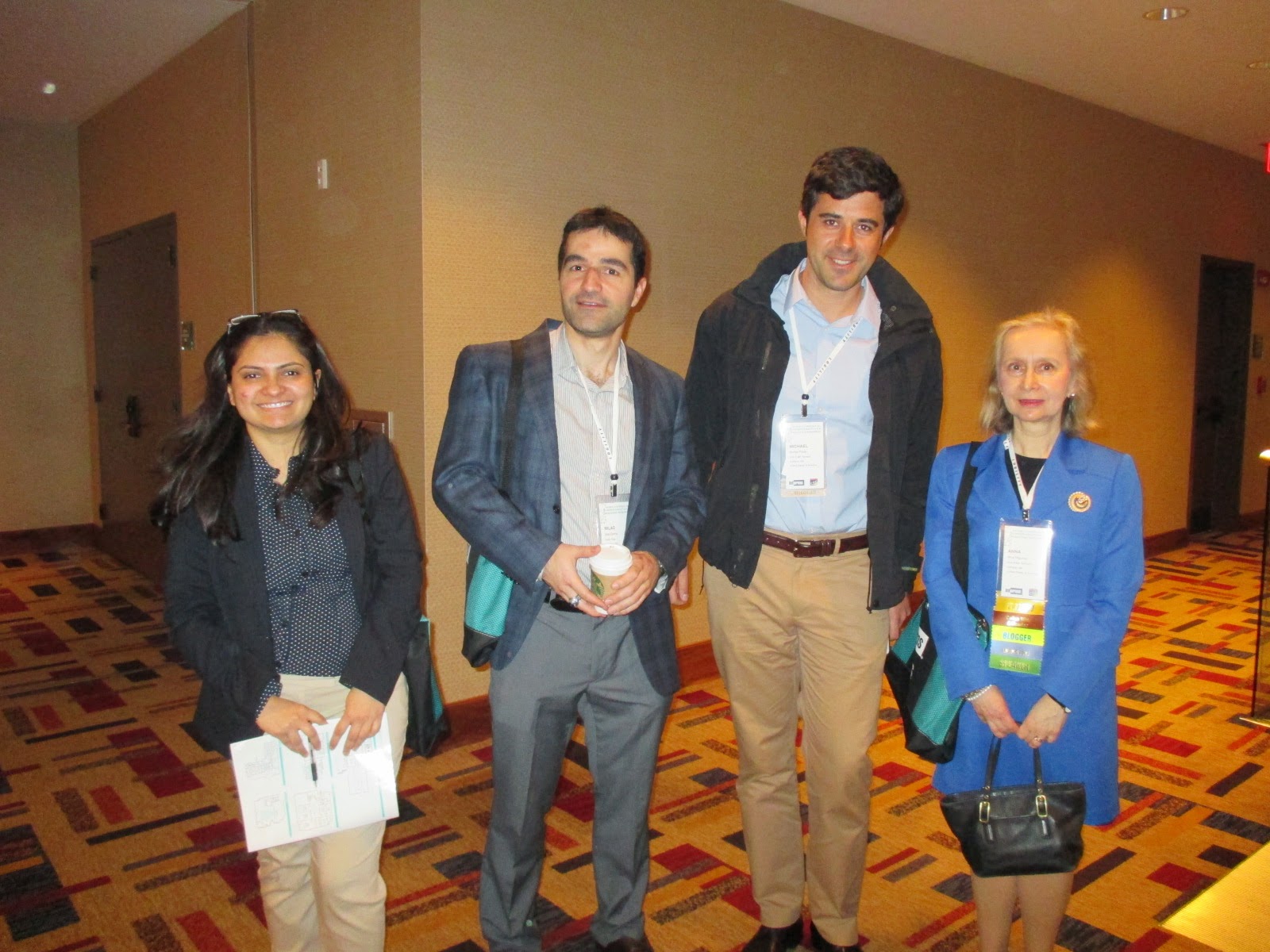
Yesterday, I marched down the hill from the Isenberg School of Management with my three doctoral students to attend the Distinguished Faculty Lecture given by Professor James Kurose of the Computer Science Department at UMass Amherst.
The title of his lecture, which was given in the Massachusetts Room of the Mullins Center to a standing room audience, was "Design and Analysis of a Content-oriented Internet."
Professor Kurose was introduced by Provost James Staros and Dean Steven Goodwin and our Chancellor, Dr. Subbaswamy, was in attendance as well as our VCRE Mike Malone.
Professor Kurose began his lecture by saying that he is "A Teacher" and provided us with an overview of the major developments in communications from the telephone to packet switching to the Internet. He emphasized that the Internet is a Network of Networks and, since I founded and direct the Supernetwork Center at UMass, I liked hearing this very much. Supernetworks are networks of networks and our research at the center has advanced both methodologies and the modeling and solution of applications ranging from multimodal transportation networks to complex supply chains and to now envisioning a Future Internet Architecture (FIA), which is funded by the National Science Foundation (NSF), and which we are working on with Co-PIs at multiple universities. Our FIA is known as ChoiceNet.
Professor Kurose emphasized that "Content is King" and stated that Cisco is predicting that, by 2017, 80-90% of the Internet traffic will be for videos, TV streaming, peer to peer, etc. He noted that consumers don't care where the content comes from as long as we get it.
Everything used to be wired but now there are more wireless devices than wired ones connected to the Internet. There are also millions of access networks - for example, at UMass we would first be connected to that network.
He also spoke about the challenges that Netflix faces and that researchers in the Computer Science Department are working on. Some of my students and I had had a preview of this topic just the day before in my Management Science doctoral seminar on Variational Inequalities, Networks, and Game Theory, since a Computer Science professor and one of his doctoral students have been sitting in this course of mine and it has been terrific to have them. We had heard the day before about how Netflix is unsure of where to position movies (store them) and makes multiple copies in multiple locations - this may reduce the speed of delivery and also add to network congestion plus storage costs - topics I have spoken about.
Afterwards there were great questions, even from our Chancellor - not surprising since he is a physicist!
I commented that the Netflix problem reminded me of a problem in humanitarian logistics (another course that I am teaching this semester) in terms of the positioninng of supplies and also mentioned our FIA project ChoiceNet, which will allow consumers to select not only content but the mode of delivery which could include less congested paths with consumers willing to pay for such enhanced services as we say "pay with their wallets."
Indeed, in our ChoiceNet project, which we already have multiple papers on, we draw comparisons with supply chain networks and freight delivery systems and recognize the importance of network economics, game theory, and operations research. Professor Kurose, after my comments, did note that I was in OR and mentioned "facility location." I have a good idea as to how to model the Netflix problem and solve it. He also mentioned that 2 out of the 5 NSF FIA [projects had UMass Amherst contributors, which is wonderful!
After his fabulous talk - clear why he has received multiple teaching awards research recognitions, I took the photo below of him with my doctoral students.
We essentially closed up the reception since there were so many interesting faculty and graduate students to talk to from Computer Science, Electrical and Computer Engineering, and even Political Science!
Professor Kurose has been at UMass Amherst for 30 years and over the next 30 we can continue to ask him many questions that his talk inspired.
I remember, back in 2005, sharing the stage with him at the Bowker Auditorium, when both of us were amongst the 12 faculty being recognized with a new award, which is now given annually - the Award for Outstanding Accomplishments in Research and Creative Activity.
Great to have the opportunity for my doctoral students in Management Science to meet him yesterday!
Thursday, April 10, 2014
Design and Analysis of a Content-oriented Internet
Sunday, April 6, 2014
Choosing a Speech Topic and the Winner Is - Our Outstanding UMass Amherst Students
I enjoy giving talks, from seminar and conference presentations to keynotes in exciting locations around the world and these are, typically, of a technical nature.
I also enjoy giving talks to audiences such as at the World Science Festival or at the NYTimes EnergyforTomorrow Conference or at the AAAS Annual meetings. The audiences at such venues are always fabulous
Certain special occasions also call for a "speech" whether at a graduation commencement or at an honor society induction or, perhaps, a banquet of some sort.
Today I had the honor and privilege of being the Guest Speaker at the UMass Amherst Campus Center Auditorium at the Phi Kappa Phi Honor Society Induction ceremony. Professor Don Katzner of our Economics Department had invited me close to a year ago. Since I enjoyed the ceremony last year so much I agreed. Phi Kappa Phi, according to its website was founded in 1897 at the University of Maine, Phi Kappa Phi is the nation's oldest, largest, and most selective collegiate honor society for all academic disciplines.
I have given commencement speeches both at an undergraduate Isenberg School commencement at the Mullins Center and also at the Graduate Ceremonies at the School of Business, Economics and Law in Gothenburg, Sweden (on two different occasions).
Selecting a topic of one's speech is very important because it provides a focus for one's thoughts and creates the overall architecture of the talk. The topic should be on a theme that you are really excited about.and the audience would also enjoy listening to. In the case of the event today, the audience consisted of student inductees, some of their family members and friends, and a few faculty members. And there was also a time limit.
I thought about various titles during several walks (I get some of my best ideas while walking or traveling) and I had a big smile on my face when I nailed it down. I was going to speak on Our Outstanding Students at UMass Amherst!
I drafted a transcript of my talk and worked on it over several days, putting in the final touches about an hour before delivering it.
The text can be downloaded here.
Today's ceremony was extra special since two faculty members received a Distinguished Service Award, Professor Alexandrina Deschamps of the Department of Women, Gender and Sexuality Studies, and Professor Donald "Don" Fisher, the Chair of the Department of Mechanical and Industrial Engineering.
Last semester, Professor Fisher gave a great tour of his Arbella Performance lab, along with a lecture, to the students in my Logistics & Transportation class.
I very much enjoyed hearing Professor Katzner, who is President of the Phi Kappa Phi Society Chapter at UMass Amherst (which is the fourth oldest chapter in the U.S., having been founded in 1904), give a speech and our Provost, Dr. James Staros, as well as the Interim Dean of Commonwealth College, Professor Daniel Gordon.
But, best of all, was seeing the inductees come to the stage, receive their awards, and hear them speak about their majors, where they are from, and their plans.
There were even several students from the Isenberg School.
The last student came to the stage and had those of us who were seated on the stage take a selfie with him, after noting David Ortiz's selfie with President Obama!
Extraordinary students we have at UMass Amherst - what a beautiful ceremony it was on a bright, sunny day! Congratulations, one and all!
Thursday, April 3, 2014
Can Financial Engineering Cure Cancer?
This past Tuesday I spoke on Cybersecurity and Financial Services at the fabulous INFORMS Conference on Business Analytics & Operations Research in Boston.
In my presentation, which can be downloaded here, I mentioned my colleagues with whom I had conducted the relevant research and also included some network images produced by one of my colleagues, Professor Mila Sherman of Finance, which was done with her dissertation advisor at the Sloan School at MIT, Professor Andrew Lo, and two other collaborators. I wrote about my experience speaking at the conference in a previous post.
Today, after teaching two of my classes, I returned to my office and in catching up with email messages found the announcement below from the Chair of our Finance Department, Professor Sanjay Nawalkha, about the CISDM Research Day in early May. I highlighted just one of the two talks that Professor Lo will be giving in bold because the title captivated me.
Dear Colleagues,
On the behalf of the Department of Finance and the Center for International Securities and Derivative Markets (CISDM), I would like to invite all of you to the CISDM Research Day on May 2nd, 2014. Andy Lo of MIT (ranked as one of the 100 most influential people by Time magazine a few years ago) will give the keynote speech at 11:30 AM. Andy will present his research on "Can Financial Engineering Cure Cancer? A New Approach to Funding Biomedical Innovation." This research is part of a broader effort to raise billions of dollars to fund research on cancer drugs stuck in the pipeline. Andy will also give another talk on relationship between efficient markets and behavioral finance via evolutionary biology and cognitive neurosciences at 2:15pm. Andy's bio and the full schedule for the CISDM Research day is attached below. Professors Bing Liang and Hossein Kazemi will also make presentations. There will be opportunities to speak with Andy and other speakers during lunch and dinner times. The CISDM Research Day is sponsored by Moody's.
The full program is on the CISDM website, which I have reprised below for your convenience.
RSVP to finance@isenberg.umass.edu if you are planning to
attend. We will be making name tags for attendees and plan to serve
lunch for those who RSVP. Looking forward to your replies and
attendance.
Andrew W. Lo is the Charles E. and Susan T. Harris Professor at the MIT Sloan School of Management and director of the MIT Laboratory for Financial Engineering. He received his Ph.D. in economics from Harvard University in 1984. Before joining MIT's finance faculty in 1988, he taught at the University of Pennsylvania's Wharton School as the W.P. Carey Assistant Professor of Finance from 1984 to 1987, and as the W.P. Carey Associate Professor of Finance from 1987 to 1988.
He has published numerous articles in finance and economics journals, and has authored several books including The Econometrics of Financial Markets, A Non-Random Walk Down Wall Street, Hedge Funds: An Analytic Perspective, and The Evolution of Technical Analysis. He is currently co-editor of the Annual Review of Financial Economics and an associate editor of the Financial Analysts Journal, the Journal of Portfolio Management, and the Journal of Computational Finance.
His awards include the Alfred P. Sloan Foundation Fellowship, the Paul A. Samuelson Award, the American Association for Individual Investors Award, the Graham and Dodd Award, the 2001 IAFE-SunGard Financial Engineer of the Year award, a Guggenheim Fellowship, the CFA Institute's James R. Vertin Award, the 2010 Harry M. Markowitz Award, and awards for teaching excellence from both Wharton and MIT.
CAN FINANCIAL ENGINEERING CURE CANCER?: A NEW APPROACH TO FUNDING
BIOMEDICAL INNOVATION
Andrew W. Lo
Abstract: As disruptive as the recent financial crisis has been, the important lessons to be learned from the spectacular failure of financial technologies gone awry may actually pave the way for some of the most significant achievements of the 21st century. In this talk, Prof. Lo will provide a brief overview of the key role that financial innovation played in the crisis, and how a deeper appreciation of human nature and incentives may allow financial engineers to focus the enormous power of global financial markets on one of society's most pressing challenges: curing cancer.
Andrew Lo is fabulous and it will be great to welcome him again to the Isenberg School.
In my presentation, which can be downloaded here, I mentioned my colleagues with whom I had conducted the relevant research and also included some network images produced by one of my colleagues, Professor Mila Sherman of Finance, which was done with her dissertation advisor at the Sloan School at MIT, Professor Andrew Lo, and two other collaborators. I wrote about my experience speaking at the conference in a previous post.
Today, after teaching two of my classes, I returned to my office and in catching up with email messages found the announcement below from the Chair of our Finance Department, Professor Sanjay Nawalkha, about the CISDM Research Day in early May. I highlighted just one of the two talks that Professor Lo will be giving in bold because the title captivated me.
Dear Colleagues,
On the behalf of the Department of Finance and the Center for International Securities and Derivative Markets (CISDM), I would like to invite all of you to the CISDM Research Day on May 2nd, 2014. Andy Lo of MIT (ranked as one of the 100 most influential people by Time magazine a few years ago) will give the keynote speech at 11:30 AM. Andy will present his research on "Can Financial Engineering Cure Cancer? A New Approach to Funding Biomedical Innovation." This research is part of a broader effort to raise billions of dollars to fund research on cancer drugs stuck in the pipeline. Andy will also give another talk on relationship between efficient markets and behavioral finance via evolutionary biology and cognitive neurosciences at 2:15pm. Andy's bio and the full schedule for the CISDM Research day is attached below. Professors Bing Liang and Hossein Kazemi will also make presentations. There will be opportunities to speak with Andy and other speakers during lunch and dinner times. The CISDM Research Day is sponsored by Moody's.
The full program is on the CISDM website, which I have reprised below for your convenience.
CISDM RESEARCH DAY - sponsored by MOODY'S
Please save May 2 for our CISDM Research Day. The agenda and description of the talks are below.
RSVP to finance@isenberg.umass.edu if you are planning to
attend. We will be making name tags for attendees and plan to serve
lunch for those who RSVP. Looking forward to your replies and
attendance.
CISDM Research Day sponsored by Moody's
Isenberg School of Management - UMass Amherst
Featuring Andrew W. Lo, Charles E. and Susan T. Harris Professor at the MIT Sloan School of Management
DATE: Friday May 2, 2014
LOCATION: Room 108, Isenberg School of Management (121 Presidents Drive, Amherst, MA)
Agenda:
Andrew W. Lo Biography:11:30am-12:30pm - Introduction and Andrew Lo (MIT) presentation: Can Financial Engineering Cure Cancer? A New Approach to Funding Biomedical Innovation
12:30-1:30pm - Lunch
1:30-2:15pm - Bing Liang (UMass Amherst) presentation (30 minute presentation and 15 minute discussion): Hedge Fund Ownership and Stock Market Efficiency
2:15-3:15pm - Andrew Lo (MIT) presentation: Lies My Finance Professor Told Me: Reconciling Efficient Markets and Behavioral Finance Via Evolutionary Biology and the Cognitive Neurosciences
3:15-3:45pm - Coffee Break
3:45-4:30pm - Hossein Kazemi (UMass Amherst) presentation (30 minute presentation and 15 minute discussion): Dynamics of Hedge Fund's Exposures: Implications for Performance and Herding
Andrew W. Lo is the Charles E. and Susan T. Harris Professor at the MIT Sloan School of Management and director of the MIT Laboratory for Financial Engineering. He received his Ph.D. in economics from Harvard University in 1984. Before joining MIT's finance faculty in 1988, he taught at the University of Pennsylvania's Wharton School as the W.P. Carey Assistant Professor of Finance from 1984 to 1987, and as the W.P. Carey Associate Professor of Finance from 1987 to 1988.
He has published numerous articles in finance and economics journals, and has authored several books including The Econometrics of Financial Markets, A Non-Random Walk Down Wall Street, Hedge Funds: An Analytic Perspective, and The Evolution of Technical Analysis. He is currently co-editor of the Annual Review of Financial Economics and an associate editor of the Financial Analysts Journal, the Journal of Portfolio Management, and the Journal of Computational Finance.
His awards include the Alfred P. Sloan Foundation Fellowship, the Paul A. Samuelson Award, the American Association for Individual Investors Award, the Graham and Dodd Award, the 2001 IAFE-SunGard Financial Engineer of the Year award, a Guggenheim Fellowship, the CFA Institute's James R. Vertin Award, the 2010 Harry M. Markowitz Award, and awards for teaching excellence from both Wharton and MIT.
CAN FINANCIAL ENGINEERING CURE CANCER?: A NEW APPROACH TO FUNDING
BIOMEDICAL INNOVATION
Andrew W. Lo
Abstract: As disruptive as the recent financial crisis has been, the important lessons to be learned from the spectacular failure of financial technologies gone awry may actually pave the way for some of the most significant achievements of the 21st century. In this talk, Prof. Lo will provide a brief overview of the key role that financial innovation played in the crisis, and how a deeper appreciation of human nature and incentives may allow financial engineers to focus the enormous power of global financial markets on one of society's most pressing challenges: curing cancer.
Andrew Lo is fabulous and it will be great to welcome him again to the Isenberg School.
Wednesday, April 2, 2014
Cybersecurity and Financial Services and Prescriptive Analytics
Yesterday, I had the honor of speaking on Cybersecurity and Financial Services at the INFORMS Analytics Conference in Boston. The conference was very well-organized, the venue at the Westin Waterfront hotel was marvelous, and the speakers came from both industry (many of the top analytics firms as developers and/or users were there) and academia. Also, there were many students and even a good-sized cohot from our UMass Amherst INFORMS Student Chapter, which I highlighted in one of my posts.
I had multiple roles at this conference, which made the experience extra rewarding, and INFORMS staff presented me with the nice streamers below.
My talk was in the Prescriptive Analytics track, which was appropriate, and Dr. Marius Solomon of Northeastern University introduced me. I have known Marius for many years through the Transportation & Logistics Society of INFORMS. He shared with me that there were 104 submissions for presentations and out of these 30 were selected. I had carefully thought about the topics that I would like to speak on and chose Cybersecurity and Financial Services since I believe that cybersecurity is a topic that could greatly benefit from analytics and operations research methodologies and the wonderful geeks and brainiacs in our professional community for whom tough problems are both challenging and enticing!
It was great to have Dr. Irv Lustig of IBM in the audience and some of you may know that Irv was also an Applied Math major at Brown University and I was his TA for an operations research course taught there by my dissertation advisor Professor Stella Dafermos. Irv is well-known at INFORMS and very active in its Certified Analytics Professional program. I posted a photo of Irv and me in my previous blogpost.
Irv asked good questions, but, then again, he has had an outstanding education (his doctoral dissertation advisor at Stanford was Professor George Dantzig, one of the founders of Operations Research). And we continued the discussion after my presentation. Great to hear that IBM is also interested in Financial Networks!
In my presentation I spoke about a project that was funded by the Advanced Cyber Security Center (ACSC) and then segued into our NSF project.
My full presentation, in pdf format, can be downloaded from the Supernetworks Center website.
In the presentation I highlighted a network model that we developed to assess financial network vulnerability and importance of different financial network components, described a network economic model of cyber crime, and also discussed our latest NSF project on envisioning a Future Internet Architecture that we are calling ChoiceNet. Imagine if we could enhance the resilience of the network through redesign.
Thanks to INFORMS for organizing such a fabulous analytics conference!
Tuesday, April 1, 2014
Highlights of INFORMS Boston Analytics Conference Through Photos
Today the sun has (finally) come out in Boston and it is the last day of the GREAT INFORMS Analytics Conference in Boston. I will be speaking later today on Cybersecurity and Financial Services, on research funded by the Advanced Cyber Security Center and the National Science Foundation.
I my previous post on this blog I included some photos of our UMass Amherst students who are attending this conference.
Below I have posted some photos from talks, networking events and also the Edelman Awards gala at which the CDC received the 2014 Edelman Award for its efforts in eradicating polio.
INFORMS Registration Area
Keynote Talk by Tom Davenport
Coffee with Member
Numerous Networking Opportunities
Superb Supply Chain Talks
Serendipity of Seeing Colleagues and Students
The Edelman Gala with a Delicious Dessert
The analytics conference has been an intellectual and professional feast!
I my previous post on this blog I included some photos of our UMass Amherst students who are attending this conference.
Below I have posted some photos from talks, networking events and also the Edelman Awards gala at which the CDC received the 2014 Edelman Award for its efforts in eradicating polio.
INFORMS Registration Area
Keynote Talk by Tom Davenport
Coffee with Member
Superb Supply Chain Talks
Serendipity of Seeing Colleagues and Students
The Edelman Gala with a Delicious Dessert
The analytics conference has been an intellectual and professional feast!
Monday, March 31, 2014
Great to See So Many UMass Amherst INFORMS Student Chapter Members at Analytics Boston
I am attending the great INFORMS Boston Analytics Conference and arrived yesterday.
The weather has not been compliant (it is cold and rainy) but the venue of the conference (the Westin Waterfront hotel), the talks (beginning with Tom Davenport's Keynote talk today), and the various networking events from the breakfasts to the lunches, etc., have been fabulous!
I am here with one of my doctoral students, Shivani Shukla, who is also the President of the award-winning UMass Amherst INFORMS Student Chapter. In addition, we have seen other students here both from the Isenberg School of Management and the College of Engineering, who are chapter members and this is great. I am the chapter's Faculty Advisor and it is so rewarding working with these terrific students.
Even one of our PhD graduates, Dr. Milad Ebtehaj, who now works at FedEX in Memphis, is here.
The photos below capture the smiles of our chapter members.
The talks that I have attended, so far, besides Tom Davenport's keynote, have ranged from those on supply chain themes to healthcare. It is fantastic to listen to practitioners' perspectives and to also have time to discuss deeply various issues and challenges that they are faced with.
I've had a chance to see Dr. Radhka Kulkarni of SAS, Dr. Les Servi of MITRE, Dr. Irv Lustig of IBM, and even Dr. Larry Seiford of Michigan. Both Les and Irv were undergrads in Applied Math at Brown University as was I a while back.
This morning I took part in "Coffee with a Member," which passed by too quickly.
The Analytics conference is so educational and informative - I am very glad that some of our students could take advantage of this great opportunity!
Saturday, March 29, 2014
Packing and Revising My Optimal Route to the INFORMS Analytics Conference in Boston
I am blogging the INFORMS Analytics Conference in Boston and below I am reposting my first submitted official post.
It is a beautiful sunny day in Massachusetts and we are very excited about the INFORMS Analytics Conference which kicks off tomorrow in Boston at the Westin Waterfront hotel!
My talk on cybersecurity and financial services, which I am presenting there on Tuesday is all set, and I have begun to pack. There is no need for printing a boarding pass and making a seat assignment, unlike for my trip of just over a week ago when I flew back from Amsterdam to Boston Logan.
Since I work on network systems, from transportation and logistical ones to the Internet, I have always been interested in optimal routing of flows.
I had settled on a route from Amherst, where I live, to Boston, which I am very familiar with, and then the email arrived from EZPass last evening, which stated:
MassDOT has planned 3 significant weekend lane restrictions on Interstate 90 (Massachusetts Turnpike) in Boston to remove the Prudential Tunnel ceiling over the roadway. The ceiling remains safe and secure, but has deteriorated beyond the point of repair and must be removed. The tunnel ceiling is owned and maintained by the Massachusetts Convention Center Authority (MCCA).
The restrictions will reduce traffic to one lane eastbound and one lane westbound inside the Prudential Center Tunnel on the following weekends:
March 28-30!!! (I added the exclamation points.)
Last Saturday, my shuttle driver from Logan made a quick maneuver when he saw the stream of glowing car backlights in the same tunnel, which is just outside of Logan. This necessitated a diversion through Arlington and added about 40 minutes to the last leg of my journey back to Amherst, which had originated in Gothenburg, Sweden, 14 hours before!
But now I was forewarned, thanks to MassDOT!
So, since we are educated as operations researchers, my revised route to Boston is below:

This INFORMS conference should be very energizing with exciting interactions between academics and practitioners plus I am even bringing one of my doctoral students, who is the President of our UMass Amherst INFORMS Student Chapter. This will be an outstanding venue for introducing her to my favorite professional society and community!
Go INFORMS, Boston, and, always, Boston Strong!
Safe travels, everyone, and see you soon!
Subscribe to:
Posts (Atom)