I returned yesterday from the NET2009 conference in Rome, Italy. Taking a taxi at 7:00AM on a Sunday to the Rome airport allowed me to experience free flow traffic in that usually very congested city. Rather than an hour trip between these two points as was my experience the previous Tuesday morning during rush hour traffic, the trip took only 20 minutes. There was congestion, however, in the Rome airport where the queues even at that time were sizable due to many departing international flights. Serendipitously, while standing in the line for security I started a conversation with a gentleman next to me who works for American Airlines and had received a PhD in industrial engineering from Purdue University several years back. So, of course, we talked about faculty and students that we both knew.
Our Air One flight (Alitalia and Air One have, in effect, merged) left an hour late but we still somehow managed to arrive on time at Logan in Boston. The food was terrific on the flight and the air crew and staff very gracious and friendly. The flight allowed me to reminisce about the experiences in Rome for the past several days, which included (over and above the conference experiences):
being asked by a nun in Italian for directions (for some reason, almost any place I have traveled to I have been asked for directions in the native tongue, including in Japan),
seeing the effects of a multi-hour transportation worker stoppage on a Saturday in Rome (busses, taxis, trains did not operate, with a consequence that some tourists were left to walk for miles since the tour busses that had deposited them would not move),
after consuming wonderful pastries, which, I suspect, had too much rum in them, ending up wandering "lost" in Rome, trying to find my hotel (luckily, the train and huge police stations are good central locations),
getting to know the staff at the Casa dell'Aviatore (the home for aviators) quite well since I had spent 5 nights there,
watching Italian news and television in the wee hours due to disco/rock bands playing "outside" my bedroom window and, hence, my inability to get to sleep (Italian TV can merit pages of blogging but it is incredibly entertaining from the news shows to the extravaganza song and dance shows with nuns usually getting front row seating),
finding a huge, simply magnificent cemetery next to La Sapienza where I walked in tranquility admiring the incredible mausoleums and memorials with mosaics and even photos of the deceased in ceramic and tile and decorated with flowers and plantings (another side benefit was that, while walking there, I came up with an interesting angle with which to tackle/unify two research problems on supply chains that I had been working on),
eating delicious meals at which people linger and enjoy the food, each other, and the conversations,
navigating the traffic as a pedestrian,
trying to decipher the graffiti (a huge problem and an eyesore in contrast to the glorious architecture),
and enjoying the elegance and charm of the people.
Thank you, Rome, for an experience unlike any other!
PS As for those of you who follow sports, yesterday, the Giro bicycle competition ended in Rome with Menchov the victor.
Showing posts sorted by relevance for query rome. Sort by date Show all posts
Showing posts sorted by relevance for query rome. Sort by date Show all posts
Monday, June 1, 2009
Tuesday, May 26, 2009
Rome and La Sapienza
I made it today to Rome, Italy and flew Alitalia out of Logan airport in Boston on Memorial Day. Amazingly, the turnpike traffic was minimal during the afternoon and we breezed through the toll booths. As a consequence I had several hours to spare at the airport but enjoyed seeing the Memorial Day holiday travelers. I had delightful companions on the Valley Transporter shuttle and got a chance to catch up with Smith College news since I shared the ride with a chair of a department at Smith and her husband who were traveling to Paris.
Alitalia provided excellent service and the dinner en flight was delicious -- salmon with green beans, a fresh salad, roasted potatos, and fresh fruit. My seatmates were a couple from New England who were traveling through Rome to Istanbul to meet a friend from Odessa there. I even managed to catch a few hours of sleep.
The taxi ride from the Rome airport allowed me to experience the morning commute traffic which was very congested but at least many of the highways are decorated with blooming flowers. Plus I had a delightful taxi driver. We communicated in my Spanish and his Italian with a bit of English here and there.
I am staying in a military hotel close to La Sapienza, the university that is the venue of the conference that I will be speaking at. The lunch today was incredible -- the salad with cherry tomatos and cheese plus the grilled fish simply delicious. This part of Rome is not touristy and very few people speak English, which makes the communications interesting.
The temperature here is very hot and humid -- so different from Amherst, Massachusetts this past week!
Alitalia provided excellent service and the dinner en flight was delicious -- salmon with green beans, a fresh salad, roasted potatos, and fresh fruit. My seatmates were a couple from New England who were traveling through Rome to Istanbul to meet a friend from Odessa there. I even managed to catch a few hours of sleep.
The taxi ride from the Rome airport allowed me to experience the morning commute traffic which was very congested but at least many of the highways are decorated with blooming flowers. Plus I had a delightful taxi driver. We communicated in my Spanish and his Italian with a bit of English here and there.
I am staying in a military hotel close to La Sapienza, the university that is the venue of the conference that I will be speaking at. The lunch today was incredible -- the salad with cherry tomatos and cheese plus the grilled fish simply delicious. This part of Rome is not touristy and very few people speak English, which makes the communications interesting.
The temperature here is very hot and humid -- so different from Amherst, Massachusetts this past week!


Thursday, May 28, 2009
Plenary talk, Net2009, Rome, and the European Soccer Championship
This morning I gave my plenary talk on supply chain network oligopolies, coalitions, and the merger paradox at the NET2009 conference at La Sapienza in Rome, Italy. I managed to find the conference room in which I was speaking due to a nice custodian who understood sufficient English and knew where the conference was taking place. The audience consisted of physicists (primarily, judging from the show of hands), operations researchers and applied mathematicians, economists, computer scientists, and a few engineers. The talks have been excellent as have been the questions. The methodologies and models of networks differ in these fields and it is fascinating to see common themes of interest and application.
I just finished eating an exquisite lunch of sauteed porcini mushrooms with pasta seasoned with parmesan cheese and parsley, grilled fish, salad, and fruit. Luckily, there is time for a short siesta since the talks will continue until around 6PM today.
One of the conference participants is from Barcelona and he showed me his Barcelona and Manchester United banner from the European soccer final, which took place in Rome yesterday. I took a photo of the banner and will post photos after my return to the US. By the way, Barcelona beat Manchester 2 to 0. Now I understand why there were so many British as well as Spaniards yesterday in Rome wearing all sorts of soccer paraphernalia. Supposedly, 50,000 fans descended on Rome to cheer the teams and all the hotels were booked so many soccer fans have been camping out wherever they can find a spot.
La Sapienza, the university that is hosting the NET2009 conference, is a world-renowned university and this is my first time speaking at this university. Interestingly, I am the only speaker from the United States!
I just finished eating an exquisite lunch of sauteed porcini mushrooms with pasta seasoned with parmesan cheese and parsley, grilled fish, salad, and fruit. Luckily, there is time for a short siesta since the talks will continue until around 6PM today.
One of the conference participants is from Barcelona and he showed me his Barcelona and Manchester United banner from the European soccer final, which took place in Rome yesterday. I took a photo of the banner and will post photos after my return to the US. By the way, Barcelona beat Manchester 2 to 0. Now I understand why there were so many British as well as Spaniards yesterday in Rome wearing all sorts of soccer paraphernalia. Supposedly, 50,000 fans descended on Rome to cheer the teams and all the hotels were booked so many soccer fans have been camping out wherever they can find a spot.
La Sapienza, the university that is hosting the NET2009 conference, is a world-renowned university and this is my first time speaking at this university. Interestingly, I am the only speaker from the United States!
Saturday, June 29, 2013
Supernetwork Center Associates at Euro INFORMS in Rome, Italy
I returned last week from Europe, where I have been spending part of my sabbatical as a Visiting Professor of Operations Management at the School of Business, Economics and Law at the University of Gothenburg in Sweden.
This sabbatical has been fabulous and I am now writing several research papers, inspired by my time in Europe and discussions with colleagues in Sweden.
The Euro INFORMS Conference will be taking place soon -- July 1-4, 2013, in Rome, Italy, and I am pleased to report that several Supernetwork Center Associates will be taking part and that they represent 4 different countries! It is wonderful to see so many operations researchers and management scientists converging from around the globe for this conference!
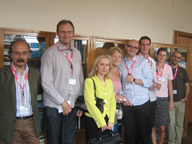
The last time that I was in Rome, Italy, was May 28-30, 2009, when I delivered a plenary talk at NET 2009: Evolution and Complexity at the Sapienza University of Rome (the photo below is from that conference.)
Although I won't be going to Euro INFORMS, our research group will be well-represented there.
Being the Director of the Virtual Center for Supernetworks, which I founded in 2001, has been incredibly rewarding and I am very pleased that we have sustained its richness of activities in terms of research, education, and outreach and that our website gets visited every day internationally. We have built a community of Supernetwork Center Associates, many of whom received their PhDs from the Isenberg School of Management at UMass Amherst, that collaborates and supports one another.
Conferences are the perfect venues in which to reconnect face to face and the Euro INFORMS Conference will be bringing together Center Associates: Professor Patrizia Daniele of the Department of Mathematics and Computer Science at the University of Catania in Italy, Professor Dmytro Matsypura of the School of Business at the University of Sydney in Australia, Professor Tina Wakolbinger of the Vienna University of Economics and Business, and Professor Jose M. Cruz of the School of Business at the University of Connecticut.
Patrizia Daniele has organized a session on Recent Advances in Dynamics of Variational Inequalities I and will be speaking on: Variational Inequalities and Applications to Network Models in session II. In the latter, Tina Wakolbinger and Jose Cruz will deliver their joint paper: Applications of Variational Inequalities in Supply Chain Management — Status Quo and Future Directions. Finally, Dmytro Matsypura will present on: Incremental Network Design with Maximum Flows. His paper is joint work with Martin Savelsbergh and Thomas Kalinowski.
And, since I could not resist, below are photos of several of the Center Associates with me, when Professor Daniele and her husband visited the Supernetwork Laboratory for Computation and Visualization at the Isenberg School at UMass Amherst, back in the summer of 2004, July 9-10.


It is wonderful to see the academic social network flourishing!
Wednesday, April 13, 2016
On Giving Plenary Talks - Off to Canada for Analytics Day!
Conferences are essential to scientific exchanges and also to networking. Plus, one gets to reconnect face-to-face with colleagues from around the globe and to make new contacts and even friends. Travel to new locations is always interesting and revisiting even places where you have been before can be quite informative and pleasant.
In most conferences there are usually special talks given by plenary (or keynote) speakers. Such speakers typically will have a longer time slot in which to present their work and the speakers are selected by conference organizers to draw interest to their events. I enjoy listening to plenary speakers and also enjoy being one.
Whenever I get a notice for a conference, I usually check whether there will be a female plenary speaker. Some may not notice such things, but I do, and it is important to have diversity represented even at the highest levels.
Tomorrow I will be flying to Toronto, Canada, since on Friday, April 15, I will be giving a plenary talk at Analytics Day at the University of Waterloo. This university is renowned for research in optimization and, coincidentally, I gave an invited seminar there in Management Sciences almost exactly 5 years ago!

Analytics Day was organized by Professor Fatma Gzara and it will bring together academics and practitioners as well as students. The program is online.
 I presented Professor Gzara with several topics and she selected: Predictive and Prescriptive Models of Cybercrime and Cybersecurity Investments Under Network Vulnerability. Cybersecurity is a very hot topic and I have given recent talks on this theme at the MITRE Corporation and also at the Heinz College at Carnegie Mellon University.
It will be exciting to be back in Canada, the country of my birth.
I have given plenary talks in some fabulous locations and thank the organizers of various conferences for these great opportunities. Last summer, for example, I traveled to Colombia, to speak at a conference in Bogota and had such a magical time that I had to blog about it.
One year ago, I was in Berlin, Germany, to address the largest physics conference in Europe. Clearly, research on networks, which has always been my passion, has no disciplinary boundaries. It's also terrific to see operations researchers welcomed by different disciplines and, in a sense, at the highest levels.
I also very much enjoyed giving a plenary talk in Rome, Italy, and even in Auckland, New Zealand. I posted some photos from the New Zealand experience here. I wrote a blogpost about my experiences in Rome which can be accessed here. I remember fondly getting lost while taking a long walk in Rome and seeing quite a few nuns (I suspect it may have been the delicious but very spiked dessert I had consumed) and glorious architecture and sites. I also remember (not so fondly) almost getting run over by the vehicles (almost saw my life pass by) while trying to cross the streets.
I thoroughly loved speaking in Paris at the NetGCoop conference in 2011 in October. Professor Asu Ozdaglar of MIT was another female plenary speaker at this conference focusing on networks, which was extra special.
I do believe that female researchers should accept invitations to deliver plenary talks at conferences since it is important for students (male and female) and others to see the great opportunities that the academic life provides.
And seeing is believing.
In most conferences there are usually special talks given by plenary (or keynote) speakers. Such speakers typically will have a longer time slot in which to present their work and the speakers are selected by conference organizers to draw interest to their events. I enjoy listening to plenary speakers and also enjoy being one.
Whenever I get a notice for a conference, I usually check whether there will be a female plenary speaker. Some may not notice such things, but I do, and it is important to have diversity represented even at the highest levels.
Tomorrow I will be flying to Toronto, Canada, since on Friday, April 15, I will be giving a plenary talk at Analytics Day at the University of Waterloo. This university is renowned for research in optimization and, coincidentally, I gave an invited seminar there in Management Sciences almost exactly 5 years ago!

Analytics Day was organized by Professor Fatma Gzara and it will bring together academics and practitioners as well as students. The program is online.

It will be exciting to be back in Canada, the country of my birth.
I have given plenary talks in some fabulous locations and thank the organizers of various conferences for these great opportunities. Last summer, for example, I traveled to Colombia, to speak at a conference in Bogota and had such a magical time that I had to blog about it.
One year ago, I was in Berlin, Germany, to address the largest physics conference in Europe. Clearly, research on networks, which has always been my passion, has no disciplinary boundaries. It's also terrific to see operations researchers welcomed by different disciplines and, in a sense, at the highest levels.
I also very much enjoyed giving a plenary talk in Rome, Italy, and even in Auckland, New Zealand. I posted some photos from the New Zealand experience here. I wrote a blogpost about my experiences in Rome which can be accessed here. I remember fondly getting lost while taking a long walk in Rome and seeing quite a few nuns (I suspect it may have been the delicious but very spiked dessert I had consumed) and glorious architecture and sites. I also remember (not so fondly) almost getting run over by the vehicles (almost saw my life pass by) while trying to cross the streets.
I thoroughly loved speaking in Paris at the NetGCoop conference in 2011 in October. Professor Asu Ozdaglar of MIT was another female plenary speaker at this conference focusing on networks, which was extra special.
I do believe that female researchers should accept invitations to deliver plenary talks at conferences since it is important for students (male and female) and others to see the great opportunities that the academic life provides.
And seeing is believing.
Monday, June 1, 2009
Photos of Rome, Italy


This past week I was blogging about the NET2009 conference in Rome, Italy and my travel/transportation experiences. Since, sometimes, a picture may be worth one thousand words, I am posting some photos of Rome, with the proviso that I was not on a Roman holiday but at a conference.
Thursday, June 20, 2013
Staying Healthy While Traveling
I do a lot of traveling, especially flying, as part of my roles as a Professor and a Speaker.
I have also lived outside of the US, due to Fulbrights and Visiting Professorships (and was born in Canada). These experiences have been some of the richest and most rewarding ones in my career and life.
Having lived in Innsbruck, Austria (on a Fulbright) with views of the Alps, as well as in Stockholm, Sweden and, now, in Gothenburg, Sweden, travel and living abroad stimulate ideas, enhance experiences that you can share with students, and provide you with cultural richness that you can't obtain by just staying in one place, no matter how comfortable you are. I have also spent time in Italy as a Fulbrighter.
This past week, I wrote about speaking in Athens, Greece and in Gothenburg, Sweden and last night my family made it back to Amherst, Massachusetts after two legs of flying and a drive from Boston.
This morning, while checking the news in my office in Sweden, I was shocked to see that James Gandolfini, who starred as Tony Soprano, in the award-winning series, Sopranos, died at age 51 while on holiday in Rome, Italy.
The fabulous mayor of Boston, Thomas Menino, was taken ill last Fall, while on a short vacation in Italy, and has endured multiple health issues since.
Last week, I was shocked to hear that Dr. Jesus Artalejo, the Editor of TOP, an operations research journal, had died (a heart attack is being suspected), while at a conference in Arizona. There are other examples of colleagues that have also passed away while at a conference in another country.
My tips for staying healthy while traveling and spending extended periods overseas:
1. Try and practice social distancing from those who are coughing heavily or are like typhoid Mary -- this has been harder to do on packed flights. If all else fails, put on your face mask -- I have done this twice and it worked. I have also spent a lot of time in the back of planes on long flights where I have met some of the most fascinating people! Especially now with the MERS virus it is important to not pick up dangerous infections (remember SARS?).
2. Wash your hands often and use your hand sanitizer during travel and at your destination.
3. Exercise, exercise, exercise -- walking through airports and at your destination will help you to overcome jetlag and will go a long way in keeping you fit and healthy. I rarely sit at an airport -- we do enough of that on transoceanic flights.
4. Drink a lot of water every day.
5. Eat healthy, nutritious food and enjoy cuisines from around the world but pay attention to food safety.
6. And, if possible, get enough sleep -- sleep needs vary from person to person.
7. Take your vitamins.
8. Don't overexert yourself.
9. Make sure that you have the necessary vaccinations for the country that you are traveling to.
10. Ejoy the experiences while traveling and pace yourself appropriately!
More advice for health and travel can be found here.
Many of my colleagues will be heading to the EURO Conference on Operations Research in Rome, Italy, so do take care of yourselves, wherever your travels may take you!
I have also lived outside of the US, due to Fulbrights and Visiting Professorships (and was born in Canada). These experiences have been some of the richest and most rewarding ones in my career and life.
Having lived in Innsbruck, Austria (on a Fulbright) with views of the Alps, as well as in Stockholm, Sweden and, now, in Gothenburg, Sweden, travel and living abroad stimulate ideas, enhance experiences that you can share with students, and provide you with cultural richness that you can't obtain by just staying in one place, no matter how comfortable you are. I have also spent time in Italy as a Fulbrighter.
This past week, I wrote about speaking in Athens, Greece and in Gothenburg, Sweden and last night my family made it back to Amherst, Massachusetts after two legs of flying and a drive from Boston.
This morning, while checking the news in my office in Sweden, I was shocked to see that James Gandolfini, who starred as Tony Soprano, in the award-winning series, Sopranos, died at age 51 while on holiday in Rome, Italy.
The fabulous mayor of Boston, Thomas Menino, was taken ill last Fall, while on a short vacation in Italy, and has endured multiple health issues since.
Last week, I was shocked to hear that Dr. Jesus Artalejo, the Editor of TOP, an operations research journal, had died (a heart attack is being suspected), while at a conference in Arizona. There are other examples of colleagues that have also passed away while at a conference in another country.
My tips for staying healthy while traveling and spending extended periods overseas:
1. Try and practice social distancing from those who are coughing heavily or are like typhoid Mary -- this has been harder to do on packed flights. If all else fails, put on your face mask -- I have done this twice and it worked. I have also spent a lot of time in the back of planes on long flights where I have met some of the most fascinating people! Especially now with the MERS virus it is important to not pick up dangerous infections (remember SARS?).
2. Wash your hands often and use your hand sanitizer during travel and at your destination.
3. Exercise, exercise, exercise -- walking through airports and at your destination will help you to overcome jetlag and will go a long way in keeping you fit and healthy. I rarely sit at an airport -- we do enough of that on transoceanic flights.
4. Drink a lot of water every day.
5. Eat healthy, nutritious food and enjoy cuisines from around the world but pay attention to food safety.
6. And, if possible, get enough sleep -- sleep needs vary from person to person.
7. Take your vitamins.
8. Don't overexert yourself.
9. Make sure that you have the necessary vaccinations for the country that you are traveling to.
10. Ejoy the experiences while traveling and pace yourself appropriately!
More advice for health and travel can be found here.
Many of my colleagues will be heading to the EURO Conference on Operations Research in Rome, Italy, so do take care of yourselves, wherever your travels may take you!
Saturday, May 30, 2009
Traffic and Pedestrians
Today is the last day of the NET2009 conference in Rome, Italy. It has been a fascinating conference and the conferees are from Switzerland, Denmark, The Netherlands, Norway, Ireland, Argentina, Turkey, Bulgaria, Romania, Germany, Spain, Italy, with me representing the United States. I have heard talks by physicists on finance, on economics, on evolutionary game theory. The theme here is definitely interdisciplinarity. My plenary talk on Thursday focused on supply chains and oligopolies and how we could assess the possible gains from mergers and acquisitions with insights into the merger paradox. My field is operations research and management science so I am interested in mathematical modeling, analysis, and effective algorithms for problem solution as well as managerial insights.
The venue at La Sapienza is a big room and we are offered Italian treats during coffee breaks. My hotel is the hotel for aviators (translated roughly from the Italian) so I am surrounded by men in uniform. Navigating the streets and crosswalks of Rome has been quite the experience. Even with a green light, I cross, only to get mopeds and cars literally almost clipping my heels. Several times I thought that I would not make it across the street, even while trying to cross with a group of Italians, but somehow, miraculously, the traffic stops and I look into the eyes of the drivers.
As for parking, I have seen cars parked on crosswalks, on sidewalks, and almost on top of one another as in those fabulous children books by Richard Scarry with the characters Huckle and Lowly.
I continue to be impressed by the elegance of the people here and how they greet each other so warmly and courteously. My hotel has the most delicious food but the rooms do not have carpets (but lovely hardwood floors) so noise travels plus one needs to lock oneself into the room with a big key. In case of fire I do not think that anyone would be able to unlock the doors to escape (in addition there are metal grates on the room windows). The rooms are clean but spartan. The beds are tiny and one gets one sheet as a cover. I must have gotten accommodations for a private rather than for an officer.
Travel always opens up one's eyes and strengthens one's survival skills and sense of adventure.
The venue at La Sapienza is a big room and we are offered Italian treats during coffee breaks. My hotel is the hotel for aviators (translated roughly from the Italian) so I am surrounded by men in uniform. Navigating the streets and crosswalks of Rome has been quite the experience. Even with a green light, I cross, only to get mopeds and cars literally almost clipping my heels. Several times I thought that I would not make it across the street, even while trying to cross with a group of Italians, but somehow, miraculously, the traffic stops and I look into the eyes of the drivers.
As for parking, I have seen cars parked on crosswalks, on sidewalks, and almost on top of one another as in those fabulous children books by Richard Scarry with the characters Huckle and Lowly.
I continue to be impressed by the elegance of the people here and how they greet each other so warmly and courteously. My hotel has the most delicious food but the rooms do not have carpets (but lovely hardwood floors) so noise travels plus one needs to lock oneself into the room with a big key. In case of fire I do not think that anyone would be able to unlock the doors to escape (in addition there are metal grates on the room windows). The rooms are clean but spartan. The beds are tiny and one gets one sheet as a cover. I must have gotten accommodations for a private rather than for an officer.
Travel always opens up one's eyes and strengthens one's survival skills and sense of adventure.
Tuesday, June 2, 2009
Plane Crash on the Same Day I was Flying (Deja Vu)
Our sincerest sympathies go out to the families and friends of the victims of the Air France plane disaster this past Sunday. The plane was flying from Rio to Paris and all perished in the Atlantic. A 3 mile area in the ocean has now been identified with the plane debris. It will take a long time to identify the cause of the crash.
Strangely, this is the second time in 2009 that I have been flying on the same day as a plane crash. Last February, I blogged about my trip to Dallas to give a talk at the INFORMS Chapter. I flew the same day as the plane crash in Buffalo and last Sunday I was flying back from Rome, Italy. The flight back from Rome was very comfortable except that the female in front of me was seriously ill during the landing and the food critic who was seated behind me also was suffering and told me that she is terrified of takeoffs and landings.
I remember flying back to Boston from Erice via Milan the morning after the Italians beat the French in the World Cup in soccer in 2006. The festivities following the win in Italy were spectacular with fireworks and much partying. I did not expect the Alitalia crew to be able to fly but fly back to the US we did. However, while taking the shuttle back to Amherst from Logan I had an uneasy feeling and asked the driver whether the tunnel we were going through (a product of the Big Dig) was in good shape. The next morning I read in the paper how only a few hours after my query part of the tunnel roof collapsed and a young woman who was in a car died. The suit was just recently settled.
Dr. Arnie Barnett, who is an expert on risk and airplane disasters and is a faculty member at MIT spoke in our INFORMS Speaker Series at UMass Amherst in the Fall 2007. The title of his presentation was "Is it Really Safe to Fly?" I could use a conversation with him now but, luckily, my upcoming speaking engagements I can reach by car and train.
Strangely, this is the second time in 2009 that I have been flying on the same day as a plane crash. Last February, I blogged about my trip to Dallas to give a talk at the INFORMS Chapter. I flew the same day as the plane crash in Buffalo and last Sunday I was flying back from Rome, Italy. The flight back from Rome was very comfortable except that the female in front of me was seriously ill during the landing and the food critic who was seated behind me also was suffering and told me that she is terrified of takeoffs and landings.
I remember flying back to Boston from Erice via Milan the morning after the Italians beat the French in the World Cup in soccer in 2006. The festivities following the win in Italy were spectacular with fireworks and much partying. I did not expect the Alitalia crew to be able to fly but fly back to the US we did. However, while taking the shuttle back to Amherst from Logan I had an uneasy feeling and asked the driver whether the tunnel we were going through (a product of the Big Dig) was in good shape. The next morning I read in the paper how only a few hours after my query part of the tunnel roof collapsed and a young woman who was in a car died. The suit was just recently settled.
Dr. Arnie Barnett, who is an expert on risk and airplane disasters and is a faculty member at MIT spoke in our INFORMS Speaker Series at UMass Amherst in the Fall 2007. The title of his presentation was "Is it Really Safe to Fly?" I could use a conversation with him now but, luckily, my upcoming speaking engagements I can reach by car and train.
Tuesday, July 2, 2013
2013 EURO Gold Medal Winner in Rome is Professor Panos M. Pardalos!
I was aware that the good news was coming but now that it is official we can all celebrate.
Our dear friend and colleague, Distinguished University Professor Panos M. Pardalos of the University of Florida, has been awarded the 2013 EURO Gold Medal at the Euro INFORMS Conference in Rome, Italy. He was recognized for his sustained contributions to Operations Research and Optimization. Information on the selection committee is here.
 Panos has chaired 53 PhD dissertations! He is a gentleman, a scholar, and one of the most creative and productive people I have ever met. He is also one of the kindest.
Just two weeks ago, I was with him in Athens, Greece, at the Network Models in Economics and Finance conference that he co-organized. The photo below is from that conference.

And, on February 17, 2013, he was one of the panelists on the AAAS Dynamics of Disasters Symposium that I organized and which took place on Boston in which ORMS star Dr. Laura McLay also spoke.
Congratulations to Professor Panos M. Pardalos on his receipt of the 2013 EURO Gold Medal -- so well-deserved!
Our dear friend and colleague, Distinguished University Professor Panos M. Pardalos of the University of Florida, has been awarded the 2013 EURO Gold Medal at the Euro INFORMS Conference in Rome, Italy. He was recognized for his sustained contributions to Operations Research and Optimization. Information on the selection committee is here.

Just two weeks ago, I was with him in Athens, Greece, at the Network Models in Economics and Finance conference that he co-organized. The photo below is from that conference.
And, on February 17, 2013, he was one of the panelists on the AAAS Dynamics of Disasters Symposium that I organized and which took place on Boston in which ORMS star Dr. Laura McLay also spoke.
Congratulations to Professor Panos M. Pardalos on his receipt of the 2013 EURO Gold Medal -- so well-deserved!
Wednesday, March 7, 2018
An Operations Research Conference in a Castle in Italy
I arrived in Reggio Calabria, Italy yesterday afternoon after twenty hours of travel from Amherst, Massachusetts to Boston Logan and flights via British Airways to Heathrow and then onwards to Rome with the final leg via Alitalia. A big shoutout to both of these airlines for fabulous service and comfort.
Reggio Calabria is in (very) southern Italy and is located in the "toe part" of the boot shape that is Italy. One can see Sicily past the Mediterranean ocean and the journey was definitely worth it. I am here, thanks to the invitation of my wonderful colleagues, Professor Sofia Guiffre' of Reggio Calabria and Professor Patrizia Daniele of Catania. They are among my dear co-authors and our paper is now in press in the International Transactions in Operational Research (ITOR). Coincidentally, while I was at the Rome airport, during a 3 hour layover - none other than the Editor of ITOR, Professor Celso Ribeiro, emailed me and told me that he, too, is now also in Europe - on sabbatical in (snowy) Oslo, Norway.
Tomorrow I will be giving a keynote talk at the VINEPA 2018 conference, which focuses on some of my methodological loves - variational inequalities and Nash Equilibria!
The venue of the conference is truly unique and, this morning, after an exquisite breakfast at my hotel with an amazing view,

I ambled to the conference venue which is a historic castle. I marched up to the top and took photos of the panorama.

 On the second floor of the caste there was artwork and the staff was getting our space ready for the conference.

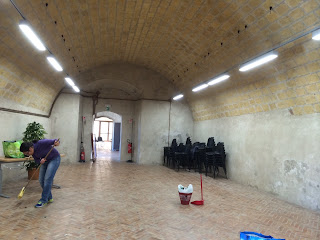 I couldn't resist snapping a photo of the one window in the conference room.

At the conference, I will see many operations research colleagues from various countries, some of whom I have not seen in quite a while, so I am very excited!
Thus far, I have managed to walk for miles (my cure for any jetlag) and walking along the Mediterranean with the astounding landscape, vegetation, architecture, and the kindness of the locals (more on this later) make all the hard work on research (which is actually a joy in itself) worth it. Massachusetts is bracing for another snowstorm so I made it out, just in time!


 I am a real tree hugger and the last time that I was so awe-struck by the vegetation of a country was when I gave a keynote talk in New Zealand. I have my favorite tree in Auckland. And, speaking of New Zealand, next week I will be at Lancaster University in England, giving a masterclass, and will see Professor Matthias Ehrgott, who is now on the faculty there and who was my host when I was in NZ!
 The kindness of the Italians in Reggio Calabria is truly special. Not many speak English but that is not a problem, and, last evening, not only did a waiter run up to help me with my trenchcoat but another one treated me to a dessert from the selection below (of course, I chose one the chocolate ones).
 I love watching the locals promenade along the beautiful mile walkway along the Mediterranean Ocean and also on the main street (which is for pedestrians only) and is filled with elegant shops. I marvel at the elegance of the people and how they acknowledge one another and (this must be the academic in me since we tend to fit anywhere) acknowledge me with a greeting.
The places that doing Operations Research can take you on our fascinating planet never fail to inspire.
Reggio Calabria is in (very) southern Italy and is located in the "toe part" of the boot shape that is Italy. One can see Sicily past the Mediterranean ocean and the journey was definitely worth it. I am here, thanks to the invitation of my wonderful colleagues, Professor Sofia Guiffre' of Reggio Calabria and Professor Patrizia Daniele of Catania. They are among my dear co-authors and our paper is now in press in the International Transactions in Operational Research (ITOR). Coincidentally, while I was at the Rome airport, during a 3 hour layover - none other than the Editor of ITOR, Professor Celso Ribeiro, emailed me and told me that he, too, is now also in Europe - on sabbatical in (snowy) Oslo, Norway.
Tomorrow I will be giving a keynote talk at the VINEPA 2018 conference, which focuses on some of my methodological loves - variational inequalities and Nash Equilibria!
The venue of the conference is truly unique and, this morning, after an exquisite breakfast at my hotel with an amazing view,

I ambled to the conference venue which is a historic castle. I marched up to the top and took photos of the panorama.


At the conference, I will see many operations research colleagues from various countries, some of whom I have not seen in quite a while, so I am very excited!
Thus far, I have managed to walk for miles (my cure for any jetlag) and walking along the Mediterranean with the astounding landscape, vegetation, architecture, and the kindness of the locals (more on this later) make all the hard work on research (which is actually a joy in itself) worth it. Massachusetts is bracing for another snowstorm so I made it out, just in time!


The places that doing Operations Research can take you on our fascinating planet never fail to inspire.
Monday, May 18, 2009
Rome, Italy and the Net2009 Conference

I had to, regretfully, not take part in the Erice, Sicily conference that was organized by my dear colleague, Professor Antonino Maugeri of the University of Catania in Italy, since I am on the search committee for the new Dean of the Isenberg School of Management. Italy's beauty is breathtaking and last year at this time I convened a conference at the Rockefeller Foundation's Bellagio Center on Lake Como (I hope that you enjoy the above photo that I took of that magical lake). Next week I will be back in Italy, in Rome, since I am an invited speaker at the Net2009 conference, whose theme on networks this year focuses on evolution and complexity. I am very excited about the interdisciplinarity of the network topics and speakers.
I will be speaking on my research on mergers and acquisitions and the merger paradox. The paper has been written. I am very much looking forward to speaking at this conference and to taking part in the exciting program that has been put together by the organizers. This will be a terrific end to an incredibly busy and interesting academic year!
Thursday, January 31, 2013
How to Build a Great Model -- Insights from Hal Varian
I have chaired 16 doctoral dissertation committees and tomorrow my 17th doctoral student will be defending his dissertation. In academia, we sometimes refer to the chair of a student's doctoral dissertation committee as his/her "advisor."
So, necessarily, a conscientious advisor offers advice to students during his/her doctoral studies especially when it comes time to doing research for the dissertation. Here one may help in selecting the topic, suggesting related problems, assisting a student in getting papers out for publication in journals, listening to a student give a talk/seminar, etc.
It is rewarding, as a faculty member, to see a student's progress and the greatest moment comes after the dissertation is successfully defended and the student receives the diploma wearing the cap and gown. Having a student get a really nice job is also important (to the student and his family and also to the advisor who has also invested a lot of time).
I regularly offer my students advice -- even what publications they should read and send them links to interesting articles -- these can be in newspapers or magazines or journals or even working papers.
Of course, it also is very helpful to read articles on how to do great research and to write papers.
Hal R. Varian who needs no introduction to many and is now the Chief Economist of Google and an emeritus professor at UC Berkeley, having been the founding Dean of the School of Information there, wrote a piece, "How to Build an Economic Model in Your Spare Time," which is very useful not only to economists, but to operations researchers, and mathematical modelers, in general. An aside, my first book, "Network Economics: A Variational Inequality Approach," appeared in 1993 was the first volume in the Advances in Computational Economics series by Kluwer (now Springer), and then appeared in revised form in 1999. And, Hal Varian was on the editorial board as was Dan McFadden, who has since received the Nobel Prize. Plus, Hal will be giving a plenary talk at EURO -- INFORMS, in Rome, Italy, July 1-4, 2013.; the link to the conference website is here.
His advice:
According to Hal Varian: This back-and-forth iteration in building a model is like sculpting: you are chipping away a little bit here, and a little bit there, hoping to find what's really inside that stubborn block of marble. I choose the analogy with sculpting purposely: like sculpture most of the work in building a model doesn't consist of adding things, it consists of subtracting them. This is the most fun part of modeling, and it can be very exciting when the form of the idea really begins to take shape. I normally walk around in a bit of a daze at this stage; and I try not to get too far away from a yellow pad. Eventually, if you're lucky, the inner workings of your model will reveal itself: you'll see the simple core of what's going on and you'll also understand how general the phenomenon really is.
So, necessarily, a conscientious advisor offers advice to students during his/her doctoral studies especially when it comes time to doing research for the dissertation. Here one may help in selecting the topic, suggesting related problems, assisting a student in getting papers out for publication in journals, listening to a student give a talk/seminar, etc.
It is rewarding, as a faculty member, to see a student's progress and the greatest moment comes after the dissertation is successfully defended and the student receives the diploma wearing the cap and gown. Having a student get a really nice job is also important (to the student and his family and also to the advisor who has also invested a lot of time).
I regularly offer my students advice -- even what publications they should read and send them links to interesting articles -- these can be in newspapers or magazines or journals or even working papers.
Of course, it also is very helpful to read articles on how to do great research and to write papers.
Hal R. Varian who needs no introduction to many and is now the Chief Economist of Google and an emeritus professor at UC Berkeley, having been the founding Dean of the School of Information there, wrote a piece, "How to Build an Economic Model in Your Spare Time," which is very useful not only to economists, but to operations researchers, and mathematical modelers, in general. An aside, my first book, "Network Economics: A Variational Inequality Approach," appeared in 1993 was the first volume in the Advances in Computational Economics series by Kluwer (now Springer), and then appeared in revised form in 1999. And, Hal Varian was on the editorial board as was Dan McFadden, who has since received the Nobel Prize. Plus, Hal will be giving a plenary talk at EURO -- INFORMS, in Rome, Italy, July 1-4, 2013.; the link to the conference website is here.
His advice:
- Look for ideas in the world, not in the journals. (especially The New York Times, The Wall Street Journal, and The Economist -- all personal favorites of mine, as well)
- First make your model as simple as possible, then generalize it and you may go back and forth. (Try out simple examples.)
- Look at the literature later, not sooner.
- Model your paper after your seminar. (Here he emphasizes the importance of presenting your work to an audience. He also suggests setting your paper aside for awhile and then going back to it.)
- Stop when you've made your point.
According to Hal Varian: This back-and-forth iteration in building a model is like sculpting: you are chipping away a little bit here, and a little bit there, hoping to find what's really inside that stubborn block of marble. I choose the analogy with sculpting purposely: like sculpture most of the work in building a model doesn't consist of adding things, it consists of subtracting them. This is the most fun part of modeling, and it can be very exciting when the form of the idea really begins to take shape. I normally walk around in a bit of a daze at this stage; and I try not to get too far away from a yellow pad. Eventually, if you're lucky, the inner workings of your model will reveal itself: you'll see the simple core of what's going on and you'll also understand how general the phenomenon really is.
Sunday, March 6, 2011
My Interview on Italian Radio
I never thought that I would be on an Italian radio program.
Thanks to our session on Mathematics and Collective Behavior at the recent AAAS meeting in Washington DC, I was interviewed by a science journalist, Mr. Federico Pedrocchi, of Milan, Italy, who also taped our session. Mr. Pedrocchi has his own radio program in Italy that focuses on scientific subjects.
His report on my presentation about User-optimized and System-optimized Travel Behavior and the Braess paradox aired last week and you can listen to it online. The segment on traffic is the second one in his report and it begins at about 3:55 minutes and runs until about 7 minutes. In the meantime, you can enjoy the Italian spoken. Of course, there are excerpts in English from my interview.
More information on Mr. Pedrocchi and his science radio program is available here.
Listening to the program made me miss Italy so I looked back at some photos I took in Rome on my last trip there and I reminisced also about the traffic experiences I had there!
Luckily, both my husband and I have Italian colleagues so what we could not figure out will be translated for us soon.
Ciao!
Thanks to our session on Mathematics and Collective Behavior at the recent AAAS meeting in Washington DC, I was interviewed by a science journalist, Mr. Federico Pedrocchi, of Milan, Italy, who also taped our session. Mr. Pedrocchi has his own radio program in Italy that focuses on scientific subjects.
His report on my presentation about User-optimized and System-optimized Travel Behavior and the Braess paradox aired last week and you can listen to it online. The segment on traffic is the second one in his report and it begins at about 3:55 minutes and runs until about 7 minutes. In the meantime, you can enjoy the Italian spoken. Of course, there are excerpts in English from my interview.
More information on Mr. Pedrocchi and his science radio program is available here.
Listening to the program made me miss Italy so I looked back at some photos I took in Rome on my last trip there and I reminisced also about the traffic experiences I had there!
Luckily, both my husband and I have Italian colleagues so what we could not figure out will be translated for us soon.
Ciao!
Tuesday, May 7, 2013
Super News from the Supernetworks Center at the Isenberg School
This has been a very eventful semester!
As we begin to wrap up a great academic year (and although I am on sabbatical) I thought it appropriate to share news even before our next Supernetwork Sentinel newsletter comes out.
Now, some of the latest highlights from the Virtual Center for Supernetworks at the Isenberg School of Management and its Center Associates.
Professor Jose M. Cruz, who received 5 degrees from UMass Amherst, including his PhD in 2004 from the Isenberg School with a concentration in Management Science, is the recipient of the 2013 UConn School of Business Graduate Teaching Award. In addition, he will be the Director of the UConn M.S. in Business Analytics and Project Management for the next two years and continues as an Ackerman Scholar until 2014.
Professor Cruz in 2010 received the Undergraduate Teaching Award from UConn's School of Business. We hosted him in our UMass Amherst INFORMS Student Chapter Speaker Series last December and his talk on how to get a tenure-track job and then get tenure was brilliant. When he shared the above great news with me he noted how much his education at UMass Amherst has helped him in his success (and as his PhD dissertation advisor, I could not be prouder).
Amir H. Masoumi will be receiving his PhD this coming Friday in Graduate Ceremonies at UMass Amherst, an event I am very much looking forward to, since now the advisor will be hooding the PhD recipient. This event will take place at the grand Mullins Center in the morning. Amir had requests for over a dozen on campus interviews when he was on the job market this past year and will be assuming a tenure-track faculty position at the School of Business at Manhattan College. He, together with Professor Min Yu, who graduated with her PhD last year (I was also her advisor), Professor Ladimer S. Nagurney of the University of Hartford, and me, had our book, Networks Against Time: Supply Chain Analytics for Perishable Products, published in 2013. This was a great supernetwork team effort!

Also, the special issue of Computational Management Science on Financial Networks, which I guest edited, is now in production. It will be a double issue consisting of 8 papers and I am so grateful to the authors (and the anonymous reviewers) for assistance in this big effort. My editorial, which discusses the papers in this special issue, can be accessed and read here.
Professor Dmytro Matsypura of the School of Business at the University of Sydney has been granted a sabbatical and will be visiting the University of Pittsburgh for two months. He, along with several other Center Associates, including Professor Tina Wakolbinger of the Vienna University of Economics and Business, will be presenting research at the Euro-INFORMS Conference in Rome, Italy this summer. Professor Wakolbinger spoke in our series this past February, after the AAAS Dynamics of Disasters Symposium in Boston with other OR/MS and Engineering luminaries such as Professors Laura McLay, Panos M. Pardalos, David McLaughlin, and Jose Holguin-Veras.
And speaking of conferences, I wrote about the wonderful Computational Management Science Conference in Montreal that I recently returned from, which overlapped by a day with the POMS Conference in Denver. My doctoral student, Dong "Michelle" Li did a great job presenting our latest work on medical nuclear supply chains and pharmaceutical supply chains with outsourcing there.
Michelle Li with Center Associate Professor Patrick Qiang of Penn State Malvern at POMS in Denver and with two other doctoral students in Management Science from the Isenberg School in first photo below.

.JPG) Michelle with Professor Dayo Shittu, UMass Amherst PhD in Industrial Engineering, who is now a Professor at Tulane University at POMS in photo above.
Michelle with Professor Dayo Shittu, UMass Amherst PhD in Industrial Engineering, who is now a Professor at Tulane University at POMS in photo above.
Our work on our big multi-institution, collaborative NSF project: Network Innovation Through Choice continues and our paper, The Cyber-Physical Marketplace: A Framework for Large-Scale Horizontal Integration in Distributed Cyber-Physical Systems,Tilman Wolf, Michael Zink, and Anna Nagurney, will kick-off The Third International Workshop on Cyber-Physical Networking Systems, in Philadelphia, in July.
And, speaking of graduations -- what a happy time of the year this is for the graduates, their proud family members, and professors. I will be back at the School of Business, Economics and Law at the University of Gothenburg in Sweden soon, as part of my sabbatical this year, and will be giving (for the second year in a row) the graduate commencement address there. The next day, I will fly to Athens, Greece to give a plenary on our NSF project at the Network Models in Economics and Finance conference.
No two days for an academic are ever alike and this is one aspect of the academic life that makes it an honor and truly special.
As we begin to wrap up a great academic year (and although I am on sabbatical) I thought it appropriate to share news even before our next Supernetwork Sentinel newsletter comes out.
Now, some of the latest highlights from the Virtual Center for Supernetworks at the Isenberg School of Management and its Center Associates.
Professor Jose M. Cruz, who received 5 degrees from UMass Amherst, including his PhD in 2004 from the Isenberg School with a concentration in Management Science, is the recipient of the 2013 UConn School of Business Graduate Teaching Award. In addition, he will be the Director of the UConn M.S. in Business Analytics and Project Management for the next two years and continues as an Ackerman Scholar until 2014.
Professor Cruz in 2010 received the Undergraduate Teaching Award from UConn's School of Business. We hosted him in our UMass Amherst INFORMS Student Chapter Speaker Series last December and his talk on how to get a tenure-track job and then get tenure was brilliant. When he shared the above great news with me he noted how much his education at UMass Amherst has helped him in his success (and as his PhD dissertation advisor, I could not be prouder).
Amir H. Masoumi will be receiving his PhD this coming Friday in Graduate Ceremonies at UMass Amherst, an event I am very much looking forward to, since now the advisor will be hooding the PhD recipient. This event will take place at the grand Mullins Center in the morning. Amir had requests for over a dozen on campus interviews when he was on the job market this past year and will be assuming a tenure-track faculty position at the School of Business at Manhattan College. He, together with Professor Min Yu, who graduated with her PhD last year (I was also her advisor), Professor Ladimer S. Nagurney of the University of Hartford, and me, had our book, Networks Against Time: Supply Chain Analytics for Perishable Products, published in 2013. This was a great supernetwork team effort!

Also, the special issue of Computational Management Science on Financial Networks, which I guest edited, is now in production. It will be a double issue consisting of 8 papers and I am so grateful to the authors (and the anonymous reviewers) for assistance in this big effort. My editorial, which discusses the papers in this special issue, can be accessed and read here.
Professor Dmytro Matsypura of the School of Business at the University of Sydney has been granted a sabbatical and will be visiting the University of Pittsburgh for two months. He, along with several other Center Associates, including Professor Tina Wakolbinger of the Vienna University of Economics and Business, will be presenting research at the Euro-INFORMS Conference in Rome, Italy this summer. Professor Wakolbinger spoke in our series this past February, after the AAAS Dynamics of Disasters Symposium in Boston with other OR/MS and Engineering luminaries such as Professors Laura McLay, Panos M. Pardalos, David McLaughlin, and Jose Holguin-Veras.
And speaking of conferences, I wrote about the wonderful Computational Management Science Conference in Montreal that I recently returned from, which overlapped by a day with the POMS Conference in Denver. My doctoral student, Dong "Michelle" Li did a great job presenting our latest work on medical nuclear supply chains and pharmaceutical supply chains with outsourcing there.
Michelle Li with Center Associate Professor Patrick Qiang of Penn State Malvern at POMS in Denver and with two other doctoral students in Management Science from the Isenberg School in first photo below.

.JPG)
Our work on our big multi-institution, collaborative NSF project: Network Innovation Through Choice continues and our paper, The Cyber-Physical Marketplace: A Framework for Large-Scale Horizontal Integration in Distributed Cyber-Physical Systems,Tilman Wolf, Michael Zink, and Anna Nagurney, will kick-off The Third International Workshop on Cyber-Physical Networking Systems, in Philadelphia, in July.
And, speaking of graduations -- what a happy time of the year this is for the graduates, their proud family members, and professors. I will be back at the School of Business, Economics and Law at the University of Gothenburg in Sweden soon, as part of my sabbatical this year, and will be giving (for the second year in a row) the graduate commencement address there. The next day, I will fly to Athens, Greece to give a plenary on our NSF project at the Network Models in Economics and Finance conference.
No two days for an academic are ever alike and this is one aspect of the academic life that makes it an honor and truly special.
Saturday, July 6, 2013
And the Research Beat Goes on Brilliantly at the Isenberg School of Management
When I was a college freshman at Brown University in Providence, Rhode Island, I was not fully aware of the caliber and reputation of the faculty that I had in Applied Mathematics and other fields.
For example, I was taught calculus my freshman year by Professor Joseph LaSalle, one of the luminaries in dynamical systems, and, from that point on, I knew that problem-solving, using math and optimization, coupled with computers, would be one of my passions. Spending (lots of) time visiting him during office hours to chat further inspired me.
I was extremely lucky and had some of the finest faculty in fields from operations research to economics to biology and other sciences to languages and literature (I think that loving to learn languages and even computer programming languages must be related to loving math).
My professors, when I was an undergraduate, and then a graduate student at Brown, were leaders in their fields and leadership came through research. They were pioneers in so many ways and gutsy (Stella Dafermos, my dissertation advisor at Brown, for example, I have written about on many occasions).
What I love about the Isenberg School of Management at UMass Amherst, in addition to our wonderful students, from our undergraduates to our PhD students, is the research that takes place here.
You can get a sense of some of the exciting research that goes on by accessing the latest edition of the Isenberg School's Research Beat, which was put together by our terrific Associate Dean, Dr. Jane K. Miller.
Great research creates outstanding synergies with teaching and education and, after my return from Sweden, as part of my sabbatical, I was delighted to see the transformed display next to the Isenberg School's gorgeous atrium that features some of the recent faculty accolades that I captured in the photos below.


 It was great to see our latest book, Networks Against Time: Supply Chain Analytics for Perishable Products, also displayed!
The Isenberg School has departments ranging from Accounting and Management and Marketing to my newly formed (after the split of the Department of Finance and Operations Management due to our growth) Operations & Information Management Department to the Mark H. McCormack Department of Sport Management and the Hospitality & Tourism Management Department. For all of you analytics types out there, you can see the cool applications and possibilities, I am sure!
We have 6 named chaired professors (I am forever grateful to be the holder of the John F. Smith Memorial Professorship in Operations Management) and have numerous books that the faculty and even staff have authored.
In addition, and this is a sign, in part, of the esteem held by peers, we (especially members of my department) have also been successful in having had sustained research funding support, which is not common in many business schools, but further attests to research emphasis and productivity. Research grants for the year are also included in the Research Beat, along with editorial roles of faculty.
Finally, it is the research that you do and the impact that it has that truly matters and since I am such a proud academic mom, I have to share with you a photo emailed jto me just yesterday, which was taken in Vienna, Austria, just after the EURO INFORMS Conference in Rome, Italy, and before the International Symposium of Logistics with the theme of Resilient Supply Chains in an Uncertain Environment, in which my former doctoral student, Professor Tina Wakolbinger is on the local committee. The Vienna conference begins tomorrow.
 (l-r) Thomas Nowak, PhD student of Professor Tina Wakolbinger, Professor Fuminori Toyasaki of York University, Professor Tina Wakolbinger of the Vienna University of Economics and Business, Professor Dmytro Matsypra of the University of Sydney, and Professor Jose M. Cruz of the University of Connecticut.
All the above Professors were my PhD students in Management Science at the Isenberg School and now are educating another generation of students on three continents. You may find their dissertation abstracts on the Supernetworks Center website. Plus, all in the photos above, except for, of course, Thomas, who is still a PhD student, have tenure at their respective universities. He will be my first official academic grandson since Tina was my academic daughter.
The Research Beat Goes On and this is Great!
For example, I was taught calculus my freshman year by Professor Joseph LaSalle, one of the luminaries in dynamical systems, and, from that point on, I knew that problem-solving, using math and optimization, coupled with computers, would be one of my passions. Spending (lots of) time visiting him during office hours to chat further inspired me.
I was extremely lucky and had some of the finest faculty in fields from operations research to economics to biology and other sciences to languages and literature (I think that loving to learn languages and even computer programming languages must be related to loving math).
My professors, when I was an undergraduate, and then a graduate student at Brown, were leaders in their fields and leadership came through research. They were pioneers in so many ways and gutsy (Stella Dafermos, my dissertation advisor at Brown, for example, I have written about on many occasions).
What I love about the Isenberg School of Management at UMass Amherst, in addition to our wonderful students, from our undergraduates to our PhD students, is the research that takes place here.
You can get a sense of some of the exciting research that goes on by accessing the latest edition of the Isenberg School's Research Beat, which was put together by our terrific Associate Dean, Dr. Jane K. Miller.
Great research creates outstanding synergies with teaching and education and, after my return from Sweden, as part of my sabbatical, I was delighted to see the transformed display next to the Isenberg School's gorgeous atrium that features some of the recent faculty accolades that I captured in the photos below.


The Isenberg School has departments ranging from Accounting and Management and Marketing to my newly formed (after the split of the Department of Finance and Operations Management due to our growth) Operations & Information Management Department to the Mark H. McCormack Department of Sport Management and the Hospitality & Tourism Management Department. For all of you analytics types out there, you can see the cool applications and possibilities, I am sure!
We have 6 named chaired professors (I am forever grateful to be the holder of the John F. Smith Memorial Professorship in Operations Management) and have numerous books that the faculty and even staff have authored.
In addition, and this is a sign, in part, of the esteem held by peers, we (especially members of my department) have also been successful in having had sustained research funding support, which is not common in many business schools, but further attests to research emphasis and productivity. Research grants for the year are also included in the Research Beat, along with editorial roles of faculty.
Finally, it is the research that you do and the impact that it has that truly matters and since I am such a proud academic mom, I have to share with you a photo emailed jto me just yesterday, which was taken in Vienna, Austria, just after the EURO INFORMS Conference in Rome, Italy, and before the International Symposium of Logistics with the theme of Resilient Supply Chains in an Uncertain Environment, in which my former doctoral student, Professor Tina Wakolbinger is on the local committee. The Vienna conference begins tomorrow.

All the above Professors were my PhD students in Management Science at the Isenberg School and now are educating another generation of students on three continents. You may find their dissertation abstracts on the Supernetworks Center website. Plus, all in the photos above, except for, of course, Thomas, who is still a PhD student, have tenure at their respective universities. He will be my first official academic grandson since Tina was my academic daughter.
The Research Beat Goes On and this is Great!
Monday, June 22, 2009
Social Networking and Producing a Newsletter

Directing the Virtual Center for Supernetworks requires the production and dissemination of The Supernetwork Sentinel newsletter three times a year. We are pleased to announce that the Summer 2009 edition is now online (in pdf format). This newsletter contains an essay on highlights of recent presentations from Vienna to Rome, provides information on the just-published book, Fragile Networks, reflects on the World Science Festival in NYC, recalls the amazing speakers that visited the Isenberg School and UMass Amherst as part of our Speaker Series, and marks notable distinctions and awards received by Center Associates.
This newsletter serves as a unified vehicle in which to document and distribute news about activities of the Center and its Associates. It also further strengthens the social network ties of the researchers and students involved in the Virtual Center for Supernetworks.
Tuesday, September 1, 2009
Number 100 -- Oh, the Places You'll Go!
This is my 100th blog post, since starting this blog in January 2009. It is also the first day of September and a gorgeous, crisp day in Amherst, Massachusetts.
The anticipation of the new academic year is clearly in the air!
I decided to name this blog post, "Oh, the Places You'll Go!" after the famous Dr. Seuss book. Dr. Theodore Seuss Geisel was born in Springfield in Western Massachusetts. Western MA is the home of numerous writers and creative folks, and I like to think that academics strive to be creative and productive.
As someone who works on networks from transportation and logistical ones to social networks, I practice what I write about and "preach." One of the best benefits/recognitions of doing solid research is the invitations that one garners and the places that one gets to go to. Indeed, one of my favorite senior colleagues is Professor Martin Beckmann, who is the co-author of the classic book, Studies in the Economics of Transportation, and who was on my dissertation committee at Brown University. He is a brilliant economist whose love of life and good food and friends has taken him around the world. I have been at conferences with Professor Beckmann from Mallacootta in the outbacks of Australia to Stockholm, Sweden, one of my favorite parts of the globe. Although he is in his mid80s he still travels and meets with colleagues in Europe and Asia. He is an amazing scholar, individual, and lover of life! You can see some photos of Professor Beckmann (even with me on a beach in Australia) if you click here and scroll down the page. Professor Beckmann is the recipient of the Robert Herman Lifetime Achievement Award in Transportation Science, among other notable recognitions.
I received an invitation a few weeks back to be a plenary speaker in Cape Town, South Africa, at a conference on life cycle management that will take place next week and, regretfully, I had to turn down this invitation since the new academic year begins next week at UMass Amherst.
Yesterday, I received an invitation to speak at a conference, which also really piqued my interest -- a conference in Mongolia! This conference, which is on Optimization, Simulation and Control will take place July 25-28, 2010, and it is worthwhile to check out the website. However, and this is painful, I have already made a commitment to be a plenary speaker at the Computational Management Science Conference to be held in Vienna, Austria, July 28-30, 2010, an invitation that came first and that I could not refuse.
Also, I have already committed to giving a tutorial on Fragile Networks at the ALIO-INFORMS conference to be held in Buenos Aires, Argentina, June 6-9, 2010, which I am very much looking forward to, and where I will really put my Spanish to practice!
Since beginning this blog, I have in 2009 alone given talks in Dallas, Ithaca, Northfield (Minnesota), Cambridge, Vienna, Rome, New York City, and Chicago and in Davis, California (but virtually). Each year brings new destinations and new adventures! The life of an academic is never dull but does require spirit, flexibility, and stamina! Some photos taken at conferences, speaking venues, and of other activities can be found here.
The anticipation of the new academic year is clearly in the air!
I decided to name this blog post, "Oh, the Places You'll Go!" after the famous Dr. Seuss book. Dr. Theodore Seuss Geisel was born in Springfield in Western Massachusetts. Western MA is the home of numerous writers and creative folks, and I like to think that academics strive to be creative and productive.
As someone who works on networks from transportation and logistical ones to social networks, I practice what I write about and "preach." One of the best benefits/recognitions of doing solid research is the invitations that one garners and the places that one gets to go to. Indeed, one of my favorite senior colleagues is Professor Martin Beckmann, who is the co-author of the classic book, Studies in the Economics of Transportation, and who was on my dissertation committee at Brown University. He is a brilliant economist whose love of life and good food and friends has taken him around the world. I have been at conferences with Professor Beckmann from Mallacootta in the outbacks of Australia to Stockholm, Sweden, one of my favorite parts of the globe. Although he is in his mid80s he still travels and meets with colleagues in Europe and Asia. He is an amazing scholar, individual, and lover of life! You can see some photos of Professor Beckmann (even with me on a beach in Australia) if you click here and scroll down the page. Professor Beckmann is the recipient of the Robert Herman Lifetime Achievement Award in Transportation Science, among other notable recognitions.
I received an invitation a few weeks back to be a plenary speaker in Cape Town, South Africa, at a conference on life cycle management that will take place next week and, regretfully, I had to turn down this invitation since the new academic year begins next week at UMass Amherst.
Yesterday, I received an invitation to speak at a conference, which also really piqued my interest -- a conference in Mongolia! This conference, which is on Optimization, Simulation and Control will take place July 25-28, 2010, and it is worthwhile to check out the website. However, and this is painful, I have already made a commitment to be a plenary speaker at the Computational Management Science Conference to be held in Vienna, Austria, July 28-30, 2010, an invitation that came first and that I could not refuse.
Also, I have already committed to giving a tutorial on Fragile Networks at the ALIO-INFORMS conference to be held in Buenos Aires, Argentina, June 6-9, 2010, which I am very much looking forward to, and where I will really put my Spanish to practice!
Since beginning this blog, I have in 2009 alone given talks in Dallas, Ithaca, Northfield (Minnesota), Cambridge, Vienna, Rome, New York City, and Chicago and in Davis, California (but virtually). Each year brings new destinations and new adventures! The life of an academic is never dull but does require spirit, flexibility, and stamina! Some photos taken at conferences, speaking venues, and of other activities can be found here.
Thursday, August 25, 2016
A Generalized Nash Equilibrium Model for Post-Disaster Humanitarian Relief - Case Study on Hurricane Katrina and Beyond
The devastating floods in Baton Rouge, Louisiana, 11 years after Hurricane Katrina, which have resulted in the worst natural disaster in the US since Hurricane Sandy, as well as the 6.2 magnitude earthquake that hit central Italy about 100 miles from Rome recently, demonstrate the impact that disasters have on societies. The response phase is essential to finding survivors and saving victims.
This paper, we believe, has big policy implications and we expect that it will also generate further research. It was quite the journey doing this research but with inspired collaborators with great passion it was also thrilling and we are ecstatic that the paper has been accepted for publication and in one of my favorite journals!

Every spring I teach my Humanitarian Logistics and Healthcare class at the Isenberg School of Management and it continues to be one of the most fascinating courses that I have ever taught. On this blog I have written posts about many of the truly special guest speakers that have come to share their experiences in emergency management and disaster response with the students.
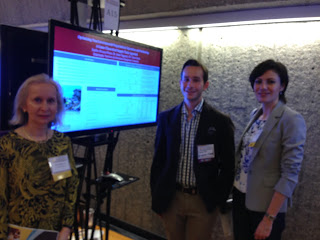
This past Spring, one of the students in the class, Emilio Alvarez Flores, who graduated with a degree in Operations and Information Management from UMass Amherst in May 2016, was also working on his honors dissertation, since he was a member of the Commonwealth Honors College. I had the pleasure of co-supervising his dissertation, along with Professor Ceren Soylu of the Economics Department at UMass Amherst. The title of his thesis was: Optimizing Non-Governmental Organizations’ Operations and
Fundraising: A Game-Theoretical Supply Chain Approach. Emilio defended his thesis at the Undergraduate Research Conference. Emilio was honored for his thesis (one of about a dozen) with a Deans Honors Award from the Commonwealth Honors College.
 Emilio had been hard at work for about one year modeling the integration of supply chain aspects as well as financial funds raised by nongovernmental organizations with a focus on integrating in a model both supply chain aspects and financial fund aspects. Together wtih Professor Soylu we spent hours discussing and working out various aspects and versions of the model. One of the unique (and challenging) aspects of disaster relief is that NGOs and governments are nonprofits and derive some utility from helping victims post-disasters. At the same time, the former compete with one another for financial funds and, depending upon their response to disasters and visibility, they may get more or less of the financial funds. Also, NGOs need to minimize their costs since waste is not something that donors and stakeholders look kindly on. Victims, on the other hand, need water, food, and medical supplies, as well as protection from the elements as soon as possible and, hopefully, no later than 72 hours.
There have been numerous instances of surpluses of one kind of relief item being delivered to victims post-disasters, whereas shortages arise of other supplies. Hurricane Katrina, which struck southern parts of the United States in August 2005, is a vivid case. It was the costliest natural disaster in US history. Making landfall in August of 2005, Katrina caused extensive damages to property and infrastructure, left 450,000 people homeless, and took 1,833 lives in Florida, Texas, Mississippi, Alabama, and Louisiana. 63% of all insurance claims were in Louisiana with overall damages assessed as being in the rang of $105 -$150 billion. In Louisiana alone, over 1.3 million people were affected, with Katrina being responsible for 300,000 jobs lost, 200,000 people left homeless, and over 1,500 fatalities. The New York Times reported that the Red Cross mismatched supplies with the victim’s needs; thereby, leading to obsolete inventory.
In developing a model that is computable and would be based on data it was clear that the model had to be a game theory one. However, most models in the disaster relief and humanitarian logistics arenas are optimization models. Moreover, we were interested in evaluating policies in order to minimize materiel convergence and to assist in the delivery of the needed amounts of relief supplies to the destinations.
Although a Nash Equilibrium model could be developed and we have a lot of experience in formulating, analyzing, and solving Nash Equilibrium models in a spectrum of supply chain applications from the pharmaceutical industry to food supply chains, the behavior there would be that of profit-maximization, which is not appropriate in the case of NGOs in disaster relief. Moreover, we wanted to explore what the possible impacts might be if there was a coordinating body, such as a supra NGO or governmental authority that would provide data as to the relief item needs in terms of lower and upper bounds at different points of demand. With such complicating constraints, which would be shared by the NGOs, the model would have to be a Generalized Nash Equilibrium model, and as far as we are aware there are no such models in the humanitarian relief sphere.
But if you have passion for a problem to be solved and, frankly, you are obsessed with the formulation and solution, you will figure out a way and you will get it done.
The result is the paper, A Generalized Nash Equilibrium Network Model for Post-Disaster Humanitarian Relief, Anna Nagurney, Emilio Alvarez Flores, and Ceren Soylu, which has now been accepted for publication in Transportation Research Part E: Logistics and Transportation Review. The paper contains a case study on Hurricane Katrina and also demonstrates how much better the solutions are under a Generalized Nash Equilibrium framework than under simply a Nash Equilibrium one in which each NGO just has to satisfy its own constraints.
As our case study in the paper reveals: It is immediately clear that there is a large contrast between the relief item product flow patterns under the Generalized Nash and Nash Equilibria. For example, the Nash Equilibrium flow pattern results in about $500 million less in donations. While this has strong implications about how collaboration between NGOs can be beneficial for their fundraising efforts, the differences in the general flow pattern highlights a much stronger point. Under the Nash Equilibrium, NGOs successfully maximize their utility. Overall, the Nash Equilibrium solution leads to an increase of utility of roughly 21% when compared to the relief item flow patterns under the Generalized Nash Equilibrium. But they do so at the expense of those in need. In the Nash Equilibrium, each NGO chooses to supply relief items such that costs can be minimized. On the surface, this might be a good thing, but recall that, given the nature of disasters, it is usually more expensive to provide aid to demand points with the greatest needs. With this in mind, one can expect oversupply to the demand points with lower demand levels, and undersupply to the most affected under a purely competitive scheme. This behavior can be seen explicitly in our results. For example, St. Charles Parish in Louisiana receives roughly 795% of its upper demand, while Orleans Parish only receives about 30.5% of its minimum requirements. That means that much of the 21% in ‘increased’ utility is in the form of waste. In contrast, the supply chain product relief item flows under the Generalized Nash Equilibrium guarantee that minimum requirements will be met and that there will be no waste; that is to say, as long as there is a coordinating authority that can enforce the upper and lower bound constraints, the humanitarian relief flow patterns under this bounded competition will be significantly better than under untethered competition.
This paper, we believe, has big policy implications and we expect that it will also generate further research. It was quite the journey doing this research but with inspired collaborators with great passion it was also thrilling and we are ecstatic that the paper has been accepted for publication and in one of my favorite journals!
In late June, I gave an invited seminar at Lancaster University in England: Disaster Relief Supply Chains: Network Models, Algorithm, and Case Studies, in which I highlighted some of our research in this area and the last part of the presentation presents highlights from our Generalized Nash Equilibrium Model for Post-Humanitarian Relief paper.

Wednesday, March 17, 2010
The Ides of March and Small Town USA
 March 15 is also known as the Ides of March, and is the day that Julius Caesar of ancient Rome was murdered. It is a day that I wish that I could just stay under the covers since something always unexpected and unusual tends to happen on that day.
This week is Spring Break for many colleges and universities, including my own. This week we planned on visiting some elderly relatives in northeastern Pennsylvania and had set out on March 15 for the long drive. We were especially looking forward to seeing my husband's uncle, who is a decorated World War II veteran, and who was born on March 27, 1923. We had a trunkload of wrapped presents for him since he was turning 87 years later this month. He had lived alone in the town where he grew up for many, many years and was a tinkerer who took great pride in his nieces and nephews. He was one of nine children and lived next door to the house where he had been raised. At this advanced age he was still independent and enjoyed going out to eat and simple pleasures.
Prior to our departure from Amherst, Massachusetts, we had tried to reach him via phone but did not succeed and as we arrived at our destination we still had not gotten a response. A very uneasy feeling settled upon all of us and we contacted the local police department. The officer who responded to our call knew our relative and said that he would check up on him.
As we arrived at his house, our worse suspicions were confirmed. There were fire trucks and ambulances in front of his house, several volunteer firemen, the police chief, another officer, as well as some of the neighbors. We were told that it looked as though the inside screen door was latched and that mail had not been picked up since Saturday from the mailbox. The fire station is located across from his house, and is staffed by volunteers.
The authorities managed to open the house door as we were approaching and then we were informed of the devastating news. Our uncle was deceased on his bedroom floor. What was to have been a birthday celebration ended with us being there to watch his body being wheeled into the hearse. The night was cool and rainy but the support that we received from the police department and the fire department in this small town USA we will never, ever forget. They stood with us and comforted us for about 3 hours until the various inspectors came to shut off the gas, the electricity, etc., and the funeral director could be contacted. Plus, we were offered coffee and a place to warm up in the fire station. We were able to reminisce about our uncle and to exchange all sorts of wonderful stories about him.
My daughter felt as though we were characters in a movie but the life lessons learned on that evening on March 15, 2010, we will never forget. It seems as though our uncle waited for us to be able to come and to see him off. He survived two tours of duty in World War II and died in his home on the street where he grew up, in a town that seemed, to us, suspended in time.
We have already followed up with personal thank you letters. Sometimes one needs to take a long journey to find some of the best things about our country and its citizens.
Subscribe to:
Posts (Atom)

 Posts
Posts