Showing posts sorted by relevance for query new zealand. Sort by date Show all posts

Monday, January 11, 2010

New Book -- Multiple Criteria Decision Making for Sustainable Energy and Transportation Systems


The new edited volume, Multiple Criteria Decision Making for Sustainable Energy and Transportation Systems, is now available. The book, edited by the international group of scholars consisting of Professors Ehrgott, Naujoks, Stewart, and Wallenius, of, respectively, New Zealand, Germany, South Africa, and Finland, is a collection of papers presented at the Multiple Criteria Decision Making (MCDM) for Sustainable Energy and Transportation Systems Conference that took place January 7-12, 2008, at the University of Auckland in New Zealand. 137 delegates from 39 countries on six continents took part in this wonderful conference.

I had the honor of being a plenary speaker, along with Professor Jim Petrie of the University of Sydney and the University of Cape Town. My plenary talk was titled, Multicriteria Decision-Making Analysis for the Environment: Sustainability and Vulnerability of Critical Infrastructure Systems from Transportation Networks to Electric Power Supply Chains.

This edited volume is a very timely collection of MCDM models and methodologies applied to sustainable energy and transportation systems. Trisha Woolley and I contributed the paper, Environmental and Cost Synergy in Supply Chain Network Integration in Mergers and Acquisitions, to it.

We congratulate the editors and the authors as well as all the conference participants for an excellent scientific conference, coupled with glorious memories. I have included several photos that I took while at this conference in Auckland, New Zealand, which took place exactly two years ago!

Monday, November 30, 2009

Music Supply Chains and Serving on International Dissertations


I came across a very interesting dissertation on music supply chains that was successfully defended for a Masters degree recently in Bergen, Norway at NHH. The dissertation, written by Brandeis Bellamy, is entitled: How Has the Changing Demand for Downloadable Music Influenced the Strategic Business Models of Firms? and it can be accessed here. I thought to myself, what a fascinating application of supply chains and a topic that anyone (and especially college students) can relate to. I couldn't help but read the dissertation and was really surprised and pleased to see that my Supply Chain Network Economics book was cited in it. I wrote this book while I was a Fellow at the Radcliffe Institute for Advanced Study at Harvard in 2005-2006. Coincidentally, Elaine Chew, who is an outstanding pianist and an operations researcher, who studies music from a mathematics perspective, was a Fellow at Radcliffe in 2007-2008, and we had the pleasure of having her speak at the Isenberg School in our INFORMS Speaker Series that Fall.

While reading the dissertation from NHH in Bergen, I so fondly recalled a doctoral dissertation that I was an examiner for, which involved travel to Bergen in northern Norway in the month of March. Bergen was magical with crocuses blooming and the defense is a very formal affair there with a reception afterwards (the student passed with glowing colors) and an elegant banquet. The defense was my second trip to Bergen. I had been there earlier for a NATO Scientific conference, after which we took the 7 hour train trip from Bergen to Oslo with spectacular views.

Tomorrow, I will be an oral examiner (sounds as though I am a dentist) for a doctoral dissertation in Auckland, New Zealand. I will not be flying out (would have to be on a plane already, if that were the case) but will be videoconferencing. The videoconferencing technology we used to stream my lecture last May to UC Davis. Tomorrow we will be using it for a doctoral defense. I am keeping my fingers crossed that everything works out.

The last time I was in Auckland, New Zealand was in January 2008 and the trip included being stuck at LAX on the tarmac in the plane for 4 hours in a fierce rainstorm before we took off for Auckland. The pain and suffering associated with this trip were compensated by the fantastic conference on Multicriteria Decision-Making and the conference talks, tours, and festivities.

Above I share with you some photos of Auckland, New Zealand.

It's never dull being an academic!

Wednesday, April 13, 2016

On Giving Plenary Talks - Off to Canada for Analytics Day!

Conferences are essential to scientific exchanges and also to networking. Plus, one gets to reconnect face-to-face with colleagues from around the globe and to make new contacts and even friends. Travel to new locations is always interesting and revisiting even places where you have been before can be quite informative and pleasant.

In most conferences there are usually special talks given by plenary (or keynote) speakers. Such speakers typically will have a longer time slot in which to present their work and the speakers are selected by conference organizers to draw interest to their events. I enjoy listening to plenary speakers and also enjoy being one.

Whenever I get a notice for a conference, I usually check whether there will be a female plenary speaker. Some may not notice such things, but I do, and it is important to have diversity represented even at the highest levels.

Tomorrow I will be flying to Toronto, Canada, since on Friday, April 15, I will be giving a plenary talk at Analytics Day at the University of Waterloo. This university is renowned for research in optimization and, coincidentally, I gave an invited seminar there in Management Sciences almost exactly 5 years ago!

Analytics Day was organized by Professor Fatma Gzara and it will bring together academics and practitioners as well as students. The program is online.
I presented Professor Gzara with several topics and she selected: Predictive and Prescriptive Models of  Cybercrime and Cybersecurity Investments Under Network Vulnerability.  Cybersecurity is a very hot topic and I have given recent talks on this theme at the MITRE Corporation and also at the Heinz College at Carnegie Mellon University.

It will be exciting to be back in Canada, the country of my birth.

I have given plenary talks in some fabulous locations and thank the organizers of various conferences for these great opportunities. Last summer, for example, I traveled to Colombia, to speak at a conference in Bogota and had such a magical time that I had to blog about it.

One year ago, I was in Berlin, Germany, to address the largest physics conference in Europe.  Clearly, research on networks, which has always been my passion, has no disciplinary boundaries. It's also terrific to see operations researchers welcomed by different disciplines and, in a sense, at the highest levels.

I also very much enjoyed giving a plenary talk in Rome, Italy,  and even in Auckland, New Zealand. I posted some photos from the New Zealand experience here. I wrote a blogpost about my experiences in Rome which can be accessed here.   I remember fondly getting lost while taking a long walk in Rome and seeing quite a few nuns (I suspect it may have been the delicious but very spiked dessert I had consumed) and glorious architecture and sites. I also remember (not so fondly) almost getting run over by the vehicles (almost saw my life pass by) while trying to cross the streets.

I thoroughly loved speaking in Paris at the NetGCoop conference in 2011 in October. Professor Asu Ozdaglar of MIT was another female plenary speaker at this conference focusing on networks, which was extra special.

I do believe that female researchers should accept invitations to deliver plenary talks at conferences since it is important for  students (male and female)  and others to see the great opportunities that the academic life provides. 

And seeing is believing.

Sunday, September 30, 2012

What is Your Worst Flight Experience -- Can You Beat Gary Shteyngart's?

I fly a lot as many academics do.

I enjoy travel tremendously and have lived in several European countries and am presently back in Gothenburg, Sweden, as a Visiting Professor.

I do, however, tend to favor certain airlines, not only because of their frequent flier benefits, but also because of previous positive experiences and, if I may say, "service." Of course, there are also tricks such as avoiding certain airports, packing up the right snacks, upgrading to a more comfortable seat, etc.


Just this past Tuesday, I had a wonderful flight on Delta from Boston Logan to Amsterdam Schiphol and the food was delicious. I have been doing this flight regularly to get to Gothenburg but did manage even a transit through Heathrow last March, which was not bad given the new terminal E -- glossy with good food and shopping.

Gary Shteyngart in a piece for The New York Times writes about his recent 30 hour nightmarish, Kafkaesque trip across the Atlantic on flight 121 from NYC to Paris on American Airlines (that is how long it has taken me to get from the East Coast of the US to New Zealand).

It was a horrific journey and I give him a lot of credit for sympathizing with those who were crying and who are older and could not make it to various gates in order to get onward with their journey from hell after they finally landed in London (although they should have been in Paris), and  after having to return to NYC after being mid-way across the Atlantic (something about the altimeter not working -- one does not want to end up swimming with the Altantic salmon).

It took us 6 and a half hours this past Wednesday from Boston to Amsterdam and it took him 30 hours on American Airlines from NYC to Paris, "compliments of American Airlines," with a bus tour in Heathrow. Note -- he and the other suffering passengers were trying to make it to Paris!

When the passengers on his flight broke through the barriers in London, I had a feeling of deja vu, since last October I had a similar experience, but in Paris, which I wrote about. I felt like Tom Hanks in the movie, The Terminal.

In a recent post I wrote about the importance of competing with quality and The Economist has a great article on The magic of good service.

As for my worst travel experiences (I won't name the airlines):

1. I had a Sydney to Sydney flight. It was the pilot's birthday and we lost an engine over the Pacific, so after several hours after taking off from Sydney we made it back to Sydney. At least we were treated to a lavish turkey dinner. The next day, many passengers had switched to Qantas so our plane was almost empty and we could stretch out and the news made CNN but we did eventually make it to LA.

2. About 3 years ago I was to give a plenary speech in Auckland, New Zealand. After crossing the US, we were stuck on the tarmac at LAX because of really bad storms for 4 hours. I got to know the stewards and stewardesses quite well chatting with them in the back of the plane. Finally,  after about 12 hours plus of "travel" I was finally over the Pacific. Auckland is fabulous and the trip was still worth it as was the conference!

3. Flying from Ithaca Airport to Bradley Airport (Hartford-Springfield) when we even had such direct flights, our wheels would not go done  on one of those charmingly named Fokker planes. I had just proven a theorem and was finishing up writing a paper so in a weird way I was "happy.."

The passengers on the plane were completely silent when the pilot announced that our wheels would not come down and we kept on circling and circling and dumping fuel. Bradley airport  was cleared and I saw bright yellow fire trucks lining up.

I knew that this was not a good sign.

Somehow we magically landed and then my husband told me that they were serving refreshments for the "survivors of the victims."

I had been flying to Ithaca regularly since I had been serving on the National Allocations Committee for the Cornell University Supercomputer Center (the good days).

That was the last time I ever got on a Fokker plane.

I'll save more flight stories for another day.

Happy travels!


Wednesday, December 2, 2009

Did She or Didn't She?

In my post yesterday, I wrote about serving on a doctoral dissertation committee for a student in New Zealand and yesterday was her dissertation defense. It was an interesting experience doing the oral defense and examination via videoconference (but this certainly reduced the carbon footprint).

The student, her dissertation advisor, and the other committee members I could see on the screen in the room set up for videoconferencing at the Isenberg School of Management. They were all seated in a room at the University of Auckland in New Zealand. Given the time difference, we scheduled the dissertation oral defense at 3PM Eastern Standard time and her advisor, Professor Matthias Ehrgott, was caught in traffic so he was a bit late.

The technology worked, although it did seem to be getting a bit tired after the majority of the questions were asked and answered.

The student successfully passed the defense, so congratulations to Ms. Andrea Raith, a new female PhD! Her dissertation is entitled: Multiobjective Routing and Transportation Problems. I especially enjoyed her novel applications to bicycling and route choice optimization using travel time and travel safety as criteria as well as her work on the bi-objective traffic assignment problem. In addition, she identified several errors in the published literature (which the referees had not caught) and also managed to correct several of the errors. As I said during the defense yesterday, I had not refereed those papers.

Friday, March 11, 2011

Will a Tsunami Hit and, If So, Where?

Many of us in the Northeast awoke to the news of the earthquake that struck northeastern Japan, making it the largest earthquake to ever strike the country and the fifth largest ever recorded in the world since 1900! The massive earthquake was registered at a magnitude of 8.9. President Obama was awoken at 4AM this morning due to tsunami warnings, with Hawaii, the west coast of the US, Latin and South America on alert. The warning has been lifted for New Zealand but initially 50 countries were notified about a potential tsunami.

The images from Japan have been striking with boats and vehicles being swept by massive waves, as well as houses, and the infrastructure collapsing. The buildings swayed in Tokyo, which is over 200 miles from the earthquake's epicenter, with airports closed, communications down, the high speed trains at a standstill, and fires raging in the northeast of the country. Luckily, the nuclear power plants were shut down automatically. Japan has an extensive, well-thought out building code, from lessons learned after the Kobe earthquake.

When I saw the news early this morning I immediately contacted my colleagues in Hawaii, a former student whose family lives in Japan (he just sent me a message that they are alright), and I even have a colleague at UMass Amherst who is scheduled to fly for spring break today to Costa Rica, another country where the alert has been sounded, not to mention Chile (which had an earthquake just last year and a tsunami warning), Colombia, and Peru. My last email correspondence last night was with a colleague in New Zealand so I breathed a sigh of relief that the tsunami warning has been lifted there since this country had its own recent earthquake that devastated Christchurch.

And my colleague from Hawaii just wrote to me: Anna: Thanks for your kind thoughts. Waves are beginning to hit the shoreline right now, and we should have a clearer idea soon of what kind of magnitude to expect.

We will have to wait, watch, and see what happens over the next several hours.

We are a global community so when disaster strikes the impacts propagate. Let's hope for the best.

Wednesday, March 7, 2018

An Operations Research Conference in a Castle in Italy

I arrived in Reggio Calabria, Italy yesterday afternoon after twenty hours of travel from Amherst, Massachusetts to Boston Logan and flights via British Airways to Heathrow and then onwards to Rome with the final leg via Alitalia. A big shoutout to both of these airlines for fabulous service and comfort.

Reggio Calabria is in (very) southern Italy and is located in the "toe part" of the boot shape that is Italy. One can see Sicily past the Mediterranean ocean and the journey was definitely worth it. I am here, thanks to the invitation of my wonderful colleagues, Professor Sofia Guiffre' of Reggio Calabria and Professor Patrizia Daniele of Catania. They are among my dear co-authors and our paper is now in press in the International Transactions in Operational Research (ITOR).  Coincidentally, while I was at the Rome airport, during a 3 hour layover - none other than the Editor of ITOR, Professor Celso Ribeiro, emailed me and told me that he, too, is now also in Europe - on sabbatical in (snowy) Oslo, Norway.

Tomorrow I will be giving a keynote talk at the VINEPA 2018 conference, which focuses on some of my methodological loves - variational inequalities and Nash Equilibria!

The venue of the conference is truly unique and, this morning, after an exquisite breakfast at my hotel with an amazing view,

I ambled to the conference venue which is a historic castle. I marched up to the top and took photos of the panorama.
On the second floor of the caste there was artwork and the staff was getting our space ready for the conference.
I couldn't resist snapping a photo of the one window in the conference room.

At the conference, I will see many operations research colleagues from various countries, some of whom I have not seen in quite a while, so I am very excited!

Thus far, I have managed to walk for miles (my cure for any jetlag) and walking along the Mediterranean with the astounding landscape, vegetation, architecture, and the kindness of the locals (more on this later)  make all the hard work on research (which is actually a joy in itself) worth it. Massachusetts is bracing for another snowstorm so I made it out, just in time!
I am a real tree hugger and the last time that I was so awe-struck by the vegetation of a country was when I gave a keynote talk in New Zealand. I have my favorite tree in Auckland. And, speaking of New Zealand, next week I will be at Lancaster University in England, giving a masterclass, and will see Professor Matthias Ehrgott, who is now on the faculty there and who was my host when I was in NZ!
The kindness of the Italians in Reggio Calabria is truly special. Not many speak English but that is not a problem, and, last evening, not only did a waiter run up to help me with my trenchcoat but another one treated me to a dessert from the selection below (of course, I chose one the chocolate ones).
I love watching the locals promenade along the beautiful mile walkway along the Mediterranean Ocean and also on the main street (which is for pedestrians only) and is filled with elegant shops. I marvel at the elegance of the people and how they acknowledge one another and (this must be the academic in me since we tend to fit anywhere) acknowledge me with a greeting.

The places that doing Operations Research can take you on our fascinating planet never fail to inspire.

Thursday, April 6, 2017

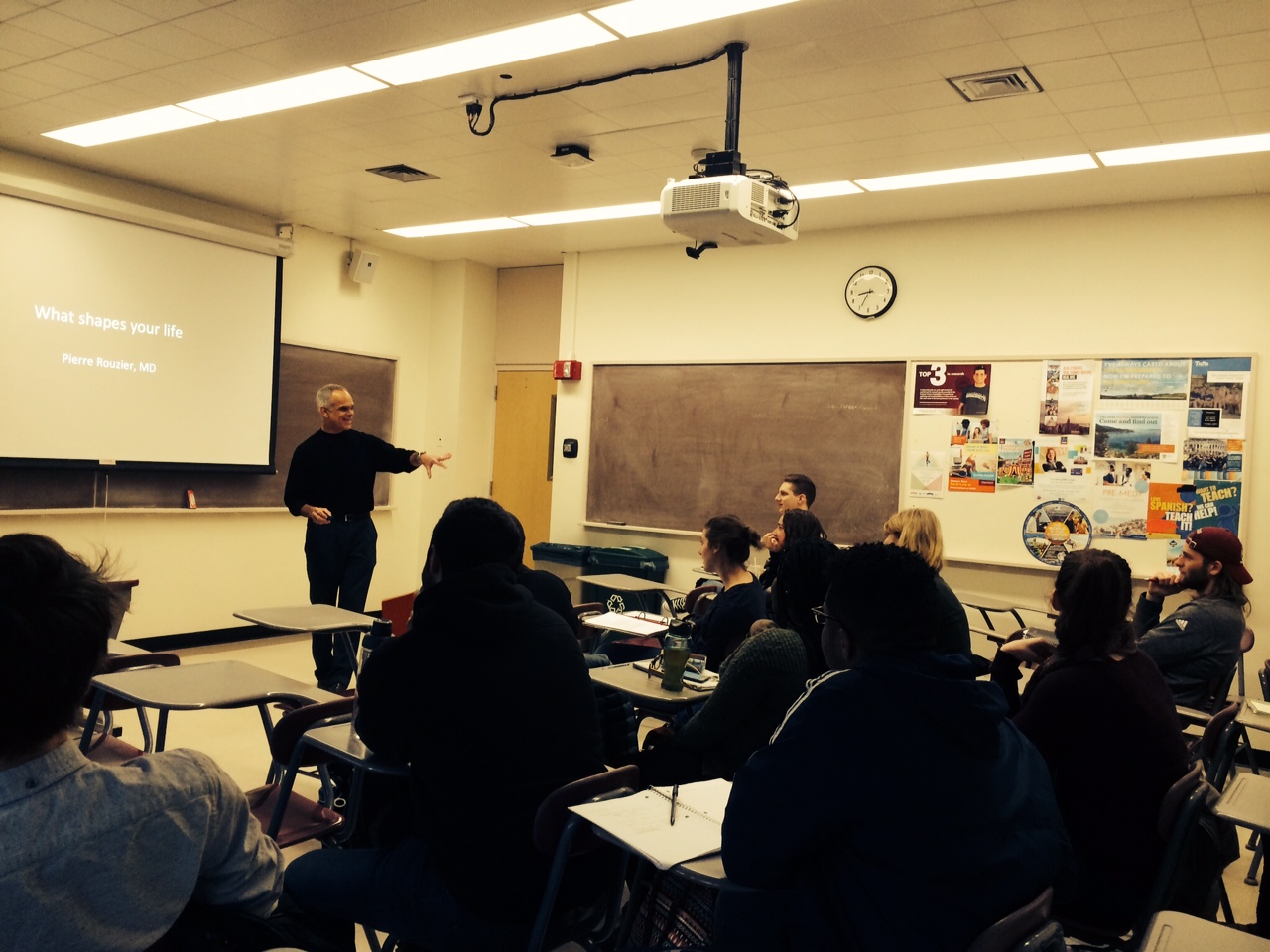
Dr. Pierre Rouzier on What Shapes Your Life? Lessons from a Truly Inspiring Physician

This morning, my students and I were mesmerized by the brilliant lecture of Dr. Pierre Rouzier, who spoke in my Humanitarian Logistics and Healthcare class at the Isenberg School.

Dr. Rouzier is the team physician at UMass Amherst and a doctor at our University Health Services. He is also a published author and a great humanitarian.

For many years he has also assisted in triage at the Boston Marathon, and was there at the bombing in 2013.

Dr. Rouzier's lecture was on "What Shapes Your Life?"  and he spoke on life shaping events, inspiring people to move (more on this), and also finding greatness in every day.

Last summer, he with a friend, Roger Grette, bicycled across the US, while disseminating the news on his children's book, Henry Gets Moving. It was published in 2012.

He covered 4,100 miles from Oregon through Massachusetts.  It took them 10 weeks to accomplish this feat and he said to us that "he had a life-changing summer and doesn't know if he even needed his life to change." Along the way he spoke to children and to adults publicizing his book, which focuses, in a warm-hearted way, on why children need to move more and to eat right. He showed us wonderful video clips of children, farmers, cowboys, and others along the way that were swept by his energy, openness, and passion for helping people and would chant: Ride, Henry, Ride!   He noted that, in 1980, 7% of children ages 6 to 11 were obese and in 2008, 20% were. Clearly, children eat what is provided. He stated that the obesification of America is a big problem.

Dr. Rouzier said that he is now in the last quarter of his life and wanted to take on the challenge of biking across the US and had done a lot of reading of experiences of others who had succeeded at this challenge. During his journey, he had many instances of the sense of wonder of meeting new people, serendipitous encounters with UMass connections, praying that the sun would shine and it did and then it snowed, and finding new friends along the journey.  The motto "Endure or Enjoy" from the book, "From the Atlantic to the Pacific on Two Wheels," by Alex Alvarez, served him well and continues to.

Dr. Rouzier also spoke about getting accepted at Stanford U. for his undergraduate studies but decided to go to UC Davis, due to the cost, and then went on to med school at USC because they had 13 weeks of vacation (rather than 6 as at UC Irvine) and he had fallen in love with travel (and also had a scholarship to med school). He had been a kinesiology major and had spent his junior year abroad in Edinburgh and loved it. He shared with us some of his hitchhiking stories in Europe, which were hysterical. He likes to travel OPM using "other people's money," which makes a lot of sense. While in med school he traveled to Australia, New Zealand, and Papua New Guinea, where he spent some time helping out at a healthcare facility. There he met 2 UMass Medical School Worcester graduates and ended up having his residency there. He has been at UMass Amherst since 1997 and are we lucky!

He has worked at Native American healthcare facilities, and spent 5 years in Colorado where he wrote a book, "The Sports Medicine Patient Advisor," which was inspired by a farmer who had hurt himself lifting bales of hay and could not take the time to drive a distance for physical therapy and asked him to just write the instructions down and he would follow them. Indeed, as his friend Bruce Bynum says: "The right book will set you free!"

Two of the life-changing events that he spoke about were the Haiti earthquake, which struck on January 12,  2010, and the Boston Marathon bombing, which took place April 15, 2013. We have talked about these two disasters in the Humanitarian Logistics and Healthcare class. Dr. Rouzier's father is from Haiti and he was in Haiti 9 weeks after the earthquake and was engaged in "despair medicine." At that point, many were suffering from illnesses brought about by the shock and ensuing stress. He even met a relative who lived on a hill and was one of the lucky ones.

Since Dr. Rouzier is not only an athlete, and former teacher and coach, but also a sports medicine expert, he also, for many years, has assisted in triage at the Boston Marathon. He was there during the bombing and shared with us that there was blood everywhere, the smell of burning flesh, and a surreal scene. He had been accompanied by a friend, Chad, who had recently had a child. He used a belt as a tourniquet and a fence post for a splint for a broken leg. He treated a female who said: I am going to die here and noone will know where I am." He said that he did not get her name and that it bothered him and it was very hard to get closure. The marathon bicycle journey across the US last summer, I believe, helped him tremendously, and he said that while en route he received a text from one of the victims thanking him.

The healing process was assisted also by people reaching out to him, even on Facebook, and especially UMass students doing so. He said: "people like you saved me."  His heroism and selflessness were so apparent throughout his brilliant lecture and we are so indebted to Dr. Pierre Rouzier for showing us what constitutes a life well lived. His nonprofit Team Henry is even helping out an orphanage in Tanzania. And, next week, Dr. Rouzier will again be assisting at the Boston Marathon.

Towards the end of his lecture today, Dr. Rouzier emphasized the power of positive thinking. He said that: "when you change the way you look at things, the things you look at change."

He told us that we need to look in the eyes of others and be nice - this is a choice that you can make. He said that "a stranger is a friend you have not yet met" and that "in every day there is something great about it."

We did not have much time for questions and answers but I wish that we had.

I presented Dr. Rouzier with a gift from the Isenberg School and also a certificate thanking him for being a terrific Professor for a Day! I then snapped a group photo of students with him as a memento of a truly inspirational and very wise lecture, with numerous life lessons.


Thursday, June 30, 2016

Great Time Speaking on Disaster Relief in the Management Science Department at Lancaster University in England

Tuesday evening, we returned from Lancaster, England, an hour late because there was a broken down train on our line in Lancaster and we had to wait for it to be repaired.

We had traveled to Lancaster the day before from Oxford by train, with a change in Birmingham.

I had been invited by Professor Graham Rand, very well-known in Operations Research internationally, several months ago to speak in the Management Science Department at Lancaster University. He had become aware that I would be a Visiting Fellow at All Souls College at Oxford University during the Trinity term so he had cordially extended the invitation, which I could not refuse.

Lancaster University's Management Science Department is the largest MS department in the United Kingdom with about 45 faculty focusing on Operations Research, Operations Management, and Information Systems. It is housed in the university's School of Management, which is located in proximity to the Lancaster House Hotel, where I overnighted, and which was very comfortable and very convenient.

Lancaster University is only about 50 years old and it has an excellent reputation in STEM (Science, Technology, Engineering, and Mathematics) as well as in Management.   The School of Management will be getting a new building soon but the existing one I found to be spacious with many windows. The university is close to the beautiful lake region and to the sea and is surrounded by green spaces so the air quality is great there.  Given that Oxford University dates to 1231, I found it very interesting to see a relatively new university in England.

I had presented Graham with a list of topics that I could speak on and, after canvassing his colleagues, the topic of disaster relief was selected, so my presentation was on Disaster Relief Supply Chains: Network Models, Algorithm, and Case Studies.
A nice announcement was prepared for my presentation, which I am very grateful for, and even though the date for my talk was June 28, 2016 and in the US it would be tough to find faculty and students to fill up an audience, I had a great attendance.  My full presentation can be downloaded here.

After arriving (my husband had accompanied me since he loves train travel), we took a walk around the campus and then it was time to meet Professor Konstantinos Zografos for dinner. Professor Zografos received his PhD from our UMass Amherst neighbor, the University of Connecticut, and I have known him since my days at MIT as a Visiting Scholar and Professor. He was recently inducted into UConn's Distinguished Academy of Engineers with a nice photo of him and other inductees with their medals on the UConn website.  Professor Zografos is an academic powerhouse with major contributions to different areas of transportation and the recipient of millions of dollars/pounds in research grants. He has been at Lancaster for about 3 years and has previously been at the University of Miami and also in Greece. He has just been appointed the new Associate Dean of Research at Lancaster's School of Management, a fantastic choice, I must say.

We had a great time at dinner, which lasted almost 4 hours and felt like 5 minutes. When we left, we heard that England got eliminated from the Euro 2016 soccer competition, as it got beaten by the lowest ranked team and the underdog, Iceland. It has been a very tough week for Britain with Brexit and now the soccer game loss.
Professor Graham Rand organized a terrific schedule for me. Prior to my seminar at noon, I met with a postdoc and a Visiting Scholar and the postdoc had been interviewed at Oxford University  on June 22 (the day of our Encaenia which I had blogged about) and had received an offer for another postdoc at the Environmental Institute there. I had an excellent conversation with him on network vulnerability, one of his research themes.

The questions after my talk were interesting and I have had requests for the presentation and so it has been posted. The talk had three parts to it: work on network performance assessment and vulnerability, a mean variance integrated disaster relief optimization model, and our latest work, which is a Generalized Nash Equilibrium model for disaster relief. There are very few game theory models in humanitarian operations so we are very excited about this work.

After my talk, it was time for lunch, and joining me were Professor Rand and the Head of the Department, Professor Matthias Ehrgott, who I last saw at a multicriteria decision-making conference that he was involved in organizing in Auckland, New Zealand, and I was an invited speaker. he has been at Lancaster for 3 years. We have many mutual interests in reseaarch so it was wonderful to see him and chat.

After the lunch I got to meet with the university's cybersecurity experts since we have been also doing a lot of research in this area and we spoke for over an hour on topics as diverse as the Desmond storm that resulted in a power outage last Fall that closed the university for almost a week to ransomware!

While I was busy, my husband had a chance to tour the downtown and to see the castle. Supposedly where the jurors meet is the room where a long time ago people would be hanged.


Then it was time to leave and we enjoyed, because of the delay, speaking to others at the Lancaster train station who were affected by the broken down train. Nevertheless, our train eventually arrived and since we had extra time in Birmingham before our connection to Oxford, I marvelled at the Birmingham train station, which resembles an airport!
I enjoyed reading the latest edition of the elegant, informative, and glossy IMPACT magazine that Professor Graham Rand gave me.  The impact that operations research / management science has had and continues to have in areas of transportation, healthcare, manufacturing, and security is tremendous. So glad to be part of such a wonderful professional community where you find friends and colleagues wherever you may go.
I will see Professor Graham Rand next week at the EURO 2016 conference in Poland, where he told me that he will be having breakfast with Professor Mike Trick of Carnegie Mellon University, the new IFORS (International Federation of Operational Research Societies) President and is very much looking forward to it and to the conference, of course.

Tuesday, December 21, 2010

A Mother who is on a Business Trip in Outer Space

Catherine "Cady" Coleman is a mother and an astronaut who has logged, to-date, over 500 hours of space travel and she will not be home for Christmas or for the New Year.

As part of a six-person crew, Coleman and Dmitry Kondratiev of the Russian Space Agency, with Paolo Nespoli (an Italian) of the European Space Agency, last week launched into space for Expedition 26 aboard a Russian Soyuz spacecraft from the Baikonur Cosmodrome in Kazakhstan. They joined NASA’s Scott Kelly, commander of the station, and flight engineers Alexander Kaleri and Oleg Skripochka, who will already be there, having launched in a separate Soyuz craft on Oct. 7.

Coleman has been a NASA astronaut for more than 15 years and is a veteran of two space missions. The mission that she is on now will involve 5 months of outer space travel during which scientific experiments will be conducted.

She received an undergrad degree in chemistry from MIT and a PhD in polymer science and engineering from UMass Amherst in 1991. She turned 50 this past December 14.

When not training or flying in outer space, she spends time in Shelburne Falls in western Massachusetts (only a few towns over from where I live) with her son, Jamey, who is now 10, and her husband, Josh Simpson, who is a well-known glass artist.

Jamey was in Baikonur, Kazakhstan to see the launch.

The New York Times ran a very touching article this past week in which Jamey said that, over the next five months, he will watch for his mother from his tree house at their home in Shelburne Falls, Massachusetts, which lost its roof in a storm. “You can just lie on the floor and look up and see all the stars,” he said. The space station “is pretty obvious. It’s the brightest light in the sky.”

And I thought that my business trips to China, Japan, New Zealand, and Australia were long - distance ones and lengthy!

Coleman did ask for permission to take her son to space but permission was not granted.

We support the amazing Coleman-Simpson family and wish all families whose members are on duty, whether in the military, on business, or even in outer space, all the very best now and in 2011!

Thursday, July 1, 2010

Life-Long Learning, Analytics, and Being Members of a Club

The Pew Research Center has released another study through its Global Attitudes Project in conjunction with The International Herald Tribune, which is reported on in The New York Times, and which will surely generate provocative discussions.

According to the study, which surveyed people in 22 different countries, people say that they firmly support equal rights for men and women, but many still believe that men should get preference when it comes to good jobs, higher education or even in some cases the simple right to work outside the home.

The poll, conducted in April and May, suggests that in both developing countries and wealthy ones, there is a pronounced gap between a belief in the equality of the sexes and how that translates into reality. In nations where equal rights are already mandated, women seem stymied by a lack of real progress, the poll found.

Several quotes in The New York Times article, by female professors, especially resonated with me. Professor Herminia Ibarra, who teaches organizational behavior at INSEAD, the international business school based in Fontainebleau, France, is quoted as saying: There are still very few women running large organizations, and business culture remains resolutely a boys’ club. And a quote by Professor Jacqui True, who teaches at the University of Auckland in New Zealand, stated: When you’re left out of the club, you know it. When you’re in the club, you don’t see what the problem is.

Clearly, women, as professionals, may belong to several "clubs," in which they can be valued members (or not) -- from their immediate departments in their academic or employer organizations to different professional organizations or societies and communities.

What is essential is that professionals understand and take part in activities of organizations that are broader in scope than simply their local ones. In this sense, they can obtain not only sustenance in being part of larger communities but they can also engage in life long learning opportunities and build relationships that they can rely upon when the "going gets tough."

Women's professional voices are being increasingly heard -- through podcasts and even through blogs and social networking sites.

I would like to single out, as an example, the learning resources of INFORMS, one of the professional societies that I belong to, which through the extraordinary efforts of Barry List, has put together a series of podcasts of wide interest and relevance. You will see that several podcasts are interviews with female experts. If you would like to see the full list in digital format, just click here.

Students and future generations need to see many different role models in terms of gender and race since the myriad problems that the world is facing from the environment to inequality to wars and strife cannot be addressed through the eye of a needle.

Sunday, August 30, 2015

Having Your Operations Research INFORM Policy

One of my favorite quotes on Operations Research is by INFORMS President-Elect Ed Kaplan of Yale University. It appears in  a paper that he wrote that was published in Omega, "Adventures in Policy Modeling! Operations Research in the Community and Beyond,"and says: Modeling need not be “off the shelf”—rather, modeling with OR techniques should be a celebration of creativity.

His paper is a very provocative and stimulating read  and shuts down naysayers.

The paper also is filled with examples as to how Operations Research has informed policy and associated decision-making. The article is focused on community-based policies.  Examples are drawn from urban applications (Dick Larson's research and practical applications), AIDS modeling and needle exchanges (work done by Kaplan), drug control (Jonathan Caulkins), and even homicides and gun availability (Al Blumstein's many contributions), to start, and, of course, security.  Some great work in this area has been done by, I note, among others, Ed Kaplan, Larry Wein, Sheldon Jacobson, and Laura McLay.

Operations Research has been instrumental in informing policies in other settings, as well, from transportation and logistics to the environment and even medical decision-making, and humanitarian operations.

I work on network systems with many associated applications and it is very gratifying when research that you do also informs policy.

A few years ago, in research conducted with Patrick Qiang, who was my doctoral student at the Isenberg School of Management, and with whom I wrote the Fragile Networks book, we introduced a network performance measure, which  allows for the identification and ranking of nodes and links in various network systems operating under decentralized behavior (think of urban transportation networks, certain supply chains, financial networks, and even the Internet). (Patrick is now a tenured Associate Professor at Penn State Great Valley, as of Fall 2015, so more congrats are in order!)

The results of this research appeared in various journals, including Operations Research ones, and even physics, since we wanted to disseminate the work broadly for maximum impact.  A high level overview of our results with some applications appears in: Fragile Networks: Identifying Vulnerabilities and Synergies in an Uncertain Age, Anna Nagurney and Qiang Qiang, International Transactions in Operational Research 19: (2012) pp 123-160.

The Nagurney-Qiang performance measure has been used in Indonesia to assess new shipping routes in a study financed in part, by the World Bank.   A nice overview of the approach is in a presentation on Prezi.

Our performance measure has also been used by researchers in Greece, led by Mitsakis and collaborators,  to conduct  network performance and components’ criticality analyses to assess the effects of the immense 2007 fires in Peloponnesus on vehicular traffic and the overall transport network.  See also recent work by some of the same researchers on climate change and our measure. 

In addition, it has been leveraged in an insightful report, "Guidebook for Enhancing Resilience of European Road Transport in Extreme Weather Events."

Schulz used our network performance measure to assess the importance of roadways in a part of Germany.  

It was also applied in Ireland to assess new Dublin metro lines. 

It has been utilized to assess the potential impact of earthquakes on critical infrastructure and is now even being applied outside the policy arena in physiological settings (yes, networks are everywhere and that is one reason why I love them!).

As for my work on paradoxes, including environmental ones, in 2007, one of my papers was featured in the New Zealand parliament; info here. 

Operations Researchers work on tough problems with solutions having broad and fascinating impacts!

Sunday, October 24, 2010

Off to Washington DC!

As an academic, my busy professional life is filled with research, teaching, and professional service activities. I often write on this blog about research and about teaching -- this post is about service.

The service activities that an academic may be involved in (let's say some do not engage in much service) take on numerous forms -- from internal service, that is, departmental, school-wide, and university service -- to professional service, which may require travel. The latter involves reviewing journal articles, serving on editorial boards, serving on society committees, on conference organizing committees, and other activities. I receive, on the average, requests to review 3 papers a week and professional service alone could keep me with a full workload if I were to accept everything that came my way.

(Note: much of the service that we do as faculty is "pro bono" and we do not get paid extra for it but it is essential to maintaining the integrity and sustainability of our disciplines and their growth and sustenance.)

Service also involves taking part in peer-review panels and in evaluating different proposals for funding. I have reviewed proposals for scientific agencies in Canada, Sweden, Hong Kong, New Zealand, Denmark, and Ireland, to name just a few. Also, I review proposals for scientific agencies in the U.S.

I will be out of town shortly to serve on a scientific review panel. Preparation entails reading thoroughly and carefully a pile of proposals and writing drafts of the evaluations. This takes place even before the face-to-face meeting and discussions with other panelists. Getting together in the DC area, where many of the major funding agencies (the National Science Foundation, the National Institutes of Health, the Department of Energy, etc.) are located and where the panels are convened, to see colleagues and to meet new ones, is always enriching intellectually. There are times of the year (Fall, late Spring and early Summer) during which the Washington DC area is quite beautiful; plus, several times during my flights to/from DC I have sat next to Congressmen, which always makes for stimulating conversations.

My suitcase is packed, my briefcase filled with proposals and my reviews, and I am looking forward to another trip to Washington DC!

Of course, my classes are covered, and when I return, I will be grading piles of midterm exams!

Wednesday, February 1, 2012

An Ode to Dr. Joseph L. Balintfy and Food Management Science

This blogpost is being written for this month's INFORMS blog challenge which is: O.R. and Food.

When the theme was selected, special memories flooded back and I knew that I had to write about the Food Management Scientist Extraordinaire -- Dr. Joseph L. Balintfy.

I first met Dr. Balintfy when I came to my interview at UMass Amherst for a faculty position, after receiving my PhD at Brown University. When I was hired at its Business School (now the Isenberg School), my senior colleague in Management Science was Dr. Joseph L. Balintfy. He had been born in Hungary and operations research / management science involving mathematical models and algorithms associated with menu planning, diets, food preferences over time, food price indices, and many other food-related issues and problems were his life's work.

Dr. John F. Raffensperger of the University of Canterbury in New Zealand, wrote a beautiful blog piece, Balintfy Made the World Better with O.R. after Professor Balintfy's passing on December 30, 2008 (an obituary also appeared in OR/MS Today). Raffensperger's tribute contains many valuable links to Balintfy's contributions.

I knew Professor Balintfy not only as a scholar but also as a truly original human being. He was married to Lily Lancaster, who was a nutritionist, and was working on her doctoral dissertation in Management Science at UMass. I had the pleasure of serving on her dissertation committee. Her dissertation was highly original -- planning how food should be displayed aesthetically on a plate. I still remember some of the lessons -- don't have all the food be yellow or all white (although I know of some children who might think otherwise).

Parties over their elegant home on Blue Hills Road in Amherst were special. Not only were the guests served elegant, delicious cuisine, in a house filled with oil paintings, but after each meal we would be "treated" to a nutritional and calorie breakdown of what we had just consumed using, of course, software that Balintfy had developed for such purposes. He had a company that sold food management science software to schools, hospitals (even in Scandinavia I recall him telling me) but what continued to frustrate him was the difficulty of selling his menu planning software to certain prison systems (including one in New Jersey). When it came to food preferences, the wardens wanted to minimize the prisoners' utilities rather than to maximize them and they would say to Balintfy: if the prisoners don't like grapefruit that is what we will serve them!

At one of the lavish parties at the Balintfy home, I met Jane Garvey and her husband, our long-serving sheriff, who were neighbors. Jane Garvey later became the head of the Federal Aviation Administration (FAA) and was responsible for air traffic during 9/11. She has been honored for her amazing leadership on multiple occasions and last Spring I received an honor named after her (quite special).

Balintfy's productivity was well-known and he worked closely with his students. I found an online list of some of the reports that his Food Management Science group had produced and you can salivate at the titles.

Fascinatingly, William P. Pierskalla, writing in a report, "Nurse Scheduling: A Successful Multi-Site O.R. Implementation -- Why? " back in 1975, stated: As was pointed out at the ORSA-TIMS_AIIE Meeting in Atlantic City two years ago, the only multi-site successful implementation of an operations research study in health was the menu-planning and dietary inventory model developed by Joseph L. Balintfy.

Joe Balintfy was always true to himself and he left not only his work but many amazing memories for those who had the experience of knowing and working with him.

Saturday, June 29, 2019

The EURO 2019 Conference in Dublin Brings Operations Researchers Together From Around the Globe

The fabulous EURO 2019 conference, which took place June 23-26 at UCD in Dublin, Ireland is now over but the impact of the scientific exchanges, the renewal of friendships and new ones made, along with wonderful memories, will sustain many for a long time to come.

It was a conference that included tutorials, keynote talks, numerous fascinating and very timely panels, as well as scientific paper presentations on Operations Research. The organizers and organizing committee are congratulated on the success of the conference. Special thanks to Professors Sean McGarraghy and Luis Eduardo Neves Gouveia, the conference chairs, for even sending me a personal thank you this morning for my tutorial at the conference!

From the very beginning of our arrival in Dublin, there were numerous surprises - upon our arrival, we saw Melissa Moore, the Executive Director of INFORMS, and, soon thereafter, Mary Magrogan of INFORMS. The organizers had put many of the invited speakers up at the lovely Radisson Blu hotel, in walking distance of the university. It was, hence, very special, to be seeing colleagues from many countries at breakfast, including IFORS President Professor Maria Grazia Speranza, or on the lovely grounds, including Professor Kash Barker, in the photo with me below!
One aspect of the conference that I very much enjoyed was seeing my former doctoral students, now professors, Dr. Sara Saberi of WPI in the USA and Dr. Dmytro Matsypura of the University of Sydney in Australia, along with my long-time collaborator, Professor Patrizia Daniele of the University of Catania in Italy, who was also a member of the organizing committee.
I had a packed schedule. Monday afternoon of the conference, I was a panelist on the Women in OR panel, which had a terrific audience and discussions. Below I am standing with Professors Christina Phillips and Paula Carroll next to the lovely flowers.
 
This EURO conference was especially thrilling since Professor Martine Labbe, in the photo above next to me, who was also on the Women in OR panel, was named the first female recipient of the EURO Gold Medal award! We are standing next to Professors Maria Paola Scaparra and Annunziata Esposito Amideo.

And, we even had a male on this panel - Professor Daniele Vigo! Many thanks to the audience, including quite a few males, for their insights and suggestions as to how we can build a stronger community of nurturing females (as well as other less represented groups) in Operations Research and in science, in general! I do believe that we have started to strengthen our community in this regard and I also especially recognized WORMS - Women in Operations Research and the Management Science, a forum of INFORMS.

Earlier on Monday, we had an editorial board meeting of the Wiley journal, International Transactions in Operational Research, expertly edited by Professor Celso Ribeiro of Brazil. A photo of those in attendance is below (some had talks to give at the same time, and they were missed, including Dr. Mauricio Resende).
Also, among the award recipients at EURO was Dr. Paolo Toth and he is the rightmost figure in the photo above. It was delightful to see so many colleagues from multiple continents. I wish there had been more time to chat with everyone, including Professor Laura Albert of the University of Wisconsin Madison! I very much appreciated the lovely flowers and thoughtfulness of the organizers with even a gift presented to me after my tutorial on Tuesday morning, from 8:30-10AM.
Due to many requests, my tutorial slides can be downloaded from here. Special thanks to Professor Matthias Ehrgott, a member of the EURO organizing committee, for his wonderful introduction of me at my tutorial. I have known Professor Ehrgott for many years and have delightful memories of dining with him not only in the UK but even in New Zealand.

Many thanks to all those who came to my tutorial, including Professors Roman Slowinski and Roman Snajder! My father's name was also Roman.
Also, on Tuesday, I heard that several outstanding colleagues, several of whom were at EURO Dublin, including Dr. Stephan Onggo, had received large grants from EPSCR! It was such a happy day! Below I am standing with Dr. Onggo, whom I had the pleasure of personally congratulating. There will be great continuing research done on disaster relief and healthcare!

It was terrific to see our most recent Dynamics of Disaster book on display at the Springer booth at the conference. Below I am standing with Springer Senior Editor Christian Rauscher.

And, I love the element of surprise and serendipity that one often experiences at an international conference. In walking outside after my tutorial I saw a colleague from UMass Amherst, Professor Maciej Ciesielski of the College of Engineering, who wanted to attend my tutorial but took the bus to DCU rather than UCD and missed it!.
Tuesday night was the conference gala banquet at the Aviva rugby stadium, which was a very interesting experience at which I even got to see Professor Ann Campbell and her family who traveled all the way from Iowa! And it was wonderful to also see a collaborator of Ann's, Professor Jan Ehmke, who had been my host at an OR conference in Berlin two Septembers ago!
 On Wednesday morning (at 8:30AM), I spoke at the Making an Impact panel, which was part of a stream of sessions.  I had been invited just the week before by Dr. Joachim Gromicho because another panelist had a medical emergency. Photos of the panelists and of some audience members  are below. I was very impressed by the energy, enthusiasm, and wisdom of all at this event.

And, on Wednesday afternoon, it was time for a session on supply chains that I had organized. Dr. Saberi spoke on her latest work on sustainable supply chains and freight and I delivered a paper just accepted for publication in the Journal of Global Optimization on tariffs and world trade, co-authored with Professor Ladimer S. Nagurney, and my Isenberg School of Management doctoral student Deniz Besik. We had an audience of researchers from the US, Italy, Morocco, the Netherlands, and France at our session!

And, would you believe, on our last morning in Dublin, before I spoke at IBM, I met at breakfast Dr. Sarah Marie Jordaan, a Professor at Johns Hopkins, whose brother is a colleague at UMass Amherst. She had even recently hosted one of our doctoral students there, who will soon be a Professor at Carnegie Mellon University, Dr. Destenie Nock. It is truly a fabulous Operations Research world!

Then, on Thursday morning, I was off to give a talk at IBM Dublin, and then onwards to additional conferences, with a weekend in beautiful London.
Many thanks to Dr. Rahul Nair and to Dr. Sergiy Zhuk of IBM for their outstanding hospitality and great discussions of their amazing research!

And, at the Dublin airport, who was at a neighboring gate - my collaborator, Professor Patrizia Daniele, heading back home to Catania, Italy!
My next conference is in Greece - the 4th International Conference on Dynamics of Disasters, which I co-organized (again) with Professors Pardalos and Kotsireas. It will be hot there!