Showing posts with label CORS. Show all posts

Thursday, January 16, 2020

Beginning of My Sabbatical and My Twelfth Year of Blogging

It is hard to believe that this month I am celebrating 11 years of writing on this blog. My first post  was on the New Year - New Administration - New Blog. In that post I also noted a Letter to the Editor that I had had published in The New York Times on the students in my Transportation and Logistics class that I teach at the Isenberg School.  It is quite interesting to look back at the posts. Many provide timely advice. Interestingly, my third post was on my interview with Linda Baker on the Braess Paradox, for an article that she wrote for the Scientific American. And, coincidentally, my most recent article is on The Braess Paradox, an invited chapter for The International Encyclopedia of Transportation.

My blog has over 1,600 posts that I have written!

I am about to start my sabbatical, which means that I will not be teaching this Spring 2020 semester. I must admit that I will miss not teaching Humanitarian Logistics and Healthcare and also my PhD Seminar but there are many projects to start and others to finish up and also numerous very exciting speaking engagements and visits. Some service activities to the Isenberg School (and beyond, of course), will still be on my plate.

I am very excited about the INFORMS Security Conference, which takes place next month in Monterey, California. The website is live and the speakers and talks look fabulous - I am especially delighted that all speakers get a 50 minute time slot, so one can really share insights and also gain some!

At this conference, I will be speaking on: Game Theory Network Models for Disaster Relief. Coincidentally, the first conference presentation that I ever gave was when I worked in the high tech sector for the Naval Underwater Systems Center in beautiful Newport, Rhode Island, and it was at an MIT/ONR Conference at the Naval Postgraduate School in Monterey! I was the only female presenter. In addition to working, I was also pursuing a Master's at Brown University at that time. It will be very special to be back there.

Some other highlights of my sabbatical, in terms of conferences and visits are the following:

In March, I will have the honor of giving a plenary talk at the Netgcoop Conference in Corsica, France, while my PhD student, Deniz Besik, presents on our work on tariffs, quotas, and trade at the INFORMS Optimization Society Conference in Greenville, South Carolina.

In April, I will have the pleasure of being an invited speaker at an International Workshop at the University of Brescia in Italy on Variational Analysis and Applications for Modelling of Energy Exchange. There I will see many wonderful Italian colleagues!

In May, it will be time to fly to Iowa, a state that I have never been to. Many thanks to Professor Ann Campbell for inviting me to give a plenary talk at a very exciting 2-day workshop - Future BA (Business Analytics) Prof! This workshop will take place at the Tippie College of Business at the University of Iowa and all expenses for accepted applicants will be covered. The workshop is for advanced PhD students and post-docs —especially women and individuals from underrepresented groups — who are interested in academic careers in Business Analytics.

A huge highlight of my sabbatical will be the CORS Conference in Toronto in June. Also at this conference I will have the immense honor of delivering the Harold Larnder Prize plenary talk. The list of previous recipients of this prize can be found here. I am absolutely thrilled by this recognition and am the only the second female to receive this prize, which dates to 1986. The title of my Larnder lecture is: Trade Wars: OR in the Economic Battlefields.

I spoke at the CORS Conference in Halifax and had a tremendous time. Having been born in Canada, and having lived for a few years in Toronto, it will be great to be back. 
I will also be giving a seminar at the University of Toronto in March.

There will be other conferences in June and I will be busy also co-editing a new Dynamics of Disasters volume with Panos M. Pardalos and Ilias S. Kotsireas. We have received a contract from Springer and work has already begin with refereeing some of  the contributions, etc.

And, in late August, as my sabbatical is coming to a close, it will be time for the CLAIO 2020 Conference in Madrid, Spain. In 2019, I had the pleasure of speaking in Chile,  Colombia, and Mexico, and am so honored to have been selected the IFORS Distinguished Lecturer (IDL) at CLAIO. I will give my IDL plenary at this conference with the title: NetwORks: Changing Our WORld for the Better. This will be my first visit to Spain.


Of course, as my schedule and time permit, I will still be supporting the great UMass Amherst INFORMS Student Chapter and its Speaker Series and also directing the Virtual Center for Supernetworks and working with my PhD students! Updates on my sabbatical will certainly be posted on this blog.

Many thanks to everyone for 11 great years of support of this blog!

Wednesday, June 6, 2018

Fabulous Operations Research Conference in Canada with Photos

It took us three days of driving to get to Halifax, Nova Scotia from Amherst, Massachusetts on a journey through Calais, Maine; St. John and Sackville, New Brunswick, and then to our destination.


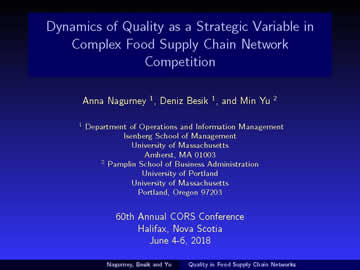
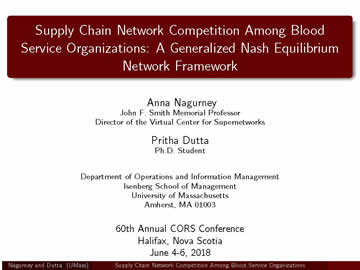
Although I was born in Canada, I never was in the Atlantic provinces before so when the announcement went out for the Canadian Operational Research Society (CORS) conference, I was intrigued and was delighted when two of our papers were accepted for presentation.
 CORS
CORS


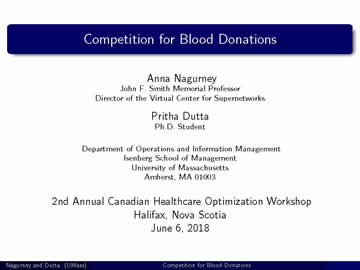
In addition, my doctoral student, Pritha Dutta, had another paper accepted for the CHOW Workshop.
 CHOW

Amazingly, on the first day of the conference, we heard that the above paper was accepted for publication in the journal Omega and yesterday we even got the galleys, which we corrected today, and took the selfie below to celebrate.


The weather was quite cool and rainy, for the most part of the conference, the warmth of the conferees and locals was very welcome. The attention to detail by the conference organizers should be lauded - from their responsiveness to queries to the excellent snacks and a banquet complete with lobster and blueberry cobbler with ice cream for dessert. So we wore bibs.
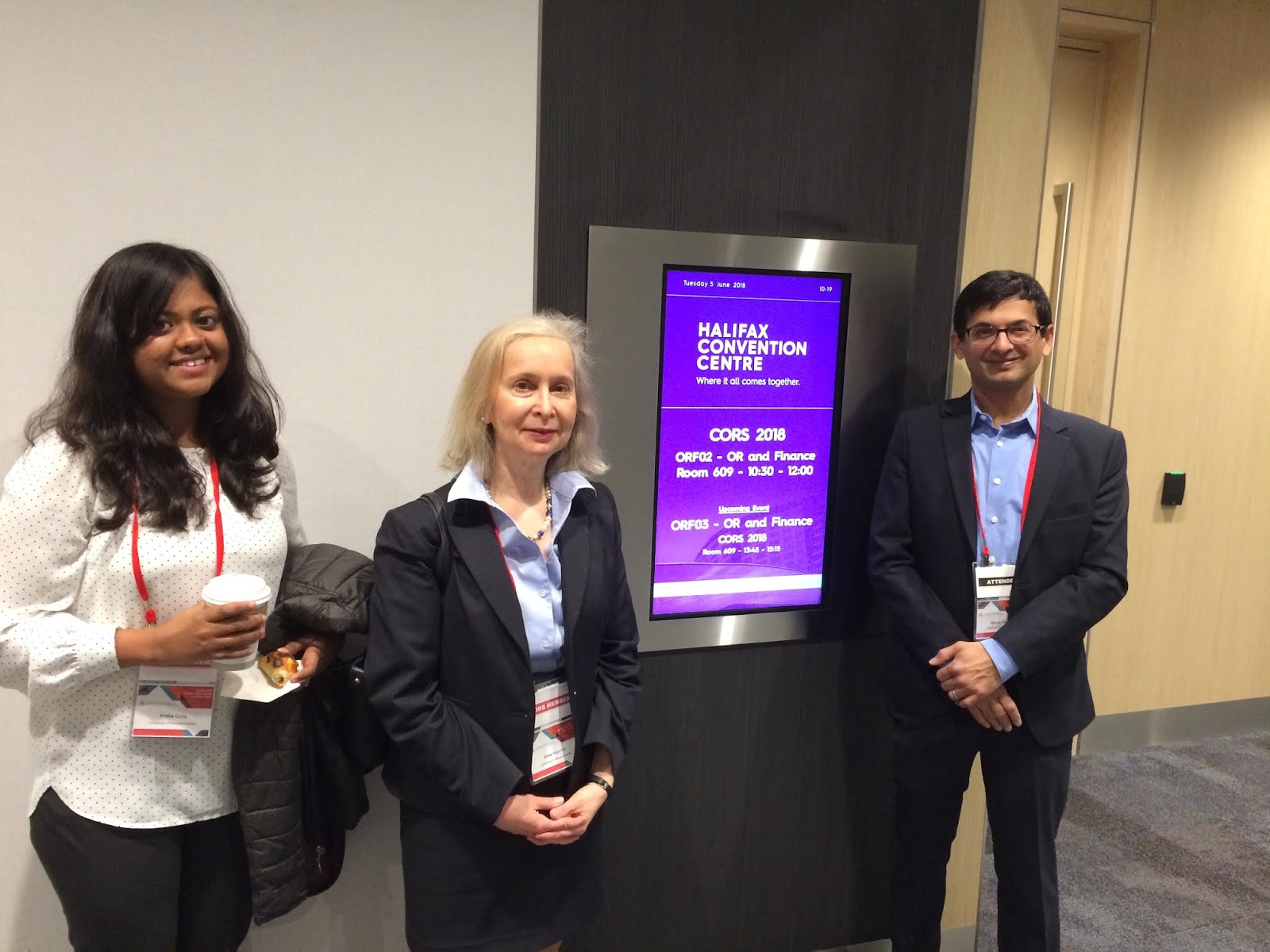
I was very pleased that my Isenberg School of Management colleague, Professor Nikunj Kapadia, also spoke at this conference (his very first OR conference) and commented on how nice and friendly our OR community is, which I fully agree.

It was extra special to see Professor Mark Daskin, an INFORMS Fellow and member of the NAE, and also Professor Martin Puterman of UBC, also an INFORMS Fellow. Professor Puterman had taught at my School of Management for two years (before my time) and he told me that the first seminar he ever gave after getting his PhD from Stanford was at my alma mater - Division of Applied Math, Brown University.
I thoroughly enjoyed all the talks that I attended, and wish that I could have been at several parallel sessions at the same time!

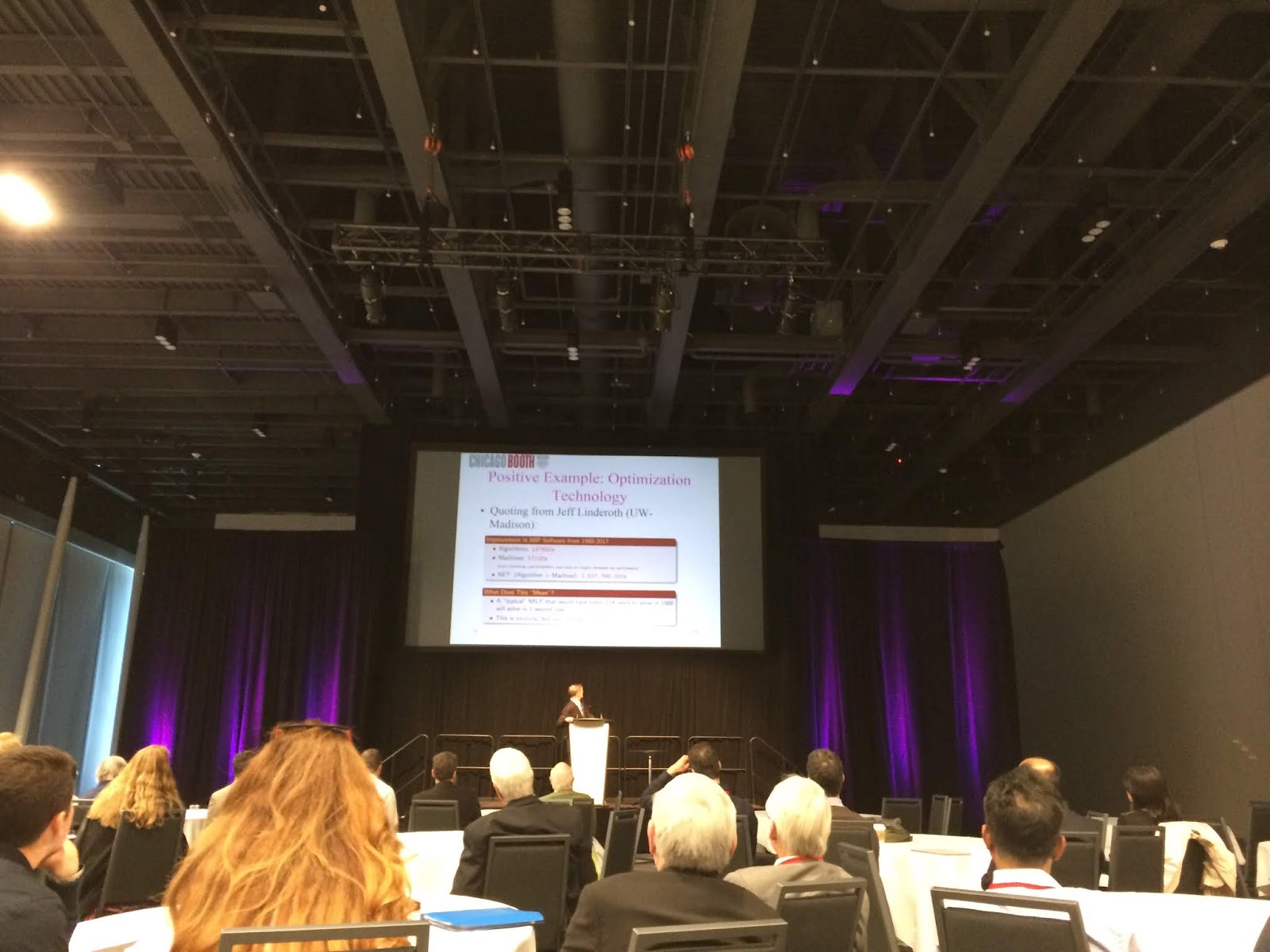
A highlight was the Harold Larnder Prize lecture given by Professor John Birge, who is also a member of the NAE and an INFORMS Fellow. The title of his lecture was: Can Big OR be Bigger than Big Data? He emphasized that what we do in OR is to improve people's lives. He also noted that the promise of advanced "analytics" in its various forms is being realized. However, according to him, unfortunately, OR is not as widely identified with the gains from recent trends. He also emphasized that realizing OR's potential depends on all of our efforts. He displayed a Google trends chart plotting terms such as machine learning, AI, neural nets,and OR.


He discussed Alpha Go and stated that machine learning is essentially stochastic optimization. He also noted that what OR can add is that we focus on the objective and take a comprehensive view and also how the objective relates to sets of parameters and any other conditions (constraints). He also stated that we ensure that the analysis is consistent with "laws" such as the law of one price and even mentioned equilibrium, which was thrilling because my group has for years focused on a variety of network equilibrium problems with fascinating applications, including supply chain ones in healthcare and disaster relief. He made several very interesting suggestions as to how we can "improve" from considering BIG projects and working with collaborators (something that I concur with as is also the focus of the Supernetwork Center that I founded at the Isenberg School at UMass Amherst).

 My colleague, Professor Fatma Gzara of the University of Waterloo, then asked the first question as to why analytics had not also been included. At our table, Mark Daskin mention decision science as also a relevant term for the work that we do.

It was great to see colleagues that I had seen at other OR conferences, including the September one in Berlin, Germany, and to meet even doctoral students from various universities. A special treat was a selfie taken by Professor Dionne Aleman of a group of tweeps. She served as the amazing CORS President for the past two years.
Special thanks also to the event manager for helping the CORS 2018 conference in Halifax be so enjoyable!
And today, once the rain stopped, we enjoyed a glorious walk in the Halifax public garden and along the historic Citadel and then downtown saw a colleague of mine from sports management, who had just arrived for another conference in Halifax and was wearing a UMass Amherst hat!