Showing posts with label IEEE Conference on Supernetworks and System Management. Show all posts

Thursday, June 30, 2011

Remembrances from the IEEE Supernetwork Conference in Shanghai

The Proceedings of the 2011 IEEE Conference on Supernetworks and System Management, which took place in Shanghai, China, have now been indexed by IEEE and are online.

I also have a hardcopy of the Proceedings in which my paper, Spatial Price Equilibrium and Food Webs: The Economics of Predator-Prey Networks, written with the "other" Professor Nagurney, appears as the lead article. The editors of the proceedings are: Professors Fu Yuan Xu and June Dong.

The Business School of the University of Shanghai for Science and Technology did a wonderful job providing us with remembrances of the conference, which are featured in the photo above, including a silk scroll of the famous Shanghai Bund.

It's great that the Isenberg School of Management at UMass Amherst has its logo featured on the conference proceedings cover as well as the Virtual Center for Supernetworks that I direct and SUNY Oswego, which was one of the sponsors, and the home institution of Professor June Dong. We also received a lovely laminated photo of all the participants which is now hanging on my office door.

Monday, May 30, 2011

Scenes from the 2011 IEEE Conference on Supernetworks in Shanghai


The 2011 IEEE Conference on Supernetworks and System Management has now come to an end. It took place in Shanghai, China, May 29-30, 2011.

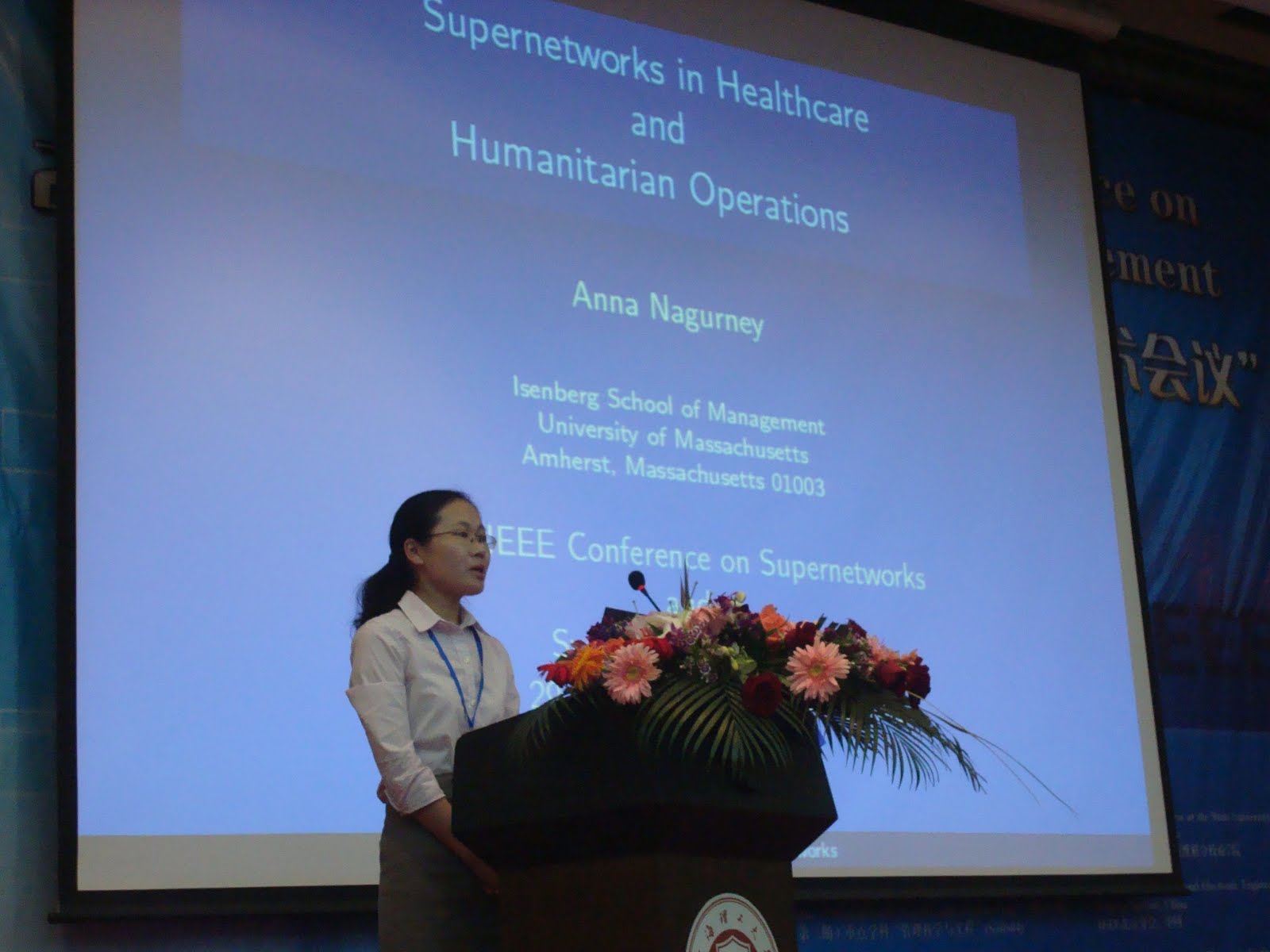
Keynote speakers included Professors June Dong, Hani Mahmassani, and Harry Timmermans. My doctoral student, Min Yu, who is from China, delivered my keynote that I prepared, entitled: Supernetworks in Healthcare and Humanitarian Operations.

Professor June Dong spoke on Disruptions in Supply Chain Supernetworks and Professor Timmermans on Applications of Supernetworks in Modeling Activity-Travel Behavior.

Several other presentations that were prepared by Center Associates of the Virtual Center for Supernetworks can be found here.

Above are photos from the conference, courtesy of Professor June Dong.

Tuesday, May 17, 2011

Starting to Pack for China and Preparing Keynote Talks

Now that the academic year has come to a close with celebratory graduations and associated events in the past, I have begun to pack for my trip to China later this week.

I will be giving two keynote talks at conferences, at the 2011 PAKDD conference in Shenzen, and at the 2011 IEEE Conference on Supernetworks and System Management in Shanghai.

At the PAKDD 2011 conference, I will speak on "Supernetworks: Opportunities and challenges for decision-making in the 21st century," and at the IEEE conference, I will speak on "Supernetworks in healthcare and humanitarian operations." Joining me at the latter conference will be a former doctoral student of mine, Professor June Dong of the School of Business at SUNY Oswego, who is helping with the organization of that conference, and a present doctoral student of mine, Min Yu, who will present our paper, Sustainable Fashion Supply Chain Management Under Oligopolistic Competition and Brand Differentiation, to appear in the International Journal of Production Economics, Special Issue on Green Manufacturing and Distribution in the Fashion and Apparel Industries. Our conference presentation can be downloaded here.

In addition to my keynote in Shanghai, I will deliver the paper, "Spatial price equilibrium and food webs: The economics of predator-prey networks," which was co-authored with my husband, Professor Ladimer Nagurney. This paper will appear in the conference proceedings and the presentation I have made available because it should be of interest to not only the ecology community but also to economists and operations researchers.

For those who think that once the teaching is over, faculty just go on vacation, I beg to differ.

Friday, April 22, 2011

Invitation Letter from China with Beautiful Stamps

I had received the invitation via email but it did not compare to the formal invitation that arrived in the envelope above. With all the virtual communications, it was delightful to be able to hold and admire the envelope with the beautiful bird stamps that traveled over two weeks from China and to read the letter inside.

I will be giving two keynote talks next month in China at conferences in Shenzen and Shanghai and the envelope and letter that I could share and show to my students made the upcoming conferences and experiences more tangible.

Now, it's time to get the visa.

Thursday, March 24, 2011

Ecological Predator-Prey Networks as Nature's Supply Chains

With the heart-breaking disasters in Japan, and the tremendous human and economic impacts, and, now, with the radiation spreading and various foods from the area surrounding the damaged Fukushima nuclear plant banned for consumption, plus even the water in Tokyo affected, I thought it time to step back and to reflect on nature.

Interestingly, we are increasingly seeing calls for "robustness" and "resiliency" in the context of supply chains since so many from automobile to airline to high tech component ones, including chips, have been adversely affected and seriously disrupted, including the biggest auto manufacturing company in the world, Toyota, because of the triple earthquake-tsunami-nuclear plant disaster that hit Japan, beginning on March 11, 2011, a date that I have sealed in my memory. In addition, journalists are making analogies of supply chains to biological organisms and even the human body and noting how resilient such systems are.

So what are the relationships between biological networks in nature and supply chains? If we can rigorously establish the connections, we should be able to learn how to design more resilient and robust systems, including supply chain networks.

In a recent study, entitled, Dynamics and Equilibria of Ecological Predator-Prey Networks as Nature’s Supply Chains, that I co-authored with the "other" Professor Nagurney, we were able to establish the equivalence between predator-prey ecological networks (think of food chains, for example, as in fisheries, to start) and multitiered supply chains consisting of "agents" who are manufacturers, retailers, or consumers, respectively. What I found fascinating is that in "product" or, shall I say, "corporate" supply chains, one explicitly considers various decision-makers' objective functions, which tend to include the maximization of profits, at least for the manufacturers and the retailers. Moreover, the various decision-makers "compete," whereas in predator-prey ecological networks, competition is clear, but, until now, no-one really quantified prices or value in that context.

In our paper, we established, using a dynamic model of predator prey interactions, that the stationary points or equilibria coincide precisely with those of the equilibria in supply chain networks! The general supply chain model that we used to show this equivalence, which was previously unexplored, was the supply chain network equilibrium model that I developed with Professors June Dong and Ding Zhang and which was published in Transportation Research E in 2002. That model has served as the foundation for numerous extensions; for just a few, click here.

Hence, amazingly, predator-prey interactions have an underlying economics, whereas supply chain networks, in a sense, are ecological predator-prey systems.

The study, Dynamics and Equilibria of Ecological Predator-Prey Networks as Nature’s Supply Chains, expanded on our earlier work that showed the equivalence between bipartite predator-prey networks and classical spatial price equilibrium problems going back to the work of the Nobel Laureate, Paul Samuelson. That paper, "Spatial Price Equilibrium and Food Webs: The Economics of Predator-Prey Networks," I will be presenting at the 2011 IEEE International Conference on Supernetworks and System Management
Shanghai, China, May 29-30, 2011, and it is in press in the Proceedings of that conference.

We became interested in this area of research due to a truly original paper, entitled "NEATS: A Network Economics Approach to Trophic Systems," published in the journal Ecological Modelling, co-authored by a group of researchers based in France: Mullon, Shin, and Cury. The paper applies some of the results in my Network Economics: A Variational Inequality Approach book to formulate and determine equilibria in predator-prey complex webs. One reads regularly about the impact of science on economics but this paper demonstrates how economics and, especially, network economics, can be used to combine both biological constraints that couple biomass balance equations with complementarity principles using Walras' law. The authors investigate the solutions to simple food chains, bilayer networks, complex food webs, and even to cannibalism (the links loop back to the specific nodes in such networks)!

Thursday, February 10, 2011

AACSB Globalization Report and Our Supernetworks Conference in Shanghai, China

The AACSB International: the Association to Advance Collegiate Schools of Business, which is the primary accrediting body for Business Schools, has issued a very important report on globalization. The Chronicle of Higher Education's article on it, which provides highlights, is at:
http://chronicle.com/article/Business-Schools-Worldwide/126320/

The report, Globalization of Management Education: Changing International Structures, Adaptive Strategies, and the Impact on Institutions, is available free to members of the association and can be purchased by others. Information is available on the association's Web site.

In all the courses that I teach at the Isenberg School, I bring an international perspective. For example, I compare transportation and logistical systems around the globe, present cases of global supply chains, highlight risk associated with different partnerships, and draw in the students who have had international experiences to bring in their experiences into the discussions. The majority of the student team projects have an international component and the students dream up these projects, which are not only fascinating, but very well-done. To view some of them, click here. Even in my graduate classes, students do projects and presentations and one of the most intriguing ones (I feel it preceded "history in the making") was by a student from Egypt who presented a project, this past December, on the optimization of waste management in her country!

As for our international activities at the Isenberg School of Management, there are numerous exciting intiatives. For example, one that I am personally involved in and very excited about is the 2011 IEEE Conference on Supernetworks and System Management that will take place in Shanghai, China at the end of May. I am an honorary co-chair of this conference, with Professor Ying-Luo, who is a Fellow of the Chinese Academy of Engineering.

Several of my former doctoral students are involved in the conference through the Virtual Center for Supernetworks, including Professor June Dong, who is at SUNY Oswego's School of Business, and is the conference Co-Chair. Dr. Patrick Qiang is involved and one of my present doctoral students, Min Yu, will also be speaking at this conference.

Keynote speakers at this conference include Professor Kieran Donaghy of Cornell University and Professor Hani S. Mahmassani of Northwestern University, along with Professor June Dong. I will also be giving a keynote talk, entitled: Supernetworks in Healthcare and Humanitarian Operations.

More information about the conference, including information on paper submissions, and the refereed proceedings, can be found at: http://csure.usst.edu.cn/icssm/

Coincidentally, a group of our undergrads from the Isenberg School will be in Shanghai, China, when our conference is taking place, so we are looking forward to a great photo-op!

I will also be giving another keynote speech at the PAKDD 2011 Conference in Shenzen, China, before the Shanghai conference, which I am very much looking forward to; see:
http://pakdd2011.pakdd.org/

Thursday, December 9, 2010

IEEE Conference on Supernetworks and System Management in Shanghai


The IEEE Conference on Supernetworks and System Management will take place May 29-30, 2011 in Shanghai, China. The call for papers may be downloaded here.

The University of Shanghai for Science and Technology (USST) will be the venue for the conference.

I am serving as the Honorary Chair of the conference along with Professor WANG Ying-Luo, who is a Fellow of the Chinese Academy of Engineering.

The Conference Chairs are Professor June Dong of the State University of New York at Oswego and Professor XU Fu-Yuan of USST.

The Program Committee Chair is Professor MA Liang of USST and Professor June Wei of the University of West Florida is the Academic Committee Chair.

Professor SUN Shao-Rong of USST and Professor Patrick QIANG of the Pennsylvania State University Great Valley are the Organization Committee Chairs.

Both Professors June Dong and Patrick Qiang also serve as Center Associates of the Virtual Center for Supernetworks at UMass Amherst that I direct.

It is exciting to see the prominence that supernetworks and associated research is getting in China.

I will be one of the keynote speakers at this conference and am very much looking forward to exchanging ideas.

The conference website is here.

Te last time I was in Shanghai was in August 2006.