Thursday, March 24, 2016
Professor Joe Sussman of MIT Speaks on High Speed Rail at UMass Amherst
The event was organized to celebrate Transportation Professor John Collura's illustrious career at UMass Amherst. The program, featured below, which continue tomorrow morning is wonderful.
And at 3PM today I had the pleasure of hearing Professor Joe Sussman of MIT give the plenary talk which was on High Speed Rail. Professor Sussman had met with me and came to my talk last December at MIT so, of course, I had to return the favor.
Professor Sussman began his presentation by introducing CSTSs, complex socio technical systems. He noted both nested complexity as well as evaluative complexity, where different stakeholders may measure performance of a system differently. For example, some may care about environmental justice, whereas others may care about social justice. His presentation was very clear, interesting, and well-done.
He emphasized that high speed rail is a CSTS and economic, environmental, and equity criteria all come to bear in this. He noted, which I liked very much, that "sustainability should be the overall design principle" in complex systems. He spoke of the concept of sustainable mega regions supported by high speed rail and brought out that when he received his chaired professorship at MIT in 1991 it was funded by Japanese Railways. When a group from JR landed in JFK and then took the "high speed" Acela from NY to Boston, he knew that their experience was not quite like the Japanese truly high speed rail, the Shinkansen.
He emphasized the importance of high speed rail connecting urban centers and noted that the sweet spot was for distances between 200 and 600 miles. For distances greater than 600 miles it was preferable to fly and for distances less than 200 miles it would be better to use road transport.
He brought out high speed rail in France (I have had the pleasure of riding the TGV there) and in Germany, He noted that the Japanese built their first high speed rail in 1964! They needed the capacity and then innovated accordingly and continue to do so.
He mentioned the political gridlock in the US as well as the capital costs associated with high speed rail although projects are under discussion in Florida, Texas, and with Chinese involvement, a link between LA and Las Vegas.
The audience very much enjoyed his presentation.
I had the opportunity to have a photo taken with Professor Sussman and with Professor John Collura, which was a special highlight for me.
I plan on attending the session tomorrow morning with speakers from Virginia Tech and Purdue. The focus will be on critical infrastructure. Thanks to my colleagues in the Transportation program for a special tribute to Professor John Collura, who is now, unbelievably, a Professor Emeritus, but still very active and busy with exciting new professional endeavors, including a big project on aviation in Westover.
Monday, September 30, 2013
Politics of Sustainability -- India and China
Mr. Sanwal worked for the United Nations from 1993 to 2007, serving first as a policy advisor to the executive director of United Nations Environment Programme (UNEP) and later to the executive secretary of United Nations Framework Convention on Climate Change (UNFCCC). Given that the IPCC just produced its Fifth Assessment report, and it has been getting a lot of attention in the media, his topic was especially timely.
Sanwal began his talk by stating that what India and China will do will frame the future. He emphasized the shifting of the population from being producers to being consumers and noted that the global middle class will triple by 2030. He noted that the climate crisis is caused by the scarcity of resources, or the distribution of resources, and sees the problem as one to be managed, and not solved -- I thought this rather pessimistic but very much appreciated his emphasis on conservation and the importance of altering the behavior of consumers. We need to have better ways of measuring carbon imprints and environmental impacts on the consumption side.
In terms of economic development, we are seeing major migrations to urban areas, especially in China and India, and urban design for sustainability is critical. The population was 1.6 billion in 1900 and will increase to 9 billion in 2050. The urban population was 30% (of 2.5 billion) in 1950 and will be 70% (of 9 billion) in 2050. Economies are now driven by the services sector and not just industry.
It is expected that the transport sector will generate half of the global emissions by 2050.
We need to educate the population about changes in lifestyle and, where feasible, also have the right legislation.
Changing behavior is not easy and society needs to agree that changes need to be made. And we can make the changes through the food that we eat, the homes that we live in, and the modes of transport that we use as well as the products that we buy.
We need a common vision for human welfare (and that of our planet).
Ken Toong, our award-winning Executive Director (and chef) of Auxiliary Enterprises, was also in the audience, and he made some great comments on what his group is doing in sustainability in terms of reducing food waste in the dining commons and also serving red meat infrequently. He is in the blue shirt in the photo above.
Lots of ideas were generated -- thanks to Mr. Mukul Sanwal for sharing his experiences and wisdon with us today.
Friday, July 12, 2013
A Collaboration Across Three Continents on Supply Chain Sustainability
It is very rewarding when you work together on challenging problems that you are passionate about and get results.
One of my passions is sustainability and developing mathematical models using networks, optimization, and game theory to assess and analyze supply chains in a holistic manner both from cost and profit perspectives as well as from their environmental impacts.
With two great co-authors, Professor Jonas Floden of the School of Business, Economics and Law at the University of Gothenburg in Sweden and Professor Min Yu (an Isenberg PhD '12 in Management Science) of the Pamplin School of Business at the University of Portland in Oregon, the paper, "Supply Chain Network Sustainability Under Competition Frequencies of Activities from Production to Distribution," has now been completed. The paper, was inspired, in part, by my paper, "Design of Sustainable Supply Chains for Sustainable Cities," which is now available online in the journal, Environment & Planning B.
Now for the challenge: the deadline for submission of our new paper for a special of a journal was fast approaching. The theme of environmental applications for the journal special issue was inspired by the year 2013 having the theme Mathematics of Planet Earth.
I was back from Gothenburg, Swedem, where Professor Floden and I had numerous discussions on environmental sustainability, use of alternative transport modes, and various surveys and case studies in Sweden and Europe. Professor Yu was in China, having attended a conference on supply chains and visiting her family. Jonas and I were also interviewed by a journalist from San Franciscoon congestion pricing and the feature appeared on SmartPlanet.
We were literally communicating and working on our paper around the clock with a 6 hour time difference between ET (in the US) and Sweden and another 6 hour one between Sweden and China.
In the past two weeks, we have dealt with some major drama -- but the news is all good and we can breathe sighs of relief. Sichuan province, where Min was based for a while, has encountered the worst floods in 50 years and you may recall that it was also the location for the major earthquake in 2008.
In our paper, we not only capture competition among firms through their supply chain networks, and assume that they produce a differentiated product, but we also include frequencies of the various supply chain activities from production to storage to ultimate distribution to the demand markets. In addition, each firm weights its environmental emissions throughout it supply chain in an individual way. We focus on GHG emissions, especially carbon, but our framework is sufficiently general to also be applicable to emissions of particulate matter (PM). PMs have recently been the focus of much media attention due to their huge negative impact on air quality and human health from China to the United Kingdom and even the U.S.!
We allow for multiple options, which is especially relevant when firms have choices associated with transport models.
Our computations reveal that not only can reducing emissions be good for profits but choosing the right transport mode (intermodal, for example, or the right size truck) can reduce emissions. You may recall the milk run load paradox, discovered by one of the PhD students in Gthenburg, Niklas Arvidsson, that I have written about, which further shows that one needs to include the load (think flow in network parlance) to calculate emissions, as we do in our paper.
Our model can be applied to products in many industries from food and fast fashion to high technology products and demonstrates that a firm's smart action and wise choices in a highly competitive environment can be good for both business and the environment!
Saturday, June 11, 2011
What Was in the Heavy Package from China?
Such an experience happened to me yesterday and above is a photograph of the contents of the padded package from China. The inscription reads: PAKDD 2011 With gratitude to Professor Anna Nagurney for her keynote speech at the conference.
How extremely thoughtful of the organizers of the PAKDD2011 Conference in Shenzhen, China to thank a keynote speaker in this way and to take the time and effort to have such a gift produced and mailed!
My keynote speech on Supernetworks: Opportunities and Challenges for Decision-Making in the 21st Century can be viewed (and heard) using different media here and the presentation, in pdf format, can be downloaded here.
As a Finance colleague of mine at the Isenberg School said, before I brought the beautiful engraved crystal creation (see photo above) to my office yesterday, we, in the Western world, should learn how to thank and recognize our speakers as the Chinese do!
Monday, May 30, 2011
Scenes from the 2011 IEEE Conference on Supernetworks in Shanghai
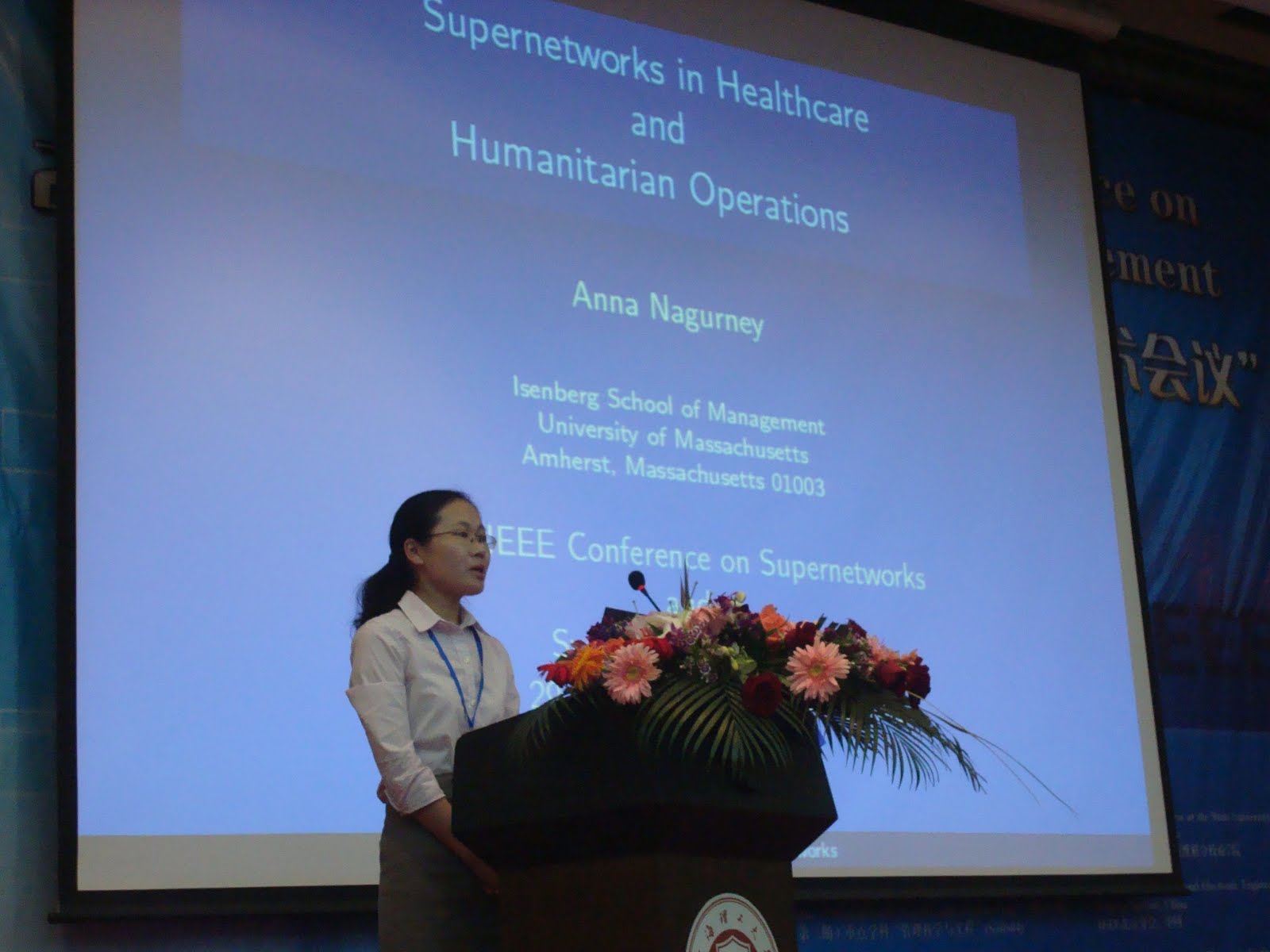
Keynote speakers included Professors June Dong, Hani Mahmassani, and Harry Timmermans. My doctoral student, Min Yu, who is from China, delivered my keynote that I prepared, entitled: Supernetworks in Healthcare and Humanitarian Operations.
Professor June Dong spoke on Disruptions in Supply Chain Supernetworks and Professor Timmermans on Applications of Supernetworks in Modeling Activity-Travel Behavior.
Several other presentations that were prepared by Center Associates of the Virtual Center for Supernetworks can be found here.
Above are photos from the conference, courtesy of Professor June Dong.
Tuesday, May 24, 2011
Keynote Talk on Supernetworks in Shenzhen, China
The PAKDD 2011 Conference begins today in Shenzhen, China.My keynote talk, prepared for this conference, is: Supernetworks: Opportunities and Challenges for Decision-Making in the 21st Century.
In the presentation, I emphasize the importance of capturing the complex behavior of decision-makers on networks today, in an era of congestion and nonlinearities, from multimodal transportation and multitiered supply chains to electric power generation and distribution networks to financial networks and the Internet. The lecture discusses the reality of networks today from their large-scale nature, to network interactions. I illustrate the Braess paradox, both in static and time-varying forms, as well as the wisdom of crowds phenomenon. I also highlight how we capture network efficiency / performance and identify which nodes and links really matter in that their destruction has the biggest impact. The lecture addresses issues of network design, through appropriate link addition/deletion, the integration of networks as in mergers and acquisitions, the evolution of social networks with supply chains and financial networks, as well as the challenges faced in humanitarian operations in disasters and the potential of identifying synergies through cooperation/collaboration.
The audio/video of my keynote can be downloaded here.
A rich media version was also generated.
The pdf of the presentation slides only can be accessed here.
This keynote will be delivered virtually.
Tuesday, May 17, 2011
Starting to Pack for China and Preparing Keynote Talks
I will be giving two keynote talks at conferences, at the 2011 PAKDD conference in Shenzen, and at the 2011 IEEE Conference on Supernetworks and System Management in Shanghai.
At the PAKDD 2011 conference, I will speak on "Supernetworks: Opportunities and challenges for decision-making in the 21st century," and at the IEEE conference, I will speak on "Supernetworks in healthcare and humanitarian operations." Joining me at the latter conference will be a former doctoral student of mine, Professor June Dong of the School of Business at SUNY Oswego, who is helping with the organization of that conference, and a present doctoral student of mine, Min Yu, who will present our paper, Sustainable Fashion Supply Chain Management Under Oligopolistic Competition and Brand Differentiation, to appear in the International Journal of Production Economics, Special Issue on Green Manufacturing and Distribution in the Fashion and Apparel Industries. Our conference presentation can be downloaded here.
In addition to my keynote in Shanghai, I will deliver the paper, "Spatial price equilibrium and food webs: The economics of predator-prey networks," which was co-authored with my husband, Professor Ladimer Nagurney. This paper will appear in the conference proceedings and the presentation I have made available because it should be of interest to not only the ecology community but also to economists and operations researchers.
For those who think that once the teaching is over, faculty just go on vacation, I beg to differ.
Friday, April 22, 2011
Invitation Letter from China with Beautiful Stamps
I will be giving two keynote talks next month in China at conferences in Shenzen and Shanghai and the envelope and letter that I could share and show to my students made the upcoming conferences and experiences more tangible.
Now, it's time to get the visa.
Thursday, February 10, 2011
AACSB Globalization Report and Our Supernetworks Conference in Shanghai, China
http://chronicle.com/article/Business-Schools-Worldwide/126320/
The report, Globalization of Management Education: Changing International Structures, Adaptive Strategies, and the Impact on Institutions, is available free to members of the association and can be purchased by others. Information is available on the association's Web site.
In all the courses that I teach at the Isenberg School, I bring an international perspective. For example, I compare transportation and logistical systems around the globe, present cases of global supply chains, highlight risk associated with different partnerships, and draw in the students who have had international experiences to bring in their experiences into the discussions. The majority of the student team projects have an international component and the students dream up these projects, which are not only fascinating, but very well-done. To view some of them, click here. Even in my graduate classes, students do projects and presentations and one of the most intriguing ones (I feel it preceded "history in the making") was by a student from Egypt who presented a project, this past December, on the optimization of waste management in her country!
As for our international activities at the Isenberg School of Management, there are numerous exciting intiatives. For example, one that I am personally involved in and very excited about is the 2011 IEEE Conference on Supernetworks and System Management that will take place in Shanghai, China at the end of May. I am an honorary co-chair of this conference, with Professor Ying-Luo, who is a Fellow of the Chinese Academy of Engineering.
Several of my former doctoral students are involved in the conference through the Virtual Center for Supernetworks, including Professor June Dong, who is at SUNY Oswego's School of Business, and is the conference Co-Chair. Dr. Patrick Qiang is involved and one of my present doctoral students, Min Yu, will also be speaking at this conference.
Keynote speakers at this conference include Professor Kieran Donaghy of Cornell University and Professor Hani S. Mahmassani of Northwestern University, along with Professor June Dong. I will also be giving a keynote talk, entitled: Supernetworks in Healthcare and Humanitarian Operations.
More information about the conference, including information on paper submissions, and the refereed proceedings, can be found at: http://csure.usst.edu.cn/icssm/
Coincidentally, a group of our undergrads from the Isenberg School will be in Shanghai, China, when our conference is taking place, so we are looking forward to a great photo-op!
I will also be giving another keynote speech at the PAKDD 2011 Conference in Shenzen, China, before the Shanghai conference, which I am very much looking forward to; see:
http://pakdd2011.pakdd.org/
Friday, July 23, 2010
Supernetworks in China


Supernetworks are big in China and two of my collaborators, Professor June Dong and Professor Patrick Qiang, are now in Shanghai discussing the formation of a sister Supernetworks Center to the Virtual Center for Supernetworks that I direct.With June Dong I wrote the 2002 book, "Supernetworks: Decision-Making for the Informatiom Age," and last year Patrick Qiang and I co-authored the "Fragile Networks" book.
My last trip to China was back in 2006 when I spoke at the Fudan Management Science Forum in Shanghai on Supernetworks: Management Science for the 21st Century. I also served on the Fudan Management Science Prize committee.
It was a terrific conference and trip, especially since June Dong was also there and she is a former native of Shanghai, China. Such well-known researchers as Mike Pinedo, Charles Corbett, and Eitan Zemel were also there. I took tons of photos.
Patrick Qiang recently gave a presentation, "Vulnerability of Fragile Networks," at the School of Management at the Shanghai University for Science and Technology and was hosted by June. Above are photos taken at his presentation, with his host, a group photo with the audience, and an announcement on the university home page, which a student of mine, helped to translate. The audience for Patrick's talk even included students of Professor Daoli Zhu, who received the Fudan Management Science prize in 2006.
Tuesday, July 6, 2010
iPhone 4 Supply Chain, Operational Efficiency, and China
The way to calculate the various costs of the components plus the labor that is needed to manufacturer and assemble them so that consumers can acquire the latest hot product from Apple is to deconstruct the iPhone supply chain.
At a cost of about $600, the iPhone 4, can be deconstructed by tracking its components from the dozen integrated chips and flash memory to the casings to the embedded GPS system. The hardware we can all see and these physical components contribute just under $200 to the price of the iPhone 4.
According to an article in The New York Times, the smallest part of Apple’s costs are those in manufacturing and assembly, which takes place in China, right now in Shenzhen. The Chinese assembly-line workers put together the microchips, which come from Germany and Korea, a touch-screen module from Taiwan, even American-made chips that pull in Wi-Fi or cellphone signals, and more than 100 other components! This is truly a global supply chain with the greatest value to the product coming at the front-end and the back-end. In the iPhone 4, more than a dozen integrated circuit chips account for about two-thirds of the cost of producing a single device, according to iSuppli.
However, soaring labor costs caused by worker shortages and unrest, a strengthening Chinese currency that makes exports more expensive, and other issues such as inflation and rising housing costs are all threatening to sharply increase the cost of making devices such as notebook computers, digital cameras and smartphones.
Desperate factory owners in China are already shifting production away from this country’s dominant electronics manufacturing center in Shenzhen toward lower-cost regions, even in China’s mountainous interior.
The world of contract manufacturers is invisible to consumers. According to The New York Times, it is a $250 billion industry, with only a few companies like Foxconn (which has been much in the news lately because of the worker strikes), Flextronics, and Jabil Circuit manufacturing and assembling for all the global electronics brands.
These companies compete on price to earn small profit margins, analysts say. As we who work and conduct research in operations and supply chains know, such firms try to benefit from even minute operational changes to attain competitive advantage. For example, the Chinese companies have very low profit margins and increasingly the Chinese are not favoring low-end assembly work. At the same time, Foxconn is spending heavily on manufacturing many of the parts, molds and metals that are used in computers and handsets, even trying to find larger and cheaper sources of raw material and locating plants closer to mines with sources of necessary raw materials.
So when you look at your smartphone, think about what went into your latest hightech gadget and favorite product, from the knowledge resources that helped to create its design, from the natural resources that enabled the construction of its components to the human resources that put the components together to the transportation services that delivered it to the stores.And remember, as you hold the product in your hands, which was made possible by the complex global supply chain that enabled its design, its manufacture, assembly, and distribution, the long journey that the product took to you.
Saturday, June 26, 2010
From the World Cup to the World Expo


After the painful loss today of the US soccer team to Ghana's at the World Cup in South Africa, resulting in the US team being eliminated, I thought that I would offer some distraction by posting the above photos taken at the World Expo which is now taking place in Shanghai, China.But, first, I would like to congratulate the US soccer team and their coaches for their extraordinary efforts. You won the hearts of our country and we are tremendously proud of how well you played.
Congrats to Ghana for being the only African country left representing this continent at this stage of the World Cup.
The above photos were taken recently by relatives of a doctoral student of mine who visited the World Expo in Shanghai and I thank them for allowing me to share them with you. Several of my collaborators are now also in Shanghai and I hope that over the summer I will be able to post additional photos.
The first photo is of China's pavilion (and interestingly in yesterday's New York Times there was a two page photo spread and ad for this World Expo). The second one is especially lovely at night, I am told, and the color and images change. The third photo is of Estonia's pavilion. The fourth photo is of the World Exposition Museum. The fifth is an artwork with four monkeys, which is a symbol of families' happiness. The bottom photo is the Qatar pavilion.
Although China did not qualify for the World Cup I am hearing marvelous things about its World Expo.
Thursday, March 19, 2009
Learning from Students, Getting a PhD, and Travel to China
Next Thursday and Friday will be very special. On Thursday, March 26, 2009, Patrick Qiang is scheduled to defend his doctoral dissertation, "Network Efficiency / Performance Measurement with Vulnerability and Robustness Analysis with Application to Critical Infrastructure." I have had the privilege of chairing Patrick's doctoral dissertation committee at the Isenberg School of Management at UMass Amherst. Patrick will be my 14th doctoral student to graduate. Of special note -- a member of his dissertation committee is Professor June Dong who received her PhD in 1994 from UMass Amherst and is now a Full Professor at the School of Business at SUNY Oswego. Professor Dong will be speaking in the UMass Amherst Spring 2009 INFORMS Speaker Series the following day. Her talk will be on supply chain disruptions. Professor Dong was also a PhD student of mine and her journey from China has been amazing. In a sense, she took me back to her home, when I visited Shanghai in August 2006. I had the very special honor of being a plenary speaker at the Fudan Management Science Forum and was also on the Fudan Management Science Prize Committee. My Chinese hosts could not have been more gracious. What made the trip even more special was being with Professor June Dong who showed me where she had gone to school in Shanghai, where her family had lived, and provided me with a wonderful education on her city.
To obtain a PhD is a lengthy and difficult process. To have had students such as the ones that I have had the privilege to teach and to work with, makes the years of effort most worthwhile! What could make a professor prouder than having students succeed and "fly on their won wings!"