Showing posts with label electric power. Show all posts

Wednesday, July 26, 2017

Great Time Speaking on Investing in Infrastructure on the Dr. Matt Townsend Show

Last April, I published an article in The Conversation, "Calculating where America should invest in its transportation and communication networks." 

The article was republished in multiple publications and in May I received an email from a very friendly segment producer of the Matt Townsend Show. The message stated that Dr. Townsend had read my article, liked it a lot, and would like to have me as a guest on his radio show. Multiple dates as options were provided, but, given my very busy conference schedule this summer, plus the fact that I am a Summer Fellow at the Radcliffe Institute for Advanced Study (RIAS) at Harvard, we settled on today as the date!

Trying to find a landline was not easy but, thanks to RIAS, a nice quiet and comfortable office was found and I also had a cell phone as a backup. I had listened to several segments of the show and very much enjoyed the facility with which Dr. Townsend asked questions and kept the conversation going on numerous timely topics being addressed by those that he was interviewing.

I came prepared with a bottle of water and my latte from Peet's to keep myself hydrated and pumped, which was easy.
 
Critical infrastructure networks is a topic I am extremely passionate about and have done research on with wonderful doctoral students from the Isenberg School as well as collaborators from Harvard to many other universities; some of these are Supernetwork Center Associates. Most notably, I mention Dr. Patrick Qiang, with whom I wrote the Fragile Networks book, and which was featured in the interview.


The interview can be accessed online.

Many thanks to Dr. Matt Townsend for the invitation to be on his show and for his terrific questions as an interviewer! I enjoyed the experience a lot.

And, coincidentally, afterwards, I had lunch with Professor David Parkes, a chaired professor of computer science at Harvard. When I was a Science Fellow at RIAS in 2005-2006, he, Professor Patrizia Daniele of the University of Catania, and I co-authored a paper on the Internet and the Braess paradox, which was published. 
Of course, in my interview with Dr. Matt Townsend I had to speak on the Braess paradox!

Friday, November 13, 2015

Brilliant Lecture by Chief Technologist Dr. Eugene Litvinov of ISO New England

Today we had the honor and privilege of hosting Dr. Eugene Litvinov, who is the Chief Technologist at the Independent System Operator (ISO) New England. Dr. Litvinov spoke in our UMass Amherst INFORMS Speaker Series, which is organized by the UMass Amherst INFORMS Student Chapter. The student chapter, some faculty, and I had the pleasure of touring ISO NE's facilities in Holyoke, MA  last spring and Dr. Litvinov was so fascinating that we were thrilled when he accepted our invitation to speak.

He attracted an audience from the Isenberg School of Management, the College of Engineering, and even folks from Physical Plant at UMass since we operate our own microgrid as well as other guests from the community. It was great to see so many PhD students and even MBA students in attendance on a Friday afternoon.

The title of his talk was "Challenges of the New Grid."

ISO NE ensures that the lights stay on in our region, that is, this organization ensures electric power reliability. It is also involved in wholesale trading as well as planning for electric power.

We began his visit with a delicious lunch at the University Club at UMass and were joined by Professor Erin Baker and two of her doctoral students. She is the PI on an NSF IGERT on wind energy. Also joining us was one of our PhD students from the Isenberg School.

The conversation at lunch was so interesting. We discussed issues of survivability, cybersecurity and the grid, renewable energy, internships, skillsets needed in this industry, and other topics and we made it to the seminar location jut in time.

The audience was eagerly awaiting Dr. Litvinov'a presentation.

I started the introductions and then our new Student Chapter President, Zana Cranmer, completed the welcome. We also noted that the student chapter last week at our INFORMS conference in Philadelphia had received the summa cum laude award from INFORMS. We had chocolate cake (to be eaten after the talk) and our award plaque displayed.
Dr. Litvinov mentioned how the grid consists of the eastern interconnection, the western interconnetcion, and that Texas is its own country.

He noted that ISO NE manages $11 billion in energy capacity a year, which is mind-boggling. Every second the monitoring of supply and demand of electricity takes place since electric power cannot be stored.

New challenges for our region include that a big percentage of the fuel is now natural gas and we don't have sufficient pipeline capacity to transport it (our region does not produce natural gas). This winter could be interesting, to say the least.

He noted that we now need different ways of controlling the system since it is much more decentralized than it has ever been. He spoke of offering customers different levels of reliabilty, which I found quite interesting.

He also noted that the transmission architecture is a mesh and the distribution architecture of the grid is radial. He emphasized the need for greater flexibility. I very much appreciated his emphasis on the importance of definitions whether they are for flexibility, reliability, survivability,  or even resilience. He spoke about risk-based optimization, which I thought was very cool, and noted robust optimization several times in his talk. I might add that Litvinov has collaborated with Dimitri Bertsimas of MIT Bertsimas spoke in our series a few years ago, as did his wife, Georgia Perakis, who had the same advisor at Brown University as I did (Stella Dafermos).  so I guess Bertsimas is my academic brother-in-law.

Dr. Litvinov  emphasized the importance of keeping the system in balance and to manage the uncertainty. I liked him saying that one needs to determine the largest set of uncertainty that can be handled without violating constraints and said that he has a paper on this, which I definitely want to read.

Dr. Litvinov also discussed that we are moving from coordinated control of the grid to cooperative control (hopefully) along with decentralized decision-making. He had visited Paris recently and viewed how electric power is managed there.
He  presented quite a few mathematical optimization models so it was great for the students to see how important mathematical programming and optimization are in this critical infrastructure sector.

His lecture was brilliant and so impressive.

The questions that followed demonstrated the interest of those who attended. There were questions on renewable energy, what his vision for the grid would be for 2030, and even cybersecurity (a growing group at ISO NE).

Dr. Litvinov stayed to answer more questions and was very generous with his time and, given his reponsibilities, we are truly grateful for his visit and his talk.
And then it was time to indulge in a piece of delicious cake from Whole Foods. What a great Friday afternoon and what a terrific day, which started with meetings in Computer Science this morning.


Sunday, October 18, 2015

Supernetworks and Critical Infrastructure at American Council of Engineering Companies Conference in Boston

Several months ago I received an invitation from Beth Larkin, who is a Vice President at HNTB, and also a UMass Amherst Civil Engineering alumna, as to whether I would be interested in speaking at the American Council of Engineering Companies (ACEC) Conference in Boston, October 14-17, 2015. 

In her message to me, Beth told me that ACEC is a national organization which represents the business interests of the engineering consulting industry. Beth is an ACEC/MA Past President.

Also, she added that: It is an industry that desperately could benefit from hearing from women thought leaders.  She also mentioned that she is part of a group of women who are trying to get more of the sessions to include women both as presenters/panelists and moderators.

Moreover, Beth wanted me to speak on Supernetworks and Critical Infrastructure.

How could I refuse such an invitation? In the meantime, I also ended up accepting an invitation to take part in the Amazon Supply Chain Optimization Summit this past week in Seattle and next week I am flying to Northwestern for a big book launch to be a panelist. One has to take advantage of opportunities!

I SO much enjoyed speaking at the ACEC conference (I was teaching on Thursday my Transportation and Logistics class, which always gets me very pumped up and supernetworks and critical infrastructure are themes that I am very passionate about).

The ACEC conference was at the Westin Copley Place hotel. The drive to Boston on Friday with the gorgeous foliage was smooth and lovely, the hotel was grand, registration was flawless, the exhibits were great, the snacks delicious and ample, and I enjoyed meeting so many professionals in this very important industry.

My presentation, The Application of Supernetworks to Critical Infrastructure from Transportation to Electric Power, can be downloaded here. 

Below are some photos from the ACEC conference with the top one of Beth Larkin with me after my presentation on Friday afternoon.

And, given that the location of the conference was Boston, it was fabulous afterwards to also walk (alot) in this great city!
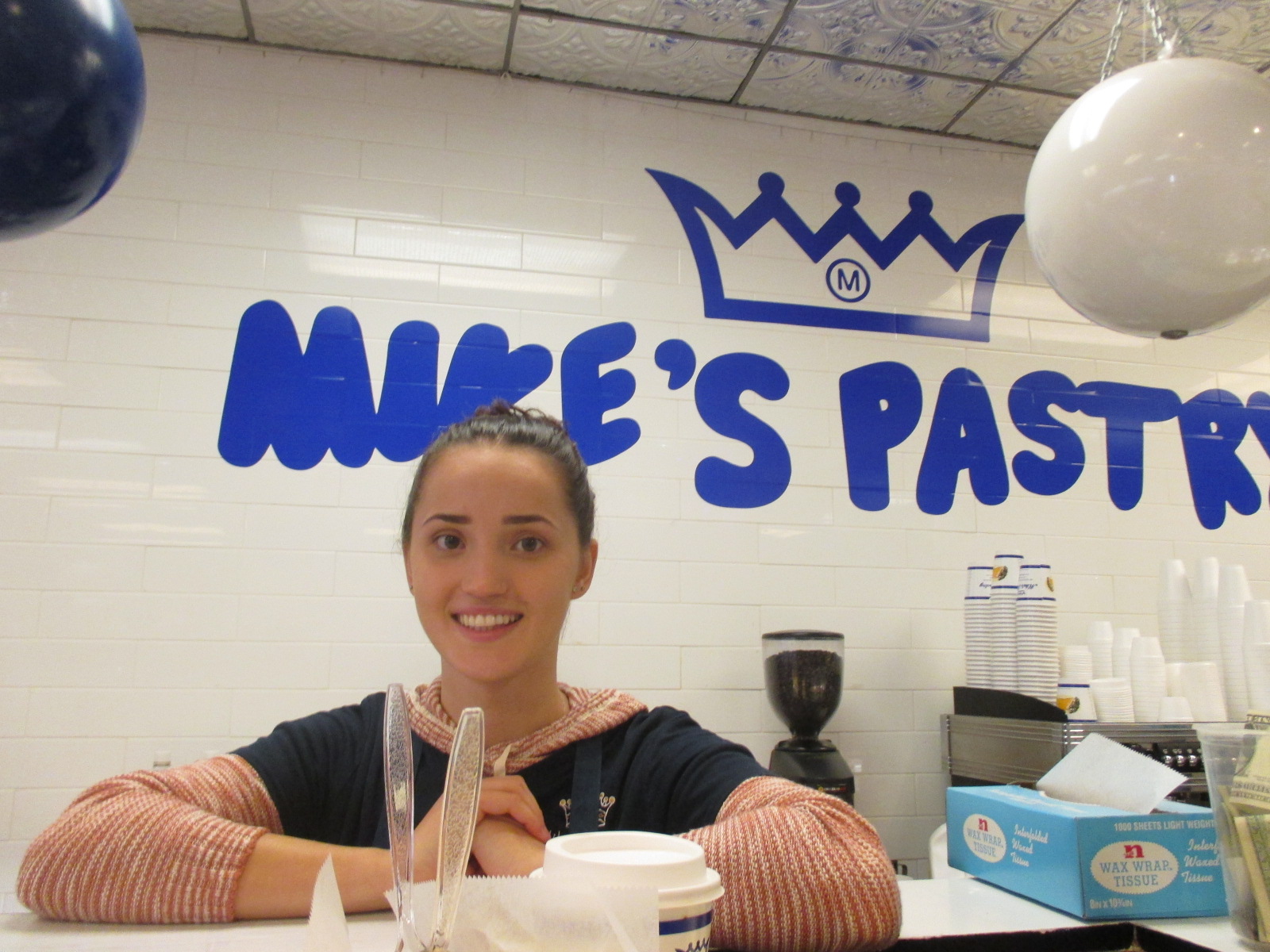
And the grand finale was having dinner in the North End with tiramisu at Mike's Pastries!
Many thanks to the ACEC for such an exceptional conference experience!

Wednesday, September 30, 2015

Speaking on Supernetworks and Critical Infrastructure at ACEC Meeting in Boston

I received an email  message from Beth Larkin, who is a Vice President at the HNTB Corporation in Boston, last March. She is a Professional Engineer and is also a UMass Amherst engineering alumna. She is a colleague of Ted Zoli's, who is the Chief Engineer at HNTB and is a MacArthur Foundation genius grant recipient. Beth had reached out to him to get a recommendation as to who may be a good speaker on Big Data and transportation in the near future for the ACEC (American Council of Engineering Companies) Boston Conference and he recommended me - what an honor.
ACEC is an organization that represents the business interests of  the engineering consulting industry.

Beth also wrote in her message to me that this industry is: An industry that desperately could benefit from hearing from women thought leaders.  Beth is an ACEC/MA Past President and part of a group of women who are trying to get more of the sessions to include women both as presenters / panelists and moderators.  

The topic that she was hoping that I could speak on was: “The Application of Supernetworks to Critical Infrastructure from Transportation to Electric Power Networks.” 

Such an invitation was impossible to refuse and I am delighted to be speaking at the ACEC Fall conference, which takes place in beautiful Boston, October 14-17, 2015.

I will be speaking on Friday afternoon, October 16, 2015, in an Educational Session.   

My presentation is ready and it had to be emailed to ACEC in early September since copies will be distributed to the audience. The expected attendance is 800 people with not all going to each session, of course. It is great to be representing the Isenberg School of Management and UMass Amherst in this way.

The conference brochure is here. 

The keynote speakers are: Doris Kearns Goodwin, who will speak on "Leadership Lessons from the White House," and Dr. Robert Ballard, the discoverer of the Titanic. 

Looking forward to a fabulous conference and so glad to have an opportunity to speak on our supernetwork and critical infrastructure research. 

An added bonus is that the Fragile Networks book that I wrote with Dr. Qiang will also be displayedat the conference.

Saturday, July 11, 2015

Optimization Workshop in Majestic Edinburgh, Scotland

I am spending 3 weeks in Europe engaged in some very serious conference" chaining." I have been blogging from different countries, beginning with Greece, where the Dynamics of Disasters conference that I co-organized with Professors Pardalos and Kotsireas took place in Kalamata.

Today we will be taking the train from Edinburgh to Glasgow, where the EURO 2015 conference will begin tomorrow.

While in majestic Edinburgh, which is breathtakig with its architecture (including the Edinburgh Castle), greenery of the Meadows,  stunning shops, multiple modes of transport (we arrived from London via Virgin Trains), and the conviviality of the people of Scotland. The food, I might add, has also been so delicious!
Of course, I would be remiss not to mention the great writers from this area, including for all the Harry Potter fans out there, J.K. Rowlings, and the cafe in which she did much of her writing of the first books. Also, Sir Artur Conan Doyle, the author of the Sherlock Holmes books, also write in Edinburgh.
The photo above was taken in front of the cathedral prior to a ceremony marking the 20th anniversary of the massacre at Srebrenica.

I was in Edinburgh to attend the EUROPT Workshop on Continuous Optimization.

It was great to see Panos Pardalos again who is also en route to EURO Glasgow.
I got a chance to enjoy some excellent talks, including a talk on closed loop supply chains in which several of my publications and my Network Economics book were noted. The finance risk sessions was also very good and the energy talks also very interesting. I could relate to these since my supernetwork team has done a lot of work on risk and supply chains and also electric power supply chains, even with data for all of New England!

Below are some photos taken at the great workshop. Special thanks to professor Julian Hall at the University of Edinburgh for being so responsive to my questions!


I will miss Edinburgh!

Sunday, April 19, 2015

Sustaining Our Electric Power Supply Chains and ISO New England

High impact experiences are essential to a college education and, on April 10, 2015, we had the pleasure of visiting ISO - New England to learn about how this organization manages the reliability of electric power for all of New England along with the pricing of it and planning for the future.

I had been to ISO - NE several years back and had wanted to bring another group of students to this awesome facility in Holyoke, Massachusetts but the last time we had scheduled a tour, Superstorm Sandy hit, and it was very difficult to reschedule.

This time there were several faculty that joined our group, which is featured  in the photo above, and which also consisted of several students from our great UMass Amherst INFORMS Student Chapter as well as several students from my Humanitarian Logistics and Healthcare class.

I have been fascinated by electric power supply chains since one of my research "bibles" is the classical book, "Studies in the Economics of Transportation," written by Beckmann, McGuire, and Winsten and in the book it is stated in the chapter on "Unsolved Problems"  at the bottom of page 108 that: "The unsolved problems concern the application of this model (they were speaking of what we now call the elastic demand user-optimized transportation network model or the traffic network equilibrium model) to particular cases. A one-commodity network would be of special interest. In particular, the problem of generation and distribution of electric energy in a network comes to mind. The task of verifying the assumptions or modifying the model might be rewarding, but will call for considerable technical knowledge of electric engineering."

With co-authors, I wrote a series of papers on electric power supply chains, in which we also transformed the electric power supply chains into transportation network equilibrium problems on an abstract network or supernetwork, resolving this unsolved problem of over half a century.


One of our papers, which used data from ISO - NE for one of the hottest months in our region  ever - July 2006, is: An Integrated Electric Power Supply Chain and Fuel Market Network Framework: Theoretical Modeling with Empirical Analysis for New England, Zugang Liu and Anna Nagurney, Naval Research Logistics 56: (2009) pp 600-624. In this paper we utilized the transformation noted earlier in this post and had actually solved the "unsolved problem" in the paper:
Dynamic Electric Power Supply Chains and Transportation Networks: An Evolutionary Variational Inequality Formulation, Anna Nagurney, Zugang Liu, Monica-Gabriela Cojocaru, and Patrizia Daniele, Transportation Research E 43: (2007) pp 624-646.

ISO New England provided us with an outstanding set of presentations on the state-of-the-art of electric power generation and distribution with new challenges of decentralization and balancing supply and demand with renewables such as solar and wind energy.  We even got to hear how the R&D group is working on robust optimization in the context of electric power planning.

We then had the shades, which had been drawn in the conference room, pulled back and we got to see the incredible control room with a huge screen depicting the New England power grid in real time! 
The below photo of the control room is courtesy of the ISO NE website.

They also informed us of the ISO to Go! app, available for both I-phone and Android, which can be positively addicting. It provides info on wholesale prices (which can even be negative) as well as the fuel mix (wind, coal, natural gas, nuclear,  etc.). Last winter, due to a capacity crisis in terms of natural gas distribution in NE, and the frigid temperatures, the fuel mix relied heavily on fossil-based fuels for electric power generation and we know from our high fuel bills that this winter was also tough financially. The wholesale price last winter was well over $50 per Megawatt hour and now it is about $14 but the price varies and is updated several times each hour.

Thanks to ISO New England for such an outstanding educational experience for the students and faculty that you welcomed last Friday!