Showing posts with label disruptions. Show all posts

Saturday, May 17, 2025

Congratulations to Dana Hassani on Receipt of the 2025 Outstanding Doctoral Student Researcher Award at the Isenberg School!

On May 9, the Isenberg School of Management held its All School Meeting to wrap up the academic year. At the meeting, various awards were given out to faculty, staff, and doctoral students.

My Isenberg PhD student in Operations Management Dana Hassani, who was announced as the recipient of the 2025 Outstanding Doctoral Student Researcher Award, was, at that time, was en route to the POM Society Conference in Atlanta, so could not attend. I had blogged about this conference in previous posts.

So, this past Thursday, after the Isenberg PhD robing ceremony, the Director of our PhD Program, Dr. George Milne, presented Dana with the award plaque in our Business Innovation Hub.

Dana arrived at UMass Amherst in January 2022, after a delay in obtaining his visa. He has published 3 journal articles, and one book chapter, which is quite remarkable. And he has also been teaching this past academic year a required course, "Business Data Analysis," for our business undergraduates each semester. Dana is the lead author of the paper, "A Multiperiod, Multicommodity, Capacitated International Agricultural Trade Network Equilibrium Model with Applications to Ukraine in Wartime," co-authored with me, and Kyiv School of Economics (KSE) colleagues: Oleg Nivievskyi and Pavlo Martyshev, which appears in in the INFORMS journal Transportation Science,  vol. 59, no. 1, January-February 2025, pp. 143–164. He is also the co-author (second author) with the same co-authors as above of the paper, "Multicommodity International Agricultural Trade Network Equilibrium: Competition for Limited Production and Transportation Capacity Under Disaster Scenarios with Implications for Food Security," published in the European Journal of Operational Research, vol. 314, no. 1, 2024,  pp. 1127-1142. He is also a co-author, with the same authors as above of the paper, "Exchange Rates and Multicommodity International Trade: Insights from Spatial Price Equilibrium Modeling with Policy Instruments via Variational Inequalities," published in the Journal of Global Optimization, vol.  87, 2023, pp. 1-30.

Dana's book chapter, co-authored with the same team as his journal articles, "Quantification of International Trade Network Performance Under Disruptions to Supply, Transportation, and Demand Capacity, and Exchange Rates in Disasters," was published in Dynamics of Disasters- From Natural Phenomena to Human Activity, I.S. Kotsireas, A. Nagurney, P.M. Pardalos, S. Pickl, C. Vogiatzis, Editors, Springer Nature Switzerland AG, 2024, pp. 151-179.

It is important to emphasize that there are 9 tracks in the Isenberg PhD Program so receiving this award is quite the achievement. And, Dana also got this award last year. He successfully defended his dissertation proposal a few months ago. I look forward to his successful PhD defense in the coming academic year. He has done excellent research focusing on agricultural supply chains and international trade under disruptions, including in Ukraine during wartime. It has been an honor to work with him and with colleagues at the Kyiv School of Economics. 

Monday, April 21, 2025

My Agricultural Supply Chain Networks Under Uncertainty Seminar is Now Online, Thanks to CORS (Canadian Operational Research Society)

I am grateful to Dr. Anjali Aswathi for inviting me to present on April 11, 2025 in a CORS event. Dr. Aswathi is the President of the Canadian Operational Research Society,

The title of my presentation was, "Agricultural Supply Chain Networks Under Uncertainty."


The link to my slide deck for the lecture is here: https://supernet.isenberg.umass.edu/visuals/CORS-Nagurney-2025.pdf

The link to the video recording on Youtube is here: https://youtu.be/AIbWpVPM4uU

The above video recording also includes the presentation by Dr. Emma Freninger, which followed my presentation.

It was also very thoughtful of the CORS President to provide the above certificate. 

Thanks to my PhD students and all others who attended our virtual presentations with special thanks to Ismael Pour for writing up some of the highlights on the UMass Amherst INFORMS Student Chapter blog: https://websites.umass.edu/umassinf/2025/04/13/two-talks-in-one-day/

Our research on agricultural supply chain networks continues!

Tuesday, October 8, 2024

The Supply Chain Resilience (SCRIPS) Workshop in DC and More!

Last week I had the great pleasure of attending the SCRIPS (Supply Chain Resilience Issues, Problems and Solutions for the Homeland Security Enterprise) Workshop in Washington DC. The workshop was extraordinary, bringing together experts from government, academia and industry. The venue was excellent - the Texas A&M Bush Center, very close to The White House. 

It was an honor to be invited to deliver the keynote: Supply Chain Resilience Research: Insights from Agricultural & Food Supply Chains.

There were 3 themes to this workshop: the agricultural and food industry, the semiconductor industry, and ports. The organizers were incredibly prescient with the workshop taking place October 1 and 2, 2024, and the  East Coast and Gulf Coast dock workers set to go on strike at midnight on October 1!

I had anticipated a possible dock workers strike and wrote this article for  The Conversation: "Brown bananas, crowded ports, empty shelves: What to expect with the US dockworkers strike." The article was updated, once the strike was announced, before my keynote on October 1. I was busy going back and forth with my Editor.  The strike ended, preventing an economic disaster, within 3 days, and I had this article published in The Conversation: "Dockworkers pause strike after Biden administration’s appeal to patriotism hits the mark." 

I'd like to take the opportunity to thank the Department of Homeland Security (DHS) Supply Chain Resilience Center, the Center for Accelerating Operational Efficiency (CAOE) at Arizona State University and the Cross-Border Threat Screening and Supply Chain Defense Center (CBTS) at Texas A&M University, both DHS Centers of Excellence, for hosting this workshop. Special thanks to Ronald Askin for inviting me to speak with gratitude also to: Ross Maciejewski, Hilary Shackelford, and Pompelli Greg, who did an amazing job leading our food/ag industry break sessions. Appreciation is extended to: Cynthia Gerber, Manish Bansal and Sara Saberi for taking and sharing some of the nice photos in the collage below. Thanks to ALL for their participation and the incredibly inspiring insights and discussions.


It was terrific to see colleagues that I know from Operations Research from multiple universities at the workshop as well as to have CDC, FEMA, and, of course, DHS representatives taking part in the workshop.

It rained periodically during the workshop but, propitiously, the rain would stop when Robert, who is responsible for the amazing Ukraine Rally DC, would be out. I had brought my Ukrainian flag and, both last Monday and Tuesday, I joined him and others.

It was very special to meet refugees from Ukraine and even Kiran and Alan, who had worked in the Peace Corps in Ukraine, and I spoke Ukrainian with them!


My time in DC was incredibly rewarding and very special! And, while walking on the street back to my hotel one evening, a gentleman cried out my name and starting hugging me. He had just arrived from Mexico, was very familiar with my research, and was starting his new job at The World Bank the next day. He also knows our UMass Amherst Chancellor Javier Reyes, who is from Mexico. What a small world it is!

Tuesday, May 21, 2024

My Isenberg School of Management PhD Student Dana Hassani Receives the Outstanding Doctoral Student Research Award

As the 2023-2024 academic year was growing to a close, there were many celebratory events including my department's award ceremony that  I had blogged about.

And, at the final All School Meeting of the Isenberg School on May 9, 2024, there were faculty and PhD students recognized for research and teaching as well as staff for their accomplishments.

I was thrilled to hear that my Isenberg School PhD student, Dana Hassani, who has completed almost two and a half years in our doctoral program in Operations Management, was the sole recipient of the 2024 Isenberg School Outstanding Doctoral Research Award! I had nominated Dana for this award.

Below is a collage of photos taken after the announcement and prior to the Senior Barbecue that followed.

Dana has already had two journal articles published, one in the European Journal of Operational Research, and the other one in the Journal of Global Optimization.


Both of these papers, Dana co-authored with me and with colleagues at the Kyiv School of Economics (KSE) in Ukraine, Professor Oleg Nivievskyi and Dr. Pavlo Martyshev. Preprints of these and other papers of ours can be found on the Supernetwork Center website: https://supernet.isenberg.umass.edu/dart.html These papers are reflective of a wonderful collaboration began through the UMass Amherst - KSE partnership, which was established after the full-scale invasion of Ukraine by Russia on February 24, 2022. Pavlo was one of 15 Virtual Scholars in our first round and was placed with me as a Faculty Host.

In addition, we, recently, heard that another joint paper of ours, "Quantification of International Trade Network Performance Under Disruptions to Supply, Transportation, and Demand Capacity, and Exchange Rates in Disasters," has been accepted for publication in: Dynamics of Disasters- From Natural Phenomena to Human Activity, I.S. Kotsireas, A. Nagurney, P.M. Pardalos, S. Pickl, C. Vogiatzis, Editors, Springer Nature Switzerland AG.

The achievement of Dana's receipt of this award is quite impressive since there are 7 departments in the Isenberg School of Management.

The research on international agricultural trade network equilibrium problems continues, with various policy interventions, analysis of disruptions due to the war, as well as impacts on food security. 

Our KSE colleagues inspire us as do all Ukrainians fighting for their freedom and that of democracies globally.

Saturday, September 3, 2022

The Outstanding Optimization and Decision Science Conference in Beautiful Firenze, Italy

I would like to thank the organizers of the outstanding Optimization and Decision Science Conference that took place August 30-September 2, 2022 in the stunning city of Firenze, Italy.

It was a conference of great scientific value, with wonderful social activities, at the University of Firenze, which brought together researchers from many different countries for face to face exchanges. For many of us, it was the first international face to face conference since the beginning of the COVID-19 pandemic. I very much enjoyed all the sessions on variational analysis and equilibrium problems!

I would also like to extend my deepest appreciation to the Conference Co-Chairs: Professors Fabio Schoen and Paola Cappanera, for the warmth and hospitality extended to all of us. The conference website can be found here. Thanks to the Local Organizing Committee and to the Program Committee for their outstanding work!

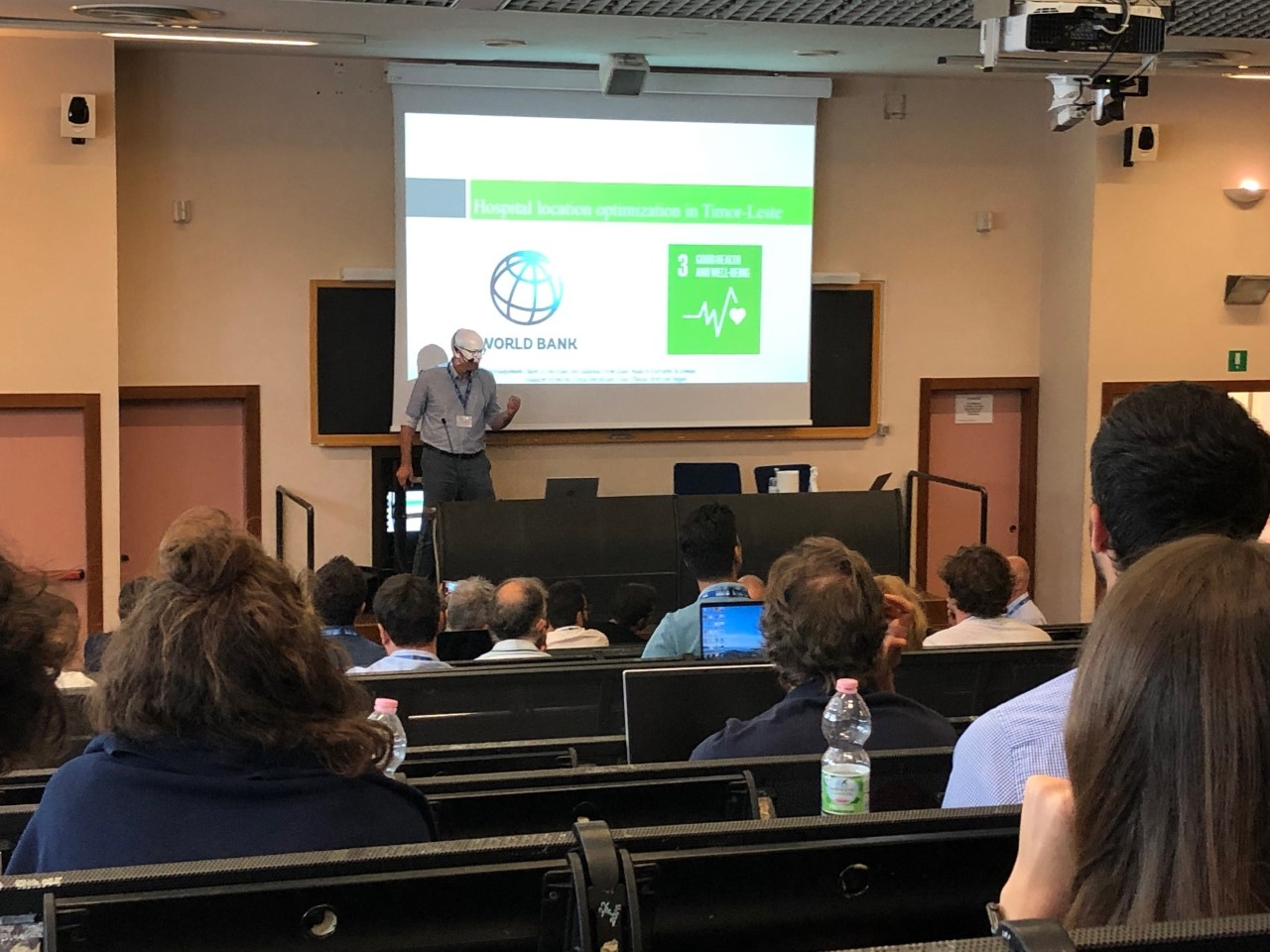
It was a great honor to give the opening keynote talk at the Museum of Innocents this past Tuesday, followed by a cocktail hour and tour of the museum.  The title of my keynote was: Labor and Supply Chain Networks: It's All About People. The slidedeck can be downloaded here.


Above I am with Drs. Alice Raffaele and Marti Fischetti, two incredibly talented OR researchers and very dynamic leaders of AIROYoung!


The energy and enthusiasm of the conferees was heartwarming to behold. New friendships were made and established relationships further cemented. The sessions were excellent and the University of Firenze a great venue.

It was fabulous that all 5 co-authors of our paper on UAVs, 5G, and Disaster Management showed up! Below are: Yours truly, Daniele Sciacca, Professor Patrizia Daniele, Professor Ladimer S. Nagurney, and Dr. Gabriela Colajanni.


I very much enjoyed listening to the other keynote talks of Professors Bertsimas (virtual presentation), Dick den Hertog, and Paola Scaparra. It was very cool that both the opening and closing keynoters were female!


Below is a photo of the female keynoters.


The social dinner was a banquet at a farm with majestic views of the landscapes in Tuscany. 


It was truly special to see Professor Ivana Ljubic and her postdoc Martina Cerulli at the banquet and to meet colleagues even from the Czech Republic!


I leave you with some views of beautiful Firenze, Italy! 


All the conferees had a fabulous time scientifically and socially.  The great discipline of Operations Research, because of the creativity and dedication of its researchers, educators, and practitioners, is making laudable positive impact globally. Working together we can achieve so much good.

Thanks to the organizers of the great Optimization and Decision Science 2022 conference for bringing many of us together again, in person!

Sunday, January 16, 2022

Congratulations to the Supernetwork Team at the Isenberg School of Management for a Great Year!

As we begin the New 2022 Year, it is time to take stock and to reflect on the year that has passed.

2021 was a remarkable year in many respects, not the least of which was that it marked the second year of the COVID-19 pandemic.  As the Center Director, I feel it to be important to share with you reflections on this extraordinary year, and to highlight some of the accomplishments of ours at the Virtual Center for Supernetworks.

In 2021, the book, "Dynamics of Disasters - Impact, Risk, Resilience, and Solutions," that I co-edited with Professors  Ilias S. Kotsireas and  Panos M. Pardalos, and Dr.  Arsenios Tsokas was published by Springer. In it, you will find many fascinating contributions, all peer-reviewed, including co-authored work by Center Associates Professor Patrizia Daniele of the University of Catania in Italy and Professor Tina Wakolbinger on the Vienna University of Economics and Business in Austria. My paper - the very first on incorporating labor into supply chain networks, which was done in the context of perishable food supply chains, also appears therein. And, in July 2021, we, again, co-organized another Dynamics of Disasters conference, which this year, because of the pandemic, although based in Athens, Greece,  nevertheless, virtual. The conference included four plenary speakers and we were delighted to hear from all of them, including Center Associate Dr. Stavros Siokos of Astarte Capital, which he co-founded in London. Center Associates were very active at this conference and included presentations of work by Center Associates Professor Patrizia Daniele,  Professor Tina Wakolbinger, Professor Deniz Besik of the University of Richmond, Professor Pritha Dutta of Pace University, Professor Ladimer S. Nagurney of the University of Hartford,  and Isenberg Doctoral Student Center Associate Mojtaba Salarpour. Mojtaba successfully defended his doctoral dissertation in March 2021.
On June 7, 2021, I was deeply honored with the receipt of the 2020 Harold Larnder Prize from the Canadian Operational Research Society.  I delivered my talk, "Novel Supply Chain Network Models Inspired by the COVID-19 Pandemic: From Optimization to Game Theory," virtually and, remarkably, the prize certificate was delivered through express courier services around the same time!  The video of my prize lecture can be viewed here. I am only the second female in its 35 year history to receive this prize - the first one was Dr. Ailsa Land, who, sadly, died in 2021. I was honored to be a panelist to recognize her receipt of the Beale Medal, which I blogged about.
In the pandemic, our expertise on supply chains and various network systems continued to be sought after. Since part of the Center's focus is public outreach, in addition to our mission of research and education, we responded to numerous media interview requests from the print media, radio shows, as well as TV news programs, and podcasts.  Print media coverage can be viewed here. For various TV and radio interviews plus podcasts, see here,
Center Associates presented at the EURO Conference as well as the INFORMS Conference, which was in hybrid format, with Professor Deniz Besik presenting at this Anaheim conference in person as well as Center Associate Professor Sara Saberi of WPI and Mojtaba Salarpour. I had the honor and pleasure of giving a tutorial at the INFORMS conference, which was recorded - "Game Theory and the COVID-19 Pandemic," which is also an INFORMS publication in its tutorial series. I thank Professors John Carlsson and Doug Shier for their great assistance and support.
In addition, to other conference presentations, we took part in an interesting conclave in India and a workshop in  Nepal, demonstrating the reach of the research that we do.  Of particular focus this year, was researching various supply chain disruptions in the pandemic, continuing work on food supply chains, modeling various trade measures in the pandemic, expanding on disasters and game theory, and  including labor into various supply chain networks in a series of papers,  as well as constructing models of human migration and associated policies, and even building a model of convalescent plasma donations! I was deeply honored that my paper, "Supply Chain Game Theory Network Modeling Under Labor Constraints: Applications to the Covid-19 Pandemic," that was published in the European Journal of Operational Research, receive a 2021 Editor's Choice Award.

I am also very grateful to Isenberg Dean Anne P. Massey and to the UMass President Marty Meehan for appointing me  the Eugene M. Isenberg Chair in Integrative Studies in April 2021.  I am very appreciative of having held the John F. Smith Memorial Professorship of Operations Management from 1998 until that point and especially thank my wonderful benefactor - Jack Smith, the former CEO and Chairman of the Board of General Motors and a UMass Amherst alumnus. 

Center Associates achieved additional accolades. Professor Deniz Besik submitted a letter with testimony to Congress on food insecurity in the pandemic. Professor Pritha Dutta was interviewed by FOX on supply chain disruptions in the pandemic, and Professor Sara Saberi received a major NSF grant to help Massachusetts manufacturing prepare for future crises.

In addition, it was a great year - despite the pandemic - for the UMass Amherst INFORMS Student Chapter, which I have served as the Faulty Advisor of since 2004. We hosted several panels as well as Dr. Mauricio Resende of Amazon and Dr. Robin Lougee, formerly of IBM in our Speaker Series! The chapter was recognized by INFORMS with the Cum Laude Award at the Annual Meeting in Anaheim. Mojtaba Salarpour, continued to serve as the Chapter President until September 2021, completing two years of exceptional service.

Plus, it was uplifting to be the invited Faculty Speaker at the UMass Amherst Chancellor's Donor Breakfast in November. The title of my presentation was: "From Supernetworks to Supply Chain in the Pandemic."

We continued to write OpEds, several of which were published in The Conversation, including my article on the shipping container, that appeared on September 21, 2021, and, to-date, has over 315,000 reads!

And, to show the research that we are engaged in, below I highlight some of our recent publications:

Supply Chain Networks, Wages, and Labor Productivity: Insights from Lagrange Analysis and Computations
Anna Nagurney, to appear in Journal of Global Optimization.

A Multiperiod Supply Chain Network Optimization Model with Investments in Labor Productivity Enhancements in an Era of COVID-19 and Climate Change
Anna Nagurney, accepted for publication in Operations Research Forum.

Optimization of Investments in Labor Productivity in Supply Chain Networks
Anna Nagurney, accepted for publication in International Transactions in Operational Research.

Wage-Dependent Labor and Supply Chain Networks in the COVID-19 Pandemic and Beyond
Anna Nagurney, in press in Analysis, Geometry, Nonlinear Optimization and Applications, P.M. Pardalos and T. M. Rassias, Editors World Scientific Publishing, Singapore, October 2021.

Game Theory and the COVID-19 Pandemic
Anna Nagurney, in INFORMS TutORials in Operations Research, October 2021. Also presented at the INFORMS 2021 Annual Meeting.

Modeling of Covid-19 Trade Measures on Essential Products: A Multiproduct, Multicountry Spatial Price Equilibrium Framework
Anna Nagurney, Mojtaba Salarpour, and June Dong, International Transactions in Operational Research 29(1), 2022, pp 226-258.

A Multiclass, Multiproduct Covid-19 Convalescent Plasma Donor Equilibrium Model
Anna Nagurney and Pritha Dutta, Operations Research Forum 2, 31 (2021) Open Access on SpringerLink

Spatial Price Equilibrium, Perishable Products, and Trade Policies in the Covid-19 Pandemic
Anna Nagurney, Montes Taurus Journal of Pure and Applied Mathematics 4(3), 2022, 9-24.

A Multicountry, Multicommodity Stochastic Game Theory Network Model of Competition for Medical Supplies Inspired by the Covid-19 Pandemic
Mojtaba Salarpour and Anna Nagurney, International Journal of Production Economics 235: (2021), 108074.

Optimization of Supply Chain Networks with Inclusion of Labor: Applications to COVID-19 Pandemic Disruptions
Anna Nagurney, International Journal of Production Economics 235: (2021) 108080.

Perishable Food Supply Chain Networks with Labor in the Covid-19 Pandemic
Anna Nagurney, Dynamics of Disasters - Impact, Risk, Resilience, and Solutions, I.S. Kotsireas, A. Nagurney, P.M. Pardalos, and A. Tsokas, Editors, Springer Nature Switzerland AG, 2021, pp 173-193.

Capacitated Human Migration Networks and Subsidization
Anna Nagurney, Patrizia Daniele, and Giorgia Cappello, Dynamics of Disasters - Impact, Risk, Resilience, and Solutions, I.S. Kotsireas, A. Nagurney, P.M. Pardalos, and A. Tsokas, Editors, Springer Nature Switzerland AG, 2021, pp 195-217.

Preface to Dynamics of Disasters Impact, Risk, Resilience, and Solutions, Ilias S. Kotsireas, Anna Nagurney, Panos M. Pardalos and Arsenios Tsokas, Editors, Springer Nature Switzerland AG, 2021, pp v-xii.

International Human Migration Networks Under Regulations
Anna Nagurney and Patrizia Daniele, European Journal of Operational Research 291(3): (2021), pp 894-905.

Networks in Economics and Finance in Networks and Beyond: A Half Century Retrospective
Anna Nagurney, written for the Special 50th Anniversary Issue of Networks, Networks 77(1): (2021), pp 50-65.

Friday, November 26, 2021

My Talk at the Managing Disaster Risk: A Way to Sustainability Workshop in Nepal

This past week I had the pleasure of speaking at the Managing Disaster Risk: A Way to Sustainability Workshop organized by NEGAAS (Nepal Germany Academic Association). Speakers and participants joined virtually from multiple continents. 

My presentation was entitled, “Labor and Supply Chain Networks: Insights from Models Inspired by the COVID-19 Pandemic.” 


After a very warm introduction and welcome by Professor Tanka Nath Dhamala, I thanked him and co-organizer Professor Urmila Pyakurel, as well as Er. Ravi Khanal and the Nepal German Academic Association (NEGAAS) and its Program on Migration and Diaspora for the invitation to speak.

In my presentation,  I first emphasized that the COVID-19 pandemic is a healthcare disaster that unlike, natural disasters, even those exacerbated by climate change, is not limited to time and space and has affected virtually the entire globe. I spoke about research on perishable and time-sensitive supply chain networks that I had done with collaborators even before the pandemic that enabled us to pivot to produce relevant research in the pandemic. Among the applications of such supply chains are: food supply chains as well as pharmaceutical and vaccine ones. Such supply chains were especially impacted in the pandemic. 

I discussed a stream of publications that I had published in the pandemic on mathematical models, both optimization and game theory ones, that include labor as a critical resource in supply chains, along with labor availability and productivity. I first discussed, at a high level, the food supply chain network model introduced in Nagurney (2021a), in which there are bounds on labor associated with supply chain network economic links of production, transportation, storage, and distribution using a generalized network optimization framework to capture food product perishability. 

I then (cf. Nagurney (2021b) highlighted another optimization model in which there are distinct sets of bounds on labor - on links, or on a tier of supply chain activity, or on the entire supply chain network. Finally, I discussed a model and results in Nagurney (2021c), where a game theory model with multiple competing firms under various labor constraints are engaged in competition under profit-maximizing behavior. The governing concept in the case of bounds on labor on links is that of Nash Equilibrium, whereas in the case of the two other sets of constraints, in which the firms compete for labor (a reality in the pandemic), the concept is that of a Generalized Nash Equilibrium. Highlights of a case study on blueberries and migrant labor, which has suffered in the pandemic, was also presented.  This paper, published in the European Journal of Operational Research was recognized by a 2021 Editor's Choice Award.

In my talk, I also noted that it is important that firms pay laborers the wages that they deserve and this can actually give them a competitive advantage (cf. Nagurney (2021d)). I  further noted the benefits of cooperation, from a study (see Nagurney and Qiang (2020)), in which synergies associated with the teaming of humanitarian organizations in disaster response can be quantified. 

In my presentation, I emphasized the importance of research and publishing on disaster management but also the need to get the research out to the public. I noted the benefits of writing OpEds and speaking with the media as well as in working with legislators to effect positive change. Below are just some of the media that I have been interviewed for in the pandemic.


I concluded my presentation by describing how work on blood supply chains that I had written about in The Conversation has impacted  national policy in the US in the pandemic.


I very much appreciated the thoughtful comments and questions after my presentation.

The full slide deck of my presentation can be downloaded here.

References

Nagurney, A., 2021a. Perishable food supply chain networks with labor in the Covid-19 pandemic. In: Dynamics of Disasters - Impact, Risk, Resilience, and Solutions. I.S. Kotsireas, A. Nagurney, P.M. Pardalos, and A. Tsokas, Editors, Springer Nature Switzerland AG, pp 173-193. 

Nagurney, A., 2021b. Optimization of supply chain networks with the inclusion of labor: Applications to Covid-19 pandemic disruptions. International Journal of Production Economics, 235, 108080.

Nagurney, A., 2021c. Supply chain game theory network modeling under labor constraints: Applications to the Covid-19 pandemic. European Journal of Operational Research, 293(3), 880-891.

Nagurney, A., 2021d. Wage-dependent labor and supply chain networks in the COVID-19 pandemic and beyond. In press in: Analysis, Geometry, Nonlinear Optimization and Applications, P.M. Pardalos and T.M. Rassias, Editors, World Scientific Publishing, Singapore. 

Nagurney, A., Qiang, Q., 2020. Quantifying supply chain network synergy for humanitarian organizations. IBM Journal of Research and Development, 64(1/2), pp 12:1-12:16.

The program of the workshop can be viewed below.


The ideas generated at this workshop were fabulous and. A big plus was the mix of academics, practitioners, and representatives from government, which made for meaningful conversations.

Friday, July 9, 2021

Busy Week with the EURO 2021 and the Dynamics of Disasters Conferences

My Supernetworks group has been hard at work preparing for conferences that we will be speaking at. This Sunday the EURO 2021 Conference begins. It is a hybrid conference, based in Athens, and goes from July 11-July 14. On July 16, the 5th International Conference on Dynamics of Disasters begins and will last through July 18. It was originally scheduled to be in person and also in Athens, but has turned virtual. I am co-organizing the latter conference with Professors Kotsireas and Pardalos and Vogiatzis with great support from Sophia Paradaki.

Interestingly, back in the summer of 2019, I spoke at EURO Dublin and we organized also a Dynamics of Disasters (DOD) Conference, which took place in Kalamata, Greece! I blogged about the great Dublin conference, where many photos can also be found.  Please also check out my post on the DOD conference in Kalamata, which was a big success and we even edited a refereed volume, which was published by Springer.

The 2021 EURO Conference has a very busy and interesting program. I was delighted to be invited by Ruth Kaufman to give a lightning talk in the OR and COVID session in the Making an Impact Stream. The Making an Impact Stream I spoke at (on a panel) in Dublin and enjoyed the experience and discussions immensely. My lightning talk is entitled, "OR and COVID-19: From Research to Policy." Also, our latest work on game theory and disasters will be presented (the talk has been recorded by my PhD student, Mojtaba Salarpour, since it was placed in an invited session but at 5:30AM EDT). The presentation is based on a paper of ours published in the International Journal of Production Economics (IJPE) in 2021. We thank Professor Tina Wakolbinger of the Vienna University of Economics and Business for inviting us to speak in this Humanitarian Operations session that she organized for EURO 2021.


One can definitely see that we have been heavily engaged in research on various supply chain network themes in the COVID-19 pandemic.

The Dynamics of Disasters Conference has an excellent line-up of plenary speakers: Professor Maria Besiou and Professor Oleg Prokopyev plus Dr. Stavros Siokos and Dr. George Karagiannis.

Our presentations at the DOD conference will include research done with Professors Deniz Besik and Pritha Dutta on food supply chains and disruptions in the pandemic; on convalescent plasma, based on a paper with Professor Pritha Dutta, recently published in Operations Research Forum, and on refugee migration networks - work done with Professors Patrizia Daniele and Ladimer S. Nagurney and based on a paper published in the Journal of Global Optimization. Mojtaba will also present our paper in IJPE presented at EURO 2021. I am looking forward to many interesting discussions and idea generation!


Looking forward to "seeing" many wonderful colleagues at these exciting conferences!

Sunday, February 28, 2021

An Update on Our Supply Chain Research with the Inclusion of Labor in the COVID-19 Pandemic

In less than two weeks,  on March 11, 2021, we will be marking the first "anniversary" of the World Health Organization declaring the COVID-19 pandemic. It has been a year like no other in our lifetimes.

It has also been a year in which many researchers and practitioners have tried to do their best in addressing many of the complex problems that have resulted, as a consequence of the pandemic. What has especially resonated with me has been the criticality of numerous supply chains from PPE and medical supply ones (and now even those associated with vaccines) to food. The shortcomings associated with such supply chains have included the fact that labor has been very seriously impacted in the pandemic with many falling ill, some succumbing to the disease, and others working in quite challenging circumstances with added stressors and anxiety, as well as new procedures, in terms of social distancing requirements, for example.

The importance of people in supply chains, including healthcare ones, has, hence, stood out. However, there was not much scientific literature that addresses disruptions on labor and impacts on supply chains. So, as a researcher and educator,  I decided to delve deeper into constructing mathematical models, both optimization and game theory ones, that would shed light on labor availability, losses in productivity, and related issues.

I am pleased to say that a series of my papers on this topic has now been accepted for publication, the first of which, was on food. The paper, "Perishable Food Supply Chain Networks with Labor in the Covid-19 Pandemic," is now in press in the refereed, edited volume: Dynamics of Disasters - Impact, Risk, Resilience, and Solutions,  I.S. Kotsireas, A. Nagurney, P.M. Pardalos, and A. Tsokas, Editors, Springer International Publishing Switzerland, 2021.

This paper explicitly captures the perishability of food from points of production to points of demand. The firm is considered to be a profit-maximizer and also encumbers costs associated with paying for labor. Each link in the supply chain network has a bound on the labor availability and also a productivity factor associated with labor. The demands for the food items are assumed to be elastic.

In the second paper in the series, "Optimization of Supply Chain Networks with Inclusion of Labor: Applications to COVID-19 Pandemic, now in press in The International Journal of Production Economics, I turn to expanding the ideas in the first paper, with a focus on healthcare products, and with consideration of 3 different sets of constraints on labor, under, first elastic demand, and then, under fixed demands. The latter is important since in the case of certain products, especially healthcare ones, demand may be inelastic when it comes to price.

And, in the third paper in this series, "Supply Chain Game Theory Network Modeling Under Labor Constraints: Applications to the Covid-19 Pandemic," I utilize game theory to consider three different sets of constraints in a supply chain network model consisting of multiple competing firms. The paper is now available online in the European Journal of Operational Research. Therein, I also capture three sets of constraints for labor but, now, in the case of two of the sets, the firms compete for labor. In this work, the first model is a Nash Equilibrium one, whereas the other two are Generalized Nash Equilibrium models.


The above work integrates economics and operations research and the underlying methodological formalism is that of the theory of variational inequalities.

This series of papers further inspired me to write an article for The Conversation, entitled: "Vaccine delays reveal unexpected weak link in supply chains: A shortage of workers."

I was honored to be, subsequently, invited to write a follow-up article, "In the End, It's All About People," by Kara Tucker, the new Editor of the INFORMS publication, ORMS Today

And, if you would like to learn more, please, feel free to listen to the INFORMS podcast: "Shining a light on the COVID-19 vaccine distribution," in which I am interviewed by Ashley Kilgore.

The three papers of mine, highlighted above, are all dedicated to essential workers! We are so grateful for their contributions in the past; in the pandemic, and wish them the very best in the future!


Saturday, November 28, 2020

Thanking Outstanding Journalists in the Pandemic

In the pandemic, a positive feature has been the number of excellent journalists that I have had the pleasure to interact with through interviews. The writings of journalists and their investigative journalism have kept us informed as new information becomes available at, sometimes, an incredibly rapid pace. Journalists are challenged now for so many reasons, including their personal safety and I thank them for their work ethic, their outreach, and their attention to digging deep. 

Honestly, one of the highlights in this pandemic is the numerous conversations that I have had with journalists, some lasting for an hour or more. I have also very much enjoyed being interviewed for several radio programs, both in the US and in England, and have enjoyed being on TV news programs in Boston and in Dallas. The intelligence of the journalists and their thoughtful questions keep this academic intellectually engaged on many dimensions. Sometimes the interviews even end with laughter and it is clear that a real connection has been made. Also, as an educator, I believe that we can play an important role, especially if our expertise is relevant, to helping journalists and the media, in general, get the important news out in the pandemic, whether it involves, for example, product shortages due to supply chain disruptions, challenges associated with the cold chains needed for the Covid-19 vaccines, and many logistical issues surrounding the distribution of the vaccines, as well as technological innovations in the vaccine cold chain.  Recently, the professional society of INFORMS, which has over 11,000 members had its virtual conference, and I was interviewed by Glenn Wegryn on my experiences with the media in the pandemic. You can view it on youtube.

In my previous blogpost, I wrote about the vaccine cold chain and noted several informative articles, including the fascinating one by Lori Hinnant in the Associated Press on challenges of the vaccine cold chain in developing countries and even the CareTalk podcast that I was honored to be a guest on.

When responding to inquiries from journalists and the media, one has to be ready, since often (but not always), they are on a tight timeline (and this is especially evident in the pandemic). I have received quite a few messages from journalists in my email marked URGENT in the subject line.

A while back I was interviewed by Charlie Slack, for the excellent article, "The pandemic offers valuable lessons that can help you compete in the months and years ahead," for the Bank of America, which is part of a series. I also thoroughly enjoyed speaking with Jeff Reinke for his article published on manufacturing.net (which has been reprinted on other outlets), "Vaccine poses immense, unprecedented distribution challenges." Jeff's knowledge of logistics is vast - honestly, I could have spoken with him for hours!

I also very much enjoyed speaking with Michael Goldstein for his superb article in Forbes, "Covid-19 vaccines are here: Are airlines ready to transport them" which presciently anticipated the big news today about Pfizer's vaccine being air shipped from Belgium to the US yesterday via United cargo!

And, I hope that all of you who celebrated Thanksgiving had a pleasant, festive day! Just before the holiday I was contacted again by a Senior Technical Writer for USA Today, Jessica Guynn, who had interviewed me a few months ago, and her latest article on product shortages, including that of, yes, here we go again, toilet paper (if you read it to the end it may make you smile). I was laughing out loud, having been reminded of summers spent at scouting camps; sleeping in a tent, and having access to very limited shower (cold water only) and bathroom facilities (outhouses).

It was a pleasure to speak with Karen Pallarito, whose article, "This is why the COVID-19 vaccine is going to take longer than you think," published on Livestrong.com.

I would also like to thank Kim Severson, a journalist for The New York Times, who had interviewed me for an article on food, "7 ways the pandemic has changed the way that we shop for food," that was published in early September. The article was very well researched and insightful. It was special to speak with Katie Surma of The Chicago Tribune for her article, "Chicago-area grocers stock up as COVID-19 cases rise.

And, as for technological innovations, Jared S. Hopkins of The Wall Street Journal, who has been writing very timely articles on the vaccine rollout, interviewed me for an article on new vials developed by Corning, that can enhance the storage and transport of the Covid-19 vaccines.

I had mentioned earlier in this blogpost that one had to be ready to respond to media inquiries. For example, I was contacted by BBC radio recently in the early afternoon for a live segment for the Colin Murray show, which took place at 5:30ET (but 10:30PM UK time).  Since I had been a Visiting Fellow at All Souls College at the University of Oxford in England, I am quite good at parsing different British accents and our conversation, I believe, was terrific.

I would also like to single out and thank Larry Collins, another award-winning journalist with whom I have had the pleasure and honor of speaking in the pandemic for the news segment, "COVID-19 vaccine distribution, shipping present challenges." The TV news segment from Dallas can be accessed here. Larry is a fabulous interviewer!

It is important to add that not every interview that one might do results in quotes. Nevertheless, I have gotten thanks from two journalists for educating them and several have told me that they wish that they had majored in operations and logistics and college, so I consider this a success.

And for those of you who are interested in reading and learning more,  INFORMS maintains regular updates on its members on its website, who have appeared in the media, and who have been interviewed on various pandemic topics, including healthcare and supply chains. This is an excellent, very valuable service.

Tuesday, June 16, 2020

Postscript on My INFORMS Webinar: Blood, Sweat, and PPEs: Rescuing Perishable Product Supply Chains and Impacting Policy Through Analytics

First, I would like to thank the INFORMS Practice Section for the invitation to deliver the inaugural webinar in its Analytics Series, which took place last Friday. The title of my webinar was: "Blood, Sweat, and PPEs: Rescuing Perishable Product Supply Chains and Impacting Policy Through Analytics." 

As noted on the INFORMS Section's webpage: the goal of the webinar series is to bring awareness of the value of applying analytics to real-world problems. The series is organized by Dr. Patricia Neri of Bayer Crop Science and Dr. Carrie Beam of the University of Arkansas.


Also, special thanks to all those who were able to join in. I was thrilled to hear from colleagues in many different countries, who were able to Zoom in.

This blogpost is a postscript on the webinar with links to my presentation and to the full webinar, which is now on youtube, and answers to questions in the Q&A.

That morning began with getting ready for the virtual event.

The logistics of the webinar, which was carried out via Zoom, was handled by Beth West and Mary Leszczynski of INFORMS and it was exciting to have it be open to the public and to have the registration be free. 

We had had multiple practice sessions, since there were slides to be included prior to my presentation about the series as well as slides afterwards, providing a link to this blog and noting that the webinar would also be posted on youtube.

Dr. Neri gave a lovely introduction to my presentation.
In the webinar, I spoke about a variety of perishable product supply chains impacted by the Covid-19 pandemic, including: food, PPE, and blood supply chains, and also provided some hope based on convalescent plasma as a treatment, under the reality of competition.  I discussed both earlier relevant research as well as research that we have conducted on supply chain disruptions and resilience during the Covid-19 pandemic. And, I also spoke about the impact of analytics during the Covid-19 pandemic on policy, including our work on blood supply chains. I emphasized the importance of the work being done by our Operations Research and Analytics community and also highlighted inspiring younger generations.


The webinar is now also online, thanks to INFORMS. 


Dr. Carrie Beam expertly handled the Q&A.

And, as promised, since we did not get a chance to address all the questions, below I provide a list of questions, followed by my response. For completeness, I also include the questions that were "live."


Question from Don Mustard of Canada: Covid has exposed a global supply chain that was not prepared for a global pandemic. What is the role of government in reinforcing supply chains' structure against disaster, ensuring that disruption is minimized?

My answer: This is an excellent question. I believe that national governments must be involved in disaster mitigation and preparedness and clearly this pandemic is a healthcare disaster. First and foremost, the government must ensure that we are prepared for a worst case scenario, as we are are experiencing now. This is an extreme disaster given the impact and prevalence over space and time (unlike an earthquake, flood, tsunami, etc.).  Many of the supply chains that have been most severely disrupted now are being referred to as "critical infrastructure" and the associated workers are truly essential ones. The government should guarantee that we have adequate stockpiles of  PPEs and medical supplies as well as the capacity to produce them, including vaccines. Investing in food supply chains is also warranted. As I discussed in my presentation, labor in many industries, including food processing, has suffered in the pandemic, resulting in product shortages. Having healthcare for workers will keep everyone safer and make our supply chains more resilient.

Question from Dr. Angelika Leskovskaya of Southern Methodist University: Will it be possible to send slides and probably recording after the webinar?

My answer: The links to the slide and the recording of the webinar are given above. I will check with INFORMS about further broadcasting of the information. Thank you.

Question from Don Mustard of Canada: Perhaps could you discuss your thoughts on the concept that Covid didn't create problems in the supply chain, but rather, just exposed them... and what your confidence that we will learn from this (vs. revert to our historical patterns of behavior).

My answer: Clearly, the pandemic dramatically illustrated to everyone not only the importance of supply chains but also the need for flexibility, agility, and having multiple suppliers, among many other important characteristics. At the same time, the necessity of closing many businesses,  incorporating social distancing measures in production and processing facilities, dealing with employee illnesses and fears of contagion, modifying freight service provision, etc., put many additional stressors on the supply chains. I do believe that Operations Research and Analytics will be utilized and valued more by many organizations as a result of the pandemic because our tools are extremely useful and can identify vulnerabilities (as well as synergies) in supply chain networks. We (firms, organizations, governments) cannot turn our backs on the lessons learned.

Question from Dr. Duncan Klett, Cofounder of Kinaxis: It seems logical that national stockpiles should be filled to close to necessary levels, then supplies would flow through the stockpile so the oldest get sent out to hospitals for immediate use, keeping the stockpile "current."

My answer: Yes, one would think that that would be and should be the case. I believe that some were surprised that masks actually can, in effect, perish over time because their quality deteriorates. This should have been addressed and mitigated way before the pandemic hit us.  

Question from Dr. Amir Masoumi of Manhattan College: Once the volume of blood donations and transfusions across the US are back to "normal", in which direction do you see the blood banking industry moving with respect to balancing the supply and demand for blood products?

My answer: I believe that there will have to be more cooperation, rather than competition among blood service organizations. That was actually one of the themes in a paper co-authored with you and with Dr. Min Yu that I mentioned in my webinar presentation. Also, with the demand for convalescent plasma, obtained through apheresis of blood donations, as I had discussed in my presentation, which is emerging as a possible treatment for Covid-19, there is now some added hope for hospitalized patients battling this disease. There is competition now for the valuable convalescent plasma but, ultimately, there should be system optimization and allocation accordingly.


Question from Rishabh Bhandawat, PhD Candidate at the University of Buffalo: Would centralized inventory with some sort of sharing mechanism have helped with Covid? 

Answer: I think that definitely, yes, especially in the case of the National Stockpile of PPEs and medical supplies. However, as I had mentioned in the webinar, there were not sufficient amounts plus there was deterioration in the quality (hence, perishability) of many items, which exacerbated the shortages. We need a sufficient centralized inventory and management of the critical needs supplies along with a fair distribution to points of demand.

Question from Dr. Robin Lougee of IBM: Does Anna want to talk about the role of blockchain?

Answer: Time did not permit a discussion on blockchain.  However, how blockchain can influence supply chains in the pandemic would be an excellent topic for a future webinar. Thanks.

Question from Dr. Robin Lougee of IBM: What's the NEXT presentation in the series?

Answer: The next webinar will take place on July 10, 2020 and is entitled, "Inventory, Packages, Price Points and People: An Inside Look at leading Technical People." The webinar will consist of panelists who will address: "How do the best geeks in the industry motivate and manage their technical teams. The panelists will be: Dr. Pooja Dewan of Otis Elevator, Dr. Anne Robinson of Kinaxis, Dr. Mallory Freeman of UPS, and Dr. Pallav Chhaochhria of Citi.

Many thanks for all the great questions! During the Q&A there were also comments sent by Marino Biagini and by Teja Krasek (from Slovenia), which were very much appreciated.

There was a glitch at the beginning of the webinar, which was quickly corrected, by the projector unmuting the computer. The Chat facility was disabled by the INFORMS folks due to prior issues for security reasons. 

Being "first" in anything is always risky, but nothing ventured, nothing gained. And with technology and the Internet there is always the possibility of a disruption.

I like forward to further discussions and important contributions from our community during these challenging times and when the pandemic is past us.