Showing posts with label engineering. Show all posts

Friday, March 13, 2026

Looking Forward to Giving a Distinguished Engineering Lecture at Purdue University

I have been enjoying working on the presentation that I will be giving at Purdue University, after our mutual spring breaks next week.


I was actually scheduled to deliver a Distinguished Lecture in Engineering at Purdue in February, 2025 but my flights were cancelled because of snowstorms so we rescheduled for 2026 and in late March.

A few years back I was offered a faculty position at Purdue but I received a counteroffer from UMass Amherst, so I stayed at the Isenberg School of Management. It will be nice to be back at Purdue and to see its growth and changes.

My talk will cover a lot of territory on research I have done with wonderful colleagues and PhD students on agricultural supply chain networks, with a focus on policies and international trade as well as disruptions (and there have been and continue to be many) plus resilience.

And, after my presentation, there will be a panel, which will allow for additional discussions.

Travel and the exchange of ideas are truly wonderful aspects of being an academic. I am very grateful to all institutions and the faculty, students, and staff who are engaged in organizing seminar series!

Thursday, June 3, 2021

Tracking Down Who Was the First Female Full Professor in OR in the World and Giving Credit Where Credit Is Due

In the past few days I have been quite busy and not just with the preparation of plenary talks for conferences this month and the writing of papers. I have been approached through emails by males in both the US and the UK to answer (or to try to answer) the following question - who was the first female Full Professor of Operations Research (OR) in the world? This question arose, and it is an important one, because of the passing of Dr. Ailsa Land, short of her 94th birthday, on May 16, 2021.  I had written a blogpost celebrating her and also Marguerite Frank, both then of age 93. Dr. Land was the recipient of the Harold Larnder Prize, the Beale Medal (first female to receive these major awards), and will also receive posthumously the EURO Gold Medal at the EURO 2021 Conference in Athens, Greece, next month. 

Please refer to this obituary for Dr. Land, prepared by the institution she had received her PhD from and had worked at for many years - the London School of Economics (LSE).

Graham Rand and Laszlo Vegh (who was prominent in the blogpost I noted above) were preparing another obituary for Dr. Ailsa Land and were wondering whether she may have been the first female Full Professor of  OR in the world. She received this title at LSE in 1980. I was also contacted by Mark Eisner, who chaired for many years the INFORMS History & Traditions Committee that I had also served on, trying to determine who was the first such female professor in the US to achieve the rank of Full Professor in OR. And, of course, my PhD advisor at Brown University, Stella Dafermos, about whom I have blogged on multiple occasions, came to mind, as did Judith Liebman, who, like Stella, received a PhD in OR from Johns Hopkins University. Stella received her PhD in 1968 and Judith in 1971. We knew that Judith had become Full Professor at the University of Illinois in 1984. I had written several obituaries when Stella Dafermos passed away in 1990 but these did not contain the year at which she became a Full Professor.

Time was running short and this morning a message came from the UK: "We are running out of time Anna." No pressure on me, of course! I then sent a message to Stella's husband, a Chaired Professor of Applied Math at Brown (and had sent multiple messages to others in the meantime), Dr. Constantine Dafermos. He graciously went to campus and told me that Stella became a Full Professor at Brown University in 1982 with appointments both in the Division of Applied Mathematics and Engineering. There is more to this, but left for another time and post.

I also sent a message out on Twitter and am grateful to all those across the globe who are trying to identify whether there was a female in OR who became a Full Professor before 1980.

In the meantime, Graham Rand, with support, has completed another obituary for Dr. Ailsa Land, and we feel quite "safe" in that she was the first female Full Professor of OR (called Operational Research) definitely in the UK, and probably in the world! If additional information to the contrary becomes available, you will hear from me. 

But the plot thickens. In trying to identify what year exactly Stella Dafermos became a Full Professor at Brown and I know that she was the first female Full Professor in both Applied Mathematics and in Engineering because I was her first PhD student and we worked closely together on many papers I came upon several "news releases" from Brown University that attributed others as being the "first." Stella, sadly, passed away at age 49 on April 1990, so she can't speak for herself but I can, so  I am.  The following article, from Brown University Engineering, no less, identifies the first female Full Professor of Engineering as getting this appointment in 2008 -- 26 years after Stella!


Giving credit where credit is due is imperative and I hope that my alma mater, Brown University, makes appropriate corrections! How easily, it seems, major institutions, and that includes research universities, can "forget" the legacy of females. 

I shared the above "oversights" with Professor Constantine Dafermos today, and he wrote me back a message that I will treasure, which included, in part: "... the obstacles that women of that generation had to overcome cannot be overemphasized. It is a good fortune that the success of several, though not enough, outstanding women like you have turned things around." 

As a scientist and as a researcher, we seek the truth. Much work remains to be done and speaking out plays a role. Thank you for reading! And, if anything needs correcting, please, let me know!


Saturday, April 4, 2020

Marking the 30th Anniversary of the Passing of Dr. Stella Dafermos, the Second Female PhD in Operations Research in the World

During the COVID-19 pandemic, many of us are hearing from relatives and friends, from far and wide, offering support during these extremely challenging times.

Last week, I heard from my Brown University room-mate, with whom I shared a dorm room for 2 years. She was also a fellow Applied Math major, with a love of Operations Research, and an exceptional ballerina from South America, who then became a member of Brown's women's crew team. I co-founded the Brown Women's track team.

My room-mate wrote to me: "Stella Dafermos has appeared on my horizon these days. I can see Stella, wearing her grey knitted vest, writing on the blackboard, remember? It may well be that we’re living one of those math models she was trying to explain back then."

And then in a follow-up message last week, she continued: "I have a memory, crystal clear in my mind’s eye: we were sophomores, we were in our room (4th floor Diman), I am looking at my notes from her latest class, literally turning the notebook upside down and sideways to see if any of it would make any sense, thinking I really don’t think this is for me..  you were changing into your running clothes, munching on an apple, you come over, eye the notes and say.. oh, yeah, there it is, that’s good! You’ll get it!   And off you go running. I didn’t get it, but later, much, much later, from Vedic texts where they teach how our reality is actualized out of infinite probabilities, well, now the value of those lessons is evident."

Interestingly, unlike my room-mate, I never had Stella while I was an undergraduate student at Brown but I would hear about her from other female Applied Math majors. 

Dr. Stella Dafermos, the second female to receive a PhD in Operations Research (OR), passed away on April 5, 1990, so we now mark the 30th anniversary of her passing.  She was the only female Professor in the Divisions of Applied Math and Engineering at Brown at that time, and I became her first PhD student. Although she passed away at the age of 49, her incredible legacy on contributions to transportation and networks, notably, continues. Her contributions were recognized in an obituary that I wrote for the journal Operations Research, the only female thus honored. Her PhD was from Johns Hopkins University in 1968, and she was surrounded by luminaries in OR there.
Below is the academic genealogy tree, with academic ancestors including Maxwell, Newton, and Galileo. It, in an expanded form, with my PhD students, hangs in my office for inspiration. You can see the list of my PhD students, with the latest, Deniz Besik, to be added soon, here.


And, in a very interesting blogpost by the esteemed Dr. Mike Trick, who happens to be not only a fellow Canadian by birth, but also my academic cousin, you can read more.

Stella passed away on a Thursday. I was that year a Visiting Scholar at the Sloan School of MIT, and, shortly after I received the phone call about her death, I gave a talk at the OR Center. Such resilience is needed now, more than ever. I recall Professor Jim Orlin coming to my office to support me. Interestingly, Dr. Les Servi, now of MITRE (and with whom I also corresponded this week), was on sabbatical at the Sloan School then, and also offered much appreciated support. 

My husband drove us to the funeral, which was on the following Saturday. I remember the daffodils at the cemetery on beautiful Blackstone Boulevard and also some snow falling. I always consider daffodils to be Stella's flower because of her surname "Dafermos."  I wrote a tribute to my "Academic Mother" here.  I also wrote a bit on my personal journey in another post, in which I recognised the 20th anniversary of her passing.

One of Stella's paper (on variational inequalities, of course) is among the most impactful ones published in the INFORMS journal Transportation Science in 50 years!

Thursday, April 20, 2017

STEMing the Tide: Brilliant Lecture On How Female Experts and Peers Act as "Social Vaccines" to Protect Young Women's Self-Concept in STEM

Yesterday, I had the distinct pleasure of attending a Distinguished Faculty Lecture at UMass Amherst given by the experimental social psychologist Dr.Nilanjana "Buju" Dasgupta. Dr. Dasgupta is renowned for her research on implicit prejudice and her work has been recognized with numerous awards.She is a faculty member in the Department of Psychological and Brain Sciences at UMass.

The title of her lecture yesterday: STEMing the tide: How female experts and peers act as "social vaccines" to protect young women's self-concept in STEM (Science, Technology, Engineering, and Mathematics." With such a title, I had to go to the talk plus Dr. Dasgupta is committed to making a difference in the world and her research is fascinating.

Professor Dasgupta was introduced by our Provost, Dr. Katherine E. Newman.
Her lecture was brilliant. She noted that females, by not majoring in STEM fields, which tend to be some of the most highly paying ones, end up with income inequality. Although females have the freedom to say no to STEM, are their choices really free?
She began her lecture by thanking her husband, her sister, numerous colleagues, as well as students, including undergraduates.

Her lecture was true to the press release (but that did not capture her eloquence, energy, and passion).  She discussed how constraints can be lifted to allow students real freedom to pursue any academic and professional path, especially ones where their group is underrepresented. She highlighted results  from a decade of research identifying people and environments in high-achieving academic settings that act as “social vaccines” to inoculate young women’s self-confidence, motivation and persistence, protecting them against negative stereotypes.

Her prescriptions from data to policy are all based on rigorous scientific research and, if there is a will from institutions, eminently doable. For example, she made the following recommendations:

1. There is a need to increase students' contact with female faculty (we are speaking here of female students in STEM, in particular).

2. Colleges need to hire more female faculty in STEM.

3. Colleges must fund peer mentoring in STEM, beginning with students in their first year of college, since the benefits last over their college careers. Evidence for this was obtained from a study of engineering students at UMass Amherst and the results were clear and definitive.

4. Showcase successes of technical women in classes. This can be done through guest speakers and even having photos of successful females in your lecture slides!  Here I was reminded of the STEMGems book, by Stephanie Espy, which features 44 females in STEM, to inspire young females. I was honored to be one of the 44 selected for this book, which I have given out to some of my PhD students, my daughter (she is a STEMGem), and nieces.
5. For classes involving teamwork (a big part of business education as well as engineering) pay attention to the gender composition. It is especially important to have females motivated in STEM and having confidence.

6.  Timing matters - juncture points are especially critical - as when one matriculates in college or then decides on graduate programs.


After her lecture she was awarded the Chancellor's Medal from the UMass Amherst Chancellor, Dr. Kumble Subbaswamy.
Multiple times Dr. Dasgupta was recognized with voluminous applause from the audience. It was also interesting to hear her say that STEM majors are more likely to have a parent or sibling in STEM.

The Q&A that followed was also excellent and demonstrated the interest from the audience in the topic. And, yes, there were quite a few males present, which was great.

I never had a single female professor in STEM during my Brown University undergraduate days. When pursuing my PhD there in Applied Mathematics, with a specialty in Operations Research, I was drawn to Stella Dafermos, the only female professor in either the School of Engineering or the Division of Applied Math, in which she held joint appointments. She became my doctoral dissertation advisor and I her first PhD student. STEM was highly valued in my family and I always loved Math and saw it as the absolute truth. I will be graduating soon my 20th PhD student, and 10th female.

Friday, April 14, 2017

Fabulous STEM Slam Organized by the UMass Amherst INFORMS Student Chapter

I just returned from a very exciting event organized by the award-winning UMass Amherst INFORMS Student Chapter.

The event was a STEM (Science, Technology, Engineering, Mathematics) Slam in which undergraduate and graduate students could present their research in a 3 minute talk with only props that they could carry on to the stage. There were 3 judges, two student ones, and my OR/MS colleague, Professor Hari Balasubramanian.
The student chapter officers did a spectacular job organizing this event which attracted speakers from numerous science and engineering departments at UMass Amherst. A big shoutout to Pritha Dutta, Ekin Koker, Deniz Besik, Amro El-Adle, Rodrigo Mercado, and Swaminathan Kandaswamy, with Destenie Nock, as the fabulous emcee, and Amirhossein Alamdar Yazdi assisting the officers!

The attention to detail made for a very successful, memorable, and exciting scientific and social event. There was also great attendance (and this is the Friday of a long weekend in Massachusetts plus a holiday weekend.)

Below are a few photos of the speakers who spoke on fascinating and wide-ranging scientific topics such as AI and consciousness, the preservation of food nutrients in outer space, reducing traffic congestion through cooperation, antibiotics and resistance to them, what causes butterflies in your stomache, RNA, rocket science, and even math modeling. All thirteen speakers were recognized with a nice slide. Props included an orange, a balloon, emulsions, and some bottles.

Pizza and donuts were provided  to fuel the speakers and the audience, which also voted for their audience choice award recipient.
While the votes were being tabulated, which were done with a nice Excel spreadsheet, there was a very entertaining trivia segment in which audience members who answered the questions posed by Destenie Nock correctly earned prizes.  In addition to the audience award winner, there was a first place and a second place winner.

All presenters were given certificates and we took the nice group photo of the speakers, judges, officers, and friends, below.


Congratulations to all involved on a wonderfully organized scientific event that showcased the importance (and fun) of public speaking on your scientific research! Thanks to the hard-working, creative, spirited, and super enthusiastic UMass Amherst Student Chapter Officers on the success of this event that will be hard to top and that was intellectually rewarding and great fun!
Bravo to the terrific UMass Amherst Student Chapter Officers for the magnificent team-work and attention to detail! You are all operations research stars!

Monday, January 30, 2017

My Co-Authors Are From 23 Different Countries

The past few days have been tumultuous with the new US President signing an Executive Order late on Friday proposing a 90-day suspension of visas and other immigration benefits to all nationals of Iran, Iraq, Syria, Sudan, Yemen, Libya and Somalia. This happened as I was working on completing a paper on blood supply chains with a former doctoral student of mine from Iran, who is now a Professor - Dr. Amir H. Masoumi, and another former doctoral student of mine from China, also now a Professor - Dr. Min Yu.

This Executive Order (EO) struck very close to home, especially since last year another doctoral student of mine at the Isenberg School of Management, Sara Saberi, had returned to Iran, for the first time in about five years, and would not have been able, most likely, to return to the US to defend her thesis and to begin her Assistant Professorship at WPI, had the EO happened last year!

A petition against the EO had been started, which was featured in The Washington Post, so I signed it, and, at this point, the petition has over 40 Nobel prize winners signing it, over 7000 faculty,  and over 12,000 other academic supporters.

Researchers live by the free exchange of ideas and disciplines, especially scientific ones, cannot move forward without the free exchange.

So, I started to wonder, how many different countries of origin were represented by my collaborators with whom I had published papers or written or co-edited  books?

I did some counting and determined that my co-authors were born in 23 different countries and the countries and the collaborators' names are below:

Austria: Tina Wakolbinger and Thomas Nowak

Canada: Francois Soumis

Cape Verde: Jose M. Cruz

China: June Dong, Dong Li, Zugang Liu, Jon Loo, Jie Pan, Patrick Qiang, Ke Ke, Jiahao Wu,  Hong Yan, Min Yu, Ding Zhang, Lan Zhao

Colombia: Luis Marentes, Yezid Donoso, Harold Castro

England: David Parkes, Alan G. Robinson

France: Christian Mullon

Germany: Dietrich Braess, Tilman Wolf

Greece: Stella Dafermos, Ilias S. Kotsireas, Panos M. Pardalos, George Rouskas, Stavros Siokos

India: Kathy Dhanda, Rudra Dutta, Padma Ramanujam, Shivani Shukla

Iran: Amir H. Masoumi, Sara Saberi

Italy: Patrizia Daniele, Antonino Maugeri

Japan: Takashi Takayama,  Fuminori Toyasaki

Korea: Dae-Shik Kim

Lebanon: Hani S. Mahmassani

Mexico: Emilio Alvarez Flores

Norway: Sten Thore

Romania: Monica-Gabriela Cojocaru

Russia: Ilia Baldine, Alexander Eydeland

Sweden: Jonas Floden

Turkey: Deniz Besik, Ceren Soylu

Ukraine: Dmytro Matsypura

United States: Trisha Wolley Anderson, J. Aronson, Phillip M. Bishop, David E. Boyce, Ken Calvert, Paul Dupuis, Jim Griffioen, Kitty Hancock, Merritt Hughes, Patricia L. Mokhtarian, Craig L. Moore, Ladimer S. Nagurney, Charles F. Nicholson, Frank Southworth, John K. Stranlund, Kai Wu.

Five different continents are represented above.

If I have missed someone, just let me know, and I will add or correct whatever needs correcting.

It is inspiring to see the diversity in countries of origin of the above collaborators and also to reflect on our joint work together. Some collaborators are operations researchers / management scientists / mathematicians; others are engineers, computer scientists, or  economists. Some have moved and are in different countries than their birthplaces and others have remained.

Working with collaborators is always enjoyable and synergistic plus motivating as well.

I was born in Canada and proud of it.

Sunday, October 18, 2015

Supernetworks and Critical Infrastructure at American Council of Engineering Companies Conference in Boston

Several months ago I received an invitation from Beth Larkin, who is a Vice President at HNTB, and also a UMass Amherst Civil Engineering alumna, as to whether I would be interested in speaking at the American Council of Engineering Companies (ACEC) Conference in Boston, October 14-17, 2015. 

In her message to me, Beth told me that ACEC is a national organization which represents the business interests of the engineering consulting industry. Beth is an ACEC/MA Past President.

Also, she added that: It is an industry that desperately could benefit from hearing from women thought leaders.  She also mentioned that she is part of a group of women who are trying to get more of the sessions to include women both as presenters/panelists and moderators.

Moreover, Beth wanted me to speak on Supernetworks and Critical Infrastructure.

How could I refuse such an invitation? In the meantime, I also ended up accepting an invitation to take part in the Amazon Supply Chain Optimization Summit this past week in Seattle and next week I am flying to Northwestern for a big book launch to be a panelist. One has to take advantage of opportunities!

I SO much enjoyed speaking at the ACEC conference (I was teaching on Thursday my Transportation and Logistics class, which always gets me very pumped up and supernetworks and critical infrastructure are themes that I am very passionate about).

The ACEC conference was at the Westin Copley Place hotel. The drive to Boston on Friday with the gorgeous foliage was smooth and lovely, the hotel was grand, registration was flawless, the exhibits were great, the snacks delicious and ample, and I enjoyed meeting so many professionals in this very important industry.

My presentation, The Application of Supernetworks to Critical Infrastructure from Transportation to Electric Power, can be downloaded here. 

Below are some photos from the ACEC conference with the top one of Beth Larkin with me after my presentation on Friday afternoon.

And, given that the location of the conference was Boston, it was fabulous afterwards to also walk (alot) in this great city!
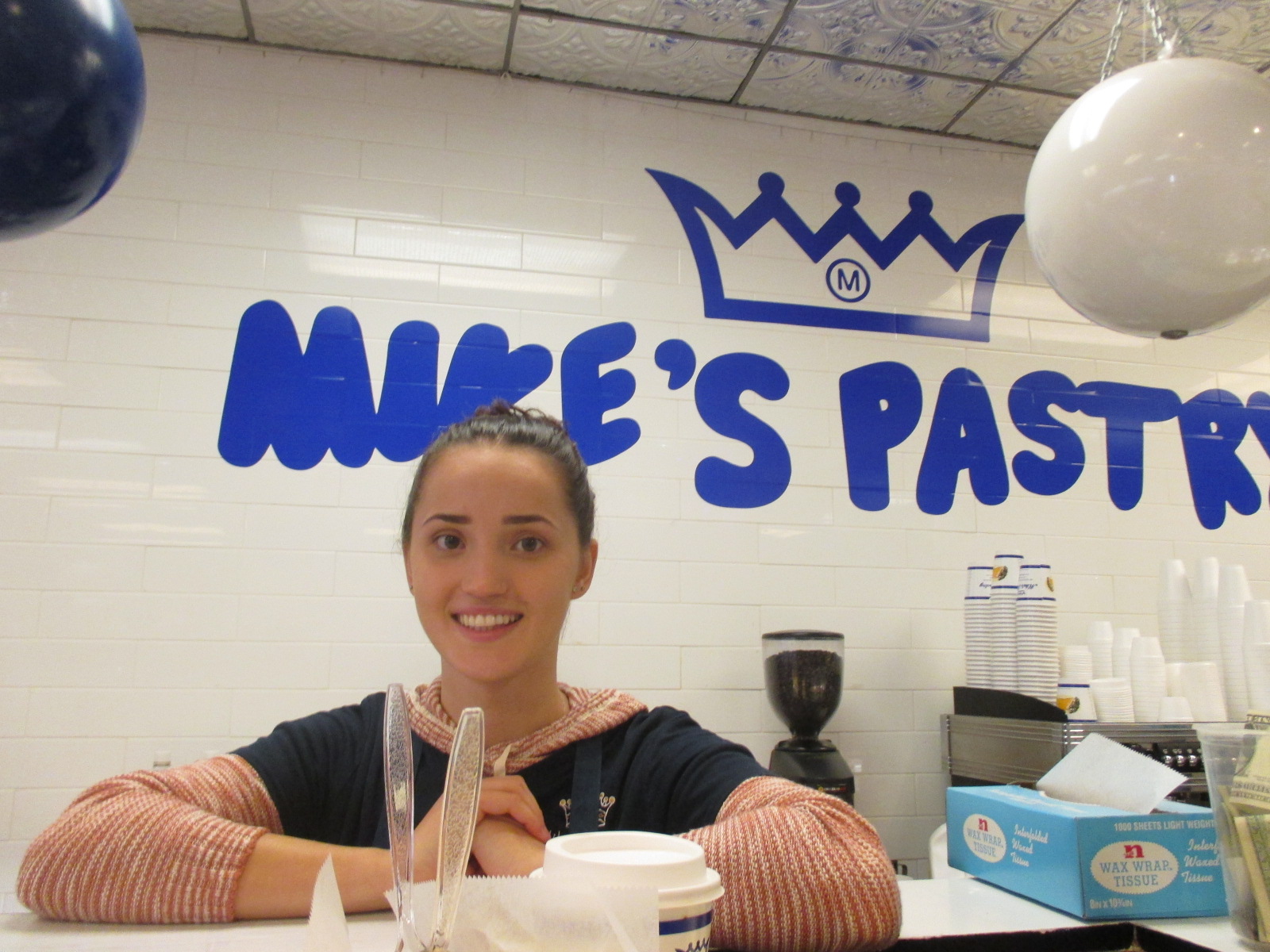
And the grand finale was having dinner in the North End with tiramisu at Mike's Pastries!
Many thanks to the ACEC for such an exceptional conference experience!

Sunday, September 6, 2015

Eager to Start Work on our NSF EAGER Collaborative Research Project

The good news came just as our 4 year National Science Foundation (NSF) project was coming to a close last month. That project: NeTS: Large: Collaborative Research: Network Innovation through Choice, was a great collaboration with the PI, my colleague, Professor Tilman Wolf of the College of Engineering, who is also an Associate Dean, and fellow Co-PIs: Professors Ken Calvert and Jim Griffioen of the Department of Computer Science of the University of Kentucky, and Professors Rudra Dutta and George Rouskas of the Department of Computer Science at North Carolina State University, and Dr. Ilya Baldine of the Renaissance Computing Institute (RENCI) in Chapel Hill, NC.

This project involved the development of ChoiceNet: An Economy Plane for the Internet and, together and individually as well as with our students, we wrote a series of papers, many of which are on the ChoiceNet site. 

The ChoiceNet project was one of five Future Internet Architecture (FIA) projects selected by NSF.

This project helped to support, in part, 3 of my female doctoral students: Sara Saberi, Shivani Shukla, and Dong "Michelle" Li, who I am very happy received her PhD from UMass Amherst with a concentration in Management Science from the Isenberg School in 2015  and is now an Assistant Professor. She's already completed 2 weeks of teaching and is very happy to be an academic.

Our new NSF grant:  EAGER: Collaborative Research: Enabling Economic Policies in Software-Defined Internet Exchange Points has as the PI (Principal Investigator) Professor Tilman Wolf of our ChoiceNet project, and we will continue to work with our University of Kentucky colleagues, Professors Calvert and Griffioen. 


We have completed all of the followup internal processing paperwork on this grant (thanks to all the administrators for signing off so quickly) and the official start date of our project is October 1, 2015. The EAGER program at NSF is for Early Concepts Grants for Exploratory Research  According to the NSF website: the EAGER program  provides a funding mechanism that can be used to support exploratory work in its early stages on untested, but potentially transformative, research ideas or approaches. This work could be considered especially "high risk-high payoff" in the sense that it, involves radically different approaches, applies new expertise, or engages novel disciplinary or interdisciplinary perspectives.

As we did for our NSF FIA ChoiceNet project, we will be having regular (typically, weekly) teleconferences in which we brainstorm and discuss our ideas with focused, intense period of work for research, computing, and writing.

I very much appreciate the confidence that NSF and our program officer have in us and we will do our best to aim for transformative research results. Specifically, we expect that in terms of the broader impacts that the results from this research have the potential for a transformative impact on how inter-domain routing---which is at the core of economic interactions between network providers in the Internet---is implemented and used to provide novel services in networks. The interdisciplinary nature of this work---crossing the boundaries of engineering and economics---presents particular challenges in developing solutions that are technically sound and can be adopted in practice. The work involves an education component. Results from our work will be disseminated in the form of open-source toolsets and publications.

Nice way in which to begin the new academic year!

Monday, August 17, 2015

A Magical Wedding of a Brown University PhD and Colleague

After spending a total of 8 weeks in various countries in Europe and South America conducting research and speaking at multiple conferences it has been nice to be back in Amherst before the new academic year begins.

Academics in the summer keep very busy (I am in the process of finishing up writing a 400 page book) and we continue to work with our students.

Summer is also a time for weddings and "academic" weddings are a lot of fun since they also, very often, serve as reunions.

Yesterday, my husband and I had the pleasure of attending a beautiful wedding of a colleague of his, Dr. Ying Yu,  who received her PhD from Brown University in engineering.  In attendance were also her dissertation advisor from Brown, Professor Harvey Silverman, whom we have known for many years, and his lovely wife, who has 3 Brown degrees (in Math and Computer Science). Professor Silverman  has a PhD from Brown. The bride was Professor Silverman's 22nd PhD student. She did a postdoc in Italy before joining the engineering faculty at the University of Hartford. This year she received her promotion to Associate Professor with tenure!

My husband has 2 graduate degrees from Brown, including his PhD, which is in physics, and I have 4 degrees from Brown, including my PhD in Applied Math with a specialty in Operations Research.

Below are some photos of the wedding, which took place at Saint Clements Castle in Connecticut.

The ceremony was outdoors followed by a reception and a lavish dinner with scrumptious desserts and dancing. The parents of the bride could not make it from China but their letter was read in Chiene and translated. Many colleagues from the University of Hartford, as well as staff, came to the wedding to help Ying celebrate. The wedding party had two female professors, one of engineering, and one of computer science. Needless to say, the conversations over dinner were on high tech topics.

We wish the newlywed couple, Ying and Eric, much happiness!


Below are the Brown University alums.
I attended the wedding of one of my PhD students, Dr. Trisha Woolley Anderson,  a few years ago. It  was a great reunion with other former PhD students in attendance.  I wrote about the experience in the blogpost: I was the Academic Mother of the Bride.