Much has happened since my most recent blogpost on March 7, which celebrated the successful PhD defense of my student, Deniz Besik.
On March 11, 2020, WHO declared a pandemic due to the coronavirus, which causes the respiratory illness now known as COVID-19.
As an operations researcher, who does research on various network systems, including perishable product supply chains, with applications in healthcare - blood supply chains and pharma supply chains, I had already been following a multiplicity of disruptions as the coronavirus was spreading globally.
In addition to the supply chain disruptions, I have also experienced professional ones as have virtually all academics worldwide as well as students.
I am on sabbatical now and was honored and delighted to have been invited to give seminars and plenary talks in multiple countries (Canada, France, Italy, and the USA, with others still on the horizon). These have all been postponed/cancelled causing not only disappointment but many foregone experiences, networking opportunities, and adventures.
But safety and health first, and we must do anything and everything in our power to mitigate the pandemic, and to flatten the curve.
I strongly believe that researchers, if at all possible, and if they have an inclination to do so, should write articles for the popular press. I saw the looming crisis in blood supply chains, having been following events in China and Iran, as closely as possible, because of COVID-19. I collected our relevant articles on blood supply chains (a topic we have been researching for the last decade), and impacts of disruptions, and wrote an Op Ed for The Conversation: How coronavirus is upsetting the blood supply chain https://theconversation.com/how-coronavirus-is-upsetting-the-blood-supply-chain-133424
The article has now been reprinted in numerous publications including: SALON, MarketWatch, NavyTimes, EconTimes, and many others. I have been contacted by individuals who wish to help out. I have reached out to medical professionals that I know at top medical facilities to see if plasma of those who have recovered from COVID-19 may be used as treatment, as has been tried in China, supposedly with some success, and is now being investigated at Johns Hopkins.
The research that we have done on the blood supply chain includes the modeling of the perishability of red blood cells; the investigation of a disruption due to a major disease outbreak, which would result in a decrease in eligible donors, as well as disruptions to capacities of testing and processing, that clearly can happen with personnel being quarantined and/or struck by the coronavirus now. Our papers have also explored competition for blood donors using game theory as well as the design of blood supply chains plus the modeling of multiple tiers and even the competition among blood service organizations. We have also worked on quantifying the potential synergy associated with the merging or teaming of blood service organizations as in the case of a disaster.
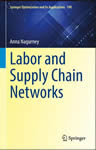
Also, we wrote a book to unify some of the knowledge on perishable product supply chains.
It is important to note that respiratory viruses are not transmitted via blood and all those who have the facility and the capability should donate. Since my article in The Conversation was published, the situation has become even more dire with severe blood shortages being reported by the American Red Cross. Blood, unlike many other products, cannot be manufactured, but must be donated by willing donors. Blood service organizations need to make this process now as comfortable and as easy for donors, as possible, by expanding mobile unit coverage, for example.
*********************************************************************************
An update since the above post was published. Thanks to INFORMS Analytics for publishing my updated article to The Conversation piece in the Coronavirus Chronicles.
And now, as we move further into the pandemic, the possibility of utilizing convalescent plasma in different ways in providing potential therapies, is generating optimism, while, at the same time, there is growing competition among different organizations, and even profit-making ones, for Covid-19 survivors' blood plasma.
Showing posts with label supply chain. Show all posts
Wednesday, March 18, 2020
Monday, July 3, 2017
Fabulous Visit to the Vienna University of Economics and Business
After the fascinating EURO HOpe conference, which took place last Thursday and Friday at the Vienna University of Economics and Business (WU) that I had blogged about, I was looking forward to meeting with WU colleagues today. It was a perfect transition between two conferences, since tomorrow I fly to Kalamata, Greece, where the Dynamics of Disasters conference that I coorganized will be taking place.
Professor Tina Wakolbinger, who was my PhD student at the Isenberg School of Management, and graduated in 2007, organized the EURO HOpe conference, which focused on Humanitarian Operations. Today, I had a chance to meet with her and two Professors: Manfred Fischer and Petra Staufer-Steinnocher. Professor Fischer is renowned in regional science and the recipient of numerous international awards. Professor Staufer-Steinnocher I had the pleasure of meeting when she was one of my hosts during my course at WU.
We began the day with a delicious lunch, which started with a cold borshcht, and I could not resist taking the photo below.
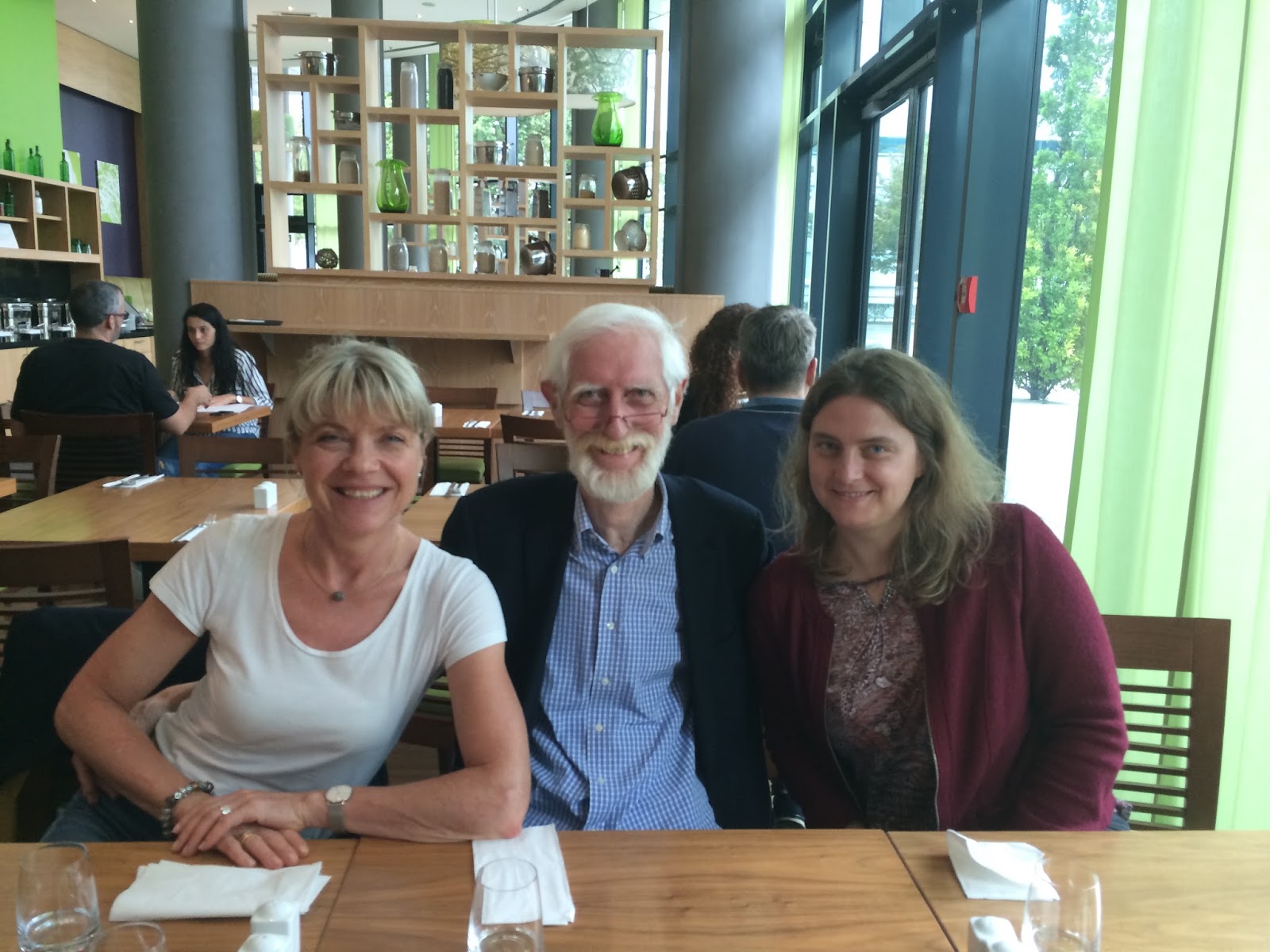
Then we took a group photo after the lunch as a memento.
WU has an amazing new campus. I had visited the previous one and very much enjoyed teaching a course on Humanitarian Logistics there. The new campus has a learning center, which was the venue for the EURO HOpe conference, and which was designed by the award-winning female architect (who died much too young) Zaha Hadid, and is featured below.
My colleagues gave me a personal tour of the campus and several of the buildings.
Professor Tina Wakolbinger is the Head of the Research Institute for Supply Chain Management at WU and has been at WU as a Full Professor since arriving in 2011. After receiving her PhD, she had been an Assistant Professor at the University of Memphis. Tina and I have published a series of papers together on supply chains and, given our many mutual interests, it was terrific to spend the better part of the day discussing research. Several of her doctoral students' research will be presented at our Dynamics of Disasters conference later this week.
I had nominated Tina for the INFORMS Judith Liebman Award, which she received, and it was delightful to see it gracing a shelf in her beautiful corner office.
It is very special to see a former PhD student, whose doctoral dissertation committee I chaired, so successful in academia and enjoying an extraordinary professional career.
Thanks for a fabulous visit to the Vienna University of Economics and Business today! And I bring back with me some souvenirs from the conference, including honey made at WU.
Professor Tina Wakolbinger, who was my PhD student at the Isenberg School of Management, and graduated in 2007, organized the EURO HOpe conference, which focused on Humanitarian Operations. Today, I had a chance to meet with her and two Professors: Manfred Fischer and Petra Staufer-Steinnocher. Professor Fischer is renowned in regional science and the recipient of numerous international awards. Professor Staufer-Steinnocher I had the pleasure of meeting when she was one of my hosts during my course at WU.
We began the day with a delicious lunch, which started with a cold borshcht, and I could not resist taking the photo below.
Then we took a group photo after the lunch as a memento.
WU has an amazing new campus. I had visited the previous one and very much enjoyed teaching a course on Humanitarian Logistics there. The new campus has a learning center, which was the venue for the EURO HOpe conference, and which was designed by the award-winning female architect (who died much too young) Zaha Hadid, and is featured below.
My colleagues gave me a personal tour of the campus and several of the buildings.
Professor Tina Wakolbinger is the Head of the Research Institute for Supply Chain Management at WU and has been at WU as a Full Professor since arriving in 2011. After receiving her PhD, she had been an Assistant Professor at the University of Memphis. Tina and I have published a series of papers together on supply chains and, given our many mutual interests, it was terrific to spend the better part of the day discussing research. Several of her doctoral students' research will be presented at our Dynamics of Disasters conference later this week.
I had nominated Tina for the INFORMS Judith Liebman Award, which she received, and it was delightful to see it gracing a shelf in her beautiful corner office.
It is very special to see a former PhD student, whose doctoral dissertation committee I chaired, so successful in academia and enjoying an extraordinary professional career.
Thanks for a fabulous visit to the Vienna University of Economics and Business today! And I bring back with me some souvenirs from the conference, including honey made at WU.
Sunday, January 22, 2017
Supply Chain Performance Assessment
It has certainly been an exciting start to the new 2017 year!
My collaborators and I were delighted to start off the new year with two journal publications, including that of the paper, Supply Chain Performance Assessment and Supplier and Component Importance Identification in a General Competitive Multitiered Supply Chain Network Model, Dong Li and Anna Nagurney, Journal of Global Optimization 67(1): (2017), pp 223-250.
It is always exciting to get a reprint, as well.
Our paper appears in a special issue of the Journal of Global Optimization edited by Professor Panos M. Pardalos.
What makes this paper unique is that, not only do we construct a multitiered supply chain network equilibrium model with suppliers, but we also provide measures for assessing an individual firm's performance in a supply chain network and also that of the entire supply chain consisting of competing firms and suppliers. In addition, we define importance indicators of suppliers as well as components in the production processes to individual firms as well as to the entire supply chain network.
For those of you who are interested (there are some very informative images therein), the link to a presentation that I prepared on this paper, with additional motivation and results, can be found here.
This paper is already getting cited, which is always gratifying to researchers.
My collaborators and I were delighted to start off the new year with two journal publications, including that of the paper, Supply Chain Performance Assessment and Supplier and Component Importance Identification in a General Competitive Multitiered Supply Chain Network Model, Dong Li and Anna Nagurney, Journal of Global Optimization 67(1): (2017), pp 223-250.
It is always exciting to get a reprint, as well.
Our paper appears in a special issue of the Journal of Global Optimization edited by Professor Panos M. Pardalos.
What makes this paper unique is that, not only do we construct a multitiered supply chain network equilibrium model with suppliers, but we also provide measures for assessing an individual firm's performance in a supply chain network and also that of the entire supply chain consisting of competing firms and suppliers. In addition, we define importance indicators of suppliers as well as components in the production processes to individual firms as well as to the entire supply chain network.
For those of you who are interested (there are some very informative images therein), the link to a presentation that I prepared on this paper, with additional motivation and results, can be found here.
This paper is already getting cited, which is always gratifying to researchers.
Monday, May 30, 2016
First Month as a Visiting Fellow at Oxford University in England
I have now officially been a Visiting Fellow at All Souls College at Oxford University in England for one month (with a sojourn back for 3 days to the US for my daughter's college graduation).
The buildings at All Souls College are magnificent.
Below is a photo of my office door and a photo of the black gown that I wear to dinners at All Souls College. Seeing these upon my arrival made me feel immediately welcome.
The view from my office continues to inspire and I work to the sounds of the fountain in the garden outside of it.
I have been blogging about the experience but thought it made sense to take stock of what the first month has meant to me. Plus, I am often asked at the delicious fellowship meals (lunches and dinners) as to how my work is going and how am I doing. I am researching supply chains while a Visiting Fellow and, specifically, focusing on capturing quality and its preservation/degradation under competition in networks with applications including food. Given the wonderful fellowship here and community, which includes the delicious meals and conversations as well as tea and coffee that follow the topic is quite timely, I must say. I have enjoyed eating fish and chips with economics Fellows and Professor Glenn Loury of my alma mater, Brown University.
I've also enjoyed conversations including with Professor Ted Sider who is a Visiting Fellow with me and a notable UMass Amherst PhD alum (he is a philosopher). Pleasantly, Dr. Su Fang Ng, who is from the University of Oklahoma, and was a Radcliffe Institute for Advanced Study Fellow at Harvard University with me, in 2005-2006, is also a Visiting Fellow now at All Souls College.
The ambience of the tea room, as well as the dining halls, adds to the beauty and uniqueness of this truly special experience.
Since arriving at All Souls College, I have revised a paper on disaster relief, and resubmitted it to a journal, and have accepted an invitation to speak on the topic to the Management Science group at Lancaster University on June 28. I will also be speaking at the Centre for Transport Studies at Imperial College in London on June 9 on perishable product supply chains, which I am very much looking forward to. That evening I will be dining with one of my former doctoral students, and co-author of the Financial Networks book, Dr. Stavros Siokos, who is a very successful financier and a UMass Amherst alum. In July, I will be flying from England to speak at the EURO conference in Poznan, Poland, which should be fantastic and there we will be presenting also our latest cybersecurity research and also work on the Braess paradox and electronic circuits. Yes, applications of operations research are fascinating and widespread!
While at Oxford University, I am delighted that the Dynamics of Disasters volume, that I co-edited with Professors Ilias Kotsireas and Panos M. Pardalos, has been completed with a very nice Introduction. It contains 18 chapters. The volume has been shipped to our publisher, Springer.
I also had a chance to attend the Responsible Business conference at the Said School of Business that I blogged about.
In addition, I have been working on a paper on supply chain quality with application to food supply chains and am looking forward to the publication of the book, "Competing on Supply Chain Quality," co-authored with Dong Li, also to be published by Springer. In it, Oxford University is acknowledged and it is also acknowledged in the Dynamics of Disasters book.
Of course, while at Oxford, I have continued to monitor the progress of my doctoral students in Management Science at the Isenberg School of Management at UMass Amherst and am looking forward to Sara Saberi defending her dissertation later this summer.
The support provided by All Souls College plus the warmth of its staff surrounds us with a positive energy which challenges us to do our best work.
The beauty of the green spaces of Oxford and its various colleges also provide us with time to think as we walk and explore.
I am sure that the next month will bring all sorts of new experiences.
The buildings at All Souls College are magnificent.
Below is a photo of my office door and a photo of the black gown that I wear to dinners at All Souls College. Seeing these upon my arrival made me feel immediately welcome.
The view from my office continues to inspire and I work to the sounds of the fountain in the garden outside of it.
I have been blogging about the experience but thought it made sense to take stock of what the first month has meant to me. Plus, I am often asked at the delicious fellowship meals (lunches and dinners) as to how my work is going and how am I doing. I am researching supply chains while a Visiting Fellow and, specifically, focusing on capturing quality and its preservation/degradation under competition in networks with applications including food. Given the wonderful fellowship here and community, which includes the delicious meals and conversations as well as tea and coffee that follow the topic is quite timely, I must say. I have enjoyed eating fish and chips with economics Fellows and Professor Glenn Loury of my alma mater, Brown University.
I've also enjoyed conversations including with Professor Ted Sider who is a Visiting Fellow with me and a notable UMass Amherst PhD alum (he is a philosopher). Pleasantly, Dr. Su Fang Ng, who is from the University of Oklahoma, and was a Radcliffe Institute for Advanced Study Fellow at Harvard University with me, in 2005-2006, is also a Visiting Fellow now at All Souls College.
The ambience of the tea room, as well as the dining halls, adds to the beauty and uniqueness of this truly special experience.
Since arriving at All Souls College, I have revised a paper on disaster relief, and resubmitted it to a journal, and have accepted an invitation to speak on the topic to the Management Science group at Lancaster University on June 28. I will also be speaking at the Centre for Transport Studies at Imperial College in London on June 9 on perishable product supply chains, which I am very much looking forward to. That evening I will be dining with one of my former doctoral students, and co-author of the Financial Networks book, Dr. Stavros Siokos, who is a very successful financier and a UMass Amherst alum. In July, I will be flying from England to speak at the EURO conference in Poznan, Poland, which should be fantastic and there we will be presenting also our latest cybersecurity research and also work on the Braess paradox and electronic circuits. Yes, applications of operations research are fascinating and widespread!
While at Oxford University, I am delighted that the Dynamics of Disasters volume, that I co-edited with Professors Ilias Kotsireas and Panos M. Pardalos, has been completed with a very nice Introduction. It contains 18 chapters. The volume has been shipped to our publisher, Springer.
I also had a chance to attend the Responsible Business conference at the Said School of Business that I blogged about.
In addition, I have been working on a paper on supply chain quality with application to food supply chains and am looking forward to the publication of the book, "Competing on Supply Chain Quality," co-authored with Dong Li, also to be published by Springer. In it, Oxford University is acknowledged and it is also acknowledged in the Dynamics of Disasters book.
Of course, while at Oxford, I have continued to monitor the progress of my doctoral students in Management Science at the Isenberg School of Management at UMass Amherst and am looking forward to Sara Saberi defending her dissertation later this summer.
The support provided by All Souls College plus the warmth of its staff surrounds us with a positive energy which challenges us to do our best work.
The beauty of the green spaces of Oxford and its various colleges also provide us with time to think as we walk and explore.
I am sure that the next month will bring all sorts of new experiences.
Tuesday, October 6, 2015
From Supply Chain Optimization Summit in Seattle to ACEC in Boston to Big Book Launch in Chicago - What an October!
The new academic year is in full swing and it is a very special time of the year in New England with the fall foliage in its full splendor.
This month of October is jam-packed with so many exciting events that I am taking part in and am very much looking forward to.
Tomorrow (I turned down a trip to France), I will be teleconferencing in for a habilitation defense in France. I am on the candidate's habilitation committee, which required the reading of a professional dissertation, his book, and several papers of his. A habilitation is even higher than a PhD and several countries expect this achievement before one can supervise doctoral students and proceed higher on the academic ladder.
Thursday, the Isenberg School is hosting Marc Schneider, the CEO of the fashion house Kenneth Cole Productions. Marc is an Isenberg School alum and will be speaking to my Logistics and Transportation class. On Friday, my Operations and Management Department will be having its Advisory Board meeting and speed mentoring event. That afternoon I will also be taking part in a networking event organized by the Computational Social Science Institute (CSSI) at UMass Amherst that I am an affiliate of.
This weekend, I will be flying to Seattle, as an invited faculty participant of the First Amazon Supply Chain Optimization Summit. There will be about 30 faculty taking part in this 2-day summit from across the globe and we are even getting a tour of the fulfillment center, complete with Kiva robots. The list of invited participants contains many well-known INFORMS members so it will be a nice small-scale reunion before our INFORMS conference in Philly at the end of the month.
Upon my return, I will teach my Logistics and Transportation class and then will be heading to Boston for the American Council of Engineering Companies (ACEC) conference. I am an invited speaker and will give the presentation, "The Application of Supernetworks to Critical Infrastructure from Transportation to Electric Power." This conference overlaps, in part, with the Head of the Charles regatta, for all the rowing fans out there! Since my college room-mate at Brown University was on the women's crew team and now my daughter is President of her college crew and also the cox for two men's boats, I will have to check out the regatta. (And there is a chance that my daughter may be coxing an alum boat from her college).
The following week, I am flying to Chicago, where I have the great pleasure and honor of being one of three panelists at the big book launch of the Boyce and Williams book, which is a scholarly masterpiece: "Forecasting Urban Travel," published by Edward Elgar. This will be a truly celebratory event.
And the week afterwards, colleagues, students, and I will be off to the INFORMS conference in Philadelphia.
Never a dull moment or day in academia!
This month of October is jam-packed with so many exciting events that I am taking part in and am very much looking forward to.
Tomorrow (I turned down a trip to France), I will be teleconferencing in for a habilitation defense in France. I am on the candidate's habilitation committee, which required the reading of a professional dissertation, his book, and several papers of his. A habilitation is even higher than a PhD and several countries expect this achievement before one can supervise doctoral students and proceed higher on the academic ladder.
Thursday, the Isenberg School is hosting Marc Schneider, the CEO of the fashion house Kenneth Cole Productions. Marc is an Isenberg School alum and will be speaking to my Logistics and Transportation class. On Friday, my Operations and Management Department will be having its Advisory Board meeting and speed mentoring event. That afternoon I will also be taking part in a networking event organized by the Computational Social Science Institute (CSSI) at UMass Amherst that I am an affiliate of.
This weekend, I will be flying to Seattle, as an invited faculty participant of the First Amazon Supply Chain Optimization Summit. There will be about 30 faculty taking part in this 2-day summit from across the globe and we are even getting a tour of the fulfillment center, complete with Kiva robots. The list of invited participants contains many well-known INFORMS members so it will be a nice small-scale reunion before our INFORMS conference in Philly at the end of the month.
Upon my return, I will teach my Logistics and Transportation class and then will be heading to Boston for the American Council of Engineering Companies (ACEC) conference. I am an invited speaker and will give the presentation, "The Application of Supernetworks to Critical Infrastructure from Transportation to Electric Power." This conference overlaps, in part, with the Head of the Charles regatta, for all the rowing fans out there! Since my college room-mate at Brown University was on the women's crew team and now my daughter is President of her college crew and also the cox for two men's boats, I will have to check out the regatta. (And there is a chance that my daughter may be coxing an alum boat from her college).
The following week, I am flying to Chicago, where I have the great pleasure and honor of being one of three panelists at the big book launch of the Boyce and Williams book, which is a scholarly masterpiece: "Forecasting Urban Travel," published by Edward Elgar. This will be a truly celebratory event.
And the week afterwards, colleagues, students, and I will be off to the INFORMS conference in Philadelphia.
Never a dull moment or day in academia!
Wednesday, March 25, 2015
Mr. Jeff Meyer, CEO of Red Cross Blood Services for MA and CT at the Isenberg School
Bringing expert speakers to share their practical know-how and experiences is fabulous for students' education!
Today we had the honor and privilege of hosting Mr. Jeff Meyer, CEO of Blood Services for the Red Cross for MA and CT, in my Humanitarian Logistics and Healthcare class at the Isenberg School of Management.
He was fabulous. First some background: Jeff received his undergrad degree at Babson and his MBA from UCLA's Anderson School of Management, where he focused on (bravo) operations management. How can you not love a speaker who comes in and starts talking about linear programming models and how in many of the team projects at UCLA students wanted to work on Red Cross projects because of the challenging problems.
Mr. Meyer drove almost 2 hours from Dedham to speak to my class and we kept him overtime for about 40 minutes because his knowledge of blood supply chains is vast. He has worked for the Red Cross for 16 years and, would you believe, he was a consultant for the Red Cross and was offered a job with this organization the day before 9/11. He accepted the job since after the terrorist attacks (and he was in DC and could not get back home for a week) since he decided he wanted to help humanity.
He had worked in California for Red Cross blood services and was responsible for managing the construction of a $41 million facility for blood services in southern CA.
Mr. Meyer had the class (and me) on the edges of our seats informing us of how the demand for blood in the U.S. has declined since 2008. He spoke of negative drivers and positive drivers and the consolidation of blood centers. The Red Cross now supplies about 40% of the blood in the US and has closed 3 of its 5 testing centers. He spoke about that there are "wet" surgeons and "dry" surgeons, with the former liking more transfusions whereas the latter utilizing fewer in their surgeries. He stated that in studies, more transfusions do not yield better outcomes.
He showed us a map of the US marking where there was Red Cross coverage and presence and as Mr. Lou Wigdor, our Isenberg School writer and editor noted, the white parts corresponded to the oil states!
I was very impressed that he multiple times spoke about the importance of network optimization, since this is what we have been learning in the class for the past 2 weeks.
He also emphasized how efficiencies can be gained from having a bigger collection site (fewer vehicles needed and there is greater potential for good service and more spread out and comfortable service as donors arrive). He noted that, although some perceive blood as being a commodity, it is not and there are many differentiated "products" that it provides.
The challenges of this supply chain are immense because of the perishability - with red blood cells having a shelf life of 42 days and platelets only 5 days. Platelets are needed to treat cancer patients and the demand for platelets is growing because of the aging population.
From 2008 and prior there were many cases of blood shortages in the U.S. but the scenario has changed due, for example, to the recession and fewer elective surgeries, more individual blood banking, and medical advances that result in less loss of blood.
He even described a Red Cross blood app which has been very successful - 80% of those who elect to give blood through the app show up for appointments whereas among those who call for an appointment only 50% do. Clearly, there are also challenges with supply meeting demand and risk associated with donors not showing up.
Interestingly, he also shared with us that different hospitals may have different preferences even as to the kinds of testing that is done on the blood which can cost $200 per pint.
Out of $3billion in annual costs of the Red Cross, $2billion of that is for blood services.
I had done research on blood supply chains with my former doctoral students, Amir H. Masoumi and Min Yu:
I'd like to thank him for sharing with the class such illuminating insights about this life-saving supply chain, for which logistics plays a fundamental role.
Today we had the honor and privilege of hosting Mr. Jeff Meyer, CEO of Blood Services for the Red Cross for MA and CT, in my Humanitarian Logistics and Healthcare class at the Isenberg School of Management.
He was fabulous. First some background: Jeff received his undergrad degree at Babson and his MBA from UCLA's Anderson School of Management, where he focused on (bravo) operations management. How can you not love a speaker who comes in and starts talking about linear programming models and how in many of the team projects at UCLA students wanted to work on Red Cross projects because of the challenging problems.
Mr. Meyer drove almost 2 hours from Dedham to speak to my class and we kept him overtime for about 40 minutes because his knowledge of blood supply chains is vast. He has worked for the Red Cross for 16 years and, would you believe, he was a consultant for the Red Cross and was offered a job with this organization the day before 9/11. He accepted the job since after the terrorist attacks (and he was in DC and could not get back home for a week) since he decided he wanted to help humanity.
He had worked in California for Red Cross blood services and was responsible for managing the construction of a $41 million facility for blood services in southern CA.
Mr. Meyer had the class (and me) on the edges of our seats informing us of how the demand for blood in the U.S. has declined since 2008. He spoke of negative drivers and positive drivers and the consolidation of blood centers. The Red Cross now supplies about 40% of the blood in the US and has closed 3 of its 5 testing centers. He spoke about that there are "wet" surgeons and "dry" surgeons, with the former liking more transfusions whereas the latter utilizing fewer in their surgeries. He stated that in studies, more transfusions do not yield better outcomes.
He showed us a map of the US marking where there was Red Cross coverage and presence and as Mr. Lou Wigdor, our Isenberg School writer and editor noted, the white parts corresponded to the oil states!
I was very impressed that he multiple times spoke about the importance of network optimization, since this is what we have been learning in the class for the past 2 weeks.
He also emphasized how efficiencies can be gained from having a bigger collection site (fewer vehicles needed and there is greater potential for good service and more spread out and comfortable service as donors arrive). He noted that, although some perceive blood as being a commodity, it is not and there are many differentiated "products" that it provides.
The challenges of this supply chain are immense because of the perishability - with red blood cells having a shelf life of 42 days and platelets only 5 days. Platelets are needed to treat cancer patients and the demand for platelets is growing because of the aging population.
From 2008 and prior there were many cases of blood shortages in the U.S. but the scenario has changed due, for example, to the recession and fewer elective surgeries, more individual blood banking, and medical advances that result in less loss of blood.
He even described a Red Cross blood app which has been very successful - 80% of those who elect to give blood through the app show up for appointments whereas among those who call for an appointment only 50% do. Clearly, there are also challenges with supply meeting demand and risk associated with donors not showing up.
Interestingly, he also shared with us that different hospitals may have different preferences even as to the kinds of testing that is done on the blood which can cost $200 per pint.
Out of $3billion in annual costs of the Red Cross, $2billion of that is for blood services.
I had done research on blood supply chains with my former doctoral students, Amir H. Masoumi and Min Yu:
- Supply Chain Network Operations Management of a Blood Banking System with Cost and Risk Minimization, Anna Nagurney, Amir H. Masoumi, and Min Yu, Computational Management Science 9(2) (2012) pp 205-231,
- Supply Chain Network Design of a Sustainable Blood Banking System
Anna Nagurney and Amir H. Masoumi, in Sustainable Supply Chains: Models, Methods and Public Policy Implications, T. Boone, V. Jayaraman, and R. Ganeshan, Editors, Springer, London, England (2012) pp 49-72.
I'd like to thank him for sharing with the class such illuminating insights about this life-saving supply chain, for which logistics plays a fundamental role.
Friday, March 20, 2015
Photos from the Great DPG Conference in Berlin
I made it back from the DPG Conference in Berlin, Germany late last night via Heathrow to Boston Logan. The flights on British Airways were terrific as was the service and the dinner of chicken curry with chocolate mousse for dessert.
I blogged several times about this great conference which had an attendance of 6,000 and I especially enjoyed the sessions organized by the Physics of Socio-Economic Systems group.
Below I have posted some photos of the speakers and the ambience as well as some sights nearby that I thoroughly enjoyed.
I'd like to thank the organizers for inviting me to speak - I have a fabulous time professionally, culturally, and socially - hard to top.
Auf wieder sehen und danke schon!
I blogged several times about this great conference which had an attendance of 6,000 and I especially enjoyed the sessions organized by the Physics of Socio-Economic Systems group.
Below I have posted some photos of the speakers and the ambience as well as some sights nearby that I thoroughly enjoyed.
I'd like to thank the organizers for inviting me to speak - I have a fabulous time professionally, culturally, and socially - hard to top.
The Science
The History and CultureAuf wieder sehen und danke schon!
Wednesday, November 5, 2014
Supply Chain Network Quality, Sustainability, and Risk
The supernetwork team is very much looking forward to the 2014 INFORMS Annual Conference in San Francisco, which begins this coming Sunday!
I organized a session in the Network Optimization cluster: Supply Chain Network Competition: Advances in Models, Methods, and Applications, which will take place next Monday afternoon.
The session will feature talks on supply chain quality, sustainability, as well as risk associated with supplier selection (using supernetworks, of course)!
Three of the presentations have been completed and I include links to them below.
Link to presentation on quality.
Link to first presentation on sustainability.
Link to second presentation on sustainability.
The final presentation in my session will be given by Professor June Dong (who was my first female PhD student at the Isenberg School of Management) and her collaborator, June Ma, who was a visitor at SUNY Oswego, where Professor Dong is a Full Professor, and who is with the Shengyang University of Science and Technology in China. Their talk is titled: "Supply Chan Supernetwork Model with Suppliers Risk Diversification."
Additional publication information on the first and third presentations above can be found below.
Equilibria and Dynamics of Supply Chain Network Competition with Information Asymmetry in Quality and Minimum Quality Standards, Anna Nagurney and Dong Li, Computational Management Science 11(3): (2014) pp 285-315.
Supply Chain Network Sustainability Under Competition and Frequencies of Activities from Production to Distribution, Anna Nagurney, Min Yu, and Jonas Floden, Computational Management Science 10(4): (2013) pp 397-422.
Professor Patrick Qiang's presentation is based on his paper, which is in press in the Journal of Cleaner Production.
I organized a session in the Network Optimization cluster: Supply Chain Network Competition: Advances in Models, Methods, and Applications, which will take place next Monday afternoon.
The session will feature talks on supply chain quality, sustainability, as well as risk associated with supplier selection (using supernetworks, of course)!
Three of the presentations have been completed and I include links to them below.
Link to presentation on quality.
Link to first presentation on sustainability.
Link to second presentation on sustainability.
The final presentation in my session will be given by Professor June Dong (who was my first female PhD student at the Isenberg School of Management) and her collaborator, June Ma, who was a visitor at SUNY Oswego, where Professor Dong is a Full Professor, and who is with the Shengyang University of Science and Technology in China. Their talk is titled: "Supply Chan Supernetwork Model with Suppliers Risk Diversification."
Additional publication information on the first and third presentations above can be found below.
Equilibria and Dynamics of Supply Chain Network Competition with Information Asymmetry in Quality and Minimum Quality Standards, Anna Nagurney and Dong Li, Computational Management Science 11(3): (2014) pp 285-315.
Supply Chain Network Sustainability Under Competition and Frequencies of Activities from Production to Distribution, Anna Nagurney, Min Yu, and Jonas Floden, Computational Management Science 10(4): (2013) pp 397-422.
Professor Patrick Qiang's presentation is based on his paper, which is in press in the Journal of Cleaner Production.
Tuesday, June 10, 2014
Blood Supply Chains and Great Journalists
My suitcase is packed and I am pumped for two conferences in Italy and in Greece at which I will be presenting research with collaborators on supply chain networks in time-sensitive markets.
But before I leave for the airport, I wanted to comment on what an amazing week this has been.
Early last week, I had the privilege of being contacted by a journalist, Paul Sisson, of UT-San Diego. Sisson focuses on healthcare topics. He was writing an article for his newspaper for the Sunday Business Section on a supply chain we should all very much care about - the blood supply chain. He was wondering, since my group at the Supernetwork Center at the Isenberg School had done quite a lot of research and writing on this topic (and even teaching about it), whether I would be willing to answer some questions.
Although I am now spending a few weeks in Sweden as a Visiting Professor, since effective healthcare supply chains, including the truly unique blood one, are passions of mine (and it was clear that Sisson feels the same way), I had to say, "yes!"
His questions were so interesting, insightful, and thoughtful, I enjoyed the process of addressing them very much.
Paul Sisson's article, "A Vital Supply Chain," is online on the newspaper website.
A pdf version is available here.
Communicating research to a journalist who is very interested in the subject is very gratifying and it also helps one to further flesh out the important aspects of the research findings and their relevance. I very much respect the important work that journalists do in keeping us informed and educated! A hearty thank you!
Journalists, working with academics, can even help to move research and education forward through appropriate and probing queries!
Although, of course, only some highlights of an interview, even even an extensive one, may actually be published in a newspaper article, the exchange stays with one. This kind of recognition is also further support of the research that we do with collaborators and with our students.
I highlight some fascinating factoids below about blood supply chains.
Think about this - The supply of human blood depends completely on volunteerism since human blood, unlike numerous products, cannot be manufactured. The producers of this critical needs product are humans themselves and they have to be altruistic in their donations, effectively giving a part of themselves to others. The great majority of blood collection facilities in the US are managed by the Red Cross (about 45%) or by the network of US Blood Centers (about 50%) and these are nonprofit organizations. Other suppliers of blood are certain hospitals, usually, larger ones. The collection facilities themselves can be either mobile or fixed. According to the American Red Cross, over 39,000 donations are needed everyday and there have been times when the supply was just 2 days short of running out.
Given that the production and, hence, supply of blood is based, primarily, to-date, on volunteers, there is uncertainty on the supply side as well as risk - will donors show up? Both great and bad weather days may result in insufficient donations. Donors may go to the beach in the case of the former and may be stuck due to a snowstorm in the case of the latter. There is also uncertainty on the demand side since although some medical procedures are pre-scheduled and for such procedures demand for blood products can be more easily forecast, there are also unforeseeable emergencies that do take place (disasters, accidents, etc.). Hence, balancing supply and demand is a matter of life and death in this supply chain. Of 1,700 hospitals taking part in a survey in 2007, a total of 492 reported cancellations of elective surgeries on one or more days due to blood shortages. Also, there are no economies of scale in "production" in this supply chain since many of the volunteers (can) donate only 1 pint at a time and do so, typically, in the case of repeat donors, only twice a year.
This blood supply chain is, in effect, a reverse supply chain. Most products - think of cars and high tech products - are assembled by putting distinct parts/components together to make the final product. Whole blood, when extracted, on the other hand, is disassembled into such components as Red Blood Cells (RBCs) and plasma with platelets extracted through a process known as asphoresis. Interestingly, thus, blood supply chains have commonality with reverse supply chains as in the electronic recycling of such products as computers and cell phones (where extraction of certain elements can be a treasure trove). (We have done research on these supply chains as well.)
Blood is highly perishable with the shelf life of RBCs ranging from 35 days - 42 days, that of platelets 5 days, whereas plasma can be frozen for up to 1 year. Therefor, there are immense time pressures on this product; at the same time, blood must undergo numerous steps of testing, processing, storage, and distribution to the points of demand such as hospitals and other healthcare facilities.
For those of you who are interested in reading more about our research on blood supply chains, which was inspired by one of my former doctoral student's (Amir H. Masoumi's) great interest in the subject, I have highlighted papers with links below.
Supply Chain Network Operations Management of a Blood Banking System with Cost and Risk Minimization, Anna Nagurney, Amir H. Masoumi, and Min Yu, Computational Management Science 9(2): (2012) pp 205-231.
Supply Chain Network Design of a Sustainable Blood Banking System, Anna Nagurney and Amir H. Masoumi, in Sustainable Supply Chains: Models, Methods and Public Policy Implications, T. Boone, V. Jayaraman, and R. Ganeshan, Editors, Springer, London, England (2012) pp 49-72.
Also, our latest book, Networks Against Time: Supply Chains for Perishable Products, co-authored with Professor Min Yu of the University of Portland, Professor Amir H. Masoumi of Manhattan College, and Professor Ladimer S. Nagurney of the University of Hartford, provides a synthesis of some of the other fascinating supply chains, along with blood supply chains, that we have worked on that deal with perishable and time-sensitive products.
Both Dr. Min Yu and Dr. Amir H. Masoumi received their PhDs from the Isenberg School of Management at UMass Amherst and their concentrations were in Management Science.
But before I leave for the airport, I wanted to comment on what an amazing week this has been.
Early last week, I had the privilege of being contacted by a journalist, Paul Sisson, of UT-San Diego. Sisson focuses on healthcare topics. He was writing an article for his newspaper for the Sunday Business Section on a supply chain we should all very much care about - the blood supply chain. He was wondering, since my group at the Supernetwork Center at the Isenberg School had done quite a lot of research and writing on this topic (and even teaching about it), whether I would be willing to answer some questions.
Although I am now spending a few weeks in Sweden as a Visiting Professor, since effective healthcare supply chains, including the truly unique blood one, are passions of mine (and it was clear that Sisson feels the same way), I had to say, "yes!"
His questions were so interesting, insightful, and thoughtful, I enjoyed the process of addressing them very much.
Paul Sisson's article, "A Vital Supply Chain," is online on the newspaper website.
A pdf version is available here.
Communicating research to a journalist who is very interested in the subject is very gratifying and it also helps one to further flesh out the important aspects of the research findings and their relevance. I very much respect the important work that journalists do in keeping us informed and educated! A hearty thank you!
Journalists, working with academics, can even help to move research and education forward through appropriate and probing queries!
Although, of course, only some highlights of an interview, even even an extensive one, may actually be published in a newspaper article, the exchange stays with one. This kind of recognition is also further support of the research that we do with collaborators and with our students.
I highlight some fascinating factoids below about blood supply chains.
Think about this - The supply of human blood depends completely on volunteerism since human blood, unlike numerous products, cannot be manufactured. The producers of this critical needs product are humans themselves and they have to be altruistic in their donations, effectively giving a part of themselves to others. The great majority of blood collection facilities in the US are managed by the Red Cross (about 45%) or by the network of US Blood Centers (about 50%) and these are nonprofit organizations. Other suppliers of blood are certain hospitals, usually, larger ones. The collection facilities themselves can be either mobile or fixed. According to the American Red Cross, over 39,000 donations are needed everyday and there have been times when the supply was just 2 days short of running out.
Given that the production and, hence, supply of blood is based, primarily, to-date, on volunteers, there is uncertainty on the supply side as well as risk - will donors show up? Both great and bad weather days may result in insufficient donations. Donors may go to the beach in the case of the former and may be stuck due to a snowstorm in the case of the latter. There is also uncertainty on the demand side since although some medical procedures are pre-scheduled and for such procedures demand for blood products can be more easily forecast, there are also unforeseeable emergencies that do take place (disasters, accidents, etc.). Hence, balancing supply and demand is a matter of life and death in this supply chain. Of 1,700 hospitals taking part in a survey in 2007, a total of 492 reported cancellations of elective surgeries on one or more days due to blood shortages. Also, there are no economies of scale in "production" in this supply chain since many of the volunteers (can) donate only 1 pint at a time and do so, typically, in the case of repeat donors, only twice a year.
This blood supply chain is, in effect, a reverse supply chain. Most products - think of cars and high tech products - are assembled by putting distinct parts/components together to make the final product. Whole blood, when extracted, on the other hand, is disassembled into such components as Red Blood Cells (RBCs) and plasma with platelets extracted through a process known as asphoresis. Interestingly, thus, blood supply chains have commonality with reverse supply chains as in the electronic recycling of such products as computers and cell phones (where extraction of certain elements can be a treasure trove). (We have done research on these supply chains as well.)
Blood is highly perishable with the shelf life of RBCs ranging from 35 days - 42 days, that of platelets 5 days, whereas plasma can be frozen for up to 1 year. Therefor, there are immense time pressures on this product; at the same time, blood must undergo numerous steps of testing, processing, storage, and distribution to the points of demand such as hospitals and other healthcare facilities.
For those of you who are interested in reading more about our research on blood supply chains, which was inspired by one of my former doctoral student's (Amir H. Masoumi's) great interest in the subject, I have highlighted papers with links below.
Supply Chain Network Operations Management of a Blood Banking System with Cost and Risk Minimization, Anna Nagurney, Amir H. Masoumi, and Min Yu, Computational Management Science 9(2): (2012) pp 205-231.
Supply Chain Network Design of a Sustainable Blood Banking System, Anna Nagurney and Amir H. Masoumi, in Sustainable Supply Chains: Models, Methods and Public Policy Implications, T. Boone, V. Jayaraman, and R. Ganeshan, Editors, Springer, London, England (2012) pp 49-72.
Also, our latest book, Networks Against Time: Supply Chains for Perishable Products, co-authored with Professor Min Yu of the University of Portland, Professor Amir H. Masoumi of Manhattan College, and Professor Ladimer S. Nagurney of the University of Hartford, provides a synthesis of some of the other fascinating supply chains, along with blood supply chains, that we have worked on that deal with perishable and time-sensitive products.
Both Dr. Min Yu and Dr. Amir H. Masoumi received their PhDs from the Isenberg School of Management at UMass Amherst and their concentrations were in Management Science.
Subscribe to:
Posts (Atom)