Showing posts with label science. Show all posts

Sunday, March 12, 2023

We Celebrated the Distinguished Career of Panos Pardalos at the PanOptiC Conference on Global Optimization at the University of Florida

On March 9 and 10, 2023, the PanOptiC Conference on Global Optimization took place at the University of Florida Gainesville. The conference was organized to celebrate the distinguished career of Professor Panos M. Pardalos.


The conference was excellent and brought speakers together from many countries. The full program can be downloaded here.

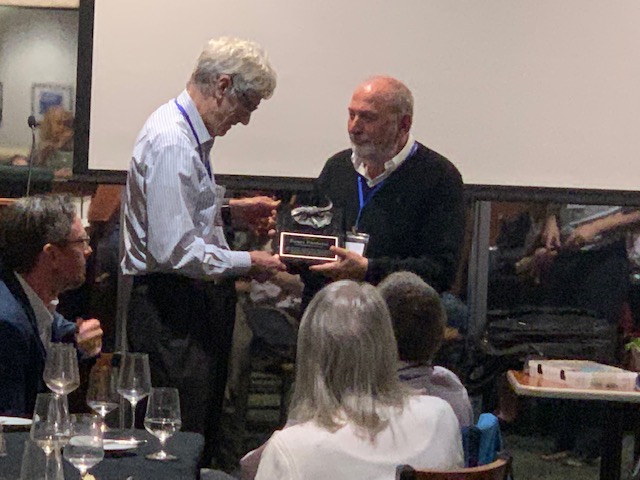
Panos (if I may) has chaired the PhD dissertations of 71 students, which is an incredible accomplishment and has an h-index of 105! His nurturing of students, colleagues, both junior and senior, and his warmth and entrepreneurial spirit in the founding of journals and book series are truly laudable. He has co-directed the Center for Applied Optimization at the U. of Florida for many years and Bill Hager presented him with an award at the banquet this past Thursday,  along with a testimonial. Many of his former PhD students and friends were in attendance. Panos also spoke as did his former PhD students Vladimir Boginskii and Clayton Commander (who has both a PhD and an MD).

It was exciting to have John Birge and Nick Sahinidis (both members of the National Academy of Engineering) give the keynote talks.


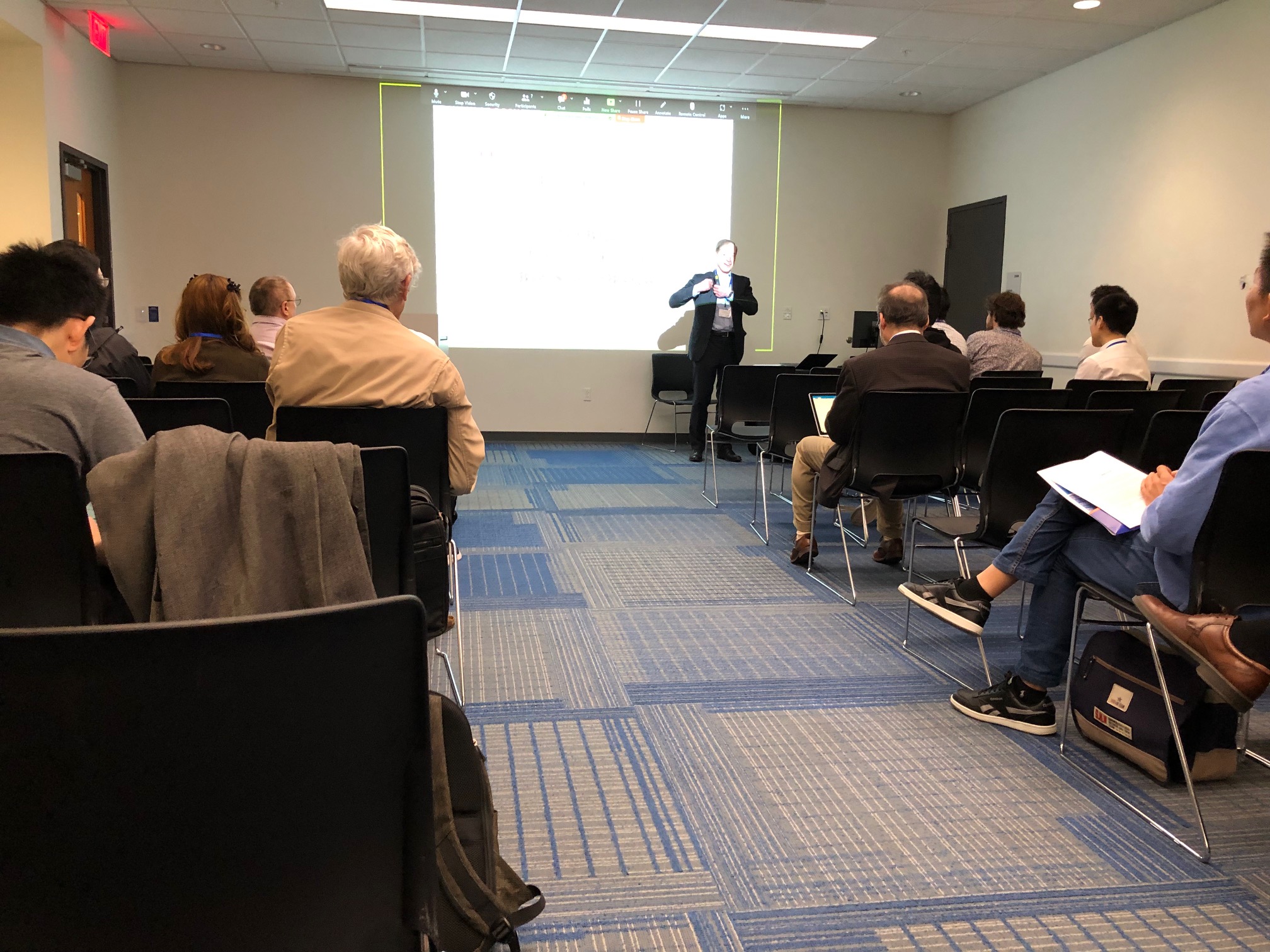
It was extra exciting for me to be at this conference since my PhD student Dana Hassani and I were presenting our work with colleagues at the Kyiv School of Economics (KSE) - Oleg Nivievskyi and Pavlo Martyshev through the partnership that UMass Amherst established with KSE.


In our presentation, I had included two collages of events with Pardalos from Greece to Bellagio in Italy as examples with many colleagues and even students in the images.


It was great to see the display of books by Springer at the conference. The display included my new Labor and Supply Chain Networks book as well as the latest Dynamics of Disasters book that I co-edited with Ilias Kotsireas, Panos Pardalos, and Arsenios Tsokas. It was wonderful to see our Editor Elizabeth Loew of Springer!


I leave you with some additional photos of wonderful colleagues including Dionne Aleman from the University of Toronto and Sandra Eksioglu from the University of Arkansas!


And, since Florida is know for its gators, I include some images of the campus.


We are lucky to have such an amazing scientific scholar and human being in our discipline. Thank you, Professor Panos M. Pardalos!

Tuesday, November 14, 2017

Becoming an Operations Research Newsmaker Through the Media

A few years ago, at the INFORMS Charlotte conference, there was a terrific (I am a bit biased, I admit) panel entitled: Becoming an O.R./Analytics Newsmaker, that I even wrote a blogpost on because I thought the tips on dealing with the media were definitely worth preserving and sharing,

Joining me, as panelists, were: Jack Levis of UPS, Dr. Margaret Brandeau of Stanford, and Dr. Sheldon Jacobson of the University of Illinois. The panelists have had experience with major news outlets, including the Associate Press, radio shows, TV programs, and documentaries. Barry List, the Communications Director of INFORMS at that time, had organized the panel and Peter Horner, the Editor of OR/MS Today, was also present. The panelists are all (now) INFORMS Fellows.

What I have learned, in addition, since that panel, based on experiences that I have had is:

1.  You never know when you might be contacted by the media, so always be prepared. It might be for a story that a journalist needs to finish with a tight deadline. When I was at Oxford University as a Visiting Fellow, for example, and in London to give a talk at Imperial College in June 2016, I received a message late at night from a journalist in Canada, who had heard of the talk on cybersecurity that I had given at the University of Waterloo and wanted my impressions on ransomware. We had a phone conversation and his article was published before midnight.

2. Sometimes you may have to wait weeks for an interview, as I recently experienced. First, I was asked if I was available to be interviewed on disaster management at 11:30PM on the same night that I was flying back from our INFORMS conference in Houston (October 25, 2017) so I, graciously, declined. There were some negotiations for another time and, this past Wednesday, I had the pleasure of being interviewed by Terry Gilberg, who is the host and Executive Producer of the radio show Think!America. That interview aired this past weekend and it is 22 minutes into last Saturday's show, which can be accessed here. She was intrigued by the article I had written in The Conversation: Response to natural disasters like Harvey could be helped with game theory and wanted me on her show.  I enjoyed the interview a lot and she even followed up with a nice phone call to my Isenberg School office!

In late August I was interviewed by Angela Kokott for her radio show in Calgary, Canada, also on my research with collaborators on disaster relief and game theory.

3. In many cases (such as 2 above) one may not get questions ahead of time so you have to be creative and anticipate the kinds of questions that you might be asked. Always be ready with one or two strong takeaway messages!  In contrast, last July, while I was a Summer Fellow at the Radcliffe Institute for Advanced Study at Harvard University, I was interviewed for the Matt Townsend Radio Show on Infrastructure Spending. One of the producers had sent me sample questions ahead of time and I was really pumped. The script was not very closely followed, but it did provide a framework. Townsend, as Gilberg and Kokott, are fabulous interviewers - very dynamic and provocative and I enjoyed these interviews tremendously.

4. And last winter, after my article: Uncertainty in blood supply chains creating challenges for the industry was published, I was contacted by our local NPR radio station for a segment: America's Blood Economy. My interviewer was Karen Brown and you get read the interview transcript here. 
For this interview, I had to show up in the recording studio, which was on caampus and very convenient.

5. A few years earlier, after  speaking on a panel at the AAAS meeting in Washington DC, I was contacted by a journalist in Italy and ended up talking about the Braess paradox on Italian radio! 

You can see from the above examples (and I have more, including experiences on TV shows and documentaries that I have been part of), that if you share your Operations Research in print outlets or even give good talks, news can be picked up by media outlets. So, do keep that great research going and try to disseminate it further since that is how you can broaden the impact.

Your university might also be able to help or sometimes even the publisher of the journal in which your exciting research has appeared but, honestly, it is also up to you. And, it can be very rewarding, fun, and also a great way in which to grow professionally.

Thursday, April 20, 2017

STEMing the Tide: Brilliant Lecture On How Female Experts and Peers Act as "Social Vaccines" to Protect Young Women's Self-Concept in STEM

Yesterday, I had the distinct pleasure of attending a Distinguished Faculty Lecture at UMass Amherst given by the experimental social psychologist Dr.Nilanjana "Buju" Dasgupta. Dr. Dasgupta is renowned for her research on implicit prejudice and her work has been recognized with numerous awards.She is a faculty member in the Department of Psychological and Brain Sciences at UMass.

The title of her lecture yesterday: STEMing the tide: How female experts and peers act as "social vaccines" to protect young women's self-concept in STEM (Science, Technology, Engineering, and Mathematics." With such a title, I had to go to the talk plus Dr. Dasgupta is committed to making a difference in the world and her research is fascinating.

Professor Dasgupta was introduced by our Provost, Dr. Katherine E. Newman.
Her lecture was brilliant. She noted that females, by not majoring in STEM fields, which tend to be some of the most highly paying ones, end up with income inequality. Although females have the freedom to say no to STEM, are their choices really free?
She began her lecture by thanking her husband, her sister, numerous colleagues, as well as students, including undergraduates.

Her lecture was true to the press release (but that did not capture her eloquence, energy, and passion).  She discussed how constraints can be lifted to allow students real freedom to pursue any academic and professional path, especially ones where their group is underrepresented. She highlighted results  from a decade of research identifying people and environments in high-achieving academic settings that act as “social vaccines” to inoculate young women’s self-confidence, motivation and persistence, protecting them against negative stereotypes.

Her prescriptions from data to policy are all based on rigorous scientific research and, if there is a will from institutions, eminently doable. For example, she made the following recommendations:

1. There is a need to increase students' contact with female faculty (we are speaking here of female students in STEM, in particular).

2. Colleges need to hire more female faculty in STEM.

3. Colleges must fund peer mentoring in STEM, beginning with students in their first year of college, since the benefits last over their college careers. Evidence for this was obtained from a study of engineering students at UMass Amherst and the results were clear and definitive.

4. Showcase successes of technical women in classes. This can be done through guest speakers and even having photos of successful females in your lecture slides!  Here I was reminded of the STEMGems book, by Stephanie Espy, which features 44 females in STEM, to inspire young females. I was honored to be one of the 44 selected for this book, which I have given out to some of my PhD students, my daughter (she is a STEMGem), and nieces.
5. For classes involving teamwork (a big part of business education as well as engineering) pay attention to the gender composition. It is especially important to have females motivated in STEM and having confidence.

6.  Timing matters - juncture points are especially critical - as when one matriculates in college or then decides on graduate programs.


After her lecture she was awarded the Chancellor's Medal from the UMass Amherst Chancellor, Dr. Kumble Subbaswamy.
Multiple times Dr. Dasgupta was recognized with voluminous applause from the audience. It was also interesting to hear her say that STEM majors are more likely to have a parent or sibling in STEM.

The Q&A that followed was also excellent and demonstrated the interest from the audience in the topic. And, yes, there were quite a few males present, which was great.

I never had a single female professor in STEM during my Brown University undergraduate days. When pursuing my PhD there in Applied Mathematics, with a specialty in Operations Research, I was drawn to Stella Dafermos, the only female professor in either the School of Engineering or the Division of Applied Math, in which she held joint appointments. She became my doctoral dissertation advisor and I her first PhD student. STEM was highly valued in my family and I always loved Math and saw it as the absolute truth. I will be graduating soon my 20th PhD student, and 10th female.

Friday, April 14, 2017

Fabulous STEM Slam Organized by the UMass Amherst INFORMS Student Chapter

I just returned from a very exciting event organized by the award-winning UMass Amherst INFORMS Student Chapter.

The event was a STEM (Science, Technology, Engineering, Mathematics) Slam in which undergraduate and graduate students could present their research in a 3 minute talk with only props that they could carry on to the stage. There were 3 judges, two student ones, and my OR/MS colleague, Professor Hari Balasubramanian.
The student chapter officers did a spectacular job organizing this event which attracted speakers from numerous science and engineering departments at UMass Amherst. A big shoutout to Pritha Dutta, Ekin Koker, Deniz Besik, Amro El-Adle, Rodrigo Mercado, and Swaminathan Kandaswamy, with Destenie Nock, as the fabulous emcee, and Amirhossein Alamdar Yazdi assisting the officers!

The attention to detail made for a very successful, memorable, and exciting scientific and social event. There was also great attendance (and this is the Friday of a long weekend in Massachusetts plus a holiday weekend.)

Below are a few photos of the speakers who spoke on fascinating and wide-ranging scientific topics such as AI and consciousness, the preservation of food nutrients in outer space, reducing traffic congestion through cooperation, antibiotics and resistance to them, what causes butterflies in your stomache, RNA, rocket science, and even math modeling. All thirteen speakers were recognized with a nice slide. Props included an orange, a balloon, emulsions, and some bottles.

Pizza and donuts were provided  to fuel the speakers and the audience, which also voted for their audience choice award recipient.
While the votes were being tabulated, which were done with a nice Excel spreadsheet, there was a very entertaining trivia segment in which audience members who answered the questions posed by Destenie Nock correctly earned prizes.  In addition to the audience award winner, there was a first place and a second place winner.

All presenters were given certificates and we took the nice group photo of the speakers, judges, officers, and friends, below.


Congratulations to all involved on a wonderfully organized scientific event that showcased the importance (and fun) of public speaking on your scientific research! Thanks to the hard-working, creative, spirited, and super enthusiastic UMass Amherst Student Chapter Officers on the success of this event that will be hard to top and that was intellectually rewarding and great fun!
Bravo to the terrific UMass Amherst Student Chapter Officers for the magnificent team-work and attention to detail! You are all operations research stars!

Friday, March 27, 2015

Congrats to Recipients of the Presidential Award for Excellence in Science, Mathematics and Engineering Mentoring (PAESMEM) from Obama

I heard today the wonderful news that one of my UMass Amherst colleagues, Professor Sandra Petersen, is one of the fourteen recipients of the Presidential Award for Excellence in Science, Mathematics and Engineering Mentoring (PAESMEM), which was announced by President Obama at the White House.

A few years back I had served on  the committee making the selections.

According to the press release issued by the National Science Foundation:
PAESMEM recognizes outstanding efforts of mentors in encouraging the next generation of innovators and developing a science and engineering workforce that reflects the diverse talent of America. The mentors will receive their awards at a White House ceremony later this year.

The recipients of the individual awards and the organization award are truly extraordinary and are listed in the release on NSF's website:

Individual awards
  • Luis Colón, State University of New York- Buffalo. Established program to increase minority students, especially Hispanics, in the chemical sciences field
  • Anne E. Donnelly, University of Florida. Successfully guided dozens of undergraduate and graduate STEM students, many through creation of a mentoring program so fruitful it spread to other universities
  • Lorraine Fleming, Howard University. Director of the school's Science, Engineering and Mathematics mentoring program that prepares students academically, socially and professionally for a career in STEM
  • Shelia M. Humphreys, University of California, Berkeley. Improved recruitment, retention and success of underrepresented groups in Berkeley's Department of Electrical Engineering and Computer Sciences
  • Murty S. Kambhampati, Southern University at New Orleans. Engaged high school and undergraduate students in research, successfully boosting graduation rates
  • Raymond L. Johnson, University of Maryland. Guided many minority students, at his home institution and across the nation, to complete degrees in mathematics, which has notoriously low retention rates
  • Gary S. May, Georgia Institute of Technology. Created new mentoring models, including collaborations with other institutions and researchers, which have increased the participation of minorities in science and engineering
  • John Tilak Ratnanather, Johns Hopkins University. Created a system to support deaf and hard-of-hearing individuals in STEM
  • John Matsui, University of California, Berkeley. Co-founded a renowned undergraduate diversity program in the school's Biology department, a model replicated at schools throughout the U.S.
  • Beth Olivares, University of Rochester. Mentored hundreds of students through the STEM pipeline and advocated for STEM opportunities for low-income students both regionally and nationally
  • Elizabeth A. Parry, North Carolina State University. Worked to increase the accessibility of engineering to students--from kindergarten through university--and their parents
  • Sandra Petersen, University of Massachusetts Amherst. Director of a consortium of research colleges and minority-serving institutions which has tripled enrollments of underrepresented groups in STEM fields
  • John B. Slaughter, University of Southern California. Developed numerous mentoring programs, at both the national and university level, to boost minority participation in STEM; also served as the first African American director of NSF (1980-82)
  • Julio Soto, San Jose State University. Mentored hundreds of students, both personally and through nationally funded programs he developed
Organizational award
  • The GeoFORCE Program, University of Texas at Austin. An outreach program encouraging minority rural and inner-city youth to study geosciences and engineering.
Congratulations to the PAESMEM recipients for your outstanding work in mentorship in STEM!

Back in 2007,  I served on a panel with Dr. Petersen at the Isenberg School, which was organized by Dr. Barbara Pearson and it was on Women in Science Climate. The provided panelist presentations that are available still are below:


   I still have the message from Dr. Pearson, which said: "Our panelists were all great and we had lively and constructive comments and questions from the audience. We were happy to host Mass-AWIS and some K-12 teachers, community college faculty, and 5-College colleagues. Thank you to TWIST, Research Liaison & Development, the Center for Virtual Supernetworks and the student chapter of INFORMS, as well as the NEAGEP Interns for their sponsorship and help. It is encouraging that several groups are working toward raising awareness of issues of “inequalities” and taking steps to resolve them."

Monday, February 16, 2015

Networks: Energy, Cities and the Control of Complex Systems

Last May, I had the pleasure of speaking in warm and beautiful Erice, Sicily on Sustainable Supply Chain Networks for Sustainable Cities, as part of the Workshop on Energy, Cities, and Control of Complex Systems organized by Drs. Adilson Motter and Robert Schock.

The workshop was the 47th Session of the International Seminars on Planetary Emergencies Energy, Cities, and the Control of Complex Systems,

I posted some photos of the venue at the Ettore Majorana Scientific Centre, the workshop participants, and the sights (and even food)  along with some reflections on this blog.

Now, I am very pleased to share with you that, through the efforts of Dr. Schock and Dr. Motter, the report on the workshop findings is now posted. Also, all the presentations are also posted. Thanks to the organizers of this great workshop as well as to the Energy Permanent Monitoring Panel, which is part of the  World Federation of Scientists, for providing a homebase for our report and all the presentations.

A direct link to my presentation is here.

I guess the audience enjoyed my presentation (and I certainly did theirs) since I was invited to speak on the topic again in Berlin, Germany next month.

We are having discussions on a possible follow on workshop, which is certainly needed, so stayed tuned and stay warm! 

Tuesday, January 6, 2015

In at the Beginnings with Philip M. Morse, the Father of Operations Research in the U.S.

I very much enjoyed the plenary lecture that the Morse Award winner Professor Dimitris Bertsimas of the Sloan School at MIT gave at the San Francisco INFORMS Meeting this past November. Paul Rubin wrote a nice blogpost on it. In his lecture, Dimitris noted that he, from time to time, rereads the autobiographical book by Philip M. Morse, after whom the award is named. The book is, "In at the Beginnings: A Physicist's Life" and it was published by MIT Press in 1977.

So, during this winter break, while revising a paper and finishing up two papers, after the holiday celebrations, I  found time to read the book, which my husband had a copy of. My husband has a PhD in physics, as did Morse. The below photos are taken from the book and I was excited to see one female featured but that was at a ceremonial dinner of the Japanese Union of Scientists and Engineers (JUSE).


Morse was born in 1903 and, after receiving his PhD from Princeton in 1929, joined the physics faculty at MIT.  He was drawn to Operations Research (OR) during World War II. The title of Morse's book is perfect, because he was truly at the beginnings of many important organizations and events, from the establishment of the Anti-Submarine Warfare Operations Research Group during World War II to the founding of the Operations Research Center at MIT.

I had met Philip Morse when my husband and I were grad students at Brown University and Professor Bob Beyer, of acoustics fame, invited us to a reception of the Acoustical Society, which was having its meeting in town and we were introduced to Morse. Interestingly, my industrial jobs, while pursuing my Master's in Applied Math at Brown, were in technical consulting for the naval submarine sector in Newport, Rhode Island.  My very first project involved developing software in AN-UYK assembly language for submarine transiting so that the enemy would not be able to detect the submraines via sonar. Hence, I enjoyed the chapters of the Morse book that described the scientific challenges of the wartime efforts.

Reading his autobiography was very special, I must say. I am also a big fan of the Operations Research Center at MIT since I had an NSF Visiting Professorship there and organized a speaker series to bring outstanding females in OR to speak.

Morse was an amazing scientist, contributing to both physics and to the, at that time, still young, but growing, discipline of Operations Research, which he was passionate about and used his extensive network of friends and contacts to promote, whether in Washington or in Europe (including NATO and the OECD).  He wrote glowingly about the founding of IFORS, the International Federation of Operations Research Societies, and its first meeting in 1957 in Oxford, followed by the conference (very successful) in Oslo. Also, Morse was the first President of ORSA, the Operations Research Society of America, the precursor to INFORMS. His doctoral student, John D.C. Little, renowned in OR, wrote a nice tribute in his honor, that was published in the journal Operations Research  on its 50th anniversary.

I enjoyed reading about how Morse was instrumental in promoting computers at MIT in the 1960s and also the challenges that he faced but, nevertheless, the Computation Center was established. I was delighted to hear him mention the role that Marvin Minsky played, who was then a young mathematician in computing and who was to become the founder of artificial intelligence. His daughter, Margaret, is a neighbor of mine in Amherst and his son and my daughter graduated Deerfield Academy together. I saw Marvin last time at the graduation festivities.

In his autobiography, Morse talks about the joys of teaching and of conducting research. On page 66, he states: "the devising of a new theory, or even the extension of a known one, is exploration, with all the excitement and trials and false starts and effort of any exploration. It is somewhat like putting together an intricate jigsaw puzzle."

On page 119, he write: "I have always learned new subjects quickly; perhaps breadth rather than depth was best for me. .. Perhaps the most interesting life results from following one's interests, wherever it leads, rather than by assuming some rigid set of obligations, self-imposed or set by others." Morse was an explorer in the truest sense of the word.

Morse was a voracious reader, reading 4 to 5 books a week, with many in the humanities. He considered his books, both those in physics and in operations research, as some of his greatest publications.

Another favorite quote from the book appears in page 318: "The delights of research in O/R (he used the slash) are multiple. To me the pleasure coming from understanding how traffic behaves is as great as that coming from understanding how two atoms combine. In addition, the practical applications of O/R theory are often immediate and satisfying." I could very much relate to his fascination with traffic, a research topic that I have pursued since my graduate days at Brown working with Professor Stella Dafermos.

In the next to the last chapter of the book, he writes about a request by the National Academy of Sciences in January 1962 by President John Kennedy to "evaluate and recommend research on behalf of the conservation and development of America's natural resources." The ultimate report identified 10 recommendations, including: to conduct research on pollution and its effect on man's total environment. However, once the report went through the review and publication processes, the President had been assassinated and the world had lost its stability.

The final chapter ends with the following beautiful lines: "For those who like exploration, immersion in scientific research is not unsocial, is not dehumanizing; in fact, it is a lot of fun. And, in the end, if one is willing to grasp the opportunities, it can enable one to contribute something to human welfare."

And physicists and operations researchers continue to tackle some of the most challenging problems today whether in terms of energy, pollution, or even healthcare.

In March,  I will be speaking in Berlin on "Design of Sustainable Supply Chains fr Sustainable Cities," at the Symposium (SOE/DY) Physics of Sustainability and Human-Nature Interactions, upon the invitation of physicists.

Professor Morse's legacy lives on through all of us.

Tuesday, June 10, 2014

Blood Supply Chains and Great Journalists

My suitcase is packed and I am pumped for two conferences in Italy and in Greece at which I will be presenting research with collaborators on supply chain networks in time-sensitive markets.

But before I leave for the airport, I wanted to comment on what an amazing week this has been.

Early last week, I had the privilege of being contacted by a journalist,  Paul Sisson, of UT-San Diego.  Sisson focuses on healthcare topics. He was writing an article for his newspaper for the Sunday Business Section on a supply chain we should all very much care about - the blood supply chain. He was wondering, since my group at the Supernetwork Center at the Isenberg School had done quite a lot of research and writing on this topic (and even teaching about it), whether I would be willing to answer some questions.
Although I am now spending a few weeks in Sweden as a Visiting Professor, since effective healthcare supply chains, including the truly unique blood one, are passions of mine (and it was clear that Sisson feels the same way), I had to say, "yes!"

His questions were so interesting, insightful, and thoughtful, I enjoyed the process of addressing them very much.

Paul Sisson's article, "A Vital Supply Chain,"  is online on the newspaper website. 
A pdf version is available here.

Communicating research to a journalist who is very interested in the subject is very gratifying and it also helps one to further flesh out the important aspects of the research findings and their relevance. I very much respect the important work that journalists do in keeping us informed and educated! A hearty thank you! 

Journalists, working with academics, can even help to move research and education forward through appropriate and probing queries!

Although, of course, only some highlights of an interview, even even an extensive one, may actually be published in a newspaper article, the exchange stays with one. This kind of recognition is also further support of the research that we do with collaborators and with our students.

I highlight some fascinating factoids below about blood supply chains.

Think about this - The supply of human blood depends completely on volunteerism since human blood, unlike numerous products, cannot be manufactured. The producers of this critical needs product are humans themselves and they have to be altruistic in their donations, effectively giving a part of themselves to others. The great majority of blood collection facilities in the US are  managed by the Red Cross (about 45%)  or by the network of US Blood Centers (about 50%) and these are nonprofit organizations. Other suppliers of blood are certain hospitals, usually, larger ones.  The collection facilities themselves can be either mobile or fixed. According to the American Red Cross, over 39,000 donations are needed everyday and there have been times when the supply was just 2 days short of running out.

Given that the production and, hence,  supply of blood is based, primarily, to-date,  on volunteers, there is uncertainty on the supply side as well as risk - will donors show up?  Both great and bad weather days may result in insufficient donations. Donors may go to the beach in the case of the former and may be stuck due to a snowstorm in the case of the latter.  There is also uncertainty  on the demand side since although some medical procedures are pre-scheduled and for such procedures demand for blood products can  be more easily forecast, there are also unforeseeable emergencies that do take place (disasters, accidents, etc.).  Hence, balancing supply and demand is a matter of life and death in this supply chain. Of 1,700 hospitals taking part in a survey in 2007, a total of 492 reported cancellations of elective surgeries on one or more days due to blood shortages. Also, there are no economies of scale in "production" in this supply chain since many of the volunteers (can) donate only 1 pint at a time and do so, typically, in the case of repeat donors, only twice a year.

This blood  supply chain is, in effect, a reverse supply chain. Most products - think of cars and high tech products - are assembled by putting distinct parts/components together to make the final product. Whole blood, when extracted, on the other hand, is disassembled into such components as Red Blood Cells (RBCs) and plasma with platelets extracted through a process known as asphoresis. Interestingly, thus, blood supply chains have commonality with reverse supply chains as in the electronic recycling of such products as computers and cell phones (where extraction of certain elements can be a treasure trove). (We have done research on these supply chains as well.)

Blood is highly perishable with the shelf life of RBCs ranging from 35 days - 42 days, that of platelets 5 days, whereas plasma can be frozen for up to 1 year. Therefor, there are immense time pressures on this product;  at the same time, blood must undergo numerous steps of testing, processing, storage, and distribution to the points of demand such as hospitals and other healthcare facilities.


For those of you who are interested in reading more about our research on blood supply chains, which was inspired by one of my former doctoral student's (Amir H. Masoumi's) great interest in the subject, I have highlighted papers with links below.

Supply Chain Network Operations Management of a Blood Banking System with Cost and Risk Minimization, Anna Nagurney, Amir H. Masoumi, and Min Yu, Computational Management Science 9(2): (2012) pp 205-231.

Supply Chain Network Design of a Sustainable Blood Banking System, Anna Nagurney and Amir H. Masoumi, in Sustainable Supply Chains: Models, Methods and Public Policy Implications, T. Boone, V. Jayaraman, and R. Ganeshan, Editors, Springer, London, England (2012) pp 49-72.

Also, our latest book, Networks Against Time: Supply Chains for Perishable Products, co-authored with Professor Min Yu of the University of Portland, Professor Amir H. Masoumi of Manhattan College, and Professor Ladimer S. Nagurney of the University of Hartford, provides a synthesis of some of the other fascinating supply chains, along with blood supply chains,  that we have worked on that deal with perishable and time-sensitive products.
Both Dr. Min Yu and Dr. Amir H. Masoumi received their PhDs from the Isenberg School of Management at UMass Amherst and their concentrations were in Management Science.


Saturday, June 7, 2014

Celebrating a Great Operations Researcher and Friend Professor Panos M. Pardalos

Very soon the conference in honor of Distinguished Professor of Industrial and Systems Engineering Panos M. Pardalos of the University of Florida, Gainesville, will take place in beautiful Chalkidiki, Greece. We will be recognizing this great operations researcher and scientist, who has been deservedly lauded with numerous awards from being elected INFORMS Fellow, class of 2006, to his receipt of the Euro Gold Medal Award in 2013, to his being appointed the first Paul and Heidi Brown Preeminent Professor in Industrial and Systems Engineering.

Panos' record of accomplishments is breath-taking from his outstanding and voluminous research in optimization and numerous applications from engineering to even medicine. At the same time, he is extremely generous and giving to his numerous doctoral students, collaborators, and colleagues from around the globe. His energy, stamina, knowledge, and vision are legendary.

And he is a very special friend and role model for multiple generations of operations researchers.

When I received an invitation from the organizers of the conference in honor of Professor Pardalos' 60th birthday, Professors Sergiy Butenko and Sakis Migdalas, I had to accept.

The conference in honor of Panos is entitled:  Conference on Optimization Control and Applications in the Information Age will take place June 15-20, 2014.

Speakers will be coming from many different countries, including my former doctoral student at the Isenberg School of Management, Dr. Dmytro Matsypura, who has tenure now at the School of Business at the stunning University of Sydney in Australia!

At the conference we will present Panos with a book, with the cover featured below. More information on the book is available from the Springer website.
 
Another former doctoral student of mine, Dr. Min Yu, of the University of Portland, and I have contributed the paper, A Supply Chain Network Game Theoretic Framework for Time-Based Competition with Transportation Costs and Product Differentiation, to this book, which is edited by  Th. M. Rassias, C. A. Floudas, and S. Butenko, Springer, New York (2014).

I will be presenting the paper, Supply Chain Network Competition in Time-Sensitive Markets, Anna Nagurney, Min Yu, Jonas Floden, and Ladimer S. Nagurney, which builds on the paper in the edited book.

The full presentation can be downloaded from the Virtual Center for Supernetworks website.

Last summer I spoke at a conference on Network Models in Economics and Finance in Athens, Greece, which Panos organized and the photo of us with some researchers is below.
We look forward to celebrating the achievements and the humanity and kindness of Professor Pardalos!

Monday, January 6, 2014

Kafkaesque Operations Management and the Good Jobs Strategy

Yesterday's Sunday New York Times was waving the flag for operations management and operations research and management science. In the Sunday Review section there was a timely OpEd by Drs. Kevin Volpp and Katherine Milkman, "How to Keep Your Resolutions," which cited their forthcoming article in Management Science, which I tracked down with the very catchy title of: "Holding the Hunger Games Hostage at the Gym: An Evaluation of Temptation Bundling." This article offered 4 tips from behavioral economics and health on how to keep your New Year's resolutions.

But another article also caught my eye - it was in the magazine section and was entitled in my hardcopy version: "A Ready-to-Assemble Business Plan"  and in the online version (no idea why the title changed) "Thinking Outside the (Big) Box," by Adam Davidson  It began with Davidson describing a trip to Ikea in Brooklyn with his wife (readers of my blog know that I love Sweden and Scandinavia and have held multiple visiting professorships there) that he said might cost him his marriage. This was a while back and was due to what he said was the lack of available sales staff to answer questions.

Well, times have changed, at least for some big box stores and their employees (and I won't in this post, revel in our great experiences of visiting Ikea when our daughter was 2, and we lived in Stockholm -- just last week, and now a teenager, she was missing Swedish meatballs with lingonberries, which we dined on last summer but in Gothenburg). Davidson and his wife did not have this meal in Ikea (perhaps they should have).

Adam Davidson's article focused on the work of Dr. Zeynep Ton, whose book, The Good Jobs Strategy, was just published and in it she argues how treating retail employees much better may make everyone (including their employers) much richer (contrary to conventional thinking).
Dr. Ton had worked in her father's apparel factory in Turkey, sewing on pockets to garments. Nothing like a difficult job to instill the value of education and good  working conditions. (I worked summers as a nurses' aide while in college (Brown University) and had lots of practice emptying bedpans but I loved the interactions with my patients, especially the elderly ones,  as well as the esprit de corps among the nursing staff).

And what do you think of the following provocative sentence by Davidson in his article: "In the last few years, Ton has become a revolutionary force in a field that would seem unlikely to generate many -- the Kafkaesque-titled Operations Management." I read a lot of Kafka (as well as Dostoevsky) as a teenager and now am propitiously a chaired professor of Operations Management. Davidson  goes on to note a study by Professor Marshall Fisher at Wharton (Volpp and Milkman also have appts. there), which noted that, for every dollar of increased wages, one retailer that was studied brought in $10 more in revenue but for more understaffed stores in the study, the boost was as high as $28. Davidson mentions that the software that is typically used considers workers as a "cost" and does not quantify the "profit" potential in terms of customer service, value added,  and quality of experience, if I may. This shows, also, the importance of selecting the right objective function that you are optimizing (or trying to)!

Since I am a researcher, I had to dig deeper and located the article that Fisher wrote that was co-authored and it is: Marshall L. Fisher, Jayanth Krishnan, Serguei Netessine (Working), Retail Store Execution: an Empirical Study, and you can read it online here.  It does have the dollar figures as noted in the Davidson article above.  More information can be found in Fisher and Raman's book, The New Science of Retailing: How Analytics are Transforming the Supply Chain and Improving Performance, which includes results for the Fisher et al. study.

Now, and this is Kafkaesque (and not found in the New York Times piece), Dr. Zeynep Ton, who received her undergrad degree at Penn State and her DBA at Harvard Business School, is an Ajunct Associate Professor at the Sloan School at MIT, and she was denied tenure at Harvard Business School where she was a very popular faculty member -- you can read more about what transpired in this article, HBS Loses 'Rock Star' Prof to MIT,  posted on the Poets & Quants website. According to the article:  Despite her sterling reputation in the classroom, Harvard decided not to promote the assistant professor who had been at the business school since 2002. The decision was a surprise to many on campus given her widespread popularity. Indeed. some students could be seen crying in the classroom when she taught the last session of a supply chain elective course.


In September, I wrote a post, Some of the First Years Had Never Had a Female Professor -- Gender Ineqality at Harvard Business School.


Perhaps Harvard will now bring back Dr. Zeynep Ton to its Harvard Business School faculty, given the visibility of her new book! Or MIT will give her tenure!


And, for those who are interested (and still reading), you can listen to Dr. Ton in her TEDx presentation.

Monday, May 13, 2013

Be an Advocate for Female Researchers

I was (very) pleasantly surprised and pleased when the Editor of a journal in Operations Research recently approached me to suggest names of female researchers who might be added to the editorial board as Associate Editors since the volume of submissions to the journal was growing dramatically.

The Editor wrote me since he knows that I care about (and try to act accordingly)  promoting the visibility of female researchers and this is clearly a substantive way in which visibility and reputation can both be increased.

This got me to thinking about being an Advocate vs. a Mentor, a topic that has been receiving a lot of attention in corporations and, also,  in scientific and academic circles, but which needs more.

According to this report, which cites several Harvard Business School publications, the hallmark of an Advocate (sometimes referred to as a Sponsor), is the inherent public nature in that advocates "stick their necks out" and, while a lot of mentoring can be done behind the scenes, advocates put their names next to your performance and make their support highly visible.

Hence, your advocate should promote your visibility, advocate for your next promotion, make connections for you with senior leaders, and connect you with career opportunities. Of course, an advocate, is still a mentor, and can offer career advice.

Dr. Joan M. Herbers, the President of the Association for Women in Science (AWIS) in an interview on Advocating for Women in Science, offers this excellent advice:

One mentor is not enough; in addition to mentors, cultivate sponsors – senior people of influence who will promote your ideas and support your career through nominations to key symposia, society awards, and the like.  

I also believe that administrators could and should be Advocates but, sometimes, and this may be due to academic politics, may try to just "work behind the scenes" whereas sending out an announcement to faculty and upper level administrators commending someone on a great accomplishment would create not only good will but would also extend the communications outreach.

Some administrators acknowledge and advocate whereas others may have their own agendas.

However, when faculty (and students) achieve the entire enterprise gains.

Academics need to feel "connected" to their schools and universities and professional societies and without advocates they may just seek acknowledgment elsewhere.

So, how can you advocate to increase the visibility of female researchers? Some ways are listed below:

  • Have them be part of a Speakers Program -- I chaired the INFORMS Speakers Program and one of the best things that we did, I think, was not only to increase the geographic representation but also the diversity. 
  • If you are organizing a conference, have at least one female plenary speaker (just recently, I received a notice for a conference with about 8 male plenary speakers and not a single female -- no chance that I'll be going there nor will I send any of my doctoral students).
  • Nominate females for professional recognitions -- from students to senior colleagues.
  • Invite female researchers to speak at your campuses.
  • Share the news about the successes of the accomplishments of females in newsletters, media, press releases, etc.
  • Nominate females for professional society offices.
  • Appoint females to editorial boards. 
  • And, when someone achieves, send a congratulatory note (I try to do this for all my colleagues, male or female)!

Tuesday, October 30, 2012

Investing in Science for Economic Growth and Our Future in the Aftermath of Hurricane Sandy

The power had gone out in our neighborhood last night in Amherst, Massachusetts at 8PM sharp.

We had been expecting that it would, at some time, given the massive size and strength of Hurricane Sandy and had planned and prepared accordingly. We had purchased supplies even in Pennsylvania, where we had spent the weekend, filling up our cars with gas, getting enough cash from the ATM machines, stocking up on water and nonperishables as well as flashlights and extra batteries.  We had worked furiously yesterday at home, taking advantage of what electric power provides and knowing full well the difficulties presented when it is not available. My husband's university and mine (UMass Amherst) were closed yesterday due to Hurricane Sandy.

Only a few days before,  I had been speculating whether this October storm would be worse than that of our freaky Halloween snowstorm of a year ago when we were without power for over 72 hours and many of our friends in Connecticut for over 8 days!

We were prepared for this one, in part, because scientists had been informing us regularly as to the status of the weather forecasts for this major hurricane. I do admit that I followed closely the predictions of the European weather forecasting computer model versus the US one and was pleased to hear when they were "converging"  since the information that was being provided allowed for emergency preparedness of many organizations and communities.

Usually, we speak of algorithms converging to a solution, but, in this case, different mathematical models were converging to similar forecasts and information for the storm that is now being estimated as having caused over $20 billion in damage and it is not even over yet. Colleges and universities have shut down for 2 days -- including 5 Ivies -- my alma mater, Brown University, the University of Pennsylvania, which we had watched row in the Schuykill rowing regatta just this past Saturday in Philadelphia, along with many other college teams, and Princeton University (that also had its own regatta on Sunday), as well as Columbia University and Yale University. The breadth of the storm is affecting 900 miles and has produced low pressures never before measured.

Millions in the northeast of the US are without power and certain colleges are still without power.

In NYC, backup generators for hospitals failed resulting in superhuman efforts by the medical staff to evacuate and to keep life support systems for patients, including newborns, functioning.

The New York Stock Exchange has now been closed for the longest period for a shutdown due to weather since 1888!  Transportation in the major cities of the Northeast from Washington DC to Philadelphia and NYC has ground to a halt with mass transit systems shut down because of the anticipated flooding, which has now come to fruition, and bridges and tunnels are closed because of the winds of over 60 miles an hour that have swept over our communities and cities. Highways that we were on just two days ago in Connecticut were closed yesterday to all traffic except for emergency vehicles as was the Tappan Zee bridge and we drove over it this past Sunday.

Beautiful shorelines in New Jersey from Atlantic City to Long Island, Connecticut, and Rhode Island, now under water, and covered with debris, will be unveiled in new realizations as the tides pull back.

Today, after the sun rises, many of us will venture out of our shelters to survey the landscape, if we can, to see if and how it has been changed by Hurricane Sandy, which, as a natural disaster, will break records in terms of economic and physical impacts.

Last night, when the power failed, my husband and I hunkered down with a big battery-operated lamp and one flashlight each to read newspapers (good backup plan since we could not then be reading news online since our power had failed). 

An OpEd in The New York Times, "Science Is the Key to Growth," by Dr. Neal Lane, a former Director of the National Science Foundation (NSF) and the Chief Science and Technology Adviser to President Bill Clinton, caught my eye. In his thought-provoking OpEd, Lane writes:

Scientific knowledge and new technologies are the building blocks for longterm economic growth -- "the key to a 21st century economy," as President Obama said in the final debate.

He goes on to emphasize that the private sector can't do it alone and although companies translate our scientific discoveries into products federal investment in R&D, especially in basic research, is critical to their success -- just think of Google, for example, which he notes was started by two former grad students, whose names are now known by everyone using a computer, who were on NSF graduate fellowships!

Investments in science create jobs in entirely new industries and we deserve and need to be again "a land of rewarding jobs."  As Dr. Lane eloquently concludes: "we need to understand the basic investment principle in America's future: no science, no growth."

The electric power in our home was restored at 4AM and I hopped out of bed to get back to work.

Without science, there would be no weather forecasting -- there would be no modern healthcare -- there would be no well-thought out and executed evacuation plans -- and the same holds for recovery and reconstruction efforts.

The disasters of last year as well as the research that we had done for our Fragile Networks book motivated me to prepare a new course, Humanitarian Logistics and Healthcare, in which the students learned about crisis management and disaster relief and one of the student team projects was on the evacuation of a hospital.  This year, although I am on sabbatical, I have been invited to teach a condensed version of the course at the Vienna University of Economics and Business, where a former doctoral student of mine, Dr. Tina Wakolbinger, who received a PhD from the Isenberg School of Management, with a concentration in Management Science, is now a Full Professor. I will have an immense amount of material to cover and will definitely include topics about Hurricane Sandy.

Science uncovers frontiers and it also helps us to undetsand what makes for resiliency and how to prepare for emergencies and crises.

As I have written before, why can't the US be more like Sweden, where I spend a lot of time as a Visiting Professor and  which Dr. Lane also singled out, along with Israel, Japan, and South Korea in terms of investments in national research and development.

Thank you, Dr. Neal Lane, for speaking out!