Friday, April 30, 2010

The Last Spring 2010 Lecture in Operations Research / Management Sciences


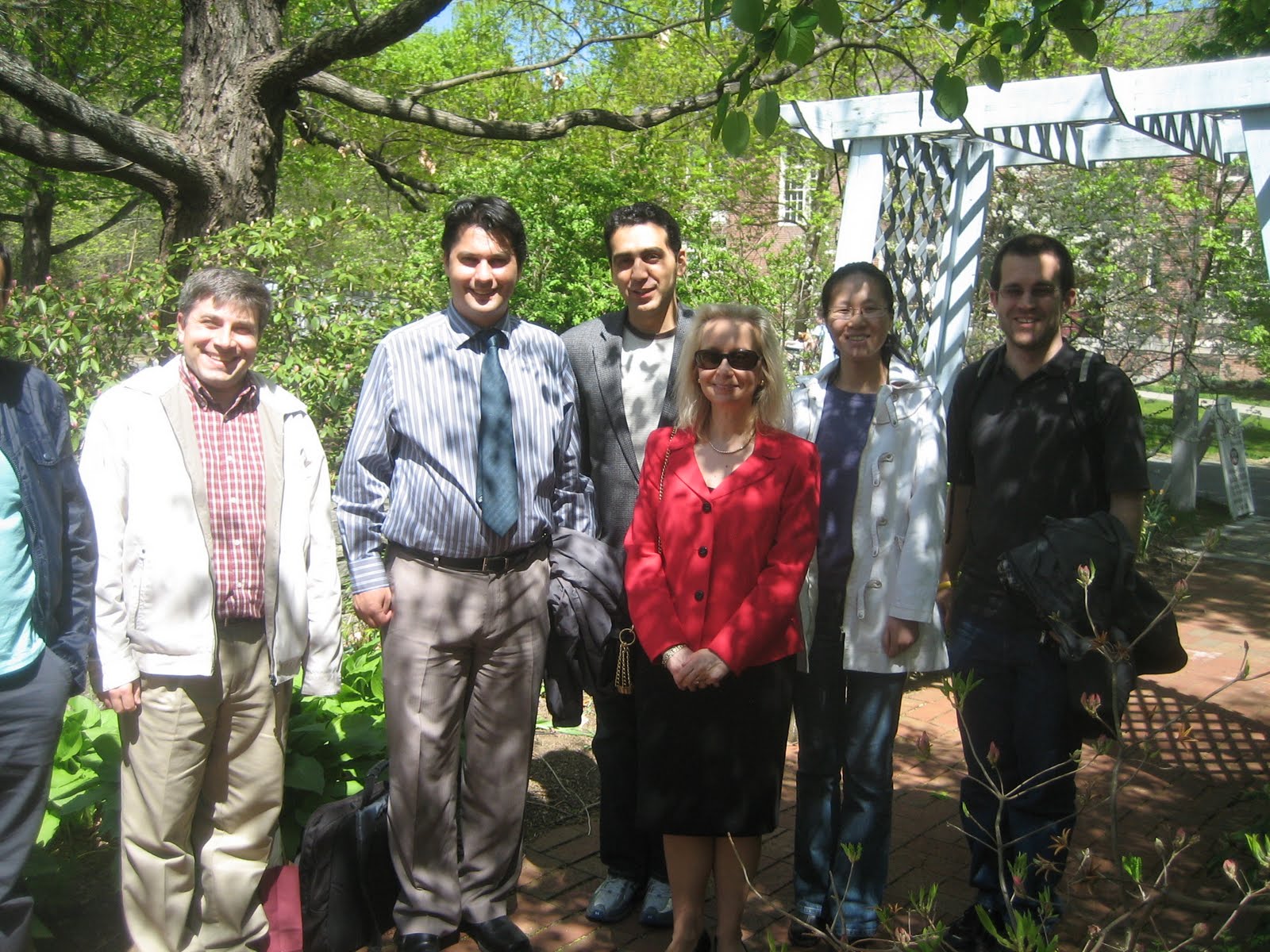
Today we were treated to a wonderful lecture by Professor Mehmet Gumus of the Desautels Faculty of Management at McGill University in Montreal, Canada. Professor Gumus concluded our Spring 2010 Speaker Series in Operations Research / Management Sciences
with a lecture on supply chains, information asymmetry, and agreements between a buyer and a reliable and a not reliable suppliers. He brought in such issues as visibility and insurance and considered uncertainty associated with the capacities of the suppliers. His results were very interesting and well-presented.

The lecture was a fitting conclusion to a wonderful Spring Speaker Series and to a wonderful set of talks that we hosted all year.

As the Faculty Advisor to the award-winning UMass Amherst INFORMS Student Chapter, I thank all of our terrific guest speakers, and commend the chapter officers and members.

Next Tuesday, we will be recognizing our chapter officers as well as staff members who have been so helpful to our chapter's activities all year at a party at the Isenberg School at UMass Amherst.

Above are some photos taken during Professor Gumus' visit on a simply spectacular April day.

Thursday, April 29, 2010

Fragile Networks Book Makes a Best Seller List!

I am delighted to share with you that, according to the Academic Newswire and the Library Journal, the Fragile Networks book that I co-authored with my former doctoral student, Patrick Qiang, is a top 20 best seller in the Engineering/Technology category. Our publisher, John Wiley & Sons, is very pleased by this recognition. This is based on data since July 2009. Our book is number 20 on this best seller list and the list contains some very well-known authors and very prestigious presses.

This news appeared in the April 8 edition

or you can access the best seller list directly here.

The book is relevant to numerous applications, ranging from critical infrastructure (transportation networks, electric power networks, financial networks, the Internet) to military operations, corporate supply chains and mergers and acquisitions, as well as humanitarian logistics. It was recently featured in the Air Force Research Laboratory Library Newsletter at Wright-Patterson's Air Force Base.

New Book and Experiment -- Bursts: The Hidden Pattern Behind Everything We Do

Albert Laszlo Barabasi's new book, which is for a general audience, is to be published today. Barabasi is the physicist (originally from Transylvania, which adds to his mystique) who has been promoting the science of networks since 1998 through his scholarly publications as well as through such books as Linked. He is now a chaired professor at Northeastern University in Boston, having left Indiana University not that long ago.

His new book, Bursts: The Hidden Pattern Behind Everything We Do, according to the publisher, Dutton Adult, provides an analysis of our electronic trails from mobile phones to the Internet and email and offers deep insights into the rhythm of how we do everything. According to Barabasi: We work and fight and play in short flourishes of activity followed by next to nothing. The pattern isn't random, it's "bursty." Randomness does not rule our lives in the way scientists have assumed up until now.

More about this book can be found here
. We hosted Dr. Barabasi in our Speaker Series in the Spring of 2006 and he spoke on the architecture of real networks.

Recently, I received the following message from Barabasi, which discusses an experiment to complement the publication of Bursts.

Dear Friends and Colleagues

some of are aware that I have spent the last two years working on a general audience book, Bursts: The Hidden Pattern Behind Everything We Do, that will published in three weeks, on April 29, 2010. Yet, it is not the book that I am writing about, but rather an experiment motivated by it that I hope you will join and enjoy.

BuRSTS is a performance in human dynamics, a game of cooperation and prediction, that will gradually unveil the full text of Bursts. In a nutshell, if you register at http://brsts.com/, you will be able to adopt one of the 84,245 words of the book. Once you adopt, the words adopted by others will become visible to you -- thus as each words finds a parent, the whole book will become visible to the adopters. But if you invite your friends (and please do!) and you are good at predicting hidden content, the book will unveil itself to you well before all words are adopted. We will even send each day free signed copied of Bursts to those with the best scores.

I am fully aware of the chronic lack of time we all suffer from. Yet, I do hope that you will join us in this fascinating experiment, being part of this collective Burst!

truly yours,

lászló

--
Albert-László Barabási
www.brsts.com

Wednesday, April 28, 2010

The Daffodil Lectures on Sustainability and the Environment at UMass Amherst Were Terrific!


Last weekend I had the distinct pleasure of attending the Daffodil Lectures at the new Integrated Sciences Building at UMass Amherst. The panel was moderated by Dr. Julie Brigham-Grette of UMass Amherst, who has done a lot of climate research in the Arctic, and consisted of Dr. Raymond Bradley, the renowned climate scientist, who is also of UMass Amherst, Andrew Revkin, a graduate of Brown University, my alma mater, and the founder of the blog Dot Earth, and former New York Times reporter, who is now a Senior Fellow for Environmental Understanding at Pace University in NYC, and Dr. Bron Taylor of the University of Florida, who is a Professor of Religion and Nature.

Dr. Raymond Bradley spoke about the world's population now being at 6.3 billion and increasing at a rate of the addition of the greater Boston area every 2 weeks. He spoke about the associated increases in methane, phosphates, and CO2 and polar bears whose bodies are filled with such man-made toxins as PCBs. He spoke about our need to reenvision land use.

He presented a graphic with a red circle boundary and said that we are pushing the earth beyond sustainability levels. He noted how such man-made inventions as the steam engine, which gave rise to the use of coal, and the internal combustion engine, to the rise of fossil fuels, have yielded a relentless rise in greenhouse gasses over the last century and a half. He noted that it is the cumulative emissions of CO2 and their effects since the Industrial Revolution that matter.

Dr. Bradley put up a quote of Al Gore's, dated December 10, 2007, that said "what were you thinking, why didn't you act." His presentation was very clear and very powerful.

Andrew Revkin (whose godson, by the way, is a UMass Amherst student, and who introduced him) began with saying that we are facing a "super wicked" problem with 9 billion people expected to be inhabiting this earth at the end of the century. In 1800, he said, there were 1 billion humans, and today, in 2010, there are 1 billion teenagers (alone). He spoke of the horrible poverty in parts of the globe and highlighted through a photo of how in Guinea students have to go to an airport parking lot because that is the only place that is sufficiently lit for them to do their homework at night. He showed us a photo of a home in Holland that "floats" since the sea levels are rising and the owners want to be prepared for the worst. He emphasized the paucity of investment over the years in energy research, where we need sociological and technological breakthroughs. He said that this generation is Generation E and that there is no "Planet B" so we should care about our planet.

Dr. Taylor spoke about his worldwide travels and how the natural world can bring deep spirituality to one's life. He talked about his books and especially about the "deep green religion."

There was a music ensemble afterwards and a wonderful table with all sorts of appetizers and desserts. This event was a very fitting tribute to the 10th anniversary of what is known as the Commonwealth College at UMass Amherst.

Above I have included several photos of the panelists.

Multi-product Supply Chains, Network Integration, and Mergers and Acquisitions

Now that the economy appears to be recovering, more and more companies are looking at mergers and acquisitions as a means of further reducing costs, expanding markets, and creating possible synergy.

In a study, Multi-product Horizontal Supply Chain Network Integration: Models, Theory, and Computational Results, published in the International Journal of Operational Research, (2010), vol. 17, pp. 333-349, we developed a framework for the identification of potential synergy associated with network integration in the case of multi-product firms. The perspective was that of system-optimization and total cost reduction associated with the sharing of resources, such as facilities (from manufacturing plants to distribution centers) within a general supply chain network framework.

The study was conducted with two of my former doctoral students, who are now professors at Business Schools: Dr. Trisha Woolley, who is a Professor at Texas Wesleyan University, and Dr. Patrick Qiang, who is a Professor at the Penn State Great Valley Campus.

The network approach that we developed can be applied to assess the potential synergy a priori of different potential mergers and acquisitions, from airlines to consumer product companies and even financial services and oil companies. Since the perspective is that of system-optimization, the tools can also be applied to the assessment of teams as in the partnering of organizations in humanitarian logistics operations.

The paper is also available at the Virtual Center for Supernetworks website.

Tuesday, April 27, 2010

Death by PowerPoint and Hypnotizing Chickens

The New York Times has an article by Elisabeth Bumiller, with a terrific spaghetti-like graphic on the military's overuse and overreliance on PowerPoint (PPT) presentations, at the expense of careful, thoughtful analysis. In the article, the leader of the American and NATO forces in Afghanistan, General McChrystal, is quoted as saying: “When we understand that slide, we’ll have won the war,” with his audience erupting in laughter.

From the Pentagon to Iraq and Afghanistan, from the boardrooms to the classrooms, PowerPoint presentations have become the props that are used for presentations. In the article, General Mattis of the Marine Corps, the Joint Forces commander, states: “PowerPoint makes us stupid.”

Military commanders note that a typical PPT relays less information than a five-page paper can hold, and the presenter does not need to carefully write to deliver an analytic point. PPTs are sometimes referred to as "hypnotizing chickens" since they dull the audience into a stupor.

Frankly, the time wasted by military and corporate analysts in preparing such talks could be put into much better use and the same goes for their seated audiences. The time would be better spent by crafting more thorough analyses and writing up the results. Presentations could then be given, with the articles disseminated, in a discussion-like setting with a white or blackboard or paperboard to highlight dynamically the relevant points. We have become, to our detriment, a visual society that craves animation and images, at the expense of thorough analysis and evidential support.

When giving the majority of my presentations
(and I have a pile coming up to give internationally) I use latex beamer rather than PowerPoint. In this way, I can include mathematical expressions, and more thorough analyses. Every presentation that I give at a conference, workshop, or seminar is based on 1 or more refereed journal articles so the results are verified.

As for teaching, despite carefully prepared slides, nothing beats the give and take of doing numerous examples on the board and interacting with the students, through Q&A, to make sure that they understand the material.

Life, whether in the classroom or at war, is not two-dimensional as PowerPoint slides are, which can dull and deaden our minds and, frankly, waste precious time.

Monday, April 26, 2010

Loving What You Do and Solving the Biggest Problems

CNN has an Opinion Piece by Professor Terence Tao, about whom I have written about in this blog when Forbes featured him. In the Opinion Piece, Professor Tao's love of his work shines through. He is a renowned mathematician, having started his PhD at Princeton at the age of 16, and is now a Professor of Mathematics and the James and Carol Collins Chair in the College of Letters and Science at UCLA. He was born in Australia and is also a citizen of the US.

He writes that, as a child, he: loved games with clear, unambiguous rules; puzzles that were tough but fair; and the clean, abstract, simplicity of numbers and symbols. He says that: it is perhaps not surprising that [he] has been drawn to mathematics for as long as [he] can remember.

Life is not always fair, but being part of a profession that acknowledges when you solve an important problem, is very satisfying (of course, the individual gets the personal satisfaction of the discovery as well and gets it first).

Professor Tao then states that: mathematics was not just an abstract game of symbols, but could be used as a tool to analyze and understand the modern world.

Indeed, the tools of mathematics (accompanied by the use of computers, I might add) are being applied to solve problems in business (from logistics to marketing to finance and accounting). Math is used in healthcare, and in humanitarian operations. It is an essential tool in engineering, in physics, in computer science, in economics, in sociology, and even in biology. Math makes the world hum. It makes order out of disorder and helps to explain chaos. Math "works" and helps to resolve the greatest puzzles of today.

Besides what could be more gratifying than solving problems!

Bill Gates (who needs no introduction) recently visited Harvard University and spoke there. He said, in his speech, that the biggest problems require the best minds. You can find some of the problems that he believes need our attention in this Harvard Gazette article. Obviously, innovative and accessible education is the foundation for it all!