Showing posts with label environment. Show all posts

Wednesday, December 24, 2025

Our Paper with Colleagues in Italy on Flexible Production Networks and Environmental Regulations is Published!

It is now the holiday season so one needs to find moments of joy, despite so many horrific events and challenges. I am very grateful to my wonderful collaborators.

The same day as the mass casualty event at my alma mater, Brown University, a paper that I co-authored with colleagues at the University of Catania in Italy: Dr. Gabriella Colajanni, Professor Patrizia Daniele, and Dr. Daniele Sciacca, was published in the European Journal of Operational Research and it is open access: https://www.sciencedirect.com/science/article/pii/S0377221725009786

Also, at about the same time, we received a huge package of chocolates from one of these co-authors, which brought light in this time of darkness.

We will be enjoying the chocolates for many weeks and will also be sharing them. 

Thank you for the friendships across the miles and for the outstanding community of Operations Researchers.

Let peace and freedom and righteousness prevail as we come to the end of the 2025 year.


Thursday, December 8, 2016

Sustainability and Operations Research: A Trek Down Memory Lane from Transportation to Supply Chains

Given the interest my blogpost on Professor Joe Sarkis' talk on greening supply chains generated I thought that I would write this piece on sustainability and operations research from the perspective of how we got interested in the subject and where it has taken us.

Professor Sarkis also mentioned in his presentation that he, like I and my research group, have been working on sustainability for a while - actually two decades and since we are hearing that "sustainability" is some fields, including operations management, is being perceived as being relatively new, I thought it deserved some commentary.

I have always been one who loves nature and I get some of my best ideas on hikes. Clean air, clean water, fresh food, and a healthy, peaceful environment we all deserve and they are essential to our well-being  and that of future generations.
As a research topic, I became interested in sustainability while working with two doctoral students at the Isenberg School of Management: Kanwalroop "Kathy" Dhanda and Padma Ramanujam in the 1990s.

Together we wrote the Environmental Networks book, which was published in 1999, and the year after, my Sustainable Transportation Networks book was published.

Vice President Al Gore wrote me a nice letter on the publication of my Sustainable Transportation Networks book, which now hangs in my office at the Isenberg School.

Prior to the publication of these books, I had co-authored several papers, which also provided the seeds for our sustainability work. These included a 1996 paper in Operations Research, written with Sten Thore and one of my first PhD students, Jie Pan, who tragically died of an autoimmune disease shortly after having receiving tenure. With Padma, that same year, we had also published a paper in Transportation Science.

Padma's dissertation,  Transportation Network Policy Modeling for Congestion and Pollution Control: A Variational Inequality Approach, was awarded a Transportation Science & Logistics dissertation prize from INFORMS in 1999, a great honor.

Some other early papers on various sustainability of ours included: "A Multimodal Traffic Network Equilibrium Model with Emission Pollution Permits: Compliance versus Noncompliance," published in Transportation Research D in 1998 and "Marketable Pollution Permits in Oligopolistic Markets with Transaction Costs," which appeared in Operations Research in 2000. I also wrote several papers on emission paradoxes, one with another doctoral student of mine, now Professor June Dong.

Hence, we were proposing tradeable pollution permits even for transportation networks in the 1990s. Padma is now working at SAS, a fabulous analytics firm, and is based in Cary, North Carolina, whereas Kathy has had several tenured professorships at different universities and continues to work on sustainability issues.

Interestingly, the Virtual Center for Supernetworks, which I founded in 2001 and continue to serve as Director of, was initiated because of three NSF grants that I had received at that time plus two AT&T Industrial Ecology Fellowship grants, which envisioned such a center. Hence, the sustainability theme has been central to our research.

In 2005, with a doctoral student from Japan, Fuminori Toyasaki, who is now a professor at York University in Toronto, I published a paper that is highly cited: "Reverse Supply Chain Management and Electronic Waste Recycling: A Multitiered Network Equilibrium Framework for E-cycling." This paper was recognized by Transportation Research E as a most cited paper.

In 2002, I had co-authored the paper, "A Supply Chain Network Equilibrium Model," with June Dong and Ding Zhang and this paper, which introduced multiple tiers of interacting decision-makers, who compete across a tier but cooperate between tiers, generated new frameworks for work on sustainability and supply chains as well. We also conducted research on energy supply chains and I have a series of papers in this area, some of which also include carbon taxes. An example is the paper, "Modeling Generator Power Plant Portfolios and Pollution Taxes in Electric Power Supply Chain Networks: A Transportation Network Equilibrium Transformation," co-authored with Kai Wu, Zugang Liu (another former PhD student of mine who is now a tenured professor), and John Stranlund, a faculty member at UMass in Resource Economics.

Another former very successful doctoral student of mine, Trisha Anderson Woolley, now a tenured professor,  also published several papers with me on sustainability, energy, and supply chains, as well as policy interventions. 

As the news about climate change resonated and its negative impacts, we continued to explore modeling of supply chains and an example of a paper reflecting this is: "Environmental Impact Assessment of Transportation Networks with Degradable Links in an Era of Climate Change, " which was published in 2010 and written with Patrick Qiang, my co-author of the Fragile Networks book (and whose dissertation received the Charles Wootan Award from the CUTC), and the "other" Professor Nagurney - Ladimer S. The paper, "Sustainable Supply Chain Network Design: A Multicriteria Perspective," written by the two Nagurneys, which was also published in 2010, remains one of the most highly cited articles in the International Journal of Sustainable Engineering.

Our more recent research on sustainability and supply chains has focused on numerous different applications, and these are quite fascinating. Much of the impetus has come from outside - such as our work on fashion and sustainability - but some of it has also been internal - as in the case of our blood supply chain sustainability research and driven by common interests and passion that I share with both students and collaborators. Examples of such papers are: Sustainable Fashion Supply Chain Management Under Oligopolistic Competition and Brand Differentiation, Anna Nagurney and Min Yu, International Journal of Production Economics, Special Section on Green Manufacturing and Distribution in the Fashion and Apparel Industries 135: (2012) pp 532-540 and Supply Chain Network Design of a Sustainable Blood Banking System, Anna Nagurney and Amir H. Masoumi, in Sustainable Supply Chains: Models, Methods and Public Policy Implications, T. Boone, V. Jayaraman, and R. Ganeshan, Editors, Springer, London, England (2012) pp 49-72.

In 2014, I was delighted to co-author a paper with two of my former PhD students, Toyasaki, already mentioned, and Professor Tina Wakolbinger, and her first PhD student, Thomas Nowak, who has since received his PhD: When and for Whom Would E-waste be a Treasure Trove? Insights from a Network Equilibrium Model of E-waste Flows, Tina Wakolbinger, Fuminori Toyasaki, Thomas Nowak, and Anna Nagurney, International Journal of Production Economics 154: (2014) pp 263–273.


Some of our other recent research has included my collaborator in Sweden, Professor Jonas Floden, since I had a fabulous Visiting Professorship at the University of Gothenburg over a 4 year period. Examples are the papers: Supply Chain Network Sustainability Under Competition and Frequencies of Activities from Production to Distribution, Anna Nagurney, Min Yu, and Jonas Floden, Computational Management Science 10(4): (2013) pp 397-422 and Fashion Supply Chain Network Competition with Ecolabelling, Anna Nagurney, Min Yu, and Jonas Floden, in Sustainable Fashion Supply Chain Management: From Sourcing to Retailing, T.-M. Choi and T.C.E. Cheng, Editors, Springer (2015) pp 61-84.

Another paper that I am quite proud of in which I move from transportation to supply chains to sustainable cities is, "Design of Sustainable Supply Chains for Sustainable Cities," invited paper for the Complex-City Workshop, December 5-6, 2011, Amsterdam, The Netherlands, Environment & Planning B 42(1): (2015) pp 40-57.

Our research on food supply chains, conducted with Professor Min Yu (yes, another former terrific Isenberg UMass PhD alumna in Management Science), and published in the European Journal of Operational Research, also has components of sustainability since we consider waste. The same holds for our work on pharmaceutical supply chains.

And, for those of you interested in perishable product supply chains, including food and medical nuclear ones, in which waste is a big issue, our Networks Against Time: Supply Chain Analytics for Perishable Products, is recommended.
And the research continues into its third decade!

Friday, July 24, 2015

Green Spaces in Some Favorite Cities

After spending multiple weeks in Europe this past summer, as a Visiting Professor in Sweden, and also speaking and attending plus co-organizing conferences in various countries, I am enjoying being in very green Amherst, Massachusetts.

But,  before long, I will be heading out again, to give a plenary talk in Bogota, Colombia. I will be speaking on Sustainable Supply Chains for Sustainable Cities.

Reflecting back on the places that I had been recently what stood out in my mind is the importance of green spaces in cities.

The New York Times recently even had an article on a scientific study on the effects of walking in nature on people's brains.


I must admit that in traveling I always try to locate a hotel close to a park.

Below are photos of green spaces in some of my favorite cities. Take in the beauty and enjoy - it may even be good for your health.

Below are scenes from Gothenburg, Sweden

Below photos are from Hyde Park, London, England

StadtPark in Vienna, Austria

The Meadows in Edinburgh, Scotland


 Oxford, England


And, of course, Central Park in New York City!

Tuesday, April 22, 2014

Sustainable Supply Chains for Sustainable Cities, Earth Day, and Erice

Today is Earth Day on which we celebrate planet earth and the environment.

I have been hard at work on a presentation, Sustainable Supply Chains for Sustainable Cities, which I will be presenting at a fascinating workshop, which will take place in early May, at the Ettore Majorana Scientific Center in Erice, Sicily. I had been then before, back in 2006, and it was a fitting ending to not only my year as a Science Fellow at the Radcliffe Institute at Harvard but also to the World Cup (Italy beat France and we were in Italy).

The title of the Workshop that I will be speaking at is given below.

      ERICE INTERNATIONAL SEMINARS ON PLANETARY EMERGENCIES
47th Session
Erice, 11 –15 May 2014
THE ENERGY PLANETARY EMERGENCY
Workshop on Energy, Cities, and the Control of Complex Systems.

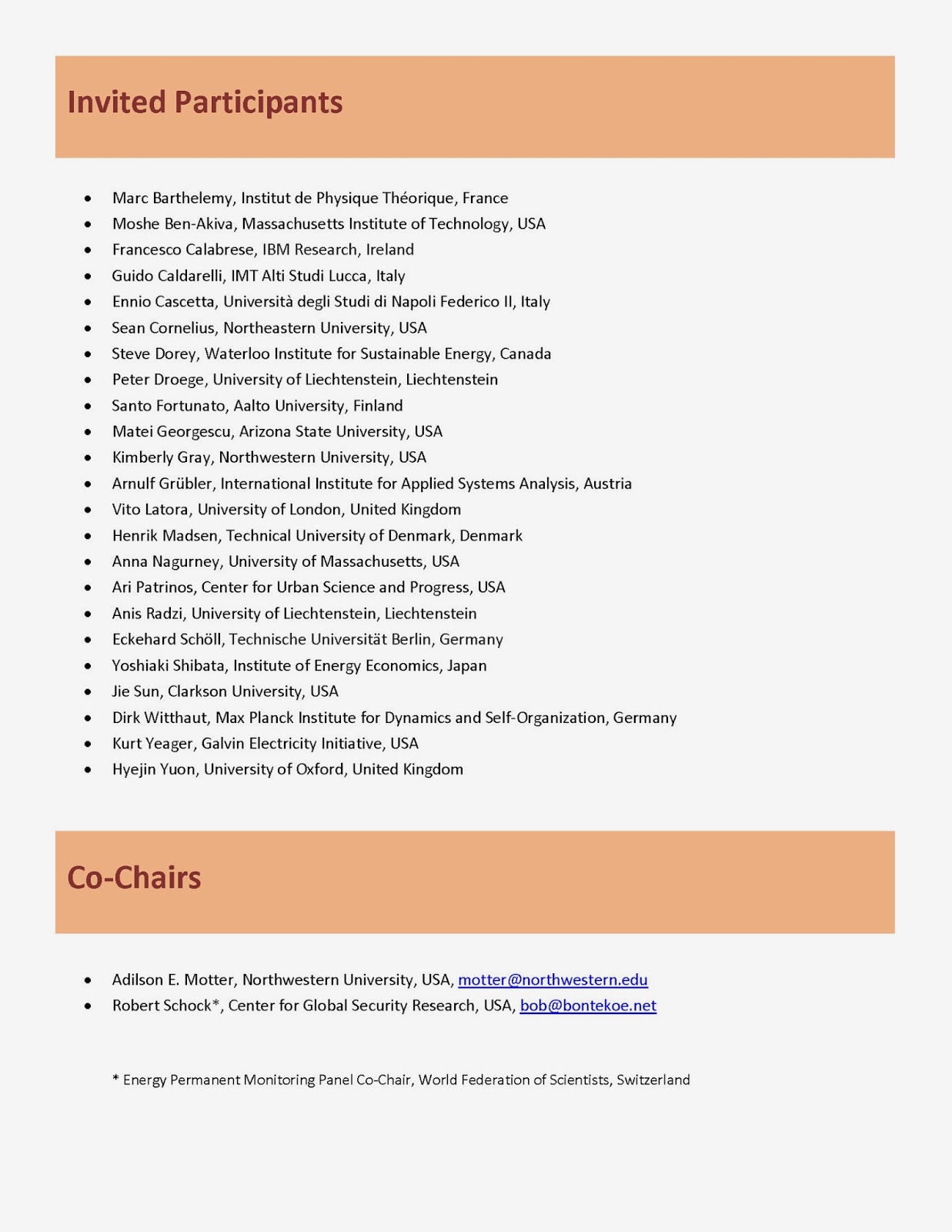
I received the formal invitation from the Director and Chairman of the Ettore Majorana Scientific Center, Professor Antonino Zichichi. The workshop is organized by Professor Adlison Motter of the Department of Physics and Astronomy, Northwestern University,
http://dyn.phys.northwestern.edu/  and by Dr. Robert Schock, Center for Global Security Research, Energy Permanent Monitoring Panel, World Federation of Scientists:

The list of invited participants is below.
 

In my presentation I will present both a supply chain network design model with a focus on frequencies, which is in press in the journal Environment & Planning B and will discuss highlights of a model developed with Drs. Min Yu and Jonas Floden on sustainable supply chain network competition and game theory with frequencies of supply chain activities as strategic variables and product path flows. This paper was recently published in the journal Computational Management Science in a special issue devoted to Planet Earth.


Saturday, December 7, 2013

Environmental Applications and Computational Management Science


The special issue of the journal Computational Management Science on Environmental Applications is now published. It is volume 10, issue 4, December 2013. Thanks to the Editors, Professors Breton and Zaccour,  for putting together this great volume. We are honored to have our latest work on supply chains, freight, and sustainability in it. 

Additional information on the full issue can be found at: http://link.springer.com/journal/10287/10/4/page/1

Preface
Michèle Breton & Georges Zaccour
Dynamic decentralization of harvesting constraints in the management of tychastic evolution of renewable resources
Jean-Pierre Aubin, Luxi Chen & Marie-Hélène Durand
A robust meta-game for climate negotiations
Frédéric Babonneau, Alain Haurie & Marc Vielle
Spatial control of invasive species in conservation landscapes
Christopher M. Baker & Michael Bode
Ecological-economic modelling for the sustainable management of biodiversity
L. Doyen, A. Cissé, S. Gourguet, L. Mouysset, P.-Y. Hardy, C. Béné, F. Blanchard, F. Jiguet, J.-C. Pereau & O. Thébaud
Computation of viability kernels: a case study of by-catch fisheries
Jacek B. Krawczyk, Alastair Pharo, Oana S. Serea & Stewart Sinclair
Supply chain network sustainability under competition and frequencies of activities from production to distribution
Anna Nagurney, Min Yu & Jonas Floden
Shallow lake economics run deep: nonlinear aspects of an economic-ecological interest conflict
Florian Wagener

Thursday, July 8, 2010

Haiti 6 Months After -- Unblock the Roads and Fragile Networks

One year ago, our book, Fragile Networks: Identifying Vulnerabilities and Synergies in an Uncertain World, was published and was recently noted by the Library Journal to be a top selling book in technology and engineering.

6 months ago, on January 12, 2010, a huge earthquake hit Haiti and awakened the world to the wrought devastation.

I wrote regularly in this blog about the earthquake, the resulting human suffering and loss of lives, and the loss of critical infrastructure from the roads to telecommunications, plus hospitals and even schools, which only added to the suffering of the survivors. I also called for better coordination among the stakeholders and especially the humanitarian organizations for the provision of necessary supplies and decent logistics.

Today, The New York Times has an OpEd piece written by my colleagues at Georgia Tech, which is right on target, and which speaks to one of the major themes of our Fragile Networks book: that the identification of the critical network links before (and after) their degradation and even ultimate devastation is essential.

According to the OpEd piece, Haiti's External Weight, by Professors Desroches, Ergun, and Swann, 6 months after the earthquake: twenty million to 25 million cubic yards of debris fill the streets, yards, sidewalks and canals of Port-au-Prince — enough to fill five Louisiana Superdomes.

Debris is one of the most significant issues keeping Haitians from rebuilding Port-au-Prince and resuming normal lives. Much of the stuff has been left in place or simply moved to the center or the sides of roads. Some streets with especially large piles of refuse are impassable. As a result, it can take hours to travel just a few miles. Meanwhile, schools, hospitals, businesses and homes remain blocked.

Amazingly, only about 5% of the original debris has been properly disposed of and there are serious concerns about the ultimate impact of the debris on the environment, as well.

Clearly, the efficiency and performance of the transportation and logistical networks in Haiti have been severely affected and degraded without a timely debris removal. Since such networks provide the infrastructure for the movement of people and goods, how can Haiti's economy and its citizens move forward?!

In May, 2008, I had the privilege of convening a workshop: Humanitarian Logistics: Networks for Africa at the Rockefeller Foundation's Bellagio Center on Lake Como. It was apparent to us then, as it is now, that with the increasing number of disasters documented globally more attention to education, to research, and to policy analysis regarding humanitarian logistics and sustainable operations is sorely needed.

Crises don't end once the media attention dissipates.

Wednesday, April 28, 2010

The Daffodil Lectures on Sustainability and the Environment at UMass Amherst Were Terrific!


Last weekend I had the distinct pleasure of attending the Daffodil Lectures at the new Integrated Sciences Building at UMass Amherst. The panel was moderated by Dr. Julie Brigham-Grette of UMass Amherst, who has done a lot of climate research in the Arctic, and consisted of Dr. Raymond Bradley, the renowned climate scientist, who is also of UMass Amherst, Andrew Revkin, a graduate of Brown University, my alma mater, and the founder of the blog Dot Earth, and former New York Times reporter, who is now a Senior Fellow for Environmental Understanding at Pace University in NYC, and Dr. Bron Taylor of the University of Florida, who is a Professor of Religion and Nature.

Dr. Raymond Bradley spoke about the world's population now being at 6.3 billion and increasing at a rate of the addition of the greater Boston area every 2 weeks. He spoke about the associated increases in methane, phosphates, and CO2 and polar bears whose bodies are filled with such man-made toxins as PCBs. He spoke about our need to reenvision land use.

He presented a graphic with a red circle boundary and said that we are pushing the earth beyond sustainability levels. He noted how such man-made inventions as the steam engine, which gave rise to the use of coal, and the internal combustion engine, to the rise of fossil fuels, have yielded a relentless rise in greenhouse gasses over the last century and a half. He noted that it is the cumulative emissions of CO2 and their effects since the Industrial Revolution that matter.

Dr. Bradley put up a quote of Al Gore's, dated December 10, 2007, that said "what were you thinking, why didn't you act." His presentation was very clear and very powerful.

Andrew Revkin (whose godson, by the way, is a UMass Amherst student, and who introduced him) began with saying that we are facing a "super wicked" problem with 9 billion people expected to be inhabiting this earth at the end of the century. In 1800, he said, there were 1 billion humans, and today, in 2010, there are 1 billion teenagers (alone). He spoke of the horrible poverty in parts of the globe and highlighted through a photo of how in Guinea students have to go to an airport parking lot because that is the only place that is sufficiently lit for them to do their homework at night. He showed us a photo of a home in Holland that "floats" since the sea levels are rising and the owners want to be prepared for the worst. He emphasized the paucity of investment over the years in energy research, where we need sociological and technological breakthroughs. He said that this generation is Generation E and that there is no "Planet B" so we should care about our planet.

Dr. Taylor spoke about his worldwide travels and how the natural world can bring deep spirituality to one's life. He talked about his books and especially about the "deep green religion."

There was a music ensemble afterwards and a wonderful table with all sorts of appetizers and desserts. This event was a very fitting tribute to the 10th anniversary of what is known as the Commonwealth College at UMass Amherst.

Above I have included several photos of the panelists.

Wednesday, April 14, 2010

Daffodil Lectures on Sustainability and the Environment

On Saturday, April 24, 2010, UMass Amherst and its Commonwealth College will be featuring the Daffodil Lectures to celebrate honors education at UMass Amherst.

The lectures will take place at 3PM at the Integrated Sciences Building (see notice above). Two of the speakers are well-known UMass Amherst faculty and one (Professor Taylor) is from the University of Florida. Andrew Revkin (who went to Brown University, as did I, and who also has a master's degree from Columbia) will also be speaking. Mr. Revkin was a long-time journalist for The New York Times (through 2009) and wrote the blog, Dot Earth.

In June, 2009, Andrew Revkin and I were among the featured speakers at the World Science Festival in NYC, which was an extraordinary experience.

Mr. Revkin is now a Fellow at Pace University in NYC. I am delighted that he will be coming to UMass Amherst and am very much looking forward to hearing all these speakers provide their unique insights into sustainability and the environment!

More information about this special event can be found here.