Wednesday, December 31, 2014

Why Newsletters Matter Even in Business Schools

As the 2014 year comes to a close, there have been many essays in the media reflecting on the events of the past year.

Also, as the first half of the academic year draws to a close, there have been many mailings, both in electronic and hardcopy form, of various newsletters.

I have in the past several days received the Fall 2014 newsletter of the Transportation & Logistics Society of INFORMS, which is now online, the Analytics e-newsletter of INFORMS, the newsletter from the Department of Mathematics & Statistics at UMass Amherst, also online (a hardcopy I received via snail mail), as well as the Harvard Gazette newsletter, which is produced regularly in electronic format, and I enjoy very much.  To view all the newsletters of the various schools and colleges at UMass Amherst, you can see the list on the Research Next website, on the bottom of this page.

The Wharton School of Business at the University of Pennsylvania, impressively, produces a newsletter, in conjunction with Merchants Bank every two weeks. The newsletter Knowledge@Wharton is well-known. The newsletters, according to the website,  contain reports on:
  • Articles based on research papers, often with links to the original paper
  • Academic summaries and abstracts of research papers
  • Book reviews and author interviews
  • Analysis of current business issues
  • Discussions between Wharton faculty members and business leaders
  • Reports on conferences and seminars
  • A searchable database of business research. 
Getting information out in a timely manner is critical in today's fast-paced business world and newsletters serve many important functions, including, for example,  the dissemination of research results, accolades received,  news items, upcoming conferences and events, and discussion of topics of interest. It takes time to produce a newsletter but constituents appreciate the efforts! I am sure that donors do as well!

As The Director of the Virtual Center for Supernetworks at the Isenberg School of Management, I find that the center's newsletter. The Supernetwork Sentinel, also serves as a valuable medium through which we communicate what we do at the center. The newsletter is produced three times a year and it marks the progress that the Center Associates, which include faculty, industry leaders, as well as doctoral students, have made. Our most recent newsletter is the Winter 2015 edition.


We've been producing this newsletter since the Fall of 2003 and all issues can be found here.

I must say that it has been not only an amazing year, but amazing many years, as the newsletters clearly reveal. I always say that to do great work, it takes a great team, and the Supernetwork Team is the best!

Monday, December 29, 2014

Scenes from Radcliffe Institute for Advanced Study at Harvard and Cambridge

Yesterday I had the pleasure of being back in Cambridge, MA so I had to visit Brattle Street, Radcliffe,  and Harvard Square.

I spent the 2005-2006 year as a Science Fellow at the Radcliffe Institute for Advanced Study at Harvard University and that year I wrote my Supply Chain Network Economics book

I have wonderful memories of that year --  of the people that I met, the friends that I made, and of the research  and writing that I did.

I lived on 83 Brattle Street in the building below on the 6th floor.

My office was in Putnam House a few buildings down from my apartment, where, in the Fall that year, one of my neighbors was the French mathematician, Pierrette.Cassou-Nogues from Bourdeaux. 
In the Spring, my collaborator Professor Patrizia Daniele, who is an operations researcher, joined me for several months and Radcliffe provided her with an office in Putnam House, which was terrific! Patrizia is from the University of Catania in Italy and she is also a Supernetwork Center Associate.

Below is a photo taken in front of Putnam House.
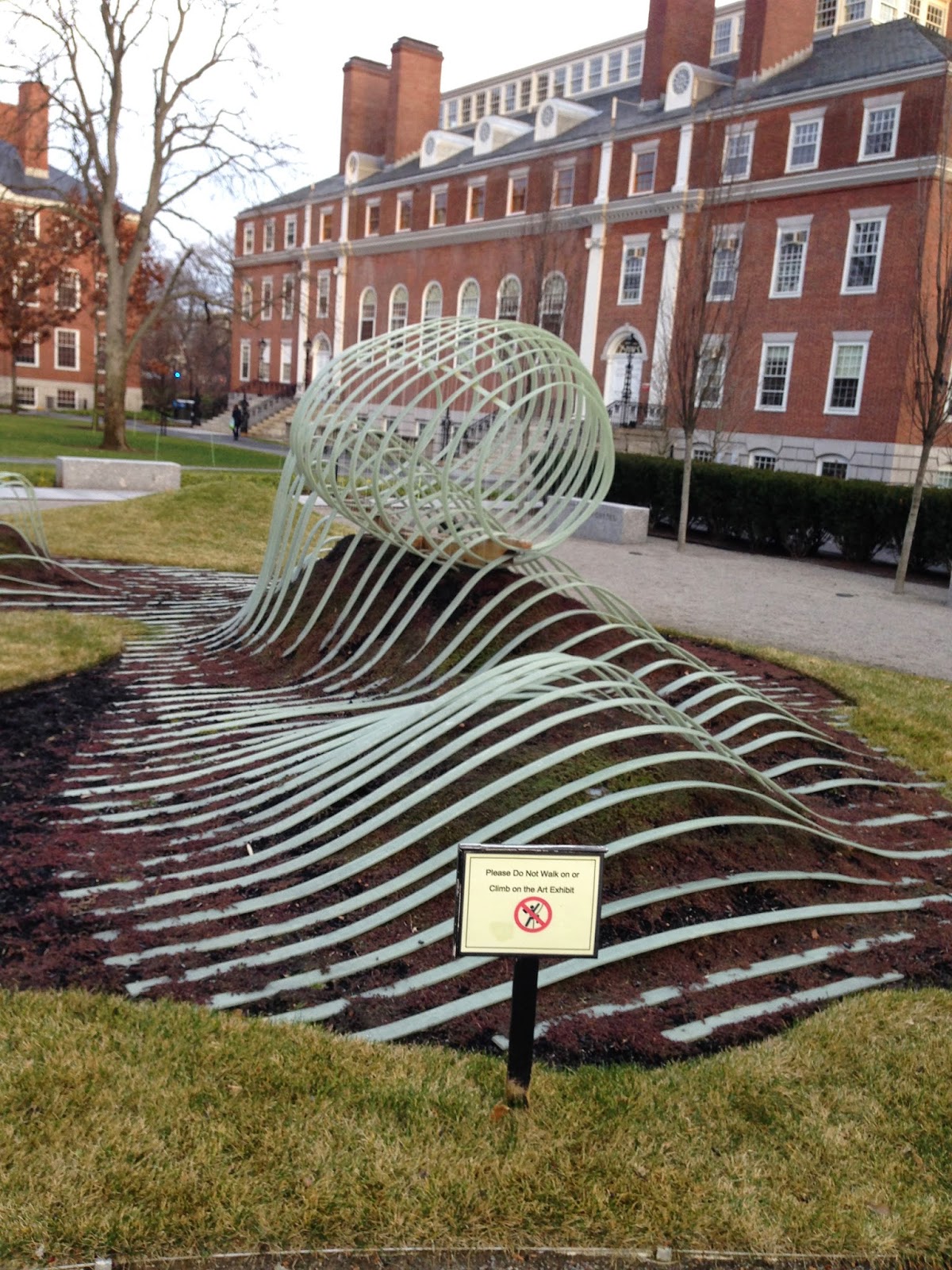
Radcliffe Yard looked beautiful and I enjoyed checking out the award-winning sculpture.

The sculpture is an installation called Saturate the Moment.

We wandered over to Bartley's, a Cambridge institution but it was closed.
 
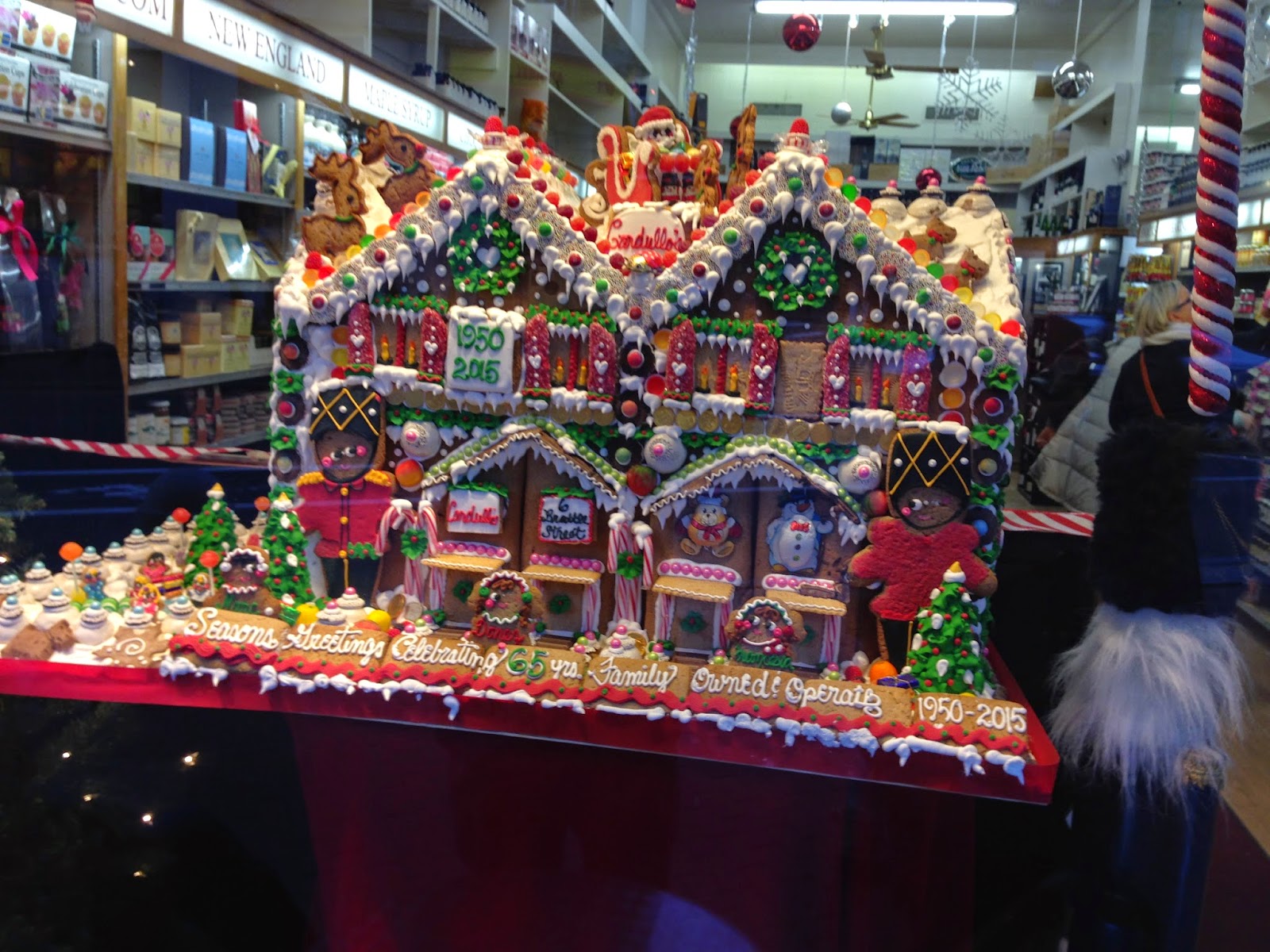
 Cardullo's in Harvard Square had the beautiful gingerbread house in its window below.

Burdick's was open so we enjoyed some delicious hot chocolate! 
We had traveled to eastern MA, since my daughter wanted to meet a friend who had returned from a semester abroad at the University of St Andews in Scotland.  The head (known as the Principal and Vice-Chancellor) of St Andrews is Dr. Louise Richardson, who was the Executive Dean of Radcliffe when I was there. You can see her at our Radcliffe Fellows "graduation" ceremony  in the top photo in my blogpost here.

You may recall that Prince William and his wife, Kate Middleton, the Duke and Dutchess of Cambridge (in England), were recently in NYC for a fundraiser for St Andrews, since they met at this university, and Dr. Richardson can be seen with them here. The 600th anniversary gala for the University of St Andrews took place at the Metropolitan Museum of Art.

And, when I returned back to Amherst last night, I had a message from none other than Dr. Pierrette Cassou-Nogues, wishing me a Happy New Year!

Friday, December 26, 2014

Looking Forward to New Book, Forecasting Urban Travel, by Boyce and Williams

I heard from my great colleague and friend, Professor David E. Boyce, who forwarded me his holiday letter that the book that he has been immersed in writing, with Professor Huw Williams, Forecasting Urban Travel: Past Present and Future, is in the final stages of production with the publisher, Edward Elgar.

On the book cover, featured above, are images of two of David's favorite cities, Chicago and Singapore. The book should be available for purchase in April 2015 from www.e-elgar.com/. Initially, it will be offered in hardcover and e-book formats. Within a year, according to David, a lower-priced paperback edition will then be issued. Finally, a Chinese translation is underway, which is quite exciting!

According to a news item published in the TSL (Transportation Science and Logistics Society) of INFORMS Fall 2014 newsletter, which we received just last week: The book presents, in a non-mathematical way the evolution of methods, models and theories underpinning travel forecasts and policy analysis, from the urban transportation studies of the 1950s to current applications throughout the urbanized world. From original documents, correspondence and interviews, especially from the United States and the United Kingdom, the authors seek to capture the spirit and problems faced in different eras, as changing information requirements, computing technology and planning objectives conditioned the nature of forecasts.

I have had the pleasure of seeing Chapter 7 of the book, which is on Transportation Network Equilibrium, which David asked me to provide feedback on, which was a pleasure to do, since it was like a trip down memory lane, during which I reminisced about the contributions of my doctoral dissertation advisor at Brown University, Professor Stella Dafermos, and her amazing contributions. It was also a pleasure to read and reflect on the work that we did jointly prior to her death.

I am sure that this book will be a classic in transportation science as well as the history of travel forecasting and am very much looking forward to its publication in the spring of 2015. Chapter 7, alone, is worth the price of the book, since there is a very human aspect to the rendition of discoveries therein and the individuals involved.

The contents of the book below are from the publisher's website:

Contents
Contents: Preface 1. Introduction 2. Emergence of the Traditional Approach 3. Early Developments in the UK 4. Travel Forecasting based on Discrete Choice Models, I 5. Travel Forecasting based on Discrete Choice Models, II 6. Activity-Based Travel Analysis and Forecasting 7. Transportation Network Equilibrium 8. Tradition and Innovation in US Practice 9. Tradition and Innovation in UK Practice 10. Computing Environment and Travel Forecasting Software 11. Achievements, Current Challenges and Future Prospects 12. Conclusion Index

Tuesday, December 23, 2014

A Trip Back to Brown University, My Alma Mater

Yesterday, in traveling back from early holiday celebrations with relatives in Newport, Rhode Island, we stopped in Providence. I was curious to see how my alma mater, Brown University, was faring, given that I had heard that construction was in the plans.

There is something very special about going back to the place where you received a great education, made many friends, and have lifelong memories. OK, I admit, I also met my husband there freshman week - he was a graduate student in physics.

Thayer Street - the main commercial street that cuts through the campus is filled with even more restaurants than ever - quite a few with an international focus, which is great.

Pembroke, pictured below, where I lived as a freshman, still looks good.

As does Diman House, where I lived, and had the best room-mate, Teresa Davila, who was on the women's crew team - amazing for a former ballerina from Chile, and fellow Applied Math major.
I loved living at Diman, because it was close to the "Ratty," the main cafeteria, as well as to the frat quad, which made life always interesting. Yes, in those days, we even got to see "streakers," including members of the football team.

Also, I have incredibly fond memories of living in the Russian House and,  even last summer, while visiting my daughter, who was doing research at the University of Colorado, Boulder, we got to see Dr. Mark Kiken, who received his PhD from Brown. He was the dorm resident assistant of Russian House when I lived there for a year. My other major (I hold an AB and an ScB from Brown) was Russian Language & Literature.
I reconnected this past year with two other Russian majors, Janice Pilch, now at Rutgers, and Jill Rappaport, now teaching at Temple. We would spend a lot of time at Marston Hall where many of  the language faculty had offices. I could not resist having the photo taken below in front of Marston.
 
Then, just a few feet away, is the beautiful Applied Math building with stained glass windows, where I would visit faculty during office hours and we would pick up our exams and homeworks.
Less than a decade after getting my PhD from Brown in Applied Math, with a specialization in Operations Research, I was back in that building on my sabbatical and there I wrote my first book, Network Economics: A Variational Inequality Approach. I lived then in an apartment complex known as Wayland Manor, on Wayland Square,  which I visited yesterday.
My apartment was on the first floor behind the trees in the photo above.

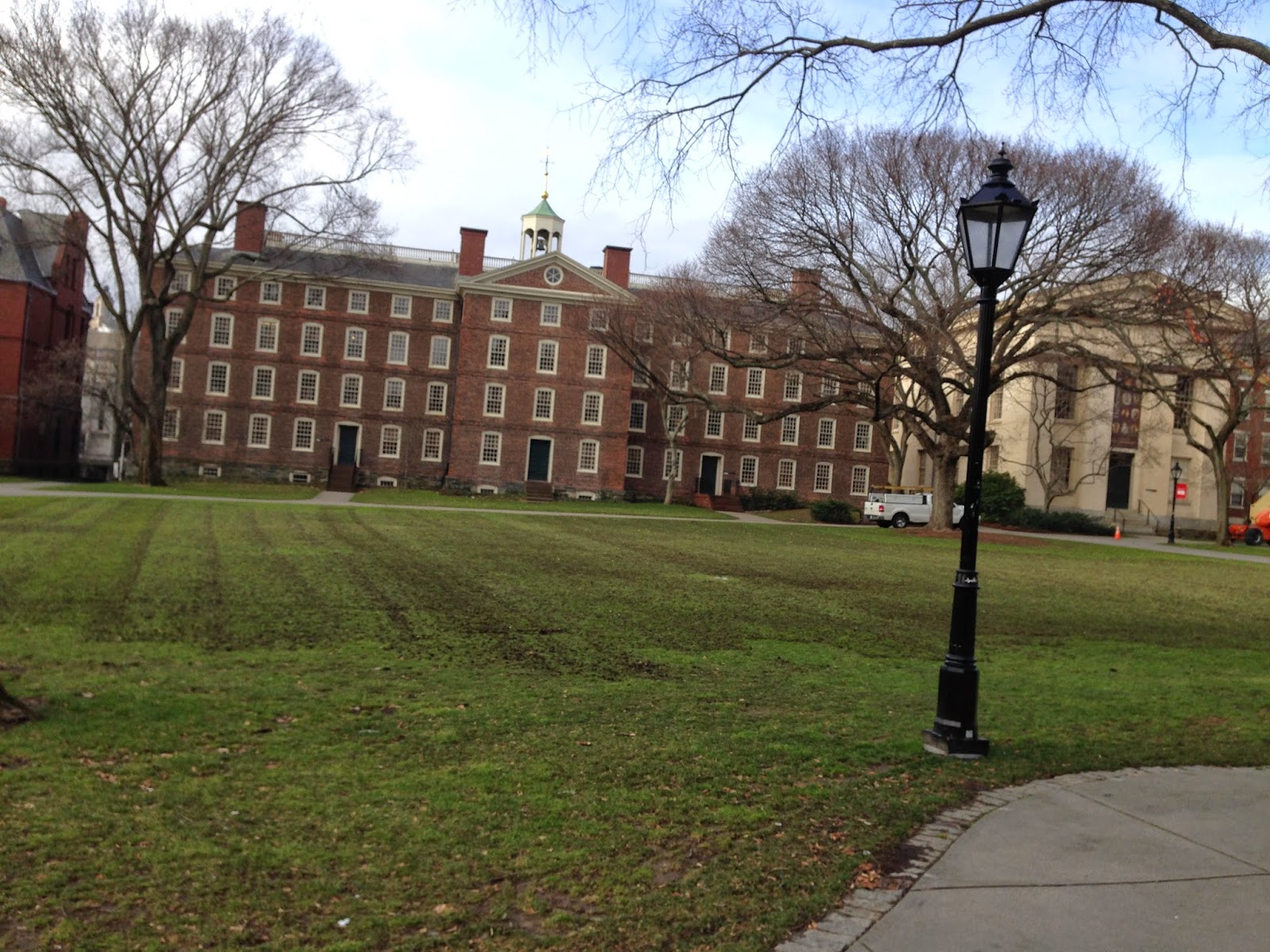
Walking through the main campus was nostalgic.
Brown had invited me back (the Mathe Department) in 2007 to speak at the SUMS conference on Operations Research to undergraduates and a clip of my talk was posted on youtube. 

And, speaking of fellow Brown University Applied Math majors, I just heard that (I was his TA in OR courses), Dr. Irv Lustig has left IBM!  Dr. Les Servi of Mitre, another fellow Brown Applied Math major, is also rrenowned in our INFORMS professional community.  And, of course, I have to mention Dr. Georgia Perakis of the Sloan School at MIT. Georgia was my dissertation advisor's 4th PhD student and I was her first.

And, while on the main campus green, I had to take a photo of Wilson Hall, where I had my calculus classes from one of the founder's of dynamical systems, Professor Joe LaSalle.
The campus was very quiet since it is now the winter break period.

After exploring Brown, it was time to head to the Italian section of Providence, on Atwell's Avenue, to see what kind of holiday pastries were on display.

I couldn't resist taking the photo of the tree below - note that instead of a double yellow line on the street, there is a long Italian flag painted.

With best wishes for a joyous holiday season to my readers!


Monday, December 22, 2014

Competing on Freight Service Quality in Supply Chains

Now is the time of the holiday season that freight carriers are extremely busy, with Christmas only 3 days away and with the memories of the delivery delays of Christmas 2013 still fresh.

In an article in today's New York Times, "Crunch Time for FedEx and UPS as Last-Minute Holiday Shipping Ramps Up," Hiroki Tabuchi writes that "UPS announced that it was hiring up to 95,000 seasonal workers, more than twice the number it employed last year. FedEx said it had hired 50,000 workers for the holidays. And both say they have invested heavily in infrastructure." The planning for this year reads like a large-scale military logistical operation with, according to the article,  FedEx saying that it has strengthened its contingency planning, after shippers were summarily slammed for delivery delays last holiday season.

Last year's delays were attributed to bad weather as well as a surge in online shopping after Thanksgiving. 

Last year's delivery debacles inspired us to work on time-based supply chain network competition and the outcome was the paper, Supply Chain Network Competition in Time-Sensitive Markets, Anna Nagurney, Min Yu, Jonas Floden, and Ladimer S. Nagurney, which was published in  Transportation Research E 70: (2014) pp 112-127. In the paper, we discuss that delays in holiday freight deliveries are not solely a US phenomenon but even happen in Sweden! We also highlight the use of alternative modes, notably, air freight, as was used to speedup deliveries of paraphernalia prroduced in China and associated with the Disney movie Frozen because of the immense demand in clothing and other gear. I can attest to this since one of my nieces had a full-fledged Frozen birthday party for her 7th birthday, complete with the Princesses Elsa and Anna making appearances!

According to the Times article, UPS also pressed retailers early for forecasts with its volume forecasting for this holiday season beginning as soon as its handlers got through last year’s chaos.
A company that did not forecast the demand for one of its products, is the iconic retailer, L.L. Bean of Maine. The demand for its boots has been astronomical (my daughter is one of the disappointed customers) with a backorder of 600,000 units (she hopes to get her pair sometime in February, way after Christmas). NPR had a nice segment on this topic and even noted the great Lafayette College vs. Lehigh U. 150th  football rivalry game at Yankee Stadium that I was at and blogged about. 

L.L. Bean sent us a letter explaining the situation with a gift of a boot keychain, which is now hanging on our tree.
Freight services are a critical component of effective and efficient supply chains and, oftentimes, they are taken for granted. During the holiday season they are challenged to the max. Since I love logistics and care about not only the quality of products but also the quality of freight service provision, out latest paper is on precisely that topic: Supply Chain Network Competition in Price and Quality with Multiple Manufacturers and Freight Service Providers, Anna Nagurney, Sara Saberi, Shivani Shukla, and Jonas Floden.

Happy Holidays, everyone, and may your packages arrive in time and in good shape!

Saturday, December 20, 2014

White House, the Stories of Women in STEM Will Remain Untold Because of Your Website Problems

I am a member of the AAAS (American Association for the Advancement of Science) and last week I received, through its e-list announcements, the following information:

Honoring Women in STEM. The White House has posted a website with audio stories about women in science, technology, engineering, or math (STEM) who have contributed to critical advancements in their field. The Administration is encouraging others to submit their own stories of women in STEM who have inspired them (e.g., school teacher) to pursue a STEM degree and/or who have contributed to S&T advancements. Go here to submit your story.

After submitting the grades for my students in  my class, I decided to check out the website.
 I  listened to a number of the podcasts, which are nicely done, several of which are by the new Chief Technology Officer, Megan Smith. I then proceeded to add to the stories, and wrote about my doctoral dissertation advisor at Brown University, Professor Stella Dafermos. I also added my experiences.
Then it was time to press the blue Commit button at the bottom of the above page.

And what I got is the page below.


I tweeted to to Megan Smith and also to the White House and tried over several days to submit, hoping that maybe the website problem had been fixed - to no avail.

Mr. President and Madame CTO, the stories of  Women in STEM will remain Untold, unless you fix the website! I am getting feelings of deja vu - ironic - of healthcare.gov.

Friday, December 19, 2014

Terrific Operations + Analytics Conferences in 2015 + More!

I am very much looking forward to the New 2015 Year!

The Spring 2015 semester I will be teaching two of my favorite courses at the Isenberg School and the Supernetwork Center Associates and I will be taking part in many conferences.

Shortly after the 1st of the New Year, there will be the 2015 INFORMS Computing Society Conference in Richmond, VA, January 11-13, at which we will be presenting our latest work on our NSF Future Internet Architecture project. The title of our paper is: A Game Theory Model for a Differentiated Service-Oriented Internet with Duration-Based Contracts, Anna Nagurney, Sara Saberi, Tilman Wolf, and Ladimer S. Nagurney. The paper will be published in the Proceedings of ICS 2015. Sara is one of my doctoral students who is also a 2014 Isenberg Scholar.

Then, on February 7, 2015 (no travel needed for us for this one for us), the second Women of Isenberg Conference will take place at, of course, the Isenberg School of Management! I have been asked to speak on the Building Your Brand panel. This should be very engaging and fun and no power point is needed! Last year I enjoyed the inaugural Women of Isenberg conference very much  and blogged about it. It was extra special to see one of my former undergrads and Supernetwork Center Associates, Christina Calvaneso there. Christina was funded, in part, under one of my NSF Research Experiences for Undergraduates (REU) grants.

Later in February I will be going to a conference in Florida: World Congress on Global Optimization: WCGO 2015, Gainesville, FL, February 22-25. There I will present work with one of my doctoral students, Dong "Michelle" Li:: Supply Chain Performance Assessment and Supplier and Component Importance Identification in a General Competitive Multitiered Supply Chain Network Model. By that time I suspect, given last year's fierce winter in New England, I will need to see some greenery and experience some warmer temps!

In March, 2015, to coincide with my Spring Break, I will have the pleasure of speaking in Berlin, Germany. Last summer I was an invited speaker at a workshop in Erice, Sicily on energy, and a member of the audience liked my presentation so the good word spread. I will be speaking in Berlin on "Sustainable Supply Chains for Sustainable Cities." The conference should be very interesting. It  is on Φ·SOE Fachverband Physik sozio-ökonomischer Systeme (Physics of Socio-Economic Systems Division), German Physical Society, March 15-20. So nice to see my name on the elegant conference flier! Danke schon!

(Some folks like to present the same talk at multiple venues - I like to present different talks!)

In April, 2015, it will be time for the INFORMS Conference on Business Analytics and Operations Research, Huntington Beach, CA, April 12-14. I had such a marvelous time last year at the Boston Analytics conference, at which I spoke on Cybersecurity and Financial Services, that I had to submit a proposal to speak in CA. We'll see if the proposal is successful! Center Associates Professor Jose Cruz of UConn and Professor Zugang "Leo" Liu of Penn State Hazleton will both be going to this conference.

In early May, to coincide, inconveniently, as also happened last year, with our UMass graduations,  the POMS conference will take place in DC. All of my doctoral students and I have submitted papers for presentation there and I have another one submitted with a former student who is a Center Associate, Dr. Min Yu of the University of Portland.

Once the semester is over with, there will be more travel, of the international kind. I am a co-organizer of the conference, 2nd International Conference on Dynamics of Disasters (DOD 2015)
Kalamata, Greece, June 29-July 2, 2015, which should be outstanding (but I am a bit biased, I must say). The Organizing Committee consists of academics and practitioners from around the globe.In Spring 2015 I am again teaching my course, Humanitarian Logistics and Healthcare, so the conference will be very synergistic.

Then it will be time for the EURO XXVII Annual Conference, Glasgow, Scotland, July 12-15,  My great colleague and Supernetwork Center Associate, Professor Patrizia Daniele, invited me to speak in her session, which will also have Professor Tyrrell Rockafellar as a speaker. He is renowned for his work in optimization!

Faculty and even doctoral students are jet-setters but conferences are extremely important venues for knowledge exchange and, of course, networking! Plus, one's institution gains from the enhanced visivility!