How often do students get to hear from a disaster researcher who has written 20 books, some of which are science-based Nordic disaster novels, with one of his books being commissioned now for a TV series?!
Yesterday, we had the pleasure of hosting Mr. Rasmus Dahlberg, who is Fellow at the Center for Disaster Research at the University of Copenhagen in Denmark. Mr. Dahlberg presented two talks yesterday (but, then again, he is a marathoner and is running the DC marathon next Sunday). He was coming to the Isenberg School from the University of Colorado Boulder where he had been conducting research for a month.
His first presentation, which was given in my 8:30AM Humanitarian Logistics and Healthcare class (after he had had a 7:30AM interview with a Danish radio station on Tom Clancy, a writer that Dahlberg is an expert on), was titled: "Offshore is Onshore" Building a Scalable Search and Rescue (SAR) Infrastructure in the Arctic.
This presentation of Dahlberg can be downloaded here.
Dahlberg also works with the Danish Emergency Management Association as well as with the Danish Red Cross so he has an immense amount of practical experience, which, coupled with his research, provides him with amazing narratives to share with audiences.
His first presentation focused on how to handle uncertainty and unpredictability in emergency management. He began with a possible crisis of a cruise ship with thousands of passengers sinking between Greenland and Iceland. He has been advising Greenland and Iceland on emergency management. He says such potential disasters keep him awake at night. He mentioned the Costa Concordia which sank in the Mediterranean in January 2012. When it comes to Arctic regions, the survivability of those in such a cruise ship disaster would be questionable. Fishermen know, for example, that, without protective gear, if they fall into such waters, they die in 2 minutes. He spoke of covered lifeboats (and also made references to the Titanic) as well as protective gear but said that what would really work, but which is not popular, would be to have two cruise ships transiting together in proximity. If passengers needed help on one, there should be sufficient capacity on the other to provide rescue and assistance.
He also spoke about Iceland, which has been the site of erupting volcanoes and earthquakes. Now the former US military base is being used as a potential triage site and not just a hangar in which to store blankets. He is working also on a big Nordic project to mitigate the affects of climate change, which will last until 2020. The Iceland Coast Guard has only 3 helicopters and 3 ships and, of course, Greenland, is even more short of transport equipment. He mentioned one big helicopter which he has flown in, in which 96 mushing dogs were transported once for a dog sled race in the middle of Greenland. What an image.
We got to hear stories of polar bears (they love Nutella) and how Iceland is building up capacity for search and rescue missions in the region. It shocked us when he said that Iceland alone could handle no more than 7 hypothermia patients at a time. Greenland can handle no more than 8 trauma victims at a time! All the search and rescue folks in Iceland are volunteers and they were the first country to respond to Haiti post the 2010 earthquake disaster. They are incredible and digging out folks, often using dogs for assistance, in avalanches, and clearly can even respond to earthquakes in warm climates! He noted that many hospitals in Scandinavia are specializing which can create capacity issues in disasters.
He told us that "safety science is driven by events" and we all know of some major disasters that spurred new policies and actions afterwards. He emphasized Nassin Taleb's work and black swans and not just dealing with risk in terms of probabilities and impacts but also thinking of possibilities and worst case scenarios - just like a cruise ship with 4,000 passengers sinking in the Arctic.
He envisions a Search and Rescue Academy in which practitioners and researchers can be working together, side by side. I loved this.
He also noted that what is needed in disaster relief and emergency management - and disasters are those events that can't be managed by existing resources - is a coordinator of coordinators. This also very much resonated with me.
We took a group photo with the Professor for a Day plaque that was presented to Dahlberg.
Then Dahlberg and I went out for coffee and delicious scones at a downtown Amherst cafe and it was time for lunch at the University Club, which I hosted. It was extra special to have both undergraduates and graduate students make time (it was a Tuesday and not our usual seminar day of Friday) to attend.
At 2PM it was time for Dahlberg to present in our great UMass Amherst INFORMS Speaker Series. His presentation was: Bridging the Gap: Preparing for Long-Term Infrastructure Disruptions and it can be downloaded here.
In this presentation, Dahlberg focused on what is critical infrastructure and emphasized multidisciplinary perspectives. He had a lot of great quotes from anthropologists including that infrastructure is "matter that enables movement of other matter." This brought out vividly that infrastructure may be invisible until it fails - we lose power, a bridge collapses, water is undrinkable, etc.
In doing his research on the importance of bridges and especially the Oresund bridge that he studied deeply, he spent days riding the train on the bridge which connects Malmo, Sweden with Copenhagen, Denmark, interviewing people as to what they would think if the bridge was inoperable, say, for one day, one month, or a more extended period of time. The knowledge workers could work at home for a period. The sewer truck driver told him that "he does not take his work home." To have a 20 minute commute each way change to a two and a half hour commute because with a bridge closure one would have to make use of multiple modes of transport, including a ferry, over greater distances, would clearly have an impact. However, this bridge was not considered a European Critical Infrastructure and, in fact, nothing in western Europe was! A small airport in Bulgaria, nevertheless, was.
I had the pleasure of meeting Mr. Dahlberg at the Dynamics of Disasters conference, which I coorganized last summer with Professors Panos M. Pardalos and Ilias Kotsireas in Kalamata, Greece. He was the first speaker and made such a powerful impression that when he said he wanted to visit me I knew that having him come and speak would be a transformative educational experience. And I am thrilled that his work on the topic that he spoke on is now a finalized chapter for the book that Kotsireas, Pardalos, and I are co-editing on the conference.
Showing posts with label Iceland. Show all posts
Wednesday, March 9, 2016
Monday, June 30, 2014
World Cup Fever and Operations Research
The 2014 World Cup has been thrilling, dramatic, and awe-inspiring with the marvelous athleticism of the globe's top soccer players engaged in games that are simply riveting.
Brazil deserves our congratulations for uniting the world as we watch the beautiful game being played at its venues.
I know of two colleagues in Operations Research who have tickets to several of the games in Brazil and I hope to catch their faces on TV at upcoming matches, Dr. Celso Ribeiro, the Editor of the journal, International Transactions in Operational Research (ITOR), and Dr. Mauricio Resende, of AT&T.
This year, as in 2010, 2006, and even 2002, I have been spending weeks during the spring and summer out of the USA, and those have also been World Cup years.
In 2002, I was living with my family in Innsbruck, Austria, where I held a Distinguished Fulbright at the SOWI Business School at the University of Innsbruck. Brazil won the tournament that year, beating Germany.
In 2006, which was my sabbatical year at Harvard, I traveled to Limassol. Cyprus, to speak at the 12th International Conference on Computing in Economics and Finance, June 22 - 24, 2006 and then to Iceland, for the 21st European Conference on Operational Research, Iceland, July 2-5, 2006, and, finally, to Erice, Sicily, to give an invited talk at the INTERNATIONAL SCHOOL OF MATHEMATICS G. STAMPACCHIA 44th Workshop: VARIATIONAL ANALYSIS AND PARTIAL DIFFERENTIAL EQUATIONS, Erice, Sicily, July 5-14.
I was with many operations researchers in Erice, when Italy beat France in the 2006 World Cup, an experience we will never forget because of the celebrations that followed and somehow I made it back the next day via Alitalia to Boston and with my hearty congratulations to the staff got upgraded to Business Class!
The below photo is of several of the Erice workshop participants, including Professor Panos Pardalos of the University of Florida, watching the final game!
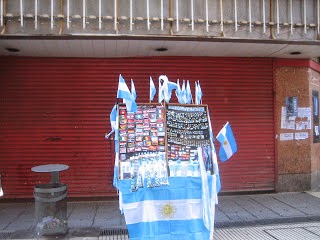
In 2010, we were in Buenos Aires, Argentina, for the great ALIO-INFORMS Conference. The World Cup that year was taking place in South Africa. Buenos Aires was replendant in celebrating its team. Spain won that year (and got eliminated early in 2014). Coincidentally, Dr. Celso Ribeiro gave a tutorial on sports scheduling at this conference, with a focus on soccer, which I enjoyed very much. A special issue of ITOR was edited on the tutorials and I also had one with Q. Qiang.
I have spent almost 2 of the past several months in Europe, being based primarily in Sweden (which did not, however, qualify for the 2014 World Cup). I have also been going to conferences in Erice (deja vu), in Taormina, also in Sicily, and in Greece. I have met up with may operations researchers at these venues and together we have cheered on many teams. I enjoy listening to the announcers in different languages.
The photo below was taken in Italy about 2 weeks ago, shortly before Italy was eliminated from the 2014 World Cup, and we commiserated with our many Italian friends.
I was disappointed that Greece lost last night especially since Greece was the most recent country at which I was at an operations research conference and it was a truly special one - as readers of my blog know. We recently celebrated Professor Pardalos' 60th birthday with a conference in Chalkidiki, Greece, at which I took the photo below, from the ferry. Many more photos are here.
The Costa Rican goalie, Keylor Navas, who was instrumental in Costa Rica beating Greece in last night's game, has made headlines with his amazing plays. Afterwards, I enjoyed his quotes, in which he emphasizes his family (and how he kept on thinking of them during last night's game against Greece): I try to be a good father. I tried to be a good friend and in such a beautiful sport as football, I always try to have my kids happy so when they grow up, they can look back and they can see a father who did important things for their country.
It is great that the USA has made the round of 16, although it lost to Germany in its latest match, and tomorrow it will be very exciting to watch the USA team play against Belgium.
Congratulations to all of the teams that qualified for this terrific 2014 World Cup in Brazil!
Brazil deserves our congratulations for uniting the world as we watch the beautiful game being played at its venues.
I know of two colleagues in Operations Research who have tickets to several of the games in Brazil and I hope to catch their faces on TV at upcoming matches, Dr. Celso Ribeiro, the Editor of the journal, International Transactions in Operational Research (ITOR), and Dr. Mauricio Resende, of AT&T.
This year, as in 2010, 2006, and even 2002, I have been spending weeks during the spring and summer out of the USA, and those have also been World Cup years.
In 2002, I was living with my family in Innsbruck, Austria, where I held a Distinguished Fulbright at the SOWI Business School at the University of Innsbruck. Brazil won the tournament that year, beating Germany.
In 2006, which was my sabbatical year at Harvard, I traveled to Limassol. Cyprus, to speak at the 12th International Conference on Computing in Economics and Finance, June 22 - 24, 2006 and then to Iceland, for the 21st European Conference on Operational Research, Iceland, July 2-5, 2006, and, finally, to Erice, Sicily, to give an invited talk at the INTERNATIONAL SCHOOL OF MATHEMATICS G. STAMPACCHIA 44th Workshop: VARIATIONAL ANALYSIS AND PARTIAL DIFFERENTIAL EQUATIONS, Erice, Sicily, July 5-14.
I was with many operations researchers in Erice, when Italy beat France in the 2006 World Cup, an experience we will never forget because of the celebrations that followed and somehow I made it back the next day via Alitalia to Boston and with my hearty congratulations to the staff got upgraded to Business Class!
The below photo is of several of the Erice workshop participants, including Professor Panos Pardalos of the University of Florida, watching the final game!
In 2010, we were in Buenos Aires, Argentina, for the great ALIO-INFORMS Conference. The World Cup that year was taking place in South Africa. Buenos Aires was replendant in celebrating its team. Spain won that year (and got eliminated early in 2014). Coincidentally, Dr. Celso Ribeiro gave a tutorial on sports scheduling at this conference, with a focus on soccer, which I enjoyed very much. A special issue of ITOR was edited on the tutorials and I also had one with Q. Qiang.
I have spent almost 2 of the past several months in Europe, being based primarily in Sweden (which did not, however, qualify for the 2014 World Cup). I have also been going to conferences in Erice (deja vu), in Taormina, also in Sicily, and in Greece. I have met up with may operations researchers at these venues and together we have cheered on many teams. I enjoy listening to the announcers in different languages.
The photo below was taken in Italy about 2 weeks ago, shortly before Italy was eliminated from the 2014 World Cup, and we commiserated with our many Italian friends.
The Costa Rican goalie, Keylor Navas, who was instrumental in Costa Rica beating Greece in last night's game, has made headlines with his amazing plays. Afterwards, I enjoyed his quotes, in which he emphasizes his family (and how he kept on thinking of them during last night's game against Greece): I try to be a good father. I tried to be a good friend and in such a beautiful sport as football, I always try to have my kids happy so when they grow up, they can look back and they can see a father who did important things for their country.
It is great that the USA has made the round of 16, although it lost to Germany in its latest match, and tomorrow it will be very exciting to watch the USA team play against Belgium.
Congratulations to all of the teams that qualified for this terrific 2014 World Cup in Brazil!
Tuesday, April 20, 2010
Air Travel Disruption Twice As Long as After 9/11 and Counting
The air travel disruptions and chaos due to the ash spewing from the Eyjafjallajokull Volcano in Iceland have now lasted 6 days, twice the period of time that air travel to/from the US was shut down following 9/11. Hundreds of thousands of travelers have been affected, and even the British navy was enlisted to try to ferry some of its stranded citizens (with not complete success). Flowers and farm products are rotting in warehouses in Kenya (since these usually are distributed to Europe by air cargo flights), travelers have been camped out for days in the JFK airport as well as in affected airports in Europe. Artists and musicians cannot make their appointed events in the US. Student groups from the US have had their dream trips to Europe abandoned due to the flight cancellations, and athletes have been unable to compete in the Boston Marathon and in a world skating event in France, since they have been unable to reach their destinations. Of course, academics have also been unable to give talks abroad since their flights have been canceled, as well.
Even President Obama and Chancellor Angela Merkel of Germany canceled their appearances at the funeral of President Lech Kaczynski of Poland and his wife, Maria, who, along with dozens of other Polish dignitaries, perished tragically in a place crash in Russia recently. Chancellor Merkel had to take quite the circuitous route and combination of modes of transportation (even riding a bus from northern Italy to Germany) to make it back from the US because of the air travel disruptions.
The Dow Jones Newswire is reporting that Asian chip and cellphone makers could be affected if the European air space closure does not end soon. Although most electronic products from Asia are shipped by sea, smaller products such as cellphones and ships are transported by air. Samsung spokesman James Chung, was quoted as saying in the report, If this volcano problem lasts longer than expected, it would have a direct impact on Samsung's chip and cellphone exports. The crisis is costing the European economy alone billions of dollars in lost business. Airlines, already suffering from economic woes, are sustaining losses of hundreds of millions of dollars a day.
Now The New York Times is reporting that a new ash cloud is looming from the Iceland volcano whose recent eruption has affected travel and economic activity from Beijing to New York!
While this natural event has been evolving and has impacted broad swaths of the civilized world, and has resulted in major economic damage (plus personal discomfort and dislocation for many), I have been busy at work completing a paper (in which the volcanic eruption is noted). The paper, Fragile Networks: Identifying Vulnerabilities and Synergies in an Uncertain Age, is a synthesis of my recent work with Professor Patrick Qiang on network vulnerability and robustness and how to identify which nodes and links in network systems (including transportation ones and the Internet) are the most important. The paper also discusses synergies associated with exploiting network structure from corporate mergers and acquisitions to teaming of humanitarian organizations in the case of disasters for logistics operations. The paper is an invited one for the journal, International Transactions in Operational Research, and is the topic of the tutorial that I will be presenting at the ALIO-INFORMS International Meeting to be held in Buenos Aires, Argentina, June 6-9, 2010.
Even President Obama and Chancellor Angela Merkel of Germany canceled their appearances at the funeral of President Lech Kaczynski of Poland and his wife, Maria, who, along with dozens of other Polish dignitaries, perished tragically in a place crash in Russia recently. Chancellor Merkel had to take quite the circuitous route and combination of modes of transportation (even riding a bus from northern Italy to Germany) to make it back from the US because of the air travel disruptions.
The Dow Jones Newswire is reporting that Asian chip and cellphone makers could be affected if the European air space closure does not end soon. Although most electronic products from Asia are shipped by sea, smaller products such as cellphones and ships are transported by air. Samsung spokesman James Chung, was quoted as saying in the report, If this volcano problem lasts longer than expected, it would have a direct impact on Samsung's chip and cellphone exports. The crisis is costing the European economy alone billions of dollars in lost business. Airlines, already suffering from economic woes, are sustaining losses of hundreds of millions of dollars a day.
Now The New York Times is reporting that a new ash cloud is looming from the Iceland volcano whose recent eruption has affected travel and economic activity from Beijing to New York!
While this natural event has been evolving and has impacted broad swaths of the civilized world, and has resulted in major economic damage (plus personal discomfort and dislocation for many), I have been busy at work completing a paper (in which the volcanic eruption is noted). The paper, Fragile Networks: Identifying Vulnerabilities and Synergies in an Uncertain Age, is a synthesis of my recent work with Professor Patrick Qiang on network vulnerability and robustness and how to identify which nodes and links in network systems (including transportation ones and the Internet) are the most important. The paper also discusses synergies associated with exploiting network structure from corporate mergers and acquisitions to teaming of humanitarian organizations in the case of disasters for logistics operations. The paper is an invited one for the journal, International Transactions in Operational Research, and is the topic of the tutorial that I will be presenting at the ALIO-INFORMS International Meeting to be held in Buenos Aires, Argentina, June 6-9, 2010.
Friday, April 16, 2010
Scenes from Iceland before the Chaos Due to the Volcanic Eruption and the Air Travel Disruptions
The above photos include one of the Blue Lagoon, the sea outside the capital, Reykjavik, and even a birthday cake in the downtown of Reykjavik to celebrate the birthday of a bank there. We also went on a whale watch but after 4 hours on the rocky sea we only saw lots of open sea and puffins (but no whales). Since that trip on a boat I have not ventured out on any other.
Subscribe to:
Posts (Atom)