Showing posts with label Argentina. Show all posts

Saturday, December 3, 2022

Looking Forward to Delivering My IFORS Distinguished Lecture in Buenos Aires!

I was deeply honored to have been selected an IFORS (International Federation of Operational Research Societies) Distinguished Lecturer.

I will deliver my Distinguished Lecture at CLAIO, which will take place in Buenos Aires, Argentina, December 12-15, 2022. Information on the conference can be accessed here.

The IFORS Distinguished Lecture program started in 1999 and the full list of previous lecturers can be found here. I find it quite remarkable that I have had the pleasure of meeting quite a few Operations Research scholars on this list!

It was such a delight to receive the letter below from IFORS.
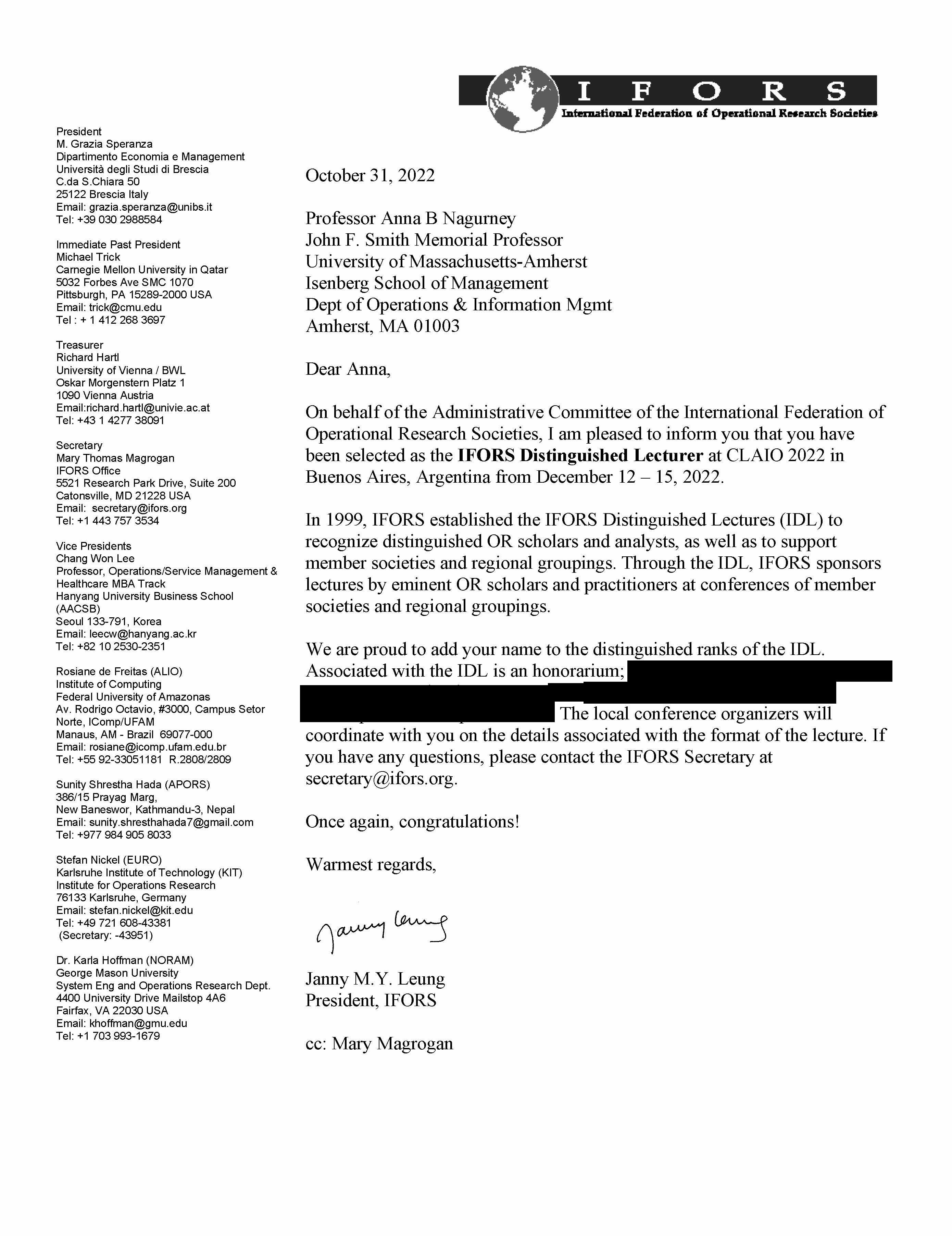
The title of my lecture is, "Human Migration Networks: How Operations Research Can Assist with Refugees and Supply Chain Labor Shortages."


I published my first paper on human migration networks, amazingly, in 1989, and the research has continued, with many wonderful co-authors. During the COVID-19 pandemic, our research on human migration networks intensified, because of the additional challenges and also increasing refugee flows as well as labor shortages in many economic sectors around the globe. Even now we are working on another human migration network paper that focuses on coalitions and social welfare.

I have very much enjoyed working on my lecture. It is dedicated to essential workers who have sustained us in the COVID-19 pandemic with acknowledgment of all the freedom-loving people on the planet including those fighting for their freedom in Ukraine. 

Some of the papers that I will be highlighting in my lecture are: a paper published in the Journal of Global Optimization, co-authored with Professors Patrizia Daniele and Ladimer S. Nagurney, on refugee networks, and the paper that I wrote and which was published in Operations Research Perspectives, which integrates human migration networks with labor in supply chain networks.

I will also highlight research that we published in the IFORS journal, International Transactions in Operational Research, on policy interventions for bringing human migration population distributions in line with system optimization.

I very much appreciate that IFORS posted the statement below on Russia's war against Ukraine on its homepage.


Coincidentally, the last time that I was in Buenos Aires, which was in June 2010 for the ALIO-INFORMS Conference, the World Cup was taking place and I blogged the experience. And, now, the World Cup is again taking place, but in the month of December, and in Qatar, and I will be back in Buenos Aires! I leave you with several photos that I took in Buenos Aires.


And congratulations to Argentina for making it to the quarterfinals of the World Cup today!

Sunday, July 13, 2014

Soccer Won - the 2014 World Cup

After Germany beat Argentina in the 2014 FIFA World Cup final today with Germany being crowned the champion of this monthlong competition in which 32 countries competed with their soccer teams, I took a walk.

I needed to process this World Cup, which I think was the best ever in terms of the drama, athleticism, surprises, and outcome. I have written two previous posts on this World Cup.

Seeing Gotze score with an amazing goal for Germany with the result that Germany won 1-0 against Argentina in overtime was quite special. The ball he bounced off his chest and then kicked it into the net.

During my walk I ran into one of my wonderful colleagues at the Isenberg School of Management, Professor Mzamo Mangaliso, with whom I always enjoy conversing. After discussing the game and the outcome he said to me: "Anna, soccer won!"

I thought that was such an astute comment that it inspired me to write my third and final post on this World Cup.

It kept us mesmerized and in suspense for a month. I watched games while in Europe - in Sweden, Italy, and Greece, and then many more upon my return to the US.

What also impressed me today was realizing that the three heads of governments of countries who were so visible today - Germany, Argentina, and Brazil, the wonderfuul host of this World Cup, are all women. Now, isn't that terrific?!

It was great to see Angela Merkel, the Chancellor of Germany,  supporting the German team from the stands in her bright red suit jacket with gold buttons and then congratulating the players and the coach when they received the 18 karat gold trophy and individual gold medals. Also, the President of Brazil, Dilma Rousseff, was present at the award ceremony today, and Brazil deserves congratulations on the success of this World Cup. Finally, the President of Argentina is Cristina Fernández de Kirchner and although Argentina did not win, its team captain, Lionel Messi, received the Golden Ball award and others were honored as well.

The fireworks following the final game were magical in Rio.

The World Cup brought the world together for a month and kept us entertained and surprised.

That is the power of sport and of soccer.

Until the next World Cup.

Friday, December 24, 2010

What a Year it Was!

It was the best of times, it was the worst of times, it was the age of wisdom, it was the age of foolishness, it was the epoch of belief, it was the epoch of incredulity, it was the season of Light, it was the season of Darkness, it was the spring of hope, it was the winter of despair, we had everything before us, we had nothing before us, we were all going direct to heaven, we were all going direct the other way ... Charles Dickens from his novel, A Tale of Two Cities.

The beginning of 2010 was marked, for many of us, by the news of the horrific earthquake that struck Haiti last January 12; with the suffering of its people continuing to this day. It was followed, only two days after, by a "local" shocking event, that happened only one town over from Amherst, and that circulated around the world -- the suicide of 15 year old Phoebe Prince.

As educators and researchers, the above deeply tragic events, had some of us refocus our energies. And, of course, some of us also had personal and familial tragedies to deal with. But as is said, what doesn't kill you, makes you stronger.
At the same time, there were so many "best of times" and some of my highlights, as a professor, I list below.

  • My former student and my co-author of the Fragile Networks book, Dr. Patrick Qiang, was honored with the Charles V. Wootan Award last January by the Council of University Transportation Centers in Washington DC for his doctoral dissertation, Network Efficiency / Performance Measurement with Vulnerability and Robustness Analysis with Application to Critical Infrastructure. Last March, Dr. Qiang joined me in giving a tutorial on the theme of our book at the SBP 2010 Conference at NIH. I then further disseminated our research in my tutorial at the ALIO-INFORMS Conference in Buenos Aires, which brought me, for the first time, to the continent of South America.
  • A female PhD student of mine, Trisha Woolley (now Anderson) received her PhD in 2010 and assumed her Assistant Professorship at Texas Wesleyan University.Her dissertation title: Sustainable Supply Chains: Multicriteria Decision-Making and Policy Analysis for the Environment. She was my 15th PhD student to graduate and my 6th female.
  • We celebrated the graduation of our wonderful undergraduate students from the Isenberg School last May -- another highlight of 2010!
  • A former doctoral student of mine, Dr. Tina Wakolbinger, received an offer of a Full Professorship from the Vienna University of Economics and Business, a position which she will start next May, having been an Assistant Professor at the University of Memphis since receiving her PhD in 2007. Her research in humanitarian operations and, more recently, on electronic recycling, and that of my other former students and collaborators, give me hope for a better future.
  • Two present doctoral students of mine had notable successes with their research: Min Yu had two papers accepted for publication, including: "Supply Chain Network Design for Critical Needs with Outsourcing," co-authored with Patrick Qiang and me. Also, Amir Masoumi completed the paper, with Min and me, entitled: "Supply Chain Network Operations Management of a Blood Banking System with Cost and Risk Minimization."
  • The UMass Amherst INFORMS Student Chapter, that I serve as the Faculty Advisor of, received the Magna Cum Laude Award for its activities at the INFORMS National Meeting in Austin, Texas last November. They have started both a Facebook page and are on twitter, thanks to the chapter's new President, Nathan Kollett.
  • The Network Science conference in Yalta brought me to the country of the birthplace of my parents, Ukraine, whereas the Computational Management Science conference at the University of Vienna brought together so many of my favorite colleagues from around the globe.
  • As for the INFORMS conference in Austin, Texas, thanks to all for the wonderful memories!
  • Also, thanks to all of my undergraduate and graduate students (both present and former ones) for being so special and so terrific! You will help to change the world for the better!

Let me end with the words of a new community service organization, Count Me In, that was started in South Hadley, in response to the tragedy of Phoebe Prince's suicide, and an article on which appears in today's Daily Hampshire Gazette.

This organization has its motto emblazoned on the backs of its t-shirts:

Respond with integrity and kindness/Embrace diversity/Stand up courageously for others/Promote a climate of safety/Eliminate hurtful words and rumors/Care for and listen to others with compassion/Take responsibility for my actions.

The above words should be followed in our daily lives.

Monday, July 12, 2010

World Cup Postcard from Argentina -- 1 Month and 1 Day

On June 11, 2010, the 2010 World Cup began and that was the same day that we mailed a postcard to ourselves from Buenos Aires, Argentina, where I spoke at the ALIO-INFORMS conference.

Remember that today is July 12, 2010, the day after the ending of this World Cup in South Africa. I am pleased to report that the postcard that we sent to ourselves (since we love to track how long deliveries can take) arrived today! It took 1 month and 1 day and, strangely enough, it had a side trip to Mexico. Perhaps it was because Argentina beat Mexico in this World Cup?!

We started getting messages from relatives and friends in the past 10 days or so that our postcards to them from Buenos Aires were trickling in.

I wish that there had been a GPS tracker on this card because I am sure that the journey that it took was fascinating from a transportation point of view.

Above is what we are calling our infamous World Cup postcard. We whited out our address, which was present, so that was not the excuse for this extreme snail mail delivery.

At least it did arrive, finally!

Saturday, July 3, 2010

The Final Four in the 2010 World Cup

Rather than having 3 South American teams in the final four of the 2010 World Cup in South Africa, as many were predicting, we have 1 team from South America left, from Uruguay (who beat Ghana yesterday with penalty kicks), and three European teams: The Netherlands (who beat Brazil 2-1), Germany (who beat Argentina 4-0 today), and Spain (who beat Paraguay today 1-0).

Next week, Uruguay will play against The Netherlands, and Spain will play against Germany.

The New York Times had a wonderful article on Diego Maradona, the coach of the Argentinian team, which, I suspect, he may even have time now to read. I heard that his top player, Lionel Messi, was not feeling well on Thursday and missed practice (perhaps that affected his team's performance today).

Congratulations to all the teams who played their hearts out at this World Cup. From my perspective as a spectator and a huge World Cup fan, they all deserve standing ovations.

Thursday, June 17, 2010

Even Hillary Clinton was in Argentina


In honor of the great World Cup win by Argentina today against South Korea to the score of 4-1, I have posted the above photos that I took in Buenos Aires last week where I attended the ALIO-INFORMS conference.

In the top photo above is a nice note from Hillary Clinton who dined at the Cafe Tortoni in Buenos Aires, a cafe that we also had the pleasure of eating at last week. I also recommend La Biela in La Recoleta, a very historic part of Buenos Aires, whose charming waiters gave us many extra pieces of exquisite dark chocolate.

If you'd like to see more photos of Buenos Aires, please see my earlier blogposts. The New York Times has front page coverage today about the Argentine soccer coach, Maradona, and his team's star player, Messi. Maradona, who is considered one of the top former soccer players ever, has promised to run naked through the streets of Buenos Aires should Argentina win the World Cup. He continues to coach his team at the World Cup matches dressed in a gray suit, which, as many have noticed (and despite the elegance of the people of Buenos Aires) does not fit him well.

Also, Professor Peter Lohmander of Umea, Sweden has kindly posted gorgeous photos that he took while at the same operations research conference in Buenos Aires . His photos may be accessed here.

Sunday, June 13, 2010

The Greening of the Metropolis


On my flights back from the ALIO-INFORMS in Buenos Aires, Argentina I had the distinct pleasure of reading the latest issue of Bloomberg Businessweek. There was a special segment in it on Clean Energy and an excellent article, "The Greening of the Metropolis." With cities being home to more than half of the world's population and generating more than two thirds of the world's carbon dioxide, greening of our megacities can make a significant difference in improving the environment.

I am hopeful. With the leadership of some of the biggest cities in the world taking proactive, creative steps to reduce emissions, much can be accomplished especially since regions and nations are failing to act.

Kudos to Los Angeles and its mayor, Antonio Villaraigosa, for 1,700 miles of bike paths that are to be completed by 2015, complete with showers and bicycle storage areas.

Bravo to the mayor of Toronto, David Miller, who plans on investing over $1 billion in public transport and environmentally-friendly air-conditioning systems for buildings.

In Tokyo, where, amazingly, 68 percent of the trips are by bike, subway, or on foot, in April a cap and trade system was instituted for carbon dioxide that is city-wide. As for Houston, Texas, where an astonishing 95% of the trips are made by car, at least officials are getting electric cars to reduce emissions.

Robert Doyle, the Lord Mayor of one of my favorite cities, Melbourne, in Australia, plans to bar cars from downtown and to offer incentives for green investments.

Copenhagen, in Denmark, is spending over a billion and a half dollars on bike paths, green energy projects, and retrofitting city buildings.

Amsterdam's infrastructure is being improved to the tune of 1 billion dollars, with its 2,400 houseboats being retrofitted to use electricity instead of diesel.

New York City, one of my absolutely favorite cities, since I grew up in Yonkers, is moving forward with its PlaNYC, to make buildings more energy efficient, power plants more environmentally-friendly, and with tax breaks for the use of solar panels.

Having spent over a week recently in another megacity -- Buenos Aires, Argentina, with about 11 million people in the central and surrounding areas, I know that much needs to be done.

The architecture of this city is stunning as are the neighborhoods with unique identities, and the lively, warm people and culture.

However, the traffic is horrendous with the busses running frequently but on diesel and their evident fumes spewing and belching out. Not only do they emit toxic pollutants but the noise that they generate is substantial. As one former Argentine physics colleague of my husband's, dating back to our Brown University days, told us during a lovely 3 hour dinner in Buenos Aires: when the busses go on strike, the people notice how much cleaner the air gets and how much more peaceful the city is even with more cars! Ironically, in parts of the developing world, getting rid of public transit with aging engines may actually improve air quality.

A better approach (and our colleague told us that he expects that this may happen but it will take about 10 years), is for the city of Buenos Aires (where 1/3 of Argentina's population lives) to purchase busses with the latest green technologies and with quieter designs.

Above are photos taken from the 14th floor of the Etoile Hotel in Buenos Aires where we spent last week. In the photos one can see the famous La Recoleta Cemetery where Eva Peron is buried and the Law School with the big columns, where the operations research conference that I attended and spoke at took place.

My talk at the ALIO-INFORMS conference was on "Sustainable Supply Chain Network Design: A Multicriteria Perspective" and it certainly hit "close to home." The paper is available here and the pdf of the presentation is here.

The Dogs and their Walkers in Argentina


Travel is always eye-opening and opens one's eyes as a travel guide never can.

Having returned from a stay in Buenos Aires, Argentina, where I attended a professional conference, I continue to be amazed at the number of dogs and their walkers that we encountered.

The above photos were taken in Buenos Aires during the past week.

The last photo above is of a dog named Rubio, who lives in the area of Buenos Aires known as La Recoleta, where we stayed at the Etoile hotel. The restaurant goers and waiters at the numerous outdoor cafes keep Rubio well-fed and quite content.

We have been told that the dogwalkers can walk up to 12 dogs at a time. As in North America, the golden retrievers and the chocolate labs love to play with tennis balls.

Saturday, June 12, 2010

The World Cup has begun and Argentina


Yesterday, I was still in Buenos Aires, Argentina, spending 1 day touring after the ALIO-INFORMS conference. The city was filled with the Argentine flag and numerous decorations to commemorate the first day of the 2010 World Cup in South Africa. While dining and getting ready to head for the airport to catch a flight back to Dulles and then to Bradley, I caught glimpses of the South Africa vs. Mexico game (score 1-1) and the France vs. Uruguay game (score 0-0) plus some of the opening ceremonies prior.

There are numerous large TV screens in Buenos Aires so that people can watch the World Cup soccer matches.

After a very comfortable flight on United from Buenos Aires to Dulles of about 10 and a half hours but a less than comfortable processing at immigration and security at Dulles with long queues and some sort of strange call for a meeting at 7:00AM for the customs and immigration workers, we just made it to our last flight from Dulles early this morning.

While unpacking, back in Amherst, we caught parts of the Argentina vs. Nigeria game in which Argentina won 1-0 with Maradona as its soccer team's coach.

Above are some photos taken in Buenos Aires, Argentina during the past week marking the World Cup festivities. I am sure that the country is celebrating with its victory in the World Cup today.

The sport of football/fusbol/soccer brings the world together during the World Cup, which takes place this year from June 11-July 11, 2010, in a terrific display of athleticism, cameraderie, appreciation of other cultures, and just pure fun!

At the ALIO-INFORMS conference in Buenos Aires, I very much enjoyed Dr. Celso Ribeiro's plenary talk on how his research was applied to construct the schedules for Brazil's soccer teams, with great success. I especially enjoyed listening to the importance of "fairness" in the schedule and how such constraints were incorporated into the optimization model.

Thursday, June 10, 2010

Faces at INFORMS Conference in Buenos Aires


Today was the first day that I could catch my breath since arriving in Buenos Aires, Argentina last Saturday to attend the ALIO-INFORMS conference. The conference was a whirlwind experience with about 1,000 conferees in attendance and just over 100 from the US. Giving a talk, taking part in a panel on international collaborations, plus attending an editorial board meeting, and giving a tutorial on Fragile Networks, still left me some time to attend both plenary talks and keynote talks as well as another tutorial (besides my own).

What a colleague said to me yesterday, I agree with -- in addition to the scientific exchanges that take place at an international conference, what makes such events so special is the people that you meet from colleagues from around the world that you get to see again and to reconnect with to new friends that are made.

Above are some photos taken at some of the above conference events that I mentioned earlier.

More photos and reflections can be found in several of my earlier blogposts.

The atmosphere in Buenos Aires, with the beautiful pale blue sky and the fascinating architecture and boulevards, plus the fantastic food and elegant people (and numerous dogs and dogwalkers), all make for a truly unique and special conference venue.

Wednesday, June 9, 2010

The Magic of Buenos Aires


The ALIO INFORMS conference that attracted operations researchers from around the world has come to an end. The organizers should be congratulated for an excellent conference. I will be writing additional blog posts about the conference but, in the meantime, in addition to the previously posted photos on this blog from Buenos Aires, Argentina I share some addtional ones with you above.

Monday, June 7, 2010

First 48 Hours in Buenos Aires, Argentina


I arrived in Buenos Aires, Argentina after about 17 hours of travel. It is Fall here but the weather is perfect with sunny skies and temps in the 60s.


The ALIO INFORMS conference has begun and I have met conferees from around the globe.


Above are some snapshots taken in Buenos Aires during my first 48 hours here.


The elegance of the city and its charms are apparent as is the warmth of the people here. Knowing Spanish is a clear advantage and it is great to have an opportunity to speak this language.

Friday, June 4, 2010

Operations Research Tutorials at ALIO-INFORMS Conference

There is a wealth of tutorials at the very soon to take place ALIO-INFORMS Conference, as well as exciting plenary talks and keynote speeches. The venue is Buenos Aires, Argentina, which has been called the "Paris of the South."

The topics of the tutorials and plenary and keynote speeches are varied and exciting and include a wide spectrum: from optimization in sports to portfolio management, OR education, revenue management, dynamic games, humanitarian operations, telecommunications applications, cliques in graphs, among others. The full list can be read here.

Mike Trick has a blog post that he is also off to the conference and has been working on his tutorial.

I am sure that this conference will be covered well by the bloggers in attendance and plan on posting from Buenos Aires!

The tutorial that I will be giving is on Fragile Networks: Identifying Vulnerabilities and Synergies in an Uncertain Age and I have made the slides available (along with those for a presentation and for the International Collaborations panel that I will be on). An invited paper, based on this tutorial, and in press in the journal, International Transactions in Operational Research, joint with my co-author of the Fragile Networks book, can be downloaded (in pdf format).

Wednesday, June 2, 2010

International Collaborations Panel

I am very much looking forward to the ALIO-INFORMS Conference that will take place in Buenos Aires, Argentina, June 6-9, 2010. Besides giving a talk on Sustainable Supply Chain Network Design at the conference and an invited tutorial: Fragile Networks: Identifying Vulnerabilities and Synergies in an Uncertain Age, which is on the theme of my latest book with Professor Patrick Qiang, I will be on a panel: International Collaborations. The panel was organized by Professor Sadan Kulturel of Pennsylvania State University Berks and is sponsored by WORMS (Women in Operations Research and the Management Sciences). Dr. Kulturel has assembled a great group of panelists that I am honored to be included with: Dr. Karla Hoffman of George Mason University, Dr. M. Gulnara Baldoquin of the Higher Polytechnic Institute in Cuba, and Dr. Lorena Pradenas of Concepcion University in Chile. More information on the panelists can be accessed here with a press release from Penn State Berks on this panel available here.

Each panelist will give a 10 minute presentation followed by questions and answers.

My presentation on my personal experiences and reflections on international collaborations is available here (complete with a lot of photos)

I am very much looking forward to this conference and to participating in the panel and discussions and I thank Dr. Sadan Kulturel for organizing this special panel.

Tuesday, April 20, 2010

Air Travel Disruption Twice As Long as After 9/11 and Counting

The air travel disruptions and chaos due to the ash spewing from the Eyjafjallajokull Volcano in Iceland have now lasted 6 days, twice the period of time that air travel to/from the US was shut down following 9/11. Hundreds of thousands of travelers have been affected, and even the British navy was enlisted to try to ferry some of its stranded citizens (with not complete success). Flowers and farm products are rotting in warehouses in Kenya (since these usually are distributed to Europe by air cargo flights), travelers have been camped out for days in the JFK airport as well as in affected airports in Europe. Artists and musicians cannot make their appointed events in the US. Student groups from the US have had their dream trips to Europe abandoned due to the flight cancellations, and athletes have been unable to compete in the Boston Marathon and in a world skating event in France, since they have been unable to reach their destinations. Of course, academics have also been unable to give talks abroad since their flights have been canceled, as well.

Even President Obama and Chancellor Angela Merkel of Germany canceled their appearances at the funeral of President Lech Kaczynski of Poland and his wife, Maria, who, along with dozens of other Polish dignitaries, perished tragically in a place crash in Russia recently. Chancellor Merkel had to take quite the circuitous route and combination of modes of transportation (even riding a bus from northern Italy to Germany) to make it back from the US because of the air travel disruptions.

The Dow Jones Newswire is reporting that Asian chip and cellphone makers could be affected if the European air space closure does not end soon. Although most electronic products from Asia are shipped by sea, smaller products such as cellphones and ships are transported by air. Samsung spokesman James Chung, was quoted as saying in the report, If this volcano problem lasts longer than expected, it would have a direct impact on Samsung's chip and cellphone exports. The crisis is costing the European economy alone billions of dollars in lost business. Airlines, already suffering from economic woes, are sustaining losses of hundreds of millions of dollars a day.

Now The New York Times is reporting that a new ash cloud is looming from the Iceland volcano whose recent eruption has affected travel and economic activity from Beijing to New York!

While this natural event has been evolving and has impacted broad swaths of the civilized world, and has resulted in major economic damage (plus personal discomfort and dislocation for many), I have been busy at work completing a paper (in which the volcanic eruption is noted). The paper, Fragile Networks: Identifying Vulnerabilities and Synergies in an Uncertain Age, is a synthesis of my recent work with Professor Patrick Qiang on network vulnerability and robustness and how to identify which nodes and links in network systems (including transportation ones and the Internet) are the most important. The paper also discusses synergies associated with exploiting network structure from corporate mergers and acquisitions to teaming of humanitarian organizations in the case of disasters for logistics operations. The paper is an invited one for the journal, International Transactions in Operational Research, and is the topic of the tutorial that I will be presenting at the ALIO-INFORMS International Meeting to be held in Buenos Aires, Argentina, June 6-9, 2010.