Showing posts with label Brown University. Show all posts

Thursday, June 3, 2021

Tracking Down Who Was the First Female Full Professor in OR in the World and Giving Credit Where Credit Is Due

In the past few days I have been quite busy and not just with the preparation of plenary talks for conferences this month and the writing of papers. I have been approached through emails by males in both the US and the UK to answer (or to try to answer) the following question - who was the first female Full Professor of Operations Research (OR) in the world? This question arose, and it is an important one, because of the passing of Dr. Ailsa Land, short of her 94th birthday, on May 16, 2021.  I had written a blogpost celebrating her and also Marguerite Frank, both then of age 93. Dr. Land was the recipient of the Harold Larnder Prize, the Beale Medal (first female to receive these major awards), and will also receive posthumously the EURO Gold Medal at the EURO 2021 Conference in Athens, Greece, next month. 

Please refer to this obituary for Dr. Land, prepared by the institution she had received her PhD from and had worked at for many years - the London School of Economics (LSE).

Graham Rand and Laszlo Vegh (who was prominent in the blogpost I noted above) were preparing another obituary for Dr. Ailsa Land and were wondering whether she may have been the first female Full Professor of  OR in the world. She received this title at LSE in 1980. I was also contacted by Mark Eisner, who chaired for many years the INFORMS History & Traditions Committee that I had also served on, trying to determine who was the first such female professor in the US to achieve the rank of Full Professor in OR. And, of course, my PhD advisor at Brown University, Stella Dafermos, about whom I have blogged on multiple occasions, came to mind, as did Judith Liebman, who, like Stella, received a PhD in OR from Johns Hopkins University. Stella received her PhD in 1968 and Judith in 1971. We knew that Judith had become Full Professor at the University of Illinois in 1984. I had written several obituaries when Stella Dafermos passed away in 1990 but these did not contain the year at which she became a Full Professor.

Time was running short and this morning a message came from the UK: "We are running out of time Anna." No pressure on me, of course! I then sent a message to Stella's husband, a Chaired Professor of Applied Math at Brown (and had sent multiple messages to others in the meantime), Dr. Constantine Dafermos. He graciously went to campus and told me that Stella became a Full Professor at Brown University in 1982 with appointments both in the Division of Applied Mathematics and Engineering. There is more to this, but left for another time and post.

I also sent a message out on Twitter and am grateful to all those across the globe who are trying to identify whether there was a female in OR who became a Full Professor before 1980.

In the meantime, Graham Rand, with support, has completed another obituary for Dr. Ailsa Land, and we feel quite "safe" in that she was the first female Full Professor of OR (called Operational Research) definitely in the UK, and probably in the world! If additional information to the contrary becomes available, you will hear from me. 

But the plot thickens. In trying to identify what year exactly Stella Dafermos became a Full Professor at Brown and I know that she was the first female Full Professor in both Applied Mathematics and in Engineering because I was her first PhD student and we worked closely together on many papers I came upon several "news releases" from Brown University that attributed others as being the "first." Stella, sadly, passed away at age 49 on April 1990, so she can't speak for herself but I can, so  I am.  The following article, from Brown University Engineering, no less, identifies the first female Full Professor of Engineering as getting this appointment in 2008 -- 26 years after Stella!


Giving credit where credit is due is imperative and I hope that my alma mater, Brown University, makes appropriate corrections! How easily, it seems, major institutions, and that includes research universities, can "forget" the legacy of females. 

I shared the above "oversights" with Professor Constantine Dafermos today, and he wrote me back a message that I will treasure, which included, in part: "... the obstacles that women of that generation had to overcome cannot be overemphasized. It is a good fortune that the success of several, though not enough, outstanding women like you have turned things around." 

As a scientist and as a researcher, we seek the truth. Much work remains to be done and speaking out plays a role. Thank you for reading! And, if anything needs correcting, please, let me know!


Saturday, April 4, 2020

Marking the 30th Anniversary of the Passing of Dr. Stella Dafermos, the Second Female PhD in Operations Research in the World

During the COVID-19 pandemic, many of us are hearing from relatives and friends, from far and wide, offering support during these extremely challenging times.

Last week, I heard from my Brown University room-mate, with whom I shared a dorm room for 2 years. She was also a fellow Applied Math major, with a love of Operations Research, and an exceptional ballerina from South America, who then became a member of Brown's women's crew team. I co-founded the Brown Women's track team.

My room-mate wrote to me: "Stella Dafermos has appeared on my horizon these days. I can see Stella, wearing her grey knitted vest, writing on the blackboard, remember? It may well be that we’re living one of those math models she was trying to explain back then."

And then in a follow-up message last week, she continued: "I have a memory, crystal clear in my mind’s eye: we were sophomores, we were in our room (4th floor Diman), I am looking at my notes from her latest class, literally turning the notebook upside down and sideways to see if any of it would make any sense, thinking I really don’t think this is for me..  you were changing into your running clothes, munching on an apple, you come over, eye the notes and say.. oh, yeah, there it is, that’s good! You’ll get it!   And off you go running. I didn’t get it, but later, much, much later, from Vedic texts where they teach how our reality is actualized out of infinite probabilities, well, now the value of those lessons is evident."

Interestingly, unlike my room-mate, I never had Stella while I was an undergraduate student at Brown but I would hear about her from other female Applied Math majors. 

Dr. Stella Dafermos, the second female to receive a PhD in Operations Research (OR), passed away on April 5, 1990, so we now mark the 30th anniversary of her passing.  She was the only female Professor in the Divisions of Applied Math and Engineering at Brown at that time, and I became her first PhD student. Although she passed away at the age of 49, her incredible legacy on contributions to transportation and networks, notably, continues. Her contributions were recognized in an obituary that I wrote for the journal Operations Research, the only female thus honored. Her PhD was from Johns Hopkins University in 1968, and she was surrounded by luminaries in OR there.
Below is the academic genealogy tree, with academic ancestors including Maxwell, Newton, and Galileo. It, in an expanded form, with my PhD students, hangs in my office for inspiration. You can see the list of my PhD students, with the latest, Deniz Besik, to be added soon, here.


And, in a very interesting blogpost by the esteemed Dr. Mike Trick, who happens to be not only a fellow Canadian by birth, but also my academic cousin, you can read more.

Stella passed away on a Thursday. I was that year a Visiting Scholar at the Sloan School of MIT, and, shortly after I received the phone call about her death, I gave a talk at the OR Center. Such resilience is needed now, more than ever. I recall Professor Jim Orlin coming to my office to support me. Interestingly, Dr. Les Servi, now of MITRE (and with whom I also corresponded this week), was on sabbatical at the Sloan School then, and also offered much appreciated support. 

My husband drove us to the funeral, which was on the following Saturday. I remember the daffodils at the cemetery on beautiful Blackstone Boulevard and also some snow falling. I always consider daffodils to be Stella's flower because of her surname "Dafermos."  I wrote a tribute to my "Academic Mother" here.  I also wrote a bit on my personal journey in another post, in which I recognised the 20th anniversary of her passing.

One of Stella's paper (on variational inequalities, of course) is among the most impactful ones published in the INFORMS journal Transportation Science in 50 years!

Wednesday, April 18, 2018

The Great 2018 INFORMS Business Analytics Conference with Some Photos

The 2018 INFORMS Business Analytics Conference, which took place in Baltimore, MD, April 15-17, 2018, was fantastic! The conference brought together over 1,000 leading analytics professionals and industry experts (executives, analysts, managers, researchers, data scientists, modelers, etc.) from around the globe to exchange ideas, network, and learn about the exciting results, insights, and opportunities generated by analytics. This is one of my favorite conferences to speak at and to attend because of the interactions with industry professionals, representatives from government, and fellow academics as well as numerous students. Below are the smiling faces of the speakers!

I flew in on Southwest on Sunday and returned back last night feeling energized and with my brain swimming with new ideas and I expect new collaborations as well. What I found especially delightful was seeing many fellow operations researchers and analytics professionals. I had very pleasant exchanges with conferees from the US, Sweden, Mexico, Turkey, Colombia, Serbia, Germany, and Japan. Honestly, I can't think of another conference that provides a better return on investment in terms of what you get out of it per unit time!

My room on the top floor of the Marriott Waterfront Baltimore had a fabulous view and it was very convenient since all the sessions and social events took place an elevator ride down.
The talk that I presented was on cybercrime and cybersecurity and it can be downloaded here.

Getting selected to speak involves a competitive screening process so I was thrilled to be able to speak on some of our latest research on this topic. The previous INFORMS Analytics Conference that  I had spoken at and also thoroughly enjoyed was in Boston in 2014.

The conference began for me with the super dynamic plenary talk by Bill Schmarzo, who, coincidentally, is also an Executive Fellow at the University of San Francisco, where my most recent Isenberg School PhD student alumna, Dr. Shivani Shukla, is now an Assistant Professor, and with whom I wrote several papers on cybersecurity. I took copious notes and enjoyed hearing him say that it's insight from data that matters and that one must start with the business. He spoke on the monetization of data and the leveraging of predictive and prescriptive analytics in order to optimize. I loved his discussion of data being an "unusual currency."
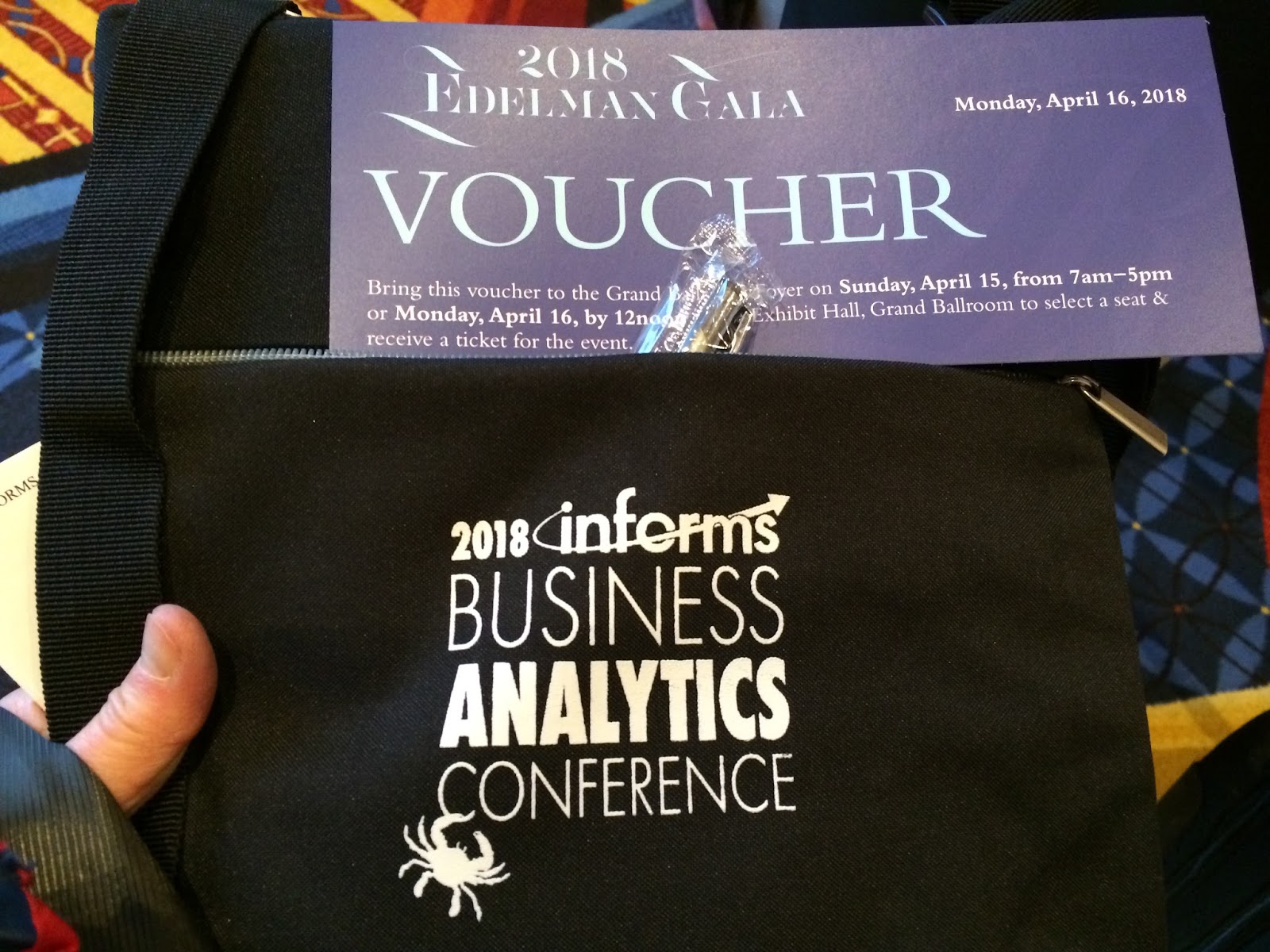
In our registration packets we were provided with a lot of nice conference "swag," including a beautiful blue notebook and a very cool conference bag.
Meals were provided, including the gala Edelman dinner on Monday night (more on this later).

The plenary talk by Bruce Greenstein, the CTO at the US Department of Health and Human Services, which he told us is the largest single government department in the world, was also excellent and took place bright and early on Tuesday morning at 8AM. His presentation was on: From Data to Analytics: How to Solve Complex Health Problems.
Greenstein spoke on Secretary Azar's focus, which includes combating the opiod crisis, bringing down the high cost of prescription drugs (and here he emphasized increasing competition, which is great), and transforming the healthcare system to a value-based system. He spoke of his unique position in connecting various departments and bridging the technical divide and also emphasized the improvement of analytics at HHS through the sharing of data, bringing in experts, and chipping away at the culture. There was even an opioid-code-athon that was very successful and I especially appreciated hearing about the "prevention track," which focused on predicting and analyzing the supply and movement of legal and illicit opioids (sounds like a network flow problem to me and probably even related to the network models that I spoke of on Monday at the conference). There is even now a Co-Lab at HHS, which is an enterprise data initiative, and led by Will Yang.

I had the pleasure of listening to Greenstein's plenary while seated next to Dr. Les Servi of MITRE and Professor Tamas Terlaky of Lehigh University.
Les and I go back to Brown University days and he was on the organizing committee of the conference and we hosted him recently in our UMass Amherst INFORMS Speaker Series. Professor Terlaky led the group that was awarded the 2017 Daniel H. Wagner Prize for Excellence in Operations Research Practice, for “The Inmate Assignment and Scheduling Problem and its Application in the PA Department of Corrections." I went to his talk on this outstanding project and enjoyed it thoroughly. Both Les and Tamas are INFORMS Fellows.

Other highlights at the conference, in addition to the outstanding talks that I attended, which were 50 minutes in length so you can really learn something, and which included those by Professor Jim Cochran of the University of Alabama and Dr. Mary Helander of IBM, was seeing Dr. Michael Prokle, a former doctoral student from UMass Amherst, now a data scientist at Phillips Research in Cambridge,  and taking part in "coffee with a member." Michael was the President of the UMass Amherst INFORMS Student Chapter and I nominated him for the INFORMS Judith Liebman Award, which he received. Coincidentally, we had both been at the Boston Analytics conference, where  the weather was also cold and rainy.
I very much enjoyed meeting and having coffee with Sarah Greenwood, who is pursuing a graduate degree in analytics, and already has several years of experience working in industry. It is thrilling to see such outstanding individuals excelling in STEM!
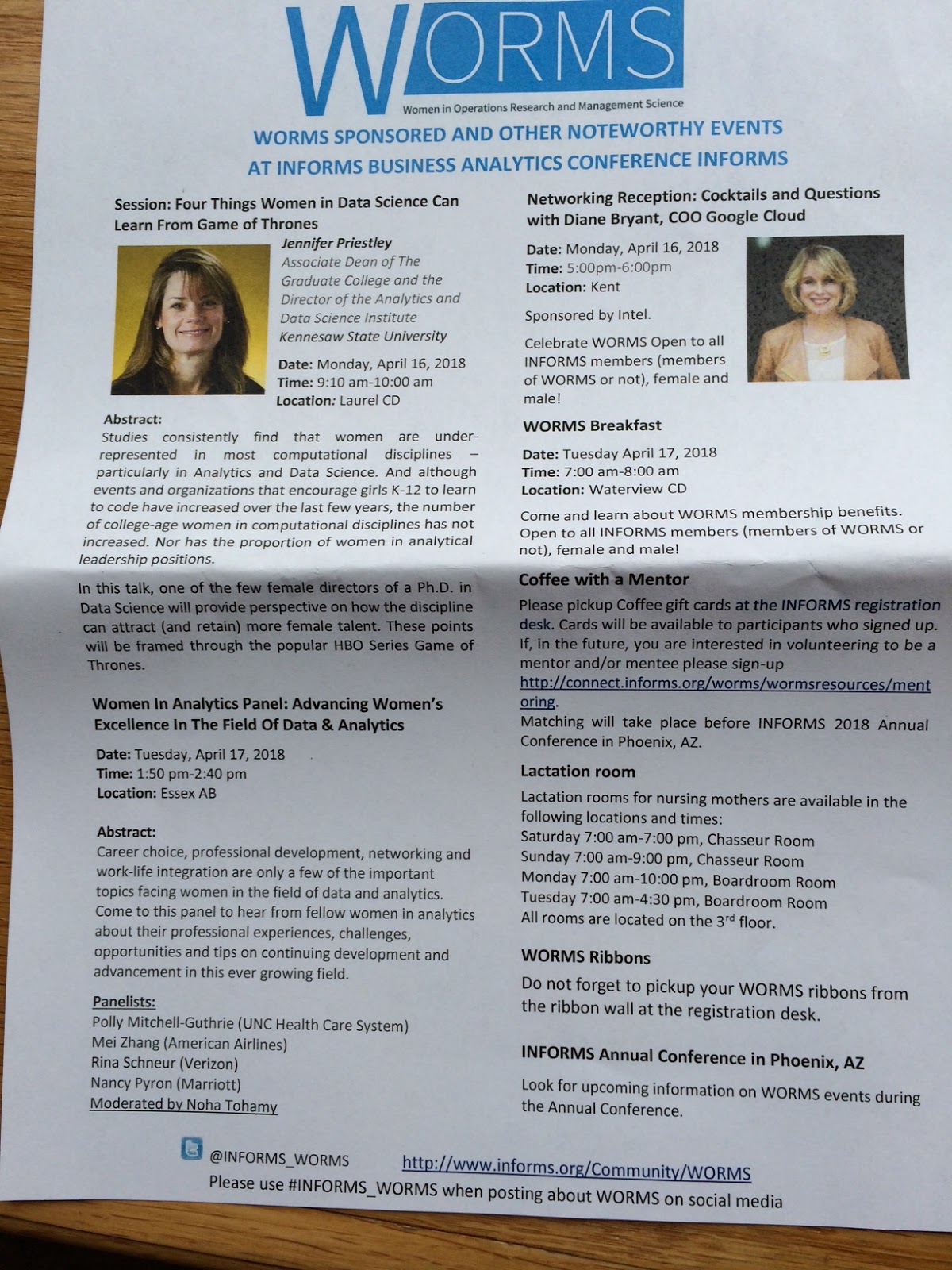
I would also like to point out and thank WORMS (Women in Operations Research and the Management Sciences), one of my absolutely favorite fora of INFORMS! And, would you believe that years ago I found out about WORMS from my male PhD students at the Isenberg School of Management, who told me that they loved many of the conference events organized by WORMS, so I joined!
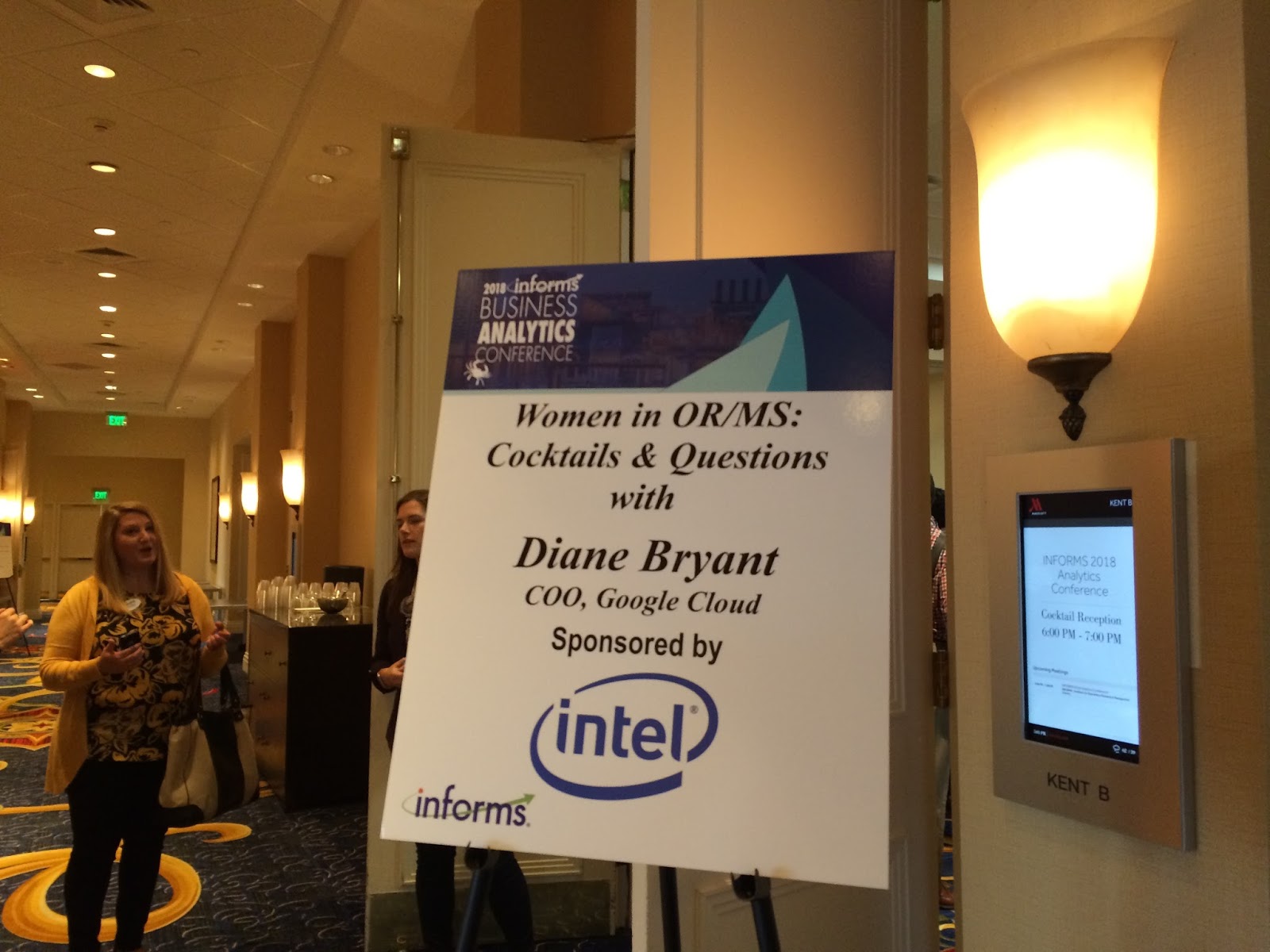
The networking reception at which the COO of Google Cloud, Diane Bryant, spoke was standing room only and incredibly interesting. She is a former VP at Intel and was one of only 6% of female VPs until she, with others, started to emphasize being a sponsor/advocate of female employees. I loved some of the takeaways:

  • If you are a good leader, you are advocating.
  • Luck is manufactured: one has to be open to new ideas - we create our own luck.
  • And, quoting Madeleine Albright: "there is a special place for women who don't help women."
  • Also, from an HBS Review article:" Women have mentors; men have sponsors."
  • Confidence is a core leadership skill. 
  • Diversity is a fact: inclusion is a choice.
The Q&A session that followed was provocative and I told her that she should write a book and I would be more than willing to help her with it.
At this session, I was joined by truly special colleagues.
And, since Michael Prokle was the President of our UMass Amherst Student Chapter when we hosted INFORMS Fellow Dr. Radhika Kulkarni, VP of SAS, I had to have the photo below taken as a memento. Also in the photo is Dr. Mary Helander of IBM, who has also spoken in our Speaker Series!
Of course, going to exhibits is also enjoyable and it was great to see my book, Competing on Supply Chain Quality, co-authored with a former doctoral student of mine, Dr. Dong "Michelle" Li, on display at the Springer booth. Many thanks to the Senior Editor, Matt Amboy, for displaying it.

And, speaking of students, INFORMS hosted a student competition, and I spoke with groups from Turkey and Colombia, who were finalists.
I have not heard, yet, who received the first prize, since I had to leave the lunch early yesterday to catch my flight.

And, on Monday evening, those at the conference had the honor and pleasure of taking part in the Edelman gala banquet and awards ceremonies, hosted by Dr. Don Kleinmuntz of  Kleinmuntz Associates and the University of Notre Dame, who was a magnificent emcee! At the 2014 Boston conference, we had the pleasure of Dr. Anne Robinson being the emcee at that Edelman gala, at which the US CDC received the Edelman Award for the eradication of polio.

The food at the dinner was delicious as was the company at our table.

And a HUGE congratulations to the winners of the 2018 Edelman prize and to all the finalists! The award went to the US Federal Communications Commission (FCC) for advancing wireless communications. The team included INFORMS Fellows: Dean Mike Trick of CMU and Professor Karla Hoffman of George Mason University! I can't help but mention that one of the coaches of the winning team was Dr. Irv Lustig of Princeton Consultants - I was his TA from the Operations Research course at Brown University when he was an undergraduate and I was a PhD student. Amazingly, two of the awards noted on Monday night have Brown University connections! Franz Edelman, after whom the Edelman Award is named, received his PhD in Applied Mathematics from Brown University (and so did I). Also, Daniel Wagner, after whom the Wagner Prize is named, received his PhD, also from Brown University, in mathematics! I enjoyed hearing my alma mater being noted twice at the gala dinner on Monday night and it is quite amazing that both Les Servi and Irv Lustig and I overlapped during part of our Brown U. days!

I would like to end this blogpost with a big thanks to the INFORMS staff for making this conference so enjoyable and rewarding.

I wish everyone safe travels back from the conference! When I landed at Bradley, my shuttle driver told me about the terrifying Southwest plane engine failure on the flight from LaGuardia to Dallas, which had an emergency landing in Philadelphia.   Thinking of those injured and the loss of life and the terror and fright  that all must have experienced.

Sunday, April 16, 2017

He Took the Shortest Route to Get to Work at Brown University and That Involved Climbing a Stone Wall - Rest In Peace, Professor Martin Beckmann!

The email came from his daughter on Thursday, saying that Professor Martin Beckmann, a renowned economist, regional scientist, transportation scientist, and operations researcher, had died two days previously, on April 11, at the age of 92. There would be an informal memorial service at his home in Providence, Rhode Island, on Saturday, April 15, also stated in his obituary.

Immediately, and despite it being a three day holiday weekend in Massachusetts, my husband and I responded that we would be coming.

I had written a tribute to Professor Beckmann, when he turned 90 years old, and had sent him a special card from Sweden, where I was spending time then as a Visiting Professor. Martin had been on my doctoral dissertation committee at Brown University and was the last surviving member, since my advisor, Stella Dafermos, had passed away at age 49, and the other committee member, George Majda, at age 51.

The news of his passing stunned me, and I communicated it to both the operations research and transportation science community and to the Regional Science Association International (RSAI) Fellows. The response was immediate and global in scale. I thank all those who replied with remarkable memories and anecdotes about this truly unique gentleman and scholar, whose impact, through his books and papers, his friendship and mentorship, and his joie de vivre,  have left a legacy that will live on. Martin Beckmann was recognized with numerous awards, including the Robert Herman Lifetime Achievement Award from the Transportation Science Section (now the Transportation Science & Logistics Society) of INFORMS.

In 2005, at the INFORMS National Meeting in San Francisco, I organized two sessions honoring the 50th anniversary of the publication of his classic book, Studies in the Economics of Transportation, with  C. Bart McGuire and Christopher B. Winsten (who had passed away). Beckmann and McGuire, and their spouses came, and then I treated a big group to lunch. We also presented the living authors with a special plaque from Yale University. More info, including presentations, can be viewed here. 
The photos below are from this event and you might be able to identify so many stars in transportation in the first photo below!
David E. Boyce, Hani S. Mahmassani, and I wrote an article on the impact of that book.

And, when my first book was published, Network Economics: A Variational Inequality Approach, I carried copies with me to a conference in Mallacootta, Australia, at which Martin was also an invited speaker.  He caught that I missed a minus sign in my presentation, which took place at about 9PM, after we had been on a boat tour, and he was right! I thought that he had been napping. The photos below are from that amazing conference - and, yes, I was the only invited female to take part.

The last time that I saw Martin Beckmann was at a symposium at Northwestern University organized in his honor by Hani S. Mahmassani in January 2010. Below are photos from the symposium.

However, in the title of this blogpost is a stone wall. Below is the stone wall, in front of Martin's home in Providence that he climbed to get to work at the Economics Department at Brown University, and then hiked through the Aldrich-Dexter Field, since it was the shortest way to work (and back home again).  His work on transportation network behavior, and location theory was fundamental, and has influenced both theory and practice. How fitting that Martin, who had been born in Germany and survived WW II, managed to optimize in both life and research. I will never forget what he taught me through his presence, his scholarship, and his incredible ability to enjoy travel, food, music, and people - wherever we met - in the US, in Europe (especially Sweden, and The Netherlands), and in Australia.

The memorial service yesterday,  at which I spoke with his son and three daughters, as well as grandchildren, and other relatives, childhood friends of his children, who, along with them, climbed the stone wall, and other structures at Brown University, and even multiple faculty of Brown University, from economists to a renowned biologist,  was truly special.  And I felt Martin's presence and even saw one of my professors from the economics department, from whom I took a grad class and got an A in. I recognized his eyes and smile.

My dissertation advisor, Stella Dafermos, was born on April 14 and had died on April 4, 1990. Now I have added April 11, 2017 to my memory bank of a date on which the community lost another brilliant mind and personality.

Monday, August 17, 2015

A Magical Wedding of a Brown University PhD and Colleague

After spending a total of 8 weeks in various countries in Europe and South America conducting research and speaking at multiple conferences it has been nice to be back in Amherst before the new academic year begins.

Academics in the summer keep very busy (I am in the process of finishing up writing a 400 page book) and we continue to work with our students.

Summer is also a time for weddings and "academic" weddings are a lot of fun since they also, very often, serve as reunions.

Yesterday, my husband and I had the pleasure of attending a beautiful wedding of a colleague of his, Dr. Ying Yu,  who received her PhD from Brown University in engineering.  In attendance were also her dissertation advisor from Brown, Professor Harvey Silverman, whom we have known for many years, and his lovely wife, who has 3 Brown degrees (in Math and Computer Science). Professor Silverman  has a PhD from Brown. The bride was Professor Silverman's 22nd PhD student. She did a postdoc in Italy before joining the engineering faculty at the University of Hartford. This year she received her promotion to Associate Professor with tenure!

My husband has 2 graduate degrees from Brown, including his PhD, which is in physics, and I have 4 degrees from Brown, including my PhD in Applied Math with a specialty in Operations Research.

Below are some photos of the wedding, which took place at Saint Clements Castle in Connecticut.

The ceremony was outdoors followed by a reception and a lavish dinner with scrumptious desserts and dancing. The parents of the bride could not make it from China but their letter was read in Chiene and translated. Many colleagues from the University of Hartford, as well as staff, came to the wedding to help Ying celebrate. The wedding party had two female professors, one of engineering, and one of computer science. Needless to say, the conversations over dinner were on high tech topics.

We wish the newlywed couple, Ying and Eric, much happiness!


Below are the Brown University alums.
I attended the wedding of one of my PhD students, Dr. Trisha Woolley Anderson,  a few years ago. It  was a great reunion with other former PhD students in attendance.  I wrote about the experience in the blogpost: I was the Academic Mother of the Bride.