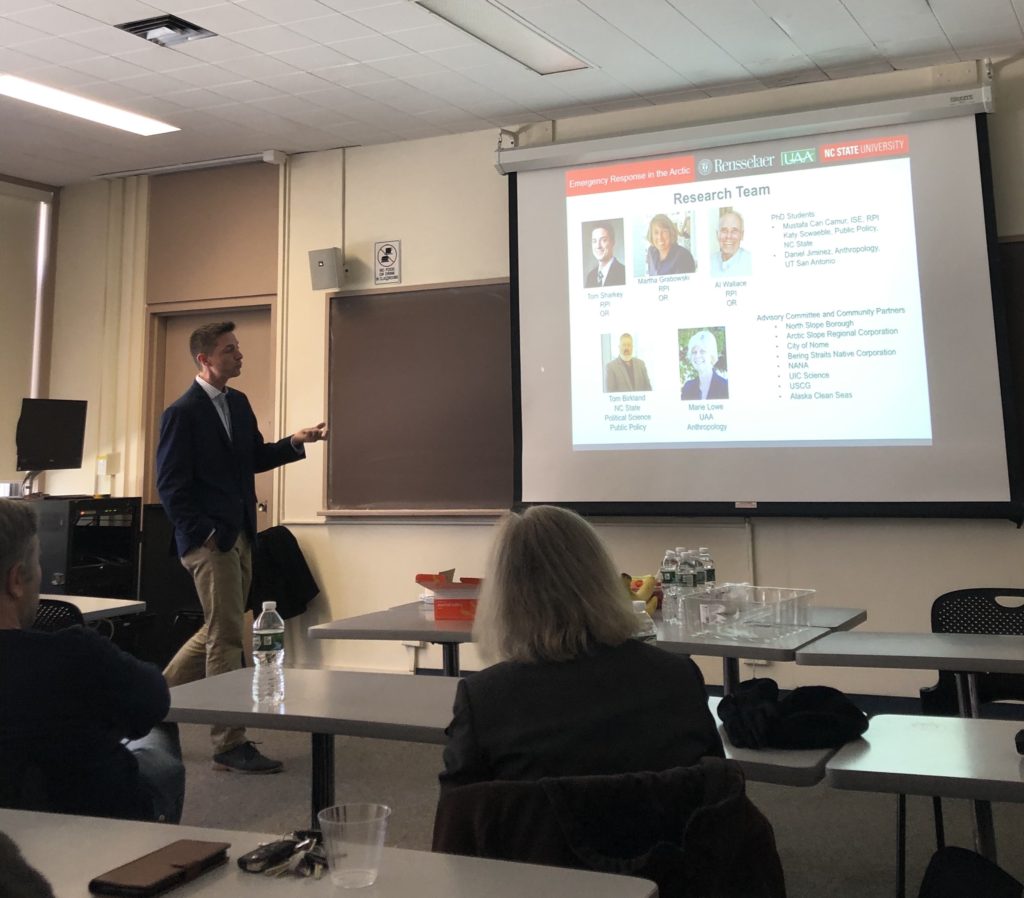
Recently, we had the great pleasure of hosting RPI Professor Tom Sharkey in our UMass Amherst INFORMS Speaker Series. His talk, based on an NSF-funded research project, was extremely timely and fascinating.
In fact, an article on this project, co-authored by Professor Sharkey with his project collaborators, including Professor Al Wallace of RPI, was the cover story in the November issue of ISE Magazine and is definitely worthwhile to read.
His talk attracted an audience of faculty and students from multiple departments and schools at UMass Amherst, including the Isenberg School, the College of Engineering, and also the College of Natural Sciences and Mathematics.
It was a pleasure to introduce Professor Sharkey - I had last seen him this past March when I gave a talk at RPI. Since then, a PhD alumna of RPI's ISE program, whose PhD advisor was Professor Wallace, Dr. Anne P. Massey, has become the first female Dean of the Isenberg School - very exciting!
Professor Sharkey emphasized the interdisciplinary nature of the project in his presentation and noted that the team is working on constructing Operations Research (OR) models to help in emergency response (ER), while also helping communities. Collaborators, outside of RPI faculty, include a professor at NCState and one at the University of Alaska.
He noted the changes that are happening in the Arctic, including tourism and increasing commercial activity, as well as the possibility of broadened maritime shipping, and the various associated challenges from uncertainty in sea conditions to shortcomings in infrastructure, including broadband. He stated that, even without oil exploration, there is still the possibility of spills. The shipping time from China to Rotterdam has now been decreased by 10-14 days. And, when it comes to ER, mobilization may be bottlenecked by the limited capacity of a community. Infrastructure investments take a while to build out. He discussed the need to determine the minimum budget required in order to achieve a certain response time in an emergency.
Also, he emphasized that there may be unintended consequences and it is important to identify who actually benefits from infrastructure investments.
Professor Sharkey described a mass rescue event, with accompanying network figure, in the case of the need to rescue cruise ship evacuees. His talk clearly resonated with me since we have done a lot of work on disaster relief and, to-date, I have co-edited two volumes on Dynamics of Disasters, with Professors Ilias S. Kotsireas and Panos M. Pardalos.
In 2016, I hosted the visit of Rasmus Dahlberg, who is a disaster researcher, based in Denmark (and also a novelist and TV and radio personality). After Sharkey's visit to UMass Amherst, I connected the two of them, due to their very similar interests in Arctic emergency response research. Dahlberg is also a practitioner in this important domain. He also has a contributed chapter in the first Dynamics of Disasters (DOD) volume that I co-edited and spoke at the first DOD conference that I co-organized in Kalamata, Greece.
Professor Sharkey spoke abut identifying "dual-use" infrastructure planning, a concept I like very much. For example, improved "connectivity" for Arctic regions is an important goal, in transport (in terms of roads and ports) as well as in communications. Fast and reliable Internet could then allow for telemedicine, as well as teleeducation in the Arctic. Of course, he also brought up the important question: "Who is going to pay?"
There were many questions during and after his very information talk. We took a group photo and then enjoyed a lunch at the University Club. We thank Professor Sharkey for his excellent, very inspiring lecture in our Speaker Series!
Also, we celebrated, with cake, 15 years of the UMass Amherst INFORMS Student Chapter (30 semesters of great speakers in its Speaker Series)!
Professor Sharkey was interviewed after the lunch for the chapter's youtube channel, and, when the approved video is posted, we will let everyone know via social media.
In the meantime, many thanks to the outstanding UMass Amherst INFORMS Student Chapter, and to its Officers, for their amazing work, that brings all those interested in Operations Research/Management Science throughout UMass Amherst (and beyond) closer together as a community, both professionally and socially.
Showing posts with label RPI. Show all posts
Sunday, November 24, 2019
Sunday, March 31, 2019
Delightful Surprises During My Visit to Speak at RPI on Disaster Relief
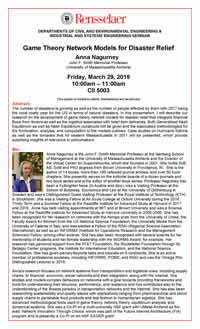
This past Friday, I had the pleasure of speaking at RPI (Rensselaer Polytechnic Institute) in Troy, New York, at 10AM, so the day began quite early with a two hour drive from Amherst, MA. I was hosted by two Engineering departments and had been invited to give a talk there a year ago but my schedule did not permit a visit until now.

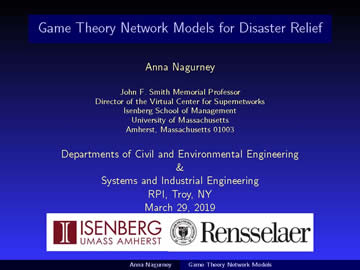
I had given my host, Professor David Mendonca, a list of topics that I could speak on and the one selected was: Game Theory Network Models for Disaster Relief.

My talk is available for download and it was exciting to polish it since, in just the past three weeks, three of our papers on the topic have been published in journals, including: An Integrated Financial and Logistical Game Theory Model for Humanitarian Organizations with Purchasing Costs, Multiple Freight Service Providers, and Budget, Capacity, and Demand Constraints, Anna Nagurney, Mojtaba Salarpour, and Patrizia Daniele, International Journal of Production Economics 212: (2019), pp 212-226.
The drive on the Mass Pike was smooth, despite the rain, and my husband was the designated driver. He had not been to RPI since he had been accepted there for Grad School, but ended up matriculating at Brown University, so he was eager to go back. I had to check my cv to see when was the last time I had spoken at RPI and found that I had given a seminar at RPI at the Electrical, Computer, and Systems Engineering Department, December 5, 2001! I recall a lavish holiday party with white roses and shrimp that I viewed in passing.
Once the technology for my presentation was set up, I heard some footsteps behind me and was absolutely thrilled to see one of my Operations and Information Management students from the Isenberg School of Management - Emily Agoglia! She had been a student in my Humanitarian Logistics and Healthcare class at Isenberg, is from Philadelphia, and is a world traveler, having most recently taken part in an academic program in Cuba! And she presented me with the lovely memento from Cuba below.
She had been in Cuba, when I was speaking and taking part in the amazing Congreso Futuro in Chile, so when we get together, we cannot stop comparing experiences. Her father is Professor Chris Agoglia, a renowned Accounting faculty member at Isenberg.
And, there was another delightful surprise - Professor William "Al" Wallace, who is now the Chair of the Department of Industrial and Systems Engineering at RPI, came to my talk. He was the doctoral dissertation advisor of the incoming Isenberg School Dean - Dr. Anne P. Massey! Dr. Massey will be the first female Dean of the Isenberg School and it has an illustrious history of over 70 years. In fact, this coming Friday, we will be celebrating the 50th anniversary of our PhD program! I am very excited since many of my former PhD students will be coming back to campus. I am preparing a talk and have organized the Management Science PhD alumni panel for that day.
The photo below is of me with Professor Wallace and Emily.
After my talk, I had the pleasure of meeting with Professors Sergio Pequito, Thomas Sharkey, and Kristin Bennett. Sergio and I talked about our love of interdisciplinary work. With Thomas "Tom" we discussed his thrilling NSF project on the Arctic and he recently returned from Alaska, so I had to take the photo below. We also chatted about colleagues Dr. Renata Konrad of WPI (a fellow Ukrainian, whom we hosted in our UMass Amherst INFORMS Speaker Series) and Dr. Kayse Maas of Northeastern (and, of course, we then talked about the NSF workshop on human trafficking). Professor Bennett remembers me from way back when when she was in Amherst and from one of her first INFORMS conferences and thanked be for being an inspiration (that and many other surprises made that rainy day a very bright one)! She received her PhD from University of Wisconsin Madison and Dr. Olvi Mangasarian was her PhD advisor.
The lunch was at the RPI Faculty Club where I enjoyed great conversations with Professors David Mendonca, Kristen Schell, and Cara Wang, and ate a spicy lunch with purple rice!
Dr. Cara Wang is a Professor of transportation and her advisor was Professor Kara Kockelman of UT Austin. I know Kara from the regional science community. Interestingly, Cara had been at Bucknell University and then moved to RPI. Coincidentally, we recently hosted Dr. Thiago Serra in our UMass Amherst INFORMS Speaker Series and he is off to Bucknell University as an Assistant Professor in the Fall. Also, Dr. Kristen Schell is a relatively new faculty member of ISE at RPI and received her PhD from CMU in engineering policy. Our IE/OR doctoral student, Destenie Nock at UMass Amherst, defended her dissertation recently and will be joining that program as an Assistant Professor in the Fall.
And I would be remiss to forget to mention that Professor David Mendonca is an undergrad alumnus of UMass Amherst, and my Management colleague, Professor Emeritus Art Elkins, had convinced him to go to CMU since the Nobel laureate in Economic Sciences Herbert Simon was there (I had had dinner with Dr. Simon in Amherst at the Lord Jeffery Inn a while ago.) Dr. Mendonca collaborates with a cognitive psychologist, Dr. Wayne Gray at RPI, who is a Lafayette College alumnus, from the same class as my husband, so he kindly kept my husband busy and very entertained while I was speaking and meeting with colleagues!
On our journey back, we turned on the radio, only to hear UMass Amherst hockey score its first goal in its game against Harvard University and they won 4-0; they repeated their amazing performance yesterday evening against Notre Dame University, also with a score of 4-0, and are now off to the NCAA Frozen Four for the first time in the history of UMass Amherst hockey! The first game in the final will be on April 11, right when we are having a special banquet at the Isenberg School for the $62 million Business Innovation Hub celebration with the official unveiling (although we have been using it already a lot since late January) on April 12.
Subscribe to:
Posts (Atom)