Showing posts with label UMass Amherst INFORMS Speaker Series. Show all posts

Sunday, November 24, 2019

Great Talk on Emergency Response in the Arctic by Professor Tom Sharkey of RPI

Recently, we had the great pleasure of hosting RPI Professor Tom Sharkey in our UMass Amherst INFORMS Speaker Series.  His talk, based on an NSF-funded research project, was extremely timely and fascinating.
In fact, an article on this project, co-authored by Professor Sharkey with his project collaborators, including Professor Al Wallace of RPI,  was the cover story in the November issue of ISE Magazine and is definitely worthwhile to read.

His talk attracted an audience of faculty and students from multiple departments and schools at UMass Amherst, including the Isenberg School, the College of Engineering, and also the College of Natural Sciences and Mathematics.

It was a pleasure to introduce Professor Sharkey - I had last seen him this past March when I gave a talk at RPI. Since then, a PhD alumna of RPI's ISE program, whose PhD advisor was Professor Wallace, Dr. Anne P. Massey, has become the first female Dean of the Isenberg School - very exciting!


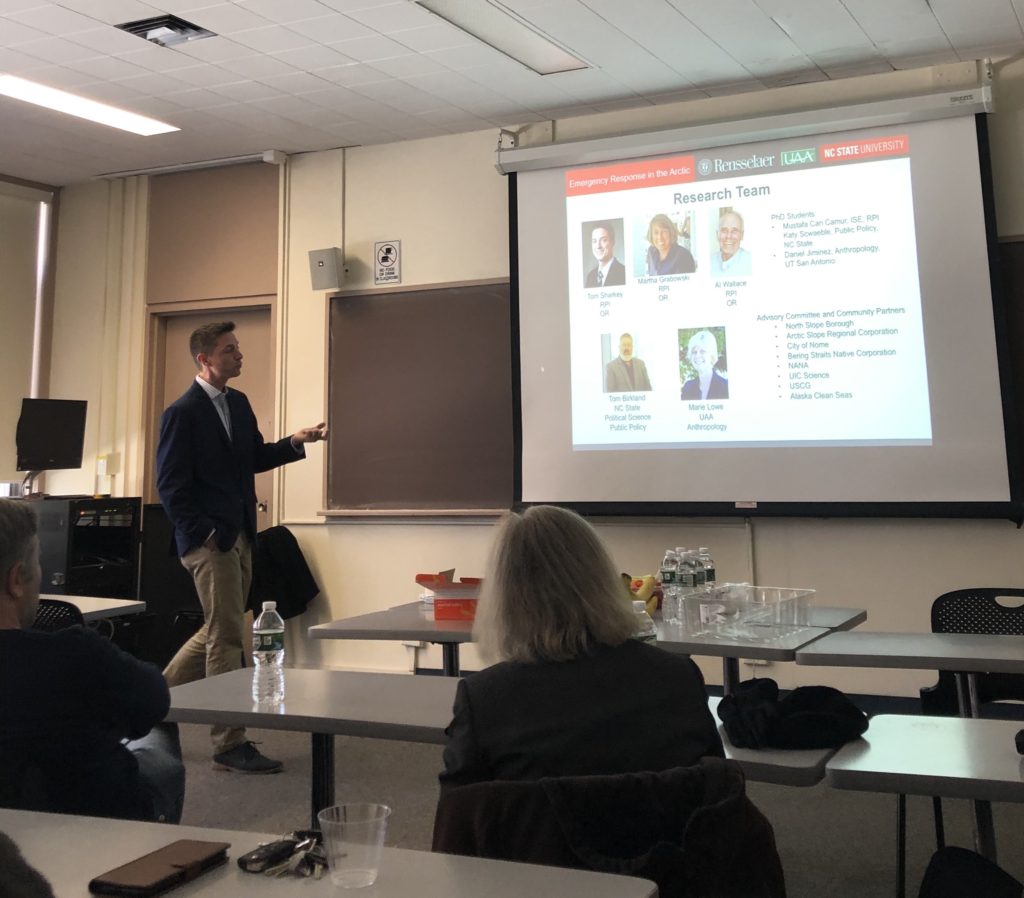
Professor Sharkey emphasized the interdisciplinary nature of the project in his presentation and noted that the team is working on constructing Operations Research (OR) models to help in emergency response (ER), while also helping communities. Collaborators, outside of RPI faculty, include a professor at NCState and one at the University of Alaska.

He noted the changes that are happening in the Arctic, including tourism and increasing commercial activity, as well as the possibility of broadened maritime shipping,  and the various associated challenges from uncertainty in sea conditions to shortcomings in infrastructure, including broadband. He stated that, even without oil exploration, there is still the possibility of spills. The shipping time from China to Rotterdam has now been decreased by 10-14 days. And, when it comes to ER, mobilization may be bottlenecked by the limited capacity of a community. Infrastructure investments take a while to build out. He discussed the need to determine the minimum budget required in order to achieve a certain response time in an emergency.

Also, he emphasized that there may be unintended consequences and it is important to identify who actually benefits from infrastructure investments.

Professor Sharkey described a mass rescue event, with accompanying network figure, in the case of the need to rescue cruise ship evacuees. His talk clearly resonated with me since we have done a lot of work on disaster relief and, to-date, I have co-edited two volumes on Dynamics of Disasters, with Professors Ilias S. Kotsireas and Panos M. Pardalos.

In 2016, I hosted the visit of Rasmus Dahlberg, who is a disaster researcher, based in Denmark (and also a novelist and TV and radio personality).  After Sharkey's visit to UMass Amherst, I connected the two of them, due to their very similar interests in Arctic emergency response research. Dahlberg is also a practitioner in this important domain. He also has a contributed chapter in the first Dynamics of Disasters (DOD) volume that I co-edited and spoke at the first DOD conference that I co-organized in Kalamata, Greece.

Professor Sharkey spoke abut identifying "dual-use" infrastructure planning, a concept I like very much. For example, improved "connectivity" for Arctic regions is an important goal, in transport (in terms of roads and ports) as well as in communications.  Fast and reliable Internet could then allow for telemedicine, as well as teleeducation in the Arctic. Of course, he also brought up the important question: "Who is going to pay?"

There were many questions during and after his very information talk. We took a group photo and then enjoyed a lunch at the University Club. We thank Professor Sharkey for his excellent, very inspiring  lecture in our Speaker Series!
Also, we celebrated, with cake, 15 years of the UMass Amherst INFORMS Student Chapter (30 semesters of great speakers in its Speaker Series)!

Professor Sharkey was interviewed after the lunch for the chapter's youtube channel, and, when the approved video is posted, we will let everyone know via social media.

In the meantime, many thanks to the outstanding UMass Amherst INFORMS Student Chapter, and to its Officers, for their amazing work, that brings all those interested in Operations Research/Management Science throughout UMass Amherst (and beyond) closer together as a community, both professionally and socially.

Friday, March 23, 2018

Fabulous Talk by INFORMS Fellow Dr. Les Servi of MITRE on Robust Mission Network Analysis

After my return from almost 2 weeks in Europe, in addition to seeing my students, I was very much looking forward to the talk by Dr. Les Servi, which took place today in our UMass Amherst INFORMS Speaker Series.
Dr. Servi is a Group Leader at MITRE Corporation in Bedford, Massachusetts and is an INFORMS Fellow. I have known Les since our Brown University days in Applied Mathematics. He went on to get a PhD at Harvard and has had an illustrious career in industry. I stayed and received my PhD at Brown and became an academic.

The title of Les' talk today was: Robust Mission Network Analysis.

Deniz Besik, the President of the UMass Amhers INFORMS Student Chapter, and I had the pleasure of introducing our terrific speaker today.
In his talk, Dr. Servi emphasized the importance of finding useful patterns, and displayed a Dilbert cartoon, which noted that The Math should fix the guessing. His tweet on that cartoon he told us generated over 17,000 views.


In his talk, he described an extension of robust optimization in the context of functional dependency network analysis (FDNA), followed by analysis without hedging and then analysis with hedging.
His presentation was based, in part,  on two papers of his, and also more recent work, with the papers being: "Deriving Global Criticality Conditions from Local Dependencies Using Functional Dependency Network Analysis (FDNA)", which he co-authored with P.R. Garvey, and which was published in the journal Systems Engineering in 2017 and the paper: "The Last Word: A Modeling Model," which was published in the Phalanx in 2017. He kindly shared these two papers with me and the figure below is from the latter and it is a variant of the figure, featured above, which was emphasized throughout his lecture today.


Some of the takeaways from his talk (and there were numerous ones which will provide us with food for thought for a long time to come):
  • Simplicity, when effective and appropriate, is the highest form of modeling.
  • Hope is a bad strategy for dealing with what is unknown.
  • A model may have needless complexity, with a complex model's fragility producing unanticipated interactions among variables leading to spurious decisions.
  • One should practice cautious hedging.
I very much enjoyed hearing about FDNA in order to capture graphically, via a network, the goal of a mission and the various mission tasks (children). He spoke about each link of the network being characterized by two parameters, which can involve a lot of interviewing of experts to determine appropriate values (and ranges) of. The network topology captures the dependencies among mission tasks. He described how the use of the chain rule can help in determining the derivative of the top node (the mission goal) with respect to other nodes, but then also mentioned that sometimes the derivative may not exist. 

The cautious hedge involves solving a robust mission problem. Of particular note, was identifying critical nodes in the network.

We took a group photo after the presentation.


A special surprise was to have Karen Li, an Isenberg School of Management alumna, class of 2017, who was also a Commonwealth Honors College graduate, and winner of the UMass Amherst Leaders for the 21st Century Award at graduation last May, travel from Boston to come to the talk. Karen was featured in an article when we published a paper based on her honors thesis.

Lunch at the University Club that followed was a special treat with even INFORMS Fellow Dr. Peter Haas (formerly of IBM and now of the College of Information and Computer Sciences at UMass) joining us.
We thank Dr. Servi for sharing with us his latest, fascinating and extremely applicable research!

Thursday, July 7, 2011

Congrats to Those Being Awarded Promotions and Tenure

This summer, besides doing research, preparing a new course, working with my students, and speaking at conferences, among other professional activities, I have been busy evaluating packets for promotions, and also for tenure. This is a very important task and when I get a request from an outside university or college to evaluate a record of an academic, I devote a substantial amount of time to reading and rereading the publications, assessing the teaching and research statements provided, as well as the supplementary materials, etc.

Sometimes the reviews are anonymous in that the candidate being evaluated has no idea that I am writing a letter of evaluation whereas other times I have been approached by a candidate and asked whether I would be willing to write a letter of support.

Today, I received lots of wonderful news -- a female professor from a southern university that I had written a letter for sent me a thank you for my letter -- she got promoted to Full Professor.

Also, today, UMass Amherst announced its promotions to Associate Professor (from Assistant Professor) and the awarding of tenure (which means your job is secure, which is very important for academics so that they can speak openly and pursue knowledge without restrictions).

In the announcement of 31 faculty awarded tenure were 3 who had spoken, in different semesters, in our UMass Amherst INFORMS Speakers Series. They are: my departmental colleague, Dr. Mila Sherman, of the Finance side, Dr. Kevin Fu of Computer Science (CS), who is the UMass rep to the I3P consortium, with me as the alternate, Dr. Daiheng Ni of Civil and Environmental Engineering, who is one of my transportation colleagues (I hold a courtesy appt. in that department). Also, on the list is another colleague of mine from CS with whom I had co-authored a grant -- Dr. Gerome Miklau.

Congratulations to these and to all the faculty on the list! This is a terrific group of faculty.

In honor of these faculty members, and, as a token of congratulations, I have included the above celebratory fireworks photo in this blogpost. Besides, the fireworks are in the spirit of the July 4th holiday season.

Thursday, May 21, 2009

Women, Math, and Most Creative in Business

Fast Company has announced its 100 most creative people in business and Dr. Brenda Dietrich of IBM, who is well-known in the INFORMS community, is on the list. Dr. Dietrich opened up our Fall 2007 Speaker Series in Operations Research / Management Science and we had the pleasure of hosting her during her visit to the Isenberg School of Management. She was hosted by the UMass Amherst INFORMS Student Chapter. Her talk was on service science and she came to Amherst with one of her daughters. It is fantastic that a female in mathematical sciences who has also achieved the ranking of IBM Fellow is now recognized for her creativity and leadership by Fast Company. She is number 27 on the list and Sheila Bair, Chair of the FDIC, who had an office two doors down from me at the Isenberg School before she left to head the FDIC, is number 26. Those of you who know Dr. Dietrich probably know that she is also an amazing knitter -- so, of course, when she was in Amherst she visited WEBS, Americas' yarn store, which is located in Northampton, and which was founded by a former colleague of mine, Professor Art Elkins, and his wife.

Nice to see that the business community continues to recognize the importance of analytics in the optimization of business processes and in the delivery of services. It is especially nice to have a female operations researcher so recognized! Congratulations to Dr. Dietrich and to IBM! Congrats also to Sheila Bair, who is a lawyer, with superb analytical skills!

Friday, April 24, 2009

Traffic Assignment and the UMass Amherst INFORMS Speaker Series

Today we will be hosting Dr. Hillel Bar-Gera of Israel in our UMass Amherst INFORMS Spring 2009 Speaker Series. He will be speaking on a new algorithm for traffic assignment. His talk will take place at the Isenberg School of Management in Room 112 at 11AM. There is a lot of excitement surrounding his visit and presentation. Dr. Bar-Gera's dissertation advisor at the University of Illinois at Chicago was Professor David E. Boyce, who received the Robert Herman Lifetime Achievement Award from the Transportation Science Section of INFORMS (the Institute for Operations Research and the Management Sciences). Professor Boyce is now a Professor Emeritus and is affiliated with Northwestern University. He is also a Fellow of the Regional Science Association International and renowned for his work in transportation and regional planning. Dr. Bar-Gera is spending this year in the US and has been based both at Arizona and at Purdue.

Effective and efficient algorithms for large-scale congested networks, including transportation, are critical in evaluating traffic flows on networks, and associated costs and travel times; where new roads should be built (or not); how to determine optimal tolls (a big topic now even in developing countries and especially in China); how to determine optimal and equilibrium product flows in supply chains, and even how to predict flows and prices in electric power generation and distribution networks. In today's competitive economies, one needs to be able to not only conceptualize difficult problems and to model them but also to solve them! Hence, algorithms and good implementation of them are essential to practice. I have been conducting research in large-scale network models, analysis, algorithms, and applications since receiving my PhD at Brown and teaching and researching in this area is always exciting and fun. Plus it is very rewarding to see one's publications not only cited but results in them applied.

This semester is the 10th semester that I have been advising and helping the award-winning UMass Amherst INFORMS Student Chapter organize its Speaker Series, which has brought about 70 speakers to the Isenberg School. Students have heard talks this year by Tom Vanderbilt, the author of the book, "Traffic," by Professor Daron Acemoglu of MIT, who is a recipient of the Bates Medal, by Dr. Grace Lin, of Global Solutions at IBM, by Dr. Alex Pentland, the author of the book, "Honest Signals." The series also gave a platform to two of our newest faculty members at the Isenberg School, Professors Ahmed Ghoniem and Senay Solak, to speak on their fascinating and highly original research. Professor Kevin Fu of the Computer Science department at UMass Amherst spoke on implantable medical devices and security issues. This semester, we hosted Professor Ellis Johnson, a member of the National Academy of Engineering, who is from Georgia Tech. Professor Hari Balasubramanian of the Department of Mechanical and Industrial Engineering at UMass Amherst regaled the audience with his experiences of working and researching healthcare at the Mayo Clinic in Minnesota. Professor June Dong of SUNY Oswego informed the audience of the unexpected and wide-ranging impact of supply chain disruptions.

On May 8, 2009, we will be hearing the last speaker in this year's series, Professor Robert Pollin, speak about "green jobs."

I believe that education takes place both in and out of the classroom. Organizing, running, advertising, etc., such a series requires a lot of hard work as well as financing, which we manage to stitch together creatively. The other day an undergrad (a junior) wandered into my office and we ended up talking for an hour about the speaker series, research on networks, and even PhD programs. This undergrad told me that on Fridays when there is no speaker he is disappointed. Hence, even with the economic and financial crisis affecting endowments in a major way, how can one turn off/shut down such a series?! Yesterday, another undergrad (a graduating senior) came to my office to chat. We talked about the transportation & logistics class that I taught last semester and that he took; we talked about how terrific the Operations Management major is at the Isenberg School; we talked about future opportunities and some contacts that I had had recently with companies interested in advancing their supply chains, and, yes, we talked about today's speaker, Dr. Bar-Gera, and his upcoming presentation on traffic assignment algorithms. One story that this undergrad shared with me that I really enjoyed was that his parents told him that even as a 5 year old he was absolutely fascinated by traffic!

So with renewed energy and enthusiasm, we are now in the process of starting to plan next year's UMass Amherst INFORMS Speaker Series. Many thanks for the support that we receive for doing this series. In the end, seeing the audience listening and interacting with the speakers and then continuing the discussions days and weeks afterwards is a priceless dimension of this addition to the educational/intellectual enterprise. I/we can't thank the speakers enough for their brilliance and generosity in sharing their work with us! You have opened the eyes and the world to many!

Saturday, April 4, 2009

Dr. Alex Pentland and "Honest Signals"


Yesterday, we had the distinct honor and privilege of hosting Dr. Alex "Sandy" Pentland of the Media Lab at MIT. Dr. Pentland spoke in the Spring 2009 Speaker Series in Operations Research / Management Science that is organized by the UMass Amherst INFORMS Student Chapter. I am the Faculty Advisor of this student chapter which is based at the Isenberg School of Management. Dr. Pentland's talk was on "Honest Signals," which is the title of his latest book published by MIT Press. Dr. Pentland discussed his research on mining honest signals, that is behaviors that are sufficiently expensive to fake that they can form the basis for a reliable channel of communication. Examples of such signals are: influence, mimicry, activity, and consistency. By wearing a device known as a sociometer data can be captured on these signals, digitally processed, and then analyzed. The beauty of the research and technology, which has been called by Technology Review as "A technology poised to change the world," is that dyadic interactions between people can be measured and quantified. The datasets generated are massive since they are over space and time. Groups from students to back office workers to bank employees and poker players have worn sociometers and their interactions codified. Scenarios from sales and negotiations to dating and hiring have been analyzed and signaling has been found to accurately predict "who will succeed, and who will not."

Pentland spoke on how these signals date to primates who interact in groups and the signals are objective and essentially impossible to fake. His book, which I could not put down and finished in one reading, contains footnotes and citations to the scholarly literature. In it, he discusses the value of brainstorming and how enthusiasm can be spread by "social circuits," plus the importance of enthusiasm and charisma (and how it can be quantified and measured). The animations in his presentation included the flows of email versus face-to-face communication of employees in an organization as well as the movements of people in San Francisco. He has also studied interactions of humans in a hospital setting.

How often can one say that a book can change the way one looks at the world?! If you read "Honest Signals" you will become more aware of human interactions and you will look at human communication in a deeper way. This is a book that I will return to in order to further plumb its pearls of wisdom and terrific and provocative phrases such as: "honest signals combine to characterize social roles - leading, teaming, listening, and exploring;" "conversation is biologically expensive," and "the signals are a reading of basic brain functions." One of my favorite quotes from the book is: "If you go to a session at the United Nations, say, you will see a person present written speeches in a designated order, and most people listen to a translator rather than the speaker themselves. The result is that while influence due to signaling has been reduced to near zero, the experience is also terminally boring."

The audience for Dr. Pentland's talk included faculty and students (from undergraduate to PhD) from the Isenberg School, from Engineering, and Computer Science as well as an economist from the University of Vermont, among other guests. The University Bookstore was kind enough to have copies of Pentland's book available for purchase and signing.

The lunch at the Chancellor's Room at the University Club at UMass Amherst was, as always, delicious, but it was the conversations that the students and I had with Pentland that we will always treasure. Pentland is a genius and I don't use that word lightly. As his talk, book, and our conversations signalled, "face-to-face communications will not be replaced by virtual communications, since the former change both the messenger as well as the receiver."

And, of course, there is another "Amherst is the Center of the Universe" moment here -- Pentland holds the same chaired professorship that the founder of Artificial Intelligence (AI), Dr. Marvin Minsky, held. Dr. Minsky's daughter, Margaret, who has a PhD in Computer Science from MIT, is a neighbor of mine in Amherst.

Saturday, February 21, 2009

Dr. Ellis Johnson from Georgia Tech Speaks

Yesterday, February 20, 2009, Professor Ellis Johnson of Georgia Tech kicked off our Spring UMass Amherst Speaker Series in Operations Research / Management Science. His talk on airline challenges and operations research attracted faculty, students, and administrators from the Isenberg School of Management, the College of Engineering, the Department of Economics, and even from the University of Vermont in Burlington! Professor Johnson is the recipient of every major INFORMS prize for his research contributions. Before joining the faculty of Georgia Tech he was with IBM for 26 years where he rose to the rank of IBM Corporate Fellow. He is also a member of the National Academy of Engineering.

Professor Johnson's talk centered on the challenges of cost reduction in the airline industry with a focus on reducing fuel costs. He compared fuel consumption of various jets, including executive jets, who would fly into smaller airports. He also emphasized the importance of doing environmentally-based research surrounding airplanes and talked about how ahead of the US Europe is in this dimension. He discussed high-speed trains in Europe and the potential/promise of such trains in the US. He had so much to report because of his extensive research contributions to airline transportation, including his work for Sabre and American Airlines, and knowledge. We did not have much time to hear about his work on airline security as well as passenger rage and passenger bills of rights, topics, which he had hoped to also be able to address, but time ran out.

After his presentation, we took Professor Ellis Johnson to lunch at the University Club on the UMass Amherst campus, which is in a building that dates to 1728 (but the food does not). We spoke about his travels to China and Thailand and about luminaries in the field of Operations Research/Management Science. We did not want the lunch to end. As one of the doctoral students said afterwards, the greatest people are also the nicest.

The UMass Amherst INFORMS Student Chapter has posted some photos from Dr. Johnson's visit to Amherst. I leave you with some pearls of wisdom from him. We asked him for advice to students so that they would be successful professionally and he offered the following:

1. be a problem solver,

2. collaborate, and

3. teach others.