Showing posts with label Traffic. Show all posts

Sunday, March 10, 2019

Smarter Cities - A Company Expert Speaks

This past Friday, just before the official of the UMass Amherst Spring Break (one week recess), we had the great pleasure of hearing Dr. Jurij Paraszczak present in our UMass Amherst INFORMS Speaker Series. And the turnout for his talk in our beautiful new Business Innovation Hub at the Isenberg School was fantastic! I was especially delighted to see undergraduates in attendance as well as faculty and students not only from the Isenberg School but also from the College of Engineering and the College of Information and Computer Sciences! We even had guests from multiple other states! Thanks to the hard work of the UMass Amherst INFORMS Student Chapter the notice for Dr. Paraszczak's talk even made the UMass Amherst homepage under "Events!"
As is our tradition, as the Faculty Advisor to this great Student Chapter, I welcomed everyone and then this year's Chapter President, Katerina Deliali, did a formal introduction of our speaker. You can see from his bio in the above poster, the amazing career that he has had at IBM, with global impact!
Dr. Paraszczak, as the Director of IBM's Smarter Cities program (and he told us that IBM's Marketing Department deserves the credit for the coinage of the "Smarter" component), has had a wealth of experience. He took the lucky audience on a panoramic view of associated projects, highlighting several ones in greater depth, both in the US and in Europe.
He began his lecture very interactively, querying the audience, as to What is a Smart City? and then continued by asking us:
  • Who decides on the objectives?
  • What resources are available?
  • Who makes the compromises?
He noted that a Smarter City is one that is "optimized around a set of goals," which is a fabulous definition.  He emphasized that there have been dramatic changes since 2013 in terms of the availability of data (sensors, social media, etc.) and Artificial Intelligence, with applications (some existing ones in certain countries in terms of traffic management and even social control and you can guess the country or countries as to the latter). One of my wonderful colleagues from Management (who also happens to be Ukrainian), Dr. Bogdan Prokopovych,  especially enjoyed the statement that: "data is the new oil."

I was delighted when Dr. Paraszczak mentioned Dr. Brenda Dietrich (formerly of IBM and now at Cornell University, who is an INFORMS Fellow). Brenda had spoken in our Speaker Series a few years ago and, coincidentally, was included in a wonderful article published recently in ORMS Today, an INFORMS publication, on ten pioneering women and a Rising Star.

Dr. Paraszczak  discussed the analysis of cities, from building simple models that relate physics to everyday activities, to statistical models, and, ultimately, predictive ones (and I would argue prescriptive ones). He spoke of the hierarchy of: analytics, data, models, and insights.

He also emphasized the competition for resources and Maslow's needs for a city and quality of life. At the Q&A I asked him which city does he think has the best quality of life and he said: Stockholm, Sweden, and both my colleague Bogdan and I agree (although I do love Gothenburg, where I have also lived). How does one do resource optimization, in terms of energy, water, traffic, etc., in a city, when many of the departments work and function as silos? He singled out Minneapolis as being an exemplar of a Smarter City in the US and mentioned that there is usually an individual/leader who has the correct vision and relationships to make things happen. I believe that the students in the audience very much appreciated his emphasis on not only technical skills, but also on soft skills.
Dr. Paraszczak said that cities need to anticipate problems, such as where there may be water breaks, or crime, or traffic gridlock (with a terrific animation of Istanbul, Turkey using cell phone data during the day). He also emphasized the need to sense, analyze, predict, and manage, and how resilience is built upon planning and operations. He noted that people want to be heard and you need to engage citizens.

He also spoke about how the lack of organization among city departments may lead to failure and the challenges of constructing a single objective for a city! Ultimately, it is desirable to "make things better" and to "improve the quality of life."

Needless to say, I was absolutely thrilled when he displayed a photo of Lviv, Ukraine (my parents hailed from that area) and spoke of his work there, which yielded successes.

And he stated that Singapore is the smartest city on the planet but still so siloed, and, coincidentally, back in October, I had the great pleasure of taking part in a Workshop at the Ivey School in Canada on Smart Cities and wrote a blogpost on it since it was amazing and we had a speaker who spoke on Singapore! That workshop was organized by Professors Joe  Naoum-Sawaya and Bissan Ghaddar.

The Q&A period was excellent (but much too short) and many lingered afterwards to chat. Katerina Deliali presented the speaker with a gift from the Isenberg School.

I took the group photo below and then off to lunch at the University Club we went!
The lunch was delicious and the conversations filled with a lot of wonderful exchanges and laughter.
Also, as we always like to do, we shared scrumptious desserts.

Afterwards, we escorted Dr. Jurij Paraszczak to the Supernetworks Lab at the Isenberg School, where Nazanin Khatami conducted an interview with him. We will let you know when the video gets posted on the Chapter's Youtube channel.

It was a great honor to be able to host Dr. Jurij Parazsczak at UMass Amherst - thanks to him and to the great audience!

And a special shoutout to Chapter officer Haris Sipetas, who maintains the chapter website, including the news, for the writeup with additional photos!

Wishing everyone a Very Happy Spring Break!

Friday, November 30, 2018

Fabulous Talk by Professor Mike Knodler on Transportation Safety and Operations with Cake Before!

Today we had the pleasure of hearing Professor Mike Knodler from the UMass Department of Civil and Environmental Engineering speak in our UMass Amherst INFORMS Speaker Series.
Dr. Knodler in the Director of the UMass Transportation Center, which includes the UMass traffic Safety Research program. We were all very much looking forward to his presentation and it was fascinating and very dynamic!

The morning began with a celebration of the UMass Amherst INFORMS Student Chapter's receipt of the Cum Laude Award from INFORMS at the INFORMS Conference in Phoenix, earlier this month, complete with a cake.
And we took a photo of the officers present.
It was great for the audience to have a chance to mingle with the speaker and one another before the presentation.
 And we enjoyed Dr. Knodler's Transportation Center socks - great branding!

Professor Knodler was introduced by this year's Chapter President, Katerina Deliali.


Professor Knodler began his presentation with the question: "What is OR (Operations Research)?" and stated that their work in transportation is to get OR into practice. He emphasized the incredible diversity of transportation and that the Center has 100 different funded topics in 60 different areas. The UMass Transportation Center links researchers with practitioners and now even includes an Aviation Center with an air traffic control simulator. Several of those affiliated with the Center are also conducting research on drones.
In his presentation he described some of the innovations to enhance traffic safety from signals to infrastructure design and also emphasized that recently the number of traffic deaths have been increasing in the US. He highlighted the many different modes of transportation introduced fairly recently, from electric bikes and scooters to under development, even hovercraft. He also spoke about complete streets and complete networks.

A highlight was when he brought out a Segway (and then another one was delivered) and brave members in the audience had the opportunity to ride one.

What very much impressed me was how the research done at the Transportation Center has become policy not only in the state of Massachusetts but even nationally.

After the great presentation and exciting Q&A we took a group photo.

Then it was time for lunch at the University Club and continuing conversations. Professor Knodler, though, had a meeting, and had to miss the desserts.
We thank Professor Knodler for taking the time out of his very busy schedule to share with us the exciting contributions of his research group and the UMass Amherst Transportation Center!

For more photos, do check out the UMass Amherst INFORMS Student Chapter writeup by Haris Csipetas.


Sunday, January 24, 2016

The Most Impactful Papers in Transportation Science in 50 Years - A Walk Down Memory Lane

I was absolutely delighted when INFORMS sent out an announcement last Friday that it was making available for free download the 12 Most Impactful papers published in the journal Transportation Science in its 50 year history. These papers are listed below in chronological order.

According to the Transportation Science website: The selection was guided by the following principles. Even though overview and survey articles are important, valuable, and often highly cited, they were excluded. Highly cited papers (either in terms of total number of citations or in terms of number of annual citations) were prime candidates. However, the impact of an article is not always captured by the number of citations, so a few articles have been included because several editorial board members felt they needed to be. In the end, the articles represent most, but not all, the research areas that have contributed and continue to contribute to the success of the journal.

Seeing the list of papers brought back so many memories and the list includes such major themes in transportation as traffic assignment and network equilibrium, location theory, network design, and vehicle routing, plus even pedestrian crowd dynamics. Below, I reflect on the impact of the papers as well as the authors I have met and some I have come to know very well.

The first paper is: An Algorithm for the Traffic Assignment Problem, S Nguyen; Transportation Science 8 (3), 203-216, 1974. I met Sang Nguyen at the first conference I ever attended as a doctoral student at the University of Montreal. This paper, and those that followed, addressed algorithms for one of my favorite problems in transportation! The model formulated and solved was one in which you could reformulate the traffic assignment problem as a convex optimization problem.
  
The second paper,  On Stochastic Models of Traffic Assignment, CF Daganzo, Y Sheffi, Transportation Science 11 (3), 253-274, 1977, is another great classic.  Carlos Daganzo was the recipient of the 2013 Robert Herman Lifetime Achievement Award in Transportation Science. He was also elected into the National Academy of Engineering. He has supervised numerous doctoral students, many of whom are good friends of mine. Incorporating stochastic elements into traffic assignment was a big innovation. Yossi Sheffi I have known for many years and I had an office down from him when I was at MIT in the Center for Transportation under the Visiting Professorship for Women program. I am also a big fan of his books, including The Resilient Enterprise. The last time that I saw Yossi was in Zurich, Switzerland, when he and I were both invited speakers at the ETH Risk Workshop on Vulnerability and Resiliency of Supply Chains in September 2013.

Carlos Daganzo also has another paper on the list of classics, paper number 6: The Distance Traveled to Visit N Points with a Maximum of C Stops per Vehicle: An Analytic Model and an Application, CF Daganzo , Transportation Science 18 (4), 331-350, 1984

The third paper on this list of classics is especially near and dear to me since it is by my PhD dissertation advisor at Brown University, Stella Dafermos:  Traffic Equilibrium and Variational Inequalities, S Dafermos, Transportation Science 14 (1), 42-54, 1980. Here you can see who has cited this great paper. Seeing the list I had to reminisce since several of the papers I had co-authored with Stella and many others with my doctoral students as well as collaborators appear there.

Below, in her memory, I have posted two photos of Stella.

The first one below,  was taken when I was with Stella at a conference in her beloved Greece, back in 1987. The second photo was taken at the International Mathematical Programming Symposium, August 28-September 2, 1988, in Tokyo, Japan. I am sure that many of you recognize that we are standing with George L. Nemhauser (more on George later in this post. Sadly, Stella passed away on April 4, 1990. Her legacy lives on.
Since the above three papers were also influenced by the book, Studies in the Economics of Transportation, Beckmann, McGuire, and Winsten (1956), I had to include below a photo of myself with Beckmann (who was on my dissertation committee at Brown) on the beach in Australia, taking a break at one of my favorite workshops ever in Mallaccootta. This photo was taken in December 1992.
Daganzo is not the only one with two papers on this esteemed list. A hearty congratulations also go out to Mark Daskin. He also has two, the first being:  A Maximum Expected Covering Location Model: Formulation, Properties and Heuristic Solution, MS Daskin, Transportation Science 17 (1), 48-70, 1983 and the second paper being number 11:   A Joint Location-Inventory Model, ZJM Shen, C Coullard, MS Daskin, Transportation Science 37 (1), 40-55, 2003. Mark is renowned for his work in location theory. I have served on several committees with him and also applaud him for his support of females in OR/MS! The second co-author in the paper above is a female. Below is a photo of Mark with transportation colleagues that many of you will recognize (Marius Solomon, Gilbert Laporte, Teo Crainic, and Hani S. Mahmassani). We awarded Michael Florian the Robert Herman Lifetime Achievement Prize that year.
The next classic paper on the Transportation Science list is: Network Design and Transportation Planning: Models and Algorithms, TL Magnanti, RT Wong, Transportation Science 18 (1), 1-55, 1984. This paper as all the others on the list is fundamental and tremendously inspiring and, may I even say, useful! Tom Magnanti, another NAE member among  authors on this list, needs no introductions. Wong was his student at MIT. Tom was a great friend and mentor to Stella Dafermos and continues to be to numerous colleagues in Operations Research and Transportation Science.

The next paper was written by another co-author of mine:  A Column Generation Approach to the Urban Transit Crew Scheduling Problem, M Desrochers, F Soumis,  Transportation Science 23 (1), 1-13, 1989. When I was a Visiting Scholar at the Sloan School at MIT in 1989-1990, I had the pleasure of interacting with Magnanti, Orlin, and so many faculty who are not only outstanding but so nice! Francois Soumis was also a visitor at MIT at that time and we wrote the paper: A Stochastic Multiclass Network Equilibrium Model, which was published in Operations Research.

The next classic paper is:  The General Pickup and Delivery Problem, MWP Savelsbergh, M Sol, Transportation Science 29 (1), 17-29, 1995. Savelsbergh and I were elected INFORMS Fellows in 2014 with some other wonderful colleagues.

And, speaking of academic small world phenomenon, Savelsbergh is a co-author, with one of my former doctoral students, Dmytro Matsypra, of a paper on network design!

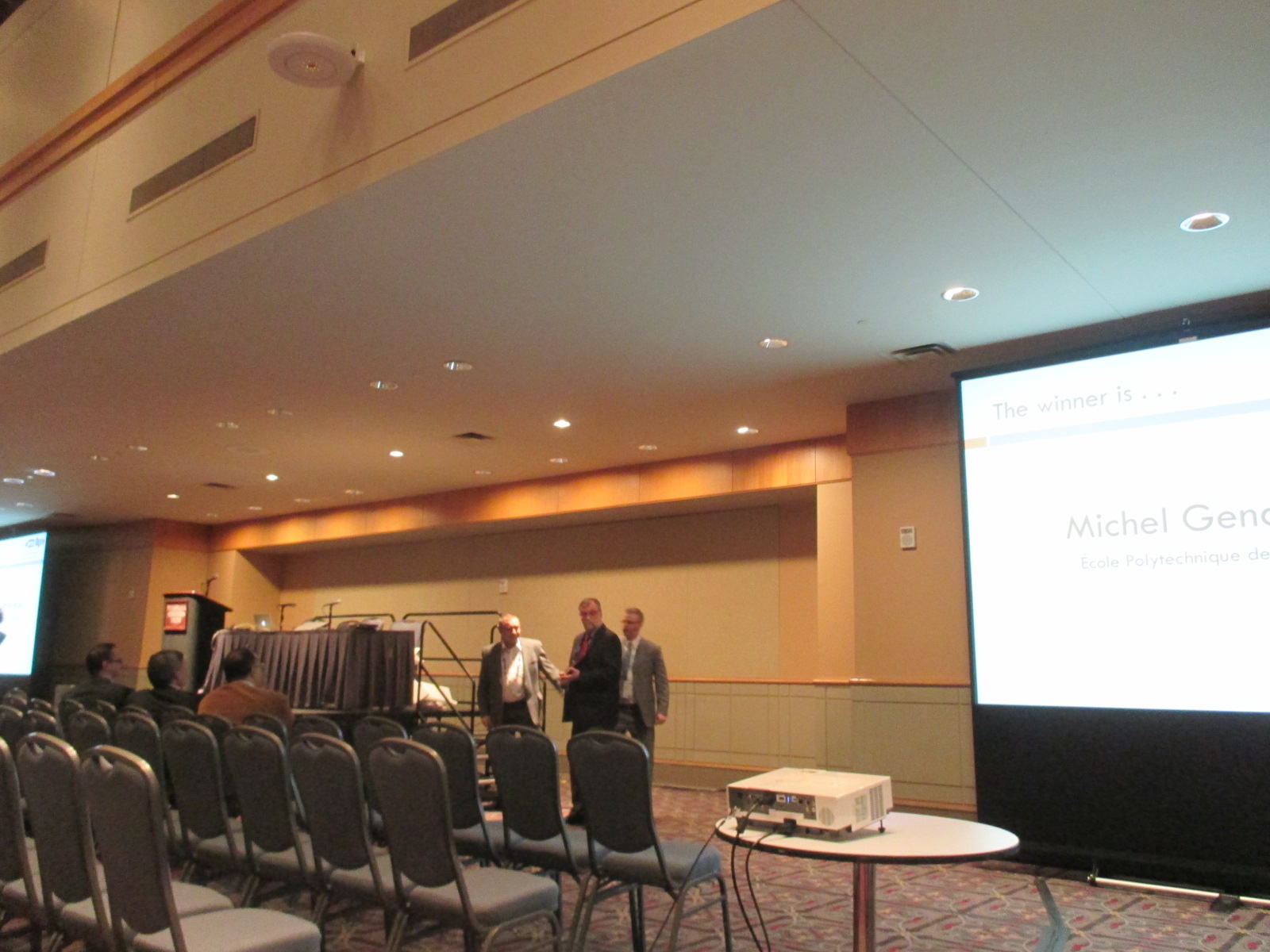
Paper number 9 on this list is: A Tabu Search Heuristic for the Vehicle Routing Problem with Soft Time Windows, É Taillard, P Badeau, M Gendreau, F Guertin, JY Potvin, Transportation Science 31 (2), 170-186, 1997 . As I had mentioned earlier, vehicle routing is an extremely important class of transportation problems. The third author, Michel Gendreau, I have known and enjoyed speaking to, going back to my days as an Assistant Professor. And, for his exceptional work, Michel, at our most recent INFORMS meeting in Philadelphia, was honored with the Robert Herman Lifetime Achievement Award. I took the photo below at the TSL meeting there.
And for all of you who love air transportation, paper number 10 is: Flight String Models for Aircraft Fleeting and Routing, C Barnhart, NL Boland, LW Clarke, EL Johnson, GL Nemhauser, RG Shenoi, Transportation Science 32 (3), 208-220, 1998.  What a terrific group of co-authors! Nemhauser, I have already mentioned earlier, and the first author is Cynthia Barnhart, who is now the Chancellor of MIT. She is a member of the National Academy of Engineering, as are Ellis Johnson and George. Both Cynthia and Ellis we had the pleasure of hosting at the Isenberg School through our great UMass Amherst INFORMS Speaker Series. The photo below I took of Cynthia after her talk with our wonderful students at that time back in 2005.
Below is a photo of Ellis Johnson after his presentation at the Isenberg School in 2009. My colleague, Senay Solak, was a doctoral student of his at Georgia Tech, and continues to work on airline problems.
And since Nemhauser is a co-author, below I have posted a photo from last year's INFORMS Computing Society conference at which he gave a great keynote talk.

The twelfth paper on the list is: Self-Organized Pedestrian Crowd Dynamics: Experiments, Simulations, and Design Solutions, D Helbing, L Buzna, A Johansson, T Werner,  Transportation Science 39 (1), 1-24, 2005. I know the first author of this paper, since not only was he with Sheffi and me at the ETH Zurich Risk Workshop, which he was involved in organizing, but, last March, he was one of my hosts when I gave a plenary talk in Berlin, Germany! Below is a photo of Dirk Helbing at the workshop in Berlin last March before his talk.
Congratulations to all the authors of these classic papers and thanks for the opportunity to walk down Memory Lane!
 

Tuesday, June 9, 2015

A Stunning Infographic via a Tweet - Nash, Braess, Sadik-Khan, and Me Thanks to Dewan Karim

It's always enjoyable to get a pleasant message whether through email, a phone call, in person, or even via a tweet.

I have been mourning the tragic death of John Nash while in Sweden since he influenced so much of my work and was such an extraordinary individual.

Last week, via Twitter, I received a message from Dewan Karim who tweeted the above infographic, which I thought was stunning. Obviously, it had taken him time to prepare  so I contacted him to thank him  and asked him for permission to post it in this blogpost, which he granted. Dewan tweets under Complete Mobility @DewanMKarim. He is a professional engineer and is a transportation planner in the greater Toronto area.

Not only did he include John Nash, but also Dietrich Braess, of Braess paradox fame, whom I also admire so much, and had the pleasure of hosting at the Isenberg School back in 2006.

Dewan told me that he attended the Traffic panel that I was a panelist on at the World Science Festival in NYC, which I wrote a post on.  He became very interested in the Braess paradox which I spoke on and, in particular, relative to Mayor Bloomberg shutting Broadway from 42nd to 47th Street to vehicular traffic and converting it to a pedestrian plaza.  This decision was made in conjunction with Dr. Janette Sadik-Khan.


Interestingly, I last saw Dr. Sadik-Khan, of whom I am also a big fan, when she and I were panelists together on the Transport and Traffic at The New York Times Energy for Tomorrow Conference, also in NYC, in  2013.

I like the above ninfographic so much that I will show it to my students in my Transportation and Logistics class at the Isenberg School next Fall.

In any event, it is so nice to be on the same page with researchers and a practitioner I so much admire.

Thank you, Dewan Karim!

Sunday, February 2, 2014

60 Years of Urban Travel Forecasting - Traffic Continues to Fascinate

It is hard to miss all the recent news about transportation and traffic,  including the (in)famous so-called "traffic study" in New Jersey that closed lanes, which, in turn,  resulted in huge traffic jams on the George Washington bridge connecting the state of New Jersey with New York, lasting 4 days, and which has now even made international news as reported by the BBC.   The lane closures, it  seems, were instrumented under the guise of studying traffic flows, but, in reality, it is being alleged, they  were to punish the mayor of Fort Lee for "misallegiance." The scandal has even damaged the reputation and standing of the governor of New Jersey, Mr.  Christie,  a potential candidate for the 2016 Republican presidential nomination.

Who would have thought that traffic mis(management) could be a political weapon or even the downfall of government officials?!

Travel forecasting, that our New Jersey "leaders" might have benefited from, has actually been studied for over 60 years!

And, there is a new book being written, a U.S. - U.K. collaboration between Professors David E. Boyce and Huw Williams, which, I am told, is nearing completion on this very topic. I was contacted by Professor Boyce a few weeks ago to review Chapter 7 of the book, which, I believe, will be published by Edward Elgar Publishing, and should be about 700 pages! Chapter 7 is on Transportation Network Equilibrium, a topic very near and dear to me. What I especially like about this chapter (and book) is the tracing of the intellectual history of the various discoveries in terms of mathematical model building and algorithms, coupled with tensions between academics and practitioners, in a sense, in that the former want to get the latest advances into practice as soon as possible with many challenges along the way.

Professor Boyce is a great colleague and mentor, and renowned in transportation circles, having received  the Robert Herman Lifetime Achievement Award in Transportation Science. He is also an INFORMS Fellow and an RSAI Fellow. I have not (yet) met his co-author,  Professor Huw Williams, although I know of his work. Last Fall, Boyce gave the talk, Urban Travel Forecasting: A 60 Year Retrospective, at the Royal Institute of Technology in Stockholm, Sweden, and  he gave me permission to post it on the Virtual Center for Supernetworks website, since I found it so fascinating. He has been periodically, as time passes, updating this talk.

You can access his presentation, in pdf format, here.

Seeing photos of such luminaries as Martin Beckmann, Dan McFadden at the Nobel ceremonies with Moshe Ben-Akiva,  John Wardrop, plus Michael Florian in the slides (with a surprise photo of Suzanne Evans and me), was a great trip in nostalgia. And, I also enjoyed David Boyce's great sense of humor as the two slides below, taken from his talk, reveal.


And, for all those researchers and practitioners out there in operations research, and transportation science, see what remains to be done below!
And for a musical rendition of the New Jersey traffic jam,  enjoy the video with Bruce Springsteen and Jimmy Fallon below.
http://www.latenightwithjimmyfallon.com/video/bruce-springsteen-and-jimmy-fallon-gov-christie-traffic-jam-born-to-run-parody/n45079/

Saturday, April 27, 2013

Sustainability is Sustainable and Good for Business, Our Health, Our World

I returned a short while ago from NYC where yesterday I took part in an extraordinary conference -- The New York Times 2013 Energy for Tomorrow Conference.

The full agenda of the conference can be accessed directly here.

It was an intellectual feast that brought together mayors, an Academy Award winner, thought leaders, scientists, environmentalists, investors, policy makers, and decision-makers, corporate employees from IBM to Google, as well as a farmer/former NBA player/MacArthur Fellow -- and these were just some of the speakers. In the audience, I met a colleague from Cornell (now retired), a diplomat from the Chinese embassy in DC, a Georgia Tech professor, numerous journalists from as far as Singapore, affordable housing advocates, urban planners, students, a researcher at MIT, head of the electric vehicle taxi program for NYC, and a financier in private equity, to single out just a few.

The conference began with a stimulating breakfast session (the food was good, too) on smart vehicles, but time was too short for me to be able to ask the question that I had -- what about cybersecurity issues in this product domain? I was thrilled that even operations research was mentioned -- indeed, where would transport studies be without OR?!

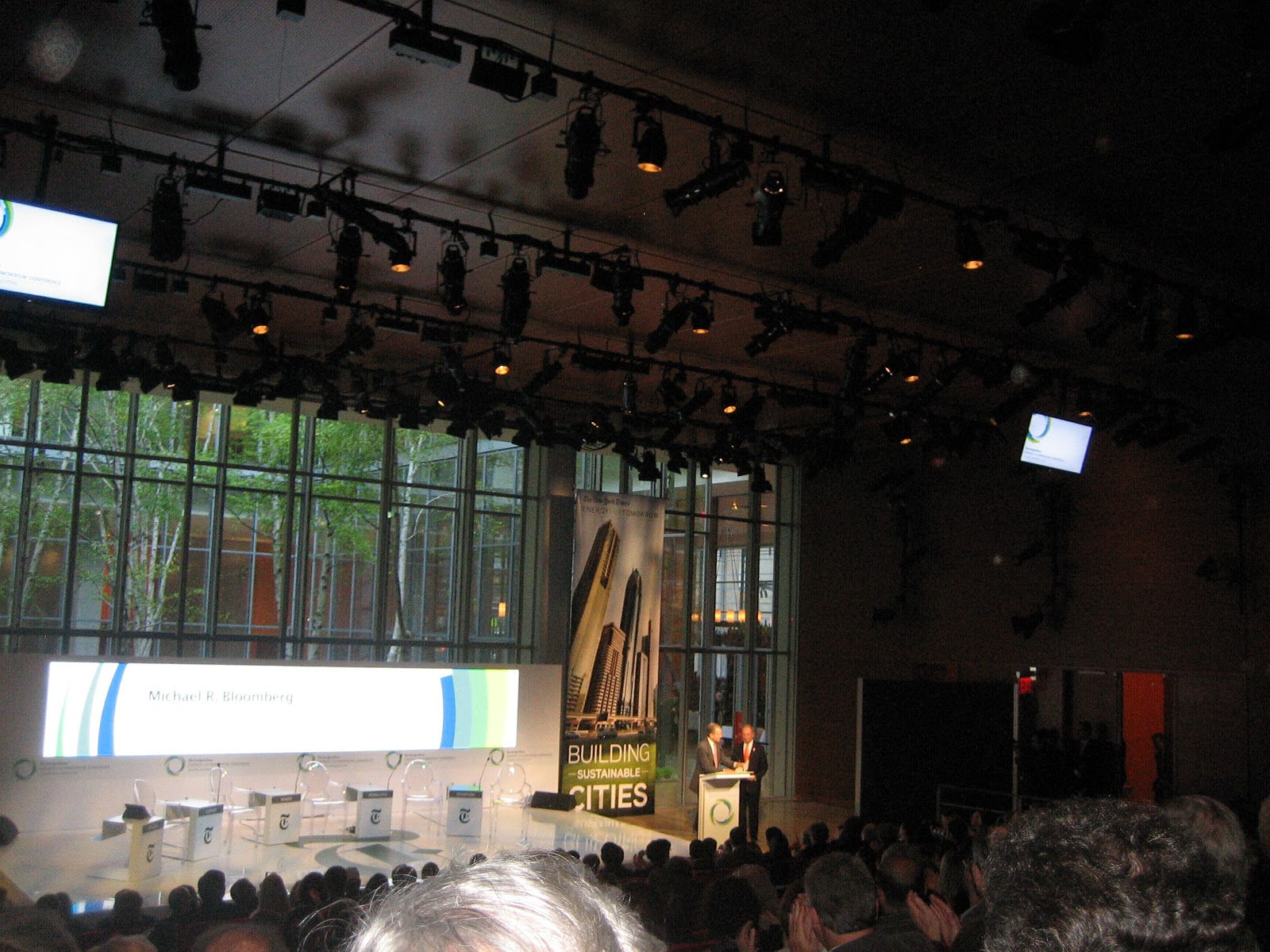
Mayor Michael Bloomberg of NYC, who needs no introduction, was introduced by Arthur Sulzberger Jr., the publisher of The New York Times, and both were absolutely brilliant.

With the paralysis in Washington (Congress) regarding environmental action, mayors and cities are leading the way.  This is the first truly urban century and cities have to (and many are) taking action. We must unlock human creativity and take actions to mitigate risk. Mayor Bloomberg chairs the C40 group, which actually consists of 60 cities.

Mayor Bloomberg had 4 major points with the first one being that one must develop a plan with goals and metrics -- you have to be able to measure. He has done much to improve air quality and water quality and, along with the Sierra Club, has been instrumental in retiring many coal-fired power plants.

750,000 trees have been planted in NYC with a goal of planting 1 million and he gave credit also to Bette Midler.

He noted how sustainability provides good economic value -- being environmentally friendly improves your brand and helps in recruiting -- vibrant, smart employees want to work in places where they can breathe clean air!

He mentioned how he, with Al Gore (former VP and of the An Inconvenient Truth fame), climbed up on a rooftop and painted it white -- with white rooftops reducing energy costs by 20% -- a quick payback.

He also emphasized private-public partnerships -- closing roads to traffic -- something I have written about, spoken about, and even been interviewed on, and how we should be stealing the best ideas in terms of transport and sustainability from around the world.

What really intrigued me is when he said that China will become a leading environmentalist in the next 10 years  He, as several others yesterday, emphasized resiliency and that we must prepare for extreme events. Hurricane Sandy was noted several times during the conference.

The next panel was the Mayors panel and the panelists were engaging, and very  entertaining with one of my favorite quotes being "cars are the next cigarettes."  The theme that people will vote with their feet (want to live and work in a sustainable location) continued.

We were then treated to a conversation between Andrew Revkin and Jeremy Irons, who has garnered not only an Academy Award, but numerous other awards for his acting. His passion for the environment resonated as did his eloquence. The night before the conference, the movie Trashed, which he was the Executive Producer of, was screened, and more info on what is being done to our globe because of garbage can be found here.  He noted that he is using the actor's power to address important problems and even emphasized electronic recycling and packaging -- his knowledge impressed me. He noted that a film can inject a feeling of purpose. He also emphasized that it is about education and that industry should prove that what it is making is 100% safe. Since my research group does a lot of work on sustainable supply chains his message was near and very dear to me. Coincidentally, Revkin is a fellow Brown University grad and I heard him deliver the Daffodil Lecture at UMass a while back.

Thomas L. Friedman of The New York Times then led a panel on renewable energy with experts from the US and abroad, including the CEO of ConEd, Kevin Burke. Joe Nocera, also of The New York Times, followed with a panel on the role of technology and innovation and I was especially moved by Stephen Kennedy Smith, who spoke on agribusiness and urban food supply. I managed to talk with him later and mentioned that when I got my PhD from Brown his nephew, John F. Kennedy Jr., received his undergraduate degree. There are also other school ties which I noted.

During lunch, we ate (a very healthy spread) and discussed the urban food supply and since one of my most recent papers was on competitive food supply chains (with Min Yu), which was published in the European Journal of Operational Research, this topic was mesmerizing. Will Allen, the Renaissance man -- farmer and MacArthur Fellow, regaled us with his work in inner cities and urban farms.

I had to then take off since it was time to get ready for the Transport and Traffic panel that I was speaking at, which was moderated by Joe Nocera, and I had terrific company!

Below are several of my fellow panelists as we get ready in the "Green" room which actually had a red door.

The day concluded with breakout sessions in which we brainstormed and a closing session Dealbook: Investing in the city of tomorrow -- provocative and timely.

Prior to that we also got to hear Bill Keller of The Times in conversation with Carol Browner -- the former energy czar. She also spoke about resilience and noted the importance of physical infrastructure, nature, and communities -- simply fabulous

The conference was videostreamed and you can access the videos of the various panels on the conference website.  The Transport and Traffic panel that I was part of can be accessed directly here.
I had to bring in the Braess paradox into the conversation as well as congestion charging and transport congestion policies dating back to Roman times -- when chariots were the problem!

And I could not resist posting photos below taken of me with Professor Richard Schuler, professor emeritus of Cornell, and of  Dr. Yajun Fang of MIT taken at the reception at the end of a very exciting day. Professor Schuler is the academic father of Professor Ben Hobbs of Hopkins, an INFORMS Fellow.


New York City was as vibrant, exciting, and stunning as always and I share with you the additional photos that I took while walking as a very happy pedestrian in NYC!


And, on the way back to Massachusetts, via Amtrak on the Vermonter, as I strolled back to the dining car for a cup of tea I heard a greeting --"Hello, Anna!" and it was one of my favorite Isenberg School of Management colleagues, Professor Glenn Wong, of sports law and sports management fame.