Showing posts with label sustainable cities. Show all posts

Saturday, October 13, 2018

Smart Cities Analytics - A Terrific Workshop In Canada

When the invitation came from Professor Joe Naoum-Sawaya of the Ivey Business School at Western University (formerly Western Ontario University) in London, Ontario, Canada, I was very intrigued. He and his colleague, Professor Bissan Ghaddar, were organizing a Workshop on Smart Cities Analytics, and might I be interested in speaking?

The invitation was quickly accepted and this past Thursday, after teaching my Transportation and Logistics class, I was off to Bradley Airport for my flights on Air Canada to Toronto and then to London (London, Ontario, that is)! The flights on the puddle jumpers were surprisingly very comfortable and I had a delightful conversation on the first leg with a mother, originally from Jamaica, who was traveling with her 7 month old daughter. She had been to visit her 90 year old grandmother in Connecticut and is still fostering children - she has fostered over 100. Hearing about such exceptional human beings is always a wonder of travel.

Having been to England in September for the OR60 conference and the Early Career Researcher Workshop at Lancaster to speak, I appreciated the big welcome sign at the London, Ontario airport (never to be confused with Heathrow but there is a Tim Horton's there). It was my first time to the Ivey School and London, Ontario.

The logistics of my travel were expertly organized with a pickup at the airport. The London Park Hotel, where the workshop guest speakers were accommodated, provided me with a suite which looked more like an apartment - I loved it! Given that I was in Canada, the next morning, I got to see many young hockey players at breakfast who were in town with their families for a tournament. Last Monday was Canadian Thanksgiving so many had a week holiday.

It was thrilling to see the guest speakers at the workshop and the participants. The Ivey School, the site of the workshop, is in a stunning building.

As you can see from the above workshop poster, the speakers traveled from France, Denmark, Ireland, and the US, with one local speaker, for the workshop, which clearly demonstrates the excitement surrounding the theme of the workshop. The full schedule with the talk titles and abstracts can be downloaded here. 

The format of the workshop was excellent, with 45 minute talks and time for discussion. Lunch was also provided as well as refreshments at breaks and registration was free, thanks to the sponsors. The audience consisted of faculty and students from the host university and neighboring universities, including the University of Waterloo (my host for my previous speaking engagement at a Canadian university). I admit, since I was born in Canada, I like to support my Operations Research and Management Science colleagues in Canada and it is a pleasure to do so.

The workshop began with a welcome and opening remarks by Professor Naoum-Sawaya and an Associate Dean at Ivey.


Thanks to Professor Joe Naoum-Sawaya for letting me be the first speaker. As promised to participants, I have posted my talk.


My talk was based on two earlier papers of mine: Design of Sustainable Supply Chains for Sustainable CitiesAnna Nagurney, Environment & Planning B 42(1): (2015) pp 40-57 and Supply Chain Network Sustainability Under Competition and Frequencies of Activities from Production to Distribution,  Anna Nagurney, Min Yu, and Jonas Floden, Computational Management Science 10(4): (2013) pp 397-422.

After the coffee break, it was time for Professor Ivana Ljubic to speak on Very Large Scale Covering Location Problems in the Design of Advanced Metering Infrastructure. Professor Ljubic is a Professor at ESSEC in France.

Her talk focused on smart metering and the Internet of Things (IoT) and the challenges posed by the limitations of current infrastructure. She described elegant models that she had constructed for related facility location problems to determine where to place bay stations for wireless communications to cover homes with the consideration of an investment budget or a percentage of demand coverage.  The exact algorithms that she presented, along with extensive computational results, on truly large-scale problems, were very elegant and impressive.
Professor Ljubic, who is very active on Twitter and is a jet-setter, and we enjoy communicating in this way, told me that she had met me at the Computational Management Science (CMS) conference in Vienna, Austria in 2010, so I promised her that I would try to retrieve some photos from that conference and I have posted them below - even with my former doctoral student, Tina Wakolbinger, who is now a Professor at the Vienna University of Economics and Business!
Professor Pierre Pinson of the Technical University of Denmark, who is French, presented a talk on Community-Based and Peer-to-Peer Electricity Markets, in which he shared with us that Copenhagen is planning on being carbon-neutral by 2050. He also told us that Denmark produces the cheapest electric power in Europe but, after taxes, it is the most expensive. He suggested that governments may need to rethink taxes in terms of social responsibility with taxes being a function of distance. He emphasized the purchasing of electricity locally and discussed consensus-based optimization with fascinating reciprocity constraints. He described how individuals have self-interest with interest to collaborate locally and how exchanges within a community do not have to be settled with monetary compensation. He also emphasized the construction of a social welfare function and the cost of a social construct with a community wanting to be as autonomous as possible. Professor Pinson further elaborated on networks of communities for urban design and mentioned blockchains and possible coordination mechanisms.He told us that "we need to change the game" and need new business models.

I thoroughly enjoyed his very thought-provoking presentation and told him that I will be reading his papers!
Then it was time for lunch and further stimulating conversations and discussions. Another special highlight for me was seeing Professor Hani S. Mahmassani, the Director of the Transportation Center at Northwestern University. Just to further emphasize how much I respect Professor Mahmassani, I even had a photo of him in my presentation that morning. Hani, if I may, is a true scholar and leader in transportation, one who not only does outstanding research but also parlays his work into practice with high impact. And, to further celebrate his accomplishments, in the introduction to his talk, Professor Naoum-Sawaya shared with us (I also heard this great news at lunch) that Professor Mahmassani has been appointed to the Advisory Board for Smart Cities for Monaco and also to the Advisory Board for the Panama Canal. So, huge congratulations to him!
Professor Mahmassani's talk was entitled: Predictive Analytics for Real-time Urban Mobility: Autonomous, Connected, Electric, Shared (ACES).

 Professor Mahmassani took us on a vivid journey of the state-of-the-art of his topic and described several key takeaways, overviewing connected vehicles (when and in what form and at what rate); major disruptive influences from technology to players; shared mobility fleets; why we still need predictive models even if we may be able to ultimately see the state of the transportation system at all times, and how transportation agencies must be willing to embrace change. He emphasized how autonomous, connected vehicle ideas have evolved from ITS with one of the goals being to eliminate or to reduce human errors. He spoke on connected systems that should be coordinated, with "cooperative driving," optimized flow and routing. He also brought up, which he recognized that I would very much appreciate - that freight services might be managed in a system-optimized manner, whereas travelers even in shared, connected vehicles, might be (should be) routed in a user-optimized way. Such discussions I have had with the students in the Transportation and Logistics class that I teach at the Isenberg School. He also brought out that intelligence (think of Google) will reside in vehicles but what about the infrastructure that will be needed to operationalize connected, autonomous vehicles? He mentioned a report put out by his center on Mobility 2050 - Emerging Futures, definitely word reading.

Given the fascinating talks, I hope that the organizers will be able to post them and, frankly, I asked when will the next such workshop be because of the stimulating important issues and discussions from multiple very creative perspectives!

Professor Mahmassani's talk was followed by a talk from another Northwestern University Professor, Professor Chaithanya Bandi of the Kellogg School. Concidentally, both are MIT PhD alums, but of different programs. Dr. Bandi changed the title and topic of his presentation  and his talk was on: Data Driven Analytics for Government, with a focus on Singapore! I have been invited to Singapore but have not been there (yet) although my husband has and he did bring me some marvelous souvenirs from there. We were presented with numerous fascinating facts about Singapore including that 80% of the population lives in public housing. The government shares "Moments of Life" in which its citizens are congratulated for various milestones. Humans are considered "sensors" with even government-aided dating taking place. Singapore is focused on "customizable communities" and Dr. Bandi shared with us the cost/taxes of vehicle ownership in Singapore. He then described some research that he has been involved in regarding hospital staffing and patient flows - data-rich but an uncertain environment. He also mentioned his work on LEGO Networks with Itai Guravich in which subsystems are first optimized and the system is then built up.
Then Professor Xianbin Wang of the Electrical and Computer Engineering at the host university discussed his research with collaborators in the presentation: Technical Challenges and Business Opportunities of Ubiquitously Connected Society. He asked the question - what are we trying to solve through IoT and by connecting everything? He also mentioned 5G and ICT infrastructure needs associated with it. Some of his concerns include interoperability issues associated with IoT and how to create internetwork collaboration. It was good to hear him mention the increasing overhead associated with cybersecurity and the proliferation of devices and impacts on communications. He is a proponent of "Software Defined Networking (SDN) Enabled Synergistic Resource Sharing".

The final presenter, and he deserves extra applause, was Professor Robert Shorten of University College Dublin, who spoke on: Distributed Ledger Technology, Cyber-Physical Systems, and Social Compliance. He, in his talk, showed us a collage of photos of activities in cities, including one with a homeless person rummaging through the trash and asked us what we had observed. He had posted this photo to demonstrate that we do not enforce social contracts and people may be putting rubbish in the incorrect bins and, hence, not recycling, as they should be. The homeless person was performing a useful task for society. Professor Shorten then described how blockchain has a lot of potential for the enforcement of social contracts and noted that distributed ledger systems (DLTs) have operational costs that are low and fast transaction times. he also spoke about competitive versus collaborative DLTs. He presented an elegant graph model of DAGs (directed acyclic graph) with no transaction fees. Underlying his work are ordinary differential equations for which he has also conducted stability analysis. It was great to see that in my talk I had described a Nash Equilibrium model for sustainable supply chains, and Professor Shorten also had Nash Equilibrium in one of his slides. He spoke about the use of tokens for "the cost of misbehaving" as when one would drive through a red light, for example, and the use of DLTs would be anonymous (an audience member brought up the use of fines). It was very interesting to listen to him speak on how to design controls so as to incentivize people to behave as in being socially compliant in traffic, given the risk of getting caught. He also brought up "string stability," as in what happens downstream in other junctions of the network, if someone drive through a red light.

Since my cellphone was dying I apologize for not taking a photo of Professor Shorten and, instead, I share several photos below of the group of speakers, the group of Twitter users, and the females on Twitter!
Thanks, again, to the organizers, the guest speakers, and the terrific audience, for a fabulous idea-generating workshop!

Tuesday, April 22, 2014

Sustainable Supply Chains for Sustainable Cities, Earth Day, and Erice

Today is Earth Day on which we celebrate planet earth and the environment.

I have been hard at work on a presentation, Sustainable Supply Chains for Sustainable Cities, which I will be presenting at a fascinating workshop, which will take place in early May, at the Ettore Majorana Scientific Center in Erice, Sicily. I had been then before, back in 2006, and it was a fitting ending to not only my year as a Science Fellow at the Radcliffe Institute at Harvard but also to the World Cup (Italy beat France and we were in Italy).

The title of the Workshop that I will be speaking at is given below.

      ERICE INTERNATIONAL SEMINARS ON PLANETARY EMERGENCIES
47th Session
Erice, 11 –15 May 2014
THE ENERGY PLANETARY EMERGENCY
Workshop on Energy, Cities, and the Control of Complex Systems.

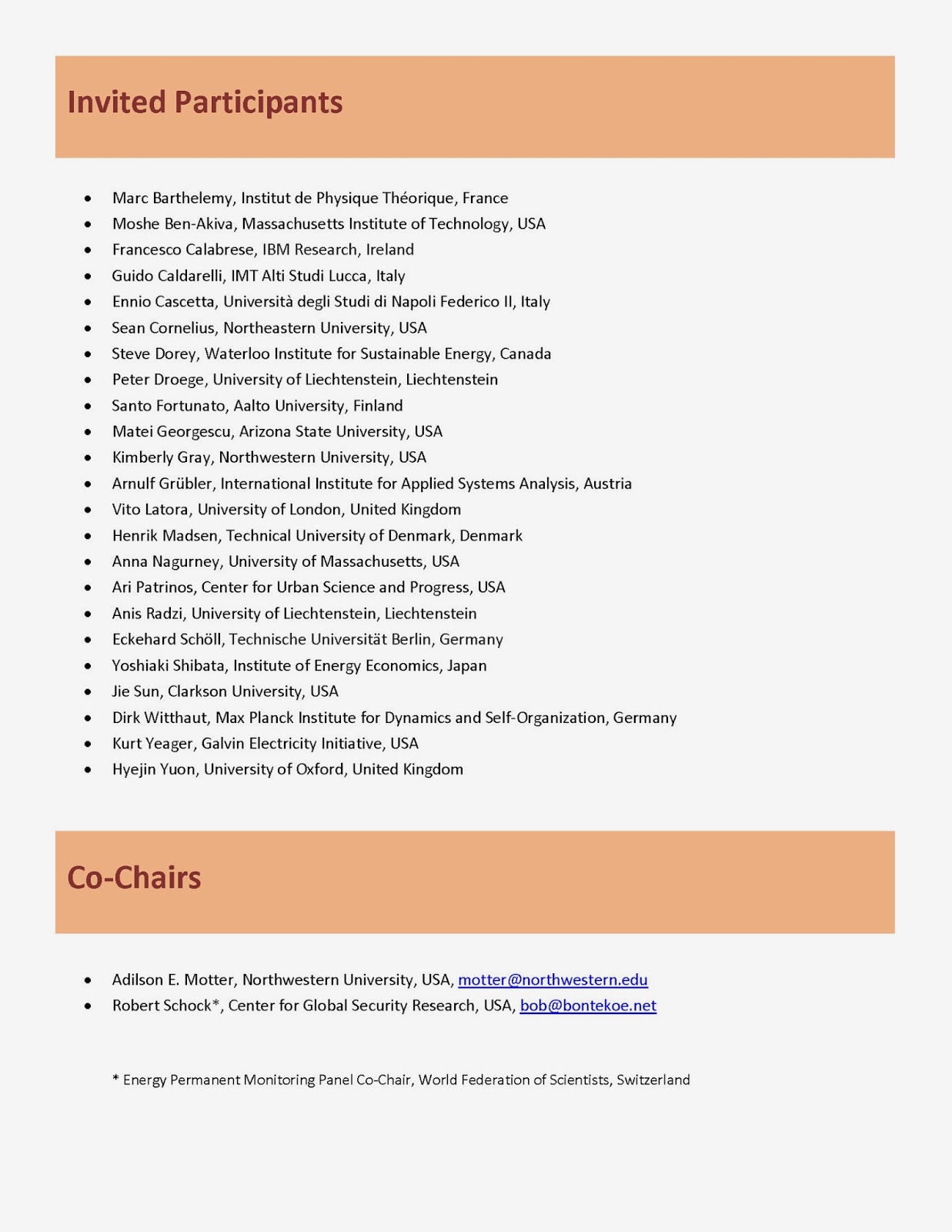
I received the formal invitation from the Director and Chairman of the Ettore Majorana Scientific Center, Professor Antonino Zichichi. The workshop is organized by Professor Adlison Motter of the Department of Physics and Astronomy, Northwestern University,
http://dyn.phys.northwestern.edu/  and by Dr. Robert Schock, Center for Global Security Research, Energy Permanent Monitoring Panel, World Federation of Scientists:

The list of invited participants is below.
 

In my presentation I will present both a supply chain network design model with a focus on frequencies, which is in press in the journal Environment & Planning B and will discuss highlights of a model developed with Drs. Min Yu and Jonas Floden on sustainable supply chain network competition and game theory with frequencies of supply chain activities as strategic variables and product path flows. This paper was recently published in the journal Computational Management Science in a special issue devoted to Planet Earth.


Sunday, June 9, 2013

Hedonistic Sustainability and Supply Chains -- Enjoying Our Environment and Our World

I often write about sustainability on this blog and also about supply chains.

I care about our world and our environment and that is one reason I am spending a lot of time in Sweden as a Visiting Professor of Operations Management, as part of my sabbatical from the Isenberg School of Management at UMass Amherst. The Scandinavians are very advanced in terms of not only social welfare but also sustainability.

This past Friday, my colleague, Professor Jonas Floden, who is one of my hosts at the School of Business, Economics and Law at the University of Gothenburg, and I were visited by a freelance journalist from San Francisco, who had heard me speak on Transport and Traffic at The New York Times EnergyForTomorrow Building Sustainable Cities event this past April.

Our conversation, accompanied by delicious coffee in our office suite, began with congestion charging in Gothenburg, implemented this past January, with contrasts to the Stockholm congestion charging system, which was implemented back in 2006. We also talked about the upcoming referendum, which is an interesting twist, and is due, in part, to the efforts of a local newspaper GT to try to overturn the tolls and they are working with car ridership down and transit use up!!!

In our discussions, we were also told about the waste to energy project of the leader of hedonistic sustainability, the Danish architectural genius Bjarke Ingels, who likes to think BIG,  and which will come with a ski slope! The project is now under construction in flat Copenhagen.

You can enjoy the wisdom and charisma of this visionary architect speaking at TED on YouTube.

Sustainability does not have to be all just about sacrifice. It is a design challenge and I could not agree more. Our work on design of sustainable supply chains,  Sustainable Supply Chain Network Design: A Multicriteria Perspective, Anna Nagurney and Ladimer S. Nagurney, International Journal of Sustainable Engineering 3: (2010) pp 189-197 and even sustainable supply chains for sustainable cities, Design of Sustainable Supply Chains for Sustainable Cities, Anna Nagurney, Invited Paper for the Complex-City Workshop, December 5-6, 2011, Amsterdam, The Netherlands, to appear in Environment & Planning B, is motivated by preserving the beauty of our world -- from the air that we breathe to the natural environment to the food that we eat and even to the clothes that we wear.

Note that consumers in Sweden favor the fish (and fishermen) that they know with information provided on the point of origin and date and I have been captivated by fish supply chains and even the use of RFID technology to track the fish.
And, how can you not enjoy the beauty and taste of the treats below, which I captured in one of my favorite cafes in Gothenburg:
Kudos also to H&M, the fast fashion house, which, I might add, was doing great sales yesterday, as evidenced by the lines in its stores in Gothenburg, for instituting its Rewear-Reuse-Recycle-ConversiontoEnergy initiative. And, according to H&M's website:

Does H&M profit from the returned garments?

No. Our revenues will be used to reward our customers, to make donations to local charity organisations and to invest in recycling innovation. For each kilogram of clothes we collect, 0.02 EUR* will be donated to a local charity organisation chosen by H&M.

I found out about H&M's Garment Collecting Initiative, after we had made purchases at H&M and I liked the bag above, which we will continue to use and reuse. Fast fashion is another passion of mine and we co-authored the paper, Sustainable Fashion Supply Chain Management Under Oligopolistic Competition and Brand Differentiation, Anna Nagurney and Min Yu, International Journal of Production Economics, Special Section on Green Manufacturing and Distribution in the Fashion and Apparel Industries 135: (2012) pp 532-540.

Whether it is the food that we eat, the medicines that we consume, or the clothes that we wear, the buildings that we live and work in, the parks and transportation systems that we enjoy, sustainability, at its best, is hedonistic. Interestingly, last Saturday, while by the Central Station and Radisson in Gothenburg, I was intrigued by the number of police and police cars (unusual in this very safe city). In asking locals what was up I was told -- a local soccer team was in town and then a Chinese princess is visiting. The truth was that a Chinese delegation had arrived and was staying at the Radisson.  According to this report, the Chinese realize west Sweden's competence in energy and eco-friendliness and have come to learn.

 I leave you with photos of the views from the top of the School of Business, Economics and Law, which has won many awards for its architecture. Note the photos of the new bus lane. I'll save the photos of the hills through the woods that I climb to get to my apartment for another post.


Saturday, April 27, 2013

Sustainability is Sustainable and Good for Business, Our Health, Our World

I returned a short while ago from NYC where yesterday I took part in an extraordinary conference -- The New York Times 2013 Energy for Tomorrow Conference.

The full agenda of the conference can be accessed directly here.

It was an intellectual feast that brought together mayors, an Academy Award winner, thought leaders, scientists, environmentalists, investors, policy makers, and decision-makers, corporate employees from IBM to Google, as well as a farmer/former NBA player/MacArthur Fellow -- and these were just some of the speakers. In the audience, I met a colleague from Cornell (now retired), a diplomat from the Chinese embassy in DC, a Georgia Tech professor, numerous journalists from as far as Singapore, affordable housing advocates, urban planners, students, a researcher at MIT, head of the electric vehicle taxi program for NYC, and a financier in private equity, to single out just a few.

The conference began with a stimulating breakfast session (the food was good, too) on smart vehicles, but time was too short for me to be able to ask the question that I had -- what about cybersecurity issues in this product domain? I was thrilled that even operations research was mentioned -- indeed, where would transport studies be without OR?!

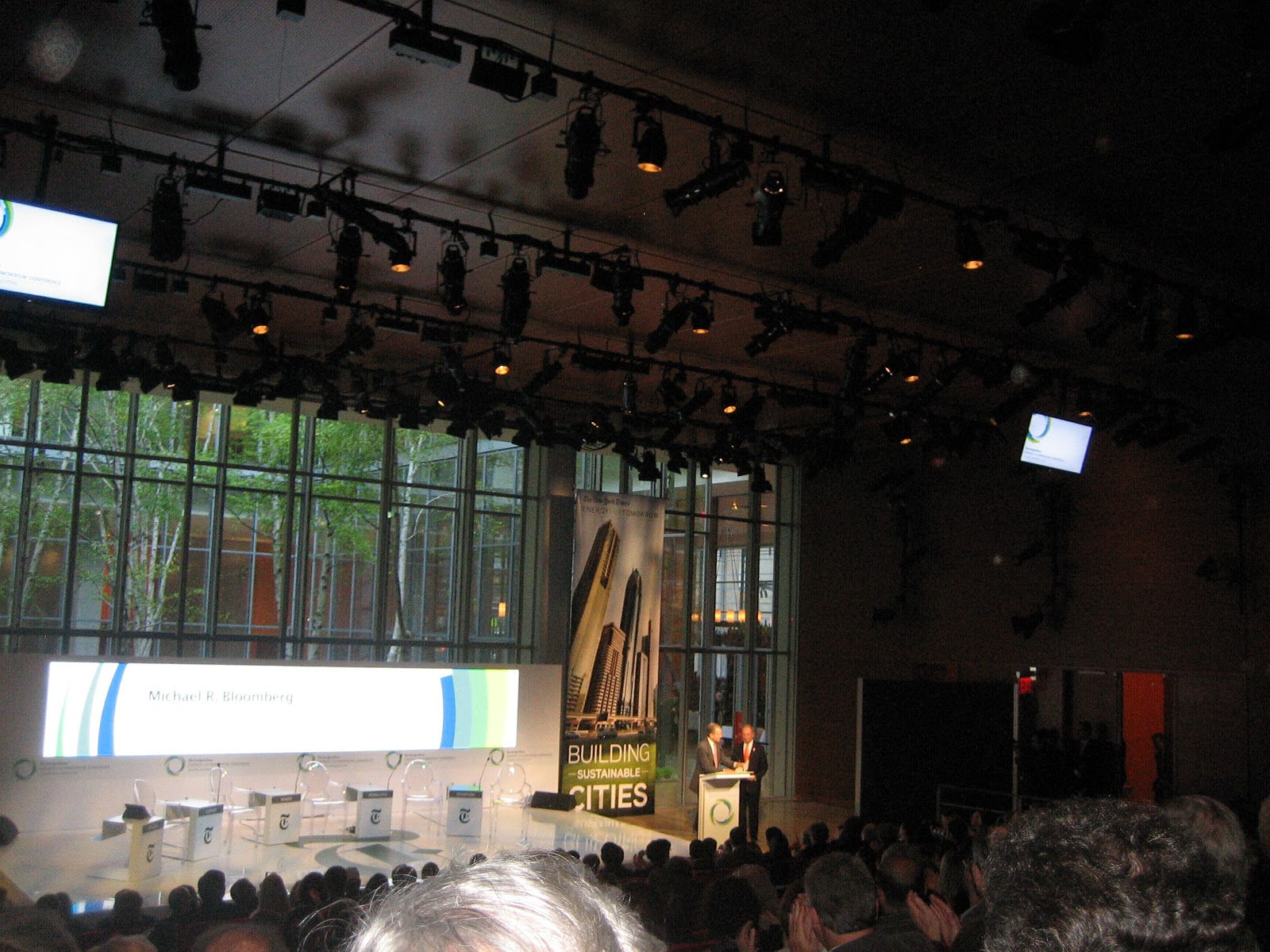
Mayor Michael Bloomberg of NYC, who needs no introduction, was introduced by Arthur Sulzberger Jr., the publisher of The New York Times, and both were absolutely brilliant.

With the paralysis in Washington (Congress) regarding environmental action, mayors and cities are leading the way.  This is the first truly urban century and cities have to (and many are) taking action. We must unlock human creativity and take actions to mitigate risk. Mayor Bloomberg chairs the C40 group, which actually consists of 60 cities.

Mayor Bloomberg had 4 major points with the first one being that one must develop a plan with goals and metrics -- you have to be able to measure. He has done much to improve air quality and water quality and, along with the Sierra Club, has been instrumental in retiring many coal-fired power plants.

750,000 trees have been planted in NYC with a goal of planting 1 million and he gave credit also to Bette Midler.

He noted how sustainability provides good economic value -- being environmentally friendly improves your brand and helps in recruiting -- vibrant, smart employees want to work in places where they can breathe clean air!

He mentioned how he, with Al Gore (former VP and of the An Inconvenient Truth fame), climbed up on a rooftop and painted it white -- with white rooftops reducing energy costs by 20% -- a quick payback.

He also emphasized private-public partnerships -- closing roads to traffic -- something I have written about, spoken about, and even been interviewed on, and how we should be stealing the best ideas in terms of transport and sustainability from around the world.

What really intrigued me is when he said that China will become a leading environmentalist in the next 10 years  He, as several others yesterday, emphasized resiliency and that we must prepare for extreme events. Hurricane Sandy was noted several times during the conference.

The next panel was the Mayors panel and the panelists were engaging, and very  entertaining with one of my favorite quotes being "cars are the next cigarettes."  The theme that people will vote with their feet (want to live and work in a sustainable location) continued.

We were then treated to a conversation between Andrew Revkin and Jeremy Irons, who has garnered not only an Academy Award, but numerous other awards for his acting. His passion for the environment resonated as did his eloquence. The night before the conference, the movie Trashed, which he was the Executive Producer of, was screened, and more info on what is being done to our globe because of garbage can be found here.  He noted that he is using the actor's power to address important problems and even emphasized electronic recycling and packaging -- his knowledge impressed me. He noted that a film can inject a feeling of purpose. He also emphasized that it is about education and that industry should prove that what it is making is 100% safe. Since my research group does a lot of work on sustainable supply chains his message was near and very dear to me. Coincidentally, Revkin is a fellow Brown University grad and I heard him deliver the Daffodil Lecture at UMass a while back.

Thomas L. Friedman of The New York Times then led a panel on renewable energy with experts from the US and abroad, including the CEO of ConEd, Kevin Burke. Joe Nocera, also of The New York Times, followed with a panel on the role of technology and innovation and I was especially moved by Stephen Kennedy Smith, who spoke on agribusiness and urban food supply. I managed to talk with him later and mentioned that when I got my PhD from Brown his nephew, John F. Kennedy Jr., received his undergraduate degree. There are also other school ties which I noted.

During lunch, we ate (a very healthy spread) and discussed the urban food supply and since one of my most recent papers was on competitive food supply chains (with Min Yu), which was published in the European Journal of Operational Research, this topic was mesmerizing. Will Allen, the Renaissance man -- farmer and MacArthur Fellow, regaled us with his work in inner cities and urban farms.

I had to then take off since it was time to get ready for the Transport and Traffic panel that I was speaking at, which was moderated by Joe Nocera, and I had terrific company!

Below are several of my fellow panelists as we get ready in the "Green" room which actually had a red door.

The day concluded with breakout sessions in which we brainstormed and a closing session Dealbook: Investing in the city of tomorrow -- provocative and timely.

Prior to that we also got to hear Bill Keller of The Times in conversation with Carol Browner -- the former energy czar. She also spoke about resilience and noted the importance of physical infrastructure, nature, and communities -- simply fabulous

The conference was videostreamed and you can access the videos of the various panels on the conference website.  The Transport and Traffic panel that I was part of can be accessed directly here.
I had to bring in the Braess paradox into the conversation as well as congestion charging and transport congestion policies dating back to Roman times -- when chariots were the problem!

And I could not resist posting photos below taken of me with Professor Richard Schuler, professor emeritus of Cornell, and of  Dr. Yajun Fang of MIT taken at the reception at the end of a very exciting day. Professor Schuler is the academic father of Professor Ben Hobbs of Hopkins, an INFORMS Fellow.


New York City was as vibrant, exciting, and stunning as always and I share with you the additional photos that I took while walking as a very happy pedestrian in NYC!


And, on the way back to Massachusetts, via Amtrak on the Vermonter, as I strolled back to the dining car for a cup of tea I heard a greeting --"Hello, Anna!" and it was one of my favorite Isenberg School of Management colleagues, Professor Glenn Wong, of sports law and sports management fame.

Wednesday, April 24, 2013

The New York Times Energy for Tomorrow Conference


This week is Earth Week and tomorrow, in NYC, The New York Times is hosting the 2013 Energy for Tomorrow Conference with the theme Building Sustainable Cities. I am very much looking forward to taking part in this event and hearing experts on energy, sustainable buildings, urban food supply, technology, and transport and traffic speak and discuss how we, together, can achieve more livable cities in this century. 

I will be part of the discussion on Transport and Traffic moderated by The New York Times OpEd columnist, Joe Nocera. The other speakers in my session are:
 Walter Hook, president, Institute for Transportation and Development Policy,
 Peder Jensen, head of programme, governance and networks, European Environment Agency,
 Naveen Lamba, intelligent transportation lead, IBM, and
 Janette Sadik-Khan, NYC transportation commissioner.


I plan on discussing the (in)famous Braess paradox in which the addition of a new road may make all travelers/drivers in the network worse off in terms of an increase in travel time as well as the milk run freight paradox, where  increasing the load factor (as often used by policy-makers as a means of improving freight efficiency), under certain conditions,  can increase total costs and total emissions. The latter was discovered by Niklas Arvidsson, a doctoral student at the School of Business, Economics and Law, where I hold a Visiting Professorship (as part of my sabbatical this year from the Isenberg School of Management at UMass Amherst).

I  will also be highlighting the importance of supply chains and city logistics for sustainable cities. This is a topic that I am passionate about and my most recent accepted paper, "Design of Sustainable Supply Chains for Sustainable Cities,"  is in press in the journal, Environment & Planning B.

The full agenda of the energy conference can be viewed here.


Wednesday, March 20, 2013

Building Sustainable Cities and The New York Times Energy Conference

I am very excited about being a speaker at The New York Times EnergyForTomorrow Conference with the theme Building Sustainable Cities that will take place next month, April 25, 2013.
 

I will be speaking in the session on Transportation and Traffic.

The agenda is thrilling as are the speakers that will be taking part.  I will certainly be in great company!

I hope to bring an international perspective to the discussions on transportation and traffic given my experiences as an academic and as a globe trotter.

For  the past three weeks I have been back in Europe -- working as a Visiting Professor at the School of Business, Economics and Law at the University of Gothenburg and  living again in glorious Sweden, with a 4 day diversion in Vienna, Austria, where I lectured on perishable product supply chains in healthcare and also instructed an intensive short course Humanitarian Logistics and Healthcare.

The Nordic countries, and even Austria, are advancing their focus on sustainability and have implemented transportation policies that are working.

For example, Stockholm's congestion pricing scheme, which originated in January 2006,  has been deemed a success, as my colleagues at the Royal Institute of Technology (KTH) in Stockholm have shown rigorously in their published research.

Gothenburg, the second largest city in Sweden, just this past January instituted a congestion tax or toll and having been here in October and now,  I can see a concrete difference in term,s of the traffic reduction. My colleagues tell me how thousands of citizens who own cars were mailed coupons for free public transport for two weeks and have altered their travel behavior. More are coming into the center city to shop on weekends since there is free parking offered in certain parking garages and in the evenings.

Since I teach transportation and logistics (among other network-based courses) at the Isenberg School of Management,  tolls are a topic that I am very familiar with, especially since my dissertation advisor at Brown University, Professor Stella Dafermos, had contributed to the literature on this topic even back in the 1970s!
What a brilliant mind she had and the operations research community lost a female genius when she died at age 49.

While in Vienna,  I was impressed by the red and black trams/trolleys snaking through the city! Also, the parking charges there are so steep (and one can park on streets for only two hours) that many elect to take public transport instead -- using, typically, a combination of modes for commuting.

In fact, none of the students in my class in Vienna had driven a car that morning-- all had taken public transport, or had bicycled, or had walked to the university.

The photos below were taken in Gothenburg and demonstrate the different modes of transport that I (and many others) avail ourselves of. Without transportation there is no mobility and no logistics (just imagine  supply chains without transportation -- a topic of my previous post) -- it's not just about the network topologies but how our critical infrastructure is utilized!

The top photo was provided by one of my wonderful hosts, Professor Jonas Floden, who has also driven me in the above golf cart on the island where he lives and where cars are banned!

Friday, March 15, 2013

Sustainable Cities Via Sustainable Supply Chains

Did you know that over one half of the world's population now resides in cities?

Which is your favorite city?

Might it be Boston?

or New York City?

perhaps Miami:
 

or Buenos Aires:

or Paris:

Stockholm:
Vienna:

or Shanghai?
I took all the above photos during speaking engagement trips over the past several years, except for the Shanghai one, which was taken by a former doctoral student of mine at the World Expo there.

When cities work well those who live in them can flourish in terms of mobility, health and welfare, accessibility, and innovation.


In the paper, "Design of Sustainable Supply Chains for Sustainable Cities," which is now accepted for publication in the journal, Environment & Planning B,  I emphasized  that cities, as dynamic complex networks, are the systems and the economic engines for commerce, research and development, education, healthcare, and even culture. They have evolved over space and time on built infrastructure from transportation networks to telecommunication and electric power networks.

At the same time, cities are the centers of resource usage from electricity and other forms of energy and fuel, to food, water, and a plethora of other products. Hence, they also are the repositories and generators of waste output and other environmental pollutants, such as carbon and other emissions, sewage, noise, etc. The term Sustainable Cities has come into increasing use in the past two decades, with a focus of making cities more livable, with an eye not only on the present generation but towards future ones, as well.

Our world is becoming a network of interconnected cities or a supernetwork of cities with  urbanization is one of the most pressing and complex challenges of the 21st century, with the citizenry characterized by a growing awareness of a threat to the sustainability of the earth’s natural environment, coupled with the increase in the number of people moving into and living in cities.

Cities are supplied by a complex array of supply chains servicing an immense spectrum of economic activities from food stores and restaurants, office supplies and high tech equipment, apparel, construction materials, as well as raw materials, to name just a few. The sustainability of supply chains is, hence, a precursor to the sustainability of our cities.

According to a Business for Social Responsibility (2009) paper, it is now widely acknowledged that making significant progress on mitigating the impact of climate change depends on reducing the negative environmental impacts of supply chains through their redesign and enhanced management (see also McKinsey Quarterly, 2008). Furthermore, as noted by Capgemini in its 2008 report: 2016: Future Supply Chain, “Preserving energy and raw materials and other resources like water will become a crucial aspect in future supply chains, as costs will likely remain volatile and supplies will continue to dwindle.”
These conditions may well create substantial pressure on current supply chain models.

In this paper, I constructed a new computable mathematical model,  that is network-based, for the design of sustainable supply chains with a focus on cities that captures the frequency of network link operations, which is especially relevant to cities due to frequent freight deliveries. An algorithm was then proposed, along with convergence results, and implemented for the computation of several numerical examples.


One of the goals in the paper was to demonstrate how, through the proper design (and operation) of these complex networks, waste can be reduced, along with the environmental impacts, while minimizing operational and frequency costs, and meeting demand.

For a presentation, with the same name, which also includes intellectual foundations inspired by Professor Martin Beckmann, the co-author of the classic book, Studies in the Economics of Transportation click here.