Showing posts with label blood supply chains. Show all posts

Thursday, January 12, 2023

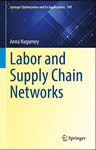
My "Labor and Supply Chain Networks" Book is Published!

I was delighted to receive a shipment of my new book, "Labor and Supply Chain Networks," yesterday. The book was published by Springer Nature and contains 12 chapters, with Acknowledgments, Preface, and an Appendix.

Writing this book was a true labor of love. The book is dedicated to: essential workers and to those fighting for freedom in Ukraine, with gratitude for your heroism. It is the result of many years of  research and writing, accompanied by adrenaline during the COVID-19 pandemic and now the war on Ukraine. 

Springer has produced both hardcopy and online versions, with more information available on the Springer website for the book. I am indebted to Elizabeth Loew of Springer for her outstanding shepherding of this book project with publication even ahead of schedule!

The front matter for the book, with the Preface and the Acknowledgments, is available for free download. In the Acknowledgments, I thank the great Isenberg School Dean Anne P. Massey, the two Operations and Information Management Department Chairs: Professors Bob Nakosteen and Senay Solak, over the period that this book was written, as well as the Vice Provost for Global Affairs at UMass Amherst Kalpen Trivedi, for his leadership of international programs. With the war in Ukraine still raging, and with my service for the Kyiv School of Economics (KSE) in Ukraine a very important part of my life, both professionally and personally, I also thank the President of KSE Tymofiy Mylovanov and Rector Tymofii Brik plus KSE colleagues Oleg Nivievskyi and Nataliia Shapoval, who have done extraordinary work on documenting the impacts of the war. 

Collaborators throughout this challenging time have made work fascinating and enjoyable. I am indebted to Professor Ladimer S. Nagurney of the University of Hartford, Professor Patrizia Daniele of the University of Catania in Italy, Professor Tina Wakolbinger of the Vienna University of Economics and Business, Professor Deniz Besik of the University of Richmond, Professor Sara Saberi of WPI, Professor Pritha Dutta of Pace University, and Professor Mojtaba Salarpour of Texas A&M Commerce. All are Center Associates of the Virtual Center for Supernetworks that I founded in 2001 and continue to direct. Acknowledgments are also extended to my long-time collaborators on Dynamics of Disasters conferences and co-edited volumes: Professor Panos M. Pardalos of the University of Florida and Professor Ilias S. Kotsireas of Wilfrid Laurier University in Canada. I also thank my PhD student Dana Hassani.

Of course, writing a book requires a great deal of focus and time and dedication, and I am so thankful to my family for their support. And, in the pandemic, having a professional society such as INFORMS that helped us to stay connected and informed and also advocated our work to the media and government, was incredible supportive and sustaining.

Workers need to be valued, supported, recognized, and paid for their contributions. Supply chains would collapse without them, as we have seen. I hope that my book, which contains chapters on both profit-maximizing firms and non-profits, including blood service organizations and those in emergency response and disaster management, helps in decision-making as well as policy-making. I believe that students will also appreciate and gain value from the material therein.

I hope that this book will inspire further research as well as implementation in practice of results therein from wages that should be paid to laborers to the productivity investments that should be made for the benefit of workers, consumers, firms, and organizations.

After all, as I wrote in my ORMS Today invited essay (thank you, INFORMS): In the End,  It's All About People!


Tuesday, May 7, 2019

Exciting POMS Conference in DC with Great Talks and Social Events

The 30th Production and Operations Management (POMS) Conference has now come to an end. It was a wonderful experience with over 2,000 conferees converging on Washington DC for the conference.

It started with some drama, because of the weather on Thursday, May 2, with big storms and temps in the 90s in DC. This resulted in flight delays for some including one of my doctoral students, Deniz Besik, who had a 4 hour delay from Bradley Airport to Reagan National Airport. The next morning, we had the first of a series of papers to present, beginning in the 8AM session. She made it to her hotel past 1AM and managed to register and to show up on time - clearly a sign of grit and success.  Some of us had taken earlier flights so we were spared delays. Also, Deniz was selected for and took part in the POMS Doctoral Colloquium on Saturday. Special congratulations to her since on Thursday afternoon, she was recognized by the Isenberg School of Management with the 2019 Outstanding Doctoral Student Researcher Award - quite the accomplishment, since our school has 7 different departments. I am very proud of her and very happy for her. Below is a photo that was shared on Twitter of Deniz with the award and with PhD friends: Rodrigo Mercado, Pritha Dutta, and Destenie Nock. Both Pritha and Destenie are receiving their PhDs at UMass Amherst ceremonies later this week and are off to academic careers. I am sure that they will be amazing professors at Pace University in NYC and at Carnegie Mellon University in Pittsburgh, respectively!

Our papers at POMS were presented in sessions on economics and operations management; healthcare, and humanitarian operations. The second and third presentations below were based on papers recently published in the journals Omega and the International Journal of Production Economics, respectively.

We have posted our presentations on the Supernetwork Center website.

The quality of the presentations in all sessions that I attended was excellent (generating many ideas and even possible new collaborations). It was a delight to see colleagues from Canada, Turkey, the UK, and across the US. Because of the location and also timing of the conference, it was a draw for many first timers and also quite a few INFORMS members, which was great. As a memento, we had photos taken of the speakers at the first session and then of even the audience as well as speakers of the third.
It is truly fabulous to see the interest in a spectrum of highly relevant topics for both research and practice!

In the below photo I am standing with Pritha Dutta, who is my 21st PhD student. She has done fundamental work on game theory and blood supply chains.
Socializing and networking are important components of any conference, as is reconnecting, and I love the serendipity of encountering colleagues and friends.
Plus, is is always thrilling to see the great Springer editors and, in this case, Matt Amboy, at the exhibits.

Of course, what would a conference in DC be without some exploring from Georgetown to the fabulous art museums. Luckily, Saturday's weather was ideal for walking.

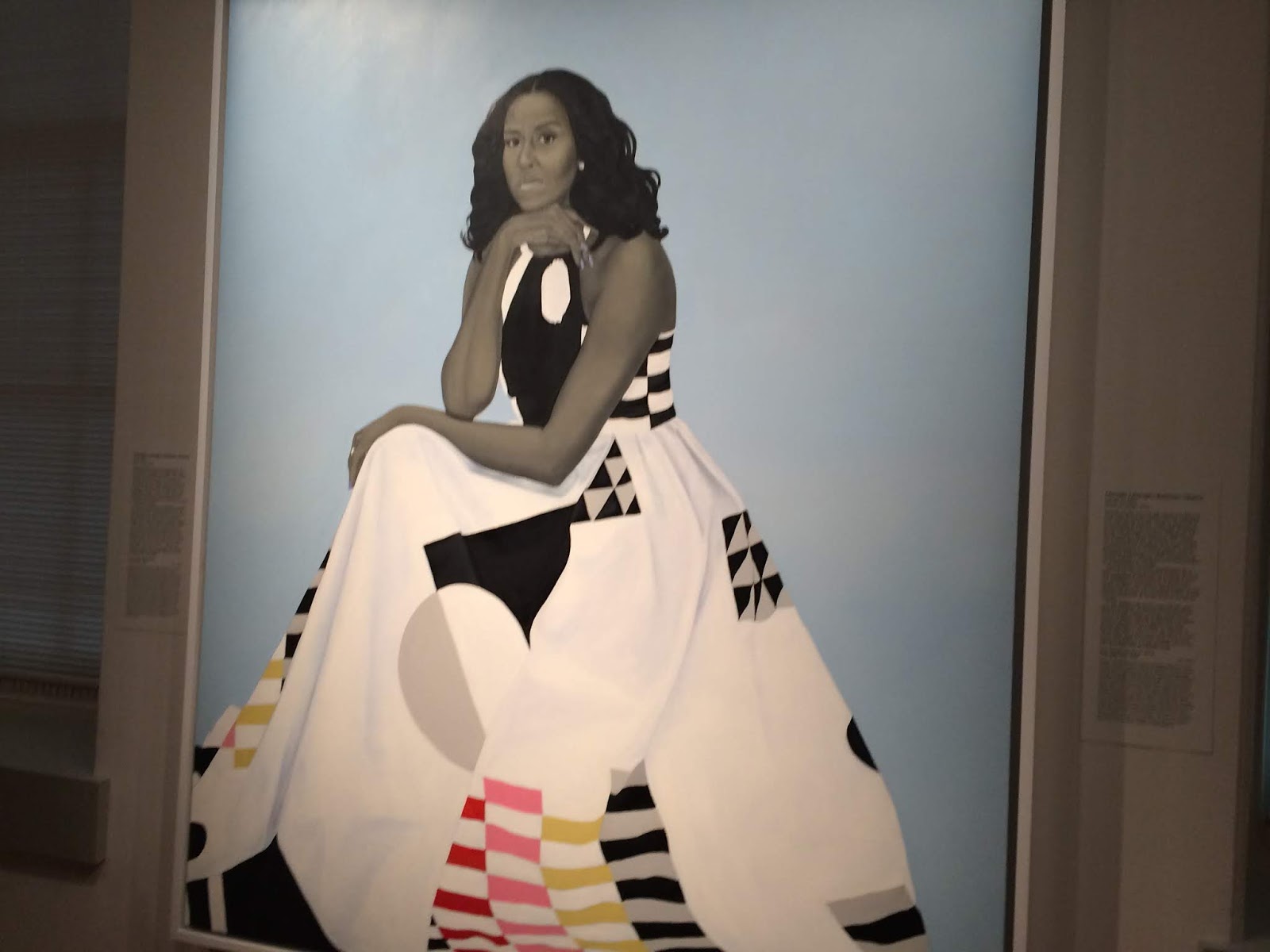
It was a delight to see Renoirs, Van Goghs, and Monets, as well as the portraits of President Obama and Michelle Obama. I was captivated by the audience viewing the latter - so many women!
My tradition at almost any conference is to treat a group that includes Supernetwork Center Associates, some of whom were my former doctoral students at the Isenberg School of Management, and friends to a dinner. On Saturday evening we enjoyed a scrumptious dinner at La Tomate, in proximity to the Hilton, which was the conference hotel. The food was magnificent and the company event better! We had an area just for us, which was very cozy.
After desserts, we took a group photo.
It is so rewarding to see my former PhD students, now professors at wonderful universities and colleges, thriving both professionally and personally.

And on a very rainy Sunday, the conferees and guests convened for a lavish awards luncheon and service was very prompt - extraordinarily efficient, but, then again, it was a POMS conference.
A special thanks to the "other" Professor Nagurney, for not only being a co-author of our first paper presentation at POMS, but for also helping me with the luggage and logistics.
Congratulations to the organizers of the 30th POMS Conference on its success!

Friday, December 15, 2017

Congratulations and Kudos to the Supernetwork Team at the Isenberg School of Management

Every year, at this time, as the Center Director of the Virtual Center for Supernetworks, I prepare a Congratulations and Kudos to the Supernetwork Team.
 
2017 was a fabulous year for the Supernetwork Team, one in which we continued to have a global reach and impact! It gives me great pleasure to highlight below some of the accomplishments and achievements of the Center Associates of the Virtual Center for Supernetwork in the past year.
Congratulations to Center Associate Dr. Patrizia Daniele of the University of Catania in Italy on her promotion to Full Professor! Also, it is not very often that there is a paper with 4 female co-authors. I was delighted that the paper, "Cybersecurity Investments with Nonlinear Budget Constraints and Conservation Laws: Variational Equilibrium, Marginal Expected Utilities, and Lagrange Multipliers," co-authored with Gabriella Colajanni, Dr. Patrizia Daniele, and Dr. Sofia Giuffre,  is now in press in the International Transactions in Operational Research. Dr. Daniele took part in the 3rd Dynamics of Disasters conference,  in early July, 2017 in Kalamata, Greece, and jointly presented a paper with Emilio Alvarez-Flores, a former undergraduate Isenberg School alum, a student of Dr. Daniele's, Valeria Caruso, and me, on game theory and disaster relief.

It was a pleasure co-organizing the Dynamics of Disasters conference with Dr. Ilias Kotsireas from the Wilfrid Laurier University in Canada and Dr. Panos M. Pardalos of the University of Florida. Also speaking at this conference were Center Associates: Dr. Dmytro Matsypura of the University of Sydney in Australia, whose recent paper, "Wildfire Fuel Management: Network-based Models and Optimization of Prescribed Burning," co-authored with Dr. Oleg Prokopyev of the University of Pittsburgh,  was published in the European Journal of Operational Research, and Dr. Ladimer S. Nagurney of the University of Hartford, who spoke on disaster communications. We had the pleasure of hosting Dr. Matsypura at the Isenberg School, his PhD alma mater,  through the UMass Amherst INFORMS Speakers Series on November 3, since he was on sabbatical this Fall.

Also presenting at the Dynamics of Disasters conference was Timo Gossler, a doctoral student of Center Associate Dr. Tina Wakolbinger of the Vienna University of Economics and Business in Austria. Dr. Wakolbinger was the organizer of the fabulous 2017 EURO HOpe conference, which focused on humanitarian operations and which took place at her university, shortly before the Dynamics of Disasters conference.

Center Associate Dr. Stavros Siokos, who is the Managing Partners of Astarte Capital Partners, based in London, England, deserves a big congratulations! His company was recognized as a "Most Innovative Manager of 2017" by the Institutional Asset Management Awards at a ceremony at the Pierre Hotel in NYC in November. And he was featured on the cover of the Finance Monthly with an interview in the November Issue!

Congratulations also to Center Associate Dr. Shivani Shukla, who successfully defended her PhD dissertation: Game Theory for Security Investments in Cyber and Supply Chain Networks, and assumed a tenure track Assistant Professor position at the University of San Francisco in California. She is my 20th PhD student to receive her doctorate. The paper, "Multifirm Models of Cybersecurity Investment Competition vs. Cooperation and Network Vulnerability," that we co-authored, was published in the European Journal of Operational Research in 2017.

Kudos to Center Associate Dr. Sara Saberi of the Foisie School of Business at Worcester Polytechnic Institute (WPI) in Massachusetts, who is lead author of the paper, "A Competitive Multiperiod Supply Chain Network Model with Freight Carriers and Green Technology Investment Option," with Center Associate Dr. Jose M. Cruz of the University of Connecticut, her colleague, Dr. Joe Sarkis, and me, which is in press in the European Journal of Operational Research. Dr. Saberi presented this work at the MSOM conference at the UNC Flagler School in June. Dr. Saberi also received a grant from APICS joint with Dr. Sarkis.

Center Associate Amir H. Masoumi was again heavily involved in organizing the latest Business Analytics competition at Manhattan College, which took place last May and is now an international competition. Center Associate Dr. Dong "Michelle" Li of Arkansas State University, was one of the judges. Kudos to Dr. Masoumi on his publication, "Mergers and Acquisitions in Blood Banking Systems: A Supply Chain Network Approach," that we co-authored with Center Associate Dr. Min Yu of the University of Portland, which was published in the International Journal of Production Economics in 2017. Also, Dr. Yu was a co-author of our paper, "Consumer Learning of Product Quality with Time Delay: Insights from Spatial Price Equilibrium Models with Differentiated Products," with Dr. Li, which is now in press in the journal Omega.

Congratulations to Doctoral Student Center Associate Deniz Besik, who had two papers published in 2017, one in the Journal of Global Optimization and the other in Socio-Economic Planning Sciences. This year she was elected President of the UMass Amherst INFORMS Student Chapter.  The chapter was recognized with its 12th award, in as many years, at the INFORMS Annual Meeting in Houston in October, with the Magna Cum Laude Award  for its activities in 2016. In 2016, Doctoral Student Center Associate Pritha Dutta served as the Chapter President. Kudos also to her for receiving the first place award by a PhD student at the NEDSI conference in Springfield, MA, in March for her presentation on a game theory model for blood donations.

We welcome Mojtaba Salarpour as a Doctoral Student Center Associate. Mr. Salarpour matriculated into the Management Science doctoral program at the Isenberg School in Fall 2017 and will be working on disaster relief.

The INFORMS Houston conference, October 22-25, 2017,  served as a great venue for many Center Associates to reconvene, with participants and speakers including Center Associates Professor Patrick Qiang of Pennsylvania State University Great Valley, Professor Trisha Anderson of Texas Wesleyan University, Professor Amir H. Masoumi of Manhattan College, Professor Min Yu of the University of Portland, Professor Dmytro Matsypura of the University of Sydney in Australia, Professor Jose M. Cruz of the University of Connecticut, Professor Dong Li of Arkansas State University, Professor Sara Saberi, and Center Associates Professor Shivani Shukla as well as Deniz Besik and Pritha Dutta.

Also, articles that we authored on topics from blood supply chains to investing in infrastructure to disaster relief and game theory to FirstNet in The Conversation were reprinted in many major publications outlets and I had the pleasure of being interviewed for multiple radio news shows in the US and in Canada. Finally, it was wonderful to be back at the Radcliffe Institute for Advanced Study at Harvard University as a Summer Fellow and to also speak at the ORBerlin Conference in September!

Thanks for the support! We wish everyone a Marvelous New 2018 Year!

Below are links to examples of some of our recent publications.
 
Multifirm Models of Cybersecurity Investment Competition vs. Cooperation and Network Vulnerability,
Anna Nagurney and Shivani Shukla, European Journal of Operational Research 260(2): (2017), pp 588-600.
 
A Competitive Multiperiod Supply Chain Network Model with Freight Carriers and Green Technology Investment Option,
Sara Saberi, Jose M. Cruz, Joseph Sarkis, and Anna Nagurney, in press in the European Journal of Operational Research.
 
Quality in Competitive Fresh Produce Supply Chains with Application to Farmers’ Markets,
Deniz Besik and Anna Nagurney, Socio-Economic Planning Sciences 60: (2017), pp 62-76.
 
Mergers and Acquisitions in Blood Banking Systems: A Supply Chain Network Approach,
Amir H. Masoumi, Min Yu, and Anna Nagurney, International Journal of Production Economics 193: (2017), pp 406-421.
 

Cybersecurity Investments with Nonlinear Budget Constraints and Conservation Laws: Variational Equilibrium, Marginal Expected Utilities, and Lagrange Multipliers,
Gabriella Colajanni, Patrizia Daniele, Sofia Giuffre, and Anna Nagurney, in press in the International Transactions in Operational Research.


Hospital Competition in Prices and Quality: A Variational Inequality Framework,
Anna Nagurney and Karen Li, Operations Research for Health Care 15: (2017), pp 91-101.


Tuesday, November 14, 2017

Becoming an Operations Research Newsmaker Through the Media

A few years ago, at the INFORMS Charlotte conference, there was a terrific (I am a bit biased, I admit) panel entitled: Becoming an O.R./Analytics Newsmaker, that I even wrote a blogpost on because I thought the tips on dealing with the media were definitely worth preserving and sharing,

Joining me, as panelists, were: Jack Levis of UPS, Dr. Margaret Brandeau of Stanford, and Dr. Sheldon Jacobson of the University of Illinois. The panelists have had experience with major news outlets, including the Associate Press, radio shows, TV programs, and documentaries. Barry List, the Communications Director of INFORMS at that time, had organized the panel and Peter Horner, the Editor of OR/MS Today, was also present. The panelists are all (now) INFORMS Fellows.

What I have learned, in addition, since that panel, based on experiences that I have had is:

1.  You never know when you might be contacted by the media, so always be prepared. It might be for a story that a journalist needs to finish with a tight deadline. When I was at Oxford University as a Visiting Fellow, for example, and in London to give a talk at Imperial College in June 2016, I received a message late at night from a journalist in Canada, who had heard of the talk on cybersecurity that I had given at the University of Waterloo and wanted my impressions on ransomware. We had a phone conversation and his article was published before midnight.

2. Sometimes you may have to wait weeks for an interview, as I recently experienced. First, I was asked if I was available to be interviewed on disaster management at 11:30PM on the same night that I was flying back from our INFORMS conference in Houston (October 25, 2017) so I, graciously, declined. There were some negotiations for another time and, this past Wednesday, I had the pleasure of being interviewed by Terry Gilberg, who is the host and Executive Producer of the radio show Think!America. That interview aired this past weekend and it is 22 minutes into last Saturday's show, which can be accessed here. She was intrigued by the article I had written in The Conversation: Response to natural disasters like Harvey could be helped with game theory and wanted me on her show.  I enjoyed the interview a lot and she even followed up with a nice phone call to my Isenberg School office!

In late August I was interviewed by Angela Kokott for her radio show in Calgary, Canada, also on my research with collaborators on disaster relief and game theory.

3. In many cases (such as 2 above) one may not get questions ahead of time so you have to be creative and anticipate the kinds of questions that you might be asked. Always be ready with one or two strong takeaway messages!  In contrast, last July, while I was a Summer Fellow at the Radcliffe Institute for Advanced Study at Harvard University, I was interviewed for the Matt Townsend Radio Show on Infrastructure Spending. One of the producers had sent me sample questions ahead of time and I was really pumped. The script was not very closely followed, but it did provide a framework. Townsend, as Gilberg and Kokott, are fabulous interviewers - very dynamic and provocative and I enjoyed these interviews tremendously.

4. And last winter, after my article: Uncertainty in blood supply chains creating challenges for the industry was published, I was contacted by our local NPR radio station for a segment: America's Blood Economy. My interviewer was Karen Brown and you get read the interview transcript here. 
For this interview, I had to show up in the recording studio, which was on caampus and very convenient.

5. A few years earlier, after  speaking on a panel at the AAAS meeting in Washington DC, I was contacted by a journalist in Italy and ended up talking about the Braess paradox on Italian radio! 

You can see from the above examples (and I have more, including experiences on TV shows and documentaries that I have been part of), that if you share your Operations Research in print outlets or even give good talks, news can be picked up by media outlets. So, do keep that great research going and try to disseminate it further since that is how you can broaden the impact.

Your university might also be able to help or sometimes even the publisher of the journal in which your exciting research has appeared but, honestly, it is also up to you. And, it can be very rewarding, fun, and also a great way in which to grow professionally.

Sunday, September 10, 2017

International OR2017 Berlin Conference Was Fabulous with 910 Participants from 46 Countries

Yesterday evening I arrived back in Massachusetts from the fabulous International Conference on Operations Research, OR2017 Berlin, in Germany.

The invitation to delivery a semiplenary talk at this conference I received back in November 2016 from Professor Jan Ehmke, a super creative, dynamic, and productive scholar in transportation and logistics and very well-known in our INFORMS community. Professor Ehmke was one of the two Chairs of the Program Committee, along with Professor Natalia Kliewer of the Freie University,  and was also on the Organizing Committee. It took me only about 24 hours to respond with a resounding, "Yes." I figured it was doable, although the dates of the conference September 6-8, 2017, coincided with the first week of classes at UMass Amherst. Professor Ehmke kindly scheduled my semiplenary on the Friday, the last day of the conference, so that I could meet with my Transportation & Logistics class students for the first class and a wonderful doctoral student covered the second class. (I am bringing back a lot of chocolates for the students). Also, I am delighted that we now again have a direct link from our local airport, Bradley in Hartford/Springfield, to Europe, with a daily flight to Dublin via Aer Lingus, which made the trip to Europe and back in 4 days manageable.

I gave Dr. Ehmke a list of topics that I could speak on and the one selected was: Blood Supply Chains: Challenges for the Industry and How Operations Research Can Help. 


So, after teaching my first class this past Tuesday, I was off to the OR2017 Berlin conference via Aer Lingus, with a short layover in Dublin, and I arrived Wednesday morning in Berlin. Accommodations were in the Harnack Haus, a historical scientific building, with additional rooms across the street and in proximity to the conference venue, which was the Freie University, in a green and stunning part of Berlin known as Dahlem.
 
 The main building there for the conference was the Henry Ford Building.
Shortly after registering at the guest house, and while marching with my luggage to the site of my room, I was greeted on the street by the Chairs of the conference: Professor Natalia Kliewer and Professor Rolf Borndorfer of the Freie University.

After freshening up, and, before going to the sessions, since the scientific program with a theme of the conference being: Decision Analytics for the Digital Economy, I treated myself to a marvelous lunch at the neighboring French cafe (several of us also indulged in some baked treats the day after).
The conference had numerous coffee breaks, receptions, a conference dinner, and even lunches, at which one could socialize and discuss with speakers their research.
 
 
Below is a photo taken with Professor Ehmke.
It was special to see my colleague from the University of Connecticut School of Business, Professor and now Associate Dean Robert Day, who also took advantage of our new air link to Europe.
I thoroughly enjoyed all the talks that I attended and, of course, the plenary and semiplenary talks, as well (although it was tough to decide which ones to go since the latter had multiple parallel ones).  The scientific quality of the presentations was uniformly excellent and I very much enjoyed talks from sustainability and logistics themes to social network models to machine learning and optimization.
I enjoyed speaking with Christian Rauscher, a Springer editor, and his colleague at the Springer display booth. I have seen Christian at wonderful Operations Research conferences around the globe.
Also it was a pleasure to see fellow INFORMS Fellow, Dr. Robert Fourer, who even came to my semiplenary talk.

Another wonderful experience was seeing the one and only Professor Marco Lubbecke from Aachen, who also gave a semiplenary talk and meeting Professor Jan Ehmke's dissertation supervisor at a sumptious breakfast: Professor Dirk Mattfeld.

Professor Stefan Zimmer was the chair of my semiplenary session and afterwards I was presented with a lovely gift of a personalized mug with the title of my talk on it and some yummy gummy bears inside.
After my presentation, I spoke with conferees from India who are also working on blood supply chains. Amazing to have 46 different countries represented at this conference!
And to make this conference experience extraordinarily special, while taking an exploratory walk after sessions on Thursday I saw the billboard of Angela Merkel below

and I came upon the John F. Kennedy Institute at the Freie University, where I had given an invited talk 15 years ago, when I was a Distinguished Chair at the University of Innsbruck under a Fulbright.
Coincidentally, when I received my PhD from Brown University in Applied Mathematics in 1983, with a specialty in Operations Research, John F. Kennedy Jr. received his undergraduate degree and his mother, Jackie Kennedy Onassis, was there (and my mother was thrilled). I have also met his sister Caroline Kennedy at an event at the Radcliffe Institute at Harvard University a while back.

This was my third trip to Berlin - in March 2015 I  gave a plenary talk at a physics conference entitled: Design of Sustainable Supply Chains for Sustainable Cities.

The OR2017 Berlin conference set new standards as to attention to detail and organization and I am very grateful for experiences that I will never forget.

Of course, I also had to indulge in some Wiener schnitzel, which will keep me fortified for quite a while, and it was as delicious as it looks in the photo below.

And, on my flight back from Dublin to Hartford/Springfield I rewarded myself by watching the movie Hidden Figures, about AfroAmerican female mathematicians who made an impact on the NASA space program. And, when the Euler method was mentioned as the method Katherine Johnson used to approximate a very important trajectory in a eureka type moment, I was thrilled. Our work on projected dynamical systems, which I had mentioned in my semiplenary talk, also involves a general iterative scheme, with a special case being the Euler method!

Plus, guess which books have been on my bedside stand?!
During OR2017 Berlin, we received messages that the INFORMS conference will take place at the originally scheduled dates in Houston, despite Hurricane Harvey, so I hope to see again many colleagues back in the US. And, strangely enough, the case study that I described in my semiplenary talk, based on our recently published paper, was focused on a blood service organization in Florida potentially merging with another organization under status quo and disaster scenarios, and now we await the brunt force of Hurricane Irma, the strongest hurricane ever recorded in the Atlantic.

Operations Research has never been more important!

Monday, August 21, 2017

Latest on Blood Supply Chains

This has been an amazing day, with not only the solar eclipse taking place,
 

and we had a wonderful turnout to view the solar eclipse, organized by Finance Professor Ben Branch of the Isenberg School,


but we also had two papers published today: Supply Chain Network Capacity Competition with Outsourcing: A Variational Equilibrium Framework, Anna Nagurney, Min Yu, and Deniz Besik,  which was published in the September issue of the Journal of Global Optimization (JOGO):

and Mergers and Acquisitions in Blood Banking Systems: A Supply Chain Network Approach, Amir H. Masoumi, Min Yu, and Anna Nagurney, which was published in the November issue of the International Journal of Production Economics (IJPE).

There has been much going on in the blood services industry in the United States and in January I had an article on the topic published in The Conversation: Uncertainty in Blood Supply Chains Creating Challenges for the Industry, which was reprinted in many news outlets.
Our IJPE article provides not only a new blood supply chain network model that incorporates frequencies of activities such as collection, testing, and distribution, but it also introduces three synergy measures to determine whether or not a merger or acquisition in this industry would be effective.  The case study examines a recent pending merger uner both status quo and disaster scenarios. The IJPE article is already garnering attention and was featured in a news post at the Pamplin School of Business at the University of Portland, where one of my co-authors, Professor Min Yu, is a faculty member.  Below is a photo of the three authors of this paper, with the lead author being Professor Amir H. Masoumi of the School of Business at Manhattan College. Both Dr. Masoumi and Dr. Yu are Isenberg School of Management UMass Amherst PhD alums (and they were also my doctoral students, with whom I continue to collaborate through the Supernetwork Center).
And, I am very excited that I will be delivering a semiplenary talk: Blood Supply Chains: Challenges for the Industry and How Operations Research Can Help  at the International Conference on Operations Research in Berlin, Germany, September 6-8, 2017.  It is an honor to be on the list of semiplenary speakers at this conference, and great to see several friends on the list!

I have been hard at work on my conference presentation, which will describe the latest on blood supply chains from network optimization models to game theory models since this healthcare sector is faced with increasing competition.
Hope you can make it to the conference and, if not, I will be posting my presentation closer to the conference date.