One of my favorite quotes on Operations Research is by INFORMS President-Elect Ed Kaplan of Yale University. It appears in a paper that he wrote that was published in Omega, "Adventures in Policy Modeling! Operations Research in the Community and Beyond,"and says: Modeling need not be “off the shelf”—rather, modeling with OR techniques should be a celebration of creativity.
His paper is a very provocative and stimulating read and shuts down naysayers.
The paper also is filled with examples as to how Operations Research has informed policy and associated decision-making. The article is focused on community-based policies. Examples are drawn from urban applications (Dick Larson's research and practical applications), AIDS modeling and needle exchanges (work done by Kaplan), drug control (Jonathan Caulkins), and even homicides and gun availability (Al Blumstein's many contributions), to start, and, of course, security. Some great work in this area has been done by, I note, among others, Ed Kaplan, Larry Wein, Sheldon Jacobson, and Laura McLay.
Operations Research has been instrumental in informing policies in other settings, as well, from transportation and logistics to the environment and even medical decision-making, and humanitarian operations.
I work on network systems with many associated applications and it is very gratifying when research that you do also informs policy.
A few years ago, in research conducted with Patrick Qiang, who was my doctoral student at the Isenberg School of Management, and with whom I wrote the Fragile Networks book, we introduced a network performance measure, which allows for the identification and ranking of nodes and links in various network systems operating under decentralized behavior (think of urban transportation networks, certain supply chains, financial networks, and even the Internet). (Patrick is now a tenured Associate Professor at Penn State Great Valley, as of Fall 2015, so more congrats are in order!)
The results of this research appeared in various journals, including Operations Research ones, and even physics, since we wanted to disseminate the work broadly for maximum impact. A high level overview of our results with some applications appears in: Fragile Networks: Identifying Vulnerabilities and Synergies in an Uncertain Age, Anna Nagurney and Qiang Qiang, International Transactions in Operational Research 19: (2012) pp 123-160.
The Nagurney-Qiang performance measure has been used in Indonesia to assess new shipping routes in a study financed in part, by the World Bank. A nice overview of the approach is in a presentation on Prezi.
Our performance measure has also been used by researchers in Greece, led by Mitsakis and collaborators, to conduct network performance and components’ criticality analyses to assess the effects of the immense 2007 fires in Peloponnesus on vehicular traffic and the overall transport network. See also recent work by some of the same researchers on climate change and our measure.
In addition, it has been leveraged in an insightful report, "Guidebook for Enhancing Resilience of European Road Transport in Extreme Weather Events."
Schulz used our network performance measure to assess the importance of roadways in a part of Germany.
It was also applied in Ireland to assess new Dublin metro lines.
It has been utilized to assess the potential impact of earthquakes on critical infrastructure and is now even being applied outside the policy arena in physiological settings (yes, networks are everywhere and that is one reason why I love them!).
As for my work on paradoxes, including environmental ones, in 2007, one of my papers was featured in the New Zealand parliament; info here.
Operations Researchers work on tough problems with solutions having broad and fascinating impacts!
Showing posts with label Fragile Networks. Show all posts
Showing posts with label Fragile Networks. Show all posts
Sunday, August 30, 2015
Wednesday, October 31, 2012
When the Critical Infrastructure Collapses -- Rebuilding for Resiliency
Many of us have seen the news and photos and have also personally experienced tremendous losses because of Hurricane Sandy, which continue.
There are still, days after Hurricane Sandy made landfall in the Northeast, extensive power outages and, in many parts of the mid-Atlantic states of the US, still uncertainty as to when electricity will be restored, and as to when the transportation networks (both nodes and links) will be fully operational and buildings that were once homes, businesses, and medical facilities, habitable. Dozens have lost their lives.
What I also find absolutely stunning is the number of colleges and universities in the mid-Atlantic states that are still without power and have cancelled classes for this full week!
And, it is next to impossible, to identify a mode or series of modes of transportation, given the disruptions to air travel, bus travel, trains, and subways in major and smaller metropolitan areas, that would get (m)any of the students safely back home, assuming that their homes even exist.
Mind you, it is October and Fall here.
I have received messages not only from operations research colleagues who lived through Hurricane Katrina but even from Italy, expressing concern for the devastation and the suffering. Thank you for asking and for caring about others. I have heard from relatives in several mid-Atlantic states, who are without power.
Who would have thought that a natural disaster could impact tens of millions of people in the US over such a short, intense period of time, and disrupt their routines, livelihoods, and even educations and affect an area of 900 miles!
At a Transportation Research Board meeting in Washington DC, in 2011, I had the honor of speaking on a panel, with the title, Disaster Recovery and Mitigation Planning and Resilience, which does seem uncannily prescient, with the program below:
Presentations:
Update on TRB Activities (P11-1419)
Jeffrey L. Western - Western Management and Consulting, LLC
Building Resilience into Fragile Transportation Networks in an Era of Increasing Disasters (P11-1394)
Anna Nagurney - University of Massachusetts
Infrastructure: Critical Link and Cutting Edge for Disaster Recovery and Mitigation (P11-1397)
Rae Zimmerman - New York University
Learning from the Haiti Reconstruction Efforts (P11-1399)
Herby Lissade - California Department of Transportation
U.K. Perspective (P11-1464)
Sujith Kollamthodi - AEA Group, United Kingdom

My presentation, Building Resilience into Fragile Networks in an Era of Increasing Disasters, I have posted since, in it, I also emphasized the impact of climate change on critical infrastructure, especially that of transportation networks. This is a topic that we have done a lot of research on and even Governor Andrew Cuomo of New York realizes that we need to design our infrastructure for resiliency as we adapt and cope with climate change.
We are now seeing that, as I have written many times, we are in an Era of Supernetworks, in which our critical infrastructure networks from electric power to transportation and logistics to communications and financial networks are so intertwined and interdependent that a failure in one can have cascading failures and long-term disruptions that propagate. And when a disaster strikes, in the form of Hurricane Sandy, we are painfully reminded that we need to design for resiliency.
Dr. June Dong and I wrote our Supernetworks book back in 2001 and it was published in 2002. When 9/11 struck, the camera-ready copy was stuck at the JFK airport but eventually made it to the publisher in England.
Now, my latest book, which was just sent off to the publisher last week, is probably floating in electronic form somewhere in lower Manhattan since my publisher's office is shut down due to the flooding and lack of electric power.
Plus, I cannot even figure out a way of getting my daughter home from her college, besides driving 5 hours on roads and over bridges, in conditions that I cannot fathom and that, just this past Sunday, were fine.
So many of our critical nodes and links have been affected, changing economic and human activities in ways we did not foresee.
There are still, days after Hurricane Sandy made landfall in the Northeast, extensive power outages and, in many parts of the mid-Atlantic states of the US, still uncertainty as to when electricity will be restored, and as to when the transportation networks (both nodes and links) will be fully operational and buildings that were once homes, businesses, and medical facilities, habitable. Dozens have lost their lives.
What I also find absolutely stunning is the number of colleges and universities in the mid-Atlantic states that are still without power and have cancelled classes for this full week!
And, it is next to impossible, to identify a mode or series of modes of transportation, given the disruptions to air travel, bus travel, trains, and subways in major and smaller metropolitan areas, that would get (m)any of the students safely back home, assuming that their homes even exist.
Mind you, it is October and Fall here.
I have received messages not only from operations research colleagues who lived through Hurricane Katrina but even from Italy, expressing concern for the devastation and the suffering. Thank you for asking and for caring about others. I have heard from relatives in several mid-Atlantic states, who are without power.
Who would have thought that a natural disaster could impact tens of millions of people in the US over such a short, intense period of time, and disrupt their routines, livelihoods, and even educations and affect an area of 900 miles!
At a Transportation Research Board meeting in Washington DC, in 2011, I had the honor of speaking on a panel, with the title, Disaster Recovery and Mitigation Planning and Resilience, which does seem uncannily prescient, with the program below:
| Event Description: | Transportation systems throughout the world are greatly affected by natural disasters and human-created events. These systems are critical for daily activities and the economy. The magnitude of the U.S. transportation infrastructure makes protecting it extremely challenging and costly. This special session highlights innovative approaches to disaster recovery planning and assesses improving transportation infrastructure resilience to extreme events. |
Presentations:
Update on TRB Activities (P11-1419)
Jeffrey L. Western - Western Management and Consulting, LLC
Building Resilience into Fragile Transportation Networks in an Era of Increasing Disasters (P11-1394)
Anna Nagurney - University of Massachusetts
Infrastructure: Critical Link and Cutting Edge for Disaster Recovery and Mitigation (P11-1397)
Rae Zimmerman - New York University
Learning from the Haiti Reconstruction Efforts (P11-1399)
Herby Lissade - California Department of Transportation
U.K. Perspective (P11-1464)
Sujith Kollamthodi - AEA Group, United Kingdom
My presentation, Building Resilience into Fragile Networks in an Era of Increasing Disasters, I have posted since, in it, I also emphasized the impact of climate change on critical infrastructure, especially that of transportation networks. This is a topic that we have done a lot of research on and even Governor Andrew Cuomo of New York realizes that we need to design our infrastructure for resiliency as we adapt and cope with climate change.
We are now seeing that, as I have written many times, we are in an Era of Supernetworks, in which our critical infrastructure networks from electric power to transportation and logistics to communications and financial networks are so intertwined and interdependent that a failure in one can have cascading failures and long-term disruptions that propagate. And when a disaster strikes, in the form of Hurricane Sandy, we are painfully reminded that we need to design for resiliency.
Dr. June Dong and I wrote our Supernetworks book back in 2001 and it was published in 2002. When 9/11 struck, the camera-ready copy was stuck at the JFK airport but eventually made it to the publisher in England.
Now, my latest book, which was just sent off to the publisher last week, is probably floating in electronic form somewhere in lower Manhattan since my publisher's office is shut down due to the flooding and lack of electric power.
Plus, I cannot even figure out a way of getting my daughter home from her college, besides driving 5 hours on roads and over bridges, in conditions that I cannot fathom and that, just this past Sunday, were fine.
So many of our critical nodes and links have been affected, changing economic and human activities in ways we did not foresee.


Thursday, October 18, 2012
Our Fragile Networks Book Was at #informs2012
I wish that we could teleport ourselves, so that, with the time difference between Gothenburg, Sweden and Phoenix, Arizona, I could have attended both the Future Urban Transport Symposium, which took place here in Gothenburg, and the 2012 INFORMS Conference in Phoenix, Arizona.
Perhaps one day such extreme transportation will be possible.
Luckily, my collaborators were at the 2012 INFORMS conference so that 5 presentations were given that I was a contributor to.
I was a panelist at the Future Urban Transport conference so we had talks taking place on two continents this past week.
 Our latest book, Fragile Networks: Identifying Vulnerabilities and Synergies in an Uncertain World, was also at the INFORMS conference, thanks to the publisher, John Wiley & Sons, and the photo above was forwarded to me by my co-author, Dr. Patrick Qiang, who is holding our book at the Wiley booth in Phoenix.
Perhaps one day such extreme transportation will be possible.
Luckily, my collaborators were at the 2012 INFORMS conference so that 5 presentations were given that I was a contributor to.
I was a panelist at the Future Urban Transport conference so we had talks taking place on two continents this past week.

Monday, June 4, 2012
Repairing Roads -- Why Can't the US be More Like Sweden?
I read the excellent OpEd piece by Robert Frank of Cornell University that was published in The New York Times on how the repair of roads in the United States might end other types of gridlock (political, let us hope, and also economic by putting people to work).
I arrived in Gothenburg, Sweden, this past Thursday. This is my second extended stay in this lovely city, which is the second largest in Sweden.
As is appropriate, I am a Visiting Professor of Operations Management at the School of Business, Economics and Law at the University of Gothenburg and am seated in my office surrounded by my Transport & Logistics colleagues and my Finance colleagues (similar to my situation back at the Isenberg School of Management at UMass Amherst).
I continue to be impressed about the wonderful transport, including road infrastructure, in this city (and wherever I have traveled in Sweden before the contrast with the US has stunned me).
There is a lot of activity here now in parts of the city in repairing the sidewalks and the roads. The workers in their uniforms have even been planting flowers down the major avenue.
No wonder there are so many people of all ages promenading around the city as well as in the lovely parks and cafes.
In addition, the traffic flows well and I continue to be impressed by the multiple modes of transport that are available here -- from the trams and busses to the ferries and even bicycles, which one can borrow at various locations.
There are also bicycle lanes and pedestrian lanes.
Thanks to Robert Frank for again emphasizing what we have been writing about from our Fragile Networks book to various other writings, including an invited commentary for Resources for the Future.
When will the US get some of its pride back? Without repairing and investing in our networks, we cannot move the economy forward. Physical goods and services cannot be delivered digitally.
Friday, April 20, 2012
Building a Resilient World by Preparing for Disasters
Dr. Judith Rodin, the President of the Rockefeller Foundation, has a wonderful OpEd piece on cnn.com, To Prepare for Disasters, Have a Plan B.
The article notes the meeting that is being convened in Washington DC this week, Embracing Change: Building Social, Economic, and Environmental Resilience.
To alleviate and reduce the impacts of food shortages, financial contagion, natural disasters, as well as pandemics, the world needs to harness the power of networks and synergistic collaborations.
This semester, I have been teaching a new course, Humanitarian Logistics and Healthcare. In the course, we have learned about emergency preparedness, mitigation, disaster response and recovery as well as risk management, vulnerability assessment, the importance of critical infrastructure robustness and resilience. We have even discussed fund raising for humanitarian relief organizations.
Our guest speakers have come from the Red Cross, the National Guard, and from industry, and we have learned about Disaster Communications, and how universities prepare for emergencies.
As a public service, I have now made my lectures notes, as well as several guest speaker talks, available online.
This course was inspired by the Humanitarian Logistics: Networks for Africa Workshop that I organized at the Rockefeller Foundation's Bellagio Center on Lake Como, Italy.
The findings from the workshop as well as the presentations can be accessed here.
Thanks to the Rockefeller Foundation for sponsorship.
Our books on related topics can be found here.
Tuesday, February 7, 2012
Designing a Critical Link to Withstand a Natural Disaster and Allow for Humanitarian Operations
Last summer I had the pleasure of attending an I3P (Institute for Information Infrastructure Protection) meeting in Berkeley, California. I wrote about my travel experiences on this blog.
During my travels back to the San Francisco airport (with some detours on the shuttle since we picked up commuters) I also had the experience of going over the Bay Bridge and to see the replacement bridge under construction, which is scheduled for completion in 2013. At that point, the existing eastern span bridge will be torn down.
Bridges have always fascinated me for their design and as critical links in joining communities and regions. It also helps that my favorite uncle has educated me over the years about bridges, since he worked for decades as a bridge designer in NYC and has received numerous awards for his engineering work.
The New York Times has a very interesting article, "A Bridge Built to Sway When the Earth Shakes," written by Henry Fountain, which states that designing the replacement bridge so that it stays intact in an earthquake has always been the engineers' chief goal. Remember the earthquake of 1906 that destroyed much of San Francisco as well as the earthquake of 1989 that partly severed the Bay Bridge in San Francisco.
According to the article there is a 2 in 3 chance that an earthquake of a magnitude of 6.7 or higher will hit the San Francisco area before 2036 and this new bridge was designed to be able to handle the largest movements of the earth expected to occur in 1,500 years!
What also very much impressed me and this I am sharing with my students in the Humanitarian Logistics and Healthcare course that I am teaching is that the bridge, even after a major earthquake / disaster is expected to be serviceable and the damage reparable. Moreover, according to the article (note the foresight in terms of emergency preparedness and response):
Emergency vehicles and personnel, at the least, should be able to use the new bridge within hours of a major earthquake, after crews inspect the structure and make temporary fixes.... Given that the Bay Area's two major airports would be expected to be out of service after such a disaster, this bridge and the Benicia-Martinez Bridge, another seismically secure span about 20 miles to the northeast, would be "lifeline" structures to bring assistance to the stricken region from an Air Force base inland.
We have developed metrics to identify critical nodes and links in transportation and other infrastructure networks and also how to assess performance of critical needs supply chains subject to disruptions, as one would expect to occur in a natural disaster, for example. The latter work is reported in a paper, "A Bi-Criteria Indicator to Assess Supply Chain Network Performance for Critical Needs Under Capacity and Demand Disruptions ," Qiang Qiang and Anna Nagurney, to appear in Transportation Research A: Special Issue on Network Vulnerability in Large-Scale Transport Networks.
It is very good to see that California understands the importance of the replacement bridge for the San Francisco Bay.
And if you are wondering where the steel for this bridge (it's actually the eastern span) is coming from -- it is coming from China and is being transported 6,500 miles to Oakland!
According to an article that appeared last summer in The New York Times: The assembly work in California, and the pouring of the concrete road surface, will be done by Americans. But construction of the bridge decks and the materials that went into them are a Made in China affair. California officials say the state saved hundreds of millions of dollars by turning to China.
This is really "the ultimate in outsourcing."
Sunday, January 8, 2012
Operations Research Tutorials from Sports Scheduling to Black Swans and Severe Uncertainty, Fragile Networks, and Humanitarian Logistics
 The two volume edition of the International Transactions in Operational Research (ITOR) is now available and just in time (see the Table of Contents above). The January-March 2012 double volume is a refereed compendium of papers, edited by Celso Ribeiro and Irene Loiseau, and is based on tutorials given at the ALIO-INFORMS meeting that took place in glorious Buenos Aires, Argentina, June 6-9, 2010.
I am using two of the tutorial papers in my new course, Humanitarian Logistics and Healthcare, that I am teaching this coming term at the Isenberg School of Management. The syllabus is available online.
These papers are: Using OR to adapt supply chain management best practices to humanitarian logistics (pages 307–322) by Luk N. Van Wassenhove and Alfonso J. Pedraza Martinez, and the paper that I co-authored with Q. Qiang: Fragile networks: identifying vulnerabilities and synergies in an uncertain age (pages 123–160).
I have also read several other tutorials in this volume including the very intriguing one by M. Sniedovich,
Black Swans, New Nostradamuses, Voodoo decision theories, and the science of decision making in the face of severe uncertainty (pages 253–281). In his tutorial paper, Sniedovich has quotes from Nassim Taleb, who not only is a best-selling author, much quoted in the Wall Street Journal, but also had a faculty appointment in my department at the Isenberg School for a period of time. Indeed, Taleb's published papers that year were included in our Research Beat of 2005 (along with those of other faculty) and he even published with Emanuel Derman of Columbia, who is the featured interviewee in the most recent INFORMS podcast with Barry List!
Sniedovich cites the book, Algorithms for Worst-Case Design and Applications to Risk Management, by Rustem and Howe, published by Princeton University Press. In addition, he cites the book Minimax and Applications by Du and Pardalos, and published by Springer. Coincidentally, I know both Berc Rustem and Panos Pardalos well and they were among the invited speakers in the Rockefeller Foundation Bellagio Center Workshop on Humanitarian Logistics: Networks for Africa that I organized and that took place in May 2008.
I had the pleasure of attending several of the tutorials at the ALIO-INFORMS conference, including Celso Ribeiro's one on sports scheduling (with a focus on soccer, which was perfect since the World Cup was just beginning) and, of course, I was there to give the tutorial on Fragile Networks (the theme of my book with Q. Qiang). My tutorial can be accessed in part I, part II, and part III.
For photos taken at the conference, including several of the tutorial givers, see this post on this blog and this one.
I tried to capture some of the magic of this historical city in other photos as well.
Sniedovich cites the book, Algorithms for Worst-Case Design and Applications to Risk Management, by Rustem and Howe, published by Princeton University Press. In addition, he cites the book Minimax and Applications by Du and Pardalos, and published by Springer. Coincidentally, I know both Berc Rustem and Panos Pardalos well and they were among the invited speakers in the Rockefeller Foundation Bellagio Center Workshop on Humanitarian Logistics: Networks for Africa that I organized and that took place in May 2008.
For photos taken at the conference, including several of the tutorial givers, see this post on this blog and this one.
I tried to capture some of the magic of this historical city in other photos as well.
Friday, March 11, 2011
Supply Chain Disruptions Post the Japanese Earthquake and the Tsunami
The devastation in Japan post the 8.9 earthquake and subsequent tsunami is severe (although it seems, for the most part, that Hawaii and the western part of the US have been spared).
Companies with operations in Japan met post the earthquake to assess the damage. According to The New York Times, In the immediate aftermath, most companies evacuated and closed plants. Some injuries and some damage to factories have been reported, but the unknown for many operations could be the effect on supply chain operations and on the ability to receive parts and ship finished goods.
Cargo shippers reported that major Japanese ports were closed, though the shutdowns may be precautionary. The country’s major seaports, most of them south of Tokyo, play a crucial role in Japan’s export-driven economy. Japanese exports — chiefly automobiles, machinery and manufactured goods — rose by almost 25 percent in 2010, the first increase in three years, and a lengthy shutdown could create costly delays up and down the global supply chain. Several airports, including Tokyo’s Narita, had been closed.
Recently, Dr. Patrick Qiang and I revised our paper, "A Bi-Criteria Measure to Assess Supply Chain Network Performance for Critical Needs Under Capacity and Demand Disruptions ," which we had submitted to a special issue of a transportation journal on Network Vulnerability. The paper provides a model for supply chain disruptions in which capacities on various links from production to storage and transportation are affected due to disruptions (all of which is happening now post the disaster in Japan). The objective is to minimize the total network costs, which are generalized costs that may include the monetary, risk, time, and social costs.
In this paper, we consider two different cases of disruption scenarios. In the first case, we assume that the impacts of the disruptions are not as severe and, although there are capacity reductions, the demands for products can still be met. In the second case, the demands cannot all be satisfied. For these two cases, we propose two individual performance measures. We then construct a bi-criteria measure to assess the supply chain network performance for critical needs (products that are needed in disasters, specifically).
I started this blog over two years ago for several reasons, and am now experiencing a case of deja vu. One of the reasons was that my co-author Dr. Patrick Qiang and I had finished our Fragile Networks book and with so many disasters occurring in the world, I thought it important to have relevant research disseminated and discussed. Plus, students and colleagues had been providing gentle pressure that I start a blog and it would serve as a good forum for commentary. Also, my daughter was at the Bement School in 9th grade then, and her class was about to embark on a trip to the Dominican Republic to assist in an orphanage there and I thought it would be interesting to share some of their experiences after their return. Who would know that less than a year afterwards a major earthquake would hit Haiti, which shares an island with the Dominican Republic. Moreover, she will soon be off on another community service trip.
Also, Dr. Qiang and I, based on a tutorial that I gave on the subject of Fragile Networks at the ALIO-INFORMS conference in Buenos Aires, Argentina, wrote a summary of some of the highlights in our book, and the article is now in press in the International Transactions in Operational Research. Our work has been applied to assess infrastructure vulnerability, especially in the context of critical infrastructure, including transportation, in various countries.
Monday, January 10, 2011
Humanitarian Logistics -- Working on the Tough Stuff
As the world marks the first anniversary of the Haiti earthquake that struck on January 12, 2010, with more than one million people there still living in tents and under tarps, I thought it important to write on how we can all learn from such catastrophic natural events and the ensuing response and reconstruction.
As an academic, I conduct research, teach, and do (tons of) professional service.
Since my general area of research is network systems, many of my topics stem from timely real-world events. Such an approach brings an immediacy to my work and also a dynamism to the classroom.
Other research topics are generated through collaborations, including those with graduate students, whose dissertations I am supervising.
Humanitarian logistics and the related theme of healthcare are two areas that I have been drawn to, beginning with the Rockefeller Foundation Conference on Humanitarian Logistics that I organized at its Bellagio Center on Lake Como in Italy.
On the website that was created for this conference, I periodically upload additional studies of ours that may be relevant and of interest to this community.
Below are some recent ones of ours.
Additional References |
Supply Chain Network Design for Critical Needs with Outsourcing, Anna Nagurney, Min Yu, and Qiang Qiang, Papers in Regional Science, in press. Sustainable Supply Chain Network Design: A Multicriteria Perspective Multiproduct Supply Chain Network Design with Applications to Healthcare Optimal Supply Chain Network Design and Redesign at Minimal Total Cost and with Demand Satisfaction Fragile Networks: Identifying Vulnerabilities and Synergies in an Uncertain Age We have also completed the paper: Supply Chain Network Operations Management of a Blood Banking System with Cost and Risk Minimization, joint with two of my doctoral students, Amir Masoumi and Min Yu, which is presently under review. This latest paper is an outgrowth of specific interests of Amir Masoumi. It was particularly challenging because of the complexity of the network model, which had to capture the perishability of this time-sensitive, but life-saving, "product." This paper we plan on presenting at the POMS Conference in Reno, Nevada and at the Northeast Regional INFORMS Conference in Amherst! As for our critical needs supply chain network design paper with outsourcing, the Isenberg School has issued a press release on it, which may be accessed here. |
Friday, January 7, 2011
Spotlight on Research
 Many institutions, including colleges and universities, produce an annual report.
UMass Amherst just published its report on research entitled Research is What's NEXT which contains highlights of the past year from biofuels research to green high performance computing to the future of the Internet to different perspectives on economics, among other major research themes.
In the report is a page called Faculty Bookshelf, displayed above, on which 19 books are spotlighted, including, as number 13, my Fragile Networks book (Wiley), co-authored with Qiang "Patrick" Qiang, who was a former doctoral student of mine.
Interestingly, 12 out of the 19 books have females as authors, including Saving State U: Why We Must Fix Public Higher Education (The New Press), authored by the economist and MacArthur Fellow Nancy Folbre, and The Search for Fulfillment: Revolutionary New Research That Reveals the Secret to Long-Term Happiness (Ballantine Books) by psychologist Susan Krauss Whitbourne.
Interestingly, both Folbre and Whitbourne are fellow bloggers. Folbre writes for The New York Times Economix blog, whereas Whitbourne writes a blog for Psychology Today.
Wednesday, December 29, 2010
The Blizzard of 2010 -- Transportation Disruptions with Cascading Failures
The meltdown of airline transportation in the Northeastern US caused by the New York and Boston airport closures during the December 26-27th blizzard, and the cancellation of over 10,000 flights, is a prime example of propagating failures. Occurring during the peak travel season of the year, it seemed as if the stars aligned for the worst possible scenario. We are now hearing that it will take almost another week until all the passengers originally scheduled to fly during that period will arrive at their destinations (lucky are those who were able to opt for other modes of transportation, where available and feasible).
In trying to determine the causes, and the possible solutions for the future, this natural event, in the form of a blizzard, happened at what was to be the peak travel week. With Christmas and New Year's Day both occurring on Saturdays in 2010, thus allowing many to take December 24th off, many traveled for the holiday. On the 26th , travelers were either scheduled to return home or to begin a post Christmas vacation, with plans to return to their destinations by January 2nd. Because of such timings of these holidays, the load factor for flights was already sky high.
While the weather was the cause that ultimately brought the system to a standstill, the root causes that led to this failure are really decisions made by the airline industry which were ultimately driven by the economy. With the uncertainty in today's economy, airlines have cut their schedules to the bare minimum. Thus, while capacity is consistent with demand, under normal circumstances, and the best scenario, a shock caused the sudden change in capacity which could not be absorbed by the airline system. Moreover, demands got altered at various nodes as people tried to rebook.
Horrific “survival” stories abounded (and continue in this prolonged nightmare) with passengers on five Cathay Pacific flights being kept on the tarmac at JFK airport from 4 to 11 hours and this was after their already lengthy flights!
Moreover, for those trapped in airports, since the number of airline call centers have been cut, also due to economic pressures, many passengers with hopes of rebooking spent hours dialing and redialing at airports, only to be cut-off, whereas a human at the other end may have been able to assist. Even the Internet was not that helpful, since most airline websites have only limited rebooking capabilities. Of course, the airlines do not cancel reservations of those who booked early, so, for example, someone who had a confirmed reservation to fly out of Boston today will have his/her seat today, while someone who had a reservation on the same flight on Monday might still be waiting to be rebooked (and transported).
This blizzard (with the 6th worst recorded snowfall in NYC history) also disrupted train travel and even stopped subways in NYC with passengers being trapped for upwards of 8 hours (and even being treated afterwards for frost-bite). It also affected emergency vehicle transport with numerous ambulances stuck.
In a recent paper of ours, "A Bi-Criteria Measure to Assess Supply Chain Network Performance for Critical Needs Under Demand and Capacity Disruptions," we developed a model of network performance under capacity and demand disruptions. Also, a recent study of ours, "Fragile Networks: Identifying Vulnerabilities and Synergies in an Uncertain Age," provides even measures for robustness of transportation networks (clearly, robustness was severely lacking this past week in the Northeast in our airline infrastructure). I hope that transportation officials and airlines will pay attention to the research.
Personally, our travel plans to NYC were also disrupted by the blizzard as were those of friends' who were hoping to fly in so that we could reconnect.
The timing of the Transportation Research Board panel on Disaster Recovery and Mitigation Planning and Resilience next month could not be better timed.
Friday, December 24, 2010
What a Year it Was!
It was the best of times, it was the worst of times, it was the age of wisdom, it was the age of foolishness, it was the epoch of belief, it was the epoch of incredulity, it was the season of Light, it was the season of Darkness, it was the spring of hope, it was the winter of despair, we had everything before us, we had nothing before us, we were all going direct to heaven, we were all going direct the other way ... Charles Dickens from his novel, A Tale of Two Cities.
The beginning of 2010 was marked, for many of us, by the news of the horrific earthquake that struck Haiti last January 12; with the suffering of its people continuing to this day. It was followed, only two days after, by a "local" shocking event, that happened only one town over from Amherst, and that circulated around the world -- the suicide of 15 year old Phoebe Prince.
As educators and researchers, the above deeply tragic events, had some of us refocus our energies. And, of course, some of us also had personal and familial tragedies to deal with. But as is said, what doesn't kill you, makes you stronger.
At the same time, there were so many "best of times" and some of my highlights, as a professor, I list below.
Let me end with the words of a new community service organization, Count Me In, that was started in South Hadley, in response to the tragedy of Phoebe Prince's suicide, and an article on which appears in today's Daily Hampshire Gazette.
This organization has its motto emblazoned on the backs of its t-shirts:
Respond with integrity and kindness/Embrace diversity/Stand up courageously for others/Promote a climate of safety/Eliminate hurtful words and rumors/Care for and listen to others with compassion/Take responsibility for my actions.
The above words should be followed in our daily lives.
The beginning of 2010 was marked, for many of us, by the news of the horrific earthquake that struck Haiti last January 12; with the suffering of its people continuing to this day. It was followed, only two days after, by a "local" shocking event, that happened only one town over from Amherst, and that circulated around the world -- the suicide of 15 year old Phoebe Prince.
As educators and researchers, the above deeply tragic events, had some of us refocus our energies. And, of course, some of us also had personal and familial tragedies to deal with. But as is said, what doesn't kill you, makes you stronger.
At the same time, there were so many "best of times" and some of my highlights, as a professor, I list below.
- My former student and my co-author of the Fragile Networks book, Dr. Patrick Qiang, was honored with the Charles V. Wootan Award last January by the Council of University Transportation Centers in Washington DC for his doctoral dissertation, Network Efficiency / Performance Measurement with Vulnerability and Robustness Analysis with Application to Critical Infrastructure. Last March, Dr. Qiang joined me in giving a tutorial on the theme of our book at the SBP 2010 Conference at NIH. I then further disseminated our research in my tutorial at the ALIO-INFORMS Conference in Buenos Aires, which brought me, for the first time, to the continent of South America.
- A female PhD student of mine, Trisha Woolley (now Anderson) received her PhD in 2010 and assumed her Assistant Professorship at Texas Wesleyan University.Her dissertation title: Sustainable Supply Chains: Multicriteria Decision-Making and Policy Analysis for the Environment. She was my 15th PhD student to graduate and my 6th female.
- We celebrated the graduation of our wonderful undergraduate students from the Isenberg School last May -- another highlight of 2010!
- A former doctoral student of mine, Dr. Tina Wakolbinger, received an offer of a Full Professorship from the Vienna University of Economics and Business, a position which she will start next May, having been an Assistant Professor at the University of Memphis since receiving her PhD in 2007. Her research in humanitarian operations and, more recently, on electronic recycling, and that of my other former students and collaborators, give me hope for a better future.
- Two present doctoral students of mine had notable successes with their research: Min Yu had two papers accepted for publication, including: "Supply Chain Network Design for Critical Needs with Outsourcing," co-authored with Patrick Qiang and me. Also, Amir Masoumi completed the paper, with Min and me, entitled: "Supply Chain Network Operations Management of a Blood Banking System with Cost and Risk Minimization."
- The UMass Amherst INFORMS Student Chapter, that I serve as the Faculty Advisor of, received the Magna Cum Laude Award for its activities at the INFORMS National Meeting in Austin, Texas last November. They have started both a Facebook page and are on twitter, thanks to the chapter's new President, Nathan Kollett.
- The Network Science conference in Yalta brought me to the country of the birthplace of my parents, Ukraine, whereas the Computational Management Science conference at the University of Vienna brought together so many of my favorite colleagues from around the globe.
- As for the INFORMS conference in Austin, Texas, thanks to all for the wonderful memories!
- Also, thanks to all of my undergraduate and graduate students (both present and former ones) for being so special and so terrific! You will help to change the world for the better!
Let me end with the words of a new community service organization, Count Me In, that was started in South Hadley, in response to the tragedy of Phoebe Prince's suicide, and an article on which appears in today's Daily Hampshire Gazette.
This organization has its motto emblazoned on the backs of its t-shirts:
Respond with integrity and kindness/Embrace diversity/Stand up courageously for others/Promote a climate of safety/Eliminate hurtful words and rumors/Care for and listen to others with compassion/Take responsibility for my actions.
The above words should be followed in our daily lives.
Friday, November 12, 2010
Yalta Optimization Conference on Network Science Featured in The Ukrainian Weekly

 I was very pleased to see that The Ukrainian Weekly ran a recent feature article on the Yalta Optimization Conference on Network Science that took place in Ukraine this past summer.
It was fascinating to visit the country of my first language and the birthplace of my parents. Although I was born in Canada, I did not learn English until my family immigrated to the US and I entered kindergarten.
The editor of The Ukrainian Weekly, Ms. Roma Hadzewycz, has given me permission to post the feature article on this terrific conference. The issues of this newspaper go online one year after print publication.
You may read the article, which is in pdf format, here. The photos therein are in black and white so I have included color versions above.
It was a privilege to deliver the first keynote lecture at this conference: Fragile Networks: Identifying Vulnerabilities and Synergies in an Uncertain Age.
You can read more about this wonderful conference and my travels and adventures in Yalta on my earlier blogposts.
Tuesday, November 2, 2010
Time-Sensitive Products, Cost, and Cargo Security
Freight as the Weakest Link in the Chain was the title of my blogpost the other day and I see that today's New York Times has an article: In Air Cargo Business, It's Speed vs. Screening, Creating a Wink Link in Security.
The article focuses on time-sensitive products, a topic that we have conducted a lot of research on from fashion supply chains (not a life or death application but clothing is a basic right) to blood supply chains (another fascinating topic of research that we are completing a study on).
The Times article has several quotes from Professor Yossi Sheffi, a colleague of mine in transportation and logistics at MIT, whose center I visited when I held an NSF Faculty Award for Women.
Sheffi says: “You cannot stop the flow of time-sensitive air freight,” and “It is simply not realistic.” Professor Sheffi is the author of the book, Urban Transportation Networks, which is one of the books that I recommend to my students in the Transportation & Logistics course that I am instructing with help from my two wonderful Teaching Assistants, Nathan Kollett and Min Yu, who are doctoral students in Management Science at the Isenberg School of Management. Sheffi is also the author of The Resilient Enterprise.
Freight is a critical link in our global supply chains that produce and distribute products around the world. Hence, their security and viability are essential to our connected enterprises.
The air cargo system is built into the way many companies do business. However, the way that cargo is packed also makes it difficult to inspect, from special packaging, such as shrink-wrapping, which may provide exemption from inspections.
We are in an era of Fragile Networks in which multicriteria decision-making needs to be the norm for decision-making coupled with the identification of vulnerabilities and potential synergies in business.
Sunday, October 31, 2010
Freight as the Weakest Link in the Chain
I travel a lot by plane, train, automobile, and/or bus and frequently write on this blog about my travel experiences. In my writings I have also commented on my air travel experiences and lack of security at distant airports. In my research, I assess network systems, in particular, those in transportation and logistics, including supply chains, from their efficiency to their vulnerability. A recent study of ours: "Fragile Networks; Identifying Vulnerabilities and Synergies in an Uncertain Age" highlights the system-wide aspects of network performance and the negative impact of disruptions as well as total link failures.
The events over the past couple of days in which cargo shipments, originating in Yemen, were found to contain explosive devices, which could have brought down airplanes, have further highlighted the importance of checking cargo.
As reported in the article, Mail Bombs Highlight Flaws in Systems for Screening Air Freight, in today's Boston Globe: "If you talk to anybody senior at airports, they will tell you freight is the weak link in the chain." This quote by Chris Yates, an aviation security specialist, is literally on target.
Some countries such as England already have heightened and thorough cargo security checks which delay shipments up to 24 hours but offer safety and piece of mind. Here we see multicriteria decision-making in action -- counterbalancing cost vs. time vs. safety/security.
Read the terrific article in the Boston Globe by Gregory Katz and ponder what else besides the passengers and crew may be on that plane with you as you circle the globe.
The events over the past couple of days in which cargo shipments, originating in Yemen, were found to contain explosive devices, which could have brought down airplanes, have further highlighted the importance of checking cargo.
As reported in the article, Mail Bombs Highlight Flaws in Systems for Screening Air Freight, in today's Boston Globe: "If you talk to anybody senior at airports, they will tell you freight is the weak link in the chain." This quote by Chris Yates, an aviation security specialist, is literally on target.
As for the facts reported in the article:
- Approximately 60 percent of all cargo coming into the United States is on passenger planes with the remainder of about 40 percent arriving on cargo planes.
- About 50,000 tons of cargo is shipped by air within the United States every day, with approximately 25 percent of that shipped by passenger airlines.
One particular vulnerability in the system: Trusted companies that regularly do business with freight shippers are allowed to ship parcels as “secure’’ cargo that is not automatically subjected to further checks.
Read the terrific article in the Boston Globe by Gregory Katz and ponder what else besides the passengers and crew may be on that plane with you as you circle the globe.
Wednesday, October 20, 2010
Panel on Disaster Recovery and Mitigation Planning and Resilience
I have accepted an invitation to be on the Disaster Recovery and Mitigation Planning and Resilience panel that will take place at the Transportation Research Board (TRB) meeting January 23-27, 2011 in Washington, DC. This will be the 90th annual TRB meeting and about 10,000 transportation professionals from around the world are expected to attend!
This panel is sponsored by the Planning and Environment - Group; the Policy and Organization - Group, and the Committee on Critical Transportation Infrastructure Protection.
The motivation for holding such a panel is as follows. Transportation systems throughout the world are greatly affected by natural disasters and human-created events. These systems are critical for daily activities and the economy. The magnitude of the U.S. transportation infrastructure makes protecting it extremely challenging and costly. This special session highlights innovative approaches to disaster recovery planning and assesses improving transportation infrastructure resilience to extreme events.
Joining me on the panel will be Jeffrey L. Western, Western Management and Consulting, LLC, Rae Zimmerman, New York University, and Herby Lissade, California Department of Transportation, with Pamela Murray-Tuite, Virginia Polytechnic Institute and State University, presiding. I know both Professors Zimmerman and Murray-Tuite and am very much looking forward to this very timely panel and to the TRB meeting!
The title of my panel presentation: Building Resilience into Fragile Transportation Networks in an Era of Increasing Disasters.
The TRB is one of six major divisions of the National Research Council, which serves as an independent adviser to the federal government and others on scientific and technical questions of national importance, and which is jointly administered by the National Academy of Sciences, the National Academy of Engineering, and the Institute of Medicine.
According to the TRB website: The mission of the Transportation Research Board is to provide leadership in transportation innovation and progress through research and information exchange, conducted within a setting that is objective, interdisciplinary, and multimodal. The Board is supported by state transportation departments, federal agencies including the component administrations of the U.S. Department of Transportation, and other organizations and individuals interested in the development of transportation.
Last year, my most recent PhD student, Dr. Patrick Qiang, received the Charles V. Wootan award from the Council of University Transportation Centers at the 2010 TRB meeting for his doctoral dissertation. The book that we co-authored: Fragile Networks: Identifying Vulnerabilities and Synergies in an Uncertain World, John Wiley & Sons, 2009, was noted in TR News last year.
Friday, August 27, 2010
The Worst Traffic Jam Ever -- 10 Days and 60 Miles!

I am getting ready to teach two courses this Fall, including my Transportation & Logistics course, to which I always bring material and news items from the real-world.
Just in time for my first class, is the news, as both The Guardian and The New York Times report, of what is being reported as the worst traffic jam ever, which occurred on a highway west of Beijing, which is part of the Beijing-Tibet highway, and lasted 10 days and 60 miles! The drivers behaved quite well during this logjam and you can view some of the photos of the gridlock here.

One of the reasons for this surreal traffic jam was that construction had started on this major thoroughfare, thus reducing its capacity. Plus, this is a major highway for the transportation not only of passenger vehicles but also of trucks carrying freight and especially coal.
Room for Debate in The New York Times has interesting takes on this mega traffic jam, with one debater stating that such a monumental traffic jam would never happen in the US. Interestingly, as well, many of the truck drivers in order to avoid tolls (and being weighed) would rather choose a longer route, as happened in this case, in China. Tolls in which there is the money vs. time issue is another topic that I will be teaching in my course.
In our Fragile Networks book we discuss how the transportation network design and the reduction of capacity can affect traffic flows, both major issues in the worst traffic jam ever. Also, we quantify the effects of enhancements of network capacity, such as the increase in road capacity. Clearly, to have effective transportation and logistics systems, one must construct the appropriate critical infrastructure, in the form of roads, bridges, and even rails, sea and air routes, to support the flows!
The subject of Transportation & Logistics is always fascinating!
Tuesday, August 24, 2010
Fragile Train Travel in NYC and Commuter Chaos vs. a Glorious Train Ride Through the Adirondacks


 While my family and I were enjoying the beauty and serenity of the Adirondacks while spending several days in Lake Placid, there were several major transportation disruptions in the NYC area that affected train travel (the LIRR, New Jersey Transit, and even Amtrak) over two days.
Fascinatingly, as The New York Times article, "Amtrak Adds to Commuter Chaos in Region," reports:
The electrical travel chaos on the Long Island Rail Road on Monday offered a frustrating reminder of the fragility of a rail network still dependent on antiquated equipment.
Embedded along the railroad tracks by Jamaica Station, and soaked by rain from the night before, two or more cables shorted out around 11 a.m., the authorities said, sending a pulse of electricity into a nearby train control tower and setting fire to the century-old equipment inside.
It seems improbable that a piece of ancient machinery, a contraption of levers and pulleys designed in 1913, would be critical to the successful operation of one of the nation’s largest commuter railroads.
But the machinery, which remained on fire for about an hour, controls the 155 track switches at a crucial choke point: Jamaica Station, which 10 of the railroad’s 11 branches must travel through to get in and out of New York City.
With no way to direct trains onto their proper routes, railroad workers scrambled onto the tracks, spikes and mallets in hand, to lock the switches into place manually so that trains could travel by, a practice known in railroad parlance as “block and spike.”
For several hours, nearly the entire railroad ground to a halt.
The fragility of networks, from transportation to the Internet, and even supply chains and financial networks, was explored in our book, Fragile Networks: Identifying Vulnerabilities and Synergies in an Uncertain World.
Above I feature photos taken at the spectacular station in Lake Saranac in upstate New York, where, in contrast, the Adirondack Scenic Railroad was working beautifully and ferrying tourists between Lake Place and Lake Saranac. The station is simply gorgeous and we felt as though we were transported to another era (which we were). My husband is a huge train buff but we all enjoyed the experience a lot from seeing the station outside and inside to viewing the turning around of the engine to reading the historic boards inside the station and even talking to the pleasant gift shop operator.
As for train travel from NYC, we were told that, in the late 1800s, one would leave NYC at midnight and then arrive in Lake Saranac at 4PM the next day. This Adirondack area was known for its restorative benefits for those with lung ailments and for "cures" for tuberculosis. There were even trains that ferried sick passengers. A notable resident of the area, who lived there for 7 months (and whose residence we also toured), was Robert Louis Stevenson, the author of Treasure Island and Dr. Jekyll and Mr. Hyde, among other works. He was born in Scotland and was very sickly (and a chain smoker). His wife credited the 7 months that they stayed at Lake Saranac as giving him 7 more years of life.
Friday, July 23, 2010
Supernetworks in China


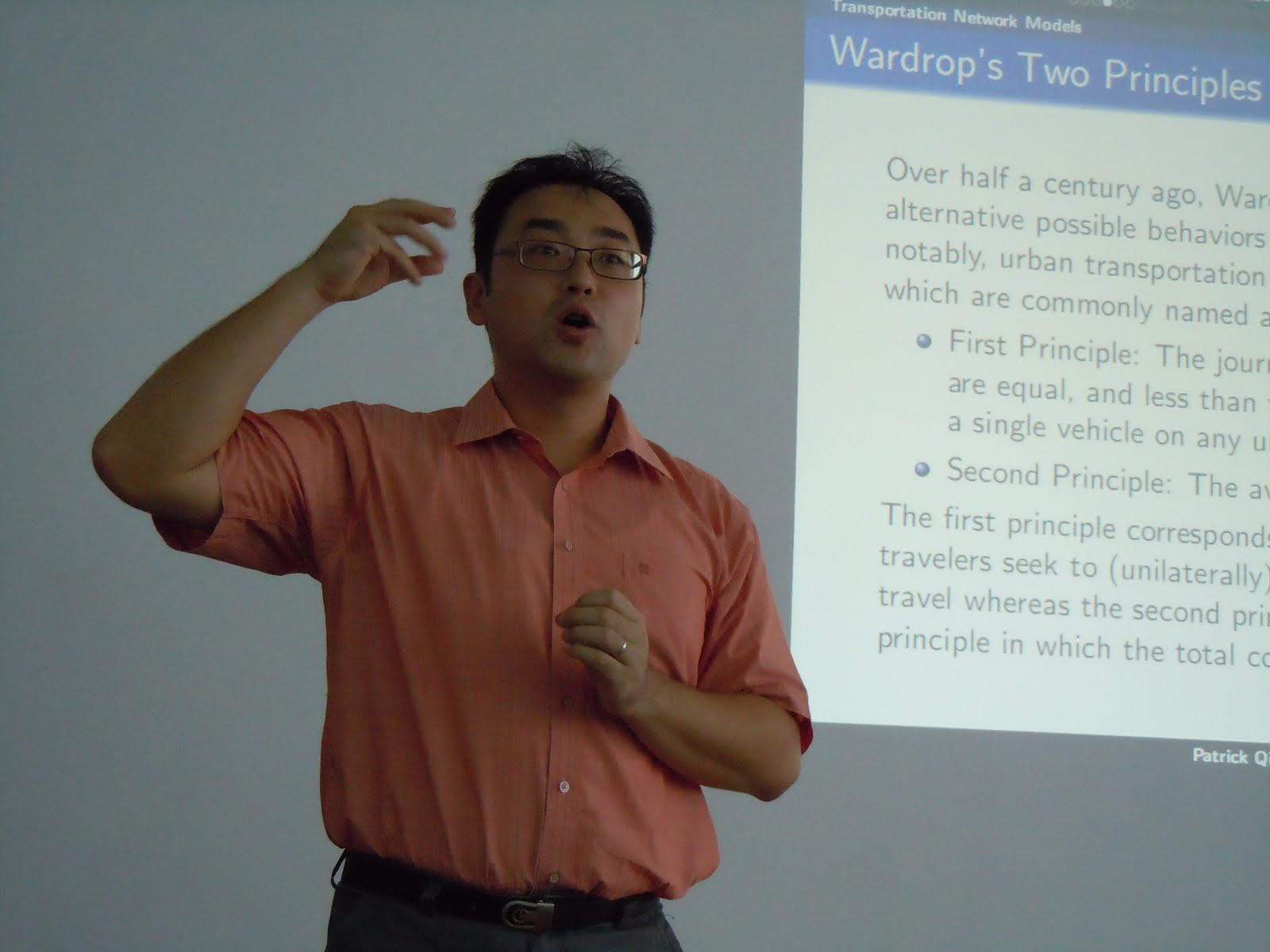
 Supernetworks are big in China and two of my collaborators, Professor June Dong and Professor Patrick Qiang, are now in Shanghai discussing the formation of a sister Supernetworks Center to the Virtual Center for Supernetworks that I direct.
With June Dong I wrote the 2002 book, "Supernetworks: Decision-Making for the Informatiom Age," and last year Patrick Qiang and I co-authored the "Fragile Networks" book.
My last trip to China was back in 2006 when I spoke at the Fudan Management Science Forum in Shanghai on Supernetworks: Management Science for the 21st Century. I also served on the Fudan Management Science Prize committee.
It was a terrific conference and trip, especially since June Dong was also there and she is a former native of Shanghai, China. Such well-known researchers as Mike Pinedo, Charles Corbett, and Eitan Zemel were also there. I took tons of photos.
Patrick Qiang recently gave a presentation, "Vulnerability of Fragile Networks," at the School of Management at the Shanghai University for Science and Technology and was hosted by June. Above are photos taken at his presentation, with his host, a group photo with the audience, and an announcement on the university home page, which a student of mine, helped to translate. The audience for Patrick's talk even included students of Professor Daoli Zhu, who received the Fudan Management Science prize in 2006.
Thursday, July 15, 2010
Network Science in Yalta, Ukraine and Keynote
 After the International Conference on Computational Management Science in Vienna, Austria, I will be off to give a keynote talk at the 3rd Yalta Optimization Conference, which will take place in Yalta, Ukraine, at the beginning of August. The theme of this year's Yalta conference is Network Science. Of course, this scientific conference should not be confused with the famous historic Yalta Conference of 1945!
I am looking forward to seeing this very scenic location on the Black Sea and to practicing both my Ukrainian and Russian. Plus, it will be great to reconnect with wonderful colleagues and friends there and to listen to the talks. Special thanks to the organizers: Professors Butenko, Prokopyev, and Shylo, for letting me deliver the keynote talk with title and abstract below.
Title: Fragile Networks: Identifying Vulnerabilities and Synergies in an Uncertain Age
Abstract: The growing number of disasters globally has dramatically demonstrated the dependence of our economies and societies on critical infrastructure networks. At the same time, the deterioration of the infrastructure from transportation and logistical networks to electric power networks due to inadequate maintenance and development as well as to climate change, has resulted in large societal and individual user costs. This talk will focus on recently introduced mathematically rigorous and computer-based tools for the assessment of network efficiency and robustness, along with vulnerability analysis. The analysis is done through the prism of distinct behavioral principles, coupled with the network topologies, the demand for resources, and the resulting flows and induced costs. The concepts will be illustrated in the context of congested transportation networks, supply chains under disruptions, financial networks, and dynamic networks such as the Internet and electric power networks. We will further explore the connections between transportation networks and different network systems and will quantify synergies associated with network integration, ranging from corporate mergers and acquisitions to collaboration among humanitarian organizations.
Subscribe to:
Posts (Atom)

 Posts