Showing posts with label Computational Management Science. Show all posts

Wednesday, October 16, 2013

Mathematics of Planet Earth -- Special Issue of Computational Management Science

According to the website for Mathematics of Planet Earth MPE2013: More than a hundred scientific societies, universities, research institutes, and organizations all over the world have banded together to dedicate 2013 as a special year for the Mathematics of Planet Earth.

 The theme “Mathematics of Planet Earth” is interpreted as broadly as possible. In addition to climate change and sustainability, it includes geophysics, ecology and epidemiology, biodiversity, as well as the global organization of the planet by humans. The different topics have been classified into four themes.

The four themes of MPE2013:
* A PLANET TO DISCOVER: oceans; meteorology and climate; mantle processes, natural resources, solar systems
* A PLANET SUPPORTING LIFE: ecology, biodiversity, evolution
* A PLANET ORGANIZED BY HUMANS: political, economic, social and financial systems; organization of transport and communications networks; management of resources; energy
* A PLANET AT RISK: climate change, sustainable development, epidemics; invasive species, natural disasters.

I became aware of this great initiative last May when I spoke at the Computational Management Science conference in Montreal, Canada,  and heard from Professor Georges Zaccour that he, and Professor Michele Breton, were guest editing a special issue of the journal Computational Management Science on this theme.  Since last year I was on sabbatical and spending a lot of time at the School of Business, Economics and Law at the University of Gothenburg in Sweden, sustainability continues to be a major theme in my research. Plus, the emphasis on the environment in Gothenburg and in Sweden, overall, made for a perfect venue in which to work on a paper for this special issue. Our paper, Supply Chain Network Sustainability Under Competition and Frequencies of Activities from Production to Distribution, Anna Nagurney, Min Yu, and Jonas Floden, is now in press in this special issue  of Computational Management Science.

I was delighted to see the Preface to this special issue online on the journal website  The special issue, according to the Guest Editors Breton and Zaccour,  has 7 papers written by scholars having an extensive expertise in mathematical modeling and in environmental issues.The objective of this issue is to report on recent advances in modeling and in the development of computational methods for environmental issues such as global warming, pollution control, adaptation, sustainable exploitation of resources (forests, fisheries, etc(, sustainable supply chains, and more!

I expect that the hardcopy of the full issue will be produced soon since the contributions are online -- I am so looking forward to receiving my copy.

Congrats to the Guest Editors and thank you for your hard work which made this special volume possible! Also, thanks to the long-serving Editor of CMS, Professor Berc Rustem, for being a visionary.

Sunday, June 2, 2013

Financial Networks Double Volume in Production

One always looks forward to seeing one's work in print -- whether a journal article, an essay, an OpEd, a Letter to the Editor, or a book!

As an Editor,  it is rewarding to see the efforts of many resulting in a complete and finalized publication!

Being invited to be a Guest Editor of a special issue of a journal on a theme is an honor and it is exciting when one sees the hard work of the contributors, who submitted their papers (and then revised them), and that of the reviewers, who made useful and constructive suggestions, coming to a conclusion.

Some special issues may languish (think of critical path analysis in project planning) since a delay by an author in terms of revising or of reviewers in terms of refereeing may delay the entire volume production. This is not fair to all those involved and I was so pleased to have everyone who contributed to the special double volume on Financial Networks of the journal Computational Management Science that  I guest edited to have been so professional in their timeliness and attention -- Thank you!

The good news is that the special double issue, which I have written about on this blog,  is now in production by the publisher Springer!

I received and approved the cover below.

Springer has now made my editorial on the special issue available online to readers.

The volume represents contributions from both academics and practitioners from several different countries. Given the financial crisis of the past several years of historic economic proportions I believe that the papers in this volume will have a long-lasting impact.

I will send out a message when the hard copies of the volume are available.

Until then, the articles are available individually in Online First Articles by Springer.

Saturday, May 4, 2013

Photos from the Great Computational Management Science Conference In Montreal

I made it back from Montreal via Air Canada and for a while there I thought that I would be the only passenger on the flight on the 18 seater airplane. Then 3 other passengers arrived (after the gate change was announced).

I wrote two blogposts about the 10th Computational Management Science Conference , which took place May 1-3, 2013 in Montreal, Canada. The first post was about Professor Yingyu Ye's plenary talk and reminiscences about Professor George Dantzig and the second one was on the hot topics at the conference.

Below I share with you some photos that I took at the conference.

The conference was fabulous and I think the photos below capture some of the presentation highlights, social events, and venue.

Many thanks to the organizers and especially to Professor Georges Zaccour, for such a pleasant and rewarding conference.


Friday, May 3, 2013

What is Hot at Computational Management Science

This is the third day of the Computational Management Science Conference, which is taking place in Montreal, Canada.

The weather has been warm and the sun is shining.

The talks have been great and we have been treated to 3 outstanding plenaries (I blogged about Dr. Yinyu Ye of Stanford University and his presentation in my previous post.). Yesterday, Professor von Stengel of the London School of Economics spoke about the Game Theory Explorer and aplications and today we were treated to Professor Michele Breton of GERAD and HEC (the venue for the conference) and highlights of her research with her PhD students on recursive methods for pricing financial derivatives.

This is my kind of conference -- wonderful lunches, coffee breaks, great discussions, with about 130 participants, very international, and, as is fairly typical for CMS, a female plenary speaker. I admit I gave one of the plenary talks at CMS in Vienna and was not even the only female plenary speaker at that conference.

The methodological sessions have included sessions on stochastic programming, dynamic games (and applications), robust optimization, and more.

I have very much enjoyed the energy application sessions which featured, among others, Professor Steve Gabriel of the U. of Maryland and Professor Warren Powell of Princeton, who noted that energy practitioners with whom he works call the delivery of electric power as `trucking`and putting electrons on wheels. This reminded me of the classic book by Beckmann, McGuire, and Winsten, Studies in the Economics of Transportation, in which they hypothesized that electric power generation and distribution networks behave like congested urban transportation networks. We have done research on the commonalities and have exploited these to formulate and solve the electric power supply chain for New England in a paper co-authored with Dr. Zugang Liu, which was published in Naval Research Logistics in 2009. Gabriel spoke on his model for the global gas market. He mentioned Ukraine several times and, since that is my heritage, he had me at the edge of my seat.

I also enjoyed energy talks by Professor David Fuller from the University of Waterloo, where I have spoken at on several occasions, and several speakers at our CMS conference talked about game theory models and complementarity approaches.

I spoke on Wednesday about our big NSF project on the Future Internet Architecture, which we call Choicenet, and on specific network economics and game theory modeling work that I did with Professor Tilman Wolf of UMass Amherst using variational inequality theory. My talk was in the first session of the conference, after the first plenary tallk, and I am also speaking in the last session today on our work with Professor Min Yu on time-based competition.

Yesterday, we had the editorial board meeting for the journal (of the same name as the conference), Computational Management Science, and it was great to hear of special issues that are coming out and are being planned. Professor Berc Rustem, of Imperial College, led the lunch board meeting and it was great to see many of our colleagues, including Professor Georg Pflug from Vienna, Austria, and Professor Daniel Kuhn of Imperial College.

My special issue on Financial Networks, which is a double issue, should be out within the next 3 months, I am told, which is very exciting.

Of course, there are also sessions on transportation and on vehicle routing since colleagues here in Canada have been long-time contributors to these application domains. No need to even mention the names of Professors Gilbert Laporte, Patrice Marcotte, and Michel Gendcreau, but I am and it was wonderful to see them all here in Montreal.

The finance sessions have also been great!

Thanks to the organizers for putting on such a rewarding conference intellectually, personally, socially, and professionally.

Kudos to Professor Georges Zaccour who has worked tirelessly to make this conference a big success!

And for those of you who are interested, the CMS conference will be in Portugal next year.


Wednesday, May 1, 2013

He Was and Is Our Hero - Professor George Dantzig

Last week I was in NYC, taking part in The New York Times Energy for Tomorrow Conference, which was fabulous.

This week I am in Montreal, at the 10th Computational Management Science conference which began today with a brilliant plenary lecture by Professor Yinyu Ye of Stanford University.

Professor Ye spoke about the simplex method and linear programming and also displayed several photos of Professor George Dantzig, the founder of our field of operations research, who was also his dissertation advisor. Professor Ye wove together the simplex method, Markovian decision processes, network flow problems, and generalized networks in a lecture filled with clarity and emphasized the criticality of theory (and, of course, application).

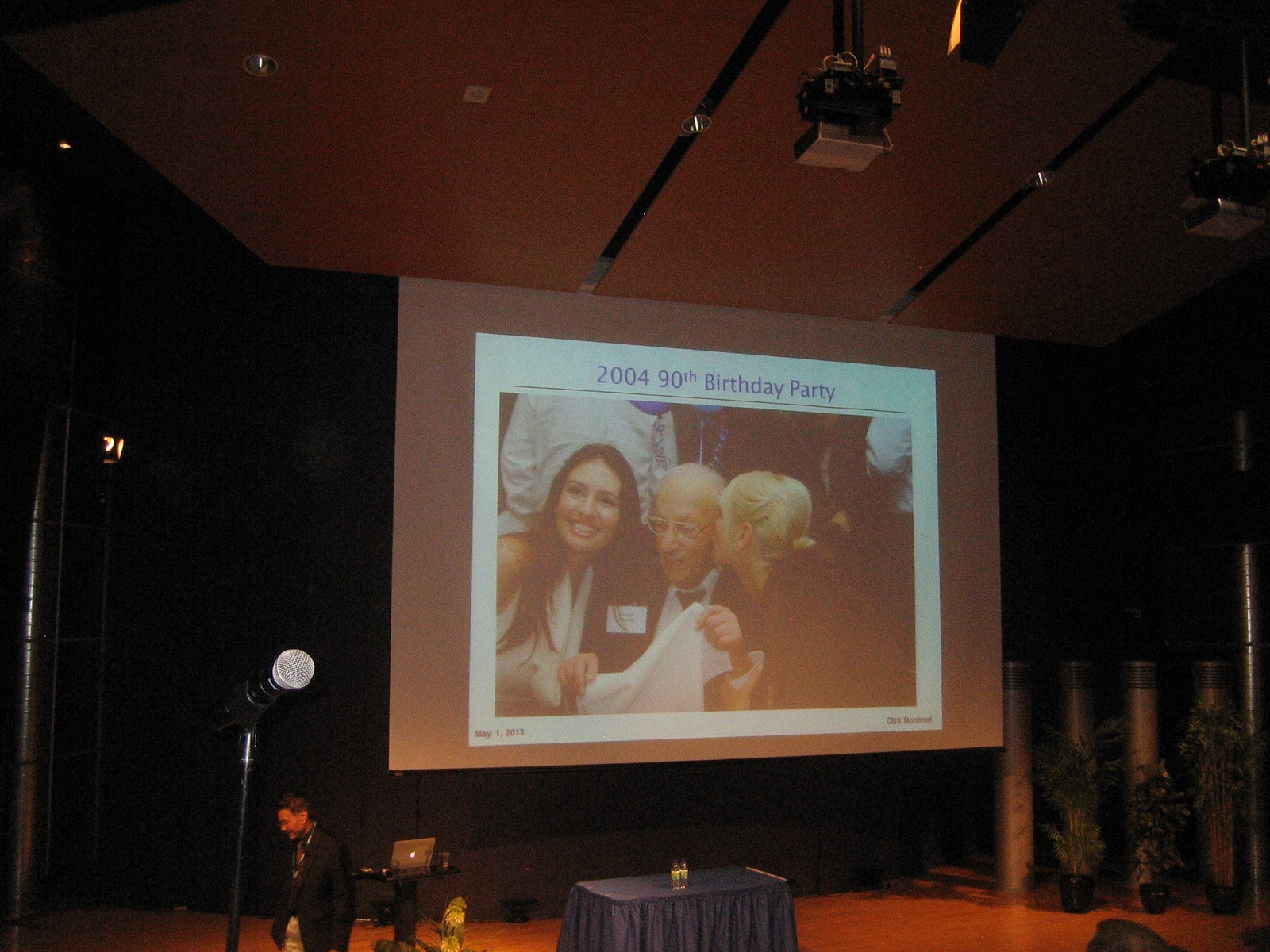
What truly touched me was how he spoke of Dantzig, even including a photo taken of him at his 90th birthday party, and that he even as he was dying regretted not being award a Nobel Prize in Economic Sciences (as Kantorovich had). His discovery of the simplex method in 1947, including the pivot rule, has performed so well in practice and is even being used by hedge fund managers in finance today.
He said that he wished that Dantzig was still alive so that he could share with him the recent theoretical discoveries regarding the simplex method and its performance in practice.

After his presentation, I ran down the stairs to congratulate him and told him how much Dantzig had meant to me. As with all great individuals that one loves and reveres, you remember the moment that you heard of his or her passing. I will never forget the kindness that George bestowed on me by attending the first talk that I ever gave at an international conference (and it was a Mathematical Programming Symposium) at MIT in Cambridge. I treasure the photo that I had taken of him with me at an INFORMS conference in San Francisco and I show it to my students whenever I teach Linear Programming.

Ye and I ended our conversation by saying that George Dantzig was (and is) our hero.

And, like his advisor a long time ago, Professor Yingu Ye came to my presentation today.

Thursday, April 18, 2013

Financial Networks -- Putting a Special Issue to Bed

I have always been fascinated by networks from transportation and supply chains to electric power and the Internet.

Two decades ago, I began work on financial networks in a project that was funded through the USDA and involved Merritt Hughes (a UMass Amherst graduate alumna) and a former doctoral student of mine, who is now an award-winning Full Professor, Dr. June Dong.

Since a series of papers that we wrote I have periodically returned to the financial networks theme since I am a systems thinker and it is intriguing to see how money flows and to determine analogies between/among different network systems.

With Dr. Stavros Siokos, who was also a former PhD student of mine, and is now a renowned financier based in London, we wrote the book, Financial Networks: Statics and Dynamics, and it was published by Springer in 1997. In 2003, I edited the volume, Innovations in Financial and Economic Networks, and it was published by Edward Elgar Publishing.

The global economic and financial crisis of 2008 and 2009 brought further attention to financial networks, systemic risk, fragility and vulnerability issues, so our research (with now Dr. Patrick Qiang) also addressed the criticality of nodes and links (and their importance and ranking) in financial networks.

In 2008, I wrote a survey on financial networks which was published in the Handbook of Information Technology and Finance, edited by  D. Seese, C. Weinhard, and F. Schlottmann.

Invitations to speak on Financial Networks at conferences, including the Measuring Systemic Risk Conference at the University of Chicago in 2010, demonstrated the growing interest in viewing financial issues, problems, and relationships through a network prism with a focus on the system. Although those of us in operations research and the management sciences as well as in economics had realized this, the finance community was slower to recognize this.

So, when the invitation from the Editor of the journal, Computational Management Science, Professor Berc Rustem, came last Spring, to guest edit a special issue on Financial Networks, I agreed, and the call for papers went out with a deadline for submission of July 15, 2013.

I am pleased to report that the edited volume is now being "put to bed." The collection consists of 8 peer-reviewed papers, plus my editorial. The contributions are from academics and practitioners and cover such timely topics as stock market graphs with applications to the US stock market, Russia, and Sweden; financial contagion, dynamic network formation using game theory, financial network equilibria and corporate social responsibility as well as the co-evolution of supply chains and corporate financial networks with insolvency risk. Methodological approaches in the formulation, analysis, and computations include network and graph theory, statistics, game theory, and variational inequality theory.

I will let my readers know when the volume is published -- it will be a double volume and, in the meantime, you can find and read some of the preprints already in the Online First Articles.

Reviewers are essential to the quality of papers and I am so grateful to all those, who, although they remain anonymous, contributed so much with their helpful comments and suggestions to the authors on their original manuscripts and their subsequent  revisions.

Sunday, September 9, 2012

Our Highly Downloaded Blood Supply Chain Network Paper is Now Available for Free Download -- Thanks to Computational Management Science and Springer

I do like it when a journals and publishers are proactive and innovative.

It also feels good, as a researcher, that the papers that you write and are published are actually read!

The paper, "Supply Chain Network Operations Management of a Blood Banking System with Cost and Risk Minimization," that I co-authored with my doctoral students, Amir H, Masoumi, and Min Yu, is now one of the most highly downloaded articles in the journal Computational Management Science.

And Springer, the journal's publisher, has made the article available for free download.


Min Yu has received her PhD, since the article was published, and is now an Assistant Professor and Pamplin Fellow at the Pamplin School of Business at the University of Portland in Oregon.

Amir and I also co-authored the paper, Supply Chain Network Design of a Sustainable Blood Banking System,which appears in the book,  Sustainable Supply Chains: Models, Methods and Public Policy Implications (2012), T. Boone, V. Jayaraman, and R. Ganeshan, Editors, Springer, London, England, pp 49-72.

In these papers, we use some of the ideas on generalized network models going back to the work that I did on dynamic spatial price equilibrium models with gains and losses with Jay Aronson in which the product flow volumes  can change over space and time because of product perishability (losses) or successful investments (gains).

Saturday, May 5, 2012

Optimal Decision Making

Every day our lives are filled with decision making, as individuals, as professionals, and as members of groups and communities that we belong to.

We are all operations researchers since survival of the fittest requires optimization and if our ancestors had not optimized we wouldn't be around today.

What never fails to fascinate me is the number of applications to which optimization can be applied to make processes and even organizations perform better.

As researchers and scholars it is imperative that we document our findings and I am delighted to report that the special issue of Computational Management Science, edited by Georg Pflug is now out and the theme is Optimal Decision Making.

This special issue, which is volume 9(2) of this journal, is the May 2012 issue. It is a collection of plenary papers from the Computational Management Science conference held in Vienna along with several invited papers. I had the pleasure of giving a plenary talk there.

The special issue has articles on optimization methodologies and applications to energy, marketing, transportation, and blood supply chains. The blood supply chain paper I co-authored with two of my doctoral students, Amir H. Masoumi and Min Yu: Supply chain network operations management of a blood banking system with cost and risk minimization. Blood is a highly perishable life-saving "product" and the optimization of blood banking processes can minimize both costs and wastes while ensuring that demand is met as closely as possible. This paper is part of a stream that we have completed on healthcare applications with the overarching theme of perishable products.


Min recently successfully defended her doctoral dissertation on time-sensitive supply chains and will be receiving her PhD with a concentration in Management Science next week at the UMass Amherst graduation ceremonies.

She will be a faculty member next Fall and will be imparting her knowledge of optimal decision making to a new generation of students.


Wednesday, December 7, 2011

Financial Networks -- Special Issue of Computational Management Science

Last December I very much enjoyed speaking on Financial Networks at the Measuring Systemic Risk Conference, organized by Lars Peter Hansen of the University of Chicago, Andrew W. Lo of the Sloan School at the Massachusetts Institute of Technology, and David Marshall of the Federal Reserve Bank of Chicago.

I wrote about the conference in a blogpost entitled, Oprah was not there and neither was George Clooney but Chicago still Sparkled with Intellectual Brilliance.

Recently, I received an invitation from the editor of the journal, Computational Management Science, Dr. Berc Rustem of Imperial College, to edit a Special Issue on Financial Networks.

This invitation I also could not refuse.

Below is a Call for Papers, which will also be posted shortly on the journal website.

Call for Papers

Special Issue of Computational Management Science

Financial Networks

Guest Editor:

Anna Nagurney

Isenberg School of Management, University of Massachusetts Amherst


Areas of Interest

Networks are a powerful scientific framework for the modeling, analysis, and solution of complex economic, social, and management problems.

Financial networks, in particular, have evolved to become a theoretical and computational paradigm for a spectrum of decision-making problems from the micro to the macro levels, and ranging from portfolio optimization to systemic risk assessment, financial intermediation, contagion analysis, and even electronic finance.

This special issue of Computational Management Science seeks to capture the state-of-the-art of financial networks through high quality, original research papers that include numerical results.

Reviewing Information

The submitted papers will be peer-reviewed by anonymous reviewers according to the standards of a leading international journal.

Submission Information

The deadline for submission is July 15, 2012. Manuscripts must be written in English and conform to the style of the journal Computational Management Science and not exceed 25 pages.

Please submit manuscripts to:

http://www.editorialmanager.com/cmsc/

and select Article Type: S.I. Networks, to ensure proper processing.

If you have questions, the Guest Editor can be contacted at:

e-mail: nagurney@isenberg.umass.edu

Thursday, October 20, 2011

Computational Management Science in London


I am delighted that the 2012 Computational Management Science (CMS) Conference will be held in London, England this coming April. It will be at Imperial College and the website and additional information can be accessed here.

I am serving on the International Programme (I like the spelling) Committee with many wonderful colleagues from around the world.

In 2010, the CMS Conference took place in Vienna, Austria and I had the great honor of delivering one of the keynote speeches on supply chains.

Last time that I was in London was in April 2007 when I spoke on critical infrastructure networks at Imperial College. My hosts, which included several of the organizers of the 2012 CMS Conference, were fabulous.

Photos from that trip to London as well as the 2007 CMS Conference in Geneva, Switzerland that preceded it (and they are worth having a look at) can be found here.

Hope to see many in our operations research and management science community in London in April!

Sunday, August 14, 2011

Our Blood Supply Chain Paper is Now Published and Reflections on Dr. Bernadine P. Healy -- RIP

I was struck by the recent death of Dr. Bernadine P. Healy, who not only was the first female head of the National Institutes of Health (NIH) but also was the second female (after Elizabeth Dole) to head the American Red Cross and did so during 9/11.

She recently passed away at the age of 67 and had an amazing career as a researcher (over 200 papers), educator, and top administrator both in academe, including Johns Hopkins University, as well as the above-noted major organizations.

She was also a wife and mother to two daughters.

The New York Times ran an obituary on her, as did many other leading newspapers and, despite some controversial decisions, she clearly brought attention to women's health care and the importance of teamwork in organizations.

Our first blood supply chain paper, in which discussions with the Red Cross were essential and are acknowledged, entitled,Supply Chain Network Operations Management of a Blood Banking System with Cost and Risk Minimization, has now been published by the journal Computational Management Science. With it, we honor her memory.

Dr. Frank Collins, the present Director of the NIH, in his moving tribute to Dr. Healy, acknowledged her words, which she made during an NIH exhibit on pioneering women doctors:

All of us, I believe, in our hearts are humanitarian. And how wonderful to be in a career that in almost any dimension of it—whether you're the doctor at the bedside, or the scientist in the laboratory, or the public health doc tracking down the latest epidemic—that you are doing something that is pure in its fundamental purpose, which is helping another human being.”

Thank you, Dr. Healy, for your gutsy leadership and R.I.P.

We hope that, through research and education, we can also make a difference.


Friday, December 24, 2010

What a Year it Was!

It was the best of times, it was the worst of times, it was the age of wisdom, it was the age of foolishness, it was the epoch of belief, it was the epoch of incredulity, it was the season of Light, it was the season of Darkness, it was the spring of hope, it was the winter of despair, we had everything before us, we had nothing before us, we were all going direct to heaven, we were all going direct the other way ... Charles Dickens from his novel, A Tale of Two Cities.

The beginning of 2010 was marked, for many of us, by the news of the horrific earthquake that struck Haiti last January 12; with the suffering of its people continuing to this day. It was followed, only two days after, by a "local" shocking event, that happened only one town over from Amherst, and that circulated around the world -- the suicide of 15 year old Phoebe Prince.

As educators and researchers, the above deeply tragic events, had some of us refocus our energies. And, of course, some of us also had personal and familial tragedies to deal with. But as is said, what doesn't kill you, makes you stronger.

At the same time, there were so many "best of times" and some of my highlights, as a professor, I list below.

  • My former student and my co-author of the Fragile Networks book, Dr. Patrick Qiang, was honored with the Charles V. Wootan Award last January by the Council of University Transportation Centers in Washington DC for his doctoral dissertation, Network Efficiency / Performance Measurement with Vulnerability and Robustness Analysis with Application to Critical Infrastructure. Last March, Dr. Qiang joined me in giving a tutorial on the theme of our book at the SBP 2010 Conference at NIH. I then further disseminated our research in my tutorial at the ALIO-INFORMS Conference in Buenos Aires, which brought me, for the first time, to the continent of South America.
  • A female PhD student of mine, Trisha Woolley (now Anderson) received her PhD in 2010 and assumed her Assistant Professorship at Texas Wesleyan University.Her dissertation title: Sustainable Supply Chains: Multicriteria Decision-Making and Policy Analysis for the Environment. She was my 15th PhD student to graduate and my 6th female.
  • We celebrated the graduation of our wonderful undergraduate students from the Isenberg School last May -- another highlight of 2010!
  • A former doctoral student of mine, Dr. Tina Wakolbinger, received an offer of a Full Professorship from the Vienna University of Economics and Business, a position which she will start next May, having been an Assistant Professor at the University of Memphis since receiving her PhD in 2007. Her research in humanitarian operations and, more recently, on electronic recycling, and that of my other former students and collaborators, give me hope for a better future.
  • Two present doctoral students of mine had notable successes with their research: Min Yu had two papers accepted for publication, including: "Supply Chain Network Design for Critical Needs with Outsourcing," co-authored with Patrick Qiang and me. Also, Amir Masoumi completed the paper, with Min and me, entitled: "Supply Chain Network Operations Management of a Blood Banking System with Cost and Risk Minimization."
  • The UMass Amherst INFORMS Student Chapter, that I serve as the Faculty Advisor of, received the Magna Cum Laude Award for its activities at the INFORMS National Meeting in Austin, Texas last November. They have started both a Facebook page and are on twitter, thanks to the chapter's new President, Nathan Kollett.
  • The Network Science conference in Yalta brought me to the country of the birthplace of my parents, Ukraine, whereas the Computational Management Science conference at the University of Vienna brought together so many of my favorite colleagues from around the globe.
  • As for the INFORMS conference in Austin, Texas, thanks to all for the wonderful memories!
  • Also, thanks to all of my undergraduate and graduate students (both present and former ones) for being so special and so terrific! You will help to change the world for the better!

Let me end with the words of a new community service organization, Count Me In, that was started in South Hadley, in response to the tragedy of Phoebe Prince's suicide, and an article on which appears in today's Daily Hampshire Gazette.

This organization has its motto emblazoned on the backs of its t-shirts:

Respond with integrity and kindness/Embrace diversity/Stand up courageously for others/Promote a climate of safety/Eliminate hurtful words and rumors/Care for and listen to others with compassion/Take responsibility for my actions.

The above words should be followed in our daily lives.

Friday, August 27, 2010

US Approves Merger of Continental and United Airlines

The New York Times is reporting that the proposed merger of Continental and United Airlines has been approved. It is expected that the deal will now move forward quickly and result in the world's largest airline.

According to The Times: In a statement posted on its Web site, the Justice Department said it had “closed its investigation” into the proposed merger after United and Continental agreed to give take-and landing slots to Southwest Airlines at Newark Liberty International Airport.

“United and Continental entered into the arrangement with Southwest in response to the department’s principal concerns regarding the competitive effects of the proposed United/Continental merger,” the Justice Department said in its statement.


This news I find especially exciting since we have been conducting a lot of research on mergers and acquisitions from a network perspective in both competitive, such as oligopolistic, settings, which is the industrial structure of many airlines, and in cooperative environments, such as in humanitarian logistics and operations where there may be teaming for disaster relief.

My paper, "Formulation and Analysis of Horizontal Mergers Among Oligopolistic Firms with Insights Into the Merger Paradox: A Supply Chain Network Perspective," has now been published online in the journal Computational Management Science and according to a message that I received yesterday from the publisher of this journal, Springer, it should be appearing in the hardcopy issue soon.

Another more personal connection is that my college room-mate from Brown University, Teresa Davila, is a United Airlines stewardess and language specialist. I hope that the corporate cultures of these two airlines mesh well so that the employees are comfortable when it ultimately takes place. I am a former Premier flier on United and my recent long distance flights on this airline were to/from spectacular Honolulu and to/from Buenos Aires, Argentina!

Friday, August 6, 2010

Photos from the 2010 CMS Conference in Vienna, Austria


The 2010 Computational Management Science conference took place July 28-30, 2010 in gorgeous Vienna, Austria.

Above are photos taken at this conference. For a full page of photos, which are also downloadable, click here.

I thank the organizer, Professor Georg Pflug, from the University of Vienna, for an outstanding venue, excellent plenary talks, and a wonderful social program.

It is very important to go to conferences, both smaller, specialized ones, as well as other more general conferences in one's professional/academic areas. One never knows whom one may meet and what interesting opportunities may arise from the serendipity of face to face encounters and discussions on topics of mutual interest!

Plus, it is so special to reconnect with many friends and colleagues from around the world in interesting locations!

Friday, July 30, 2010

Last Day of the Computational Management Science Conference in Vienna

Today is the last day of the 2010 Computational Management Science (CMS) conference that is taking place in Vienna, Austria. The weather is now cool and rainy but it should be clearing up later today.

It has been absolutely wonderful to listen to talks on topics ranging from the design of transportation networks for hazardous material shipments, to the analysis of earmarks and financing in humanitarian operations to the formulation of teams and resource allocation.

I have been going to the supply chain, transportation, and networks stream of talks and also to several of the game theory and stochastic programming ones.

Many of the participants have told me that they will be coming back to future CMS conferences since they have learned so much from this conference and have also had a wonderful time socially.

The next CMS conference will take place in Spring 2011 in Neuchatel, Switzerland.

Today I will be attending another plenary lecture (the final one and the closing session of this conference) which will be delivered by Dr. Claudia Sagastizabal who is Argentinian but works in Rio de Janeiro, Brazil.

I commend the organizers for having two female plenary speakers (out of four)!

My plenary talk, Supply Chain Networks: Challenges and Opportunities from Analysis to Design, can be accessed, in pdf format here. Given the number of positive comments that I have received from audience members, I believe that I got the importance of this topic and the fascinating applications across.

Plenary talks play a very important role at scientific conferences. I have already extended my congratulations to the other plenary speakers -- Professor Campi of the University of Brescia in Italy and Professor Pistikopoulos of Imperial College in London. The content of their talks as well as their delivery of them were fabulous. I am getting intellectually spoiled here by the originality of and creativity behind the research presented.

The organizers have done a magnificent job of getting this conference together and I thank them as well.

Thursday, July 29, 2010

A Perfect First Day at the CMS Conference in Vienna

My flight from Logan Airport in Boston to Frankfurt via Lufthansa was wonderful except that there was a dog underneath my seat named Bailey, who is a shitzu, and who whined painfully for hours. Some of us thought that the plane was experiencing mechanical difficulties.

As I wrote back in May on this blog, on my flight back from Honolulu, there was a cat next to me that a serviceman had brought on board.

Bailey's owner said that it was his third trip to Germany and, for some reason, he could not settle down. I managed to converse a bit with my seatmate and read the NYTimes but then decided that with the conference and my speaking engagements in Europe I had better get some sleep. Luckily, a stewardess found me another aisle seat so that I could catch some shuteye. My new seatmate was a postdoc from Germany, who is Italian, and who was returning from a Gordon conference in New Hampshire so we ended up having a delightful conversation about scientific research and even the World Cup and we even managed to get some sleep.

The Lufthansa plane had terrific and very comfortable seats and the bathrooms (first time I had seen this) were in the middle of the plane and a staircase down (lots of legroom there).

After a brief layover at the Frankfurt airport I caught my Austrian Airways flight to Vienna.

Yesterday was the first day of the Computational Management Science conference which is taking place in glorious Vienna, Austria. The weather here is sunny and cool with gentle breezes -- simply perfect and a very welcome break from the heat back in the US.

Yesterday I gave the opening keynote talk on supply chains networks and had a chance to speak at another session that I had organized. In the latter, one of my former doctoral students, Professor Tina Wakolbinger also spoke, and it is always extra special to see former students doing so well. In addition, a group of us, including colleagues from Texas and Florida, went out to lunch together.

Last evening a group of us was invited to Professor Georg Pflug's home in Vienna for a lavish dinner buffet. Professor Pflug is the organizer of this conference. It was the perfect evening with colleagues from around the world conversing and dining in an elegant setting.

It will be hard to leave this magnificent city!

Of course, I already also managed to indulge in some delicious Mozart kugel chocolates.

Wednesday, July 14, 2010

Computational Management Science in Glorious Vienna

I am very much looking forward to the International Conference on Computational Management Science that will take place in Vienna, Austria later this month. Vienna is a center of scholarship, culture, architecture, music, and intrigue.

The last time that I was in Vienna
was back in March 2009 when I spoke on Synergies and Vulnerabilities of Supply Chain Networks in a Global Economy at the Vienna University of Economics and Business Administration and was hosted by my esteemed and wonderful colleague there, Professor Manfred Fischer.

At the Computational Management Science (CMS) 2010 conference, which will be at the University of Vienna, I will be giving a keynote / plenary talk, entitled, Supply Chain Networks: Challenges and Opportunities from Analysis to Design, and the abstract is below.

Abstract: Supply chain networks provide the backbones for our economies since they involve the production, storage, and distribution of products as varied as vaccines and medicines, food, high tech products, automobiles, and even energy. Many of the supply chains today are global in nature and present challenging aspects for modeling and analysis. In this talk I will discuss different perspectives for supply chain modeling, analysis, and computation based on centralized vs. decentralized decision-making behavior, along with suitable methodological frameworks. I will also highlight applications to mergers and acquisitions and even humanitarian logistics through supply chain network integration. Such timely issues as risk management, demand uncertainty, outsourcing, and disruption management in the context of our recent research on supply chain network design and redesign will also be discussed. Suggestions for new directions and opportunities in healthcare and sustainable supply chain networks will conclude this talk.

I thank the organizers of CMS 2010 for giving me the opportunity to deliver this talk.

Monday, July 5, 2010

2010 Computational Management Science Conference in Vienna, Austria

I am preparing my talks for the 2010 International Conference in Computational Management Science, which will take place in glorious Vienna, Austria, July 28-30, at the University of Vienna. I am very much looking forward to this conference.

Besides giving the invited keynote talk, "Supply Chain Networks: Challenges and Opportunities from Analysis to Design," I will also be presenting, "Supply Chain Network Design for Critical Needs with Outsourcing," which is based on the paper forthcoming in the journal, Papers in Regional Science, with my doctoral student, Min Yu, and Professor Qiang "Patrick" Qiang of Pennsylvania State University in Malvern.

The latter presentation will be given in the invited session: Supply Chains, Transportation and Networks that I organized. Other presenters in this session and their papers are:

Mr. Thomas Seyffertitiz of the Vienna University of Economics and Business (the largest business school in Europe) will be speaking on "Vulnerability and Disruption Analysis in Supply Chain Networks: A Layered Network Perspective;"

Professor Tina Wakolbinger of the Fogelman College of Business and Economics at the University of Memphis in Tennessee, will deliver the talk, "An Analysis of Impacts Associated with Earmarked Private Donations for Disaster Relief," which is based on joint work with Professor Fuminori Toyasaki of York University in Canada, and

Professor Patrizia Daniele of the Department of Mathematics and Computer Science at the University of Catania in Italy will present: "Supply Chain Networks and Infinite Dimensional Duality Theory."

The list of invited keynote speakers can be found here
.

The program with accepted talks and schedule can be downloaded here
.