Showing posts with label Leadership. Show all posts

Wednesday, July 24, 2024

On Serving on Boards, Including Board of Directors

As an academic, one is engaged in research, teaching, and service and, also, public outreach, if that is your interest and forte. Service can take many forms from internal department and university service to external service, including professional service of different kinds.

This post is on service on boards.

For example, just two days ago, I had a meeting with fellow Co-Chairs of the Board of Directors of the Kyiv School of Economics (KSE): Olena Bilan, Oleksandr Kravchenko, and Makar Paseniuk, and the KSE President Tymofiy Mylovanov.

We have regular meetings throughout the year and the previous meeting I attended virtually while in Brno Czechia, from my hotel room, since I was conferencing in Europe over three weeks.

The full list of the Board of Directors of KSE is here.

It is an outstanding group of thought leaders, public intellectuals, academics, business leaders, former ambassadors, a Nobel prize winner, and even a Ukrainian rockstar. 

The newest members of the KSE Board of Directors are:

Michael A. McFaul — Director of the Freeman Spogli Institute for International Studies (FSI), Former US National Security Advisor, U.S. Ambassador to Russia (2012-2014), Co-Chair of the International Working Group on Sanctions against Russia,

Lola Woetzel — Senior partner of McKinsey & Company, Director of the McKinsey Global Institute,

William B. Taylor — Vice president, Europe and Russia, at the U.S. Institute of Peace, 6th US Ambassador to Ukraine (2006–2009), US ChargĂ© d’Affaires to Ukraine in 2019.

Since Russia's full-scale invasion of Ukraine on February 24, 2022, our input has been more needed than ever and supporting this higher education institution in Ukraine is incredibly humbling and inspiring.

In addition, I have been serving on the International Academic Board (IAB) of KSE for over half a decade. Its Chair is the Nobel laureate Roger Myerson. The full list is here. It is thrilling to have as the KSE IAB's newest members: Serhii Plokhii, the Director of the Harvard University Research Institute, and Maryna Viazovska, the Fields Medalist.

It has been amazing as well as thrilling to see KSE triple its student enrollment since Russia's full-scale invasion and also to expand its programs. It also has many new partnerships and I am especially excited about the partnership between UMass Amherst and KSE, which has funded two cohorts of Virtual Scholars based in Ukraine who have been matched with faculty at UMass Amherst, the latest 10 with faculty at the Isenberg School of Management. Plus, in the Fall we will have another set of exchange students from KSE studying at UMass Amherst. Some info here.

These are not the only boards that I am now serving on.

I am chairing the INFORMS Magazine Editorial Advisory Board (MEAB) and am working with Kara Tucker of INFORMS and other wonderful board members. Our meeting last week was incredibly engaging intellectually and personally.

Also, and this is expected of many of us academics, I serve on multiple journal editorial boards and also book series. 

In addition, I enjoy interacting with board members such as the Advisory Board of my Operations and Information Management Department.

I have not yet served on a corporate board but would be interested in doing so. Of course, there are also opportunities in serving on other nonprofit boards, including those outside of academia, such as, for example, on a hospital board or on an NGO one.

Working with other board members can be incredibly exciting and rewarding and one can help institutions to grow and to be more effective.

Thanks to all who provide such valuable service!


Wednesday, February 14, 2024

Higher Ed Leadership In Ukraine in Wartime - KSE President Tymofiy Mylovanov

This past Monday, we had the honor and pleasure of hosting Dr. Tymofiy Mylovanov, the President of the Kyiv School of Economics in Ukraine, at the University of Massachusetts Amherst. This was his second visit to UMass Amherst - his first was on February 22, 2023. 

His visit was very timely, as was his lecture,  since we are approaching the second anniversary of the full-scale invasion of Ukraine by Russia.

Mylovanov had sent me a message just a few days before his arrival saying that he would like to visit and speak and, despite multiple logistical hurdles and scheduling issues, we made it work.

Leading a university is extremely challenging and leading one in wartime, with success, is extraordinary.

I have had the great honor of serving as a Co-Chair of the KSE of Board of Directors, having been elected shortly after the full-scale invasion. But my relationship with KSE has been over half a decade, since I also serve on its International Academic Board and its Board of Directors. Also, back in March 2022, UMass Amherst and KSE established a partnership, which has further synergized our connections, and is now supporting both exchange students from KSE as well as Virtual Scholars in Ukraine (we will be starting the second round soon) to reduce brain drain.

The leadership exhibited by KSE President Mylovanov is one characterized by: immense care for the safety of his students, faculty and staff; agility in creating new degree programs at KSE; talent in connecting with thought leaders and disseminating the needs and accomplishments of KSE to donors, stakeholders, and the world at large; expanding KSE to include a business school, and supporting the outstanding KSE Institute, which produces many white papers and studies of relevance in wartime that are regularly cited by international media,  plus growing the KSE Charitable Foundation to assist in the financing of humanitarian endeavors in Ukraine. Such important activities require steadfastness, great intelligence, resilience, and ability to get data and information quickly. It also requires innovation and associated thinking under immense pressures and even danger.

What also truly inspires me is his understanding of the importance of not only face to face education but also visiting supporters and donors and advocating for KSE and Ukraine in person.

Below is a photo of Dr. Mylovanov presenting at the Isenberg School of Management at UMass Amherst this past Monday.


UMass Amherst issued this nice press release announcing his talk. The UMass Amherst INFORMS Student Chapter, in turn, prepared this nice poster, and the students, along with the International Programs Office at UMass and the Isenberg School helped with the logistics.

During his visit, Dr. Mylovanov met with top university administrators, faculty, and students, and also had a chance to chat with guests. At the meeting with the Provost, the VCRE, and the Director of our International Programs Office, Dr. Mylovanov made a statement that I found vey moving and, also, informative. He said that we all will die, so we need to identify what will be our legacy. His, he believes, is building up the Kyiv School of Economics and that is "his mile." He also, when asked, responded to the challenges of being a public persona. He is, above his educational leadership role, also a frequent guest on CNN, BBC and other media and news platforms. He said that he plays a public role because he believes that there are positives and, I believe, his sharing of information and commentary is beneficial not only to KSE but also to those interested in Ukraine around the globe.

I was thrilled to have him emphasize the importance of the partnership between UMass Amherst and KSE and its highly original model of supporting both students, as through the exchange program, and also research since Virtual Scholars in Ukraine are partnered with Faculty Hosts at UMass Amherst. Last year, for example, there were 9 Virtual Scholars in Ukraine working with faculty at the Isenberg School, and 15 Scholars total placed with UMass faculty. We have organized  joint symposia, and have published terrific journal articles and have also had multiple conference presentations based on the collaborations across the miles. The friendships that have been made support the researchers in Ukraine and are enriching to those of us who have the honor of working with them. Some additional information on the partnership can be found here.

Below is a photo of KSE President Mylovanov with two of our KSE exchange students after the lunch on Monday.

The attendance at his presentation at the Isenberg School was excellent, despite a short notice, and also a last minute room change.

The UMass Amherst INFORMS Student Chapter conducted an interview with Dr. Mylovanov and a gift was presented to him. We will let you know when the interview is posted on the Chapter's youtube channel.

It was wonderful to have discussions with him over lunch and dinner and I am very grateful to all the administrators who made time in their very busy schedules to meet with us.


There will be additional media coverage, but many thanks to Daniella Pikman for her article on Dr. Mylovanov's presentation published already in the Daily Collegian.

Below is a collage of photos capturing the highlights of Mylovanov's visit. Thanks to all who took part. And, with a pending snowstorm, we managed to find him a hotel next to Bradley Airport and he caught a 6AM flight to DC on Tuesday morning (his 10AM flight had been cancelled) and made his meetings there in time. Quite a few neighboring universities were closed on Tuesday but not UMass Amherst.


Thanks to KSE President Tymofiy Mylovanov for the extraordinary leadership of KSE in Ukraine! Information on KSE is here.

Monday, June 11, 2018

My Former PhD Students Continue to Amaze Me!


One of the greatest gifts of being a professor is seeing one's students graduate and continue to thrive in their chosen careers. In the case of PhD students in Operations Research/Management Science, some go on to assume academic appointments and continue to educate generations of their own students, whereas others may elect to make an impact in industry and become practitioners and/or entrepreneurs.
 

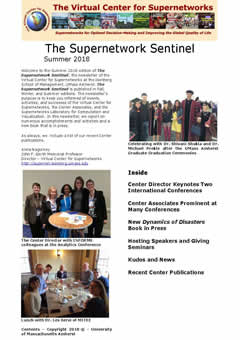
As the Founding Director of the Virtual Center for Supernetworks, which I established in 2001 at the Isenberg School of Management at UMass Amherst, I continue to be amazed by the accomplishments of my former PhD students (I have chaired the doctoral dissertations of 20 students). Many have continued their association with the Center as Center Associates, an affiliation that provides a vigorous professional and support mechanism. Also, as the Director of the Center, I share three newsletters that are published per year, documenting the activities and accomplishments.

I am pleased to announce that the Summer 2018 edition of the newsletter, The Supernetwork Sentinel, is now available online. It reflects what I believe are some truly awesome accomplishments, which merit further highlighting.
 Summer 2018

For example, my former UMass Amherst doctoral student, Dr. Stavros Siokos, with whom I co-authored the Financial Networks book, has had an amazing career in finance.
 

Stavros is now the Managing Partner of the London-based Astarte Capital Partners, which he co-founded in 2015.  He recently launched a new program for investing in the education of underprivileged youth, an initiative, which demonstrates generosity and heart and also corporate social responsibility. I was very touched to read the interview with Stavros on his initiative, which appeared in Institutional Investing in Infrastructure. In the interview, he states: As far as I am aware, we are the first private equity firm to be committed toward allocating part of our profitability for such an initiative. We are also looking to bring this effort to a wider audience of asset managers so that the initiative has a much larger impact.


Another former doctoral student of mine, Professor Zugang "Leo" Liu, who is a tenured Associate Professor at Penn State Hazleton, is behind an initiative to start a new degree in project management and supply chain management which will provide a much needed educated and highly skilled workforce. Penn State issued this press release describing the new bachelor's degree.

Professor Patrick Qiang, with whom I co-authored the Fragile Networks book, and his dissertation received the Charles Wootan Award, also a tenured faculty member at a Penn State campus, was part of a delegation to China that visited 5 universities to enhance relationships and partnerships. The press release with details can be read here.

What truly impresses me about my former PhD students is their ability to lead and to conduct research that crosses boundaries and that makes a positive impact. Other exemplars of my former Isenberg School PhD students include: Professor Tina Wakolbinger, who became a Full Professor at the Vienna University of Economics and Business only 4 years after receiving her PhD, and is heading a Supply Chain Research Institute and is responsible for several programs. She is heavily involved in humanitarian logistics research, and is supervising several doctoral students (so the academic family tree is flourishing). And, closer to home, Professor Jose M. Cruz, who received 5 degrees from UMass Amherst, including an MBA, and is a tenured Associate Professor at the School of Business at the University of Connecticut, has received multiple awards, from being named an Ackerman Scholar twice, to multiple teaching awards at both undergraduate and graduate levels, and even a service award. His research focuses on supply chains and environmental issues as well as corporate social responsibility. He is the Director of the very successful Master of Science Program in Business Analytics and Project Management! You can read more about this highly ranked program here.

Sunday, February 26, 2017

Congrats to Isenberg Women in Business for a Fabulous Conference!

Yesterday, I had the pleasure of attending the 2017 Women of Isenberg Conference, organized by the Isenberg Women in Business Society at the Isenberg School of Management. The conference took place at the Campus Center of UMass Amherst. The conference is now an annual conference, with the inaugural one taking place in 2014. I had the pleasure of being a panelist at the second conference in 2015.

As we registered for the conference and picked up our elegant badges, we were greeted by a sign, and by members of the conference organizing committee.

The conference with about 350 attendees, mostly women, and a few very welcome males, including my Finance colleague, Professor Nikos Artavanis, was a huge success.
I was very much looking forward to the conference, since I had nominated two of my former Operations and Information Management students, now alumna, Johanna Zuber and Zheng Ding, as panelists, and they were selected. Johanna spoke on the Networking panel and Zheng on the Mentoring panel. Johanna and Zheng had been in my Logistics and Transportation class at the Isenberg School of Management and, after working in big companies, are now both at startups in NYC.

The organization of the conference was truly outstanding and the Isenberg Women in Business Society is an undergraduate student club so kudos to the officers, its members, and to all the volunteers for a great day.

There were keynote talks, multiple panels, and a lunch that was exquisite. I had the salmon, salad, mushroom risotto, with roasted veggies (beets, squash). It was served efficiently buffet style and then we brought our food back to the large room to listen to a very interesting panel on career challenges with four professional females from Pratt and Whitney. One, who works on global supply chains, had arrived from Poland at 2AM!

The full list of keynoters, panels, speakers and panel members, can be accessed here.

It was a terrific time to catch up with alumnae and some staff plus faculty.

I very much enjoyed all the panels that I attended and the discussions along with the Q&A. There was a great deal of energy and style present and support for one another at this special conference.

Plus, the treats during the afternoon coffee break were simply exquisite. I thought I was back in Paris.
The advice offered throughout the day will, I am sure, benefit all attendees, as well as the new acquaintances made. The nice canvas bag with amenities inside is a nice memento of a very rewarding day.
 Congrats to Isenberg Women in Business for a Fabulous Conference!

Saturday, October 8, 2016

A Fabulous Conversation with Steve Wozniak - Co-Founder of Apple

Yesterday, after a three and a half hour journey (it was the Friday before the Columbus Day long weekend), from the Isenberg School of Management at UMass Amherst, via the Mass Turnpike (a journey that should take no more than 2 hours), we arrived at The UMass Club in downtown Boston.

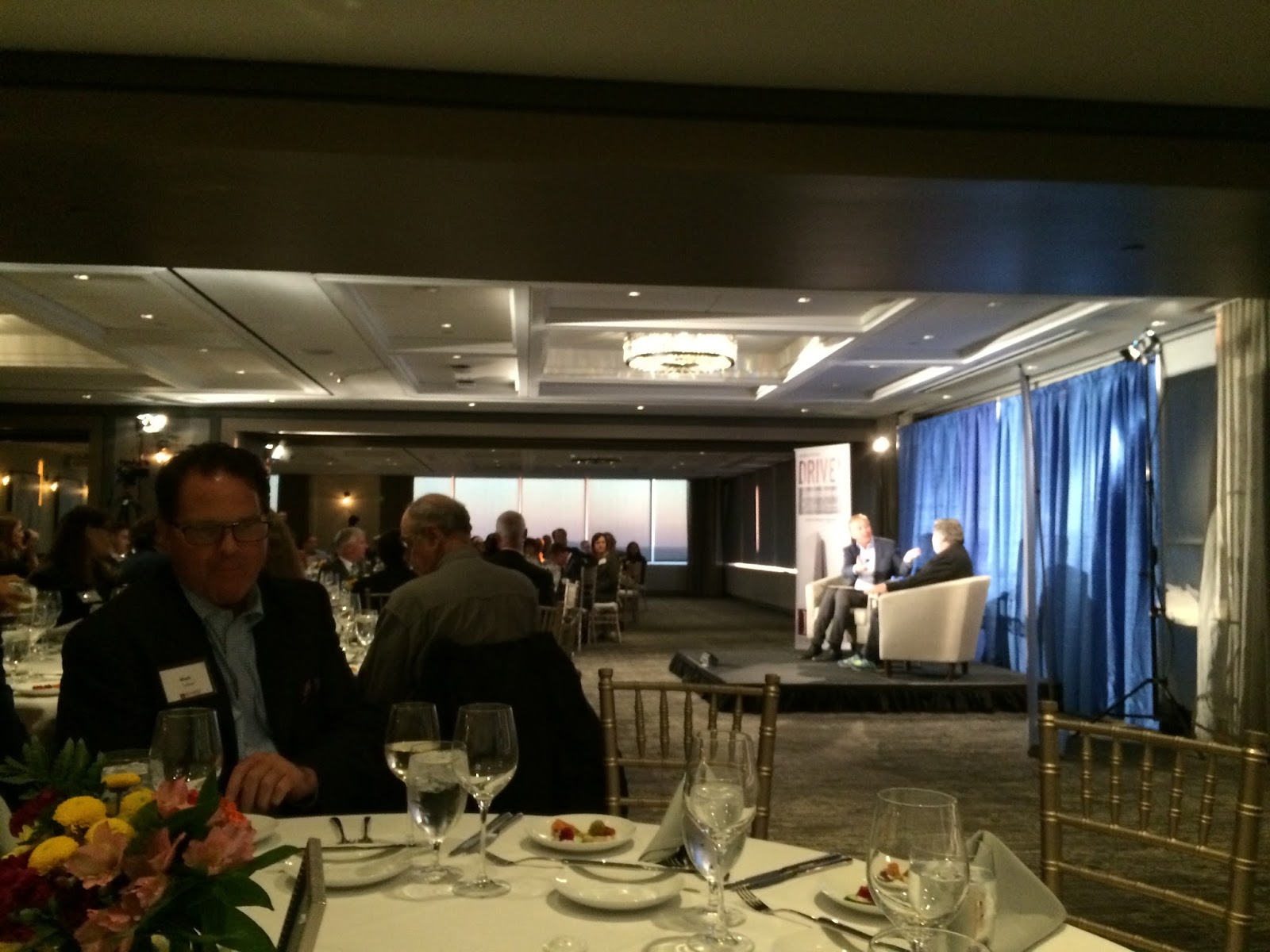
We were driven by a UMass student, Jenna, on a courtesy van provided by the Isenberg School to attend an event with Steve Wozniak, the co-founder of Apple. The event was an inaugural lecture in a new series, part of the Isenberg School's #Driven campaign.

The van ride was long but what made it fun was being with colleagues such as my department chair, Iqbal Agha, the chair of the Finance department, Sanjay Nawalkha, and our new clinical professor, Charlie Johnson, who was hired for our entrepreneurship program, and has been a Boston lawyer for over 30 years. Also with us was our wonderful Isenberg School Communications Director, Lou Wigdor.

The faculty on the van had been invited to be table facilitators with the evening program consisting of a 60 minute conversation with Steve Wozniak, moderated by the fabulous Tom Ashbrook, the host of NPR's, On Point, followed by a dinner. Other faculty facilitators included the chair of the Marketing Department, the one and only Bruce Weinberg, and my colleague, Alan Robinson.

Attendance was great at this event, and several remarked to me that they heard of it on NPR a few days ago and decided to come. The view of Boston from The UMass Club, which is on the 32nd floor, was stunning. I saw several alums, including Vinnie Daboul!
Sitting with me at the table were several GE employees, an employee of Nuance Communications, of the Markley Group, and  Mendix, as well as an Operations and Information Management (OIM) undergraduate student who had volunteered to help out. We talked about our jobs, Wozniak, high tech, and had a great time.

It was fabulous to see the UMass President, Marty Meehan, there and I told him how one of my former students shared with me that, when he turned 21, and was then a student at UMass Lowell, President Meehan took him out to celebrate. The student will never forget this.

While nibbling on some canapes the conversation began and the energy of Wozniak was incredible. I had caught up with his travels by checking out his Twitter account and he had come in from London just the day before and the week before he had spoken in Canada. He lives in California.


He spoke on the founding of Apple, his childhood, during which he loved ham radios (my husband is a ham radio operator so I very much appreciated this) and also electronics. I am sure that many of you have read both the book on Steve Jobs by Walter Isaacson and Wozniak's book iWoz. But it was extra special to see him in person and also to meet with him afterwards with a group asking for autographs. He, like Jobs, was a prankster, and usually got away with his pranks, since he did not advertise them.  He loved soldering and constructing computers so as to minimize resources, typically, computer chips. He clearly has a mindset of an Operations Researcher! He recalled fondly his time with the Homebrew Computer Club and thought that he would spend his entire life as an engineer at HP and could design computers in the off hours. His design of the Apple I and Apple II computers revolutionized personal computers and the computer industry.
He emphasized that happiness is important and his integrity was vivid throughout his presentation/conversation.  He said that he builds computers since he was inspired by social causes. Steve Jobs was the one with the business mind and, together, originally they had to hustle for the computer parts that they needed. He did mention that the Lisa and Apple III computers were not successful but he was not involved in their designs.

Interestingly, although the general public believes he is no longer with Apple, Wozniak actually still gets a paycheck from Apple. Apple II provided the company with revenues for 10 years. He also spoke about gaming and the importance of color and how the fact that Visicalc could run on an Apple computer very much helped in sales. People wanted computer solutions. Steve Jobs wanted computers to get easier and easier to use. He was not technical, according to Wozniak.

He said that in order to lead you have to be willing to take risks. Ashbrook asked him about the future of technology and Wozniak emphasized that we had earlier the advantage of Moore's Law. As for Artificial Intelligence, the question is how can it improve the world? 

He was proud that he eventually received his college degree from UC Berkeley but since he was already very well-known at that time, it is "Rocky" Raccoon Clark that appears ob his diploma.

He still has the first Apple I computer that he ever made.

Wozniak noted that we should be partners with computers.

He told us it is about "food, fun, and friends," and that his equation for happiness is: smiles minus frowns. He also mentioned that his wife is from Kansas.

We had time but only for a few questions and I enjoyed his insights on autonomous vehicles. 

It was a fantastic evening and we made it back to the Isenberg School in less than 2 hours. Joining us on the van back was Susan Boyer. The conversations were fabulous and the evening is one we will long remember.

Many thanks to Steve Wozniak  and to Tom Ashbrook as well as to the Isenberg Dean, Dr. Mark Fuller, and to Assistant Dean Chris Pilsner for organizing and making possible this great inaugural lecture! Also thanks to Associate Dean Tom Moliterno for inviting me to be a table facilitator at this great inaugural lecture.

Saturday, February 7, 2015

Congrats on an Extraordinary Women in Business Conference at the Isenberg School Today!

The 2015 Women of Isenberg Conference took place at the Isenberg School of Management today and it was extraordinary!

I salute the Women of Isenberg Student Planning Committee: Lauren Cacaceli, Abby Wells, Mary Lynch, Diana Cioccolini, and Casey Gover  for a conference that will be hard to top in terms of organization, attention to detail, stunning programs  with photos and speaker bios, fabulous panels,  great networking events, delicious pastries and refreshments plus fresh fruit, and a fabulous luncheon buffet - with salmon and roasted potatoes and chocolate torte with fresh cream for dessert.

The Isenberg Women in Business Club were behind this second annual conference with support provided by the Career Center and Development.

Alums came from throughout the Northeast to speak as panelists and provide advice to students and other professionals.

The program was crafted to be stimulating with an opening keynote speaker, Nicole Simeral,  in the morning and Kelly O'Kane at the end of the conference. Nicole's company was voted Best of Boston 2014 and you can read more about her here.  Kelly graduated from the Isenberg School in 2010 with a degree in Finance and recently heard that she was accepted into the MBA program at Stanford.

There were several panels to choose from in each time slot and I wish that I could have attended them all!

Networking
Startups
Building Your Brand (Part 1)
Career Advocating
Women in Sport
Finding a Balance
Building Your Brand (Part 2)
How to Grow to C-Level Positions
Corporate Social Responsibility
Young Alum

Our Dean, Dr. Mark Fuller,  had opening comments as did our Undergraduate Associate Dean, Dr. Linda Shea.

Below I share some photos from this great day!

You can see from the above photos that there were quite a few men in attendance as well!

And we received canvas tote bags with goodies inside - even "branded M&Ms and a water bottle filled with Lindt chocolates.

Truly special was also receiving a personal Thank You card from the moderator of my panel: Building Your Brand I, Caroline Malloy, Isenberg '15.

Congratulations to all concerned on an exceptional Women of Isenberg 2015 Conference and thank you!

And the Women in Business Club raised $30,000 to help make this all possible so many thanks also to the sponsors!


Sunday, October 27, 2013

Administrators Need to Celebrate (and by so Doing Build a High-Achieving Culture)

As an academic, I speak at many different venues with audiences ranging from other academics and students to representatives from industry  and government as well as leaders and practitioners from a wide range of sectors and disciplines.

As a world traveler, I always try to learn from the people that I encounter and in many recent conversations it seems that issues surrounding administrators and their role in building communities and culture and change management have been some prime topics of discussion.

Doesn't every professional want to be part of a high-achieving organization?

Administrators, who are true leaders (see my recent post which mentioned Winston Churchill), can play a significant role in raising their organizations (whether at the department, school, or even university level and the same holds for corporations), by celebrating the achievements of the employees (from faculty to the staff to students).

Think of your favorite and most effective politician -- he/she,  before giving a speech, will engage the audience by acknowledging individuals who are present and will also recognize constituents who have done wonderful things.

At the first department meeting or school meeting of the year, besides stating what you personally have accomplished as an administrator and which you perceive as being the needed direction for the organization, recognize what others have done since the last meeting (which could have been months ago).

Putting up a slide of faculty (and other) achievements and having those recognized stand up is a small way in which to give a pat on the back. An interesting example -- my husband spent some time at a government research facility. There, the Director used some of his discretionary funds to provide gift certificates to those who had notable achievements. At meetings, people were called up in front of everyone to select an envelope with the gift certificate inside. This action recognized achievements publicly and helped to change the culture in a very positive way. People felt noticed and excited that their hard work valued.

One of the administrators at a neighboring university from UMass Amherst had a spouse who was an elementary school teacher with a button making machine (I'd like to get my hands on one of these). He would make buttons for his faculty and staff stating, for example, "I published a paper," and after the accrediting team (think ABET if you are in  engineering or AACSB if you are in business), he passed out buttons stating "We survived the accreditation visit!"

An exemplar of a leader (at the Presidential university level) was Dr. Stephen Joel Trachtenberg, about whom I have written before. He was known to give out thank you notes which included a small bill stating "the dessert is on me -- go celebrate." He also gave out lottery tickets for birthdays. Dr. Tom O'Brien, without whose leadership we would not have the named Isenberg School of Management, would send bouquets of flowers with chocolate chip cookies for the recognized faculty member's children, always accompanied for the former with a hand-written note. Do you wonder why he was so good at development (raising funds -- pretty obvious).

So, when a faculty member has an achievement (or any member of the organization), administrators from all levels should publicly recognize the achievement as well as individually in a substantive way.

This has to be done in a meritocratic way and not just for one's "buddies."   My great Swedish colleagues have inculcated this in me.

What do administrators gain for celebrating the achievements of ALL those in their hierarchical food chain?

1. Those who are recognized will increase their loyalty, will continue their high achievements, and the reputation of the organization will grow.

2. There will be greater trust -- public recognition makes for a more level playing field.

3. Workers not only work for the paycheck but want to contribute and in academia especially when research and publishing may take a long time, getting grants can be very challenging, and educating students well requires a lot of energy and imagination, kind words (not just a quick email blurb) both spoken and in writing, backed up in  a little celebratory way can make a huge impact.

Yes, getting  faculty to go in the same direction is like herding cats but, by creating a positive, supportive culture, it can be done. People will enjoy coming to work and faculty may even be in their offices (when not traveling for professional reasons) on Fridays.

I am not an administrator (yet) in the strict academic sense (although I have been given some fabulous outside offers in this dimension ....). I am, however,  the Director of the Supernetworks Center, have served, in the past,  as the Area Director for the Management Science PhD program for over a decade, and am also the Faculty Advisor for the UMass Amherst INFORMS Student Chapter.

So this Friday from 1:30-2:00PM in the Isenberg School of Management Room 112, please join us for cake and a celebration. The students (apples don't fall far from the tree) will be celebrating 3 awards that were received at the recent INFORMS conference in Minneapolis.


Saturday, August 31, 2013

Recognizing the Achievements of Assistant Professors

The new academic year is upon us and it is so exciting to see the students moving into their dorms!

With the new year we also welcome new faculty to the various colleges and universities and they bring new perspectives, new research ideas, and lots of terrific energy!

Colleges and universities are built on the faculty and the most junior faculty are those who have received their PhDs within the past 5 or 6 years and they are called Assistant Professors.

In this blog, I periodically write what might be construed as an "advice column" and for many of these posts I get special thank yous. I have written on leadership on many occasions (even acknowledged by various Deans) and also on being an advocate for women. The latter was picked up by the WORMS President, Dr. Laura McLay, who recently gave an invited presentation, Five Observations on Women in Engineering,  and referenced my post. She told me afterwards that the males especially appreciated the advocacy suggestions that I had suggested.

The Isenberg School of Management at UMass Amherst has hired several new faculty and  I have been very much enjoying meeting several of them over the past several weeks and getting to know then. They are terrific!

Yes, I may be a bit "nostalgic" and am thinking  back to the time when I was an Assistant Professor, fresh with my PhD from Brown University.  I was very lucky, although, in those days, there was no formalized parental leave (so I had a child after becoming a Full Professor, but, through hard work, that promotion came only 8 years after my PhD and promotion to Associate Professor with tenure only 4 years after my PhD). There were also no teaching load reductions per se and I taught extra classes as an Assistant Professor w/o any added compensation, but to be a "good citizen" and because I was asked by my chairman at that time.

However, I had support from senior colleagues, even in other departments, who would congratulate me regularly and, with their sense of humor, make it fun to come to work. We had regular newsletters that were disseminated to faculty so we were informed as to the goings-on. I very often would be one of the first to arrive in the building, having breakfasted in the Newman Center,  whose opening I awaited at 7AM.

Assistant Professors, who have not yet achieved promotion to Associate Professor, and tenure, work very hard and, in academia, typically, achievement in the three pillars of research, teaching, and service is what matters for promotions.

But Assistant Professors do need support and kind words and collegiality can go a long way!

In addition, Assistant Professors (and don't we all) also want to feel part of a community in which their hard work is valued and when they achieve, their achievements should be recognized.

For example, administrators could and should send a congratulatory email note not just to the individual, but copy to the department and even to the school! It may take awhile to update websites and achievements ranging from getting grants, receiving best paper awards and other professional awards, and even press and media coverage, should be noted!

Why is this so hard to do for some in the Internet Age?!

Assistant Professors are ambassadors for academic programs and if they feel valued and recognized they will say positive things within the building and to the professional communities that they are part of. Happy Assistant Professors  are more likely to stay and to not seek employment elsewhere.

Given university investments in new faculty in terms of salaries and startup packages, is not recognizing the achievements of Assistant (and other) Professors a small price to pay?

Besides, when faculty do outstanding work, the reputation of the institution grows and everyone benefits.

Truly, don't you think that over time, those who feel recognized will do more for your programs and institutions?

As an Assistant Professor recently told me, a university cannot thrive if we are all islands.

So celebrate the achievements of Assistant Professors!

Some suggestions:

1. Disseminate good news regularly, including in personal messages that are copied to all faculty and even staff. This will bring smiles on the faces of many.

2. Do write a  personal congratulatory note -- I have a collection in my offices, which are posted -- they continue to inspire me and to lift me up.

3. Send a small token of appreciation -- I have written about a former Dean of mine, Dr. Tom O'Brien, who was amazing in this way and he was so good at development (not surprising)! Bouquets of flowers would arrive at my door -- sometimes at home and sometimes at my office, accompanied by chocolate chip cookies for my daughter.

4. Announce faculty achievements at public venues and don't forget to:

5.  Communicate the goods news to others outside the institution, including alums,  as appropriate, and through the right channels regularly.

6. Celebrate when Assistant Professors get promotion and tenure by broadcasting to the whole school!

And as the UMass Amherst Chancellor recently stated:

Let's build a community that will be the pride of the nation.

If my readers have other suggestions as to how to support and recognize Assistant Professors, please let me know -- Thanks!


Tuesday, May 21, 2013

Preparing a Graduate Commencement Speech -- From the Isenberg School of Management to the School of Business, Economics and Law in Sweden

Now is the time for college graduations and, in Massachusetts, over the past several days, we have been the scene for numerous ones -- from the UMass Amherst graduations to graduations in Boston and to even the Smith College graduation last weekend at which Arianna Huffington gave the commencement address. And Oprah Winfrey will be speaking at Harvard University's commencement on May 30.

Last, year, I was honored to give the commencement address at the Master's degree graduate commencement ceremony at the University of Gothenburg's School of Business, Economics and Law on June 14, 2013. My speech was on Life as a Network and it can be accessed here.

A writeup on the speech appeared in the UMass Amherst's In the Loop.

When I received an invitation a few months ago from Dean Maureen McKelvey of the University of Gothenburg to give this year's commencement speech, I immediately agreed.

Giving a commencement speech in the US is one thing -- giving a commencement speech in another country is a truly special experience.

I had the great experience of giving the commencement speech at the Isenberg School's undergraduate commencement in May 2003, which took place at the Mullins Center, so I can say that I have given such speeches on 2 continents.


This will be my fifth visit/stay in Gothenburg, since 2012, and,  as a Visiting Professor of Operations Management there, through its unique Visiting Professorship Programme, Gothenburg, Sweden has become my second home.

I will be delivering my commencement speech on June 12, 2013 in Gothenburg and my theme this year will be Leadership.

I will speak on what makes a great leader -- one of many themes that I have been writing about on this blog and will also bring personal experiences into the text.

I plan on emphasizing resiliency, creativity, communications, diversity, and integrity, and, as I did last year, I will share with you photos from the ceremony.


Wednesday, December 5, 2012

If I Were Dean

I have been approached over the years by headhunters and by administrators as well as faculty asking me whether I would be interested in being a Dean.

Having seen a lot as a faculty member, not only at my own university, but also at other universities at which I have had various appointments (Harvard, MIT, Brown, the Royal Institute of Technology, the University of Innsbruck, and, most recently, the University of Gothenburg), and having had numerous discussions with many faculty and having served on numerous search committees, I have given such invitations serious thought and consideration.

I have been a faculty member under "permanent," interim, and, my favorite -- "acting" deans. I have also worked under DITS (just this past weekend a colleague told me that this acronym stands for "Dean in Training").

Dr. Christina Paxson, the recently inducted new President of Brown University, in an interview published in BAM, stated why she moved into administration: “When you’re not an administrator,” she explained, “your impact can be great, but it’s still somewhat limited to your own students and your own research. When you move into administration, if you do well, you have a positive impact on the education and research of a lot of people. You sort of amplify what you can do.”

Indeed, she nailed it -- having a positive impact. But what concrete steps can result in a truly positive impact?

If I were Dean I would:

  • Communicate regularly with faculty and outside constituencies through such simple (but very important) things as giving pats on the back for great work, writing a nice personal note, making sure that newsletters are published and are online, publicizing accomplishments to all electronically and otherwise.  I would nominate my deserving faculty for rewards, awards,  and recognitions and would celebrate their achievements, recognizing that different individuals have different strengths and talents. A wonderful past Dean would have flowers delivered to my office and even to my home when there was a notable accomplishment and I still have certain thank you notes from him. (Is it surprising that he was also outstanding at raising funds -- clearly not -- everyone responded to his genuine warmth and caring and although he is no longer a Dean, he is still sought after for advice).  
  • Have integrity and right wrongs when and where needed. Be proactive. I have seen too much of a "it's a departmental issue." But if there is no leadership at the departmental level, this is a major copout.  True leadership MUST come from the top. My model of a truly outstanding Dean was Dean Robert J. Birgeneau of MIT. He was the Dean of the School of Science at MIT who not only established the Committee on Women Faculty with a report that demonstrated with data how women faculty were marginalized there and what was needed to be done. You can read the historic events in The MIT Faculty Newsletter Special Edition. The study and analyses demonstrated that making institutional change must come from the top and that administrative support is needed. The problems that needed to be addressed regarding female faculty included:  unequal resources and rewards; undervaluation of equal accomplishments, marginalization of women as they rise (this never stops, does it?), family-work conflicts, and the small number of female faculty. Now for a fascinating fact -- in 1960 there were ZERO female faculty in science and engineering at MIT. Birgeneau helped tremendously to change the environment at MIT but, once he left, the momentum receded.  He left MIT to go to UC Berkeley and the hiring of female faculty went flat again.  If you have the time (I listened and watched spellbound) you can learn more about these issues in a video lecture by Dr. Nancy Hopkins of MIT given recently in Hong Kong, entitled:, "Addressing the Under-representation of Women Faculty in Science and Engineering at MIT - A Data-driven Approach" A faculty member at HKUST who was in the audience and is a dear friend brought this video to my attention. You can hear Dr. Hopkins talk about how she walked around at MIT at night with a tape measure to measure the lab spaces given to various faculty. 
  • Support the intellectual life of the community. Education happens not only in the classroom but also outside the classroom. In a university it is essential to have speakers. I have personally used my own funds to support speakers over many years. You can see the lists over many semesters of individuals from whom we learned a tremendous amount. These talks were not required and we packed them in. Faculty came from throughout the UMass Amherst campus and some audience members came from as far as Boston, and even Vermont, and New Jersey. However, there comes a time when (and I did this for 14 semesters) when it is time for the administration to step up and support such activities and not just have a single female not only helping the students through the UMass Amherst INFORMS Student Chapter to organize the series but to also fund the majority of it.
  • Shape the direction of the school through inputs from faculty, students, staff, alums, and other constituencies. Be a bridge builder. Without substance and content a "brand" has no meaning. A reputation is built on the quality of the curriculum, the advances in research and knowledge, and on the excellence in terms of both breadth and depth of outreach activities. It also rests on the ability to work as a team and with proper incentives in place.
  • Give others a chance. Don't just appoint and reappoint those who have had opportunities in the past. Invite new faces to serve on important committees or as administrators, if they so wish to.

Sunday, July 29, 2012

Crisis Management and Resilient Leaders


People are starting to take notice.

It is hard not to -- with record-breaking temperatures in the United States this summer, severe drought enveloping many states, including some of our major grain and corn states, which will surely drive prices up for food products, extreme weather events and storms happening with increasing frequency, plus climate change even affecting our infrastructure -- from our roads to our electric power networks.

There is even a blood shortage this summer -- the worst in 15 years -- being reported by the Red Cross, partially attributed to the storms and heat this summer.

We have been researching fragile critical infrastructure networks and even wrote the book, Fragile Networks, in which we defined terms such as robustness and quantified synergies associated with network integration, through the prism of supply chains, since, truly, it is supply chains that link our economic activities together through production, transportation, storage, and ultimate distribution. I spoke on Building Resiliency in Washington DC on a special Transportation Research Board panel.

Our world is changing and  leaders must become aware of crisis management.


We are in need of Resilient Leaders.

The Isenberg School of Management at UMass Amherst has on its homepage the following:

Resilient Leadership for an Evolving Business Climate

and it is great to see new courses being taught around this theme and new initiatives.

There is a feature news article, Students Learn Crisis Management in Innovative Isenberg Course,  on the new course in Humanitarian Logistics and Healthcare  that I taught in Spring 2012. In the course, we had speakers from the National Guard, the Red Cross, the UMass emergency preparedness group, and even a disaster communication expert and a former student of mine from the profit sector, who has worked in healthcare. Nice to see my students quoted in the article.

Yes, even the army has realized the importance of location theory in determining where its critical supplies should be stored since it expects a greater role in humanitarian crises and evacuation management -- topics that we studied in my course and timely response and deliveries can save lives in crises.

Our research from blood supply chains to supply chain metrics in the case of disasters can be accessed on the Virtual Center for Supernetworks website.


Thursday, January 26, 2012

A (Humorous) Test for Your Potential as Dean

I have been invited to apply for certain deanships through contacts by search firms and other networks.

I also regularly write about leadership on this blog because, as an academic, I am naturally observant and curious and have had enough war stories both from several years in industry and many more as a female professor to have insights as to how effective organizations are run.

The Chronicle of Higher Education has a test for evaluating prospective deans.

The Gotcha Quiz was composed by an actual Dean, Dr. Scott Dalrymple.

My favorite questions on it are:

4. Do you want to be provost or president someday?

Chronicle of Higher Education Chronicle of Higher Education YES , Incorrect. We haven't even interviewed you yet, and already you're halfway out the door. We need someone who wants to do this job. How can you give your best effort if you're constantly planning your next career move? Sheesh.

Chronicle of Higher Education Chronicle of Higher Education NO , Incorrect. Have you no ambition? Do you expect to simply coast into retirement, collecting an annuity from us? Not here, pal.

5. In a faculty meeting, you spend 20 minutes pontificating on a budget matter. Later you realize that some of your assumptions were wrong, making what you said complete drivel. You suspect that faculty members will never discover this on their own. Do you issue a mea culpa?

Chronicle of Higher Education Chronicle of Higher Education YES , Incorrect. Show any sign of weakness and the faculty will eviscerate you. Picture a lion and a three-legged gazelle. You aren't the lion.

Chronicle of Higher Education Chronicle of Higher Education NO , Correct. +5 points.

6. Are you a technology enthusiast, e.g. iPods, iPads, etc.?

Chronicle of Higher Education Chronicle of Higher Education YES , Incorrect. The last guy treated us like his own personal Best Buy, racking up tens of thousands of dollars in charges for "educational technology." Overhead projectors were good enough when we were in school, and they're good enough now.

Chronicle of Higher Education Chronicle of Higher Education NO , Incorrect. The gal before Mr. Best Buy was a complete Luddite, and what a legal-pad-infested nightmare that was. We need someone who can relate to today's techno-savvy students. Someone who is up on the latest trends, like Prodigy, Geocities, and MySpace.

The full quiz can be accessed here.