Showing posts with label climate change. Show all posts

Sunday, July 16, 2023

Thanks to ALL Who Took Part in Our International Conference on Dynamics of Disasters in Greece

It has been an incredibly busy, yet energizing, several few weeks with two international conferences on different continents and different seasons (summer and winter).

I'd like to take the opportunity to thank all those who took part in the 6th International Conference on Dynamics of Disasters, which took place in Piraeus, Greece, July 3-6, 2023.

The below collage was constructed to capture a few of the highlights.

The venue of the conference was the Historical Library of the Aikaterini Laskaridis Foundation in Piraeus.

We had the pleasure of hearing from outstanding plenary speakers, both practitioners and academics.

It was inspiring to see conferees representing many different countries including: Austria, Germany, Nepal, Japan, Canada, Greece,  Italy, Turkey, the UK, and the US.

In a period in history with compounding disasters, the exchange of knowledge and best practices and working together to address the great challenges that we are faced with are needed more than ever.

Information about the conference, including the presenters and their talk titles can be found on the conference website.

I had the pleasure of presenting work done with my PhD student at the Isenberg School of Management Dana Hassani and colleagues at the Kyiv School of Economics: Professor Oleg Nivievskyi and Dr. Pavlo Martyshev. The link to the slidedeck of the presentation can be accessed here.

Not everyone could join us because of visa and other extenuating circumstances. Sadly, in April, Professor Urmila Pyakurel of Nepal passed away. She was an avid participant in our previous Dynamics of Disasters conference. We paid a tribute to her in Piraeus. A PhD student of hers presented on their joint work. Urmila lost her life to cancer, which she had battled for many years. She was also a Humboldtian. You can read about some aspects of her amazing life here.

And, while I was at the IFORS conference in Santiago, Chile, July 10-14, 2023, at which I gave a keynote, we heard from Springer Nature that we are getting a contract to edit the volume: "Dynamics of Disasters: From Natural Phenomena to Human Activity." My fellow Co-Editors on this project are: Professors Ilias S. Kotsireas, Panos M. Pardalos, Stefan Pickl, and Chrys Vogiatzis. It was a pleasure to work with them on the organization of this very timely conference.

Friday, July 24, 2020

Our Recent Research on Human Migration Networks, Climate Change, and Covid-19

The New York Times yesterday published an article, "The Great Climate Migration,"  which stated: As with much modeling work, the point here is not to provide concrete numerical predictions so much as it is to provide glimpses into possible futures. Human movement is notoriously hard to model.

I have been working on the modeling for human migration networks for over 20 years and, in the past year, with collaborators, I have returned to this important topic. Our research was motivated by real-world events. According to the United Nations Department of Economic and Social Affairs, Population Division, by the end of 2019 the number of people forcibly displaced due to war, conflict, persecution, human rights violations, poverty and economic inequality but also climate change and natural disasters, had grown to 79.5 million. Furthermore, the vulnerability of millions of international migrants may be exacerbated in crisis situations, as actually is the case now with the COVID-19, and, of course, by climate change.

In addition,  migration interactions will be the key to achieving the 2030 Sustainable Development Goals (SDGs) adopted by the member states of the United Nations. In the 2030 Agenda, 9 out of the 17 goals contain targets and indicators that are related to migration or mobility.

In the series of papers, we first set out to include the impacts of regulations on migratory flows and utilities, and took the perspective of migrants behaving in a user-optimizing manner, that is, choosing their locations, subject to the differential between the destination location utility and that in the origin location minus the migration cost. This led us to publishing the paper, "International human migration networks under regulations,"  in the European Journal of Operational Research:


This paper we then extended to include multiple paths between origin and destination nodes, with each path possibly consisting of multiple links. The paper, "Refugee migration networks and regulations: A multiclass, multipath variational inequality framework," was published in the Journal of Global Optimization:

We also introduced, for the first time, a system-optimized perspective for human migration, in which a central authority allocates migrants to locations in a way that is optimal from a societal perspective. In the paper, published in the International Transactions in Operational Research (ITOR):  "Human migration networks and policy interventions: Bringing population distributions in line with system optimization," we demonstrated how, through policy interventions, in the form of subsidies, a governmental body could ensure that, once imposed the migratory flows (and associated population distributions) would generate a system optimum, although migrants were behaving in a user-optimizing manner.  Those of you well-versed in transportation science can see the analogues.

Subsequently, we included capacities associated with the population locations of the multiclass migrants in the paper, "Capacitated human migration networks and subsidization." The paper has been accepted in the volume:  Dynamics of Disasters - Impact, Risk, Resilience, and Solutions, I.S. Kotsireas, A. Nagurney, and P.M. Pardalos, Editors, Springer International Publishing Switzerland, 2020. This paper shows that the results for the  policy interventions in ITOR also hold in the capacitated case.

And, in our most recent paper on human migration, "A system-optimization model for multiclass human migration with migration costs and regulations in the Covid-19 pandemic," also co-authored with Professor Patrizia Daniele of the University of Catania in Italy and her PhD student, Giorgia Cappello, we proposed novel utility functions associated with origin an destination nodes and also considered regulations as in the above work. The COVID-19 pandemic has dramatically  affected global mobility in the form of blockages, restrictions, and travel disruptions, as risk mitigation measures are being implemented by numerous countries. Indeed, the International Organization for Migration (IOM) reports that between 11 March 2020, when the World Health Organization (WHO) declared COVID-19 a pandemic, and 20 April 2020, the total number of movement restrictions implemented around the world has increased to more than 48,000! This paper is now under review in a special issues of a journal.

People since time immemorial have sought to identify better locations for themselves and their families. As The New York Times also noted,  our model offers something far more potentially valuable to policymakers: a detailed look at the staggering human suffering that will be inflicted if countries shut their doors.

Research on human migration networks will continue.

Saturday, February 22, 2020

Brilliant Lecture on Resilience by a Great Dane - Dr. Rasmus Dahlberg

Yesterday, we had the honor and pleasure of hosting Professor Rasmus Dahlberg of Denmark in our UMass Amherst INFORMS Speaker Series. His talk on "Resilience - the Danish Version" was brilliant. It is not often that one has the opportunity to hear from someone who is not only a disaster research scholar and a practitioner, with many fascinating experiences in a spectrum of emergency management exercises and events, including ones in the Arctic, but is also a novelist and media personality!
I had had the pleasure of hosting Dr. Dahlberg previously and met him when he presented a paper in the first Dynamics of Disasters conference that I co-organized in Kalamata, Greece. The paper that he delivered at this conference appears in the refereed conference proceedings.

Coincidentally, Dr. Dahberg delivered his talk yesterday in Isenberg's new Business Innovation Hub, which was designed by the award-winning Danish architect Bjarke Ingels. Last April, Ingels came and spoke at the unveiling of the hub and accompanying celebrations.

I gave some opening remarks and then Mojtaba Salarpour, the President of the UMass Amherst INFORMS Student Chapter, welcomed the speaker and the audience. It was great to have faculty and students from the Isenberg School, the UMass Amherst College of Engineering, and the College of Computer and Information Sciences in attendance, as well as faculty from other universities, and even several journalism students who were excited about covering the event!


Dr. Dahlberg is a faculty member at the Royal Danish Defence College and considers himself a "disaster historian." He has worked for the Danish Emergency Management Agency in the Department of Crisis Management.
He emphasized that there are no natural hazards in Denmark and that "all disasters are man-made." What is especially challenging now is that there are more risks from climate change and advanced technology. And many disasters have been the result of human error, due to complexities of advanced technology.  He also emphasized that Denmark is one of the most peaceful countries but is being faced with sea level rise, along with expansions of maritime routes, which can lead to more maritime accidents and disasters.
He noted that emergency management in Denmark has evolved from "civil protection" and that Denmark in the Anthropocene is seeing more and more extreme weather events with extreme rainfall.

He brought up numerous interesting points, including the need for  "zero responders," who are volunteers rising up to assist. He mentioned an incident of extreme rainfall and flooding in Denmark in 2013, for which multiple shelters were identified but very few citizens actually used them. The Danes, through social media, had informed the community that they had opened up their own residences to those needing shelter and, in effect, solved the disaster response effectively. People, for the first time, in Denmark, used one another and social media in this way. The peer to peer coordination and communication was very successful!

Dr. Dahlberg, on February 7, 2014, contributed to a Danish Emergency Management Association Workshop which he called "Resilience 101," in which he spoke about resilience as being the ability "to bounce forward" after a disturbance that disrupts normal operations. He noted the work of Dr. Tierney, who was also on his PhD dissertation committee, who defines "resilience as the obverse of risk" and the work of Dr. Alexander Augustine, who notes that "We need to build resilience to the uncertainties that lie ahead."

A more resilient Denmark is needed to tackle climate change. He also emphasized that "we cannot build our way out of everything" and mentioned the Rockefeller Foundation's 100 Resilient Cities program.

Dahlberg believes that one must stress the system for resiliency.
He also emphasized that it is expensive to invest in emergency management and singled out the "Arctic Response Force." He singled out the possibility of a cruise ship disaster in Arctic waters. He has even written up disaster scenarios, which were then used in Denmark for disaster preparedness and response exercises!

After his presentation, there was a terrific Q&A; we took a group photo of those who were still in attendance, followed by a delicious lunch at the University Club at UMass Amherst, at which the stimulating conversations continued.

And, at lunch, he told us how to escape from a car sinking in the water and provided us with advice to always wear hiking boots while flying (helps in climbing out should you need to evacuate while taking off or landing).

We thank Dr. Rasmus Dahlberg for his brilliant lecture on resilience and wish him much continuing professional and personal success! His work and energy inspired all of us.
We ended the perfect intellectual and social day with dinner at Judie's in Amherst, complete with their iconic item - popovers!

Friday, October 20, 2017

UMass Amherst INFORMS Student Chapter Tunes Up for National Conference in Houston

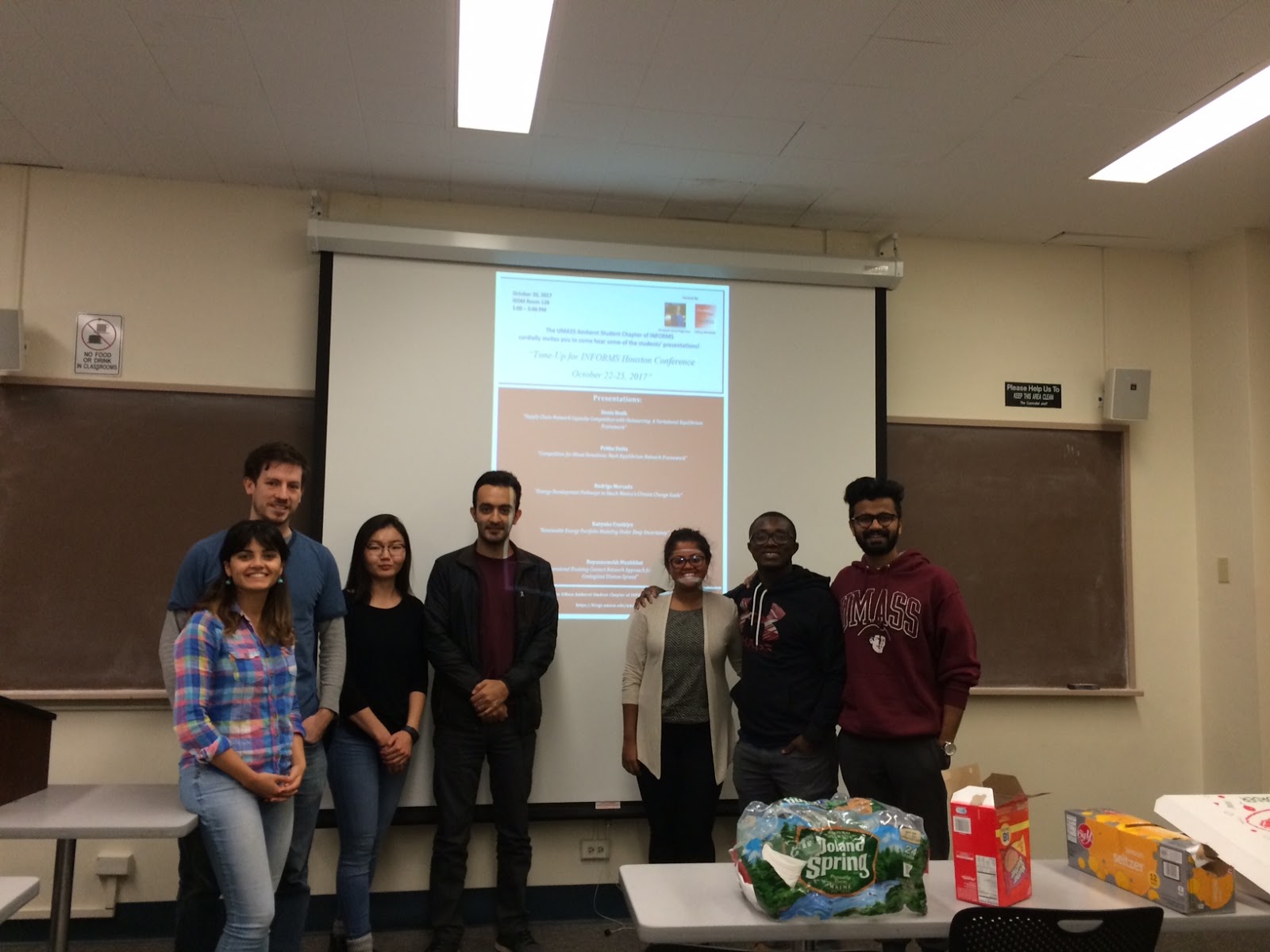
The 2017 Annual INFORMS conference is taking place in Houston, Texas, October 22-25, 2017, and today I had the pleasure of attending the tune-up for the conference that was organized by the UMass Amherst INFORMS Student Chapter.  Although everyone is very busy it is very important to support the doctoral students, and the tune-up, which has become an annual tradition, allows the students to not only practice their conference talks and to receive feedback, but the audience members learn about some of the exciting research in operations research and management science that is being conducted on our campus.

We had blocked off a two hour time slot this Friday afternoon at the Isenberg School of Management for 5 presentations as in the nice poster that the students prepared below.
Both doctoral students from the Isenberg School and from the College of Engineering presented today and I thoroughly enjoyed the presentations on a diversity of important topics, ranging from supply chains (capacity competition and outsourcing), game theory and blood donations, energy and Mexico with a goal of achieving climate change goals, deep uncertainty and energy modeling, as well as network models for the spread of diseases.

I was impressed by the professionalism of the slides prepared as well as by the delivery of the presenters. These students are ready for their presentations in Houston. It was special to also see the enthusiasm that they have for their research.

The students even had brought refreshments including pizza!

Below are photos taken of the individual speakers, followed by a group photo that I took.
 
The doctoral student presenters today hail from Mexico, Turkey, India, Sierra Leone, and Mongolia!

They, along with other students from UMass as well as faculty, will be joining me on Monday evening at the Hilton in Houston to receive the Magna Cum Laude Award from INFORMS for the activities of the UMass Amherst INFORMS Student Chapter this past year, an honor richly deserved.
This is the 12th award from INFORMS in the past 12 consecutive years.

And, during a short break this afternoon, I found out that a paper (one of seven) that  I am a co-author of that we are presenting at INFORMS Houston got accepted for publication in the journal Omega and we has just finished the slides this morning! Gratifying to have hard work rewarded.

Safe travels to all those heading to INFORMS Houston and see you soon!

Thursday, June 1, 2017

Sustainable Supply Chains to Save Our Planet Through Operations Research

This has not been a good day with President Trump announcing, as had been expected (but we were hoping otherwise), that the US is quitting the Paris Climate Pact. This puts US at odds with over 190 nations that had signed this pact. 

Frankly, I feel physically repulsed and ill by his decision, which is contrary to that of not only many world leaders but also top executives and even some of his very own advisors. I guess for some, breathing clean air and having their children breathe clean air, too; having clean water, and a diversity of species, and not dealing with more  turbulent weather, uncertainty, and possible food insecurity due to climate change, does not matter. This is so ironic, since the green economy can actually be a very successful economy and can generate jobs and is doing so (as the Chinese have even started to figure out). The costs of not slowing down climate change will be immense and are already upon us.

I do have some hope, however, in leaders from certain industries in the US as well as on the state levels (including California, New York, and Massachusetts) that progress will, nevertheless, be made to reduce pollution and emissions and to combat climate change.

In addition, I have hope because of students and this generation as well as a community of academics and practitioners that has a passion for sustainability and saving our planet.
Our most recent work on supply chains and sustainability, we will be presenting at the MSOM meeting this month. There we will present the paper,  A Competitive Multiperiod Supply Chain Network Model with Freight Carriers and Green Technology Investment Option, which was co-authored by Professors Sara Saberi and Joe Sarkis of WPI, Professor Jose M. Cruz of UConn, and me. In this work, we construct a model with multiple manufacturers, retailers, and freight carriers who maximize the net present value (NPV) of their investments in ecologically friendly technology. Future production, inventory, transaction, and transportation costs savings are used to help fund investments. The environmental impact of production, inventory, transportation, and consumption of products in the supply chain network are all integrated. The tradeoff between the initial technology investment and its ecological footprint effect are considered for the supply chain planning period. This is a large-scale multiperiod game theory problem for  a supply chain of multiple echelons, which we provide theoretical results for an extensive numerical results with policy implications.

We have also published on design of sustainable supply chains:  Design of Sustainable Supply Chains for Sustainable Cities, Anna Nagurney,   Environment & Planning B 42(1): (2015) pp 40-57 and Sustainable Supply Chain Network Design: A Multicriteria Perspective, Anna Nagurney and Ladimer S. Nagurney, International Journal of Sustainable Engineering 3: (2010) pp 189-197.

Also, topics related to transportation have been a theme in our sustainability research:   Environmental Impact Assessment of Transportation Networks with Degradable Links in an Era of Climate Change, Anna Nagurney, Qiang Qiang, and Ladimer Nagurney, International Journal of Sustainable Transportation 4: (2010) pp 154-171 and  Environmental and Cost Synergy in Supply Chain Network Integration in Mergers and Acquisitions, Anna Nagurney and Trisha Woolley, in Sustainable Energy and Transportation Systems, Proceedings of the 19th International Conference on Multiple Criteria Decision Making, Lecture Notes in Economics and Mathematical Systems, M. Ehrgott, B. Naujoks, T. Stewart, and J. Wallenius, Editors, Springer, Berlin, Germany (2010) pp 51-78.

Electronic recycling has also been a theme of several papers of ours, including:   When and for Whom would E-waste be a Treasure Trove? Insights from a Network Equilibrium Model of W-waste Flows, Tina Wakolbinger, Fuminori Toyasaki, Thomas Nowak, and Anna Nagurney, International Journal of Production Economics 154: (2014) pp 263–273.

Food, given the costs associated with waste, has obsessed us in our research, with an example being:  Competitive Food Supply Chain Networks with Application to Fresh Produce, Min Yu and Anna Nagurney, European Journal of Operational Research 224(2): (2013) pp 273-282.

Other sustainable supply chain research of ours has included work on fashion supply chains: Fashion Supply Chain Network Competition with Ecolabelling, Anna Nagurney, Min Yu, and Jonas Floden, in Sustainable Fashion Supply Chain Management: From Sourcing to Retailing, T.-M. Choi and T.C.E. Cheng, Editors, Springer (2015) pp 61-84 and Sustainable Fashion Supply Chain Management Under Oligopolistic Competition and Brand Differentiation, Anna Nagurney and Min Yu, International Journal of Production Economics, Special Section on Green Manufacturing and Distribution in the Fashion and Apparel Industries 135: (2012) pp 532-540.

Finally, in addition to several books that I have written on sustainability, with examples highlighted here,  we have also written on sustainability issues in healthcare in the papers: 
Securing the Sustainability of Global Medical Nuclear Supply Chains Through Economic Cost Recovery, Risk Management, and Optimization, Anna Nagurney, Ladimer S. Nagurney, and Dong Li, International Journal of Sustainable Transportation 9(6): (2015) pp 405-418 and Supply Chain Network Design of a Sustainable Blood Banking System, Anna Nagurney and Amir H. Masoumi, in Sustainable Supply Chains: Models, Methods and Public Policy Implications, T. Boone, V. Jayaraman, and R. Ganeshan, Editors, Springer, London, England (2012) pp 49-72.

We have also published on policies and energy and the environment with an example of that research being:  Spatially Differentiated Trade of Permits for Multipollutant Electric Power Supply Chains, Trisha Woolley, Anna Nagurney, and John Stranlund, in Optimization in the Energy Industry, J. Kallrath, P. Pardalos, S. Rebennack, and M. Scheidt, Editors, Springer, Berlin, Germany (2009) pp 277-296.

Sustainability of our supply chains has never been more essential.

Friday, November 11, 2016

Looking Forward to @INFORMS2016 in Nashville with Talks on Disaster Relief to Cybersecurity

Last week, I was at New York University for a fantastic Game Theory and Security conference that I blogged about and this week has been historic with the US Presidential election result on Tuesday. I am glad that we live in Amherst, Massachusetts.

As a faculty member, one keeps on marching on, and, this past Wednesday, the UMass Amherst INFORMS Student Chapter, which will be receiving its 11th award from INFORMS in as many years at  the INFORMS conference that takes place in Nashville, Tennessee, November 13-16, 2016, hosted a Tune-Up for this conference and two  other upcoming ones. The 6 students who presented on their research with their advisors did a wonderful job and, frankly, it was a great distraction from the election outcome. 3 of the 6 talks were on climate change issues, one was on healthcare, one on global distribution, and my student spoke on competitive supply chains with quality of fresh produce with applications to farmers' markets. She will be presenting this joint work of ours at the INFORMS Computing Society conference in Texas in January. We had several faculty and additional students show up to support the speakers. The event lasted two and a half hours with questions and comments to improve the students' talks, if need be.
Below are a few photos from the above event.
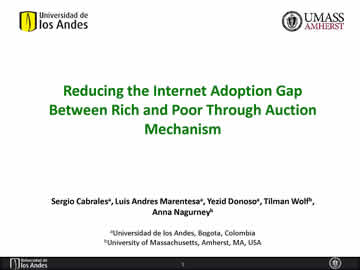
At the INFORMS conference in Nashville, I am a co-author of five paper presentations and four are now ready. Please visit the Supernetwork Center website at the Isenberg School of Management for the presentations that we have uploaded. I organized a session for this conference on Novel Applications of Network Optimization and look forward to the talks on supply chains, disaster relief, financial hedging, and medical resource allocation in epidemics. The annual INFORMS conference also always serves as a fabulous venue for a reunion of many of the Supernetwork Center Associates, so there will be nice get-togethers and also photo opportunities. Some of our presentation topics, from disaster relief to cybersecurity, that we will be presenting are shown below. I am also very excited that a collaborator from Colombia will be coming to the conference to speak on our joint work on auction mechanisms for Internet adoption.

In addition to sessions, there are many special events at this conference and I am looking forward to the INFORMS Fellows Awards lunch, the WORMS (Women in Operations Research and the Management Sciences) lunch, the Transportation & Logistics Society meeting, the INFORMS Computing Society meeting, some editorial board meetings,  and award ceremonies.  It will be a very busy but enjoyable conference.

Wishing everyone safe travels to Nashville and a fabulous INFORMS conference!

Wednesday, October 16, 2013

Mathematics of Planet Earth -- Special Issue of Computational Management Science

According to the website for Mathematics of Planet Earth MPE2013: More than a hundred scientific societies, universities, research institutes, and organizations all over the world have banded together to dedicate 2013 as a special year for the Mathematics of Planet Earth.

 The theme “Mathematics of Planet Earth” is interpreted as broadly as possible. In addition to climate change and sustainability, it includes geophysics, ecology and epidemiology, biodiversity, as well as the global organization of the planet by humans. The different topics have been classified into four themes.

The four themes of MPE2013:
* A PLANET TO DISCOVER: oceans; meteorology and climate; mantle processes, natural resources, solar systems
* A PLANET SUPPORTING LIFE: ecology, biodiversity, evolution
* A PLANET ORGANIZED BY HUMANS: political, economic, social and financial systems; organization of transport and communications networks; management of resources; energy
* A PLANET AT RISK: climate change, sustainable development, epidemics; invasive species, natural disasters.

I became aware of this great initiative last May when I spoke at the Computational Management Science conference in Montreal, Canada,  and heard from Professor Georges Zaccour that he, and Professor Michele Breton, were guest editing a special issue of the journal Computational Management Science on this theme.  Since last year I was on sabbatical and spending a lot of time at the School of Business, Economics and Law at the University of Gothenburg in Sweden, sustainability continues to be a major theme in my research. Plus, the emphasis on the environment in Gothenburg and in Sweden, overall, made for a perfect venue in which to work on a paper for this special issue. Our paper, Supply Chain Network Sustainability Under Competition and Frequencies of Activities from Production to Distribution, Anna Nagurney, Min Yu, and Jonas Floden, is now in press in this special issue  of Computational Management Science.

I was delighted to see the Preface to this special issue online on the journal website  The special issue, according to the Guest Editors Breton and Zaccour,  has 7 papers written by scholars having an extensive expertise in mathematical modeling and in environmental issues.The objective of this issue is to report on recent advances in modeling and in the development of computational methods for environmental issues such as global warming, pollution control, adaptation, sustainable exploitation of resources (forests, fisheries, etc(, sustainable supply chains, and more!

I expect that the hardcopy of the full issue will be produced soon since the contributions are online -- I am so looking forward to receiving my copy.

Congrats to the Guest Editors and thank you for your hard work which made this special volume possible! Also, thanks to the long-serving Editor of CMS, Professor Berc Rustem, for being a visionary.

Monday, September 30, 2013

Politics of Sustainability -- India and China

The title of the talk -- Politics of Sustainability -- intrigued me and it was heavily promoted on the UMass Amherst website, so I gathered two of my doctoral students, one from China and the other from India, and off we went to hear former United Nations policy advisor Mukul Sanwal speak on climate change and sustainability. His talk was under the auspices of the political science department at UMass and Five Colleges, Inc.
Mr. Sanwal worked for the United Nations from 1993 to 2007, serving first as a policy advisor to the executive director of United Nations Environment Programme (UNEP) and later to the executive secretary of United Nations Framework Convention on Climate Change (UNFCCC). Given that the IPCC just produced its Fifth Assessment report, and it has been getting a lot of attention in the media, his topic was especially timely.
Sanwal began his talk by stating that what India and China will do will frame the future. He emphasized the shifting of the population from being producers to being consumers and noted that the global middle class will triple by 2030. He noted that the climate crisis is caused by the scarcity of resources, or the distribution of resources, and sees the problem as one to be managed, and not solved -- I thought this rather pessimistic but very much appreciated his emphasis on conservation and the importance of altering the behavior of consumers. We need to have better ways of measuring carbon imprints and environmental impacts on the consumption side.

In terms of economic development, we are seeing major migrations to urban areas, especially in China and India, and urban design for sustainability is critical. The population was 1.6 billion in 1900 and will increase to 9 billion in 2050. The urban population was 30% (of 2.5 billion) in 1950 and will be 70% (of 9 billion) in 2050. Economies are now driven by the services sector and not just industry.

It is expected that the transport sector will generate half of the global emissions by 2050.

We need to educate the population about changes in lifestyle and, where feasible, also have the right legislation.

Changing behavior is not easy and society needs to agree that changes need to be made. And we can make the changes through the food that we eat, the homes that we live in, and the modes of transport that we use as well as the products that we buy.

We need a common vision for human welfare (and that of our planet).

Ken Toong, our award-winning Executive Director (and chef) of Auxiliary Enterprises, was also in the audience, and he made some great comments on what his group is doing in sustainability in terms of reducing food waste in the dining commons and also serving red meat infrequently. He is in the blue shirt in the photo above.

Lots of ideas were generated -- thanks to Mr. Mukul Sanwal for sharing his experiences and wisdon with us today.

Tuesday, November 30, 2010

Public Transit and Climate Change

A few days ago I was interviewed by a student journalist for the UMass Amherst student newspaper, the Daily Collegian. I agreed to the interview, since the topic was on transportation and the environment, a theme that I have written a lot about and am very passionate about. The interview focused specifically on public transit and its role in reducing emissions (and congestion, I might add).

As someone, who did not get her license until she became a Full Professor and mother, I have always enjoyed using different modes of transportation, including public transportation. Growing up in Yonkers, New York, we would walk for miles, ride busses, and sometimes take the train to NYC along the Hudson River. I would ride the subway from the Bronx into Manhattan and back regularly.

During my international travels, I always pay attention to the transportation infrastructure in different countries and make a point of taking public transit.

Frankly, I enjoy the social aspects of public transit -- seeing different people from all walks of life. Last Friday and Saturday, I was in Cambridge and Boston and taking the Red Line from Harvard Square to Park Street always takes my breath away as we approach the Charles MGH station with the gorgeous water views. I also got a chance to ride the Green Line.

The article in the Daily Collegian, entitled: UMass Transit encourages students, residents, to hop on for climate change, by Tim Jones was published today. Jones did an excellent job of capturing the major issues and the importance of having more transit alternatives available that reduce carbon emissions. You can read the article here.

So do take a more environmentally-friendly mode of transportation, whenever you can, and do it not just for yourself but for future generations. You may even meet some really nice people en route.