Sunday, March 31, 2019

Delightful Surprises During My Visit to Speak at RPI on Disaster Relief


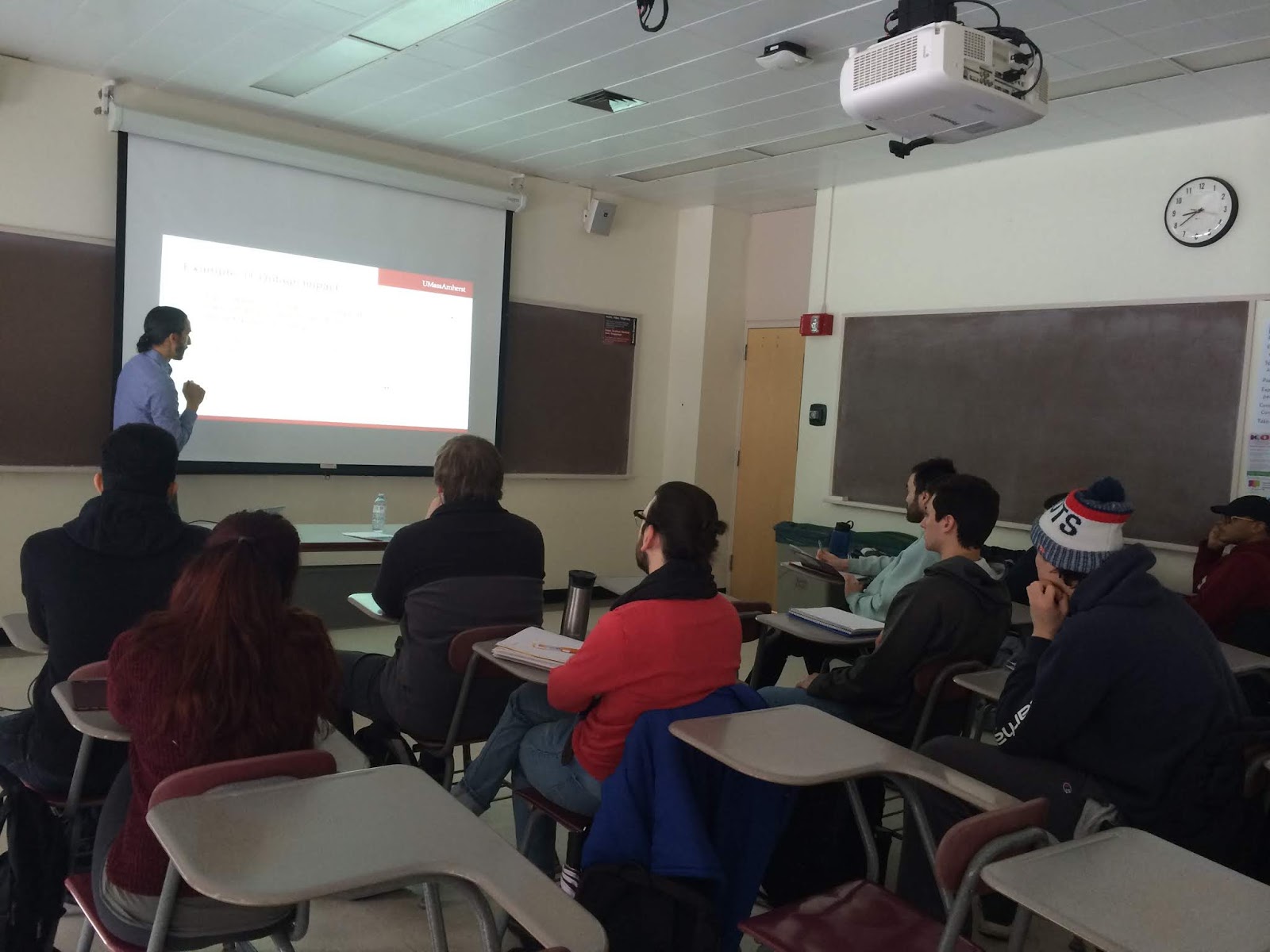
This past Friday, I had the pleasure of speaking at RPI (Rensselaer Polytechnic Institute) in Troy, New York, at 10AM, so the day began quite early with a two hour drive from Amherst, MA. I was hosted by two Engineering departments and had been invited to give a talk there a year ago but my schedule did not permit a visit until now.
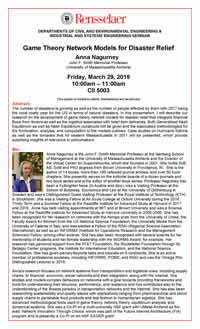
                                                   RPI
I had given my host, Professor David Mendonca, a list of topics that I could speak on and the one selected was: Game Theory Network Models for Disaster Relief.
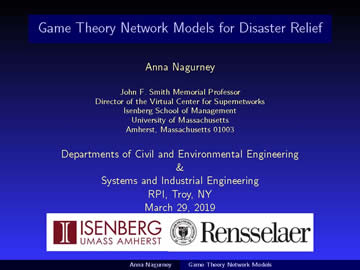
 RPI
My talk is available for download and it was exciting to polish it since, in just the past three weeks, three of our papers on the topic have been published in journals, including: An Integrated Financial and Logistical Game Theory Model for Humanitarian Organizations with Purchasing Costs, Multiple Freight Service Providers, and Budget, Capacity, and Demand Constraints,  Anna Nagurney, Mojtaba Salarpour, and Patrizia Daniele, International Journal of Production Economics 212: (2019), pp 212-226.

The drive on the Mass Pike was smooth, despite the rain, and my husband was the designated driver. He had not been to RPI since he had been accepted there for Grad School, but ended up matriculating at Brown University, so he was eager to go back. I had to check my cv to see when was the last time I had spoken at RPI and found that I had given a seminar at RPI at the Electrical, Computer, and Systems Engineering Department,  December 5, 2001! I recall a lavish holiday party with white roses and shrimp that I viewed in passing.

Once the technology for my presentation was set up, I heard some footsteps behind me and was absolutely thrilled to see one of my Operations and Information Management students from the Isenberg School of Management - Emily Agoglia! She had been a student in my Humanitarian Logistics and Healthcare class at Isenberg, is from Philadelphia, and is a world traveler, having most recently taken part in an academic program in Cuba! And she presented me with the lovely memento from Cuba below.
She had been in Cuba, when I was speaking and taking part in the amazing Congreso Futuro in Chile, so when we get together, we cannot stop comparing experiences. Her father is Professor Chris Agoglia, a renowned Accounting faculty member at Isenberg.

And, there was another delightful surprise - Professor William "Al" Wallace, who is now the Chair of the Department of Industrial and Systems Engineering at RPI, came to my talk. He was the doctoral dissertation advisor of the incoming Isenberg School Dean - Dr. Anne P. Massey! Dr. Massey will be the first female Dean of the Isenberg School and it has an illustrious history of over 70 years. In fact, this coming Friday, we will be celebrating the 50th anniversary of our PhD program! I am very excited since many of my former PhD students will be coming back to campus. I am preparing a talk and have organized the Management Science PhD alumni panel for that day.

The photo below is of me with Professor Wallace and Emily.
After my talk, I had the pleasure of meeting with Professors Sergio Pequito, Thomas Sharkey, and Kristin Bennett. Sergio and I talked about our love of interdisciplinary work. With Thomas "Tom" we discussed his thrilling NSF project on the Arctic and he recently returned from Alaska, so I had to take the photo below. We also chatted about colleagues Dr. Renata Konrad of WPI (a fellow Ukrainian, whom we hosted in our UMass Amherst INFORMS Speaker Series) and Dr. Kayse Maas of Northeastern (and, of course, we then talked about the NSF workshop on human trafficking). Professor Bennett remembers me from way back when when she was in Amherst and from one of her first INFORMS conferences and thanked be for being an inspiration (that and many other surprises  made that rainy day a very bright one)! She received her PhD from University of Wisconsin Madison and Dr. Olvi Mangasarian was her PhD advisor.
The lunch was at the RPI Faculty Club where I enjoyed great conversations with Professors David Mendonca, Kristen Schell, and Cara Wang,  and ate a spicy lunch with purple rice!
Dr. Cara Wang is a Professor of transportation and her advisor was Professor Kara Kockelman of UT Austin. I know Kara from the regional science community. Interestingly, Cara had been at Bucknell University and then moved to RPI. Coincidentally, we recently hosted Dr. Thiago Serra in our UMass Amherst INFORMS Speaker Series and he is off to Bucknell University as an Assistant Professor in the Fall. Also, Dr. Kristen Schell is a relatively new faculty member of ISE at RPI and received her PhD from CMU in engineering policy. Our IE/OR doctoral student, Destenie Nock at UMass Amherst, defended her dissertation recently and will be joining that program as an Assistant Professor in the Fall.

And I would be remiss to forget to mention that Professor David Mendonca is an undergrad alumnus of UMass Amherst, and my Management colleague, Professor Emeritus Art Elkins, had convinced him to go to CMU since the Nobel laureate in Economic Sciences Herbert Simon was there (I had had dinner with Dr. Simon in Amherst at the Lord Jeffery Inn a while ago.) Dr. Mendonca collaborates with a cognitive psychologist, Dr. Wayne Gray at RPI, who is a Lafayette College alumnus, from the same class as my husband, so he kindly kept my husband busy and very entertained while I was speaking and meeting with colleagues!

On our journey back, we turned on the radio, only to hear UMass Amherst hockey score its first goal in its game against Harvard University and they won 4-0; they repeated their amazing performance yesterday evening against Notre Dame University, also with a score of 4-0, and are now off to the NCAA Frozen Four for the first time in the history of UMass Amherst hockey! The first game in the final will be on April 11, right when we are having a special banquet at the Isenberg School for the $62 million Business Innovation Hub celebration with the official unveiling (although we have been using it already a lot since late January) on April 12.

Saturday, March 23, 2019

Fabulous Guest Lecture by a MEMA Expert on the Boston Marathon - Public Safety and Security Experience

Having expert practitioners speak to students in my Humanitarian Logistics and Healthcare class provides outstanding educational experiences that stay with students even after they graduate. The logistics of scheduling experts can, in itself, be challenging, but the risks reap great rewards.

This past Tuesday, we had the honor of hosting Ms. Sara Zalieckas, who is an All Hazards Planner with MEMA (Massachusetts Emergency Management Agency) and is based in Framingham, Massachusetts (about a two hour drive to UMass Amherst). She arrived in time for the early morning class, which meets from 8:30AM-9:45AM and, although I was waiting for her in the original atrium to escort her to the classroom, and she was in the new $62million addition to the Isenberg School,  we connected in time!

Ms Zalieckas is a Canadian, which made me extra excited since I was also born in Canada, and, in fact, had been to Halifax last summer to present at the CORS (Canadian Operations Research Society) conference, where she is from! She has worked for MEMA since 2012 and, hence, was employed by MEMA, when the bombing at the Boston Marathon took place on April 15, 2013.
The title of her guest lecture was: The Boston Marathon - Public Safety and Security Experience.

This year's Boston Marathon is taking place on April 15, 2019.

Ms. Zalieckas informed us of the extensive planning involved among multiple organizations to ensure the safety and security of runners, volunteers, supporters, and spectators alike in this major sports event, which covers over 26 miles (I have run several Ocean State marathons in RI, so I understand the energy and athleticism involved). It is considered the most challenging sports event to secure in the country. The Super Bowl is in one location, in contrast, for example. In 2013, there were 27,000 registered runners and the weather was ideal. In 2019, 60,000 runners are expected.

Rather than detailing the horrific attacks at the 2013 Boston Marathon, I will refer you to a blogpost I wrote following the guest lecture of Dr. Pierre Rouzier, who is a sports medicine physician, based at UMass Amherst, and who was working in a triage tent at that Marathon.

Post 2013, the focus  has been on lessons learned, and on assessing vulnerabilities and threats. Ms. Zalieckas brought to our attention, the 2013 Boston Marathon after action report, which can be accessed here.

Previously, jurisdictions had been working in silos, which was understandable since the marathon course covers a distance of over 26 miles.  Now there is a Unified Coordination Plan, with plans for evacuations, should the need arise, along the course in multiple locations, with even alternative routes to shelters along the Boston Marathon route identified, along with transportation options, such as buses staged. This I found truly fascinating. Now there is a joint information center and system, so that rumors, which are unsubstantiated, do not propagate, along with misinformation. There are also station "blocking" vehicles along the course.

The level of detail and the organizations involved to ensure public safety and security is extraordinary. More intense planning has been taking place since January 2019 to test out communications, to run tabletop exercises and training, to conduct intelligence and investigations (with appropriate federal partners), and to also address how to respond to mass casualty events. I also found it very impressive that MEMA, along with partners, has structured coordination of decision making and there is now a Unified Coordination Center. You may know that the MEMA headquarters in Framingham is actually an underground bunker built during the Cold War and our President at that time, John F. Kennedy, was to inaugurate its opening, but he was assassinated.

It is also so impressive that there is!a drone response plan is in place for the Boston Marathon and, of course, GIS is also utilized to monitor congestion along the route.

Ms. Sara Zaieckas' guest lecture was mesmerizing. I also was very pleased that we had a female speaker this term (and will be having another one next month).

We took a group photo after her guest lecture.

In appreciation, we presented Ms. Zalieckas with a gift from the Isenberg School of Management, and I followed up with several photos and a formal thank you letter, which I also copied to the new Director of MEMA, Ms. Samantha Phillips, which was recently appointed to this important most by Governor Charlie Baker. Quite exciting to have a female at the helm of MEMA!

I wish all the runners, the volunteers, supporters, and spectators, as well as the emergency management folks and their liaisons, a wonderful and safe 2019 Boston Marathon! We will be watching and cheering from near and far!

Sunday, March 10, 2019

Smarter Cities - A Company Expert Speaks

This past Friday, just before the official of the UMass Amherst Spring Break (one week recess), we had the great pleasure of hearing Dr. Jurij Paraszczak present in our UMass Amherst INFORMS Speaker Series. And the turnout for his talk in our beautiful new Business Innovation Hub at the Isenberg School was fantastic! I was especially delighted to see undergraduates in attendance as well as faculty and students not only from the Isenberg School but also from the College of Engineering and the College of Information and Computer Sciences! We even had guests from multiple other states! Thanks to the hard work of the UMass Amherst INFORMS Student Chapter the notice for Dr. Paraszczak's talk even made the UMass Amherst homepage under "Events!"
As is our tradition, as the Faculty Advisor to this great Student Chapter, I welcomed everyone and then this year's Chapter President, Katerina Deliali, did a formal introduction of our speaker. You can see from his bio in the above poster, the amazing career that he has had at IBM, with global impact!
Dr. Paraszczak, as the Director of IBM's Smarter Cities program (and he told us that IBM's Marketing Department deserves the credit for the coinage of the "Smarter" component), has had a wealth of experience. He took the lucky audience on a panoramic view of associated projects, highlighting several ones in greater depth, both in the US and in Europe.
He began his lecture very interactively, querying the audience, as to What is a Smart City? and then continued by asking us:
  • Who decides on the objectives?
  • What resources are available?
  • Who makes the compromises?
He noted that a Smarter City is one that is "optimized around a set of goals," which is a fabulous definition.  He emphasized that there have been dramatic changes since 2013 in terms of the availability of data (sensors, social media, etc.) and Artificial Intelligence, with applications (some existing ones in certain countries in terms of traffic management and even social control and you can guess the country or countries as to the latter). One of my wonderful colleagues from Management (who also happens to be Ukrainian), Dr. Bogdan Prokopovych,  especially enjoyed the statement that: "data is the new oil."

I was delighted when Dr. Paraszczak mentioned Dr. Brenda Dietrich (formerly of IBM and now at Cornell University, who is an INFORMS Fellow). Brenda had spoken in our Speaker Series a few years ago and, coincidentally, was included in a wonderful article published recently in ORMS Today, an INFORMS publication, on ten pioneering women and a Rising Star.

Dr. Paraszczak  discussed the analysis of cities, from building simple models that relate physics to everyday activities, to statistical models, and, ultimately, predictive ones (and I would argue prescriptive ones). He spoke of the hierarchy of: analytics, data, models, and insights.

He also emphasized the competition for resources and Maslow's needs for a city and quality of life. At the Q&A I asked him which city does he think has the best quality of life and he said: Stockholm, Sweden, and both my colleague Bogdan and I agree (although I do love Gothenburg, where I have also lived). How does one do resource optimization, in terms of energy, water, traffic, etc., in a city, when many of the departments work and function as silos? He singled out Minneapolis as being an exemplar of a Smarter City in the US and mentioned that there is usually an individual/leader who has the correct vision and relationships to make things happen. I believe that the students in the audience very much appreciated his emphasis on not only technical skills, but also on soft skills.
Dr. Paraszczak said that cities need to anticipate problems, such as where there may be water breaks, or crime, or traffic gridlock (with a terrific animation of Istanbul, Turkey using cell phone data during the day). He also emphasized the need to sense, analyze, predict, and manage, and how resilience is built upon planning and operations. He noted that people want to be heard and you need to engage citizens.

He also spoke about how the lack of organization among city departments may lead to failure and the challenges of constructing a single objective for a city! Ultimately, it is desirable to "make things better" and to "improve the quality of life."

Needless to say, I was absolutely thrilled when he displayed a photo of Lviv, Ukraine (my parents hailed from that area) and spoke of his work there, which yielded successes.

And he stated that Singapore is the smartest city on the planet but still so siloed, and, coincidentally, back in October, I had the great pleasure of taking part in a Workshop at the Ivey School in Canada on Smart Cities and wrote a blogpost on it since it was amazing and we had a speaker who spoke on Singapore! That workshop was organized by Professors Joe  Naoum-Sawaya and Bissan Ghaddar.

The Q&A period was excellent (but much too short) and many lingered afterwards to chat. Katerina Deliali presented the speaker with a gift from the Isenberg School.

I took the group photo below and then off to lunch at the University Club we went!
The lunch was delicious and the conversations filled with a lot of wonderful exchanges and laughter.
Also, as we always like to do, we shared scrumptious desserts.

Afterwards, we escorted Dr. Jurij Paraszczak to the Supernetworks Lab at the Isenberg School, where Nazanin Khatami conducted an interview with him. We will let you know when the video gets posted on the Chapter's Youtube channel.

It was a great honor to be able to host Dr. Jurij Parazsczak at UMass Amherst - thanks to him and to the great audience!

And a special shoutout to Chapter officer Haris Sipetas, who maintains the chapter website, including the news, for the writeup with additional photos!

Wishing everyone a Very Happy Spring Break!

Tuesday, March 5, 2019

Information Security at a Research University

Last Thursday, the students in my Humanitarian Logistics and Healthcare class and I had the honor of hearing Chris Misra, the Interim Vice Chancellor for Information Technology and CIO at UMass Amherst, deliver a guest lecture. 

We had had a joint project on cybersecurity with my Isenberg School colleagues, Senay Solak and Mila Sherman, and Wayne Burleson of the College of Engineering at UMass that was funded by the Advanced Cyber Security Center (ACSC) . You can read more about our project and see a presentation here, thanks to INFORMS. Cybersecurity is also a topic that my Supernetwork Team has been conducting research on and we have a stream of papers of the subject, with more to come.

Given  that information security is essential to enterprises, both profit and nonprofit ones, I thought that having Chris Misra speak on Information Security at a University would be very timely and fascinating and, indeed, his lecture was! I had communicated with him early that morning around 6AM, and told him that I would be waiting for him in the Isenberg School atrium. When I did not see him shortly before the class was to start, I emailed him and found out that he was waiting for me in the atrium of our new $62 million addition! Ironically (and the first time this semester), there were some issues with the technology in my classroom, but soon those were addressed, thanks to our TSS staff! Luckily, also, the university did not have a delayed start time, given the snow forecast.

Mr. Misra began his lecture with an overview of how Amherst College, a neighboring elite, very well-endowed liberal arts college, recently experienced a "technical mishap that left the campus without access to online services -- for five days".  Faculty, students, and staff at Amherst College were without access to Wi-Fi, email, and a variety of student support and other services; in effect, any content hosted by the college's website was not accessible. The cause was ultimately attributed to a network outage (and not a cyberattack)  and I heard from Chris Misra that Cisco came to the rescue.

Running an enterprise network for a university of the size of UMass Amherst is a major operation/ endeavor with both network engineering and network operations being essential and with the former also involving switches, routers, and even long haul networks to the other UMass campuses. Misra emphasized that there is a lot of complexity that you don't see, including the copper and fiber cabling. There is builtin redundancy to mitigate risk and there is a separate control domain from transport with 50,000-70,000 devices. Clearly, a very complex system to manage and to maintain.

I was so impressed that Chris Misra had even looked at the course syllabus and remarked that the course looked so interesting (yes, I love teaching this course because of the dynamism of the subject). 

He noted that "security is a negative deliverable - you don't know when you have it - only when you lose it." Clearly, similar to critical infrastructure. And, when it comes to information security, the three primitives are: confidentiality, integrity, and the availability of information, which I think the students very much appreciated. Regarding confidentiality, you want the information concealed across transmission, storage, and processing. As for integrity, one cares about the trustworthiness of the information or resources, and availability ensures the ability to access the information - extremely important in a university environment.
Chris highlighted security measures of training and education, policy and practice, and also technology. He even mentioned budgeting in the context of how much should a university spend to achieve a desired level of risk management (bringing down risk to an acceptable risk) since IT resources are critical assets. It was great to hear how the IT governance at UMass Amherst emphasizes transparent decision-making and priority setting and taking action.

Information security  also involves environmental controls, physical and logical access management, and "technical" change management. Every user holds some responsibility for information security. 

Mr. Misra also discussed disaster recovery under various scenarios and hazard events and noted that the planning for outages could include: loss of connectivity, loss of email functions, teaching/learning technology unavailable, student payroll, billing, etc. unavailable, and research grant processing disrupted. Also, UMass Amherst IT is responsible for our IT at the University Health Services, adding another layer of critical assets and private medical information.

We had some time after the fabulous lecture for Q&A, which my students always prepare very well for.

Absolutely stunning was the evolution of the types of actors engaged in cyber attacks against the university over the past decade! We could have discussed for hours the topic of information security at a research university!

We presented Mr. Misra with a gift from Isenberg and I took a group photo, followed by a formal  thank you letter, which I copied to top level administrators. He was an amazing Professor for a Day and we are lucky at UMass Amherst to have someone with such expertise and skills at the helm of IT!


Sunday, February 24, 2019

Very Exciting Talks in Our UMass Amherst INFORMS Speaker Series this Spring from Knowledge Networks to Machine Learning, and Smart Cities and Analytics

One of the favorite aspects of being the Faculty Advisor to the UMass Amherst INFORMS Student Chapter (and since I have had this role since 2004, I must really enjoy it) is helping the students organize the Speaker Series each semester.  There is a lot of planning that goes into this, as well as some serendipity. It is always wonderful to have speakers even reach out to us because they want to speak in our Series. Hosting speakers requires excellent logistics, attention to details, and warm hospitality because one wants to create a pleasant experience for all.

This semester has been extra exciting since we are now holding the talks in our new $62million Business Innovation Hub of the Isenberg School, which was opened "for business" in late January 2019.

Thus far, this semester, we have had the pleasure of hosting two speakers, Professor Aurora Liu of the Isenberg School, who spoke on February 1, and Professor Peter Haas of the UMass Amherst's College of Information and Computer Sciences, who spoke this past Friday.

The posters for their fabulous talks are below.
 
Next month we will be hosting two speakers, which we are also very excited about: Dr. Jurij Paraszczak and Dr. Thiago Serra. The posters announcing their talks are below.

Interestingly, all of our speakers this semester have had industrial experience - Dr. Liu was a management consultant focusing on mergers and acquisitions in pharma earlier in her career; Dr. Haas spent over 30 years at IBM and is both an INFORMS Fellow and an ACM Fellow (we believe he is the only individual to have earned this two major accolades). Dr. Jurij Paraszczak, is also a long-time IBMer, and Dr. Thiago Serra is now at the Mitsubishi Electric Research Labs in Cambridge, MA, before he joins the faculty of Bucknell University in the Fall 2019!

Both speakers, to-date, have emphasized networks and graphs (near and dear to my heart) and the solution of very large-scale problems on Big Data, including dynamic Twitter data.  They have attracted audiences from the Isenberg School of Engineering, the UMass Amherst College of Engineering, as well as the College of Computer and Information Sciences. The talks have demonstrated the need for the integration of a variety of methodological tools (helpful, if your team and co-authors have such skill sets) from probability and statistics, to graph analytics, optimization, network analysis and centrality measures, algorithm development, including for machine learning, and even stochastic dynamical systems (loved that part, too)!

Many thanks to the Chapter President, Katerina Deliali, for expertly constructing the above posters and introducing the speakers. Also, thanks to our amazing Chapter Webmaster, Haris Sipetas, who so promptly posts writeups and photos after the speakers' visits.

Plus, please visit the Chapter's Youtube channel, where interviews with our great speakers are posted - more coming soon!

And I can't resist also sharing with you a few photos from our first two talks!

Below are photos from Professor Aurora's talk and lunch afterwards.
 And below are a few photos from Professor Haas's presentation and lunch afterwards.
Of course, as is our tradition, we always share desserts!

Thursday, February 14, 2019

A Public Thank You to the UMass Amherst Police Department for a Great Field Trip for My Humanitarian Logistics Class

Today is Valentine's Day and I brought muffins from Whole Foods (so they must be healthy) for the students in my Humanitarian Logistics and Healthcare class at the Isenberg School. I thought it a nice way to celebrate the holiday and also to show appreciation to my students for their great questions this past Tuesday on our class field trip to the UMass Amherst Police Department at the corner of East Pleasant Street and Eastman Lane in Amherst.

I am a big believer in hosting practitioners in such a class as well as organizing field trips and, since the class meets early, from 8:30-10:00AM, that helps with the logistics of such special experiences.
Our host was Lt. Tom O'Donnell, who himself is a UMass Amherst grad in criminal science, and the experience was so educational and fascinating that today I delivered a gift to him, along with a thank you card signed by the students.
I was so proud of my students since the Lt. had sent me a message, after our field trip, which included the following:

Thanks for the note, it is very kind of you. Please let the students know they asked some of the best questions I have ever had. I can usually guess the questions that will be asked when giving a tour, and your class asked some of the most in-depth questions that I can remember.

The field trip began with a session in a classroom at the police station, which included a lot of Q&A. We got to hear the challenges of policing at UMass Amherst over thirty years and how the challenges have changed over time. It was very impressive to learn about how the police department prepares over months for special scheduled events and also how it anticipates incidents. There are 61 police officers, who are supplemented with cadets that live in the dorms and provide useful input. The UMass Amherst Police Department also is heavily involved in the community and has organized fishing trips, an Amazing Race, and even bike rodeos. It has also hosted middle schoolers for movies.

The UMass Amherst police officers all are professionally trained. Because of their expertise they are sometimes even called upon by the neighboring town of Hadley, which has a tiny police force. The humanity of Lt. Tom O'Donnell was so apparent and his concern about students and their welfare. He even noted how students, these days, are under so much pressure to succeed and this can impact their mental health.

The Police Station, which is only a few years old, is stunning and another highlight was touring the facility, from the high tech room, where we got to meet and speak with the dispatchers (and marveled at the big screen with the weather, since we were facing a big snowstorm) to even the cells, where there are places for those under protective custody. Everything has been thought through, from the best way to deliver those brought in, to audio and video equipment to record answers of those brought in, to questions that they are asked to ascertain their condition, such as: Who is the President of the US? Even the flusher for each toilet in a cell is located outside the cell. We were asked whether we knew the reason behind this. We saw the blankets, carefully wrapped, and used for those who stay overnight and learned how those brought in are fed before being released or transferred to the Northampton facility.
What also amazed me is how spotless everything was - very scrubbed and well-maintained. We learned about "Run, Hide, Fight" in case of certain incidents and that the police department will soon be introducing a six minute video, which I am sure will be a must-see.

The impact that Lt. Tom O'Donnell has had and continues to have also reaches outside of our community to, would you believe, Ecuador! In January, at about the same time that I was taking part in and speaking at the fabulous Congreso Futuro in Chile, Lt. O'Donnell, with a coterie of colleagues, was training police in Ecuador.

He shared with us some of the policing techniques that they educated the police force there on (and, frankly, I will be checking out episodes of Law and Order to see if the right tactics are being followed), which will be shared with 40,000 police members nationally in Ecuador. 

After the indoor time, we took a group photo.

For those who did not have to rush off to their next class at 10AM on campus, we got to tour the garage, where the police bikes are stored, and the special vehicles in the lot, including a Humvee and the Command Center. We did not get a chance to see the police horses, who are housed elsewhere!


And, to top off the fantastic field trip, we even received 5 souvenirs each from Lt. O'Donnell and the UMass  Amherst Police Department, including a portable stapler, which will come in good use, and a lovely notebook with colorful stickers, and even tissues, given that this is winter!
A huge thank to to Lt. Tom O'Donnell for a wonderful educational experience for my class! We so much appreciate what you and the UMass Amherst Police Department do for our great university and beyond.

Sunday, February 10, 2019

Lots of Good News from the Supernetwork Center at the Isenberg School of Management

In 2001, the Virtual Center for Supernetworks was established at the Isenberg School of Management at UMass Amherst and I have continued to serve as its Founding Director.

Each year we produce three newsletters to keep our stakeholders and constituents informed of activities at the Center and also the successes of the Supernetwork Center Associates, which include faculty, practitioners, as well as doctoral students.

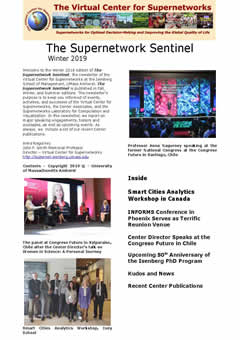
It gives me great pleasure to announce that the Winter 2019 edition of The Supernetwork Sentinel, the newsletter of the Supernetwork Center is now available and online. I am so honored to serve as the Center's Director and continue to marvel as to how much this remarkable team accomplishes through mutual support in all of its endeavors from research to outreach and various other professional activities.
 Winter 0219


 All newsletters can be downloaded and viewed from here.

Thank you for the support!