It has been fabulous to be back in Sweden where I am continuing my third year appointment as a Visiting Professor at the School of Business, Economics and Law at the University of Gothenburg. I arrived in Europe on May 11.
Being based in Europe for a couple of glorious weeks allows for some great conference chaining which I have been doing and have also been highlighting on this blog in several previous posts.
There has also been a North South theme to this visit since I have given talks at workshops and conferences, since my arrival, in Erice, Sicily (south), came back to Sweden (north), then ventured to Taormina, Sicily and Catania, also in Sicily (south) and onwards to Chalkidiki, Greece (south). Back in the north now in Gothenburg.
As a researcher and a very frequent flier, who also works on networks and their numerous and fascinating applications, including transportation and communications, practical, real-world experiences reinforce my research and vice versa! Plus, you acquire great stories to share with your students in classes.
Before flying to Europe, we were finishing up a paper on Delay Tolerant Networks, and, in the meantime, we have also completed another one. This is a collaboration initiated by a doctoral student in engineering, who is from Colombia, and who is visiting my Co-PI on our National Science Foundation project, Network Innovation Through Choice, Professor Tilman Wolf of the College of Engineering at UMass Amherst. The doctoral student is Luis Marentes and he sat in on my SOM 825 course this past semester on Variational Inequalities, Networks, and Game Theory.
In the beautiful parts of southern Europe - I can't resist sharing some photos of Sicily and Greece where I spoke at below, there, nevertheless, were major issues with the Internet! Even when it was up it might take as long as an hour to access an email message and, as for tweeting 140 characters, sometimes we waited for 24 hours, and the tweet was still not transferred. But we were patient and the beauty and the caliber of the conferences and people made up for the technology shortcomings. I will share a story at the end of this post.
Our work on Delay Tolerant Networks, is inspired, in part, by that of Dr. Alex "Sandy" Pentland of MIT, whom we have hosted at the Isenberg School of Management at UMass in our INFORMS Speaker Series, and whom I have interacted with on other occasions. I am a huge fan of Sandy's and was thrilled when he was ecleted to the National Academy of Engineering this year.
Pentland's paper, DakNet: Rethinking Connectivity in Developing Nations, published in Computer in 2004, speaks of connecting remote villages in India and Cambodia through a combination of wireless and asynchronous means.
When I tell people that there are parts of the globe in which residents desperately need information that we take for granted and that which we access through the Internet but they lack digital connectivity because of market and pricing forces (including poverty) and can benefit from using transportation modes (from busses to mules - I am not kidding) to secure the information, I receive expressions of shock!
In our first paper, "Overcoming Economic Challenges of Internet Operators in Low Income Regions Through a Delay Tolerant Architecture with Mechanic Backhauls," Luis Marentes, Tilman Wolf, Anna Nagurney, Yezid Donosoa, and Harold Castro, we study the following. Regions with low population densities and low income, which may be rural, are far behind in Internet access as compared to their urban counterparts. Economic unsustainable deployments have been suggested as one of the factors with high negative impact. Researchers using the Delay Tolerant Network Architecture (DTN) have established a less expensive alternative, but they do not provide guidelines on how to price the new possible services nor any indication as to operators’ profitability. These two points are the contributions of this paper. Based on a continuous pricing model, we show that projects using the DTN architecture have a positive net present value using real demand data.
In this paper, we also explore how far the use of this technology is going to help in attaining profitable deployments with real and delay tolerant services. Our findings indicate that although it is not possible to support the investment reported in a previous actual deployment, a great portion of the investment is actually covered by the predicted gross profit of our model. We hypothesize that the remaining value is affordable if service differentiation is enabled by means of a new architecture. Three components to test the hypothesis are introduced: (1) the pricing elements to form service level agreements, (2) a general overview of the architecture requirements, and (3) a novel pricing model. In this regard, our results show a positive effect of service differentiation which improves profits by 10% without any customer additional payment.
In our second paper, "Towards Pricing Mechanisms for Delay Tolerant Services," Luis Marentes, Tilman Wolf, Anna Nagurney, and Yezid Donoso, we again note that one of the applications of the Delay Tolerant Architecture (DTN) is rural networks. For this application researchers have argued benefits on lowering costs and overcoming challenging conditions under which, for instance, protocols such as TCP/IP cannot work because their underlying requisites are not satisfied. New responses are required in order to understand the true adoption opportunities of this technology. Constraints in service level agreements and viable alternative pricing schemes are some of the new issues that arise as a consequence of the particular operation mode.
In this paper, we propose a novel model for pricing delay tolerant services, which adjusts prices to demand variability subject to constraints imposed by the DTN operation. With this model we also show how important parameters such as channel rental costs, cycle times of providers, and market sensitivities affect business opportunities of operators.
In both of these papers, the consumers respond to the average time of the delivery of the services, which could consist of a combination of communication and transport modes!
As for our journeys in southern Europe, we ended up, in Chalkidiki, Greece taking the ferry to the neighboring town of Marmara (transport) and back to seek a decent WiFi connection.
And we were successful. Decent WiFi was found at a restaurant at which we also had a fabulous meal - it was so good that I blew kisses to the cooks and then they surprised us with a tray of fresh cherries and exotic, delicious Greek desserts!
We then, the next day, explored another mode of transport to access the Internet - we walked rather than taking the ferry to Marmara and it took us about the same amount of time - plus the beach views were glorious. And for those news junkies there, we even found a small shop where we purchased the same day edition of The International New York Times, which was printed in Greece. The owner is British.
Showing posts with label Sicily. Show all posts
Sunday, June 22, 2014
Delay Tolerant Networks - When Transportation Trumps the Internet
Labels:
DakNet,
game theory,
Greece,
Internet,
Internet problems,
Isenberg School of Management,
Network Innovation Through Choice,
networks,
NSF,
pricing,
rural regions,
Sandy Pentland,
Sicily,
transportation,
UMass
Thursday, June 19, 2014
Networks and Variational Inequalities Rock at the ECMI Conference in Stunning Taormina, Sicily
We made it back to Gothenburg, Sweden last night after 10 days in southern Europe where, although the Internet was not always stable or speedy, the conferences and seminar venues as well as the ambience, beauty, and great people I will never forget.
Exactly one week ago, we were in Taormina, Sicily, which was the location for 2014 ECMI (European Conference on Mathematics for Industry). Taormina is a stunning, historical city.
I was at the conference, upon the invitation of Professor Patrizia Daniele of the Department of Mathematics and Computer Science at the University of Catania. She had organized the session below, which was broken up by a delicious lunch and also a plenary session but it worked!
Conference Room 3 - Vincenzo Bellini Room: MS 48
Patrizia Daniele
Recent advances on equilibrium problems with applications to networks
12:00 Patrizia Daniele, Fuminori Toyasaki and Tina Wakolbinger
A Variational Inequality Formulation of Equilibrium Models for End-of-Life Products with Nonlinear Constraints
12:30 Anna Nagurney, Min Yu, Jonas Floden and Ladimer Nagurney
Supply Chain Network Competition in Time-Sensitive Markets
17:00 Tina Wakolbinger, Fuminori Toyasaki, Thomas Nowak and Anna Nagurney
When and for whom would e-waste be a treasure trove? Insights from a network equilibrium
17:30 Fabio Raciti
Nash equilibrium problems with uncertain data.
This conference was also a great reunion! Patrizia and I have co-authored several papers, and she and I organized a Complex Network Workshop a few years back at her university when I held a Senior Fulbright Specialist Award there. Patrizia has also worked with me as a Visiting Scholar at Harvard when I was a Science Fellow at the Radcliffe Institute for Advanced Study there on my sabbatical in 2005-2006.
It was great to see my former doctoral student, Dr. Fuminori Toyasaki, who is now on sabbatical in Vienna, having received promotion and tenure at York University in Toronto, Canada. Their first paper in the session, with another former doctoral student of mine, Dr. Tina Wakolbinger, who is a Professor at the Vienna University of Economics and Business, was recently published in the European Journal of Operational Research.
My presentation at ECMI, with colleague Professor Jonas Floden from the University of Gothenburg, my former doctoral student, Dr. Min Yu of the University of Portland, and Professor Ladimer S. Nagurney of the University of Hartford, can be downloaded here.
Dr. Toyasaki presented our paper, with Tina's doctoral student, Thomas Nowak (3 generations of scholars!), which was just published in the International Journal of Production Economics!
Dr. Raciti of the University of Catania gave a fabulous presentation on his latest work on variational inequalities in which the data in uncertain.
It was great to meet again face to face in this remote but magical location. The photos below capture how happy we were to be together again! Nothing beats meeting collaborators in exotic venues and exchanging the latest research results!
Professors Daniele and Wakolbinger are Center Associates of the Supernetwork Center at the Isenberg School of Management and very much enjoy visiting me at UMass Amherst and have hosted me at their universities.
Exactly one week ago, we were in Taormina, Sicily, which was the location for 2014 ECMI (European Conference on Mathematics for Industry). Taormina is a stunning, historical city.
I was at the conference, upon the invitation of Professor Patrizia Daniele of the Department of Mathematics and Computer Science at the University of Catania. She had organized the session below, which was broken up by a delicious lunch and also a plenary session but it worked!
Conference Room 3 - Vincenzo Bellini Room: MS 48
Patrizia Daniele
Recent advances on equilibrium problems with applications to networks
12:00 Patrizia Daniele, Fuminori Toyasaki and Tina Wakolbinger
A Variational Inequality Formulation of Equilibrium Models for End-of-Life Products with Nonlinear Constraints
12:30 Anna Nagurney, Min Yu, Jonas Floden and Ladimer Nagurney
Supply Chain Network Competition in Time-Sensitive Markets
17:00 Tina Wakolbinger, Fuminori Toyasaki, Thomas Nowak and Anna Nagurney
When and for whom would e-waste be a treasure trove? Insights from a network equilibrium
17:30 Fabio Raciti
Nash equilibrium problems with uncertain data.
This conference was also a great reunion! Patrizia and I have co-authored several papers, and she and I organized a Complex Network Workshop a few years back at her university when I held a Senior Fulbright Specialist Award there. Patrizia has also worked with me as a Visiting Scholar at Harvard when I was a Science Fellow at the Radcliffe Institute for Advanced Study there on my sabbatical in 2005-2006.
It was great to see my former doctoral student, Dr. Fuminori Toyasaki, who is now on sabbatical in Vienna, having received promotion and tenure at York University in Toronto, Canada. Their first paper in the session, with another former doctoral student of mine, Dr. Tina Wakolbinger, who is a Professor at the Vienna University of Economics and Business, was recently published in the European Journal of Operational Research.
My presentation at ECMI, with colleague Professor Jonas Floden from the University of Gothenburg, my former doctoral student, Dr. Min Yu of the University of Portland, and Professor Ladimer S. Nagurney of the University of Hartford, can be downloaded here.
Dr. Toyasaki presented our paper, with Tina's doctoral student, Thomas Nowak (3 generations of scholars!), which was just published in the International Journal of Production Economics!
Dr. Raciti of the University of Catania gave a fabulous presentation on his latest work on variational inequalities in which the data in uncertain.
It was great to meet again face to face in this remote but magical location. The photos below capture how happy we were to be together again! Nothing beats meeting collaborators in exotic venues and exchanging the latest research results!
Professors Daniele and Wakolbinger are Center Associates of the Supernetwork Center at the Isenberg School of Management and very much enjoy visiting me at UMass Amherst and have hosted me at their universities.
Thursday, June 12, 2014
From Sweden to Sicily for the Love of Supply Chains
This past Tuesday, we had quite the adventurous travel from Gothenburg, Sweden to Taormina, Sicily. We made it uneventfully via Air Berlin from Landvetter Airport in Gothenburg to Berlin, Germany (can't wait for the new Berlin Airport to be finally finished) and enjoyed the delicious chocolates that we were given upon disembarking (through the back door of the plane, no less).
After a great lunch at the Berlin Airport we saw that our flight to Catania, Sicily was on time so we went to security only to find out that our carryon bags were too heavy so that we had to check them. Upon arriving at the checkin counter for Air Berlin we were told our flight was delayed by 8 hours and would leave (if you trust) at 10:30PM! Since there was still about a one hour trip by taxi from Catania to Taormina we knew that this would not work for us and there was too much uncertainty, in any event.
After standuing in line for 40 minutes at the Air Berlin counter to wait for a reassignment we were told we were on our own so off we ran to the Germanwings counter to try and get on a flight at 4:20PM. Great service and not a bad price and after a wait we were comfortably seated and en route to Sicily!
Upon arrival in Catania, we were met by an Italian taxi driver who took us in his black Mercedes to Taormina where the conference, Mathematics in Industry. was taking place. The drive at high speed on the flowerstudded expressway was quite the experience and, when we arrived at the conference hotel, we were told that we were put into another hotel (5 star!) a 10 minute walk away.
The venue in Taormina has been magical but, best of all, was seeing Professor Patrizia Daniele, who is a Supernetwork Center Associate and who has visited me at the Isenberg School and when I was a Fellow at the Radcliffe Institute for Advanced Study at Harvard. She invited me to speak at this conference and organized a special session, Recent Advances on Equilibrium Problems with Applications to Networks. Plus, one of my former doctoral students, Professor Fuminori Toyasaki, who is a Professor at York University in Toronto, is also here and he will be presenting a joint paper of ours on electronic recycling, co-authored with Professor Tina Wakolbinger of the Vienna University of Economics and Business (who also was my former doctoral student at the Isenberg School of Management), and her doctoral student, Thomas Nowak. That paper was just published in the International Journal of Production Economics.
Our session takes place later today and I am so exited to be presenting the paper, Supply Chain Network Competition in Time-Sensitive Markets, co-authored with my former doctoral student, Professor Min Yu of the University of Portland, my great colleague at the University of Gothenburg, Professor Jonas Floden, and even my husband, Professor Ladimer S. Nagurney of the University of Hartford!
The photos below were taken at the conference venue and surrounding area. No wonder movie stars will soon be converging here in Taormina where a major movie festival will take place. The beauty of this part of Italy is breathtaking and the people are so friendly and generous.
And I have to mention that the food in Sicily is delicious and so beautifully presented! I can see why those who consume the Mediterranean diet live longer, but, perhaps, it is also the climate and the beauty of where they live.
After a great lunch at the Berlin Airport we saw that our flight to Catania, Sicily was on time so we went to security only to find out that our carryon bags were too heavy so that we had to check them. Upon arriving at the checkin counter for Air Berlin we were told our flight was delayed by 8 hours and would leave (if you trust) at 10:30PM! Since there was still about a one hour trip by taxi from Catania to Taormina we knew that this would not work for us and there was too much uncertainty, in any event.
After standuing in line for 40 minutes at the Air Berlin counter to wait for a reassignment we were told we were on our own so off we ran to the Germanwings counter to try and get on a flight at 4:20PM. Great service and not a bad price and after a wait we were comfortably seated and en route to Sicily!
Upon arrival in Catania, we were met by an Italian taxi driver who took us in his black Mercedes to Taormina where the conference, Mathematics in Industry. was taking place. The drive at high speed on the flowerstudded expressway was quite the experience and, when we arrived at the conference hotel, we were told that we were put into another hotel (5 star!) a 10 minute walk away.
The venue in Taormina has been magical but, best of all, was seeing Professor Patrizia Daniele, who is a Supernetwork Center Associate and who has visited me at the Isenberg School and when I was a Fellow at the Radcliffe Institute for Advanced Study at Harvard. She invited me to speak at this conference and organized a special session, Recent Advances on Equilibrium Problems with Applications to Networks. Plus, one of my former doctoral students, Professor Fuminori Toyasaki, who is a Professor at York University in Toronto, is also here and he will be presenting a joint paper of ours on electronic recycling, co-authored with Professor Tina Wakolbinger of the Vienna University of Economics and Business (who also was my former doctoral student at the Isenberg School of Management), and her doctoral student, Thomas Nowak. That paper was just published in the International Journal of Production Economics.
Our session takes place later today and I am so exited to be presenting the paper, Supply Chain Network Competition in Time-Sensitive Markets, co-authored with my former doctoral student, Professor Min Yu of the University of Portland, my great colleague at the University of Gothenburg, Professor Jonas Floden, and even my husband, Professor Ladimer S. Nagurney of the University of Hartford!
The photos below were taken at the conference venue and surrounding area. No wonder movie stars will soon be converging here in Taormina where a major movie festival will take place. The beauty of this part of Italy is breathtaking and the people are so friendly and generous.
And I have to mention that the food in Sicily is delicious and so beautifully presented! I can see why those who consume the Mediterranean diet live longer, but, perhaps, it is also the climate and the beauty of where they live.
Friday, May 23, 2014
Terrific Energy, Cities, and Complex Systems Workshop in Magical Erice, Sicily
Last week I was in beautiful Erice, Sicily, where I had been once before, back in 2006, also for a workshop.
This time, I was an invited speaker at the Workshop on Energy, Cities, and Control of Complex Systems organized by Drs. Adilson Motter and Robert Schock. Dr. Motter is a Professor at Northwestern University and Dr. Schock is a Senior Fellow on Global Security Research at Lawrence Livermore Lab in Berkeley. Dr. Schock, this past week, received an honorary degree from his undergrad alma mater, Colorado College, so congratulations are in order! In the photo above I am standing with Dr. Schock who has a PhD from RPI.
The venue for the workshop was the Ettore Majorana Scientific Center, which was originally 4 monasteries with the bells pealing regularly to remind us of that point.
The workshop convened physicists, engineers, transportation researchers, network scientists, a computer scientist (from IBM), as well as energy researchers, an atmospheric scientist, a statistician, several policy makers (including one from Toronto, Canada), and an operations researcher and network economist (me).
This was a multidisciplinary workshop with talks ranging from those with not a single equation to those with many beautiful equations. Quite a few of the talks were on network themes, which I appreciated very much as well as the emphasis on nonlinear dynamics.
My presentation was on Sustainable Supply Chains for Sustainable Cities.
The workshop took place in a room with not great acoustics but with frescoes on the walls.
The meals were provided and the food was delicious - with fish caught that morning and with cannolis that we consumed and did not get heart attacks from. Perhaps it was all the oranges that we ate.
We were picked up at the Palermo airport and bussed through the beautiful hills of Sicily covered with poppies and other flowers to historic Erice.
Now I am back in Gothenburg, Sweden, where, interestingly, it is very warm, whereas it was quite cool in Sicily!
This time, I was an invited speaker at the Workshop on Energy, Cities, and Control of Complex Systems organized by Drs. Adilson Motter and Robert Schock. Dr. Motter is a Professor at Northwestern University and Dr. Schock is a Senior Fellow on Global Security Research at Lawrence Livermore Lab in Berkeley. Dr. Schock, this past week, received an honorary degree from his undergrad alma mater, Colorado College, so congratulations are in order! In the photo above I am standing with Dr. Schock who has a PhD from RPI.
The venue for the workshop was the Ettore Majorana Scientific Center, which was originally 4 monasteries with the bells pealing regularly to remind us of that point.
The workshop convened physicists, engineers, transportation researchers, network scientists, a computer scientist (from IBM), as well as energy researchers, an atmospheric scientist, a statistician, several policy makers (including one from Toronto, Canada), and an operations researcher and network economist (me).
This was a multidisciplinary workshop with talks ranging from those with not a single equation to those with many beautiful equations. Quite a few of the talks were on network themes, which I appreciated very much as well as the emphasis on nonlinear dynamics.
My presentation was on Sustainable Supply Chains for Sustainable Cities.
The workshop took place in a room with not great acoustics but with frescoes on the walls.
The meals were provided and the food was delicious - with fish caught that morning and with cannolis that we consumed and did not get heart attacks from. Perhaps it was all the oranges that we ate.
We were picked up at the Palermo airport and bussed through the beautiful hills of Sicily covered with poppies and other flowers to historic Erice.
Now I am back in Gothenburg, Sweden, where, interestingly, it is very warm, whereas it was quite cool in Sicily!
Tuesday, April 22, 2014
Sustainable Supply Chains for Sustainable Cities, Earth Day, and Erice
Today is Earth Day on which we celebrate planet earth and the environment.
I have been hard at work on a presentation, Sustainable Supply Chains for Sustainable Cities, which I will be presenting at a fascinating workshop, which will take place in early May, at the Ettore Majorana Scientific Center in Erice, Sicily. I had been then before, back in 2006, and it was a fitting ending to not only my year as a Science Fellow at the Radcliffe Institute at Harvard but also to the World Cup (Italy beat France and we were in Italy).
The title of the Workshop that I will be speaking at is given below.
I have been hard at work on a presentation, Sustainable Supply Chains for Sustainable Cities, which I will be presenting at a fascinating workshop, which will take place in early May, at the Ettore Majorana Scientific Center in Erice, Sicily. I had been then before, back in 2006, and it was a fitting ending to not only my year as a Science Fellow at the Radcliffe Institute at Harvard but also to the World Cup (Italy beat France and we were in Italy).
The title of the Workshop that I will be speaking at is given below.
ERICE INTERNATIONAL SEMINARS ON
PLANETARY EMERGENCIES
47th
Session
Erice, 11 –15 May 2014
THE
ENERGY PLANETARY EMERGENCY
Workshop
on Energy, Cities, and the Control of Complex Systems.
I received the formal invitation from the Director and Chairman of the Ettore Majorana Scientific Center, Professor Antonino Zichichi. The workshop is organized by Professor Adlison Motter of the Department of Physics and Astronomy, Northwestern University,
http://dyn.phys.northwestern.edu/ and by Dr. Robert Schock, Center for Global Security Research, Energy Permanent Monitoring Panel, World Federation of Scientists:
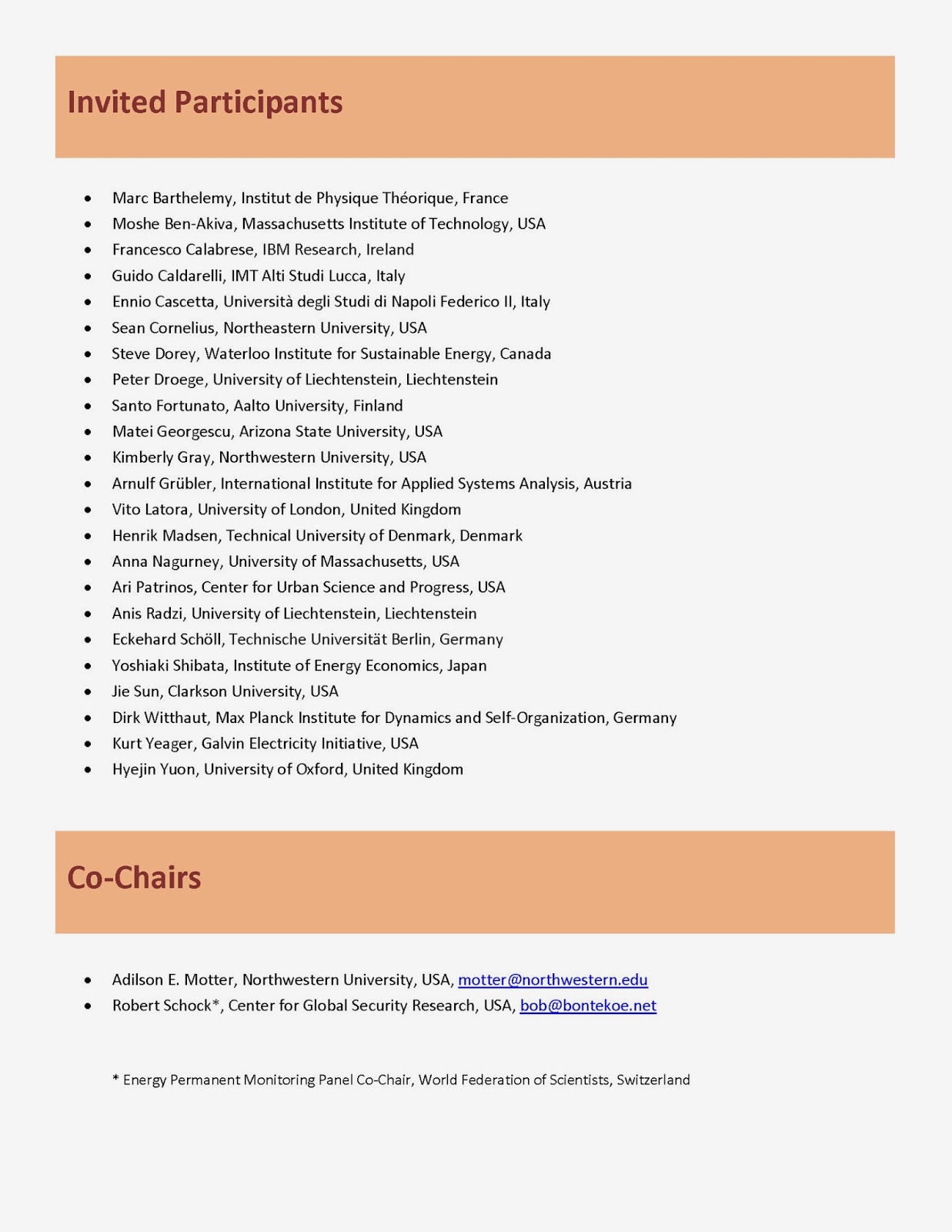
The list of invited participants is below.
In my presentation I will present both a supply chain network design model with a focus on frequencies, which is in press in the journal Environment & Planning B and will discuss highlights of a model developed with Drs. Min Yu and Jonas Floden on sustainable supply chain network competition and game theory with frequencies of supply chain activities as strategic variables and product path flows. This paper was recently published in the journal Computational Management Science in a special issue devoted to Planet Earth.
Monday, June 21, 2010
Professors and the World Cup
During the 2010 World Cup that is taking place now in South Africa there has been a lot of drama, unexpected victories, and unexpected losses.
I have heard recently from friends who are from Chile, The Netherlands, Brazil, Argentina, Egypt, Italy, China, Cape Verde, Ukraine, and other countries, all of whom are intently following the various games and upsets (as well as dubious calls by the refs, the incidents of good sportsmanship and the opposite, and all the various trials and tribulations and the associated drama).
As I had mentioned in an earlier blogpost, the 2010 World Cup began while I was at a conference in Buenos Aires, Argentina.
At the finals of the previous World Cup, in 2006, I was at a conference in glorious Erice in Italy and we watched Italy beat France and then this entire town, which is on the island of Sicily, erupted in celebrations and fireworks. Amazingly, the morning after, I flew back to Boston safely on Alitalia from Naples without incident and enjoyed a delicious meal on the plane.
During the World Cup in 2002, my family and I were living in Innsbruck, Austria, while I was on a Fulbright.
Above are photos taken in Erice during the finals back in 2006.
What a difference 4 years make in terms of World Cup play!
Subscribe to:
Posts (Atom)