Showing posts with label Complex Networks. Show all posts

Tuesday, April 22, 2014

Sustainable Supply Chains for Sustainable Cities, Earth Day, and Erice

Today is Earth Day on which we celebrate planet earth and the environment.

I have been hard at work on a presentation, Sustainable Supply Chains for Sustainable Cities, which I will be presenting at a fascinating workshop, which will take place in early May, at the Ettore Majorana Scientific Center in Erice, Sicily. I had been then before, back in 2006, and it was a fitting ending to not only my year as a Science Fellow at the Radcliffe Institute at Harvard but also to the World Cup (Italy beat France and we were in Italy).

The title of the Workshop that I will be speaking at is given below.

      ERICE INTERNATIONAL SEMINARS ON PLANETARY EMERGENCIES
47th Session
Erice, 11 –15 May 2014
THE ENERGY PLANETARY EMERGENCY
Workshop on Energy, Cities, and the Control of Complex Systems.

I received the formal invitation from the Director and Chairman of the Ettore Majorana Scientific Center, Professor Antonino Zichichi. The workshop is organized by Professor Adlison Motter of the Department of Physics and Astronomy, Northwestern University,
http://dyn.phys.northwestern.edu/  and by Dr. Robert Schock, Center for Global Security Research, Energy Permanent Monitoring Panel, World Federation of Scientists:

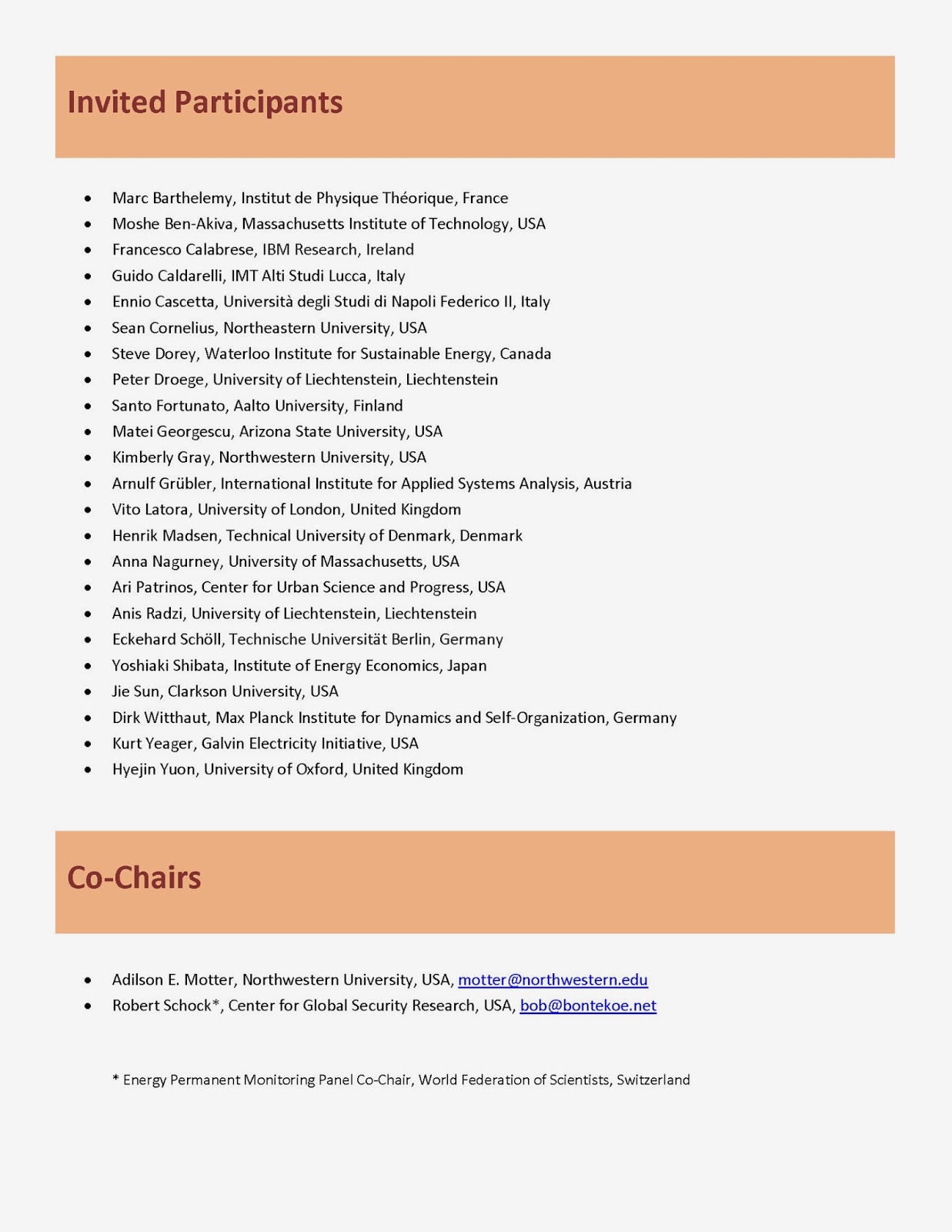
The list of invited participants is below.
 

In my presentation I will present both a supply chain network design model with a focus on frequencies, which is in press in the journal Environment & Planning B and will discuss highlights of a model developed with Drs. Min Yu and Jonas Floden on sustainable supply chain network competition and game theory with frequencies of supply chain activities as strategic variables and product path flows. This paper was recently published in the journal Computational Management Science in a special issue devoted to Planet Earth.


Monday, December 9, 2013

For the Love of Networks

When the invitation came from Dr. Adilson Motter to speak at the 2013 Network Frontier Workshop that he was organizing at Northwestern University I was very intrigued, even though the workshop was to take place in early December. Since I live (most of the time) in Massachusetts, I have experience with cold weather but, for some reason, that cold on Lake Michigan is quite unique.

But, since I love researching networks and teaching about the subject and find it one of the most powerful of scientific topics in bridging disciplines, of course, I said "yes!"

This workshop, which was a huge success, and I am still savoring the talks and discussions as well as the people that I met, was a three-day event, that took place last week, December 4-6, highlighting leading-edge research on complex networks. According to the workshop website: Participants working on innovative aspects of complex systems will communicate recent results and ideas relevant to fields as diverse as brain, climate, and socio-technological research. Sessions will include theory and applications of nonlinear dynamics and statistical physics in the context of synchronization, cascades, transportation, control, and failure recovery in complex dynamical systems.

The program, which featured talks on applications ranging from climate science to brain physiology and envisioning the future Internet (my topic) can be downloaded here.  The list of invited speakers can be viewed here.  Invited speakers were from the US, Europe, and Asia, and one industrialist told me that he flew in from China just to hear me speak. I hope that I did not disappoint.

I loved the applications described as well as the methodologies, which included innovations in dynamical systems and control theory applied to networks.

Thanks to Dr. Motter  and his team at the Northwestern Institute for Complex Systems (NICO) for putting this great workshop together. You succeeded in bringing researchers, practitioners, and students together to Evanston in December for the love of networks!

Below are some photos that I managed to take even though, honestly, my digital camera seemed to freeze (although I had charged it before flying out to Chicago).

The lunches and refreshments were delicious!

And, today, UMass Amherst has delayed its opening until noon because of the inclement weather but since we are interviewing a candidate for a faculty position, I will be going in. This afternoon, we are having our annual Isenberg Reindeer Seminar in the Isenberg School of Management atrium, which is a holiday party but first there will be a Personnel Committee meeting to attend. Never a dull moment in academia!


Friday, November 29, 2013

Speaking on Future Internet Architecture at Network Frontier Workshop at Northwestern

First, I hope that all those celebrating had a very pleasant Thanksgiving and for all those who still have journeys ahead of you, I wish you safe and comfortable travels!

Next week, I will be speaking at the Network Frontier Workshop at Northwestern University. This should be a fascinating event and has been organized by Dr. Adilson E. Motter.

The workshop will bring scientists from different disciplines together who are passionate about networks and are contributing to their study and understanding in numerous ways.

The full list of invited speakers can be seen here.

The full program with all speakers' talk titles is available in pdf format here.

After the great TEDx UMass Amherst Professor Speaker Showcase event last Monday at which I spoke on The Traffic Circle of Life I started to prepare my presentation for Northwestern.

I will be speaking next Thursday on "Envisioning a Future Internet Architecture: The Network Economics of ChoiceNet." My presentation is based on our NSF multi-university project: Network Innovation Through Choice. Our great team already has several papers published or in press -- some of which are highlighted below:

A Network Economic Game Theory Model of a Service-Oriented Internet with Choices and Quality Competition, Anna Nagurney, Dong Li, Tilman Wolf, and Sara Saberi, Netnomics 14(1-2): (2013) pp 1-25.

ChoiceNet: Network Innovation Through Choice, George N. Rouskas, Ilia Baldine, Ken Calvert, Rudra Dutta, James Griffioen, Anna Nagurney, and Tilman Wolf, invited paper for the 17th Conference on Optical Network Design and Modeling (ONDM 2013).

Choice as a Principle in Network Architecture, Tilman Wolf, Jim Griffioen, Ken Calvert, Rudra Dutta, George Rouskas, Ilia Baldine, and Anna Nagurney, in the Proceedings of ACM SIGCOMM 2012, Helsinki, Finland, August 13-17, 2012.

I will be focusing my presentation on one of our most recent papers: A Cournot-Nash–Bertrand Game Theory Model of a Service-Oriented Internet with Price and Quality Competition Among Network Transport Providers, Anna Nagurney and Tilman Wolf, in press in Computational Management Science.

I am very much looking forward to being back at Northwestern!

Tuesday, September 3, 2013

Information on the Network Frontier Workshop at Northwestern University

Nothing is cooler or more fascinating than Networks!

When I received the invitation from Professor Motter of Northwestern University to speak at the upcoming 2013 Network Frontier Workshop, I had to accept. 

Professor Motter recently received the Erdos-Renyi Prize in Network Science, so congratulations are also in order!

I like the workshop poster and am featuring it above to generate more interest.  The website is now live.


For all of you who love the interdisciplinary unifying power of networks, I hope that you can join us!

The below from the poster announcement is captivating!

The Network Frontier Workshop 2013  is a three-day event highlighting leading-edge research on complex networks. Participants working on innovative aspects of complex systems will communicate recent results and ideas relevant to fields as diverse as brain, climate, and socio-technological research. Sessions will include theory and applications of nonlinear dynamics and statistical physics in the context of synchronization, cascades, transportation, control, and failure recovery in complex dynamical systems.


Thursday, August 22, 2013

Entrepreneurial Opportunities and Innovation Thanks to the National Science Foundation (NSF)

Robert Shiller, the Sterling Professor of Economics at Yale University, wrote a wonderful OpEd in last Sunday's New York Times: "Why Innovation is Still Capitalism's Star," in which he spoke about the company he founded with Karl Case of Wellesley College (I used to attend seminars at Harvard when I was a Visiting Scholar and Associate Professor at the Sloan School and School of Engineering, respectively, at MIT, at which Karl would be present). The company was sold but its "products," now known as the S&P/Case-Shiller Home Price Indices, are very often used and referred to.

In the OpEd, Shiller writes that his business made its mark without any help from the government but then writes the following:

Long before I started any commercial ventures of my own, I received some federal government support — in the form of National Science Foundation research grants, awarded to me decades ago as a young professor. They allowed me to do research, and though it was not directly related to my later business endeavors, the process developed my expertise and reinforced a sense of entrepreneurial opportunity.

These grants were awarded competitively, based on the quality of the proposals, and gave me experience with a system focused on creating opportunities for those who try hard. Later, from 1983 to 1985, I evaluated others’ proposals when I served on the foundation’s panel for economics. Observing the process from the government side convinced me that the foundation really works. Maybe it’s because the panelists are chosen from successful scientists, who serve anonymously out of public spirit.


The first year that I was at MIT, 1989-1990, I was funded by the National Science Foundation's Visiting Professorship for Women, and was based at the Center for Transportation in the Department of Civil Engineering (Building 1 for those of you familiar with MIT).  Besides teaching a course there and doing a lot of research, I also organized a Women in Operations Research (OR) Speaker Series, which took place at MIT's Operations Research Center, located on Amherst Street (which made me feel at home). I was following in the footsteps of my dissertation advisor at Brown University, Professor Stella Dafermos, who had also had an NSF Visiting Professorship at MIT,  a few years prior to me. My readers know that she was the second female in the world to received a PhD in OR!


The receipt of  that NSF grant, plus 3 more, early in the new millennium, including a large one with two females: professors,  June Dong and Patricia Mokhtarian, gave me the confidence needed to take risks with my research, and engendered an entrepreneurial spirit.

That large NSF grant, Decentralized Decision-Making in Complex Network Systems, along with two AT&T Industrial Ecology Fellowships, enabled me to establish the Virtual Center for Supernetworks at the Isenberg School of Management in 2001.

An additional stimulus behind the Supernetworks Center was the publication of  my book, with June Dong, Supernetworks: Decision-Making for the Information Age.

In 2003, under the leadership of our great Dean at that time, Dr. Tom O'Brien (with whom I had such a nice conversation the other day), I was given lovely space to create the Supernetworks Laboratory for Computation and Visualization. Our new Dean, Dr. Mark Fuller, now holds a Chaired Professorship in Tom's name.


And, just this past week, I received the letter from our Provost, James Staros, and our Vice Chancellor for research and Engagement, Mike Malone, that the UMass Amherst Evaluation Committee for Centers & Institutes has recommended the continuation of the Virtual Center for Supernetworks for another 5 years. The evaluation cited many of the activities of the Center and its Associates, which have even included undergraduates conducting research under NSF's Research Experiences for Undergraduates (REU) program.


As I have written before, in the context of Steve Jobs, risk-taking is essential to innovation, and support, such as that provided by NSF, gives females concrete evidence and financing that they can lead and even establish a center. And, now, we are involved in another truly thrilling NSF research project, Network Innovation Through Choice.

Thank you, NSF, for supporting scientific research without boundaries and for recognizing also the contributions of females to scientific innovation and discoveries!

Friday, March 15, 2013

Sustainable Cities Via Sustainable Supply Chains

Did you know that over one half of the world's population now resides in cities?

Which is your favorite city?

Might it be Boston?

or New York City?

perhaps Miami:
 

or Buenos Aires:

or Paris:

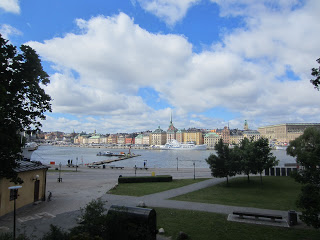
Stockholm:
Vienna:

or Shanghai?
I took all the above photos during speaking engagement trips over the past several years, except for the Shanghai one, which was taken by a former doctoral student of mine at the World Expo there.

When cities work well those who live in them can flourish in terms of mobility, health and welfare, accessibility, and innovation.


In the paper, "Design of Sustainable Supply Chains for Sustainable Cities," which is now accepted for publication in the journal, Environment & Planning B,  I emphasized  that cities, as dynamic complex networks, are the systems and the economic engines for commerce, research and development, education, healthcare, and even culture. They have evolved over space and time on built infrastructure from transportation networks to telecommunication and electric power networks.

At the same time, cities are the centers of resource usage from electricity and other forms of energy and fuel, to food, water, and a plethora of other products. Hence, they also are the repositories and generators of waste output and other environmental pollutants, such as carbon and other emissions, sewage, noise, etc. The term Sustainable Cities has come into increasing use in the past two decades, with a focus of making cities more livable, with an eye not only on the present generation but towards future ones, as well.

Our world is becoming a network of interconnected cities or a supernetwork of cities with  urbanization is one of the most pressing and complex challenges of the 21st century, with the citizenry characterized by a growing awareness of a threat to the sustainability of the earth’s natural environment, coupled with the increase in the number of people moving into and living in cities.

Cities are supplied by a complex array of supply chains servicing an immense spectrum of economic activities from food stores and restaurants, office supplies and high tech equipment, apparel, construction materials, as well as raw materials, to name just a few. The sustainability of supply chains is, hence, a precursor to the sustainability of our cities.

According to a Business for Social Responsibility (2009) paper, it is now widely acknowledged that making significant progress on mitigating the impact of climate change depends on reducing the negative environmental impacts of supply chains through their redesign and enhanced management (see also McKinsey Quarterly, 2008). Furthermore, as noted by Capgemini in its 2008 report: 2016: Future Supply Chain, “Preserving energy and raw materials and other resources like water will become a crucial aspect in future supply chains, as costs will likely remain volatile and supplies will continue to dwindle.”
These conditions may well create substantial pressure on current supply chain models.

In this paper, I constructed a new computable mathematical model,  that is network-based, for the design of sustainable supply chains with a focus on cities that captures the frequency of network link operations, which is especially relevant to cities due to frequent freight deliveries. An algorithm was then proposed, along with convergence results, and implemented for the computation of several numerical examples.


One of the goals in the paper was to demonstrate how, through the proper design (and operation) of these complex networks, waste can be reduced, along with the environmental impacts, while minimizing operational and frequency costs, and meeting demand.

For a presentation, with the same name, which also includes intellectual foundations inspired by Professor Martin Beckmann, the co-author of the classic book, Studies in the Economics of Transportation click here.


Monday, October 15, 2012

Complex Network Workshop in Berlin -- Deadline for Submissions Approaching

The 4th International Workshop on Complex Networks  (CompleNet 2013) will take place March 13-15, 2013 in Berlin, Germany.

According to the nice flier on this workshop, CompleNet 2013 aims at bringing together researchers and practitioners working on areas related to complex networks. In the past two decades we have been witnessing an exponential increase on the number of publications in this field. From biological systems to computer science, from economic to social systems, complex networks are becoming pervasive in many fields of science. It is this interdisciplinary nature of complex networks that this workshop aims at addressing.

I am on the Program Committee for this conference, and it promises to be very intellectually stimulating and provocative and it will take place at a great venue!

The deadline for paper submissions is coming up and it is November 2, 2012.  Information on paper submissions and stylefiles can be found here.

Hope to see many of you at CompleNet 2013!


Thursday, October 7, 2010

Mark Newman Speaks on Networks at UMass Amherst

I attended a very enjoyable colloquium yesterday in the physics department at UMass Amherst given by Professor Mark Newman of the University of Michigan and the Santa Fe Institute.

The title of his talk was: Epidemics, Erdos Numbers, and the Internet: The Structure and Function of Complex Networks

Abstract: There are networks in almost every part of our lives. Some of them are familiar and obvious: the Internet, the power grid, the road network. Others are less obvious but just as important. The patterns of friendships or acquaintances between people form a social network; the species in an ecosystem join together to form a food web; the workings of the body's cells are dictated by a metabolic network of chemical reactions. As large-scale data on these networks and others have become available in the last few years, a new science of networks has grown up, drawing on ideas from physics, math, engineering, biology, and other fields to shed light on systems ranging from bacteria to the whole of human society. This talk will examine some new discoveries regarding networks, how those discoveries were made, and what they can tell us about the way the world works.

I had hosted Professor Newman several Octobers ago, when Professor David Parkes and I organized an Exploratory Seminar on Dynamic Networks at the Radcliffe Institute for Advanced Study at Harvard, so it was nice to see him back in Massachusetts.

Some of the network images that he used in his talk yesterday are available here.

His audience yesterday was comprised of physicists, engineers, and computer scientists and yours truly (plus some folks I could not name nor did I know their backgrounds).

His talk (with a wonderful delivery and enthusiasm) focused mostly on network structure, whereas my research focuses on a wide spectrum of networks where flows and user behavior matters, in addition to network structure, from supply chains to transportation networks and the Internet as well as economic and financial networks and electric power networks. He mentioned food webs which I could relate to since my work in network economics is being applied to fisheries. I told him afterwards that I would like to see more work in social networks that includes flows (as the work that I did with my former doctoral student, who is now a Professor, Dr. Tina Wakolbinger, does).

Also, as I tell my students, we in operations research/management science and even in economics can trace the literature on the subject even back to the mid1800s! Networks in terms of model formulations, applications, and even methodologies and algorithms have been major topics of scientific research especially beginning with the 1950s and beyond. The fascination with networks and novel applications have made the subject seem "new" to some and especially to disciplines, who have more recently discovered networks and are applying tools from their disciplines to their study.

Monday, February 8, 2010

The Cybersecurity Website is Now Live!

The Cybersecurity website that details the breadth and depth of research and education activities at UMass Amherst on this topic is now live. We are delighted with this important initiative that includes faculty and students from such outstanding departments and schools at UMass Amherst as: Computer Science, Electrical and Computer Engineering, Civil and Environmental Engineering, Mathematics and Statistics, Political Science, Communications, and the Isenberg School of Management.

You will find on this site more information about the various campus-wide activities, including the relevant research that we have been conducting at the Virtual Center for Supernetworks on the Modeling, Analysis, and Computation of Solutions to Complex Network Systems.

Last term, as part of the UMass Amherst INFORMS Speaker Series in Operations Research / Management Science, we hosted the presentation of Professor Brian Levine of the Computer Science Department on cyber forensics (which the audience members are still talking about). This term, the upcoming talk of Richard Brooks on smart grids is also relevant to cyber security.

We are looking forward to further supporting the important research and education efforts on this most important topic and are glad that we were able to support financially, in part, the development of this website.

Monday, June 15, 2009

Discover magazine, Infrastructure, The New York Times, and the Fragile Networks book

I am back from the World Science Festival (WSF) in NYC, which concluded yesterday with a science street fair. Photos from the numerous events have been posted on flickr.

There are also photos from the Traffic panel that I took part in last Friday evening.

The World Science Festival, which took place June 10-14, 2009, transformed NYC into a science mecca in which scientific research and exploration were recognized and celebrated. The atmosphere at the events, from the gala to yesterday's science fair, can only be described as electric -- the seats were filled at the various panels and events and I believe that many of those that participated will be looking at the world around us in new ways.

Megan Talkington, a journalist with Discover magazine, wrote a very nice article on the Traffic panel.

Now, it's time to reconnoiter and being on the Traffic panel at the World Science Festival has been the perfect segue for my new book with Patrick Qiang: Fragile Networks: Identifying Vulnerabilities and Synergies in an Uncertain World. Wiley, the book's publisher, has informed us that the book will be "released" this Friday, June 19, with worldwide distribution set for July 2009. Wiley issued a press release on the book in conjunction with my participation in the World Science Festival. The publication of this book is especially timely, given the interest surrounding infrastructure from transportation networks to the Internet and even electric power generation and distribution networks, plus financial networks. Indeed, the New York Times devoted yesterday its entire Sunday magazine to infrastructure. Plus, there have been recent OpEd pieces and major newspapers in the US highlighting the importance of complex networks and infrastructure. Our book provides an original synthesis of infrastructure networks and focuses on unique perspectives and solutions. The beauty and elegance of the book's approaches lie in a systematic analysis of networks, their resilience and robustness, as well as their vulnerability and the associated systemic risk. Fragile Networks identifies how to determine which nodes and links truly matter from economic and engineering perspectives. The book even formalizes mergers and acquisitions in a network framework!

Sunday, March 1, 2009

Was it Only a Year Ago -- My "Second" Fulbright

Today is March 1, 2009, and it feels that March is coming in as a lion with a lot of snowfall expected in New England!

In my last post I wrote about my first Fulbright, which took place in Innsbruck, Austria, and began in March, 2002. In 2005, I was awarded a Distinguished Chaired Fulbright in Canada but could not accept that and a Science Fellowship at the Radcliffe Institute for Advanced Study at Harvard so I declined the Fulbright in Canada. Wanting to experience another Fulbright adventure, I applied for a Senior Fulbright Specialist Award in Business Administration and was informed last year by the Italian Fulbright Commission that I was granted the award. My "second" Fulbright took place last March at the University of Catania in Italy. Catania is located at the base of the volcano Mt. Etna, which periodically still erupts, and is on the island of Sicily. My host was Professor Patrizia Daniele of the Department of Mathematics and Computer Science who is also a Center Associate of the Virtual Center for Supernetworks.

As part of this Fulbright, Professor Daniele and I organized a workshop on "Complex Networks -- Equilibrium and Vulnerability Analysis with Applications," which brought together scientists from different disciplines -- mathematics, physics, computer science, and operations research/management science. It was a terrific event and we were especially pleased that so many female scientists spoke and participated. In addition, I had the wonderful experience of teaching a class at the University of Catania and in interacting with colleagues in the Department of Mathematics and Computer Science.

Evenings we would spend promenading down the main avenue, Via Etnea, in Catania which was filled with families walking, shopping, and having treats such as gelato and wonderful Italian pastries. Catania has cobblestone streets, magnificent architecture, shops with beautiful Italian made crafts, and is located on the Mediterranean Sea. Photos that were taken capture, in part, the beauty of Catania and the warmth of its people. The hospitality of Professor Patrizia Daniele and Professor Antonino Maugeri was tremendously appreciated.