Showing posts with label freight. Show all posts

Tuesday, July 10, 2018

From Disaster Relief to Freight Sustainability - Our Talks at EURO in Valencia, Spain

This summer I am again spending at the Radcliffe Institute for Advanced Study at Harvard University where I am a Summer Fellow. I have been busy working on a project on perishable product supply chains from food to blood.

Last summer I was also at Harvard as a Summer Fellow but spent a considerable amount of time flying to conferences, including one I co-organized on the Dynamics of Disasters, which took place in Kalamata, Greece.

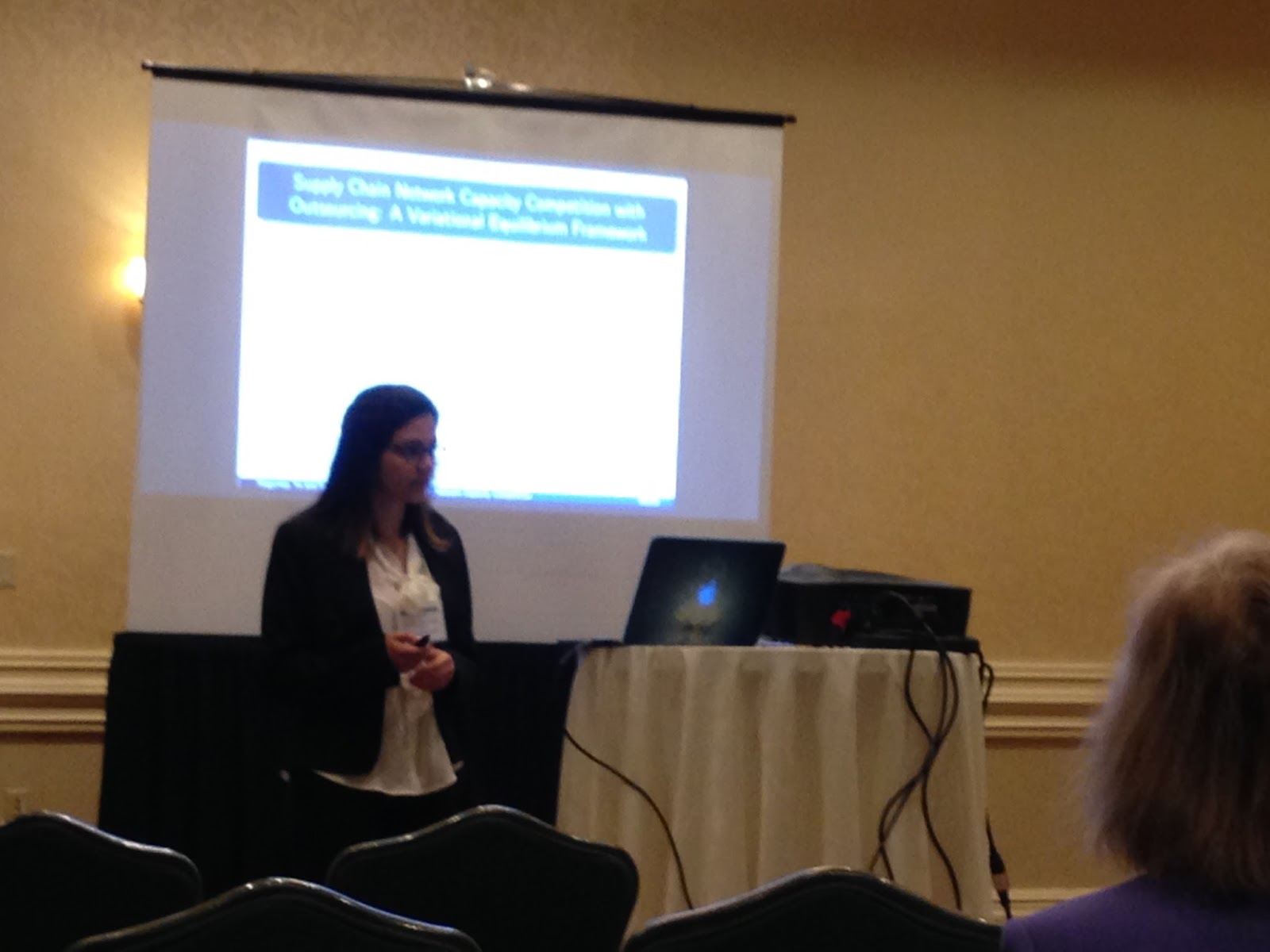
Since I will have a heavy set of speaking engagements this Fall and I also wanted to fully take advantage of my time at the incredible Radcliffe Institute for Advanced Study, I have had co-authors present our latest work at the EURO Conference in Valencia, Spain.

I am delighted to report that our three presentations, two on disaster relief, and one on sustainable freight, have now been presented!

These presentations can be downloaded in their entirety here.

The first paper above is in press in the new Dynamic of Disasters: Algorithmic Approaches and Applications volume that I co-edited with Professors Ilias Kotsireas and Panos M. Pardalos.  The published is Springer. The last paper above was published in the European Journal of Operational Research very recently and was co-authored with Professor Sara Saberi (also a former doctoral student of mine) and her colleague at WPI, Professor Joe Sarkis.  The second paper above has three generations of scholars as authors: besides myself - Professor Tina Wakolbinger and her doctoral student, Timo Gossler, in addition to our collaborator Professor Patrizia Daniele.

Below I have posted a few photos from the conference, thanks to my wonderful co-author from Italy, Professor Patrizia Daniele. What is truly special is that three of my former PhD students from the Isenberg School, Professor Jose M. Cruz of UCONN's School of Business, Professor Tina Wakolbinger of the Vienna University of Economics and Business, and Professor Dmytro Matsypura of the University of Sydney in Australia, were all at the conference, and both Jose and Tina, as well as Patrizia, spoke on our joint research. They all continue as Supernetwork Center Associates and
it is fabulous to see how synergistic our research has been over the years and how beautifully the friendships established in our doctoral program have continued!
A big thank you to the organizers of the terrific EURO 2018 Conference in Valencia, Spain, for a fabulous conference for the exchange of the latest in scientific accomplishments n Operations Research and Analytics!

Sunday, March 26, 2017

Isenberg School of Management PhD Students and Faculty Shine at NEDSI Conference

Yesterday was a glorious day and the last day of the Northeast Decision Sciences Institute conference, which took place March 22-25, 2017, in Springfield, Massachusetts. The full conference program can be downloaded here.

Given the proximity of Springfield to Amherst, Massachusetts and also the opportunity to network and to present papers, this was a conference that my doctoral students in Management Science and I were very much looking forward to.  The conference was wonderful and below I share just a few of the highlights and also some pleasant surprises.

My doctoral student in Management Science, Shivani Shukla, presented our paper on freight service provision security investments for high value cargo on Thursday.


Yesterday, Deniz Besik, presented, for the first time at a conference, our paper, which was recently accepted for publication in the Journal of Global Optimization.

Then it was time for Pritha Dutta to present on our work on game theory and blood donations.

Our PhD students were terrific at answering questions from the audience and also enjoyed seeing other colleagues from the College of Engineering at UMass Amherst and even UMass Boston! Their full presentations can be downloaded here.
Also, the other Professor Nagurney - Dr. Ladimer S. Nagurney, enjoyed seeing his colleague from the Barney School at the University of Hartford.

Everyone appreciated very much the attention to detail with numerous delicious receptions throughout the day.

Last evening, before the sumptious gala banquet, we had the pleasure of hearing my colleague, Nirenberg Chaired Professor Charles "Chuck" Manz, deliver a keynote talk on Twisted Leadership. His presentation was fascinating as he took us on a journey discussing self-leadership, super leadership, shared leadership, and socially responsible leadership and how all of these should be intertwined like a rope. We had front row seats for his talk.
He was introduced by the conference organizer, Dr. Minoo Tehrani.

His talk was interspersed with many interesting cases from practice as well as words of wisdom from leaders over the centuries and also jokes.

Then it was time for the banquet!
The food was delicious and we thank the organizer and the venue - the Marriott in Springfield - for the soup, salad, roasted veggies, potatoes, beef, chicken, and salmon and incredible desserts!

Towards the end of the banquet, the awards were announced and what a truly special surprise awaited us.

The PhD presentation awards were swept by Isenberg School of Management PhD students in Management Science! A big congratulations to Pritha Dutta, who received the first place award for presenting on our work on blood donations, and to Yueran Zhuo, whose advisor is my colleague, Professor Senay Solak, and who spoke on management of cybersecurity investments, and received the second place award.

Pritha was presented with the first place award by Dr. Joy Field of Boston College and Dr. Minoo Tehrani.
Many thanks to all those involved for such special memories and congratulations to our wonderful Isenberg School PhD students in Management Science! Being able to present in an engaging and informative way on challenging, technical problems with enthusiasm and clarity is quite an accomplishment!

Thursday, November 6, 2014

Maritime Container Terminals, Game Theory, and Math is Everything!

Today I heard a terrific talk, Playing Games at Maritime Container  Terminals, which was given by Professor Golias from the University of Memphis in Tennessee. Professor Golias was hosted by the Transportation group at UMass Amherst.

I loved the way he described how his visit to a port cen=mented his education and research directions and his enthusiasm for the various research issues was clear. Since I also have a Visiting Professorship at the University of Gothenburg in Sweden, I have often visited  the major port there, which has even welcomed the biggest ship in the world, owned by Maersk, and called Mary.

Professor Golias emphasized the differences between freight and passenger transport, and noted that Europe is a leaer in both research and practice when it comes to freight and I fully agree. He talked about the fact that, in freight, you only make money when you are moving, so  delays due to congestion and lack of collaboration can result in lower profits. He motivated his research by talking about globalized supply chains and maritime transport of containers. He had many photos in his presentation, which held our interest.

His particular approach was inspired by the work of Professor Michael Bell, well-known in transportation circles, who is from the United Kingdom. He talked about issues of seaside, yardside, and landside, and the transfer issues of containers, which are brought by ships to the port, then unloaded, stored, and loaded again for further  transport. He emphasized uncertainty as to handling times and even weather and three approaches: reactive, proactive, and hybrid. He also noted the relevance of multiobjective optimization.

He pointed out the various stakeholders involved and that one has to model the behavior of the different decision-makers, which I fully concur with and that is what we do in our competitive supply chain network models.

He emphasized game theory from Nash equilibrium to Stackelberg equilibria and hierarchical decision-making associated with ports. 

I almost got up to cheer when he told the students the importance of learning as much as possible when they are at the university and to take courses in operations research and computer science as well as from business schools. He also mentioned variational inequalities, which is the methodology that I utilize in our game theory network models.

And, he had a slide that said, "Math is Everything!" He emphasizes the importance of math to optimization and game theory problems both in his classes and in talks.

He also listed hot topics in freight - I could add to the list since I am lately obsessing about freight network problems and synergies and similarities to Future Internet Architectures, but that may be a topic for another blogpost.

Some of the hot topics according to Professor Golias:
  • near-shoring and reshoring
  • the impact of the rebuilding of the Panama Canal and Suez Canal on shipping
  • port asset management
  • truck driver shortages
  • chassis shortages for containers.

I leave you with the photos taken at this great seminar today.
Also, since one of my former PhD students, Tina Wakolbinger, had her first academic position at the University of Memphis, in its business school, and I had been there to give two talks, it was special to have a faculty member from there come to UMass to speak. Tina is now a Full Professor at the Vienna University of Economics and Business and leads its Supply Chain Management Institute (Yes, several of my former students truy have their dream jobs).


Friday, March 14, 2014

Back in Sweden

Some head south for spring break and, no wonder, given the winter that we have had this year in Massachusetts!

I get my muse in Sweden, where I have written several books and where the natural beauty, architecture, people, and culture, plus food, I never get tired of!

I am now back in Gothenburg, Sweden where I have been reappointed a Visiting Professor at the School of Business, Economics and Law at the University of Gothenburg. This reappointment enables me to finish up some projects (and, of course, start some new ones) that have evolved from my time here while on my sabbatical.

It always feels wonderful to be back - to see my great colleagues here and to catch up with many friends.

The crocuses have been blooming here and there is green grass (unlike the snow back in Massachusetts)!

I am especially excited about some research on intermodal transportation and sustainability as well as different business models for freight which I believe also may be of relevance to the Future Internet Architecture NSF-funded project that we have been working on. Just last week our group submitted a revision of our paper to a special issue of a journal that will feature different such architectures.

The big news in my group here in Gothenburg is that we got a new coffee machine and the cappuccino I just had was delicious!

Plus, they have hired a new senior faculty member, Professor Kevin Cullinane, from Great Britain, who will be arriving on May 1. This is a fabulous addition.

I've already had several meetings with both faculty and doctoral students here in Gothenburg.

While in Sweden I heard the sad news that Dr. Bertil Liander, who interviewed me for the position at UMass Amherst and was the MBA Director at the School of Management when I started out as an Assistant Professor,  passed away. He was Swedish and such a charming and pleasant individual. He will be missed! He had studied at the Stockholm School of Economics and received his PhD from what is now the Isenberg School of Management at UMass Amherst. He was 87. We enjoyed seeing him and his lovely wife periodically at Whole Foods.

Saturday, December 7, 2013

Environmental Applications and Computational Management Science


The special issue of the journal Computational Management Science on Environmental Applications is now published. It is volume 10, issue 4, December 2013. Thanks to the Editors, Professors Breton and Zaccour,  for putting together this great volume. We are honored to have our latest work on supply chains, freight, and sustainability in it. 

Additional information on the full issue can be found at: http://link.springer.com/journal/10287/10/4/page/1

Preface
Michèle Breton & Georges Zaccour
Dynamic decentralization of harvesting constraints in the management of tychastic evolution of renewable resources
Jean-Pierre Aubin, Luxi Chen & Marie-Hélène Durand
A robust meta-game for climate negotiations
Frédéric Babonneau, Alain Haurie & Marc Vielle
Spatial control of invasive species in conservation landscapes
Christopher M. Baker & Michael Bode
Ecological-economic modelling for the sustainable management of biodiversity
L. Doyen, A. Cissé, S. Gourguet, L. Mouysset, P.-Y. Hardy, C. Béné, F. Blanchard, F. Jiguet, J.-C. Pereau & O. Thébaud
Computation of viability kernels: a case study of by-catch fisheries
Jacek B. Krawczyk, Alastair Pharo, Oana S. Serea & Stewart Sinclair
Supply chain network sustainability under competition and frequencies of activities from production to distribution
Anna Nagurney, Min Yu & Jonas Floden
Shallow lake economics run deep: nonlinear aspects of an economic-ecological interest conflict
Florian Wagener

Thursday, April 19, 2012

Transportation Network Systems -- Their Glory and Vulnerability Revealed

Last night's episode of America Revealed, Nation on the Move,  was on our nation's transportation systems.

As a researcher and educator, whose passion has always been networks (and especially transportation and logistics), I knew that this was another PBS TV production that I could not miss.

I am also a bit biased, since its host, Yul Kwon, interviewed me in NYC for a video segment on the Braess paradox and gridlock, and the interview is now part of the production's extensive website for education purposes.

The segment last night highlighted both private and public transportation and included beautifully filmed segments on school busses, subways, airplanes, and even freight. The graphics were fantastic -- demonstrating dynamically the flows of various transportation modes on the networks.

Yul began by saying how he is fascinated by networks and systems and then reported on transportation from airplanes, a traffic reporter's helicopter, and even a school bus in Arizona.

I have always loved transportation and my readers know that I got my driver's license (yes, I passed my driver's test in Northampton, MA) only after becoming a Full Professor and a mother. But, then again,  growing up in Yonkers, I would walk to public transportation, and ride busses and subways in NYC. As a student at Brown University, and a member of the women's cross country and track teams, I could get to where I needed to by foot (or with friends would take the bus into Boston and ride Amtrak home for holidays). As a faculty member, many of the most interesting places required air travel, and I continue to love flying and collecting conversations and experiences throughout the journeys and my explorations at various destinations. Luckily, now I get invited to speak and usually someone else pays the tab (thank you).

I very much enjoyed the freight segment last night, with a focus on Chicago, where Amtrak, commuter trains, and freight trains all have to share the same tracks. I have written about the freight capacity crisis and competition for scarce resources and the U.S. for years has not been devoting the attention and financial resources that our critical infrastructure (especially transportation) needs. America Revealed also captured some of the history of transportation construction in the U.S. with poor decisions made, which now are being undone at much greater costs.


My students get it and repeatedly ask me why can't the U.S. have transportation systems with trains and busses similar to parts of Europe?!


Sunday, October 31, 2010

Freight as the Weakest Link in the Chain

I travel a lot by plane, train, automobile, and/or bus and frequently write on this blog about my travel experiences. In my writings I have also commented on my air travel experiences and lack of security at distant airports. In my research, I assess network systems, in particular, those in transportation and logistics, including supply chains, from their efficiency to their vulnerability. A recent study of ours: "Fragile Networks; Identifying Vulnerabilities and Synergies in an Uncertain Age" highlights the system-wide aspects of network performance and the negative impact of disruptions as well as total link failures.

The events over the past couple of days in which cargo shipments, originating in Yemen, were found to contain explosive devices, which could have brought down airplanes, have further highlighted the importance of checking cargo.

As reported in the article, Mail Bombs Highlight Flaws in Systems for Screening Air Freight, in today's Boston Globe: "If you talk to anybody senior at airports, they will tell you freight is the weak link in the chain." This quote by Chris Yates, an aviation security specialist, is literally on target.

As for the facts reported in the article:

  • Approximately 60 percent of all cargo coming into the United States is on passenger planes with the remainder of about 40 percent arriving on cargo planes.
  • About 50,000 tons of cargo is shipped by air within the United States every day, with approximately 25 percent of that shipped by passenger airlines.

One particular vulnerability in the system: Trusted companies that regularly do business with freight shippers are allowed to ship parcels as “secure’’ cargo that is not automatically subjected to further checks.

Some countries such as England already have heightened and thorough cargo security checks which delay shipments up to 24 hours but offer safety and piece of mind. Here we see multicriteria decision-making in action -- counterbalancing cost vs. time vs. safety/security.

Read the terrific article in the Boston Globe by Gregory Katz and ponder what else besides the passengers and crew may be on that plane with you as you circle the globe.

Sunday, August 29, 2010

Investing in the Nation's Infrastructure but Doing it Right

In an interesting Op-Ed piece in The New York Times, Dr. Laura Tyson of the Haas School of Business at UC Berkeley, and a member of President Obama's Economic Recovery Advisory Board, is calling for a new stimulus package to invest in the nation's infrastructure.

My colleagues and I at the Supernetworks Center have been writing a lot on how to identify not only the costs of infrastructure degradation from our roads and bridges and even the Internet, from an economic and performance standpoint, but also on how to identify the effects of enhancement and investments by taking into consideration the behavior of those who will ultimately be using the infrastructure. In addition, it is imperative that the investments are made with cognizance of climate change and how best to adapt our infrastructure investments accordingly from transportation networks to supply chains and electric power generation and distribution networks.

Our paper, which contains highlights from our research and major findings, but in a more condensed fashion than found in our Fragile Networks book is entitled: "Fragile Networks: Identifying Vulnerabilities and Synergies in an Uncertain Age,"and it is in press in the journal International Transactions in Operational Research.

I just hope that if a new stimulus does get passed and even an Infrastructure Bank established, that economists, engineers, operations researchers and management scientists, and even environmental scientists, all work together so that what gets built, renovated, expanded, enhanced, and where, can have the greatest positive impact economically not only in the short-term but also in the long-term.